
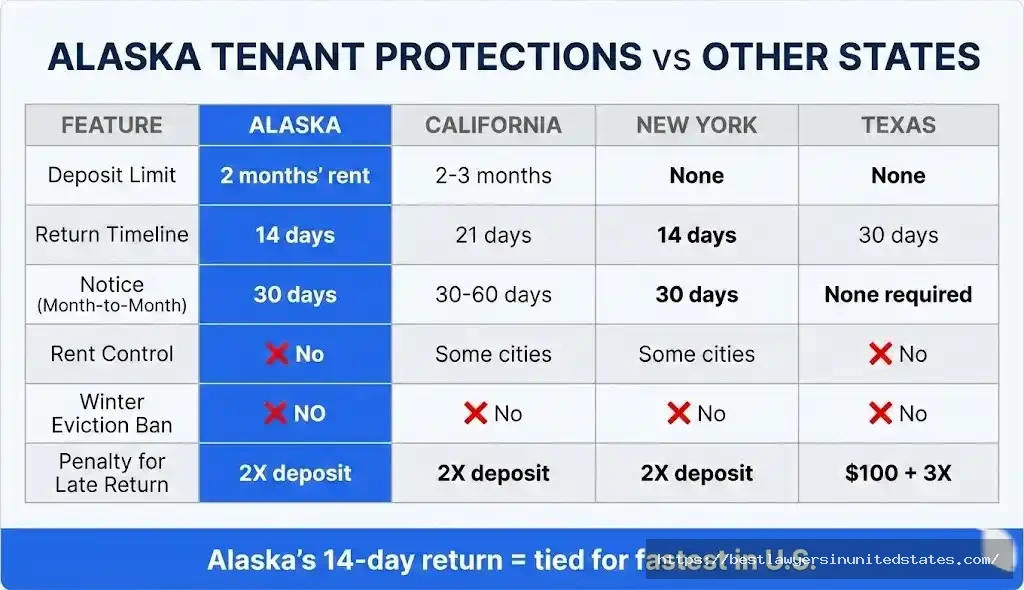
Alaska renters have strong protections under the Alaska Uniform Residential Landlord and Tenant Act (AS 34.03). Landlords must return security deposits within 14 days, provide 24-hour notice before entering, and maintain safe, habitable housing. Tenants can face eviction year-round (there’s no winter eviction ban), but landlords must follow strict notice requirements ranging from 7 to 30 days depending on the violation.
This guide covers everything Alaska renters need to know about their rights, from security deposits to eviction defense. All information reflects Alaska law as of 2026.
What Are Your Rights as an Alaska Tenant?
Alaska tenants have rights protected under AS 34.03.010 through AS 34.03.380, known as the Alaska Uniform Residential Landlord and Tenant Act. These laws apply to all residential rentals including apartments, houses, and mobile home spaces.
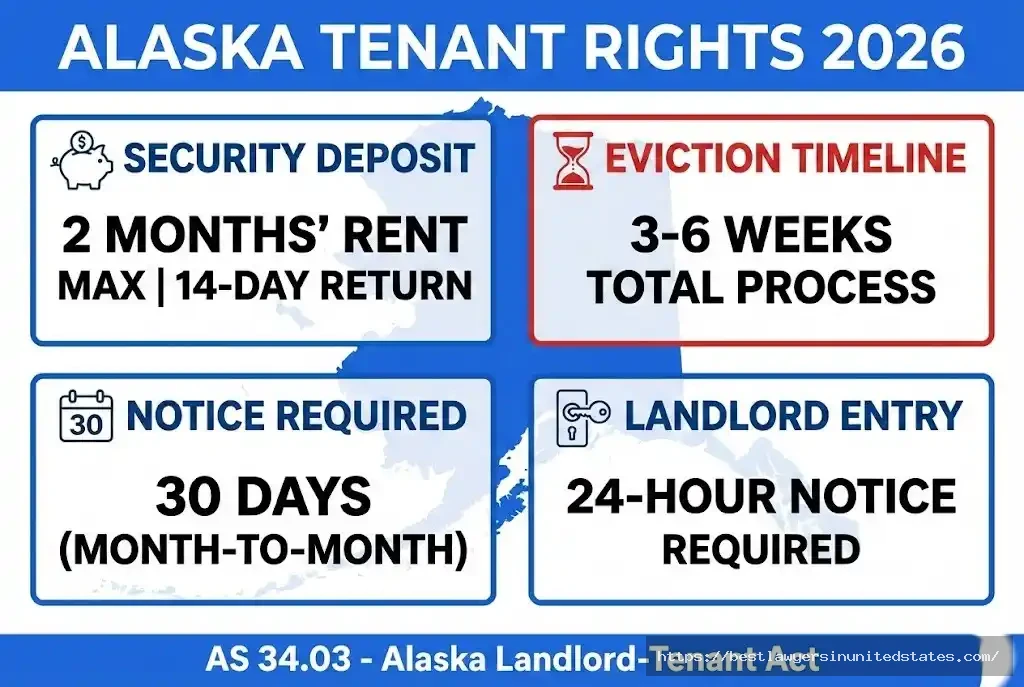
Your core rights include:
- Safe, habitable housing with working heat, water, and plumbing
- Security deposit return within 14 days of move-out
- 24-hour notice before landlord entry (except emergencies)
- Protection from discrimination based on race, religion, sex, national origin, disability, marital status, or pregnancy
- Protection from retaliation when exercising your legal rights
- Right to “repair and deduct” for essential service failures
Alaska law also gives you access to free legal help through the Alaska Legal Services Corporation (ALSC) at (907) 272-9431 or (888) 478-2572.
Alaska Security Deposit Laws
What Is the Maximum Security Deposit in Alaska?
Alaska limits security deposits to two months’ rent for most rentals under AS 34.03.070(a). Landlords can charge an additional pet deposit of up to one month’s rent for non-service animals.
Alaska deposit limits:
| Unit Type | Maximum Deposit | Additional Pet Deposit | Example (Rent: $1,500/month) |
|---|---|---|---|
| Under $2,000/month | 2 months’ rent | + 1 month’s rent | $3,000 security + $1,500 pet = $4,500 total |
| Over $2,000/month | No limit | No limit | No statutory cap |
Service animals and emotional support animals cannot be charged a pet deposit under fair housing laws. The regular security deposit must be kept separate from any pet deposit, and landlords must account for each separately.
How Long Do Alaska Landlords Have to Return Deposits?
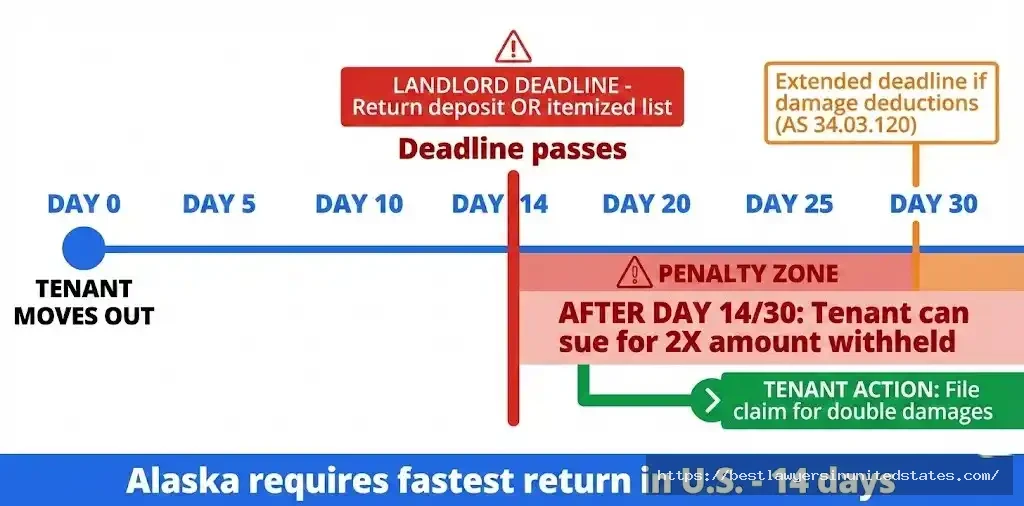
Alaska landlords must return your full security deposit or provide an itemized list of deductions within 14 days of move-out under AS 34.03.070(b). This is one of the shortest timelines in the United States.
The 14-day deadline extends to 30 days only if:
- Landlord withholds money for damages caused by your failure to maintain the property
- Deductions are based on violations of AS 34.03.120 (tenant responsibilities)
If your landlord willfully fails to return your deposit or provide an accounting within the deadline, you can sue for up to twice the amount wrongfully withheld (AS 34.03.070(d)).
What landlords must include in the accounting:
- Itemized list of all deductions
- Receipts for repair costs
- Remaining balance owed to you
- Check or payment for any refund due
Want to know if your landlord owes you money? Our calculator helps determine your exact refund amount and deadline based on Alaska’s specific laws, including checking whether deductions are legal under AS 34.03.
What Can Landlords Deduct From Your Deposit?
Alaska landlords can only deduct money for actual damages beyond normal wear and tear. They cannot charge you for routine maintenance or deterioration from regular use.
Allowed deductions:
- ✅ Unpaid rent
- ✅ Repairs for tenant-caused damage (holes in walls, broken fixtures)
- ✅ Cleaning costs if you left the unit dirty
- ✅ Unpaid utilities (if you were responsible under the lease)
NOT allowed:
- ❌ Normal wear and tear (faded paint, worn carpet)
- ❌ Routine cleaning between tenants
- ❌ Painting after normal use
- ❌ Carpet shampooing (unless you caused specific stains or damage)
If carpets were professionally cleaned when you moved in, Alaska law allows landlords to require professional cleaning at move-out under AS 34.03.120(c). Always document the unit’s condition with photos when you move in and out.
Calculate Your Security Deposit Rights in Alaska
Moving out soon? Use our free calculator to determine if your landlord owes you a security deposit refund and by what deadline. This calculator uses Alaska’s specific security deposit laws including the 14-day return timeline, allowable deductions, and penalty calculations for late returns.
🏠 Security Deposit Calculator
All 50 States + DC
Calculate max legal deposits, return deadlines, and penalties for violations.
📋 Enter Your Information
Special Conditions (if applicable)
✓ Results for
Based on current state law. Always verify with local regulations.
Link: https://bestlawyersinunitedstates.com/tenant-rights/security-deposit-calculator/
Calculator features:
- Alaska-specific deposit limits (2 months’ rent + pet deposit)
- 14-day vs. 30-day return deadline checker
- Deduction legality analyzer
- Penalty calculation for late returns (up to 2x deposit)
- Next steps if your rights are violated
The calculator shows whether your landlord’s deductions comply with AS 34.03.070 and calculates any penalties you might be owed for late returns or improper withholding.
Questions about your tenant rights or need legal help?
[Find Tenant Rights Lawyers in Alaska – Free Consultation]
Email: [email protected]
Alaska Eviction Laws and Process
Can You Be Evicted in Winter in Alaska? (Myth Busted)
Quick Answer: YES. Alaska has no winter eviction moratorium. Landlords can evict tenants year-round as long as they follow proper notice requirements.
This is one of the most searched questions about Alaska tenant law, but it’s based on a myth. While harsh winter conditions make evictions especially difficult, Alaska law does not prohibit winter evictions under AS 34.03.220.
Landlords must still provide proper written notice and go through the court eviction process (called a “FED action” in Alaska) regardless of the season. The same notice periods apply whether it’s January or July.
Types of Eviction Notices in Alaska
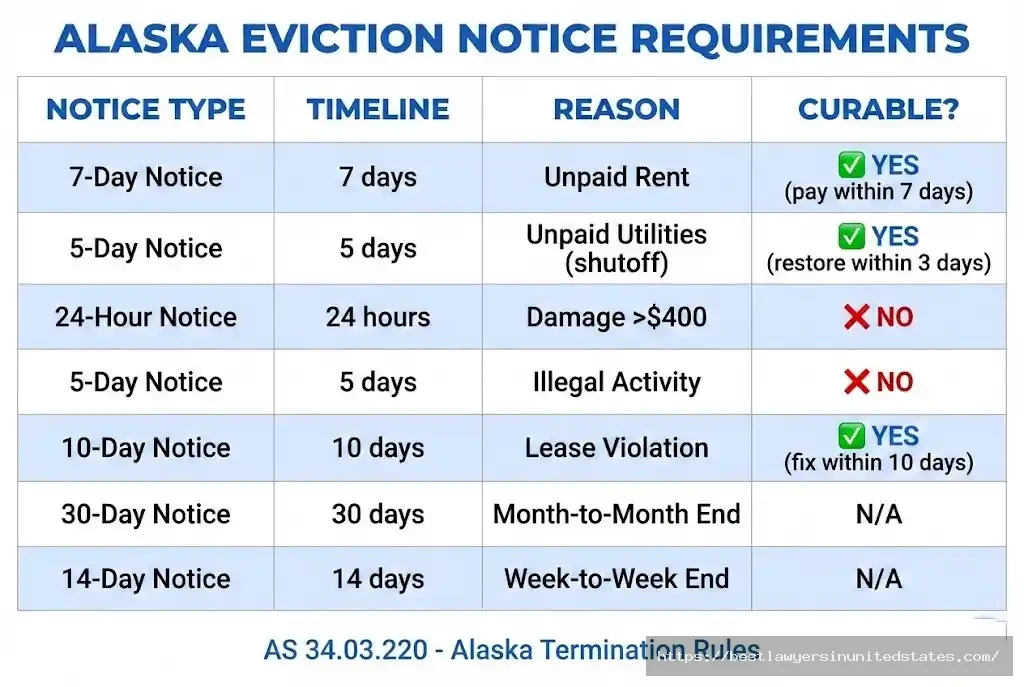
Alaska law requires different notice periods depending on why your landlord wants you to leave. Understanding these timelines helps you know your rights and plan accordingly.
| Notice Type | Timeline | Reason | Curable? |
|---|---|---|---|
| 7-Day Notice | 7 days | Unpaid rent | ✅ Yes (pay within 7 days) |
| 5-Day Notice | 5 days | Unpaid utilities causing shutoff | ✅ Yes (restore service + repay landlord within 3 days) |
| 24-Hour Notice | 24 hours | Intentional damage over $400 | ❌ No |
| 5-Day Notice (Illegal Activity) | 5 days | Drugs, prostitution, gambling on premises | ❌ No |
| 10-Day Notice | 10 days | Lease violation or duty breach | ✅ Yes (fix within 10 days) |
| 30-Day Notice | 30 days before rental due date | Month-to-month termination | N/A |
| 14-Day Notice | 14 days | Week-to-week termination | N/A |
Important: If you receive a 7-day notice for unpaid rent and pay before the 7 days expire, your landlord must accept payment and cannot proceed with eviction under AS 34.03.220(b).
What Is Alaska’s FED Action Process?
“FED” stands for Forcible Entry and Detainer—Alaska’s legal term for eviction lawsuits. Understanding this process helps you prepare a defense or know when to seek legal help.
Alaska eviction timeline:
- Notice to Quit – Landlord serves proper written notice (7-30 days depending on reason)
- File FED Complaint – If you don’t move, landlord files lawsuit in district court
- Summons Served – You receive court papers at least 2 days before hearing
- Possession Hearing – Court decides who gets the property (within 15 days of filing)
- Judgment – Judge rules for landlord or tenant
- Writ of Assistance – If landlord wins, sheriff can remove you
- Damages Hearing – Separate hearing for money owed (scheduled later)
Alaska uses a two-hearing system. The first hearing only determines who gets possession of the property. A second hearing addresses money damages either party claims.
You have important defenses available at the possession hearing, including improper notice, landlord retaliation, discrimination, or the landlord’s failure to maintain the property. If you’re facing eviction and need legal representation, understanding typical costs can help—our guide on eviction lawyer expenses (https://bestlawyersinunitedstates.com/eviction-lawyer-cost-explained-in-simple-terms-for-tenants-and-landlords/) explains what to expect.
Critical deadline: You must file a written answer to the complaint within 20 days, though the hearing usually happens before your answer is due.
Illegal Eviction Tactics (What Landlords Cannot Do)
Alaska law prohibits “self-help” evictions under AS 34.03.210. Your landlord cannot force you out without a court order, even if you’re behind on rent.
Illegal eviction tactics:
- 🚫 Changing locks while you’re away
- 🚫 Shutting off utilities (heat, water, electricity)
- 🚫 Removing your belongings
- 🚫 Physically removing you or threatening violence
- 🚫 Making the unit uninhabitable to force you out
If your landlord uses any of these tactics, you can sue for up to 1.5 times your actual damages plus attorney fees (AS 34.03.210). You can also call the police, as these actions may be criminal.
Calculate Your Eviction Timeline in Alaska
Facing eviction? Know exactly how long the process takes and your rights at each stage. Our calculator provides a detailed timeline based on Alaska’s eviction laws, including notice periods, court timelines, and appeal windows.
Eviction Timeline Calculator
Understand the Process in All 50 States + DC
Get a step-by-step breakdown of the eviction process, notice requirements, court timelines, and your legal rights as a tenant.
📋 Enter Your Situation
Enter the date you received the eviction notice to see projected dates
📅 Eviction Timeline for
Estimated timeline for
📍 Step-by-Step Timeline
Link: https://bestlawyersinunitedstates.com/tenant-rights/eviction-timeline-calculator/
Calculator features:
- Stage-by-stage eviction timeline from notice to sheriff lockout
- Alaska-specific notice requirements for each violation type
- Court filing to possession hearing dates
- Tenant defense deadlines and answer requirements
- Appeal window calculations
The calculator accounts for Alaska’s unique FED action process and shows you critical deadlines for filing defenses or appealing an eviction judgment.
Facing illegal eviction? Get immediate legal help from Alaska tenant rights lawyers.
Email: [email protected]
Notice Requirements in Alaska
How Much Notice Must You Give to Move Out?
Alaska ties notice requirements to your “rental due date”—the day of the month when rent is due. This system is unique and often confuses tenants who think they just need to give 30 days’ notice.
For month-to-month tenancies: You must give written notice at least 30 days before the rental due date when you want to move out (AS 34.03.290(b)).
Example: Your rent is due on the 15th of each month. You want to move out April 15th. You must give notice by March 15th (the rental due date that’s at least 30 days before your move-out date).
If you give notice on March 20th, you cannot move out until May 15th because you missed the March 15th rental due date.
For week-to-week tenancies: Give written notice at least 14 days before your move-out date (AS 34.03.290(a)).
Breaking these rules means you could owe rent for an extra period even after you’ve moved out. Always calculate your notice date carefully or use our notice period calculator to avoid mistakes.
How Much Notice Must Your Landlord Give You?
Landlords must follow the same rental due date system when ending month-to-month tenancies. They must give you written notice at least 30 days before the rental due date when they want you to move (AS 34.03.290(b)).
What the notice must include:
- The specific date and time you must be out
- Reason for termination (if required by law)
- Warning that landlord may file a FED action if you don’t leave
- If violation is curable, what you must do to fix it and by when
For evictions based on lease violations or unpaid rent, landlords must give shorter notice periods (7-10 days) as shown in the eviction table above. These notices must specify the violation and, if curable, give you a chance to fix the problem.
Calculate Notice Periods in Alaska
Need to move out or wondering how much notice your landlord must give? Our calculator determines the exact notice period required based on your lease type and Alaska law, including notice to vacate, lease termination, and landlord entry notice requirements.
📬 Notice Period Calculator
All 50 States + DC
Find required notice periods for lease termination, rent increases, and landlord entry.
📋 Select Your Situation
What type of notice do you need? *
Select your role first
To calculate when notice must be given
Some states require longer notice for longer tenancies
✓ Notice Requirements for
📊 All Notice Periods for
| Notice Type | Tenant | Landlord |
|---|
Link: https://bestlawyersinunitedstates.com/tenant-rights/notice-period-calculator/
Calculator features:
- Notice requirements by lease type (month-to-month, week-to-week, fixed-term)
- Move-out notice deadlines tied to your rental due date
- Landlord entry notice rules (24-hour requirement)
- Rent increase notice periods (30 days)
- Lease termination timelines for both parties
This calculator handles Alaska’s unique rental due date system, ensuring you give notice on the correct date to avoid owing extra rent.
Questions about your lease? Speak with Alaska housing attorneys today.
Email: [email protected]
Alaska Landlord Responsibilities
What Must Landlords Provide?
Alaska law requires landlords to maintain habitable housing under AS 34.03.100. This means your rental must meet basic health and safety standards from the day you move in.
Landlord must provide:
- ✅ Working heat at all times (with limited exceptions)
- ✅ Hot and cold running water
- ✅ Functional plumbing, electrical, and heating systems
- ✅ Safe structure (roof, walls, floors without holes or leaks)
- ✅ Adequate trash removal
- ✅ Snow and ice removal from common areas
- ✅ Working locks when requested
- ✅ Smoke and carbon monoxide detectors (AS 18.70.095)
- ✅ Pest control if building-wide infestation
These duties exist regardless of what your lease says. Any lease provision waiving these requirements is void under AS 34.03.040(a)(1).
Rural Alaska exceptions: If your rental is in an undeveloped area without public water or sewer service that was never connected before your tenancy, your landlord may not be liable for lacking these services (AS 34.03.100(b)). This exception recognizes Alaska’s unique rural housing challenges.
When Can Your Landlord Enter Your Unit?
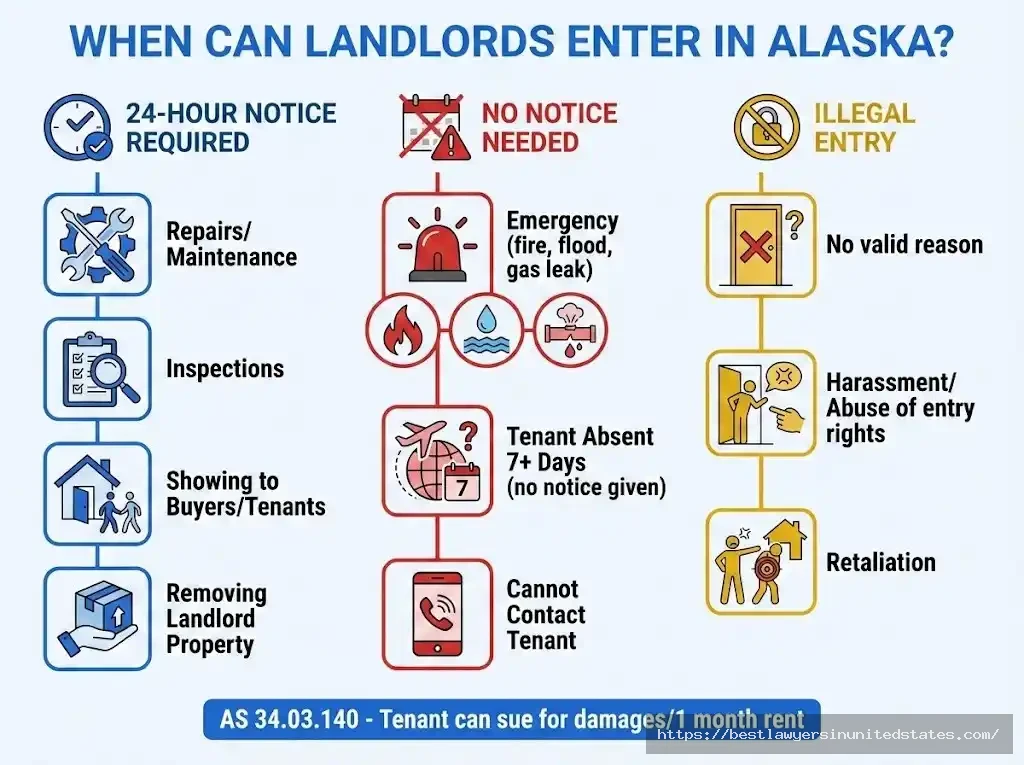
Alaska landlords must give 24-hour advance notice before entering your rental in most situations (AS 34.03.140). The notice should state the time of entry and try to pick a time that works for you.
Situations requiring 24-hour notice:
- Repairs or maintenance
- Inspections
- Showing the unit to buyers or new tenants
- Removing landlord’s property not covered by the lease
Landlord can enter WITHOUT notice only:
- Emergency (fire, flood, gas leak, burst pipe)
- You’ve been absent 7+ days without notifying landlord
- Unable to contact you by normal means
If your landlord abuses entry rights by coming in repeatedly without notice or harassing you, you can sue for actual damages or one month’s rent (whichever is greater) under AS 34.03.300(b). You can also terminate your tenancy with 10-day notice.
What If Your Landlord Won’t Make Repairs?
Alaska gives you several options when landlords fail to maintain essential services like heat, water, or plumbing. Don’t just stop paying rent—that can lead to eviction.
Your legal options under AS 34.03.180:
- Repair and Deduct – Fix the problem yourself and deduct the cost from rent
- Substitute Housing – Move to another place temporarily and stop paying rent
- Sue for Damages – Take landlord to small claims court for reduced rental value
- Move Out – Terminate your lease early with proper notice
To use repair and deduct:
- Give landlord written notice of the problem
- Wait a reasonable time (usually 3-7 days for non-emergencies)
- Hire a licensed contractor
- Keep all receipts
- Deduct actual, reasonable costs from next month’s rent
- Provide receipts to landlord
Alaska law doesn’t cap how much you can deduct, but the costs must be “actual and reasonable.” Using repair and deduct incorrectly could lead to eviction for unpaid rent, so document everything carefully.
Alaska Tenant Responsibilities
What Are Your Duties as a Tenant?
Alaska tenants must maintain their rental unit and follow basic rules to avoid lease violations (AS 34.03.120).
Your required duties:
- Keep your unit as clean and safe as its condition permits
- Dispose of trash properly
- Keep plumbing fixtures clean
- Use all facilities reasonably (don’t abuse appliances, heating, plumbing)
- Don’t damage the property or allow guests to damage it
- Don’t disturb neighbors
- Maintain smoke and CO detector batteries
- Notify landlord before being absent 7+ days
- Get landlord’s written permission before changing locks (except emergencies)
- Don’t exceed occupancy limits in your lease
Failing these duties can lead to a 10-day eviction notice. If you correct the problem within 10 days, you can stay. But if the same violation happens again within 6 months, your landlord can give you just 5 days to move with no chance to fix it (AS 34.03.220(e)).
Normal Wear and Tear vs. Damage
One of the biggest deposit disputes involves “normal wear and tear.” Alaska law says landlords cannot charge you for deterioration from intended use of the rental (AS 34.03.070(b)).
Examples of normal wear and tear:
- Faded paint or wallpaper
- Worn carpet in traffic areas
- Small nail holes from hanging pictures
- Loose door handles from regular use
- Slightly worn flooring
- Minor scuffs on walls
Examples of tenant damage:
- Large holes in walls
- Pet stains or odors in carpet
- Broken windows or doors
- Cigarette burns
- Graffiti or permanent marks
- Broken appliances from misuse
Landlords must expect that any property will need wall painting, carpet replacement, and deep cleaning between tenants as part of normal turnover. They cannot charge you for these costs unless you caused damage beyond normal use.
Rent Increases and Rent Control in Alaska
Can Your Landlord Raise Your Rent?
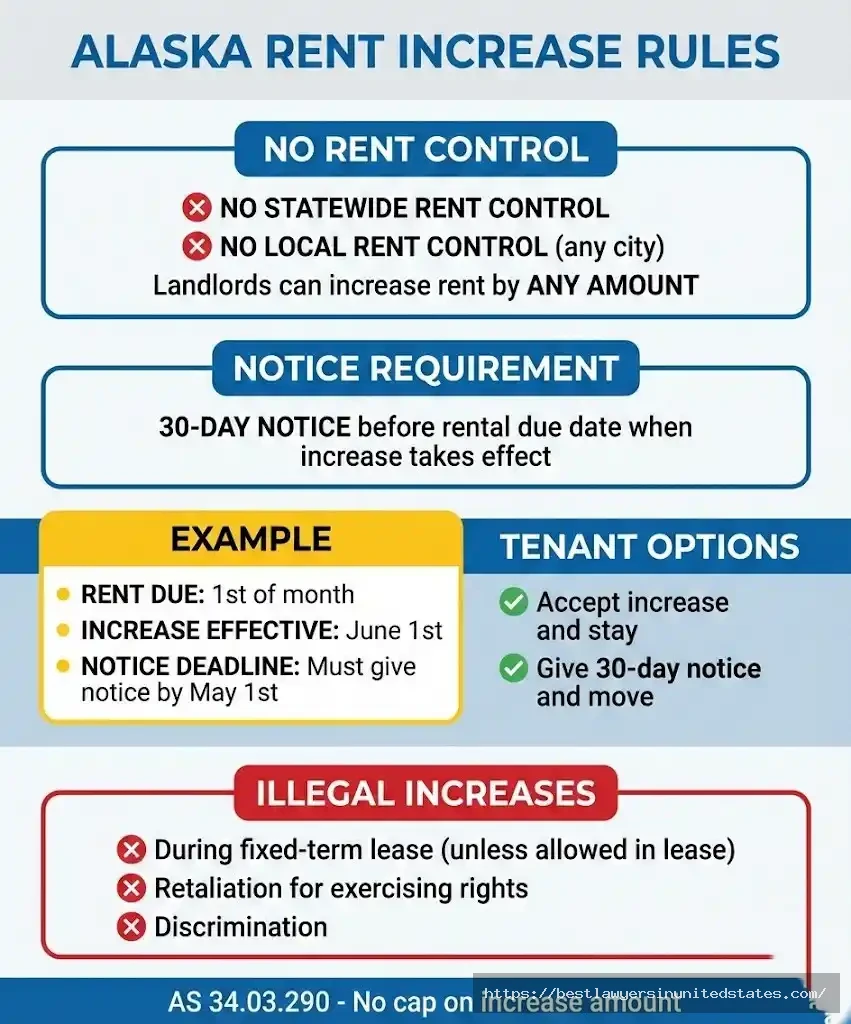
Alaska has no statewide rent control, and no Alaska cities currently have local rent control ordinances. Landlords can increase rent by any amount for month-to-month tenancies.
Requirements for rent increases:
- Must give 30-day written notice before the rental due date when increase takes effect
- Cannot raise rent during a fixed-term lease unless lease allows it
- Cannot raise rent in retaliation for exercising your rights
Example: Rent is due on the 1st of each month. Landlord wants rent to increase June 1st. They must give you notice by May 1st.
If your landlord gives you notice on May 5th, the earliest the increase can take effect is July 1st (the next rental due date that’s 30+ days away).
You can either accept the increase or give your own 30-day notice to move out. Check whether your increased rent might affect your wage calculations—Alaska’s minimum wage laws (https://bestlawyersinunitedstates.com/alaska-minimum-wage/) set the baseline for what workers earn, which impacts affordability.
Discrimination and Fair Housing in Alaska
What Classes Are Protected in Alaska?
Alaska law prohibits housing discrimination based on more categories than federal law requires (AS 18.80.200).
Protected classes in Alaska:
- Race or color
- Religion
- National origin
- Sex (including pregnancy)
- Disability
- Marital status or change in marital status
- Age (in Anchorage only – AMC 05.20.020)
- Familial status (having children)
Landlords cannot refuse to rent to you, charge you more, or give you different terms based on these characteristics. They also cannot ask questions designed to determine your status in these categories during the application process (AS 18.80.240(3)).
Service Animals and Emotional Support Animals
Alaska law recognizes service animals as trained animals that perform tasks for people with disabilities (AS 34.03.070(i)). Landlords cannot charge pet deposits for service animals or emotional support animals.
Key differences:
| Type | Training Required | Pet Deposit? | Documentation Needed? |
|---|---|---|---|
| Service Animal | Yes (specific tasks) | ❌ No | Disability and need |
| Emotional Support Animal | No | ❌ No | Doctor’s letter |
| Pet | No | ✅ Yes (up to 1 month rent) | None |
Landlords can ask if an animal is required due to a disability and what tasks it performs. They cannot demand specific medical records or ask about the nature of your disability.
If a landlord denies your reasonable accommodation request for a service or support animal, contact the Alaska State Commission for Human Rights at (800) 478-4692.
Mobile Home Tenant Rights in Alaska
Mobile home park tenants have special protections beyond standard renters under AS 34.03.225. These laws recognize that mobile home owners cannot easily move their property.
Special protections for mobile home tenants:
- Limited eviction reasons (only nonpayment, law violations, lease breaches, or land use changes)
- 270-day notice required for land use changes (or 1 year for condo conversions)
- Landlords cannot charge fees for mobile home sales, transfers, or setups
- Cannot prohibit you from selling your mobile home
- Cannot require you to buy supplies from specific vendors
- Must disclose required capital improvements before you move in
These protections make Alaska one of the more mobile home tenant-friendly states. Mobile home park operators who violate AS 34.03.225 face significant penalties and cannot evict you for exercising these rights.
Retaliation Protections in Alaska
What Actions Are Protected?
Alaska law protects you from landlord retaliation when you exercise your legal rights (AS 34.03.310).
Protected activities:
- Complaining to your landlord about repairs or violations
- Reporting code violations to government agencies
- Organizing or joining a tenant union
- Exercising any right under AS 34.03
Prohibited retaliation:
- Raising your rent
- Decreasing services
- Threatening to evict you or filing eviction
- Harassing you
If retaliation occurs, you can sue for 1.5 times your actual damages (AS 34.03.310(b)). Document everything—save emails, texts, photos of problems, and notes about verbal conversations.
When it’s NOT retaliation: Alaska law lists legitimate reasons landlords can act that look like retaliation but aren’t (AS 34.03.310(c)):
- You’re actually behind on rent
- Unit needs major repairs to meet code
- Landlord wants to use unit personally or demolish/remodel it
- Property is being sold and new owner will use it personally
Even if your landlord has a legitimate reason, timing matters. If they raise rent or file eviction within weeks of you complaining about habitability issues, courts may still see it as retaliation.
Getting Help: Alaska Legal Resources
Alaska Legal Services Corporation (ALSC)
ALSC provides free legal help to low-income Alaskans facing housing issues. They run the statewide Landlord/Tenant Helpline and offer legal clinics across Alaska.
Contact ALSC:
- Helpline: (907) 272-9431 or toll-free (888) 478-2572
- Website: www.alsc-law.org
- Offices: Anchorage, Fairbanks, Juneau, Barrow, Bethel, Dillingham, Kenai, Ketchikan, Kotzebue, Palmer, Nome
Call immediately if you receive an eviction notice. ALSC can help you file defenses and represent you at FED hearings if you qualify based on income.
Alaska Housing Agencies
- Alaska Housing Finance Corporation (AHFC): (907) 330-8432 – Handles subsidized housing programs
- Alaska State Commission for Human Rights: (800) 478-4692 – File discrimination complaints
- Anchorage Equal Rights Commission: (907) 343-4342 – Local discrimination enforcement
- Alaska Court System: www.courts.alaska.gov – Download eviction forms (CIV-720)
Small Claims Court
You can sue your landlord in small claims court for up to $10,000 without hiring an attorney. Common tenant claims include illegal deposit retention, habitability issues, and illegal eviction damages.
File in the district court in the area where your rental is located. The Alaska Court System provides a Small Claims Handbook and forms at www.courts.alaska.gov. For other legal forms you might need during your tenancy, check our legal forms library (https://bestlawyersinunitedstates.com/legal-forms/).
Alaska Tenant Rights FAQs
Can you be evicted in winter in Alaska?
Quick Answer: Yes. Alaska allows evictions year-round with no winter moratorium. Landlords must still provide proper notice and follow FED court procedures regardless of season.
The myth of winter eviction protection likely comes from the practical difficulties of finding housing in Alaska winters. But AS 34.03.220 contains no seasonal restrictions on eviction notices or court proceedings.
How much can a landlord charge for a security deposit in Alaska?
Quick Answer: Alaska landlords can charge a maximum of 2 months’ rent for security deposits plus prepaid rent on rentals under $2,000/month. They can add up to 1 month’s rent for a pet deposit.
For example, if rent is $1,200/month, maximum charges are: $2,400 security deposit + $1,200 prepaid rent + $1,200 pet deposit = $4,800 total. Rentals over $2,000/month have no deposit limit (AS 34.03.070).
How long does my landlord have to return my security deposit in Alaska?
Quick Answer: Alaska landlords must return deposits within 14 days of move-out with an itemized statement of deductions. The deadline extends to 30 days only if withholding for tenant-caused damages.
Willful failure to meet this deadline means you can sue for up to twice the amount wrongfully withheld under AS 34.03.070(d). Use our security deposit calculator (https://bestlawyersinunitedstates.com/tenant-rights/security-deposit-calculator/) to check if your landlord followed the law.
Can I withhold rent if my landlord won’t make repairs in Alaska?
Quick Answer: No. Alaska does not allow simple rent withholding. But you can use “repair and deduct” to fix essential services yourself and deduct costs from rent under AS 34.03.180.
Give your landlord written notice first. If they don’t fix essential services (heat, water, plumbing), you can hire a contractor, keep receipts, and deduct actual costs from your next rent payment. Withholding rent without following this process can lead to eviction.
What is a FED action in Alaska?
Quick Answer: FED (Forcible Entry and Detainer) is Alaska’s legal term for eviction lawsuits filed in district court when tenants don’t move after receiving proper notice.
Alaska’s FED process includes two hearings: one for possession of the property (within 15 days of filing) and a separate hearing for money damages. You must file a written answer within 20 days and can raise defenses like improper notice, retaliation, or discrimination.
How much notice does my landlord have to give before entering my apartment in Alaska?
Quick Answer: Alaska landlords must give 24-hour advance notice before entering for repairs, inspections, or showings under AS 34.03.140.
They can only enter without notice during emergencies, if you’re absent 7+ days without notifying them, or if they cannot contact you. Landlords who abuse entry rights can be sued for damages or one month’s rent (AS 34.03.300).
Do Alaska landlords have to pay interest on security deposits?
Quick Answer: No. Alaska law does not require landlords to pay interest on security deposits unless they voluntarily choose to do so.
If deposits do earn interest in the trust account, that interest belongs to the tenant under general trust law principles unless both parties agreed otherwise. Property managers must give interest to tenants under Alaska real estate licensing rules (12 AAC 64.210).
Can my landlord evict me without going to court in Alaska?
Quick Answer: No. Alaska law prohibits “self-help” evictions. Landlords must go through the FED court process even if you’re behind on rent or violating your lease.
Landlords who change locks, shut off utilities, or remove your belongings face lawsuits for up to 1.5 times actual damages under AS 34.03.210. Call police if your landlord tries an illegal lockout.
How long does the eviction process take in Alaska?
Quick Answer: Alaska evictions typically take 3-6 weeks from notice to sheriff lockout, but timelines vary based on notice type and court schedules.
The process includes: notice period (7-30 days), FED filing, service of summons (2+ days), possession hearing (within 15 days), and writ of assistance. Use our eviction timeline calculator (https://bestlawyersinunitedstates.com/tenant-rights/eviction-timeline-calculator/) to see your specific timeline.
What is normal wear and tear in Alaska?
Quick Answer: Normal wear and tear is deterioration from intended use of the rental that landlords cannot deduct from your security deposit under AS 34.03.070(b).
Examples include faded paint, worn carpet in traffic areas, minor scuffs, and loose hardware from regular use. Landlords can charge for actual damage like holes in walls, broken fixtures, or unusual stains.
Can I break my lease early in Alaska?
Quick Answer: You can break your lease early in Alaska if your landlord materially violates the rental agreement or fails to maintain habitability. Otherwise, you owe rent until the lease ends or the unit is re-rented.
Give written notice describing the violation and allow 10 days for repairs. If not fixed, you can terminate with 20-day notice under AS 34.03.160. Landlords must make reasonable efforts to re-rent after you leave.
Are emotional support animals allowed in Alaska rentals?
Quick Answer: Yes. Alaska fair housing laws require landlords to make reasonable accommodations for emotional support animals for tenants with disabilities. No pet deposit can be charged.
Provide your landlord with documentation from a healthcare provider stating you have a disability and need the animal. Landlords can deny requests only if the animal poses safety risks or would require unreasonable accommodation.
How do I calculate my notice period in Alaska?
Quick Answer: Alaska ties notice periods to your rental due date. For month-to-month tenancies, give notice at least 30 days before the rental due date when you want to move out.
Example: Rent due on the 10th, want to move May 10th = give notice by April 10th. Our notice period calculator (https://bestlawyersinunitedstates.com/tenant-rights/notice-period-calculator/) handles Alaska’s unique system.
What can I do if my landlord retaliates against me in Alaska?
Quick Answer: Sue your landlord for up to 1.5 times actual damages if they retaliate for exercising your legal rights under AS 34.03.310.
Document all retaliation (rent increases, threats, eviction notices) and contact Alaska Legal Services at (888) 478-2572. You may also be able to terminate your tenancy and sue for moving costs and other damages.
Do mobile home park tenants have special rights in Alaska?
Quick Answer: Yes. Alaska mobile home park tenants can only be evicted for specific reasons and must receive 270-day notice for land use changes under AS 34.03.225.
Park operators cannot charge fees for mobile home sales or require purchases from specific vendors. These protections recognize the difficulty of moving mobile homes.
Protecting Your Rights as an Alaska Tenant
Alaska’s tenant protection laws rank among the strongest in the United States, with strict deposit return timelines, retaliation protections, and court processes that give you time to mount a defense. The key to protecting your rights is acting quickly and documenting everything.
Take these steps to protect yourself:
- Get everything in writing (rental agreements, repair requests, notices)
- Take photos when moving in and out
- Keep copies of all rent payments
- Know your deadlines (14 days for deposits, 7-30 days for eviction notices)
- Contact Alaska Legal Services immediately if facing eviction
- Use the calculators in this guide to verify your rights
Alaska’s tenant rights laws exist to ensure safe, fair housing for all residents. Whether you’re dealing with a security deposit dispute, facing eviction, or need repairs, AS 34.03 gives you tools to enforce your rights. For comprehensive tenant rights information across all states, visit our tenant rights hub (https://bestlawyersinunitedstates.com/tenant-rights/).
Need immediate legal help? Contact Alaska Legal Services Corporation:
- Helpline: (907) 272-9431 or (888) 478-2572
- Email: [email protected]
Disclaimer: This guide provides general information about Alaska tenant rights as of 2026. Laws change and every situation is unique. Consult with an Alaska tenant rights attorney for advice about your specific situation.