
Connecticut tenant rights are governed by Connecticut General Statutes §§ 47a-1 through 47a-74, known as the Connecticut Landlord-Tenant Act. The state is landlord-friendly with no rent control and flexible rent increase policies. However, Connecticut tenants still have strong protections for security deposits, eviction procedures, and housing standards.
This guide explains your rights as a Connecticut renter in 2026. You’ll find specific timelines, legal requirements, and free calculators to determine your exact rights under Connecticut law.
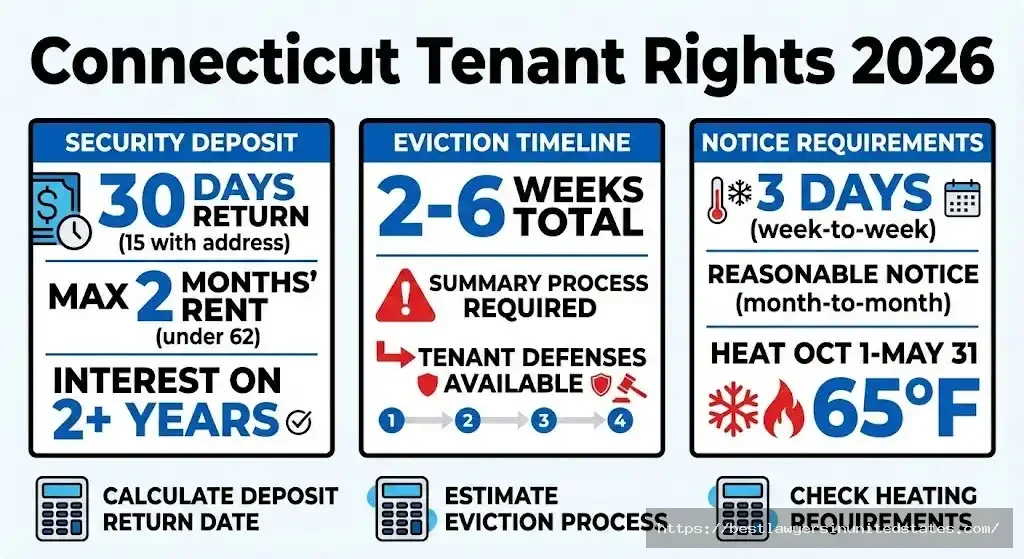
Connecticut is landlord-friendly but offers tenant protections: 30-day security deposit return, Summary Process eviction requirements, and anti-retaliation provisions under CGS § 47a-20.
Is Connecticut a Landlord-Friendly State?
Yes, Connecticut is generally considered a landlord-friendly state. Landlords can increase rent without statutory limits on month-to-month leases. The state has no statewide rent control. Connecticut also allows landlords to collect first month’s rent, last month’s rent, AND a security deposit.
Key Landlord-Friendly Policies
Connecticut law favors landlords in several ways:
- No Rent Control: Landlords set rent prices without state limits
- First + Last + Security Allowed: Collect up to 4 months’ rent upfront for tenants under 62
- Flexible Notice Requirements: No specific statute for month-to-month termination notice
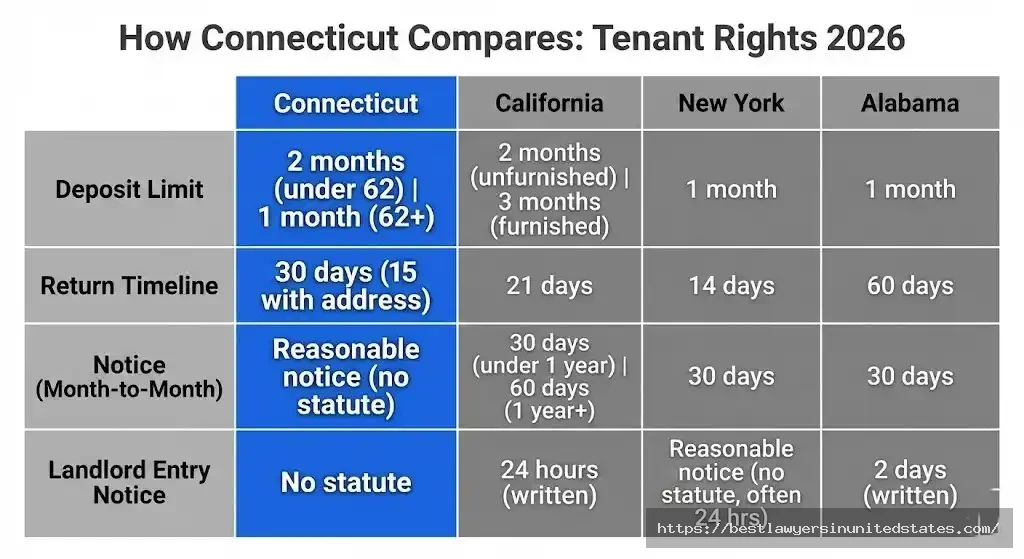
- No Landlord Entry Restrictions: Unlike California tenant rights laws, Connecticut has no statute requiring 24-48 hour notice before entry
However, tenants still have important protections detailed in this guide.
Connecticut Security Deposit Laws
Connecticut limits security deposits based on tenant age. Landlords must return deposits within specific timelines and provide itemized deductions.
Maximum Security Deposit Limits
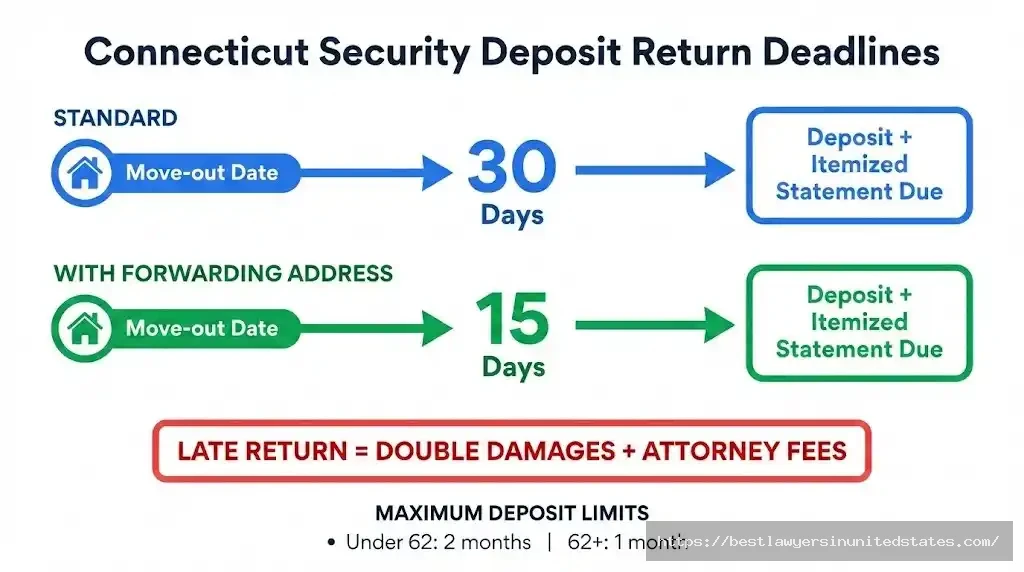
Connecticut law sets different limits based on your age:
| Tenant Age | Maximum Security Deposit | Example (Rent: $1,500/month) |
|---|---|---|
| Under 62 | 2 months’ rent | $3,000 |
| 62 and older | 1 month’s rent | $1,500 |
Connecticut Statute: CGS § 47a-21
Can Landlords Collect First, Last, AND Security in Connecticut?
Yes. Connecticut is one of few states allowing landlords to collect all three:
- ✅ First month’s rent
- ✅ Last month’s rent
- ✅ Security deposit (up to age-based limits)
This means move-in costs can reach 4 months’ rent for tenants under 62. For a $1,500/month apartment, you could pay $6,000 upfront.
Security Deposit Return Timeline
Connecticut landlords must return security deposits within:
| Situation | Return Deadline | Required Documents |
|---|---|---|
| Standard move-out | 30 days | Itemized statement |
| With forwarding address | 15 days | Itemized statement + remaining deposit |
Use our Connecticut Security Deposit Calculator to determine your exact return deadline.
Security Deposit Interest Requirements
Connecticut requires landlords to pay interest on deposits held 2 or more years. The interest rate is set by statute. Landlords must pay interest:
- Annually, OR
- At lease termination
Our calculator shows exactly how much interest your landlord owes on deposits held 2+ years.
Calculate Your Security Deposit Rights in Connecticut
Moving out soon? Use our free calculator to determine if your landlord owes you a security deposit refund and by what deadline. This calculator uses Connecticut’s specific security deposit laws including return timelines, allowable deductions, and penalty calculations.
🏠 Security Deposit Calculator
All 50 States + DC
Calculate max legal deposits, return deadlines, and penalties for violations.
📋 Enter Your Information
Special Conditions (if applicable)
✓ Results for
Based on current state law. Always verify with local regulations.
Link: https://bestlawyersinunitedstates.com/tenant-rights/security-deposit-calculator/
Calculator features:
- Connecticut-specific deposit limits and timelines
- Deduction legality checker
- Penalty calculation for late returns
- Itemized deduction analyzer
- Next steps if your rights are violated
Need help recovering your deposit? Contact Connecticut tenant rights attorneys for free consultation.
Questions about your tenant rights or need legal help?
Email: [email protected]
What Can Landlords Deduct From My Deposit?
Landlords can only deduct for specific reasons:
Allowed deductions:
- ✅ Unpaid rent
- ✅ Damage beyond normal wear and tear
- ✅ Costs specified in lease agreement
NOT allowed:
- ❌ Normal wear and tear
- ❌ Routine carpet cleaning
- ❌ Repainting after normal use
Landlords must provide:
- Itemized list of deductions
- Receipts or estimates for repairs
- Remaining balance within return timeline
What If My Landlord Doesn’t Return My Deposit?
If your landlord fails to return your deposit or provide an itemized statement, you can:
- Send a demand letter citing CGS § 47a-21
- File a small claims lawsuit (up to $5,000 in Connecticut)
- Potentially recover double the deposit amount plus attorney fees
Connecticut Statute: CGS § 47a-21
Connecticut Eviction Process: Summary Process Explained
Connecticut uses a specialized court system called “Summary Process” specifically for eviction cases. This process has specific timelines different from standard civil lawsuits. Understanding Connecticut’s eviction timeline helps you prepare your defense.
Legal Grounds for Eviction in Connecticut
Connecticut landlords can only evict for specific reasons:
| Eviction Reason | Notice Required | Details |
|---|---|---|
| Nonpayment of Rent | None | Can proceed immediately after nonpayment |
| Lease Violation | Varies | After cure period if applicable |
| Lease Expiration | None | Unless lease specifies otherwise |
| Illegal Activity | Varies | Criminal activity on premises |
| Holdover Tenancy | Varies | Staying after lease ends |
Connecticut doesn’t allow “no-cause” evictions during active lease terms.
The Connecticut “7-Minute Rule” (Cure Period)
Connecticut provides tenants the opportunity to cure certain lease violations before eviction continues. While called the “7-minute rule,” the actual provision allows tenants to pay rent owed plus costs before the court hearing to stop eviction.
This gives you a chance to avoid eviction by paying what you owe before the final judgment.
Connecticut Eviction Timeline
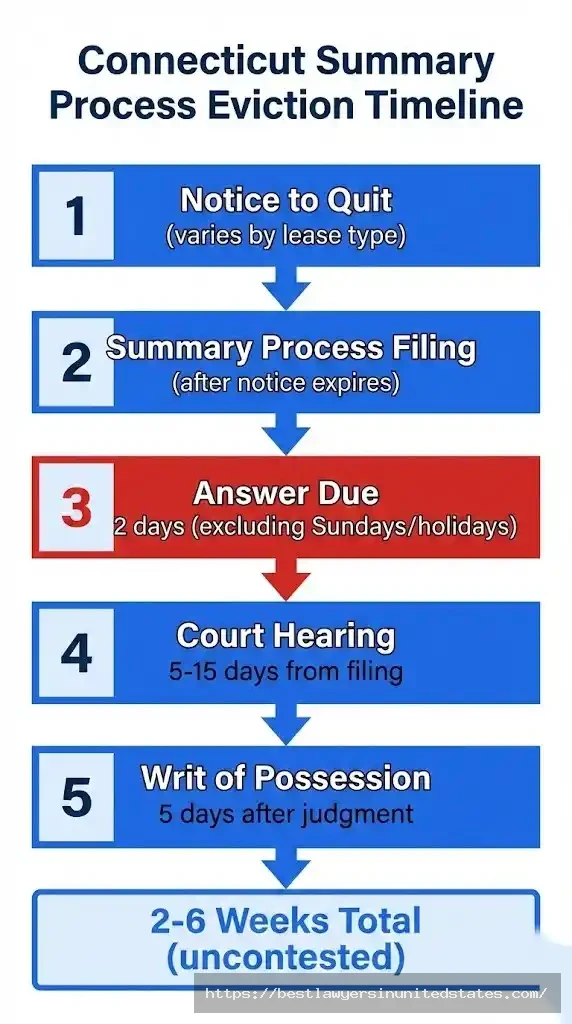
Step 1: Notice to Quit
| Lease Type | Notice Required | Notes |
|---|---|---|
| Nonpayment | No specific period | Landlord can proceed immediately |
| Week-to-Week | 3 days | Written or oral notice |
| Month-to-Month | Reasonable notice | Case law suggests 30 days |
| Fixed-Term | None | No notice at lease end unless specified |
Important: A Notice to Quit is NOT an eviction. It’s a warning that eviction proceedings may follow. The actual eviction process is called Summary Process.
Step 2: Summary Process Filing
If you don’t comply with the Notice to Quit, your landlord files a Summary Process complaint in Connecticut Housing Court.
Step 3: Court Hearing
You receive a summons and have 2 days (excluding Sundays and holidays) to file an Answer. The court hearing is typically scheduled within 5-15 days of filing.
Step 4: Judgment
If the landlord wins, the court issues a judgment for possession.
Step 5: Writ of Possession
After 5 days from judgment, the landlord can request execution of the writ (actual eviction by marshal).
Total Timeline: 2-6 weeks from Notice to Quit to physical eviction (if uncontested).
Calculate Your Eviction Timeline in Connecticut
Facing eviction? Know exactly how long the process takes and your rights at each stage. Our calculator provides a detailed timeline based on Connecticut’s eviction laws, including notice periods, court timelines, and appeal windows.
⏱️ Eviction Timeline Calculator
All 50 States + DC
Get step-by-step breakdown of eviction process, notice requirements, and your legal rights.
📋 Enter Your Situation
Enter the date you received the eviction notice to see projected dates
📅 Eviction Timeline for
Estimated timeline for
📍 Step-by-Step Timeline
Link: https://bestlawyersinunitedstates.com/tenant-rights/eviction-timeline-calculator/
Calculator features:
- Stage-by-stage eviction timeline
- Connecticut-specific notice requirements
- Court filing to sheriff lockout dates
- Tenant defense deadlines
- Appeal window calculations
Facing illegal eviction? Get immediate legal help from Connecticut tenant rights lawyers.
Questions about your tenant rights or need legal help?
Email: [email protected]
Eviction Without a Lease in Connecticut
Yes, landlords can evict without a written lease. Even without written agreement, tenants have rights:
- Month-to-month tenancy is presumed
- Landlord must follow Summary Process
- Notice to Quit required (reasonable notice)
- Cannot use “self-help” eviction (changing locks, removing belongings)
What Makes a Notice to Quit Invalid?
A Notice to Quit may be invalid if:
- ✅ Improper service (not delivered according to statute)
- ✅ Incorrect information (wrong tenant name, address, dates)
- ✅ Insufficient notice period
- ✅ Retaliatory or discriminatory motive
Tenant Defenses in Eviction Cases
Connecticut tenants can defend against eviction by arguing:
| Defense | Legal Basis | What You Must Prove |
|---|---|---|
| Retaliation | CGS § 47a-20 | Eviction after exercising tenant rights |
| Discrimination | CGS § 46a-64c | Eviction based on protected class |
| Landlord Breach | CGS § 47a-7 | Landlord failed to maintain habitability |
| Procedural Errors | Various | Notice to Quit was improper |
| Payment Made | Various | Rent was paid before deadline |
Eviction Help in Connecticut
If facing eviction, get help immediately:
- Statewide Legal Services of Connecticut: 1-800-453-3320
- Connecticut Legal Services: Free legal aid for low-income tenants
- Connecticut Fair Housing Center: Fair housing violations
- Local tenant advocacy groups
Connecticut Statute: CGS §§ 47a-23 to 47a-35 (Summary Process)
Connecticut Notice Requirements for Tenants
Connecticut notice requirements vary by lease type. Understanding your exact notice period helps you avoid lease violations and potential fees.
How Much Notice Does a Tenant Have to Give to Move Out in Connecticut?
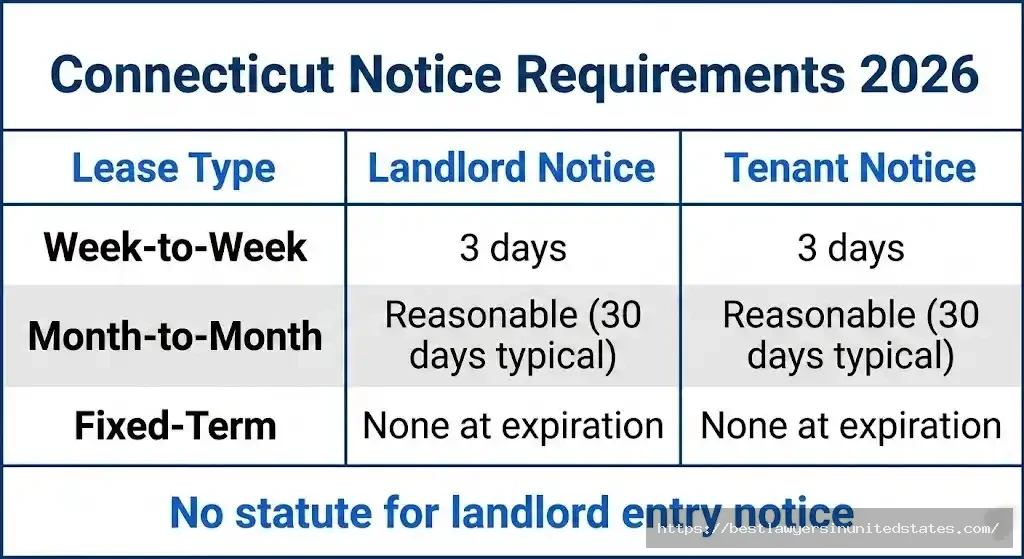
| Lease Type | Tenant Notice Required | Notes |
|---|---|---|
| Week-to-Week | 3 days | Written or oral (written recommended) |
| Month-to-Month | Reasonable notice | Typically 30 days (no specific statute) |
| Fixed-Term | None | Lease automatically expires at end date |
Connecticut has no specific statute for month-to-month notice. Case law suggests “reasonable notice,” typically interpreted as 30 days. Always check your lease agreement for specific terms.
Do You Have to Give a 60-Day Notice on a Month-to-Month Lease?
Not in Connecticut. While 30 days is customary, Connecticut law doesn’t specify 60 days for month-to-month tenancies. Your lease may require different notice periods.
Use our Connecticut Notice Period Calculator to determine your exact requirement.
Calculate Notice Periods in Connecticut
Need to move out or wondering how much notice your landlord must give? Our calculator determines the exact notice period required based on your lease type and Connecticut law, including notice to vacate, lease termination, and landlord entry notice requirements.
📬 Notice Period Calculator
All 50 States + DC
Find required notice periods for lease termination, rent increases, and landlord entry.
📋 Select Your Situation
What type of notice do you need? *
Select your role first
To calculate when notice must be given
Some states require longer notice for longer tenancies
✓ Notice Requirements for
📊 All Notice Periods for
| Notice Type | Tenant | Landlord |
|---|
Link: https://bestlawyersinunitedstates.com/tenant-rights/notice-period-calculator/
Calculator features:
- Notice requirements by lease type
- Move-out notice deadlines
- Landlord entry notice rules
- Rent increase notice periods
- Lease termination timelines
Questions about your lease? Speak with Connecticut housing attorneys today.
Questions about your tenant rights or need legal help?
Email: [email protected]
30-Day Notice to Vacate in Connecticut
If your landlord serves a 30-day notice to vacate:
- ✅ Typically used for month-to-month tenancies
- ✅ Must be in writing
- ✅ Counts from date of service
- ❌ Cannot be retaliatory or discriminatory
Connecticut Month-to-Month Lease Termination
Either party can terminate a month-to-month lease with proper notice:
- Landlord: Reasonable notice (typically 30 days)
- Tenant: Reasonable notice (typically 30 days)
- Always check lease agreement for specific terms
Can a landlord refuse a month-to-month lease? Yes, landlords are not required to offer month-to-month tenancies after a fixed-term lease expires.
Connecticut Statute: CGS § 47a-23
Connecticut Tenant Rights and Protections
Connecticut tenants have rights to habitable housing, privacy, security deposit return, non-discrimination, and protection from retaliation.
What Are My Rights as a Tenant in Connecticut?
Connecticut law guarantees these rights:
| Right | Legal Protection | What It Means |
|---|---|---|
| Habitable Housing | Implied warranty | Landlord must maintain livable conditions |
| Privacy | Common law | Freedom from unreasonable intrusion |
| Security Deposit Return | CGS § 47a-21 | Return within 30 days (or 15 with address) |
| Non-Discrimination | CGS § 46a-64c | Protected under Fair Housing laws |
| Retaliation Protection | CGS § 47a-20 | Cannot be evicted for exercising rights |
| Repair Requests | CGS § 47a-7 | Right to necessary repairs |
| Fair Eviction | CGS §§ 47a-23 to 47a-35 | Summary Process protections |
Tenants’ Rights When Landlord Sells Property in Connecticut
If your landlord sells the rental property:
- ✅ Existing lease remains valid: New owner must honor your lease terms
- ✅ Security deposit transfers: New owner responsible for returning deposit
- ✅ Landlord must notify you: Inform you of ownership change
- ⏰ Month-to-month tenancies: New owner can terminate with reasonable notice
Commercial Tenant Rights in Connecticut
Commercial tenants have different protections:
- Connecticut Landlord-Tenant Act applies primarily to residential tenancies
- Commercial leases governed by contract law
- Fewer statutory protections
- Always consult a commercial real estate attorney
Connecticut Landlord Responsibilities
Connecticut landlords must maintain habitability, make repairs, provide heat, return deposits, and follow eviction procedures. They cannot retaliate or discriminate.
What Are Landlord Responsibilities in Connecticut?
| Responsibility | Legal Requirement | Deadline/Details |
|---|---|---|
| Maintain Habitability | CGS § 47a-7 | Keep units safe and livable |
| Make Repairs | CGS § 47a-7 | Reasonable timeframe |
| Provide Heat | CGS § 47a-7 | Oct 1 – May 31, min 65°F |
| Return Deposits | CGS § 47a-21 | 30 days (or 15 with address) |
| Follow Eviction Laws | CGS §§ 47a-23 to 47a-35 | Use Summary Process only |
| No Retaliation | CGS § 47a-20 | Cannot punish tenant rights |
| Disclose Lead Paint | Federal law | Pre-1978 housing |
| Disclose Authorized Parties | Connecticut law | Who acts for landlord |
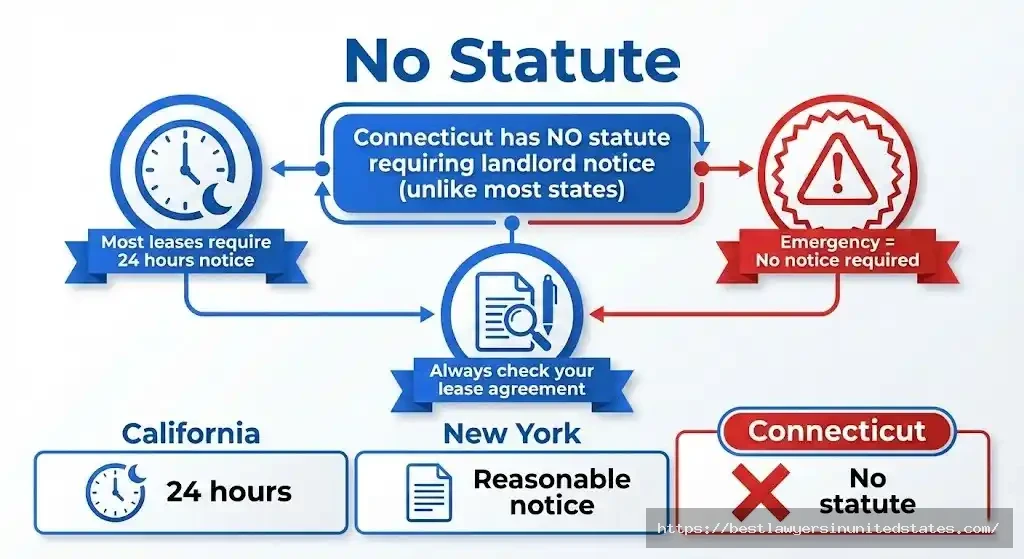
Can a Landlord Enter Without Permission in Connecticut?
Connecticut does not have a statute specifying notice requirements for landlord entry. This differs from states like Colorado tenant rights laws requiring specific notice periods.
Best practices:
- Most leases specify notice requirements (commonly 24 hours)
- Landlords should provide reasonable notice except emergencies
- Tenants can refuse entry without proper notice (unless emergency)
- Document all entry attempts and communications
Connecticut Heat Law Requirements
Connecticut General Statute § 47a-7 requires landlords to provide heat:
| Requirement | Details |
|---|---|
| Season | October 1 through May 31 |
| Minimum Temperature | At least 65°F |
| Applies to | All residential rentals where landlord provides heat |
If your landlord fails to provide heat, you can:
- File complaint with local housing inspector
- Withhold rent (after proper notice and procedures)
- Repair and deduct (after following statutory process)
- File Summary Process action for landlord breach
Connecticut Statute: CGS § 47a-7
What Can’t a Landlord Do in Connecticut?
Connecticut landlords CANNOT:
| Prohibited Action | Legal Consequence |
|---|---|
| Evict without Summary Process | Illegal “self-help” eviction (changing locks, removing belongings) |
| Retaliate | CGS § 47a-20 violations |
| Discriminate | CGS § 46a-64c violations |
| Withhold Deposit Unlawfully | Double damages possible |
| Enter Without Notice | Lease violation (though no statute) |
| Charge Excessive Deposit | Max 2 months’ rent (1 month for 62+) |
| Refuse Necessary Repairs | Habitability violations |
What Is Considered Landlord Negligence in Connecticut?
Landlord negligence includes:
- Failure to repair known hazards (broken stairs, mold, pests)
- Ignoring tenant repair requests for extended periods
- Failing to meet habitability standards
- Not providing required heat (October 1 – May 31)
- Allowing dangerous conditions
Connecticut Statute: CGS § 47a-7 (repairs and habitability)
When Does a Guest Become a Tenant in Connecticut?
Connecticut does not have a specific statute defining when a guest becomes a tenant. Courts determine this case-by-case based on multiple factors.
Factors Courts Consider
| Factor | What Courts Look For |
|---|---|
| Length of Stay | 14+ days raises questions, 30+ days strongly suggests tenancy |
| Payment | Does guest contribute to rent or utilities? |
| Possessions | Has guest moved belongings into unit? |
| Keys | Does guest have their own key? |
| Does guest receive mail at address? | |
| Landlord Knowledge | Is landlord aware of occupant? |
Why It Matters
Once someone is considered a tenant, they have full tenant rights:
- Cannot be removed without eviction
- Entitled to Summary Process protections
- May be liable for rent
- Creates month-to-month tenancy
How to Prevent Guest-to-Tenant Issues
- Include guest policies in lease (limit stays to 7-14 days)
- Get landlord approval for extended visitors
- Document all occupants on lease
- Communicate with landlord about temporary guests
Comparison to Other States
| State | Guest-to-Tenant Timeline |
|---|---|
| Connecticut | No specific statute (case-by-case) |
| New York | 30 days |
| California | 14+ days in 6-month period |
| Massachusetts | 30 days |
| Arizona | No specific statute |
Connecticut Case Law: No single bright-line rule; determined by factual circumstances
Breaking a Lease in Connecticut
Connecticut law doesn’t automatically allow tenants to break leases without penalty. However, specific exceptions exist for military service, domestic violence, and uninhabitable conditions.
Legal Reasons to Break a Lease
| Reason | Legal Protection | Requirements |
|---|---|---|
| Active Military Service | SCRA | Deployment or PCS orders |
| Landlord Breach | CGS § 47a-7 | Failure to maintain habitability |
| Domestic Violence | CGS § 47a-11e | Proper documentation required |
| Uninhabitable Conditions | CGS § 47a-7 | Severe health/safety violations |
Early Termination Penalties
If you break a lease without legal justification:
- You may owe remaining rent through lease end
- Landlord has duty to mitigate (re-rent the unit)
- You’re only liable until landlord finds new tenant
- Early termination fees (if specified in lease)
Landlord’s Duty to Mitigate
Connecticut requires landlords to make reasonable efforts to re-rent after you break the lease. You’re not liable for rent after the landlord successfully re-rents.
Connecticut Statute: CGS § 47a-11e (domestic violence early termination)
Connecticut Fair Housing and Discrimination Laws
Under the Connecticut Fair Housing Act (CGS § 46a-64c) and federal Fair Housing Act, landlords cannot discriminate based on protected classes.
Protected Classes in Connecticut
Connecticut law prohibits discrimination based on:
| Protected Class | Connecticut Law | Federal Law |
|---|---|---|
| Race or Color | ✅ | ✅ |
| National Origin | ✅ | ✅ |
| Religion | ✅ | ✅ |
| Sex (including orientation/identity) | ✅ | ✅ |
| Familial Status | ✅ | ✅ |
| Disability | ✅ | ✅ |
| Age | ✅ | ❌ |
| Marital Status | ✅ | ❌ |
| Lawful Source of Income (Section 8) | ✅ | ❌ |
Protecting Tenants with Disabilities
Connecticut law requires landlords to:
- ✅ Allow reasonable modifications (tenant pays)
- ✅ Provide reasonable accommodations (no cost to tenant)
- ✅ Allow service/emotional support animals (even with “no pets” policy)
- ✅ Make common areas accessible
Responding to Discrimination Claims
If you experience housing discrimination:
- Document Everything: Save emails, texts, notices
- File Complaint: Contact Connecticut Commission on Human Rights and Opportunities (CHRO)
- Contact HUD: File federal Fair Housing complaint (1-year deadline)
- Legal Aid: Connecticut Fair Housing Center provides assistance
- Private Lawsuit: You can sue for damages
CHRO Contact: 1-800-477-5737
Connecticut Statute: CGS § 46a-64c
Connecticut Retaliation Protections
Connecticut law (CGS § 47a-20) prohibits landlords from retaliating against tenants who exercise legal rights.
What Is Retaliatory Eviction?
Retaliation occurs when landlords punish tenants for:
- Complaining to landlord about repairs
- Filing complaint with housing inspectors
- Joining tenant organization
- Exercising any legal rights
Presumption of Retaliation
If landlord takes adverse action within 6 months of you exercising rights, Connecticut law presumes retaliation. The landlord must prove the action was not retaliatory.
Protected actions:
- ✅ Repair requests
- ✅ Code enforcement complaints
- ✅ Rent withholding (after proper procedure)
- ✅ Organizing with other tenants
Connecticut Statute: CGS § 47a-20
Suing Your Landlord in Connecticut
Connecticut tenants can sue landlords for security deposit violations, illegal eviction, discrimination, retaliation, and negligence.
What Can I Sue My Landlord For?
| Claim | Potential Recovery | Court |
|---|---|---|
| Security Deposit Violations | Double deposit + attorney fees | Small claims (up to $5,000) |
| Illegal Eviction | Actual damages + fees | Superior Court |
| Discrimination | Damages + fees | Superior Court / CHRO |
| Retaliation | Actual damages | Superior Court |
| Breach of Contract | Damages per lease | Small claims / Superior |
| Negligence | Medical costs + damages | Superior Court |
| Emotional Distress | Varies ($1,000-$50,000+) | Superior Court |
How Much Can I Sue for Emotional Distress?
Emotional distress claims in Connecticut require:
- Extreme and outrageous conduct by landlord
- Actual emotional harm (provable)
- Typically paired with another claim (discrimination, negligence)
- Damages vary widely ($1,000-$50,000+ depending on severity)
Examples:
- PTSD from landlord harassment
- Anxiety from prolonged uninhabitable conditions
- Emotional harm from discriminatory conduct
What Legally Qualifies as Emotional Distress?
In Connecticut, emotional distress must be:
- Severe: Beyond ordinary frustration
- Provable: Medical records, therapy notes, witness statements
- Caused by Landlord: Direct link between actions and harm
How to File a Complaint Against a Landlord
| Complaint Type | Where to File | Contact |
|---|---|---|
| Housing Code Violations | Local health/housing department | City-specific |
| Discrimination | CHRO | 1-800-477-5737 |
| Security Deposit | Small claims court | After demand letter |
| Fair Housing | CT Fair Housing Center | 888-247-4401 |
Connecticut Statute: CGS § 47a-21 (security deposit penalties)
Connecticut Tenant Resources and Legal Aid
Connecticut offers multiple resources for tenants facing housing issues.
Legal Aid and Support Services
| Organization | Services | Contact |
|---|---|---|
| Statewide Legal Services of CT | Free legal aid for low-income tenants | 1-800-453-3320 |
| Connecticut Legal Services | Legal representation | https://ctlegal.org |
| CT Fair Housing Center | Discrimination complaints | 888-247-4401 |
| CHRO | Human rights violations | 1-800-477-5737 |
| CT Department of Housing | Housing programs | 860-270-8000 |
Connecticut Housing Court Locations
Connecticut has specialized Housing Courts in:
- Hartford
- New Haven
- Bridgeport
- Waterbury
- Stamford/Norwalk
These courts handle Summary Process (eviction) cases and landlord-tenant disputes.
Frequently Asked Questions (FAQs)
How do I calculate if my landlord owes me my security deposit?
Quick Answer: Use our Connecticut Security Deposit Calculator to determine if your landlord must return your deposit within 30 days (or 15 days with forwarding address) and calculate penalties for late returns.
Enter your move-out date, deposit amount, and whether you provided a forwarding address. The calculator shows your exact deadline and potential penalties.
How long does the eviction process take in Connecticut?
Quick Answer: Connecticut evictions take 2-6 weeks from Notice to Quit to physical eviction if uncontested. Use our Eviction Timeline Calculator to map your specific timeline.
The timeline includes Notice to Quit period, Summary Process filing, court hearing (within 5-15 days), judgment, and 5-day wait before writ execution.
How much notice does my landlord need to give me in Connecticut?
Quick Answer: For month-to-month leases, landlords must give “reasonable notice” (typically 30 days). Use our Notice Period Calculator to determine your exact requirement based on lease type.
Week-to-week leases require 3 days notice. Fixed-term leases require no notice at expiration unless the lease specifies otherwise.
How hard is it to evict a tenant in Connecticut?
Quick Answer: Connecticut’s Summary Process makes eviction relatively straightforward for landlords with valid legal grounds. Timeline is 2-6 weeks for uncontested evictions.
However, tenants have procedural protections and defenses. Retaliation, discrimination, and landlord breach can defeat eviction attempts.
Who can I report my landlord to in Connecticut?
Quick Answer: Report code violations to your local health/housing department, discrimination to CHRO (1-800-477-5737), and fair housing violations to Connecticut Fair Housing Center (888-247-4401).
For legal violations, contact Connecticut Legal Services for free legal aid.
Can my landlord walk into my house without notice?
Quick Answer: Connecticut has no statute requiring landlord notice before entry. However, leases typically require 24 hours notice, and landlords should provide reasonable notice except in emergencies.
You can refuse entry without proper notice unless it’s an emergency.
What is the 7-minute rule in CT?
Quick Answer: The “7-minute rule” refers to a tenant’s right to cure violations (like late rent) before eviction concludes. Tenants can pay rent owed plus costs before the court hearing to stop eviction.
This gives you one final chance to avoid eviction by resolving the issue.
How much notice does a tenant have to give a landlord to move out in CT?
Quick Answer: Week-to-week leases require 3 days notice. Month-to-month leases have no specific statute but typically require reasonable notice (30 days). Fixed-term leases require no notice at expiration.
Always check your lease agreement for specific requirements.
How long does a landlord have to return a security deposit in CT?
Quick Answer: 30 days from lease termination (or 15 days if you provide a forwarding address in writing).
Landlords must include an itemized statement of deductions. Failure to comply may result in double damages.
Can a landlord ask for first and last month rent plus security in CT?
Quick Answer: Yes. Connecticut allows landlords to collect first month’s rent, last month’s rent, AND security deposit (up to 2 months’ rent for tenants under 62, 1 month for 62+).
Total move-in costs can reach 4 months’ rent for tenants under 62.
Is Connecticut a landlord-friendly state?
Quick Answer: Yes. Connecticut has no rent control, flexible rent increase policies, and allows collection of first + last + security deposits.
However, tenants still have protections for security deposits, evictions, and habitability.
What’s the most common action taken by landlords against tenants in breach of contract?
Quick Answer: Eviction for nonpayment of rent or lease violations through Summary Process in Connecticut Housing Court.
Landlords must follow proper notice and court procedures. Self-help evictions are illegal.
When does a guest become a tenant in Connecticut?
Quick Answer: Connecticut has no specific statute. Courts consider length of stay (14+ days raises questions), payment contributions, possessions, keys, and mail delivery on a case-by-case basis.
Extended stays beyond 30 days strongly suggest tenancy status.
Can my landlord refuse to make repairs in Connecticut?
Quick Answer: No. Connecticut landlords must maintain habitability under CGS § 47a-7. Tenants can file complaints, withhold rent (after proper procedure), or repair and deduct.
Landlords must address necessary repairs in a reasonable timeframe.
What can I do if my landlord retaliates against me?
Quick Answer: Connecticut law (CGS § 47a-20) presumes retaliation if landlord takes adverse action within 6 months of you exercising tenant rights.
File a complaint with Connecticut Legal Services or sue for damages in court.
Conclusion
Connecticut tenant rights balance landlord flexibility with important tenant protections. Understanding your rights helps you protect your deposit, avoid illegal evictions, and maintain safe housing.
Key takeaways:
✅ Security Deposits: 30-day return (15 with address), interest on 2+ year deposits, max 2 months’ rent (1 month for 62+)
✅ Eviction Process: Summary Process through Housing Court, 2-6 week timeline, tenant defenses available
✅ Notice Requirements: 3 days (week-to-week), reasonable notice (month-to-month), no notice (fixed-term)
✅ Landlord Obligations: Habitability, heat (Oct 1 – May 31, 65°F min), repairs, no retaliation
✅ Tenant Protections: Anti-discrimination, anti-retaliation, fair eviction procedures
Use our free calculators:
- Connecticut Security Deposit Calculator
- Connecticut Eviction Timeline Calculator
- Connecticut Notice Period Calculator
For legal assistance, contact Statewide Legal Services of Connecticut at 1-800-453-3320.