
Quick Answer
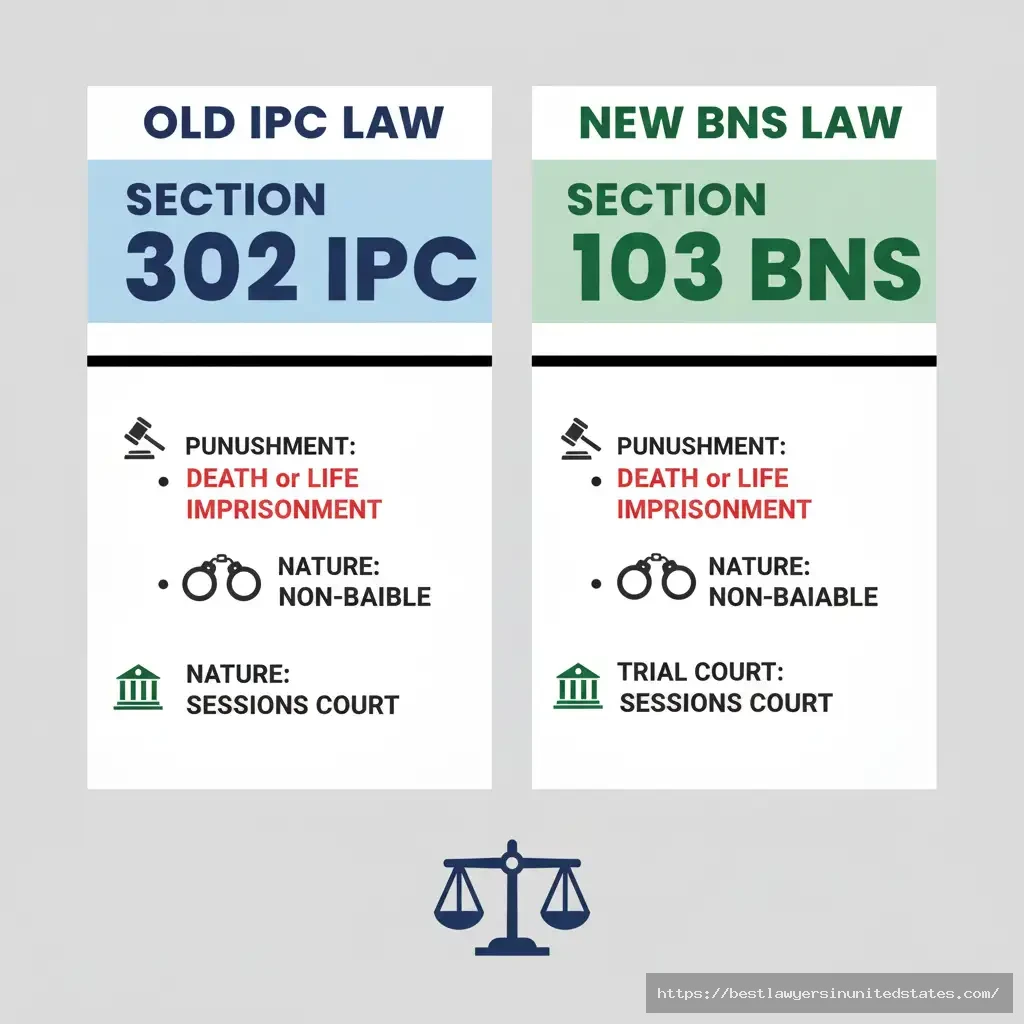
Section 302 of the Indian Penal Code (IPC) prescribes punishment for murder: Death penalty OR life imprisonment, plus fine. This is a non-bailable, cognizable offence tried exclusively by the Court of Session. Under the new Bharatiya Nyaya Sanhita (BNS) 2023, Section 302 IPC is now covered under Section 103 BNS with identical provisions.

Section 302 IPC vs BNS Quick Reference
| Aspect | IPC (Old Law) | BNS (New Law – July 2024) |
|---|---|---|
| Section Number | Section 302 IPC | Section 103 BNS |
| Offence | Murder | Murder (unchanged) |
| Punishment | Death OR Life Imprisonment + Fine | Death OR Life Imprisonment + Fine |
| Bailable Status | Non-Bailable | Non-Bailable |
| Cognizance | Cognizable | Cognizable |
| Trial Court | Court of Session | Court of Session |
| Effective Date | 1860-2024 | July 1, 2024 onwards |
What is Section 302 IPC?
Section 302 IPC is India’s primary legal provision for punishing murder. The exact text states:
“Whoever commits murder shall be punished with death, or imprisonment for life, and shall also be liable to fine.”
This section doesn’t define murder—that’s covered under Section 300 IPC. Instead, Section 302 prescribes the consequences once someone is convicted of murder.
Key requirement: The prosecution must prove the accused committed murder as defined in Section 300 IPC, which requires:
- Intentional killing
- Knowledge that the act would cause death
- Death caused by inflicting bodily injury intended to cause death
Murder differs from culpable homicide (Section 304 IPC) primarily in the degree of intent and premeditation involved.
Understanding the Legal Framework: Section 299 vs 300 vs 302 IPC
Many people confuse these three interconnected sections. Here’s how they work together:
Section 299 IPC: Defines culpable homicide (the broader category)
- Any act causing death with intention or knowledge that death may result
- Less severe form of unlawful killing
Section 300 IPC: Defines murder (a specific type of culpable homicide)
- Culpable homicide becomes murder when:
- The act is done with intention to cause death
- Bodily injury is inflicted intentionally, knowing it will likely cause death
- The act is done with knowledge that it’s imminently dangerous and will likely cause death
Section 302 IPC: Prescribes punishment for murder
- Comes into effect only after murder (under Section 300) is proven
- Court decides between death penalty or life imprisonment
Think of it as: Section 299 is the umbrella, Section 300 narrows it to murder, and Section 302 delivers the punishment.
Ingredients Required to Prove Section 302 IPC
For conviction under Section 302 IPC, the prosecution must establish these essential elements beyond reasonable doubt:
1. Death of a Human Being
- Victim must be alive at the time of the act
- Death must have actually occurred (medical evidence required)
- Victim must be a reasonable person (not covered under exceptions)
2. Accused Caused the Death
- Direct causal link between the accused’s act and the victim’s death
- Proven through medical reports, forensic evidence, and witness testimony
- Post-mortem reports play crucial role
3. Criminal Intent (Mens Rea)
The accused must have:
- Intention to cause death, OR
- Knowledge that the act would likely cause death, OR
- Intention to cause bodily injury that would likely cause death
This mental element distinguishes murder from accidental death or culpable homicide.
4. Act Was Unlawful
- The killing wasn’t justified under any legal exception
- Not covered under right to private defense (Section 96-106 IPC)
- Not protected by any of the five exceptions under Section 300 IPC
Punishment Under Section 302 IPC: Death Penalty or Life Imprisonment

Courts have two sentencing options when someone is convicted of murder:
Option 1: Death Penalty (Capital Punishment)
- Reserved for the “rarest of rare cases” (established in Bachan Singh v. State of Punjab, 1980)
- Requires special reasons to be recorded in writing by the judge
- Considered when the crime is exceptionally brutal, heinous, or threatens societal order
Option 2: Life Imprisonment
- Means imprisonment for the remainder of the convict’s natural life (not just 14 or 20 years)
- Most common sentence in murder convictions
- Can be commuted by the President or Governor under clemency provisions
Plus Fine
In addition to either punishment, the court must impose a fine. The amount depends on:
- Circumstances of the case
- Financial capacity of the convict
- Compensation considerations for victim’s family
When Is Death Penalty Awarded? The “Rarest of Rare” Doctrine

India doesn’t automatically impose death sentences for murder. The Supreme Court established strict guidelines in landmark cases, similar to principles seen in Aniah’s Law and justice for victims.
Machhi Singh v. State of Punjab (1983) Guidelines
The Court must consider five factors:
1. Manner of Commission
- Was the murder committed with extreme brutality?
- Were torture or cruelty involved?
- Example: Multiple stabbings, burning alive, dismemberment
2. Motive for Murder
- Was it committed for personal gain, revenge, or without provocation?
- Heinous motives (like killing for insurance money) weigh heavily
3. Anti-Social or Abhorrent Nature
- Does the crime shock the collective conscience?
- Murders involving rape, children, or mass killings
- Honor killings fall under this category
4. Magnitude of the Crime
- Multiple murders or mass casualties
- Example: Terrorist attacks, serial killings
5. Personality of the Victim
- Murders of children, helpless persons, or public servants on duty
- Victims who were particularly vulnerable
Recent Supreme Court Trends (2023-2025)
Courts have become increasingly cautious about death penalties. Recent judgments show:
- Greater emphasis on mitigating circumstances (age, mental health, socio-economic background)
- More commutations from death to life imprisonment
- Recognition that long delays in execution can justify commutation
- Only 4-6% of murder convictions result in death sentences
Is Section 302 IPC Bailable? Understanding Bail Provisions
Direct Answer: No. Section 302 IPC is a non-bailable offence.
This means:
- Accused has no automatic right to bail
- Police can arrest without warrant
- Bail is granted only at court’s discretion under exceptional circumstances
When Can Bail Be Granted in Murder Cases?
While challenging, bail isn’t impossible. Courts may grant bail if:
1. Weak Prosecution Case
- Insufficient evidence linking accused to the crime
- Contradictory witness statements
- Lack of motive or medical evidence
2. Long Trial Delays
- Accused has been in custody for extended period without trial conclusion
- Trial court not expediting hearings
- Undertrial imprisonment approaching potential sentence length
3. Medical Grounds
- Serious illness requiring specialized treatment
- Terminal conditions
- Must be verified by medical board
4. Humanitarian Reasons
- Death of close family member
- Temporary bail for specific purposes (marriage, final rites)
- Usually for short durations with strict conditions
Bail Application Timeline
| Stage | Typical Timeline | Success Rate |
|---|---|---|
| Police Custody Bail | Within 15 days of arrest | Very Low (5-10%) |
| Regular Bail (Trial Stage) | 1-6 months into custody | Low (15-25%) |
| Bail After Charge Sheet | After investigation complete | Moderate (20-30%) |
| Bail During Trial | 1-3 years into trial | Higher (30-40%) if delays |
| Appeal Bail (Post-Conviction) | After Sessions Court conviction | Low (10-15%) |
Documents Required for Bail Application
- Bail application with grounds
- Copy of FIR
- Medical certificates (if applicable)
- Character certificates
- Surety details and documentation
- Property documents of surety
- Previous bail order copies (if any)
Important: Even if bail is granted, conditions are strict—regular court appearances, travel restrictions, and periodic police reporting.
Section 302 IPC in Bharatiya Nyaya Sanhita (BNS) 2023: Complete Transition Guide
As of July 1, 2024, the Indian Penal Code has been replaced by the Bharatiya Nyaya Sanhita (BNS). Here’s what changed and what stayed the same.
Section 302 IPC is Now Section 103 BNS
| Element | Change Status |
|---|---|
| Section Number | Changed: 302 IPC → 103 BNS |
| Definition of Murder | Unchanged (still under Section 300) |
| Punishment | Unchanged: Death OR Life + Fine |
| Bailable Status | Unchanged: Non-Bailable |
| Trial Court | Unchanged: Court of Session |
| Legal Interpretation | Unchanged: Same case laws apply |
How to Cite Post-July 2024
For offences committed before July 1, 2024: Use Section 302 IPC (old law applies)
For offences committed on/after July 1, 2024: Use Section 103 BNS (new law applies)
Example:
- Murder on June 15, 2024 = Section 302 IPC
- Murder on July 15, 2024 = Section 103 BNS
Why the Change Doesn’t Affect Most Cases
The BNS modernized language and structure but didn’t alter substantive murder law. All Supreme Court precedents under Section 302 IPC remain valid for Section 103 BNS because:
- The legal definition of murder is identical
- Punishment provisions are unchanged
- Procedural requirements remain the same
Practical Impact: Lawyers will reference Section 103 BNS going forward, but the legal principles, defenses, and case law established over 160+ years under the IPC continue to apply.
Five Exceptions to Murder: When Section 302 Doesn’t Apply
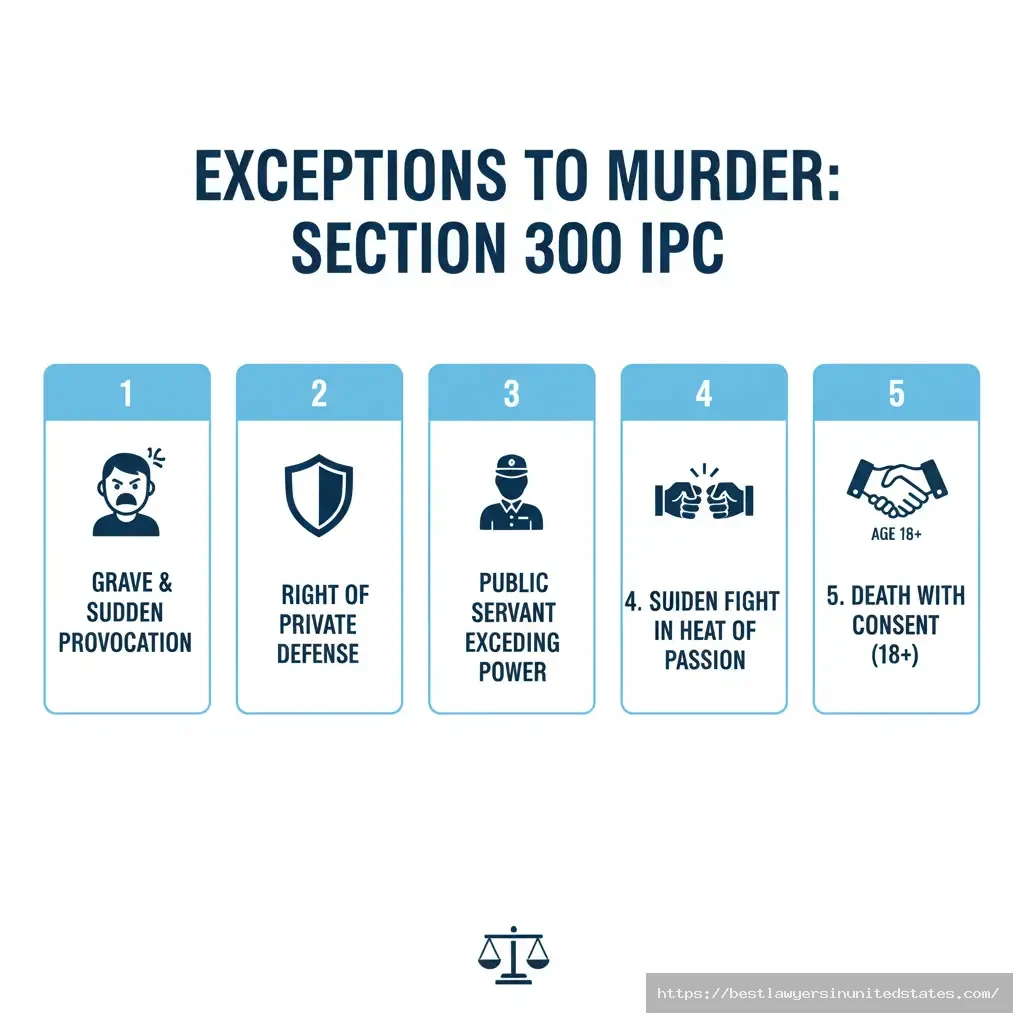
Section 300 IPC provides five situations where culpable homicide does not amount to murder. If proven, these reduce charges from Section 302 (murder) to Section 304 (culpable homicide not amounting to murder).
Exception 1: Grave and Sudden Provocation
When it applies: The accused kills in the heat of passion caused by sudden and grave provocation from the victim.
Requirements:
- Provocation must be sudden (no cooling-off period)
- Must be grave enough that a reasonable person would lose self-control
- The act must be in the heat of that provocation
What doesn’t qualify:
- Provocation sought by the accused
- Provocation given by someone acting lawfully
- Private defense situations
Real Example: A husband returns home unexpectedly and finds his wife in a compromising position with another man. In a fit of rage, he attacks and kills the man. Courts may consider this Exception 1 if the act was immediate.
Case Law: K.M. Nanavati v. State of Maharashtra (1962) – Naval officer killed his wife’s lover. Court held that the time gap between discovering the affair and the killing negated “sudden” provocation.
Exception 2: Private Defense Exceeding Legal Limits
When it applies: The accused exercises the right to private defense but causes more harm than necessary for protection.
Requirements:
- Person was genuinely defending themselves or others
- Exceeded what was reasonably necessary
- Exceeded in good faith, without premeditation
- Was in the fear of death or grievous hurt
Example: During a robbery, the victim grabs the attacker’s weapon and in panic, continues to strike the attacker multiple times even after the threat is neutralized, causing death.
Key Distinction: The line between justified private defense and exceeding it is often decided by:
- Whether the threat had ceased
- Number and nature of injuries inflicted
- Whether escape was possible
Exception 3: Public Servant Exceeding Lawful Powers
When it applies: A public servant exceeding lawful powers causes death while acting in good faith for public justice.
Requirements:
- Person must be a public servant acting in official capacity
- Believed in good faith they were acting lawfully
- Intended to advance public justice
- Exceeded authority without malicious intent
Example: A police officer during a riot control operation uses force that results in death, genuinely believing it necessary to prevent greater harm, but exceeds legal use-of-force guidelines.
This is the rarest exception and scrutinized heavily by courts to prevent abuse of power.
Exception 4: Sudden Fight Without Premeditation
When it applies: Death occurs in a sudden fight in the heat of passion, without the accused taking undue advantage or acting cruelly.
Requirements:
- Fight must be sudden (no prior planning)
- Both parties participated in the fight
- Accused didn’t take unfair advantage
- Accused didn’t act with unusual cruelty
Example: Two neighbors get into a heated argument over property boundary. The argument escalates into a physical altercation where one picks up a nearby object and strikes the other, causing fatal injury.
Key Factor: Courts examine whether the fight was mutual or whether one party was clearly the aggressor.
Case Law: Courts often look at whether weapons were brought to the scene (indicating premeditation) or found at the scene (indicating spontaneity).
Exception 5: Consent of the Person Killed (Age 18+)
When it applies: The person who died was over 18 years old and gave consent to their own death.
Requirements:
- Deceased must be 18 or older
- Must have given free and informed consent
- Not applicable if consent obtained under fear, fraud, or misconception
- Not applicable to mercy killing/euthanasia (still illegal in India)
This exception is extremely narrow and rarely succeeds because:
- Euthanasia remains illegal in India (except passive euthanasia in specific conditions post-Aruna Shanbaug case)
- Difficult to prove genuine consent
- Public policy considerations against allowing consent to murder
Example (Theoretical): A terminally ill person in extreme pain explicitly asks someone to end their life and provides written consent. Even with consent, Indian law doesn’t permit active euthanasia.
Impact of Exceptions: Punishment Reduction
| Charge | Section | Maximum Punishment |
|---|---|---|
| Murder (no exception applies) | Section 302 IPC | Death or Life Imprisonment |
| Exception 1 (Provocation) | Section 304 Part I IPC | Life Imprisonment or 10 years |
| Exceptions 2-5 (Other exceptions) | Section 304 Part II IPC | 10 years imprisonment |
Defense Strategy: In murder trials, defense attorneys extensively argue these exceptions to reduce culpability from murder to culpable homicide, potentially saving the accused from death penalty or life imprisonment.
Section 302 IPC Combined with Other Criminal Charges
Murder rarely occurs in isolation. Here’s how Section 302 IPC works when combined with other criminal charges under the Indian Penal Code:
302 + 307 IPC: Murder and Attempt to Murder
Scenario: Accused kills one person and attempts to kill another in the same incident.
Legal Position:
- Both charges can be filed simultaneously
- Different victims = different offences
- Example: During a family dispute, accused kills father (302) and attempts to kill mother (307)
Sentencing: Convictions under both sections typically result in consecutive sentences, though courts may order concurrent sentences based on circumstances.
302 + 34 IPC: Murder with Common Intention
Scenario: Multiple accused persons act together with common intention to commit murder.
Legal Position:
- Section 34 IPC makes all participants equally liable
- Even if only one person struck the fatal blow, all with common intention can be charged with 302
- Prosecution must prove shared criminal intent
Example: Three persons plan to kill someone. Person A holds the victim, Person B strikes with weapon causing death, Person C keeps watch. All three can be convicted under Section 302 read with Section 34 IPC.
Important: Mere presence at the scene isn’t enough—prosecution must prove active participation or shared intent.
302 + 201 IPC: Murder + Destruction of Evidence
Scenario: After committing murder, the accused destroys evidence or disposes of the body.
Legal Position:
- Section 201: Causing disappearance of evidence or giving false information
- Shows consciousness of guilt
- Separate offence with punishment up to 7 years
Common Forms:
- Burning or burying the body
- Cleaning crime scene
- Disposing of murder weapon
- Providing false alibis
Sentencing Impact: While Section 201 adds to prison time, it also strengthens the prosecution’s case by demonstrating guilty knowledge and intent.
302 + 120B IPC: Murder as Part of Criminal Conspiracy
Scenario: Murder committed as part of a larger conspiracy.
Legal Position:
- Section 120B: Criminal conspiracy
- All conspirators liable for murder even if they didn’t directly participate
- Requires proof of agreement between two or more persons
Example: Hired killings, contract murders, organized crime murders.
Enhanced Punishment: Conspiracy charges significantly increase sentencing severity and can bring in additional accused who planned but didn’t execute the murder.
302 + 376 IPC: Murder with Rape
Scenario: Murder committed during or after rape under Section 376 IPC almost always results in death penalty consideration.
Legal Position:
- Among the most heinous crimes
- Almost always results in death penalty consideration
- Falls under “rarest of rare” category
Recent Trends: Post-Nirbhaya case (2012), such cases receive expedited trial and severe punishment. Courts consistently award death penalties in rape-murder cases involving:
- Extreme brutality
- Child victims
- Multiple offenders
How Murder Cases Are Investigated: From FIR to Conviction
Understanding the investigation and trial process helps families and accused alike know what to expect, and how forensic evidence in criminal trials can strengthen or weaken a case.
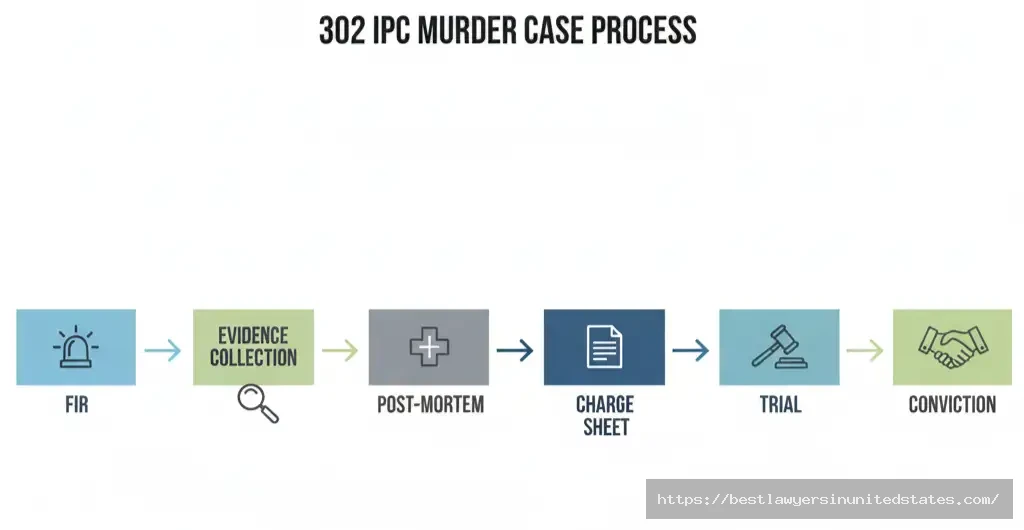
Stage 1: FIR Registration (Day 1)
What happens:
- Police receive information about the death
- First Information Report (FIR) is registered
- Crime scene secured
- Initial investigation begins
Documents created:
- FIR copy (can be obtained by victim’s family)
- Inquest report (if death reported to police)
- Panchnama (scene of crime documentation)
Timeline: FIR must be registered immediately; delay requires explanation.
Stage 2: Crime Scene Investigation (Days 1-3)
Police actions:
- Forensic team collects evidence
- Photographs and videos of crime scene
- Recovery of weapons, bloodstains, fingerprints
- Identification of body
Evidence collected:
- Physical evidence (weapons, clothes)
- Biological evidence (blood, hair, DNA)
- Documentary evidence (CCTV, phone records)
- Circumstantial evidence (motive, opportunity)
Stage 3: Post-Mortem and Medical Evidence (Days 2-7)
Crucial step: Post-mortem examination determines:
- Cause of death
- Time of death (approximate)
- Nature of injuries
- Whether death was homicidal, suicidal, or accidental
Medical evidence must establish:
- Death occurred due to injuries inflicted
- Nature of force used
- Whether injuries could cause death
- Time correlation between attack and death
Stage 4: Arrest and Interrogation (Days 1-90)
If accused identified:
- Arrest made (Section 302 is cognizable, so no warrant needed)
- Accused presented before magistrate within 24 hours
- Police custody remand (usually 15 days) for investigation
- Judicial custody during investigation
Accused rights:
- Right to legal counsel
- Right to be informed of grounds of arrest
- Right against self-incrimination
- Right to bail hearing (though usually denied)
Stage 5: Charge Sheet Filing (Within 90 Days)
Police complete investigation and file charge sheet containing:
- List of witnesses (typically 15-30 in murder cases)
- Evidence collected
- Medical reports
- Forensic reports
- Statements recorded under Section 161 CrPC
If charge sheet not filed within 90 days: Accused can apply for default bail, though rarely granted in murder cases due to gravity.
Stage 6: Framing of Charges (Months 4-8)
Court proceedings begin:
- Court examines charge sheet
- Accused informed of charges
- Plea taken (usually “not guilty” in serious cases)
- Charges formally framed
Charges typically include:
- Section 302 IPC (or 103 BNS) – Murder
- Any additional sections (34, 201, 307, etc.)
Stage 7: Trial in Court of Session (Years 1-5)

Trial stages:
- Prosecution Evidence
- Witnesses examined (direct examination)
- Cross-examination by defense
- Medical experts testify
- Forensic reports presented
- Defense Evidence
- Defense witnesses (if any)
- Accused’s statement under Section 313 CrPC
- Defense can choose not to present evidence
- Arguments
- Prosecution’s final arguments
- Defense’s final arguments
- Prosecution’s rebuttal
- Judgment
- Court analyzes evidence
- Determines guilt beyond reasonable doubt
- Acquittal or conviction
Average trial duration: 2-5 years (Delhi HC data shows average of 3.2 years for murder trials)
Stage 8: Sentencing (If Convicted)
Bifurcated hearing:
- Conviction stage: Determines guilt
- Sentencing stage: Determines punishment (separate hearing)
Sentencing hearing includes:
- Aggravating circumstances (prosecution’s arguments for severe punishment)
- Mitigating circumstances (defense’s arguments for leniency)
- Victim impact statements (from victim’s family)
- Accused’s background, age, mental state, socio-economic conditions
Court decides: Death penalty or life imprisonment plus fine
Stage 9: Appeals (Years 5-15+)
Appeal hierarchy:
| Court | Timeline | Success Rate |
|---|---|---|
| High Court (Appeal against Sessions Court) | 2-5 years | 20-30% acquittals |
| Supreme Court (Final appeal) | 3-7 years | 10-15% acquittals |
| Review Petition (Supreme Court) | 1-2 years | <5% success |
| Curative Petition (Last resort) | 1-2 years | <2% success |
Death sentence appeals: Automatically go to High Court even if accused doesn’t file appeal. If upheld, accused can appeal to Supreme Court.
Defenses Available in Section 302 IPC Murder Cases
A strong criminal defense lawyer strategy can mean the difference between acquittal, conviction for a lesser offense, or conviction for murder.
1. Lack of Intention or Knowledge
Argument: Death occurred accidentally or without criminal intent.
When it works:
- Injuries were accidental
- Accused didn’t intend to cause death
- Act wasn’t likely to cause death
Evidence required:
- Medical evidence showing injuries weren’t necessarily fatal
- Witness testimony about the incident being accidental
- Lack of motive
Result if successful: Charges reduced to Section 304A IPC (causing death by negligence) or acquittal.
2. Self-Defense (Right to Private Defense)
Argument: Accused acted to protect themselves or others from imminent danger.
Legal requirements (Section 96-106 IPC):
- Reasonable apprehension of danger to life or grievous hurt
- Force used was proportionate
- No safe retreat option available
- Act done without premeditation
Evidence required:
- Injuries on accused showing they were attacked
- Witness testimony supporting self-defense claim
- Nature of victim’s weapon or threat
- Medical evidence of defensive injuries
Common prosecution challenge: “You exceeded reasonable force” – which may reduce charge to Exception 2 (culpable homicide) rather than complete acquittal.
3. Alibi Defense
Argument: Accused was elsewhere when the murder occurred and couldn’t have committed it.
Requirements:
- Credible witnesses placing accused at different location
- Documentary evidence (CCTV, phone location, travel tickets)
- Timeline corroboration
Risk: False alibi can severely damage defense credibility.
Success factors:
- Multiple independent witnesses
- Documentary proof (not just witness statements)
- Consistency in timeline
4. Challenging Evidence Reliability
Common challenges:
a) Eyewitness Testimony:
- Contradictions in statements
- Night-time identification issues
- Distance from crime scene
- Prior enmity with accused (biased witnesses)
b) Medical Evidence:
- Post-mortem inconsistencies
- Alternative cause of death possibilities
- Time of death discrepancies
c) Forensic Evidence:
- Chain of custody gaps
- Contamination possibilities
- Lab report errors
Defense strategy: Create reasonable doubt about prosecution’s case without necessarily proving innocence.
5. False Implication/Frame-Up
Argument: Accused falsely implicated due to:
- Personal enmity
- Property disputes
- Family rivalries
- Scapegoating by actual perpetrators
Evidence required:
- Motive for false implication
- Inconsistencies in prosecution case
- Alternative suspects
- Prior disputes documented
This defense is high-risk: Courts are skeptical without strong supporting evidence.
6. Provocation Defense (Exception 1)
Argument: Accused acted in heat of passion due to grave and sudden provocation.
Requirements:
- Victim provoked the accused
- Provocation was sudden and grave
- Act occurred immediately, without cooling-off time
- Reasonable person would have lost self-control
Result if successful: Conviction under Section 304 Part I instead of Section 302 (reduces from life/death to maximum 10 years).
7. Mental Incapacity/Insanity Defense (Section 84 IPC)
Argument: Accused was of unsound mind and incapable of understanding the nature of the act.
Legal standard:
- Person was incapable of knowing nature of act, OR
- Incapable of knowing it was wrong or contrary to law
- Mental condition existed at the time of the act
Evidence required:
- Psychiatric evaluation reports
- Medical history of mental illness
- Witness testimony about behavioral changes
- Expert testimony from psychiatrists
Burden of proof: On the accused to prove insanity (unlike other defenses where prosecution must prove guilt).
Result if successful: Acquittal on grounds of insanity, but may be detained in mental institution.
8. Challenging Identification
Particularly relevant in cases without eyewitnesses:
Test Identification Parade issues:
- Was it conducted fairly?
- Were there sufficient similar-looking persons?
- Was it done promptly after arrest?
- Any suggestions made to witnesses?
CCTV/Photo identification challenges:
- Image quality
- Lighting conditions
- Angle and distance
- Tampering possibilities
9. Absence of Motive
While motive isn’t legally required for conviction, its absence can create doubt.
Defense argument:
- No prior enmity
- No financial gain
- No personal dispute
- No reason to harm victim
Prosecution response: Motive strengthens their case but isn’t essential if direct evidence exists.
Landmark Supreme Court Judgments on Section 302 IPC
These cases have shaped how murder law is interpreted and applied in India:
1. Bachan Singh v. State of Punjab (1980)
Issue: Constitutional validity of death penalty
Ruling:
- Death penalty is constitutional but must be imposed only in “rarest of rare cases”
- Special reasons must be recorded for death sentence
- Courts must consider mitigating and aggravating circumstances
Impact: Established the foundational doctrine that guides all death penalty cases in India today.
2. Machhi Singh v. State of Punjab (1983)
Issue: What constitutes “rarest of rare cases”?
Ruling: Court laid down five categories for assessing when death penalty is appropriate:
- Manner of commission
- Motive
- Anti-social or abhorrent nature
- Magnitude of crime
- Personality of victim
Impact: Provides concrete guidelines courts use to determine death penalty appropriateness.
3. K.M. Nanavati v. State of Maharashtra (1962)
Facts: Naval officer killed his wife’s lover
Issue: Whether grave and sudden provocation defense applied
Ruling:
- Time gap between discovery and killing negated “sudden” element
- Provocation defense requires immediate reaction
- Conviction under Section 302 IPC upheld
Impact: Clarified interpretation of Exception 1 (provocation) to Section 300 IPC. Last jury trial in India.
4. Virsa Singh v. State of Punjab (1958)
Issue: Establishing intention in murder cases
Ruling:
- Prosecution must prove accused intended to inflict the specific injury found on victim
- Such injury must be sufficient in ordinary course to cause death
- Knowledge that act could cause death isn’t enough for Section 302
Impact: Defined the mental element (mens rea) required for murder conviction.
5. Jagmohan Singh v. State of Uttar Pradesh (1973)
Issue: Whether death penalty violates Articles 14, 19, and 21 of Constitution
Ruling:
- Death penalty doesn’t violate fundamental rights
- It’s a valid punishment for murder
- Judicial discretion in awarding death penalty is constitutional
Impact: Affirmed constitutional validity of capital punishment in India.
6. Shatrughan Chauhan v. Union of India (2014)
Issue: Effect of prolonged delay in execution of death sentence
Ruling:
- Inordinate delay in execution can be a ground for commutation
- Mental illness developed during imprisonment is a mitigating factor
- Rights of death row convicts must be protected
Impact: Recognized humanitarian considerations in death penalty cases; led to several death sentence commutations.
7. Mukesh & Anr v. State for NCT of Delhi (2017) – Nirbhaya Case
Facts: Gang rape and murder of 23-year-old woman in Delhi
Ruling:
- Death penalty upheld for all four adult convicts
- Case fell under “rarest of rare” category due to extreme brutality
- Collective conscience of society was shocked
Impact: Reinforced that rape-murder cases with extreme brutality warrant death penalty; led to faster trial procedures for sexual violence cases.
Rights of Victim’s Family in Section 302 IPC Cases
Victim’s families often feel sidelined in the criminal justice process. Here are their legal rights and remedies:
1. Right to Information
Families can obtain:
- Copy of FIR
- Status of investigation
- Autopsy report (through court application)
- Updates on case proceedings
- Details of arrests made
How to access: Submit written application to investigating officer or approach Victim Assistance Cell at police station.
2. Right to Engage Private Lawyer
Victim’s family can:
- Appoint private counsel to assist public prosecutor
- Private lawyer can’t replace public prosecutor but can support
- Help ensure case is properly argued
- File applications on behalf of victim’s family
Cost consideration: While public prosecutor is free, private counsel involves legal fees.
3. Right to Compensation
Under Section 357A CrPC:
- Victim’s family entitled to compensation from State Victim Compensation Fund under Section 357A CrPC can also seek wrongful death lawyer support for families to claim damages.
- Amount varies by state (₹2-10 lakhs typically)
- Application filed before District Legal Services Authority
Under Section 357 CrPC:
- Court can order accused to pay compensation to victim’s family
- Amount deducted from fine imposed
- Separate from criminal punishment
Process:
- File application with District Legal Services Authority
- Provide death certificate and FIR copy
- Attend committee hearing
- Compensation disbursed if approved (usually within 2-3 months)
4. Right to Be Heard During Sentencing
Victim Impact Statement:
- Family can submit written statement about impact of murder
- Can address court during sentencing hearing
- Court considers this for determining punishment quantum
What to include:
- Emotional trauma suffered
- Financial loss (loss of earning member)
- Impact on children/dependents
- How crime affected family’s life
This has increasingly influenced courts, especially in deciding between life imprisonment and death penalty.
5. Right to Appeal Against Acquittal
If trial court acquits accused:
- Victim’s family can’t directly appeal (no legal standing)
- Can approach High Court or Supreme Court through:
- Public prosecutor
- Filing protest petition requesting prosecutor to appeal
- Seeking leave to appeal in exceptional cases
Success rate: Low, as appellate courts are reluctant to overturn acquittals unless grave legal errors occurred.
6. Right to Monitor Investigation
If dissatisfied with police investigation:
- File application in High Court under Article 226 for CBI investigation
- Seek court-monitored investigation
- File complaint about police inaction
Grounds for intervention:
- Deliberate delay
- Bias towards accuse
6. Right to Monitor Investigation (continued)
If dissatisfied with police investigation:
- File application in High Court under Article 226 for CBI investigation
- Seek court-monitored investigation
- File complaint about police inaction
Grounds for intervention:
- Deliberate delay
- Bias towards accused
- Failure to collect crucial evidence
- Not arresting identified suspects
- Pressure from influential persons
Supreme Court guidelines: In serious cases where local police appears compromised, courts can transfer investigation to CBI or Special Investigation Team (SIT).
7. Right to Witness Protection
If family members are witnesses:
- Protection under Witness Protection Scheme, 2018
- Categories of protection available:
- Identity protection
- Police protection
- Relocation (in extreme cases)
- Security during court appearances
Application process: File application with trial court judge stating threat perception and requesting protection.
8. Right to Speedy Trial
Victim’s family can:
- File applications seeking expedited trial
- Request daily hearings in prolonged cases
- Move higher courts if trial court causing unreasonable delays
Recent judicial trend: Courts increasingly sensitive to victim’s family rights; several High Courts have issued directions for time-bound murder trials (completion within 2 years).
Latest Supreme Court Judgments on Section 302 IPC (2023-2025)
Recent cases show evolving judicial approach toward murder sentencing:
1. Death Penalty Commutations Trend
Observed pattern (2023-2025):
- Supreme Court commuted 60%+ death penalties to life imprisonment
- Increasing emphasis on mitigating factors:
- Young age at time of offense
- Socio-economic deprivation
- Reformative potential
- Mental health issues
- Prolonged incarceration before execution
Key reasoning: Courts moving toward reformation over retribution unless crime is exceptionally heinous.
2. Bail Jurisprudence Shift
Recent Supreme Court observations:
- “Bail is the rule, jail is the exception” principle increasingly applied
- If trial delayed beyond 2-3 years without progress, bail consideration strengthened
- However, murder cases still face higher scrutiny
Practical impact: Marginally increased bail grants in cases with:
- Weak circumstantial evidence
- Trial delays exceeding 4-5 years
- Accused in custody for 5+ years without trial completion
3. Emphasis on Scientific Evidence
2024 trends:
- Courts demanding forensic corroboration
- DNA evidence, ballistic reports, CCTV footage gaining prominence
- Eyewitness testimony alone (without corroboration) viewed skeptically
- Several acquittals due to lack of forensic evidence linking accused
Implication for prosecution: Investigation quality matters more than ever; weak forensic work leads to acquittals despite circumstantial evidence.
4. Mental Health Considerations
Growing recognition:
- Mental illness at time of offense increasingly treated as mitigating factor
- Courts ordering psychiatric evaluations more frequently
- Depression, PTSD, schizophrenia considered in sentencing
- Several death penalties commuted on mental health grounds
Section 302 IPC vs Murder Laws Globally: International Comparison

Understanding how India’s murder laws compare with other countries:
| Country | Murder Provision | Maximum Punishment | Life Imprisonment Definition | Death Penalty Status |
|---|---|---|---|---|
| India | Section 302 IPC / 103 BNS | Death or Life + Fine | Entire natural life | Active (rarely used) |
| United States | Varies by state (1st/2nd degree) | Death or Life without parole | Varies: 15-25 years to natural life | Active (32 states) |
| United Kingdom | Murder Act 1965 | Life imprisonment (mandatory) | Minimum 15 years, often whole life | Abolished 1965 |
| Canada | Section 229 Criminal Code | Life imprisonment | 25 years minimum before parole | Abolished 1976 |
| Australia | Varies by state | Life imprisonment | 20-25 years to natural life | Abolished 1985 |
| China | Article 232 Criminal Law | Death penalty | 10 years to life | Active (extensively used) |
| Saudi Arabia | Sharia Law | Death penalty (mandatory for murder) | Not applicable | Active (extensively used) |
| Japan | Article 199 Penal Code | Death or Life + hard labor | Minimum 10 years | Active (used regularly) |
Key Differences in Legal Approach
1. Degrees of Murder
United States: Distinguishes between:
- First-degree murder (premeditated)
- Second-degree murder (intentional but not premeditated)
- Felony murder (death during commission of another crime)
- Voluntary/involuntary manslaughter
India: Doesn’t formally classify murder into degrees, but distinguishes through:
- Section 302 (murder)
- Section 304 (culpable homicide not amounting to murder)
- Exceptions provide similar function as degrees
2. Mandatory vs Discretionary Sentencing
United Kingdom: Life imprisonment is mandatory for murder; judge has no discretion.
India: Judge has discretion between death penalty and life imprisonment based on case circumstances.
United States: Varies by state; some states have mandatory life without parole, others allow judicial discretion.
3. Death Penalty Application
India (Rarest of Rare):
- Applied in <5% of murder convictions
- Extensive judicial review before execution
- No execution since 2020
United States:
- Active in 32 states
- Applied more frequently than India
- Executions continue regularly in states like Texas, Oklahoma
China:
- Most executions globally (estimated thousands annually)
- Applied for various crimes including corruption
- Limited transparency
European Union & Commonwealth nations: Abolished entirely; considered violation of human rights.
4. Life Imprisonment Interpretation
India: “Life imprisonment” means imprisonment for the convict’s natural life (not 14 or 20 years as commonly misunderstood). However, remission possible in certain cases.
United Kingdom: Life imprisonment with minimum tariff (15-30 years typically); parole possible after minimum term.
United States: “Life without parole” common in murder cases; no possibility of release.
5. Juvenile Offenders
India: Juveniles (under 18) tried under Juvenile Justice Act; exception for heinous crimes by 16-18 year-olds post-2015 amendment (can be tried as adults).
United States: Several states allow juveniles to be tried as adults for murder; life without parole possible.
United Kingdom & EU: Juveniles never tried as adults; rehabilitation-focused approach.
Extradition Implications
Death penalty creates extradition complications:
Scenario: Accused flees India to UK/EU country
Problem: European countries won’t extradite if accused faces death penalty (violates European Convention on Human Rights).
Solution: India must provide assurance that death penalty won’t be imposed or will be commuted to life imprisonment.
Recent case example: Extradition requests in high-profile cases often require such assurances, delaying justice.
How to Get Bail in Section 302 IPC: Step-by-Step Process
While challenging, here’s the practical process for seeking bail in murder cases:
Step 1: Assess Bail Eligibility (Days 1-15)
Consult criminal lawyer to evaluate:
- Strength of prosecution evidence
- Nature of accusations
- Chances of bail approval
- Whether to approach lower court or High Court directly
Realistic assessment needed: In cases with strong eyewitness testimony, medical evidence, and clear motive, bail chances are minimal regardless of court.
Step 2: Prepare Bail Application (Days 15-30)
Application must contain:
- Basic Details:
- Name, age, address of accused
- FIR number and police station
- Date of arrest
- Current custody status
- Grounds for Bail:
- Weak prosecution case (specific details)
- Lack of evidence linking accused
- Availability of sureties
- Medical conditions requiring treatment
- Family responsibilities
- Clean criminal record
- Willingness to cooperate with investigation
- Legal Grounds:
- Delay in trial proceedings
- Violation of procedural requirements
- Parity with co-accused (if they got bail)
- Supporting Documents:
- Medical certificates (if claiming health issues)
- Character certificates
- Proof of residence
- Employment/business records
- Family dependency proof
Step 3: File Bail Application (Day 30-45)
Where to file:
Option 1: Sessions Court (if charge sheet filed and trial begun)
- Lower court fees
- Faster hearing (usually)
- Lower success rate in murder cases
Option 2: High Court (can be filed anytime after arrest)
- Higher court fees
- Takes longer to list
- Slightly better success rate
- Preferred if Sessions Court rejected bail
Filing requirements:
- Bail application (properly drafted)
- Vakalatnama (lawyer’s authorization)
- Affidavit by accused
- Supporting documents
- Court fees
Step 4: Bail Hearing (Days 60-120)
Process:
- Listing: Application listed for hearing (may take 2-8 weeks)
- Prosecutor’s Opposition: Public prosecutor argues against bail:
- Gravity of offense
- Evidence strength
- Flight risk
- Witness tampering concerns
- Previous criminal history (if any)
- Defense Arguments: Defense lawyer presents:
- Grounds for bail
- Precedents where bail was granted
- Personal circumstances
- Assurances offered
- Court Queries: Judge may ask:
- About evidence
- Accused’s background
- Surety details
- Conditions accused willing to accept
Step 5: Court Decision
Possible outcomes:
A) Bail Granted (with strict conditions):
- Personal bond (₹50,000 to ₹5 lakh)
- Two sureties of similar amount
- Surrender passport
- Regular police station reporting (weekly/fortnightly)
- Not to leave city/state without permission
- Not to contact witnesses
- Not to commit any offense while on bail
B) Bail Rejected:
- Order specifying reasons
- Option to appeal to higher court
- Can file fresh bail application after 3-6 months citing changed circumstances
C) Hearing Adjourned:
- Court seeks additional information
- Prosecution requests time to file counter-affidavit
- Re-listed for future date
Step 6: If Bail Granted – Release Process (Days 1-7)
Post-bail order procedure:
- Furnish Sureties:
- Sureties must appear before court
- Submit property documents as security
- Sign surety bonds
- Personal Bond:
- Accused signs personal bond undertaking
- Acknowledges bail conditions
- Verification:
- Court verifies surety documents
- May send police for surety address verification
- Release Orders:
- Court issues release warrant
- Sent to jail authorities
- Physical Release:
- Usually within 24-48 hours after documentation complete
- Accused must report to police station as per bail conditions
Step 7: Bail Compliance (Throughout Trial)
Mandatory compliance:
✅ Attend all court hearings (failure = bail cancellation)
✅ Report to police station as directed
✅ Inform court of address changes
✅ Don’t contact prosecution witnesses
✅ Don’t leave jurisdiction without permission
✅ Don’t commit any criminal offense
Bail cancellation grounds:
- Absconding/not attending court
- Threatening witnesses
- Tampering with evidence
- Committing another offense
- Violating bail conditions
Alternative: Anticipatory Bail (Section 438 CrPC)
When applicable: If arrest anticipated but not yet made
Procedure:
- File anticipatory bail application in Sessions Court or High Court
- Hearing process similar to regular bail
- If granted, accused can’t be arrested (or will be released immediately after arrest)
Limitation: Many High Courts don’t grant anticipatory bail in murder cases due to gravity of offense.
Success Rates & Realistic Expectations
| Stage | Bail Success Rate | Typical Conditions |
|---|---|---|
| During Investigation (Pre-charge sheet) | 5-10% | Strict; high surety amounts |
| After Charge Sheet Filed | 15-20% | Strict; regular reporting |
| After Trial Delay (2+ years) | 30-40% | Moderate; depends on delay length |
| Weak Prosecution Case | 40-50% | Moderate; focus on case weakness |
| Post-Conviction (pending appeal) | 5-10% | Very strict; rare in murder cases |
Frequently Asked Questions (FAQs)
What is Section 302 IPC?
Section 302 IPC prescribes punishment for murder: death penalty or life imprisonment plus fine. It’s a non-bailable, cognizable offence tried by the Court of Session. Under the new BNS 2023, it’s now Section 103 with identical provisions.
What is the punishment under Section 302 IPC?
The court can award either death penalty or life imprisonment, along with a fine. Death penalty is reserved for “rarest of rare cases” based on the gravity and circumstances of the murder. Life imprisonment means imprisonment for the convict’s entire natural life, not just 14 or 20 years.
Is Section 302 IPC bailable or non-bailable?
Section 302 IPC is non-bailable. The accused has no automatic right to bail and must apply to the court, which grants bail only in exceptional circumstances like weak evidence, prolonged trial delays, or serious medical conditions.
How many years is the punishment for 302 IPC?
Life imprisonment under Section 302 means imprisonment for the convict’s entire natural life. It’s not a fixed term of 14 or 20 years. The only alternative is the death penalty in rarest of rare cases.
What is Section 302 IPC in BNS?
Section 302 IPC is now Section 103 in the Bharatiya Nyaya Sanhita (BNS) 2023, effective from July 1, 2024. The punishment, definition, and legal procedures remain identical—only the section number has changed.
What is the difference between Section 302 and 304 IPC?
Section 302 IPC punishes murder with death or life imprisonment. Section 304 IPC punishes culpable homicide not amounting to murder with up to 10 years imprisonment. The difference lies in intent and circumstances—murder involves greater premeditation and intent, while Section 304 applies when exceptions under Section 300 are proven.
Can anticipatory bail be granted in Section 302 IPC?
Anticipatory bail is rarely granted in murder cases due to the gravity of the offense. Most High Courts decline anticipatory bail applications for Section 302 IPC, though it’s not legally prohibited. Regular bail after arrest is the more viable option.
What is the difference between 307 and 302 IPC?
Section 302 IPC deals with completed murder (death occurred). Section 307 IPC deals with attempt to murder (death didn’t occur despite intent). Section 307 carries up to 10 years or life imprisonment, while Section 302 carries death penalty or life imprisonment.
Which court tries Section 302 IPC cases?
Section 302 IPC cases are tried exclusively by the Court of Session. Magistrate courts have no jurisdiction to try murder cases. The trial is conducted before a Sessions Judge.
What are the exceptions to Section 302 IPC?
Section 300 IPC provides five exceptions that reduce murder to culpable homicide (Section 304): (1) grave and sudden provocation, (2) exceeding private defense rights, (3) public servant exceeding lawful powers, (4) sudden fight without premeditation, and (5) consent of person killed (if over 18).
How long does a Section 302 IPC trial take?
Murder trials in India typically take 2-5 years to complete, with an average of 3.2 years. Factors affecting duration include witness availability, court backlog, adjournments, and complexity of evidence. Fast-track courts can conclude trials within 6-12 months.
Can Section 302 IPC be compounded?
No. Section 302 IPC is not listed under compoundable offenses in Section 320 CrPC. Murder cases cannot be settled between parties or withdrawn—they proceed as state offenses regardless of victim’s family wishes.
What evidence is required to prove Section 302 IPC?
Prosecution must prove: (1) death of a human being, (2) accused caused the death, (3) criminal intent or knowledge, and (4) act was unlawful. Evidence includes medical reports, eyewitness testimony, forensic evidence, motive, and circumstantial evidence.
What happens if someone is falsely implicated in 302 IPC?
The accused can defend by challenging evidence reliability, presenting alibi, demonstrating lack of motive, or proving false implication due to enmity. If acquitted, they can file a malicious prosecution case against false complainants for compensation and legal harassment.
Can a person get bail after conviction under Section 302 IPC?
Post-conviction bail (pending appeal) is extremely rare in murder cases. High Courts grant it only in exceptional circumstances: gross miscarriage of justice, weak conviction grounds, or serious health issues. Success rate is below 10%.
What is the minimum punishment for Section 302 IPC?
There is no minimum punishment specified. The court has discretion to award either death penalty or life imprisonment. In practice, life imprisonment is the most common sentence, with death penalty reserved for rarest of rare cases.
How to file a murder case under Section 302 IPC?
File an FIR at the police station having jurisdiction over the crime location. Provide details of the incident, victim identity, suspect information (if known), and any evidence. Police will register the FIR and begin investigation. Victim’s family should engage a criminal lawyer to monitor the case.
What is the difference between IPC 300 and 302?
Section 300 IPC defines what constitutes murder—it’s the definition provision. Section 302 IPC prescribes the punishment for murder—it’s the sentencing provision. Both sections work together: Section 300 determines if an act is murder, and Section 302 provides the penalty.
Can juveniles be charged under Section 302 IPC?
Juveniles (under 18) are generally tried under the Juvenile Justice Act, not IPC. However, the 2015 amendment allows 16-18 year-olds accused of heinous offenses like murder to be tried as adults if the Juvenile Justice Board transfers the case.
What is the appeal process after Section 302 IPC conviction?
The accused can appeal to the High Court within 30 days of conviction. If High Court upholds conviction, appeal to the Supreme Court is possible. Death sentences automatically go to High Court for confirmation even without filing an appeal. The entire appeal process can take 5-15 years.
Conclusion: Understanding Section 302 IPC in Practice
Section 302 IPC (now Section 103 BNS) remains one of India’s most serious criminal provisions, carrying the ultimate punishments of death or lifelong imprisonment. Over 160 years of jurisprudence has shaped its application, consistently balancing punishment with principles of justice and human rights.
Key takeaways:
✅ Murder requires proof of intent and knowledge beyond reasonable doubt
✅ Death penalty is constitutional but applied only in “rarest of rare cases”
✅ Bail is possible but extremely challenging in murder cases
✅ Five exceptions can reduce charges from murder to culpable homicide
✅ IPC to BNS transition changed section numbers but not substantive law
✅ Victim’s families have legal rights including compensation and participation
✅ Strong legal defense can mean difference between acquittal and conviction
For legal advice specific to your case, consult a qualified criminal defense lawyer. This article provides general legal information and doesn’t constitute legal advice.
Disclaimer: This article is for informational purposes only and does not constitute legal advice. Laws and judicial interpretations evolve; consult a practicing criminal lawyer for case-specific guidance.
