
Arkansas ranks as one of the most landlord-friendly states in America. The Arkansas Residential Landlord-Tenant Act of 2007 provides limited protections for renters compared to states like California or New York. Understanding your rights under Arkansas law can prevent costly disputes and illegal evictions.
This guide covers security deposits, eviction timelines, notice requirements, and landlord entry rules specific to Arkansas. You’ll find three free calculators to determine your exact rights based on your situation. Arkansas has no rent control, no warranty of habitability statute, and allows rapid evictions with proper notice.
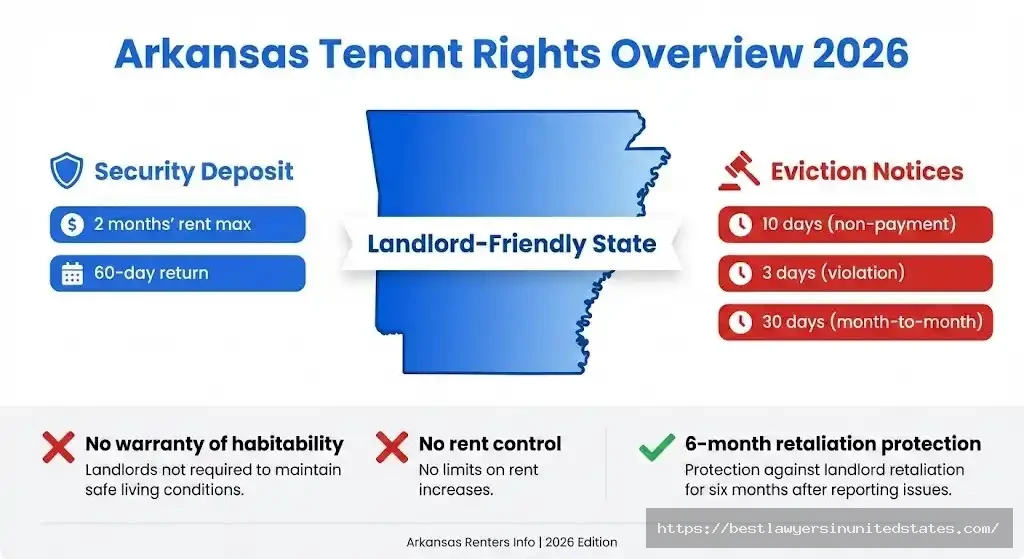
Whether you’re renting in Little Rock, Fort Smith, Fayetteville, or anywhere in Arkansas, knowing state-specific tenant rights protections helps you avoid common landlord-tenant disputes.
Quick Reference: Arkansas Tenant Rights Summary
| Right/Law | Arkansas Rule | Key Details |
|---|---|---|
| Security Deposit Limit | 2 months’ rent | No interest required |
| Deposit Return Timeline | 60 days | Itemized deductions required |
| Eviction Notice (Non-Payment) | 10 days | Must give tenant chance to pay |
| Eviction Notice (Violation) | 3 days | Cure or quit |
| Month-to-Month Termination | 30 days | Either party can terminate |
| Warranty of Habitability | ❌ None | Major weakness for tenants |
| Rent Control | ❌ None | Statewide prohibition |
| Landlord Entry Notice | Reasonable | Emergency = no notice required |
Is Arkansas a Landlord-Friendly State?
Quick Answer: Yes. Arkansas is one of the most landlord-friendly states in the United States due to weak tenant protections, no rent control, no warranty of habitability, and rapid eviction procedures.
Arkansas landlords have significant advantages under state law. The state imposes no limits on rent increases for month-to-month tenancies. Landlords can raise rent by any amount with proper notice. Arkansas also lacks just-cause eviction requirements, meaning landlords can terminate month-to-month leases for almost any legal reason.
The absence of a warranty of habitability statute means landlords have minimal obligations to maintain rental properties unless specified in the lease. This contrasts sharply with states like Alabama and Alaska, which provide stronger tenant protections.
Why Arkansas Favors Landlords
Arkansas law creates three major advantages for property owners:
No Rent Control: Cities and counties cannot enact rent control ordinances. Landlords set rental prices based solely on market conditions. Unlike California or New York, where rent stabilization exists in some areas, Arkansas prohibits all local rent control measures.
No Habitability Warranty: Arkansas is one of few states without an implied warranty of habitability. Landlords must only provide conditions specified in the lease. If your lease doesn’t require working air conditioning and it breaks, your landlord may not be obligated to repair it despite Arkansas’s hot summers.
Fast Evictions: Arkansas allows 3-day notices for lease violations and 10-day notices for non-payment. The complete eviction process takes 30-45 days from initial notice to sheriff enforcement, faster than most states.
Arkansas Residential Landlord-Tenant Act of 2007
The Arkansas Residential Landlord-Tenant Act of 2007 (Ark. Code Ann. § 18-16-101 et seq.) governs most rental relationships in Arkansas. This law establishes basic rights and responsibilities for both landlords and tenants. However, it provides fewer tenant protections than similar laws in other states.
What the Act Covers
The 2007 Act addresses security deposits, eviction procedures, lease requirements, and tenant obligations. It sets a maximum security deposit limit of two months’ rent and requires landlords to return deposits within 60 days of move-out. The law also establishes eviction notice requirements and prohibits self-help evictions like changing locks or shutting off utilities.
However, the Act notably lacks a warranty of habitability requirement. This omission means tenants cannot withhold rent for repair issues unless their lease specifically allows it.
What the Act Doesn’t Cover
Arkansas law does not regulate rent increases, require specific notice for rent hikes, or mandate grace periods for late rent. The Act also doesn’t establish landlord entry notice requirements beyond “reasonable notice” for non-emergencies. These gaps leave tenants vulnerable to sudden rent increases and frequent property inspections.
Mobile home tenants fall under separate statutes. The Arkansas Mobile Home Communities Act provides additional protections not available to apartment or house renters.
Arkansas Security Deposit Laws
Quick Answer: Arkansas landlords can charge up to two months’ rent as a security deposit. They must return deposits within 60 days of move-out with an itemized statement of deductions.
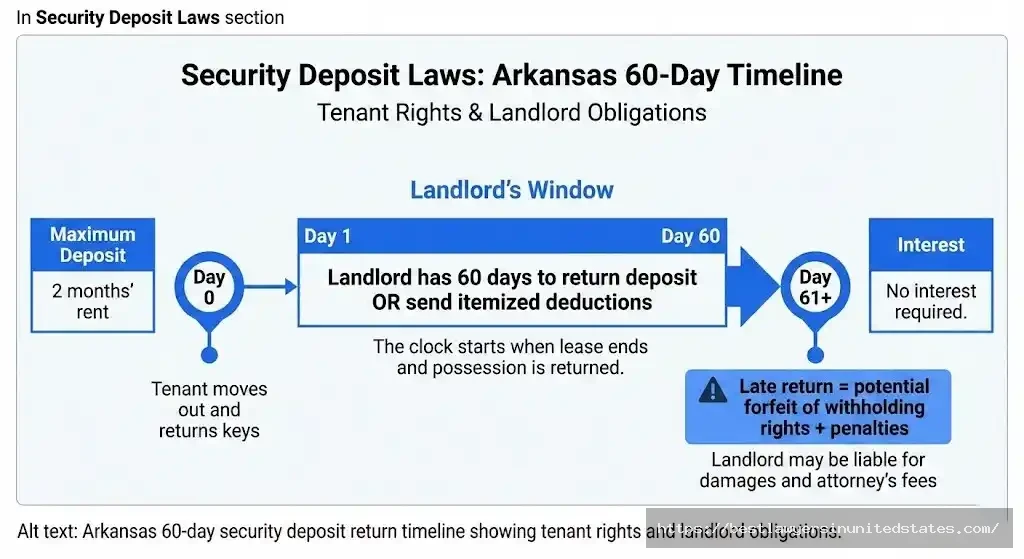
Arkansas security deposit law (Ark. Code Ann. § 18-16-305) limits deposits to two times the monthly rent. This applies to both furnished and unfurnished units. Landlords cannot charge additional deposits beyond this limit, though they can charge non-refundable fees for specific services if clearly stated in the lease.
Calculate Your Security Deposit Rights in Arkansas
Moving out soon? Use our free calculator to determine if your landlord owes you a security deposit refund and by what deadline. This calculator uses Arkansas’s specific security deposit laws including return timelines, allowable deductions, and penalty calculations.
🏠 Security Deposit Calculator
All 50 States + DC
Calculate max legal deposits, return deadlines, and penalties for violations.
📋 Enter Your Information
Special Conditions (if applicable)
✓ Results for
Based on current state law. Always verify with local regulations.
Calculator features:
- Arkansas-specific deposit limits and timelines
- Deduction legality checker
- Penalty calculation for late returns
- Itemized deduction analyzer
- Next steps if your rights are violated
Need help recovering your deposit? Contact Arkansas tenant rights attorneys for free consultation.
Email: [email protected]
Maximum Deposit Limits
Arkansas law caps security deposits at two months’ rent regardless of unit type. For a rental with $800 monthly rent, the maximum legal deposit is $1,600. Landlords charging more violate state law and may face penalties.
| Monthly Rent | Maximum Legal Deposit |
|---|---|
| $600 | $1,200 |
| $800 | $1,600 |
| $1,000 | $2,000 |
| $1,200 | $2,400 |
| $1,500 | $3,000 |
Pet deposits and last month’s rent count toward this two-month limit. A landlord cannot charge two months’ rent as a security deposit plus an additional month’s rent as a pet deposit.
Return Timeline and Requirements
Arkansas landlords have 60 days from the date you move out and return possession to return your security deposit or provide an itemized statement of deductions. This 60-day period begins when you vacate the property and return all keys, not when your lease ends.
What landlords must provide:
- Full deposit refund OR itemized deduction statement within 60 days
- Written list of all deductions with specific amounts
- Forwarding address confirmation (you must provide this)
- Actual cost documentation for repairs exceeding normal wear and tear
What happens if your landlord is late: If your landlord fails to return your deposit or provide an itemized statement within 60 days, they may forfeit the right to withhold any portion. You can sue in small claims court for twice the wrongfully withheld amount plus attorney fees.
Allowable Deductions
Arkansas law permits security deposit deductions for specific damages and costs:
Legal deductions:
- Unpaid rent for any period
- Unpaid utility bills if you were responsible under the lease
- Damage beyond normal wear and tear
- Cleaning costs to return unit to move-in condition
- Unpaid late fees specified in your lease
- Cost to replace lost or unreturned keys
Illegal deductions:
- Normal wear and tear (faded paint, worn carpet from normal use)
- Pre-existing damage you documented at move-in
- Cleaning that exceeds move-in cleanliness standards
- Repairs for landlord’s neglected maintenance
- Carpet cleaning unless lease requires professional cleaning
Arkansas does not require landlords to pay interest on security deposits. Your deposit can sit in a regular checking account for years without earning interest.
Penalties for Landlord Violations
Landlords who wrongfully withhold security deposits face serious penalties under Arkansas law. If your landlord fails to return your deposit within 60 days without providing a valid itemized statement, you can file suit in small claims court.
Potential recovery:
- Full deposit amount wrongfully withheld
- Up to two times the deposit amount in damages
- Court costs and filing fees
- Attorney fees (if you hire a lawyer)
Document everything. Take photos and videos during your move-in inspection and again at move-out. Keep copies of your lease, rent payment records, and all communications with your landlord. This evidence proves your case if you need to sue.
Arkansas Eviction Laws
Quick Answer: Arkansas eviction timelines range from 30-45 days total, depending on the eviction reason. Landlords must provide 10 days’ notice for non-payment, 3 days for lease violations, and 30 days to terminate month-to-month leases.
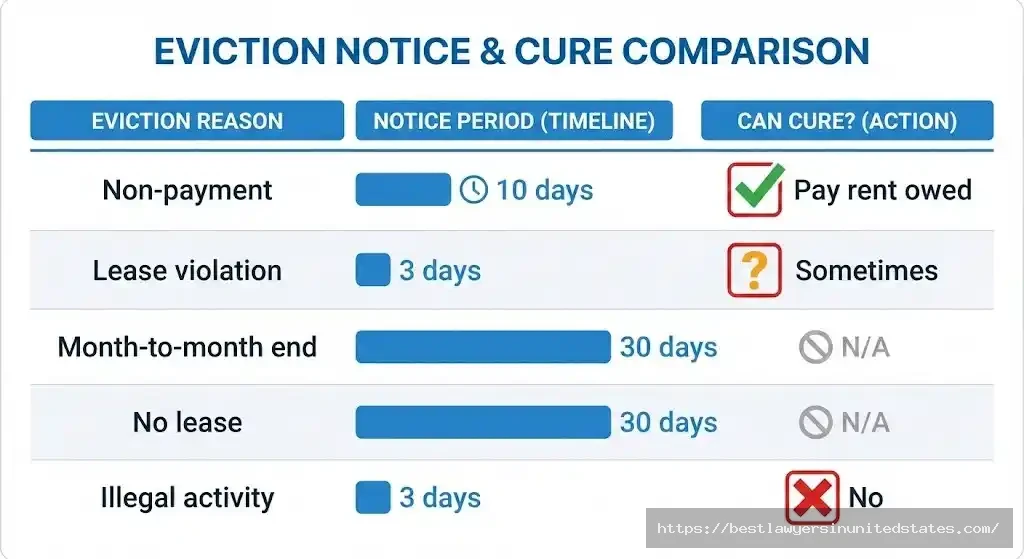
Arkansas uses “unlawful detainer” proceedings to remove tenants who won’t leave voluntarily. All evictions require court involvement. Landlords cannot force you out by changing locks, removing your belongings, or shutting off utilities. These “self-help” evictions violate Arkansas law and give you grounds to sue.
Eviction Notice Requirements by Type
Arkansas law requires different notice periods based on the eviction reason:
| Eviction Reason | Notice Period | Can Tenant Cure? | Next Step if Tenant Doesn’t Leave |
|---|---|---|---|
| Non-payment of rent | 10 days | Yes (pay rent owed) | Court filing after 10 days |
| Lease violation | 3 days | Sometimes | Court filing after 3 days |
| Month-to-month termination | 30 days | N/A | Court filing after 30 days |
| No lease (at-will) | 30 days | N/A | Court filing after 30 days |
| Illegal activity | 3 days | No | Immediate court filing |
Non-Payment of Rent Evictions
Arkansas law (Ark. Code Ann. § 18-16-101) requires landlords to give you 10 days’ written notice before filing for eviction based on unpaid rent. This notice must state the amount owed and give you 10 days to pay in full.
If you pay all rent owed plus any late fees specified in your lease within the 10-day period, the eviction stops. Your landlord cannot proceed with court action once you’ve cured the non-payment. However, if you don’t pay within 10 days, your landlord can file an unlawful detainer lawsuit in circuit court.
Arkansas has no mandatory grace period for late rent. If your rent is due on the first and you don’t pay, your landlord can begin the eviction process immediately by serving a 10-day notice. Some leases provide grace periods (commonly 3-5 days), but this is a contract term, not a legal requirement.
Calculate Your Eviction Timeline in Arkansas
Facing eviction? Know exactly how long the process takes and your rights at each stage. Our calculator provides a detailed timeline based on Arkansas’s eviction laws, including notice periods, court timelines, and appeal windows.
⏱️ Eviction Timeline Calculator
All 50 States + DC
Get step-by-step breakdown of eviction process, notice requirements, and your legal rights.
📋 Enter Your Situation
Enter the date you received the eviction notice to see projected dates
📅 Eviction Timeline for
Estimated timeline for
📍 Step-by-Step Timeline
Calculator features:
- Stage-by-stage eviction timeline
- Arkansas-specific notice requirements
- Court filing to sheriff lockout dates
- Tenant defense deadlines
- Appeal window calculations
Facing illegal eviction? Get immediate legal help from Arkansas tenant rights lawyers.
Email: [email protected]
Lease Violation Evictions
Landlords must provide 3 days’ written notice to cure or quit for lease violations. This shorter notice period applies to violations like unauthorized pets, excessive noise, unauthorized occupants, or property damage.
The notice must specifically describe the violation and state whether you can cure it. Some violations cannot be cured, like illegal activity on the property. For curable violations, you have 3 days to fix the problem or move out.
Examples of lease violations:
- Having a pet when lease prohibits animals
- Subletting without landlord permission
- Causing property damage
- Creating excessive noise or disturbances
- Having unauthorized occupants
- Using property for illegal purposes
Month-to-Month Lease Termination
Either you or your landlord can terminate a month-to-month lease with 30 days’ written notice. This notice doesn’t require a reason. Arkansas doesn’t have just-cause eviction requirements, so landlords can end month-to-month tenancies for any legal reason or no reason at all.
The 30-day notice must be in writing and properly served. It terminates the tenancy at the end of the 30-day period. If you remain after that date, your landlord can file for eviction.
Evictions Without a Lease
Quick Answer: Arkansas treats tenants without written leases as “at-will” tenants who can be evicted with 30 days’ notice unless they pay rent monthly, which creates a month-to-month tenancy.
When you rent without a written lease, Arkansas law determines your tenancy type based on your rent payment schedule. If you pay rent monthly, courts treat you as a month-to-month tenant with 30-day notice requirements for termination.
Your landlord must still follow proper eviction procedures even without a written lease. They cannot forcibly remove you or your belongings. For non-payment, they must serve a 10-day notice. For termination without cause, they need 30 days’ notice.
The Unlawful Detainer Court Process
Once notice periods expire and you haven’t left, your landlord files an unlawful detainer lawsuit in Arkansas circuit court. This begins the formal eviction process.
Eviction court timeline:
Day 1-3: Landlord files unlawful detainer complaint and summons. Filing fee: approximately $165 depending on county.
Day 4-10: Sheriff serves you with summons and complaint. You receive notice of court hearing date, typically 7-10 days after filing.
Day 11-20: Court hearing occurs. Both parties present evidence. You can raise defenses like improper notice, paid rent, or landlord retaliation. The judge issues a ruling the same day or within a few days.
Day 21-25: If landlord wins, court issues “writ of possession” ordering you to vacate within 24 hours. If you don’t leave voluntarily, sheriff enforces the writ.
Day 26-30: Sheriff posts final notice and removes you and your belongings from the property.
Total timeline: 30-45 days from initial notice to physical removal, depending on court schedules and whether you contest the eviction.
Failure to Vacate Consequences
“Failure to vacate” in Arkansas can lead to criminal charges, not just civil eviction. Arkansas law (Ark. Code Ann. § 18-16-101) allows landlords to pursue criminal prosecution against tenants who refuse to leave after receiving proper notice and court judgment.
Potential consequences:
- Criminal trespassing charges (Class C misdemeanor)
- Fines up to $500
- Potential jail time (up to 30 days for misdemeanor)
- Eviction judgment on your record
- Difficulty renting future apartments
- Liability for landlord’s attorney fees and court costs
Never remain in a rental after a court orders you to leave. The consequences extend far beyond civil liability. Moving out before sheriff enforcement protects you from criminal charges.
Cost to Evict a Tenant in Arkansas
From landlord’s perspective:
| Cost Item | Estimated Amount |
|---|---|
| Court filing fee | $150-$200 |
| Sheriff service fee | $40-$75 |
| Attorney fees (optional) | $500-$1,500 |
| Writ of possession fee | $50-$100 |
| Sheriff eviction enforcement | $50-$150 |
| Property clean-out/storage | $200-$1,000+ |
| Total minimum cost | $490-$3,025+ |
These costs vary by county. Pulaski County (Little Rock) charges higher fees than rural counties. Landlords can seek to recover these costs from tenants through the court judgment, but collection often proves difficult.
Tenant Defenses to Eviction
You can fight an eviction if your landlord violated Arkansas law or your lease terms. Valid defenses include:
Improper notice: Landlord didn’t provide required notice period or failed to properly serve notice. Arkansas requires personal service or posting at your residence.
Retaliation: Landlord is evicting you because you complained about housing code violations or exercised legal rights. Arkansas law (Ark. Code Ann. § 18-16-509) prohibits retaliatory evictions within 6 months of tenant complaints.
Discrimination: Eviction is based on race, religion, national origin, familial status, disability, or sex. Fair Housing Act violations provide strong defenses.
Rent already paid: You paid rent before the notice period expired or before the court hearing. Bring receipts and payment records to court.
Landlord breach: Landlord failed to maintain property as required by lease. Document issues with photos and written complaints you sent to your landlord.
Present all evidence at your court hearing. Judges can dismiss eviction cases when landlords fail to follow proper procedures.
Arkansas Notice Requirements
Quick Answer: Arkansas requires 10 days’ notice for non-payment evictions, 3 days for lease violations, and 30 days to terminate month-to-month leases. Landlords must provide “reasonable notice” (typically 24-48 hours) before entering your rental unit except in emergencies.
Proper notice protects both landlord and tenant rights. Arkansas law specifies exact notice periods for different situations. Landlords who fail to provide adequate notice cannot proceed with evictions or lease terminations.
Calculate Notice Periods in Arkansas
Need to move out or wondering how much notice your landlord must give? Our calculator determines the exact notice period required based on your lease type and Arkansas law, including notice to vacate, lease termination, and landlord entry notice requirements.
📬 Notice Period Calculator
All 50 States + DC
Find required notice periods for lease termination, rent increases, and landlord entry.
📋 Select Your Situation
What type of notice do you need? *
Select your role first
To calculate when notice must be given
Some states require longer notice for longer tenancies
✓ Notice Requirements for
📊 All Notice Periods for
| Notice Type | Tenant | Landlord |
|---|
Calculator features:
- Notice requirements by lease type
- Move-out notice deadlines
- Landlord entry notice rules
- Rent increase notice periods
- Lease termination timelines
Questions about your lease? Speak with Arkansas housing attorneys today.
Email: [email protected]
Notice to Vacate Requirements
Arkansas law establishes different notice requirements based on lease type and termination reason:
| Lease Type | Landlord Must Give | Tenant Must Give | Reason Required? |
|---|---|---|---|
| Month-to-month | 30 days | 30 days | No |
| Week-to-week | 7 days | 7 days | No |
| Fixed-term (1 year) | No notice needed* | No notice needed* | N/A |
| At-will (no lease) | 30 days | 30 days | No |
*Fixed-term leases end automatically on the termination date unless both parties agree to renew.
Arkansas doesn’t require landlords to provide reasons for terminating month-to-month leases. They simply need to give proper written notice 30 days before the termination date.
When Does a Guest Become a Tenant in Arkansas?
Quick Answer: Arkansas law doesn’t specify an exact timeline for when a guest becomes a tenant. Courts generally consider guests who stay longer than 14-30 days and contribute to rent as tenants with legal protections.
This frequently searched question has no simple answer under Arkansas law. The Arkansas Residential Landlord-Tenant Act doesn’t define when a guest’s status changes to tenant. Courts examine multiple factors:
Factors courts consider:
- Length of stay (14+ days raises questions, 30+ days strongly suggests tenancy)
- Payment toward rent or utilities
- Receives mail at the address
- Has exclusive access to a room or area
- Stores personal belongings long-term
- Lists address on official documents (driver’s license, voter registration)
- Landlord knew about and approved the person’s presence
Why this matters: Once someone qualifies as a tenant, your landlord must follow formal eviction procedures to remove them. They can’t simply tell you to make your “guest” leave. This protects people from illegal evictions but can complicate housing situations.
Best practice: If someone will stay more than 14 days, notify your landlord in writing and get approval. Review your lease for guest policy limitations. Most Arkansas leases limit guest stays to 7-14 consecutive days or 21-30 days per year.
Arkansas Tenant Rights and Landlord Responsibilities
Arkansas law establishes baseline rights and responsibilities for both parties in a rental relationship. However, Arkansas provides fewer mandatory protections than many other states, making your lease terms especially important.
What Tenants Have the Right To
Quick Answer: Arkansas tenants have the right to proper eviction notice, non-discrimination protection, privacy with reasonable notice for entry, lease term compliance, and security deposit return within 60 days.
Arkansas tenants are protected under both state and federal law:
Federal protections (apply everywhere):
- Fair Housing Act protections against discrimination based on race, color, national origin, religion, sex, familial status, or disability
- Americans with Disabilities Act reasonable accommodation requirements
- Safe housing free from lead paint hazards (pre-1978 buildings)
- Servicemembers Civil Relief Act protections for active military
Arkansas-specific rights:
- Receive proper written notice before eviction (10 days for non-payment, 3 days for violations, 30 days for month-to-month termination)
- Security deposit return within 60 days with itemized deductions
- No self-help evictions (landlord cannot change locks, remove belongings, or shut off utilities)
- Reasonable notice before landlord entry except emergencies
- Lease terms honored as written
- Retaliation protection for 6 months after reporting housing code violations
What Tenants Are Responsible For
Arkansas law (Ark. Code Ann. § 18-16-108) requires tenants to:
- Pay rent on time according to lease terms
- Maintain clean and sanitary conditions
- Use fixtures and appliances properly
- Not damage property beyond normal wear and tear
- Comply with all lease provisions
- Allow landlord access for repairs with reasonable notice
- Provide 30 days’ written notice before vacating month-to-month lease
- Leave property in same condition as move-in (minus normal wear)
Failing these responsibilities gives landlords grounds for eviction or security deposit deductions. Document your compliance by taking photos at move-in and move-out.
What a Landlord Cannot Do in Arkansas
Quick Answer: Arkansas landlords cannot discriminate, retaliate against tenant complaints, enter without reasonable notice (except emergencies), shut off utilities, change locks without court order, or keep security deposits without itemized deductions.
Illegal landlord actions:
Self-help evictions: Changing locks, removing tenant property, boarding up the unit, or shutting off utilities to force you out. These actions violate Arkansas law even if you owe rent. Landlords must use court eviction procedures.
Discrimination: Refusing to rent, offering different terms, or harassing tenants based on protected classes (race, color, religion, national origin, sex, familial status, disability). The Fair Housing Act applies in all Arkansas rentals.
Retaliation: Evicting, raising rent, or reducing services within 6 months after a tenant complains to housing authorities, reports code violations, or joins a tenant organization. Arkansas law (Ark. Code Ann. § 18-16-509) prohibits retaliatory actions.
Excessive security deposits: Charging more than two months’ rent as a security deposit. This violates Arkansas Code Ann. § 18-16-305.
Keeping deposits without explanation: Failing to return deposits or provide itemized deduction statements within 60 days.
Refusing reasonable accommodations: Denying disability-related accommodation requests like service animals or accessible parking spaces.
If your landlord commits these violations, you can file complaints with the Arkansas Fair Housing Commission or sue in circuit court for damages.
Arkansas Habitability Law: The Major Gap
Quick Answer: Arkansas has NO implied warranty of habitability. Landlords are not legally required to maintain rental properties in livable condition unless your lease specifically requires it.
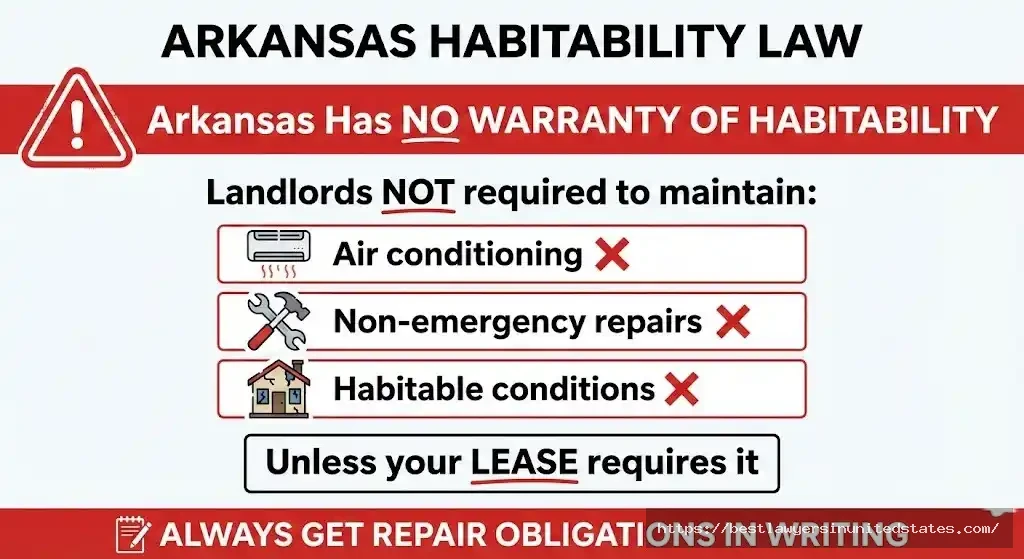
This is Arkansas’s most significant tenant rights weakness. Unlike most states, Arkansas law does not require landlords to provide habitable housing. Your landlord’s repair and maintenance obligations come entirely from your lease, not from state statute.
Why Arkansas Is Different
Most states impose an “implied warranty of habitability” requiring landlords to maintain properties meeting basic health and safety standards. This includes working plumbing, heating, electricity, weatherproofing, and structural soundness.
Arkansas is one of only a handful of states without this protection. If your lease doesn’t require your landlord to make repairs, you have limited legal recourse for maintenance problems. This places Arkansas tenants at a severe disadvantage compared to renters in Alabama or other states with stronger protections.
What this means for you:
- Landlords aren’t required to fix non-emergency issues unless lease requires it
- You generally cannot withhold rent for repair issues
- You cannot force landlords to make improvements
- Repair and deduct options exist only if your lease allows it
Air Conditioning in Arkansas Rentals
Quick Answer: Arkansas law does not require landlords to provide or maintain air conditioning, even during extreme summer heat. If your AC breaks, your landlord must repair it only if your lease requires working air conditioning.
This frequently searched issue surprises many Arkansas renters. Despite summer temperatures regularly exceeding 95°F, Arkansas has no legal requirement for air conditioning in rental units. If your lease doesn’t mention AC, your landlord has no obligation to install or repair it.
Key rules:
- If AC existed and worked when you moved in AND your lease mentions it, landlord must maintain it
- If lease is silent about AC, landlord has no repair obligation even if unit has AC
- Landlords can remove AC units without violating Arkansas law if lease doesn’t guarantee it
- Window units you install yourself remain your property
Practical tip: Before signing a lease, ensure it specifically states that functional air conditioning is included and will be maintained. Get this in writing. Given Arkansas summers and Arkansas minimum wage rates limiting tenant resources, AC is essential for health and safety.
Repair Request Process in Arkansas
Since Arkansas lacks habitability requirements, repairs follow lease terms rather than statutory procedures:
Step 1: Review your lease Check what repairs your landlord agreed to make. Most leases require landlords to maintain plumbing, heating, electrical, and structural elements.
Step 2: Written repair request Send written notice describing the problem. Email creates a paper trail. Include photos if possible. State the specific lease provision requiring the repair.
Step 3: Reasonable time to repair Arkansas law doesn’t specify repair timelines. “Reasonable time” depends on the problem’s severity. Emergency repairs (burst pipes, no heat in winter) require immediate response. Non-emergency issues might take weeks.
Step 4: Limited tenant remedies If your landlord won’t make repairs required by your lease:
Option A – Repair and deduct: Some Arkansas leases allow you to hire a contractor and deduct costs from rent. This is NOT a legal right under Arkansas law, only available if your lease permits it.
Option B – Lease termination: If conditions violate your lease to the point the unit is uninhabitable under your lease terms, you may be able to terminate early. Consult an attorney first.
Option C – Sue for breach of lease: You can sue your landlord for failing to provide conditions promised in the lease. Small claims court handles disputes under $5,000.
Option D (RISKY) – Withholding rent: Arkansas law doesn’t authorize rent withholding for repairs. Doing so gives your landlord grounds to evict you for non-payment. Only withhold rent with attorney guidance.
Landlord Entry Laws in Arkansas
Quick Answer: Arkansas landlords must provide “reasonable notice” before entering rental units for non-emergency purposes, typically interpreted as 24-48 hours. Landlords can enter immediately without notice in emergencies.
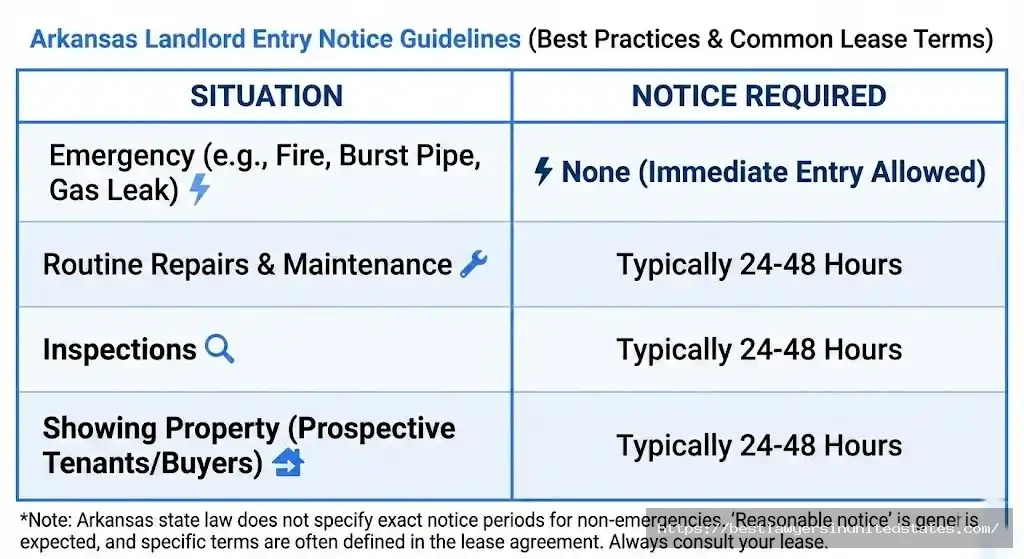
Arkansas law (Ark. Code Ann. § 18-16-112) requires landlords to give reasonable notice before entering your rental unit. The law doesn’t define “reasonable,” but courts generally consider 24-48 hours adequate except in emergencies.
When Landlords Can Enter
Arkansas landlords can enter your rental unit for specific reasons:
| Situation | Notice Required | Details |
|---|---|---|
| Emergency repairs | None | Gas leak, burst pipe, fire, serious safety hazard |
| Routine repairs | 24-48 hours | Scheduled maintenance, appliance repair |
| Property inspection | 24-48 hours | Annual or periodic inspection per lease |
| Show to prospective tenants/buyers | 24-48 hours | During your notice period |
| Suspected lease violation | 24-48 hours | Must have reasonable suspicion |
What Is “Reasonable Notice”?
Arkansas statute doesn’t specify exact hours or days for entry notice. Court decisions and common practice suggest 24-48 hours written notice meets the “reasonable” standard for non-emergency entry.
Reasonable notice includes:
- Specific date and time of entry
- Reason for entry
- Approximate duration
- Delivered in writing (text, email, or paper notice)
- During normal business hours (typically 8 AM – 6 PM)
Your landlord cannot enter repeatedly or at unreasonable times even with proper notice. Excessive entries or nighttime entries may constitute harassment.
Emergency Entry Without Notice
Arkansas law allows immediate entry without notice for genuine emergencies. “Emergency” means situations threatening property damage, tenant safety, or public health.
True emergencies:
- Gas leaks or strong gas odors
- Burst pipes or major water leaks
- Fire or smoke
- Broken windows during storms
- Serious electrical problems
- Security threats
Not emergencies:
- Routine repairs (even if urgent)
- Inspections
- Showing unit to prospective renters
- Suspected lease violations
If your landlord enters claiming an emergency without a genuine safety threat, they may have violated your privacy rights. Document the entry and consult a tenant rights attorney.
Your Rights When Landlord Enters
You can be present during landlord entry. Request to be home during scheduled entries. If you cannot be present, your landlord must respect your property and privacy.
During entry, landlords must:
- Limit access to areas necessary for the stated purpose
- Not search through personal belongings
- Not bring unnecessary people (one repair person is appropriate, five people is not)
- Lock the unit upon leaving
- Not disturb your quiet enjoyment
If your landlord violates entry rules repeatedly, document each incident with dates, times, and purposes. Excessive unannounced entries may constitute harassment or violate your right to quiet enjoyment.
Fair Housing and Discrimination Protections
Quick Answer: The Fair Housing Act protects Arkansas tenants from discrimination based on race, color, national origin, religion, sex, familial status, or disability. Arkansas provides limited additional state-level protections.
Federal fair housing law applies to virtually all Arkansas rental housing. Landlords cannot refuse to rent, set different terms, or harass tenants based on protected characteristics.
Protected Classes Under Federal Law
The Fair Housing Act (42 U.S.C. § 3601 et seq.) prohibits housing discrimination based on:
- Race or color: Cannot refuse to rent, charge different rent, or provide different services based on race
- National origin: Includes immigration status, accent, or ethnicity
- Religion: Cannot refuse to rent to particular faiths or impose different rules
- Sex: Includes gender, sexual orientation, gender identity, and sexual harassment
- Familial status: Cannot discriminate against families with children under 18 or pregnant women
- Disability: Must provide reasonable accommodations and allow modifications
What Constitutes Illegal Discrimination?
Discrimination takes many forms beyond obvious refusal to rent:
Advertising: “Adults only,” “no children,” “perfect for singles,” or “Christian community” violate fair housing law. Ads must not suggest preferences for protected classes.
Application screening: Requiring different income levels, credit scores, or background checks for different groups is illegal.
Lease terms: Charging families higher security deposits or restricting children to certain units violates fair housing law.
Maintenance: Providing slower or lower-quality repairs to tenants in protected classes.
Harassment: Unwelcome sexual advances, racial slurs, or hostile environment based on protected characteristics.
Retaliation: Evicting or penalizing tenants who complain about discrimination.
Disability Accommodations and Modifications
Arkansas landlords must provide reasonable accommodations for disabled tenants under both the Fair Housing Act and Americans with Disabilities Act.
Reasonable accommodations change rules or policies to provide equal housing access:
- Allowing service animals despite no-pet policies
- Assigning accessible parking spaces
- Providing communication in alternative formats for hearing/vision impaired tenants
- Waiving “adults only” rules for caregivers
Reasonable modifications permit physical changes to units:
- Installing grab bars in bathrooms
- Widening doorways for wheelchair access
- Lowering countertops or cabinets
- Adding ramps at entrances
Landlords can require you to pay for modifications and restore the unit when you move out, unless the modifications don’t interfere with future tenants’ use (like grab bars).
Emotional Support Animals in Arkansas
Quick Answer: Arkansas landlords must allow emotional support animals (ESAs) as a reasonable accommodation for disability even in no-pet buildings. ESAs are NOT pets under fair housing law.
Emotional support animals differ from service animals. ESAs don’t require specialized training but must alleviate symptoms of a disability. Your landlord cannot charge pet deposits or pet rent for ESAs.
To request an ESA accommodation:
- Submit written request to landlord
- Provide documentation from healthcare provider stating you have a disability and the ESA helps alleviate symptoms
- Landlord must respond to reasonable accommodation requests promptly
Landlords can deny ESA requests only if:
- The animal poses a direct threat to safety
- The animal would cause substantial property damage
- Accommodation would create undue financial burden
Service animals (typically dogs trained to perform specific tasks for disabilities) have broader rights than ESAs and can enter public spaces where ESAs cannot.
Arkansas Fair Housing Enforcement
File housing discrimination complaints with:
Arkansas Fair Housing Commission
- Handles state-level complaints
- Investigates discrimination allegations
- Can impose penalties on violating landlords
U.S. Department of Housing and Urban Development (HUD)
- Federal fair housing enforcement
- Accepts complaints online at HUD.gov
- Investigates within 100 days
- Can refer cases to Department of Justice for prosecution
Private lawsuit
- File in federal or state court within 2 years of discrimination
- Can seek damages, attorney fees, and injunctive relief
- Consult a housing discrimination attorney
Lease Agreements in Arkansas
Arkansas law requires few specific lease terms, giving landlords significant flexibility in lease provisions. However, certain requirements and prohibitions apply to all Arkansas residential leases.
Required Lease Terms
Arkansas doesn’t mandate many specific lease provisions, but certain terms must be clear:
Basic requirements:
- Names of all parties (landlord and all adult tenants)
- Property address and description
- Rent amount and due date
- Lease term (start and end dates)
- Security deposit amount
Verbal leases are legally enforceable in Arkansas for terms under one year. However, written leases protect both parties by documenting agreed terms. Always insist on written leases.
Prohibited Lease Terms
Arkansas law (Ark. Code Ann. § 18-16-112) prohibits certain lease provisions:
Illegal lease terms:
- Waiving your right to proper eviction notice
- Waiving landlord liability for negligence or property damage from landlord’s actions
- Allowing landlord to confiscate your property without court order
- Permitting landlord to enter without any notice except emergencies
- Waiving your right to court hearing for eviction
- Requiring you to pay landlord’s attorney fees in all disputes (you can agree to mutual attorney fee provisions)
These provisions are void even if you sign a lease containing them. Courts will not enforce illegal lease terms.
Lease Renewal and Termination
Fixed-term leases (typically 6-12 months) end automatically on the termination date. Neither party must provide notice unless the lease requires it. If you stay beyond the end date and your landlord accepts rent, Arkansas law creates a month-to-month tenancy with the same terms.
Month-to-month leases require 30 days’ written notice from either party to terminate. The notice must specify a termination date at least 30 days away. For example, notice given on January 5 can terminate the lease no earlier than February 5.
Week-to-week leases require only 7 days’ written notice to terminate.
Early Lease Termination
Arkansas law provides few protections for tenants who need to break leases early. Unless your lease includes specific early termination provisions, you remain liable for rent through the end of the lease term.
Limited exceptions:
- Active military deployment (Servicemembers Civil Relief Act)
- Landlord’s material breach of lease
- Unit becomes uninhabitable due to landlord’s neglect
- Domestic violence (Arkansas law allows early termination with protective order)
- Landlord agreement to release you from lease
Arkansas has no general “landlord duty to mitigate” statute requiring landlords to find replacement tenants when you break a lease. However, some Arkansas courts have recognized a common law duty to make reasonable efforts to re-rent. Consult an attorney before breaking your lease.
Rent Laws in Arkansas
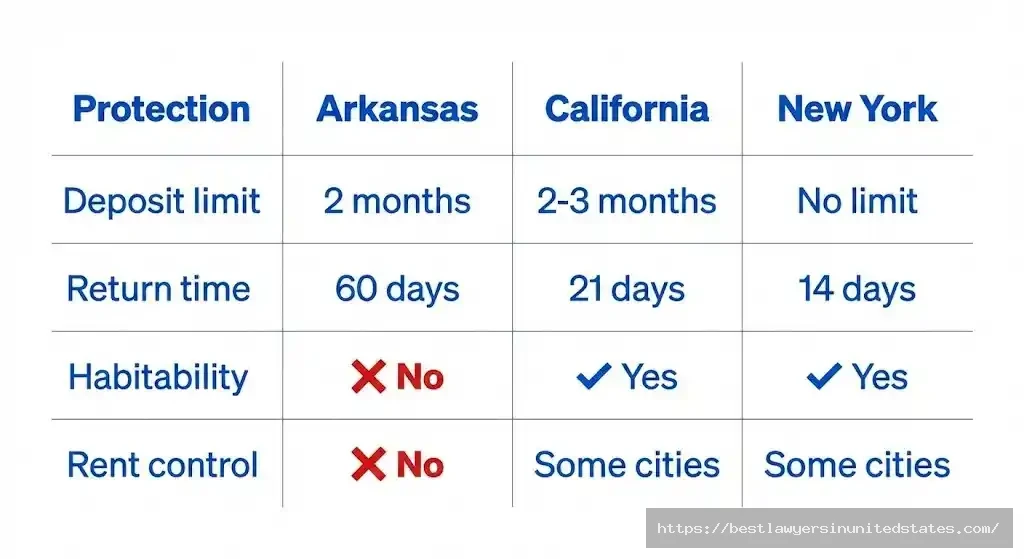
Quick Answer: Arkansas has no rent control, no mandatory grace period for late rent, and no notice requirements for rent increases on month-to-month leases. Rent increase timing and late fee amounts are governed by your lease.
Arkansas gives landlords broad control over rent amounts and increases. Understanding these rules helps you avoid surprise rent hikes and excessive late fees.
Rent Increases in Arkansas
Arkansas prohibits all local rent control ordinances. No Arkansas city or county can limit rent increases or require just cause for rent hikes. Landlords set rents based purely on market conditions.
For month-to-month leases: Landlords can raise rent by any amount at any time with proper notice. Arkansas doesn’t specify required notice periods for rent increases. Most courts require “reasonable notice,” typically 30 days, matching the lease termination notice requirement.
For fixed-term leases: Landlords cannot raise rent during the lease term unless your lease specifically allows mid-term increases. Most fixed-term leases prohibit rent changes until renewal.
No limits on increase amounts: Arkansas imposes no cap on rent increase percentages. Your landlord can double your rent if they choose, as long as they provide proper notice for month-to-month leases or wait until lease renewal for fixed-term leases.
| Lease Type | When Rent Can Increase | Notice Required |
|---|---|---|
| Month-to-month | Anytime | 30 days (typically) |
| Fixed-term (6-12 months) | At renewal only | No notice required* |
| Week-to-week | Anytime | 7 days (typically) |
*Unless lease requires renewal notice
Late Fees and Grace Periods
Quick Answer: Arkansas has no mandatory grace period for late rent. Landlords can charge late fees starting the day after rent is due if your lease allows it.
Unlike some states, Arkansas doesn’t require a grace period before late fees apply. If your rent is due on the first and you pay on the second, your landlord can charge late fees immediately if your lease permits.
Late fee requirements:
- Must be stated in your lease
- Must be “reasonable” (Arkansas law doesn’t define this)
- Cannot be charged retroactively if not in original lease
- Can accumulate (daily late fees are legal if specified in lease)
Courts generally consider late fees reasonable if they don’t exceed 5-10% of monthly rent. A $50 late fee on $800 rent (6.25%) would likely be considered reasonable. A $200 late fee (25%) might be found excessive.
Grace periods: Many Arkansas leases provide 3-5 day grace periods as a business practice, not because law requires it. Check your lease for specific grace period provisions. If your lease is silent, no grace period exists.
Rent Withholding Risks
Quick Answer: Arkansas law does NOT allow rent withholding for repairs or habitability issues. Withholding rent gives your landlord grounds to evict you for non-payment regardless of property conditions.
Some states permit tenants to withhold rent when landlords fail to make necessary repairs. Arkansas is not one of them. The absence of warranty of habitability means you cannot withhold rent for repair issues except in very limited circumstances where your lease specifically authorizes it.
Risks of withholding rent:
- Landlord can serve 10-day notice to pay or quit
- Eviction proceedings begin if you don’t pay within 10 days
- Eviction judgment on your record
- Difficulty renting in the future
- Liability for landlord’s attorney fees and court costs
Safer alternatives:
- Document repair issues thoroughly with photos and written complaints
- Request repairs in writing per lease terms
- Contact local housing code enforcement if health/safety violations exist
- Sue for breach of lease if landlord fails to provide conditions promised in lease
- Consider “repair and deduct” only if your lease explicitly allows it
Never withhold rent without consulting an Arkansas tenant rights attorney first.
Special Tenant Situations
Arkansas law provides specific protections for tenants in certain situations, though these protections are often narrower than in other states.
Domestic Violence Protections
Arkansas law (Ark. Code Ann. § 18-16-112) allows victims of domestic violence to terminate leases early under specific conditions:
Requirements to break lease:
- Obtain a protective order or order of protection against the abuser
- Abuser is not also on the lease
- Provide landlord with copy of protective order
- Give at least 30 days’ written notice of intent to terminate
- Vacate within 30 days of notice
Landlord cannot:
- Charge early termination fees beyond rent owed for notice period
- Sue for remaining lease term after you vacate
- Report the early termination negatively on tenant screening reports
Confidentiality: Landlords must keep protective orders and domestic violence information confidential. They cannot disclose this information to other tenants or prospective landlords.
Military Service Members (SCRA)
The Servicemembers Civil Relief Act provides federal protections for active duty military members:
Lease termination rights:
- Can terminate lease if receiving permanent change of station (PCS) orders
- Can terminate if deploying for 90+ days
- Must provide landlord with written notice and copy of orders
- Lease terminates 30 days after next rent payment date
Rent protections:
- Rent cannot exceed $4,201.50/month (2026 rate) for service members who entered lease before active duty
- Landlord must reduce rent to statutory maximum upon request with proof of active duty
Eviction protections:
- Court can stay eviction proceedings during deployment
- Reduced rental obligations during military service
Mobile Home Tenants
Arkansas Mobile Home Communities Act provides additional protections beyond the standard Landlord-Tenant Act:
Mobile home-specific rights:
- Written lease required for lot rentals
- 30-day notice required for rent increases
- Cannot evict without court order
- Protection from discriminatory eviction
- Right to sell mobile home while keeping lot lease
Mobile home lot rentals differ from standard apartment leases. If you rent a mobile home lot, consult the Mobile Home Communities Act (Ark. Code Ann. § 18-16-301 et seq.) for specific rights.
Tenant Remedies and Legal Resources
When landlords violate Arkansas law or lease terms, tenants have several remedies available.
Small Claims Court
Arkansas small claims court (formally “Small Claims Division of Circuit Court”) handles disputes up to $5,000 without requiring attorneys.
Filing process:
- File complaint at circuit court clerk’s office
- Pay filing fee (approximately $65-$85 depending on county)
- Serve defendant (landlord) with summons
- Attend hearing (typically 30-45 days after filing)
- Present evidence (photos, receipts, lease, communications)
- Judge issues ruling same day or within days
Common tenant claims:
- Security deposit wrongfully withheld
- Repairs landlord agreed to make but didn’t
- Illegal eviction attempts
- Landlord failure to provide services specified in lease
- Return of overpaid rent or fees
What to bring:
- Lease agreement
- Photos of property conditions
- Receipts for rent payments
- Written communications with landlord
- Estimates or receipts for repairs
- Witness testimony if available
Small claims court doesn’t allow attorneys to represent parties, though you can consult an attorney before filing. Represent yourself clearly and stick to facts.
Legal Assistance Organizations
Several Arkansas organizations provide free or low-cost legal help to qualifying tenants:
Center for Arkansas Legal Services
- Statewide legal aid for low-income residents
- Handles housing disputes, evictions, and discrimination
- Income limits apply (typically 125% of federal poverty level)
- Multiple offices across Arkansas
Arkansas Legal Services Partnership
- Free legal assistance for qualifying low-income Arkansans
- Represents tenants in eviction defense
- Helps with security deposit disputes
University of Arkansas Law School Clinics
- Law students supervised by attorneys provide free representation
- Limited case capacity
Local bar association lawyer referral services
- Connect you with private attorneys
- Some offer reduced-fee initial consultations
- Arkansas Bar Association: (501) 375-4606
Filing Government Complaints
Arkansas Fair Housing Commission
- Handles discrimination complaints
- Investigates violations
- Can impose penalties
U.S. Department of Housing and Urban Development (HUD)
- Federal fair housing enforcement
- File complaints at HUD.gov/fairhousing
- Toll-free: 1-800-669-9777
Local code enforcement
- Report health and safety violations
- Building code violations
- Housing standards violations
- Contact your city or county code enforcement office
Arkansas Attorney General Consumer Protection Division
- Handles deceptive trade practices
- Investigates consumer fraud
- Cannot resolve individual landlord-tenant disputes but tracks patterns
Document everything before filing complaints. Evidence includes photos, written communications, lease agreements, and repair records.
FAQs: Arkansas Tenant Rights
Can a Landlord Evict You Without a Court Order in Arkansas?
Quick Answer: No. Arkansas law requires court process (unlawful detainer) for all evictions. Self-help evictions like lockouts, utility shutoffs, or removing belongings are illegal.
Even if you owe months of rent or violated your lease, your landlord must file court papers and obtain a judge’s order before removing you. Landlords who change locks, shut off utilities, or remove your property without a court order violate Arkansas law and you can sue for damages.
How Much Notice Does a Landlord Have to Give a Tenant to Move Out in Arkansas?
Quick Answer: Arkansas requires 10 days’ notice for non-payment of rent, 3 days’ notice for lease violations, and 30 days’ notice to terminate month-to-month leases.
The notice period depends on the termination reason. Non-payment evictions require 10 days to pay rent or vacate. Lease violation evictions need 3 days to cure or quit. Month-to-month lease terminations require 30 days’ notice with no reason needed.
Can I Withhold Rent if My Landlord Won’t Make Repairs in Arkansas?
Quick Answer: No. Arkansas law does not authorize rent withholding for repairs. Withholding rent gives your landlord grounds to evict you for non-payment.
Arkansas lacks a warranty of habitability statute, meaning rent withholding for repairs is illegal and risky. Your landlord can serve a 10-day pay or quit notice if you withhold rent, leading to eviction. Repair and deduct options exist only if explicitly stated in your lease.
Is Arkansas a Tenant-Friendly State?
Quick Answer: No. Arkansas ranks as one of the least tenant-friendly states due to weak protections, no rent control, no warranty of habitability, and rapid eviction procedures.
Arkansas strongly favors landlords over tenants compared to states with robust tenant protections. The lack of habitability requirements, rent control prohibition, and limited retaliation protections place Arkansas tenants at a significant disadvantage.
How Long Does It Take to Evict a Tenant in Arkansas?
Quick Answer: Typically 30-45 days from initial notice to sheriff removal, depending on notice type and court schedule.
The eviction timeline includes the notice period (3-30 days depending on reason), court filing and hearing (7-14 days), and sheriff enforcement (5-10 days after judgment). Use our Arkansas eviction timeline calculator to estimate your specific timeline.
What Is the Maximum Security Deposit in Arkansas?
Quick Answer: Two months’ rent. Arkansas law caps security deposits at twice the monthly rent regardless of unit type.
For a rental with $1,000 monthly rent, the maximum legal deposit is $2,000. This includes pet deposits and any other refundable fees. Calculate your specific deposit rights with our Arkansas security deposit calculator.
Do Landlords Have to Pay Interest on Security Deposits in Arkansas?
Quick Answer: No. Arkansas law does not require landlords to pay interest on security deposits.
Your landlord can hold your security deposit in a regular checking account without paying you any interest, even if they hold it for years. Many other states require interest payments or segregated deposit accounts, but Arkansas imposes no such requirement.
Can a Landlord Enter Without Permission in Arkansas?
Quick Answer: For emergencies, yes. For non-emergencies, landlords must provide reasonable notice, typically 24-48 hours.
Arkansas law requires “reasonable notice” before non-emergency entry. Courts interpret this as 24-48 hours’ written notice. Landlords can enter immediately without notice for genuine emergencies like gas leaks, burst pipes, or fires.
When Does a Guest Become a Tenant in Arkansas?
Quick Answer: Arkansas law doesn’t specify an exact timeline. Courts consider guests who stay 14-30+ days and contribute to rent as tenants with legal protections.
Common law factors determine tenant status: length of stay, payment toward rent, receiving mail, exclusive access to space, and landlord knowledge. Most leases limit guest stays to 7-14 consecutive days. Review your lease guest policy carefully.
Can I Sue My Landlord in Arkansas?
Quick Answer: Yes, in small claims court for disputes under $5,000 or circuit court for larger claims. Common lawsuits include security deposit disputes, illegal evictions, and discrimination.
Arkansas small claims court provides accessible justice for most tenant-landlord disputes. File at your local circuit court clerk’s office with filing fee around $65-$85. Bring your lease, evidence, and documentation. For disputes over $5,000 or complex legal issues, consult an attorney.
Does Arkansas Have Rent Control?
Quick Answer: No. Arkansas prohibits all state and local rent control laws. Landlords can charge any rent amount the market will bear.
Arkansas statute preempts local rent control ordinances. No Arkansas city or county can limit rent increases, establish rent caps, or require just cause for rent hikes. This differs from states like California and New York where some cities impose rent control.
Are Emotional Support Animals Allowed in Arkansas Rentals?
Quick Answer: Yes, under Fair Housing Act. Landlords must provide reasonable accommodation for ESAs even in no-pet buildings. Landlords cannot charge pet deposits or pet rent for legitimate ESAs.
Emotional support animals are not pets under federal law. You need documentation from a healthcare provider stating you have a disability and the ESA alleviates symptoms. Landlords can deny requests only if the animal poses safety threats or would cause substantial property damage.
How Far Behind on Rent Before Eviction in Arkansas?
Quick Answer: Arkansas landlords can begin eviction as soon as rent is one day late by serving a 10-day pay or quit notice.
Arkansas has no mandatory grace period. If rent is due January 1 and you don’t pay, your landlord can serve eviction notice January 2. Some leases provide grace periods (commonly 3-5 days), but this is a contract term, not a legal requirement.
What Are Red Flags in a Lease Agreement?
Quick Answer: Illegal provisions waiving your rights to notice, judicial process, or holding landlord harmless for negligence. Also watch for excessive fees, vague terms, and automatic renewal clauses.
Illegal lease terms include waiving eviction notice rights, permitting entry without any notice, waiving landlord liability for negligence, or allowing landlord to confiscate property. These provisions are void even if you sign. Also beware vague fee provisions, automatic renewal without notice requirements, and terms allowing rent increases during fixed lease terms.
How Do I Calculate If My Landlord Owes Me My Security Deposit?
Use our Arkansas security deposit calculator to determine if your landlord owes you a refund. Enter your deposit amount, move-out date, and any claimed deductions. The calculator applies Arkansas’s 60-day return requirement and evaluates deduction legality under state law.
Arkansas vs. Other States: How Tenant Rights Compare
Arkansas provides significantly weaker tenant protections than most U.S. states. Understanding these differences helps Arkansas renters recognize their limited rights.
| Protection | Arkansas | Alabama | Alaska | California | New York |
|---|---|---|---|---|---|
| Security Deposit Limit | 2 months’ rent | 1 month rent (unfurnished) | 2 months’ rent | 2-3 months’ rent | No limit |
| Deposit Return Timeline | 60 days | 60 days | 14-30 days | 21 days | 14 days |
| Warranty of Habitability | ❌ No | ✅ Yes | ✅ Yes | ✅ Yes | ✅ Yes |
| Rent Control Allowed | ❌ No | ❌ No | ❌ No | ✅ Some cities | ✅ Some cities |
| Retaliation Protection | Limited (6 months) | Yes | Yes | Strong | Strong |
| Just-Cause Eviction | ❌ No | ❌ No | ❌ No | Some cities | Some cities |
| Notice for Entry | Reasonable | 24 hours | 24 hours | 24 hours | Reasonable |
Key differences:
Arkansas’s lack of warranty of habitability is its most significant weakness. Tenants in states with this protection can demand repairs and potentially withhold rent for serious maintenance failures. Arkansas tenants have no such power.
Arkansas’s prohibition on rent control means landlords can raise rents without limit. While many states also lack rent control, some allow local jurisdictions to establish rent stabilization programs. Arkansas preempts all local control.
The 60-day security deposit return timeline is longer than high-protection states like California (21 days) or New York (14 days), though comparable to Alabama’s 60-day requirement.
Arkansas does provide basic anti-retaliation protections for 6 months after tenant complaints, placing it ahead of states with no retaliation statute but behind states with stronger protections.
Conclusion
Arkansas tenant rights are limited compared to most states. The Arkansas Residential Landlord-Tenant Act of 2007 establishes baseline protections but lacks critical tenant safeguards like warranty of habitability, rent control, and just-cause eviction requirements.
Key takeaways for Arkansas tenants:
Know your notice requirements. Arkansas requires 10 days for non-payment evictions, 3 days for violations, and 30 days for month-to-month terminations. Understanding these timelines helps you respond appropriately to eviction notices.
Your lease is critical. Without statutory habitability protections, your lease determines your landlord’s repair obligations. Ensure your lease specifies maintenance responsibilities before signing.
Use our calculators. The security deposit calculator, eviction timeline calculator, and notice period calculator help you understand your exact rights under Arkansas law.
Document everything. Take photos at move-in and move-out. Save all written communications with your landlord. Keep rent payment receipts. This evidence proves your case if disputes arise.
Seek legal help when needed. For complex evictions, discrimination claims, or security deposit disputes over $500, consult an Arkansas tenant rights attorney. Free legal aid is available for qualifying low-income tenants through organizations like Center for Arkansas Legal Services.
Arkansas may be landlord-friendly, but knowing your limited rights helps you protect yourself within the existing legal framework.
Related Tools and Resources
Interactive Calculators:
- Arkansas Security Deposit Calculator
- Arkansas Eviction Timeline Calculator
- Arkansas Notice Period Calculator
Arkansas Legal Resources:
Compare Arkansas to Other States:
Legal Help: Free consultation: [email protected]