
What Are Tenant Rights in Colorado?
Colorado tenant rights protect renters from illegal evictions, unfair security deposit deductions, and uninhabitable living conditions. The state’s landlord-tenant laws, found in Colorado Revised Statutes Title 38, Article 12, give tenants the right to a safe home, proper notice before eviction, and timely return of security deposits.
In 2026, Colorado tenants have stronger protections than ever before. New laws passed in 2025 expanded security deposit protections, reformed rental application screening, and added safeguards for domestic violence survivors. Unlike states with rent control, Colorado prohibits cities from capping rent increases. However, the state requires landlords to offer mediation before filing eviction and gives tenants specific timelines to challenge illegal actions.
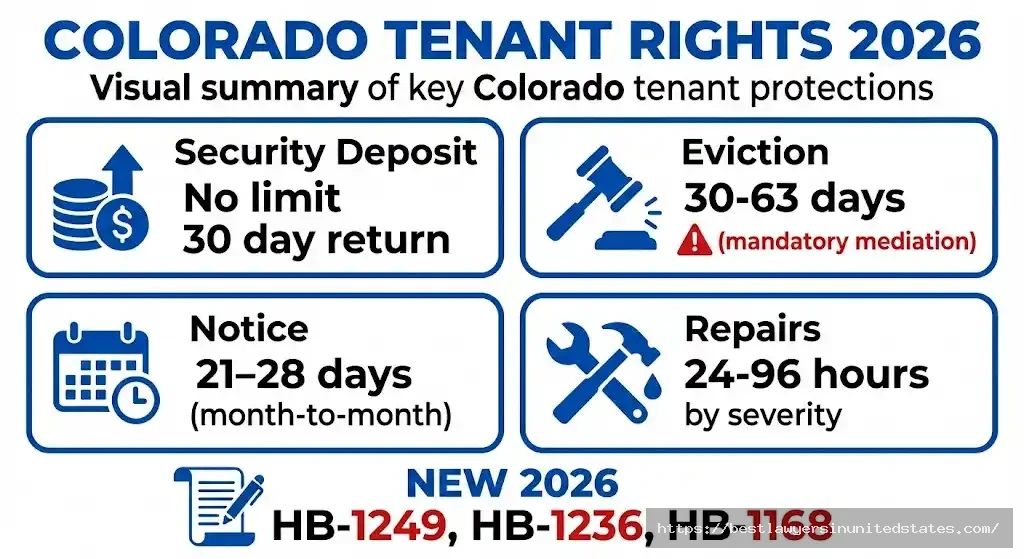
This guide covers everything Colorado renters need to know about their rights, from understanding security deposit return deadlines to navigating the eviction process. We’ve included three free calculators to help you determine your exact rights based on Colorado law.
Key Colorado tenant protections include:
- No state limit on security deposit amounts
- One-month deadline for deposit returns
- Mandatory mediation offer before eviction
- 24-96 hour repair timelines for habitability issues
- Protection from retaliation and discrimination
- Right to break lease for domestic violence or military duty
How Colorado Compares to Other States
Colorado’s tenant laws fall somewhere between landlord-friendly and tenant-friendly states. The state has no security deposit limit, which differs from California’s strict two-month cap for unfurnished units. However, Colorado’s one-month return deadline is faster than many states. The state also requires landlords to offer mediation before eviction, which provides more protection than Arizona’s streamlined eviction process.
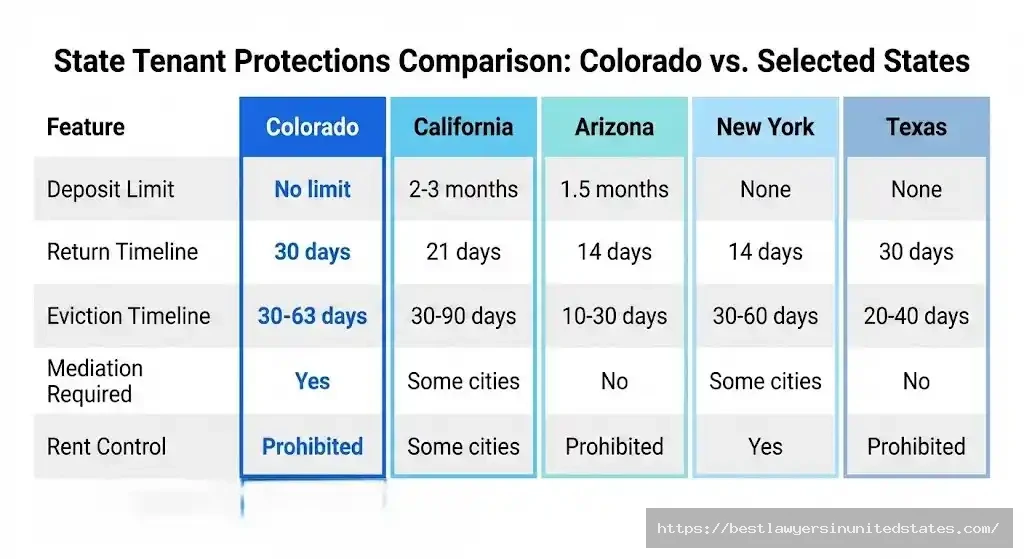
Cities like Denver and Boulder have added local protections beyond state law. Boulder requires rental licensing and has specific water utility billing rules. Denver runs tenant rights programs and anti-displacement initiatives. Colorado Springs enforces city-specific protections for renters.
2025-2026 Colorado Tenant Law Changes
Colorado passed six major tenant protection laws in 2025 that took effect between May 2025 and January 2026. These laws strengthen security deposit protections, reform rental screening, and expand rights for vulnerable tenants. Landlords who fail to comply with these new requirements face penalties including forfeiture of deposits and civil lawsuits.
HB-1249: Enhanced Security Deposit Protections (Effective January 1, 2026)
HB-1249 strengthens how landlords must handle security deposits in Colorado. The law requires more detailed itemization of deductions and faster timelines for certain deposit returns. Landlords must now provide receipts for any repair costs over $50, down from the previous threshold. The law also doubles penalties for landlords who wrongfully withhold deposits.
Key changes under HB-1249:
- Receipts required for repairs over $50 (previously no requirement)
- Itemized statements must include specific room locations for damage
- Landlords cannot deduct for “general wear” without detailed explanation
- Penalties increased to three times the deposit amount for willful violations
- Tenants can request deposit return via electronic transfer
HB-1236: Rental Application Screening Reforms (Effective January 1, 2026)
HB-1236 limits what landlords can consider during tenant screening. The law restricts use of criminal records, credit history, and eviction records when evaluating rental applications. Landlords must now provide specific reasons for application denials and allow applicants to dispute inaccurate information.
Application screening changes:
- Criminal records over 7 years old cannot be considered
- Evictions filed but not completed cannot count against applicants
- Medical debt cannot be used in credit evaluations
- Landlords must accept alternate income verification (not just pay stubs)
- Application fees capped at actual screening costs
Other 2025-2026 Tenant Protection Laws
HB-1240: Housing Subsidy Protections (Effective May 29, 2025) Landlords cannot refuse to rent to tenants using housing vouchers or subsidies. The law prohibits “source of income” discrimination and requires landlords to accept Section 8 and other government rental assistance.
HB-1168: Domestic Violence Survivor Protections (Effective August 6, 2025) Tenants experiencing domestic violence can break leases early without penalty. They must provide documentation such as a protection order or police report. Landlords cannot disclose the tenant’s new address to the abuser.
HB-1108: Death-Related Lease Provisions (Effective September 1, 2025) Landlords cannot include lease clauses that automatically terminate upon a tenant’s death. Estate representatives now have 30 days to remove belongings and terminate the lease properly.
SB-020: Tenant Law Enforcement This law strengthens enforcement of existing tenant protections. It allows tenants to file complaints with the Colorado Division of Housing and increases penalties for repeat violator landlords.
Colorado Security Deposit Laws
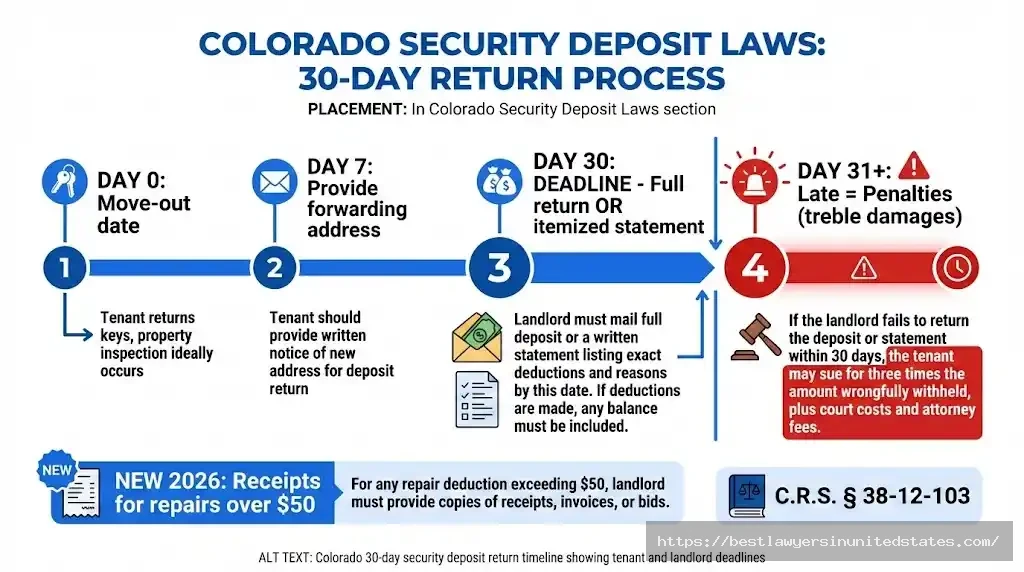
Colorado has no state-imposed limit on security deposit amounts. Landlords can charge any amount they choose, though market competition typically keeps deposits around one to two months’ rent. Once a tenant moves out, landlords have exactly one month to return the deposit or provide a detailed explanation of deductions under C.R.S. § 38-12-103.
What Is the Security Deposit Limit in Colorado?
Colorado law does not cap security deposit amounts. Landlords set their own limits based on property type, tenant qualifications, and market conditions. Most landlords in Colorado charge between one and two months’ rent for unfurnished units. Furnished units, properties allowing pets, or rentals to tenants with lower credit scores often require higher deposits.
Common Colorado security deposit amounts:
| Property Type | Typical Deposit | Example (Monthly Rent: $1,800) |
|---|---|---|
| Unfurnished apartment | 1-1.5 months’ rent | $1,800-$2,700 |
| Furnished apartment | 1.5-2 months’ rent | $2,700-$3,600 |
| Single-family home | 1-2 months’ rent | $1,800-$3,600 |
| With pets | Additional $200-$500 | $2,000-$4,100 |
Some landlords also charge separate pet deposits or fees. Colorado law treats pet deposits the same as security deposits, meaning they must be returned within one month if not used for pet damage.
How Long Does My Landlord Have to Return My Deposit?
Colorado landlords must return security deposits within one month (30 days) after the tenant moves out. This deadline applies regardless of lease type or rental amount. If the landlord withholds any portion of the deposit, they must provide an itemized statement explaining each deduction within the same 30-day period under C.R.S. § 38-12-103.
Colorado security deposit return requirements:
| Requirement | Timeline | Details |
|---|---|---|
| Full return OR itemized statement | 30 days | From move-out date |
| Receipts for repairs over $50 | With statement | Required under HB-1249 (2026) |
| Interest payment (if applicable) | With deposit | Only for leases over 12 months |
| Mailing address | Within 7 days | Tenant must provide forwarding address |
Landlords who miss the 30-day deadline may forfeit their right to make any deductions. Tenants can then demand the full deposit amount plus penalties. The new HB-1249 law allows tenants to request electronic deposit returns instead of waiting for mailed checks.
What Can Landlords Deduct From Security Deposits?
Colorado landlords can deduct from security deposits only for specific costs beyond normal wear and tear. Allowed deductions include unpaid rent, cleaning costs to restore the unit to move-in condition, repairs for tenant-caused damage, and unpaid utilities if the lease requires tenant payment.
Allowed security deposit deductions in Colorado:
- ✅ Unpaid rent (monthly rent plus late fees in lease)
- ✅ Cleaning costs beyond normal wear
- ✅ Repairs for damage caused by tenant or guests
- ✅ Unpaid utilities (if specified in lease)
- ✅ Cost to replace lost keys or remotes
NOT allowed – normal wear and tear:
- ❌ Carpet cleaning after normal use
- ❌ Repainting walls after several years
- ❌ Minor nail holes from hanging pictures
- ❌ Faded paint or worn flooring from age
- ❌ Cleaning already-clean units
Under the new HB-1249 law effective January 2026, landlords must provide receipts for any repair costs over $50. They must also specify exact room locations for damage in the itemized statement. Vague descriptions like “general wear throughout” no longer meet legal requirements.
How to File a 7-Day Demand Letter in Colorado
If your landlord wrongfully withholds your security deposit, Colorado law gives you a powerful tool: the 7-day demand letter under C.R.S. § 38-12-103. This letter demands return of the deposit within seven days or the landlord owes you treble damages (three times the wrongfully withheld amount).
Steps to file a 7-day demand letter:
- Wait 30 days – Give your landlord the full legal deadline first
- Send written demand – Mail via certified mail with return receipt
- Include specific amount – State exact deposit amount owed
- Wait 7 days – Landlord has one week to pay or face penalties
- File small claims – If unpaid, sue for three times the deposit amount
Sample 7-day demand letter format:
[Your name and address]
[Date]

[Landlord name and address]

Re: 7-Day Demand for Security Deposit - [Property address]

Dear [Landlord name],

I moved out of [address] on [date]. More than 30 days have passed, but I have not received my $[amount] security deposit or any itemized statement of deductions as required by C.R.S. § 38-12-103.

This letter serves as my 7-day demand for return of my full security deposit. If you do not return $[amount] within 7 days of receiving this letter, I will file suit in small claims court for three times this amount plus court costs and attorney fees as allowed by Colorado law.

Sincerely,
[Your signature]
[Your name]
Many landlords return deposits quickly after receiving a 7-day demand letter. The threat of treble damages makes it financially risky to continue withholding deposits without legal justification.
Calculate Your Security Deposit Rights in Colorado
Moving out soon? Use our free calculator to determine if your landlord owes you a security deposit refund and by what deadline. This calculator uses Colorado’s specific security deposit laws including return timelines, allowable deductions, and penalty calculations.
🏠 Security Deposit Calculator
All 50 States + DC
Calculate max legal deposits, return deadlines, and penalties for violations.
📋 Enter Your Information
Special Conditions (if applicable)
✓ Results for
Based on current state law. Always verify with local regulations.
Link: https://bestlawyersinunitedstates.com/tenant-rights/security-deposit-calculator/
Calculator features:
- Colorado-specific deposit limits and timelines
- Deduction legality checker
- Penalty calculation for late returns (treble damages under C.R.S. § 38-12-103)
- Itemized deduction analyzer
- Next steps if your rights are violated
Need help recovering your deposit? Contact Colorado tenant rights attorneys for free consultation.
Questions about your tenant rights or need legal help?
[Find Tenant Rights Lawyers in Colorado – Free Consultation]
Email: [email protected]
Colorado Eviction Process: 8-Step Timeline
Colorado has a structured eviction process that typically takes 30 to 60 days from initial notice to sheriff lockout. Unlike some states, Colorado requires landlords to offer mediation before filing court paperwork. This gives tenants a chance to resolve disputes without going to court. The process follows C.R.S. § 13-40-101 et seq.
What Are Legal Grounds for Eviction in Colorado?
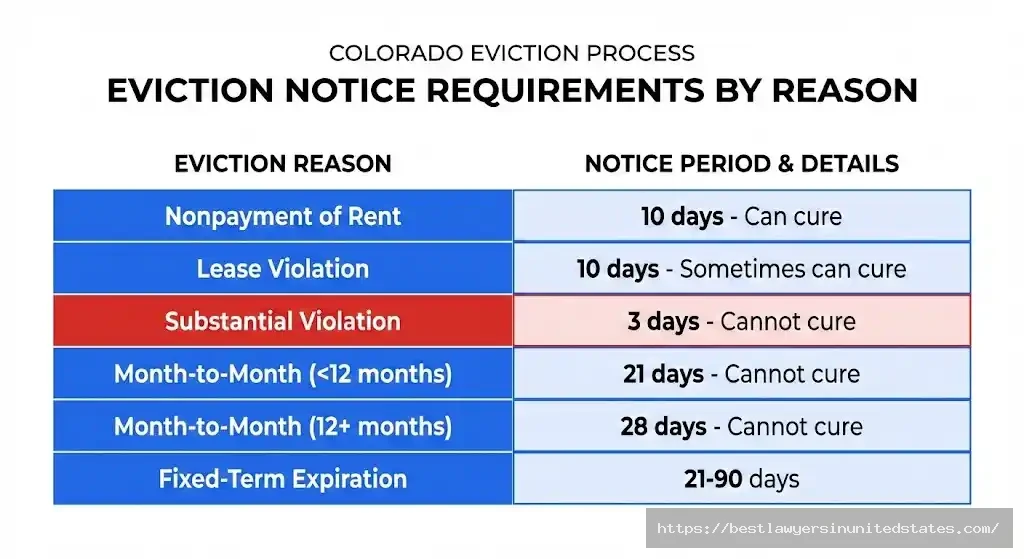
Colorado landlords can evict tenants only for specific legal reasons. The most common grounds are nonpayment of rent, lease violations, and lease expiration. Each eviction reason requires different notice periods and procedures.
Legal eviction grounds in Colorado:
| Eviction Reason | Notice Period | Can Tenant Cure? | Details |
|---|---|---|---|
| Nonpayment of rent | 10 days | Yes | Tenant can pay full amount owed |
| Lease violation | 10 days | Sometimes | Depends on violation type |
| Substantial violation | 3 days | No | Illegal activity, violence, major damage |
| Lease expiration | Varies | No | 21+ days if under 12 months tenancy |
| No-fault (month-to-month) | 21-28 days | No | Based on tenancy length |
Substantial violations that allow 3-day notice include illegal drug activity, gang-related activity, violent threats, or major property damage. For these serious violations, tenants cannot fix the problem to avoid eviction.
Colorado’s 8-Step Eviction Timeline Explained
The Colorado eviction process involves eight distinct stages from initial notice to final removal by sheriff. Each stage has specific deadlines and requirements. Missing a deadline can extend the timeline or restart the process.
Step 1: Landlord Serves Notice to Quit (Day 1-10)
The landlord must serve proper written notice based on the eviction reason. For nonpayment of rent, tenants get 10 days to pay or vacate. For lease violations, tenants get 10 days to fix the problem or move out. For month-to-month tenancies, notice periods range from 21 to 28 days based on how long the tenant has lived there.
Step 2: Mandatory Mediation Offer (Before Court Filing)
Before filing eviction paperwork with the court, Colorado law requires landlords to offer mediation. The landlord must send a written mediation offer along with the eviction notice or within a reasonable time after. Tenants can accept or decline mediation. If accepted, both parties meet with a neutral mediator to try resolving the dispute.
Step 3: Court Summons Filed (After Notice Expires)
If the tenant doesn’t move out and doesn’t accept mediation, the landlord can file a Forcible Entry and Detainer (FED) lawsuit. The court issues a summons requiring the tenant to respond within 7 days. Filing fees typically range from $85 to $165 depending on the county.
Step 4: Tenant Answer Filed (Within 7 Days)
Tenants must file a written answer with the court within 7 days of receiving the summons. The answer should state defenses such as landlord retaliation, improper notice, or violation of warranty of habitability. Filing fees for tenants range from $0 to $50 based on income.
Step 5: Court Hearing Scheduled (10-14 Days from Filing)
The court schedules a hearing within 10 to 14 days after the landlord files. Both parties appear before a judge. Hearings typically last 15 to 30 minutes. Tenants should bring all evidence including photos, communications, receipts, and the lease agreement.
Step 6: Judge Issues Judgment (Same Day or Within 1 Week)
The judge decides whether the landlord can evict the tenant. If the landlord wins, the judge issues a judgment for possession. Tenants usually have 48 hours to vacate after judgment. The judge may also award back rent, late fees, and court costs to the landlord.
Step 7: Writ of Restitution Issued (If Tenant Doesn’t Leave)
If the tenant doesn’t move out within 48 hours of the judgment, the landlord requests a Writ of Restitution from the court. This writ authorizes the sheriff to physically remove the tenant. The court typically issues the writ within 1 to 3 days.
Step 8: Sheriff Lockout (Final Removal)
The sheriff posts a notice on the door giving the tenant 48 hours to vacate. If the tenant still doesn’t leave, the sheriff returns and physically removes the tenant and their belongings. The landlord can then change the locks and regain possession.
Colorado eviction timeline summary:
| Stage | Timeline | Cumulative Days |
|---|---|---|
| Notice to Quit | 10-28 days | Days 1-28 |
| Mediation Offer | Varies | Days 15-30 |
| Court Filing | Immediate | Day 28-30 |
| Tenant Response | 7 days | Day 35-37 |
| Court Hearing | 10-14 days | Day 45-51 |
| Judgment | 0-7 days | Day 45-58 |
| Writ of Restitution | 1-3 days | Day 46-61 |
| Sheriff Lockout | 2 days | Day 48-63 |
| TOTAL PROCESS | 30-63 days | Minimum to maximum |
Actual timelines vary based on court schedules, whether the tenant contests the eviction, and local procedures. Denver and Boulder courts often have longer wait times than rural counties.
Tenant Defenses Against Eviction
Colorado tenants can fight eviction by raising legal defenses in court. Common defenses include improper notice, retaliation, discrimination, and breach of warranty of habitability. Tenants must file their defenses in the written answer within 7 days of receiving the summons.
Valid eviction defenses in Colorado:
- ⚖️ Improper notice – Landlord didn’t follow required notice procedures
- 🛡️ Retaliation – Eviction follows tenant complaint about repairs or violations
- ⚖️ Discrimination – Eviction based on protected class (race, disability, etc.)
- 🏚️ Uninhabitable conditions – Landlord failed to maintain habitable unit
- 📋 Landlord breach – Landlord violated lease terms first
- 💰 Rent already paid – Tenant has proof of payment
If you raise retaliation as a defense, you must show that the eviction came shortly after you exercised a legal right. Examples include complaining about needed repairs, reporting code violations, or joining a tenant organization. Colorado law presumes retaliation if eviction follows within 60 days of these protected activities.
Calculate Your Eviction Timeline in Colorado
Facing eviction? Know exactly how long the process takes and your rights at each stage. Our calculator provides a detailed timeline based on Colorado’s eviction laws, including notice periods, court timelines, and appeal windows.
⏱️ Eviction Timeline Calculator
All 50 States + DC
Get step-by-step breakdown of eviction process, notice requirements, and your legal rights.
📋 Enter Your Situation
Enter the date you received the eviction notice to see projected dates
📅 Eviction Timeline for
Estimated timeline for
📍 Step-by-Step Timeline
Link: https://bestlawyersinunitedstates.com/tenant-rights/eviction-timeline-calculator/
Calculator features:
- Stage-by-stage eviction timeline for Colorado
- State-specific notice requirements (10 days for nonpayment, 21-28 days for no-fault)
- Court filing to sheriff lockout dates
- Tenant defense deadlines (7-day answer requirement)
- Appeal window calculations
- Mediation offer timeline
Facing illegal eviction? Get immediate legal help from Colorado tenant rights lawyers.
Questions about your tenant rights or need legal help?
[Find Tenant Rights Lawyers in Colorado – Free Consultation]
Email: [email protected]
Notice Requirements in Colorado
Colorado law requires specific notice periods before landlords can terminate leases, enter rental units, or increase rent. Notice requirements vary based on lease type and tenancy length. Proper notice must be in writing and delivered according to legal procedures.
How Much Notice Must Landlords Give Tenants to Move Out?
Notice requirements depend on the type of lease and how long the tenant has lived in the unit. For month-to-month leases, landlords must provide more notice to longer-term tenants. Fixed-term leases typically require notice 21 to 90 days before expiration if the landlord doesn’t want to renew.
Colorado notice to vacate requirements:
| Lease Type | Tenancy Length | Landlord Notice | Tenant Notice |
|---|---|---|---|
| Month-to-Month | Less than 12 months | 21 days | 21 days |
| Month-to-Month | 12+ months | 28 days | 28 days |
| Fixed-Term | Any length | 21-90 days before end | Per lease terms |
| Week-to-Week | Any length | 3 days | 3 days |
For month-to-month leases, the 2021 law HB 21-1121 increased minimum notice periods. Before 2021, landlords could terminate month-to-month tenancies with just 10 days’ notice. Now tenants with less than one year of residency get 21 days. Tenants who have lived in the unit for 12 months or more get 28 days’ notice.
Notice must be in writing and delivered by one of these methods:
- Personal delivery to the tenant
- Certified mail with return receipt
- Regular mail plus email or text
- Posting on the door if tenant can’t be reached
Notice periods start the day after delivery. If a landlord mails notice on January 1, the 21-day period starts January 2 and ends January 22.
When Can Landlords Enter Rental Units in Colorado?
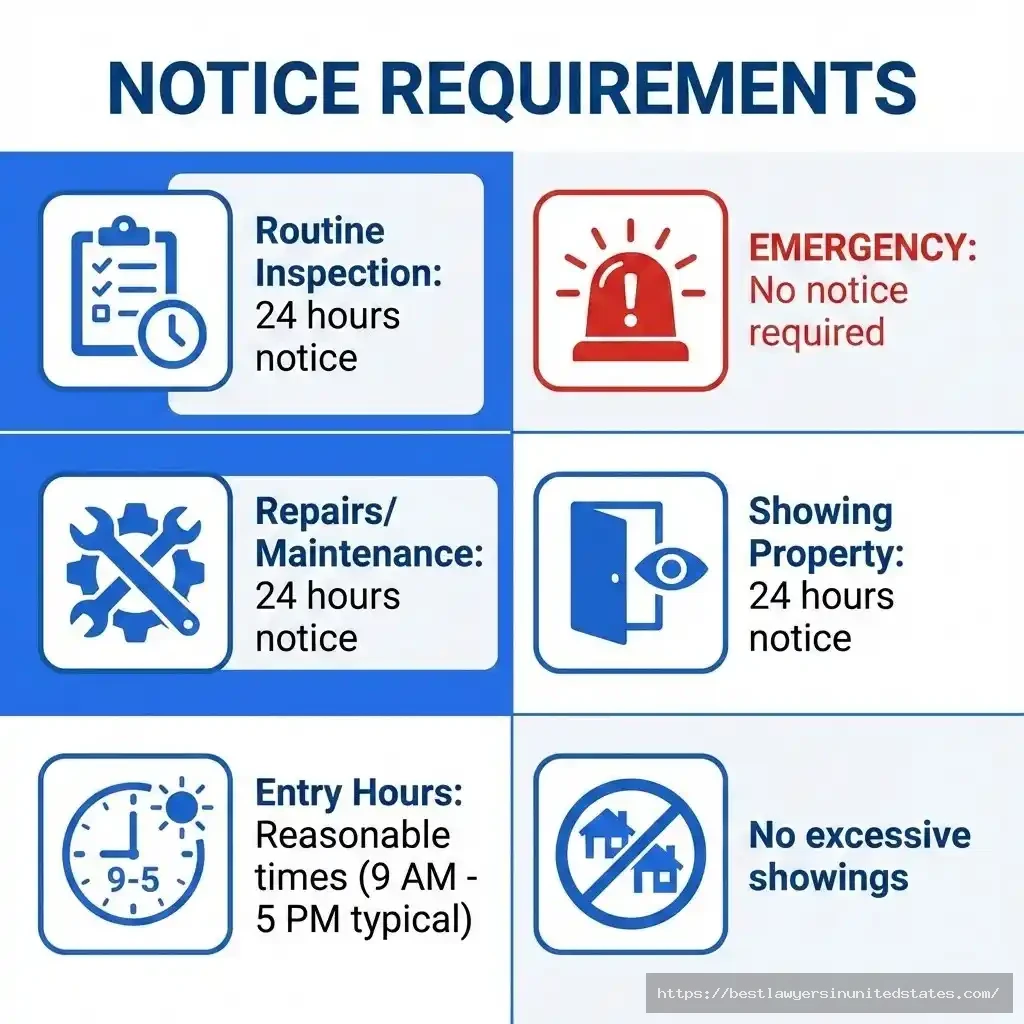
Colorado law requires landlords to give tenants reasonable notice before entering rental units. While Colorado statutes don’t specify exact notice periods, courts generally consider 24 hours’ notice reasonable for non-emergency situations. Some leases require more notice, and those lease terms override the general rule.
Landlord entry rules in Colorado:
| Situation | Notice Required | Time of Entry | Details |
|---|---|---|---|
| Routine inspection | 24 hours | 9 AM – 5 PM | Reasonable hours only |
| Repairs/maintenance | 24 hours | Reasonable hours | Or per lease terms |
| Emergency | None | Any time | Health/safety threats |
| Showing to buyers/renters | 24 hours | Reasonable hours | Cannot be excessive |
Emergencies that allow immediate entry without notice include:
- Fire or gas leak
- Burst pipes or flooding
- Break-in or security threat
- Medical emergency involving tenant
- Carbon monoxide alarm
For routine inspections and showings, landlords cannot enter so frequently that it violates the tenant’s right to quiet enjoyment. Most courts consider more than one showing per week excessive unless the tenant agrees.
Do Landlords Need to Give Notice for Rent Increases?
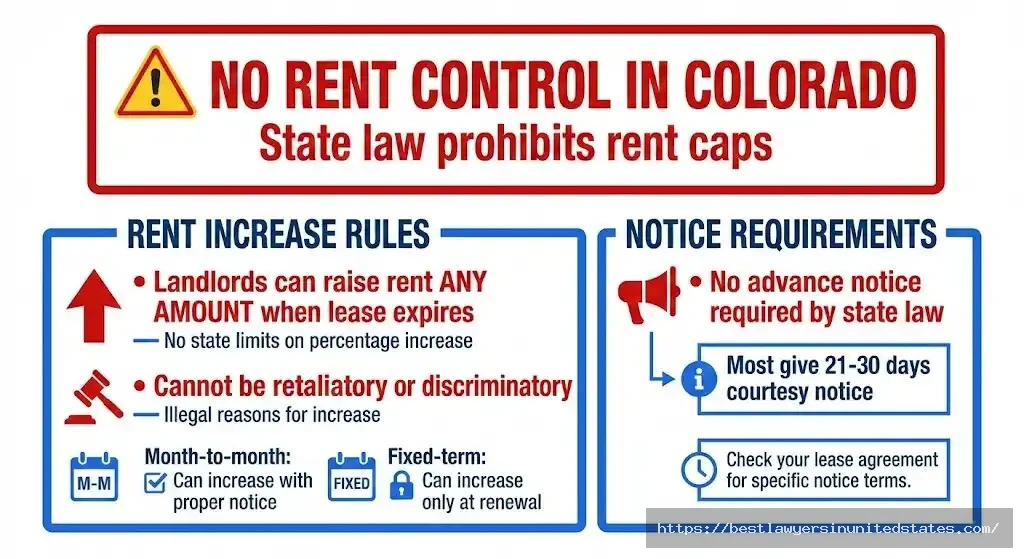
Colorado has no state law requiring landlords to give advance notice before raising rent. However, landlords can only increase rent when a lease expires or with the tenant’s written agreement. For month-to-month leases, landlords typically give 21 to 30 days’ notice as a courtesy, even though not legally required.
Many leases include specific rent increase notice requirements. These contractual terms override the lack of state law. If your lease says the landlord must give 30 days’ notice for rent increases, that requirement is enforceable.
Colorado prohibits rent control at the state level. Cities and counties cannot cap rent increase amounts or frequencies. This means landlords can raise rent by any percentage when a lease expires or renews. However, the increase cannot be retaliatory or discriminatory.
Calculate Notice Periods in Colorado
Need to move out or wondering how much notice your landlord must give? Our calculator determines the exact notice period required based on your lease type and Colorado law, including notice to vacate, lease termination, and landlord entry notice requirements.
📬 Notice Period Calculator
All 50 States + DC
Find required notice periods for lease termination, rent increases, and landlord entry.
📋 Select Your Situation
What type of notice do you need? *
Select your role first
To calculate when notice must be given
Some states require longer notice for longer tenancies
✓ Notice Requirements for
📊 All Notice Periods for
| Notice Type | Tenant | Landlord |
|---|
Link: https://bestlawyersinunitedstates.com/tenant-rights/notice-period-calculator/
Calculator features:
- Notice requirements by lease type (month-to-month, fixed-term, week-to-week)
- Move-out notice deadlines based on tenancy length
- Landlord entry notice rules (24-hour standard)
- Rent increase notice periods
- Lease termination timelines
- Proper notice delivery methods
Questions about your lease? Speak with Colorado housing attorneys today.
Questions about your tenant rights or need legal help?
[Find Tenant Rights Lawyers in Colorado – Free Consultation]
Email: [email protected]
Warranty of Habitability in Colorado
Colorado law requires all residential rental units to meet basic habitability standards under C.R.S. § 38-12-503. This warranty of habitability means landlords must provide safe, sanitary housing with working utilities, weatherproofing, and freedom from health hazards. Tenants cannot waive these rights, even if the lease includes a waiver clause.
What Makes a Rental Unit Uninhabitable in Colorado?
A unit becomes uninhabitable when conditions threaten tenant health or safety. Colorado law lists specific conditions presumed uninhabitable, including lack of heat, water, or electricity. Other problems like severe mold, pest infestations, or structural damage may also violate habitability standards.
Conditions presumed uninhabitable under Colorado law:
- 🌡️ No heat or heating system in disrepair (winter months)
- 💧 No running water or water system breakdown
- ⚡ No electricity or dangerous electrical hazards
- 🚽 Non-functional toilet or sewage backup
- 🏚️ Structural hazards (collapsed ceiling, broken stairs)
- 🪟 Broken windows or doors that don’t lock
- 🦠 Severe mold or pest infestation
- ❄️ Inadequate cooling when temperatures exceed 90°F
- 🔥 No working smoke or carbon monoxide detectors
- ⛽ Natural gas leaks or CO hazards
Colorado added cooling device requirements in recent years. When outdoor temperatures exceed 90°F, landlords must provide functional cooling devices in common areas or units. This doesn’t always mean air conditioning, but could include fans and ventilation that lower indoor temperatures.
How Fast Must Landlords Fix Habitability Problems?
Colorado law sets specific response timelines for landlords to repair habitability issues. The severity of the problem determines the deadline. Life-threatening issues require immediate response, while less serious problems allow more time.
Colorado landlord repair timelines:
| Problem Type | Response Deadline | Examples |
|---|---|---|
| No heat or hot water | 24 hours | Furnace broken in winter |
| No water | 48 hours | Water main break, no service |
| Other habitability issues | 96 hours (4 days) | Broken toilet, leaking roof |
| Non-habitability repairs | Reasonable time | Cosmetic damage, minor issues |
The clock starts when the tenant notifies the landlord in writing. Tenants should document all repair requests with dates, times, and methods of communication. Photos and videos of the problem strengthen the tenant’s position if legal action becomes necessary.
If the landlord doesn’t respond within the required timeframe, tenants have several legal remedies. These include repair-and-deduct (paying for repairs and subtracting from rent), rent withholding, breaking the lease without penalty, or suing for damages.
Tenant Remedies for Uninhabitable Conditions
When landlords fail to maintain habitable units, Colorado tenants can take several legal actions. The appropriate remedy depends on the severity of the problem and how long the landlord has ignored it.
Colorado tenant remedies for habitability violations:
| Remedy | How It Works | Requirements |
|---|---|---|
| Repair and Deduct | Tenant pays for repair, deducts from rent | Cannot exceed 1 month’s rent or $300 |
| Rent Withholding | Tenant stops paying rent | Must deposit rent with court |
| Lease Termination | Tenant moves out without penalty | Provide written notice of violation |
| Sue for Damages | Tenant files lawsuit | Can recover actual damages + costs |
| Temporary Housing | Tenant stays elsewhere, landlord pays | For severe uninhabitability only |
Repair and deduct allows tenants to hire contractors for necessary repairs, then deduct the cost from next month’s rent. Colorado limits this remedy to $300 or one month’s rent, whichever is greater. The repair must be necessary to restore habitability, not just cosmetic improvements.
Before withholding rent, tenants should check if their situation qualifies. Courts often rule against tenants who withhold rent without following proper procedures. Safer options include depositing rent payments with the court while the dispute resolves.
Warning about withholding rent: Never simply stop paying rent without legal advice. Landlords can evict for nonpayment even if the unit has problems. Instead, deposit rent with the court through a rent deposit proceeding or consult a tenant rights attorney.
Retaliation Is Illegal in Colorado
Colorado law prohibits landlords from retaliating against tenants who exercise their legal rights. Retaliation includes eviction, rent increases, service reductions, or harassment following a tenant’s protected activity. If retaliation occurs within 60 days of the protected action, Colorado law presumes the landlord acted illegally.
Protected tenant activities that trigger retaliation protection:
- Complaining about needed repairs or code violations
- Reporting landlord to housing authorities
- Joining or organizing a tenant union
- Testifying in court against the landlord
- Exercising rights under the lease or Colorado law
Tenants who face retaliation can defend against eviction, sue for damages, or terminate the lease without penalty. Courts may award actual damages, attorney fees, and court costs to tenants who prove retaliation.
Tenant Protections Against Discrimination and Retaliation
Colorado and federal law protect tenants from discrimination based on protected characteristics. Landlords cannot refuse to rent, set different terms, or harass tenants because of race, color, religion, national origin, sex, disability, familial status, sexual orientation, gender identity, or source of income.
What Are Protected Classes in Colorado?
Colorado’s fair housing law goes beyond federal protections. While the federal Fair Housing Act covers seven protected classes, Colorado adds protections for sexual orientation, gender identity, marital status, and source of income (including housing vouchers).
Protected classes under Colorado law:
- 👨👩👧👦 Race, color, national origin
- ✝️ Religion
- ♀️ Sex, sexual orientation, gender identity
- ♿ Disability (physical or mental)
- 👶 Familial status (children under 18)
- 💍 Marital status
- 💰 Source of income (vouchers, subsidies)
Source of income protection became especially important under HB-1240, effective May 2025. Landlords must now accept Section 8 vouchers and other government housing assistance. They cannot advertise “no Section 8” or refuse applications from voucher holders.
Reasonable Accommodations for Disabled Tenants
Tenants with disabilities can request reasonable accommodations to have equal access to housing. Common accommodations include allowing service animals despite no-pet policies, installing grab bars in bathrooms, or assigning accessible parking spaces.
Examples of reasonable accommodations:
- Emotional support animals in no-pet buildings
- Wheelchair ramps or wider doorways
- Accessible parking near entrance
- Visual alerts for deaf tenants (doorbells, fire alarms)
- Ground-floor units for mobility issues
Landlords must grant accommodation requests unless they create undue financial burden or fundamentally alter the property. The tenant typically pays for physical modifications, but the landlord cannot charge extra rent or fees for approved service animals or emotional support animals.
To request accommodation, tenants should:
- Submit written request describing the disability and needed accommodation
- Provide documentation from medical provider if disability not obvious
- Wait for response – landlord has reasonable time to approve or deny
- Negotiate alternatives if the first request is denied
Under federal and Colorado law, landlords cannot ask about the nature of the disability or demand detailed medical records. A letter from a healthcare provider confirming the disability and need for accommodation is usually sufficient.
Early Lease Termination for Domestic Violence
Colorado law allows domestic violence survivors to break leases without penalty under HB-1168, effective August 2025. Tenants must provide documentation such as a protection order, police report, or medical records showing abuse occurred within the past 60 days.
How to terminate a lease for domestic violence:
- Obtain documentation – Protection order, police report, medical records, or signed statement from qualified third party
- Provide 30 days’ written notice – Notice must include copy of documentation
- Pay rent through termination date – Tenant owes rent for 30 days from notice
- Move out by termination date – Lease ends on specified date
- Landlord cannot disclose new address – Privacy protections apply
The landlord cannot charge early termination fees or withhold security deposits for breaking the lease. However, the landlord can still deduct for damage or unpaid rent through the termination date. The tenant remains responsible for rent during the 30-day notice period.
Privacy protections prevent landlords from sharing the tenant’s new address with the abuser or including abuse-related information in rental references. These protections help survivors safely relocate without fear of the abuser finding them.
City-Specific Tenant Protections in Colorado
While Colorado state law sets baseline tenant protections, several cities have enacted stronger local ordinances. Denver, Boulder, and other municipalities offer additional rights beyond state requirements. Tenants should check their city’s housing code for local rules.
Denver Tenant Rights and Resources
Denver runs multiple tenant assistance programs through the Department of Housing Stability. The city provides free mediation services, emergency rental assistance, and education about tenant rights. Denver also enforces stricter code requirements than state law in some areas.
Denver-specific tenant programs:
- Free tenant-landlord mediation through the city
- Emergency rental assistance for rent/utilities
- Tenant rights hotline: 720-913-1311
- Anti-displacement protections in designated areas
- Code enforcement for habitability violations
Denver’s mediation program helps resolve disputes without court. Tenants and landlords can request free mediation for security deposit disputes, repair issues, or lease disagreements. The service is voluntary but often resolves problems faster than court proceedings.
Boulder Rental Licensing Requirements
Boulder requires landlords to obtain rental licenses for most residential properties. The licensing program ensures properties meet minimum safety and habitability standards. Unlicensed rentals face fines and may not evict tenants until they obtain proper licenses.
Boulder rental licensing rules:
- All rental properties need licenses (some exemptions)
- Annual inspections required for safety compliance
- Water utility billing restrictions for tenants
- Stricter occupancy limits than state law
- License information public record
Boulder’s occupancy limits restrict how many unrelated people can live in a rental unit. The rules vary by zone but generally limit occupancy more than state law. These restrictions face ongoing legal challenges from student groups and housing advocates.
Water utility billing in Boulder has special rules. Landlords cannot charge tenants more than the city charges for water service. If the landlord pays the city directly, they can bill tenants only for their proportional share based on occupancy or metering.
Colorado Springs Tenant Protections
Colorado Springs enforces city-specific housing codes and provides tenant assistance through the Housing and Community Vitality division. The city handles code complaints and offers resources for tenants facing housing instability.
Colorado Springs tenant resources:
- Housing code enforcement: 719-444-7891
- Pikes Peak Legal Aid for low-income tenants
- Rental assistance programs
- Fair housing complaint process
- City-specific building codes
Colorado Springs recently updated its rental housing code to require landlords to maintain minimum standards. The city can cite landlords for code violations and require repairs within specific timeframes.
Breaking Your Lease Early in Colorado
Colorado allows tenants to break leases without penalty only in specific circumstances. Legal reasons include military deployment, domestic violence, landlord harassment, or serious habitability violations. Breaking a lease for other reasons typically requires paying remaining rent or early termination fees.
Legal Reasons to Terminate a Lease Early
Colorado law permits lease termination without penalty for active military duty under the federal Servicemembers Civil Relief Act (SCRA). Service members who receive deployment or permanent change of station (PCS) orders can terminate leases with 30 days’ notice.
Colorado legal lease break reasons:
| Reason | Notice Required | Documentation Needed |
|---|---|---|
| Military deployment | 30 days | Copy of orders |
| Domestic violence | 30 days | Protection order or police report |
| Uninhabitable conditions | Reasonable notice | Photos, repair requests, evidence |
| Landlord harassment | Immediate to 30 days | Documentation of harassment |
| Senior or disabled care | 30 days | Proof of care facility admission |
For seniors moving into assisted living or nursing homes, Colorado law allows lease termination with 30 days’ notice. Tenants must provide documentation of admission to a licensed care facility.
What Happens If I Break My Lease Without Legal Reason?
Tenants who break leases without legal justification typically owe rent until the landlord finds a new tenant or the lease expires, whichever comes first. Colorado law requires landlords to make reasonable efforts to re-rent the unit and minimize tenant losses.
Potential costs of breaking a lease illegally:
- Remaining monthly rent payments through lease end
- Early termination fee (if in lease, usually 1-2 months’ rent)
- Advertising costs to find new tenant
- Lost rent during vacancy period
- Forfeiture of security deposit for unpaid rent
Colorado follows the duty to mitigate doctrine. Landlords must try to find replacement tenants quickly. They cannot let the unit sit vacant for months while charging the original tenant full rent. If the landlord successfully re-rents the unit, the original tenant’s obligation ends.
Some leases include buyout clauses that allow tenants to break leases for a set fee, typically one to two months’ rent. These clauses provide certainty about costs and avoid disputes over mitigation.
Tenant Resources and How to Get Help
Colorado offers multiple resources for tenants facing housing problems. Free legal aid, mediation services, and government agencies can help tenants understand their rights and resolve disputes.
Colorado Tenant Rights Hotline
Colorado Housing Connects: 1-844-926-6632
This statewide hotline provides information about tenant rights, landlord obligations, and housing resources. The service is free and available Monday through Friday, 9 AM to 5 PM. Staff can answer questions in multiple languages and help tenants file complaints.
Denver Tenant Rights Hotline: 720-913-1311
Denver residents can call this city-run hotline for information about local tenant protections and mediation services.
Free Legal Aid Organizations
Colorado Legal Services
- Serves low-income tenants statewide
- Website: https://www.coloradolegalservices.org
- Provides free legal advice and representation
- Handles eviction defense, habitability claims, discrimination
Brothers Redevelopment Tenant-Landlord Mediation
- Free mediation services in Denver metro area
- Website: https://www.brothersredevelopment.org
- Resolves disputes without court
- Success rate over 80%
Pikes Peak Legal Aid (Colorado Springs)
- Serves El Paso and Teller counties
- Phone: 719-471-0380
- Free legal help for qualifying tenants
- Eviction defense and housing law
Where to File Tenant Rights Complaints
Colorado Division of Housing
- Enforces fair housing laws
- Website: https://cdola.colorado.gov/housing-division
- Handles discrimination complaints
- Investigates landlord violations
Colorado Civil Rights Division
- Investigates housing discrimination
- Phone: 1-800-262-4845
- Enforces Colorado Anti-Discrimination Act
- Can order remedies and penalties
U.S. Department of Housing and Urban Development (HUD)
- Federal fair housing enforcement
- Phone: 1-800-669-9777
- Handles federal Fair Housing Act violations
- Regional office in Denver
For local code enforcement and habitability complaints, contact your city or county housing department. Most jurisdictions have inspectors who investigate tenant complaints and can cite landlords for violations.
Frequently Asked Questions About Colorado Tenant Rights
How long does my landlord have to return my security deposit in Colorado?
Quick Answer: Colorado landlords must return security deposits within 30 days of move-out, along with an itemized statement of any deductions under C.R.S. § 38-12-103.
If the landlord misses this deadline, they may forfeit the right to make any deductions. Under the new HB-1249 law effective January 2026, landlords must also provide receipts for any repair costs over $50.
What is the maximum security deposit in Colorado?
Quick Answer: Colorado has no state-imposed limit on security deposit amounts, unlike California’s two-month cap for unfurnished units.
Landlords can charge any deposit amount they choose, though market competition typically keeps deposits around one to two months’ rent. Some local ordinances may impose limits.
How long does the eviction process take in Colorado?
Quick Answer: The Colorado eviction process takes 30 to 63 days from initial notice to sheriff lockout, depending on the eviction reason and whether the tenant contests.
Nonpayment evictions move faster than lease violation evictions. The process includes a 10-day notice period, mandatory mediation offer, court filing, hearing, judgment, and sheriff enforcement. Use our eviction timeline calculator to determine your specific timeline.
How much notice does my landlord need to give me to move out in Colorado?
Quick Answer: For month-to-month leases, landlords must give 21 days’ notice if you’ve lived there under 12 months, or 28 days if you’ve been there 12 months or longer.
Fixed-term leases typically require 21 to 90 days’ notice before expiration if the landlord doesn’t want to renew. Check our notice period calculator for your exact requirements.
Can I withhold rent for repairs in Colorado?
Quick Answer: Colorado tenants can withhold rent for serious habitability violations, but must deposit rent payments with the court during the dispute.
Simply not paying rent can lead to eviction even if the unit has problems. Safer options include repair-and-deduct (up to $300 or one month’s rent) or suing the landlord for habitability violations.
How much notice does my landlord need to give before entering my rental?
Quick Answer: Colorado law requires landlords to give reasonable notice before entering rental units, which courts generally interpret as 24 hours for non-emergency situations.
Your lease may require more notice. Landlords can enter immediately without notice for emergencies like fires, gas leaks, or medical emergencies involving the tenant.
Can my landlord raise my rent in Colorado?
Quick Answer: Yes, Colorado landlords can raise rent by any amount when a lease expires or renews, as the state prohibits rent control.
For month-to-month leases, landlords typically give 21 to 30 days’ notice before rent increases, though Colorado law doesn’t require advance notice. Rent increases cannot be retaliatory or discriminatory.
What can I do if my landlord retaliates against me?
Quick Answer: Colorado law prohibits landlord retaliation for tenants exercising legal rights. If retaliation occurs within 60 days of a protected action, the law presumes the landlord acted illegally.
You can defend against eviction, sue for damages, or terminate your lease without penalty. Protected actions include complaining about repairs, reporting violations, or joining tenant organizations.
Can I break my lease for domestic violence in Colorado?
Quick Answer: Yes, under HB-1168 effective August 2025, domestic violence survivors can break leases with 30 days’ written notice and documentation such as a protection order or police report.
Landlords cannot charge early termination fees or disclose your new address to the abuser. You remain responsible for rent during the 30-day notice period.
How do I calculate if my landlord owes me my security deposit?
Quick Answer: Use our free security deposit calculator to determine if your Colorado landlord owes you a deposit refund.
The calculator uses Colorado’s 30-day return deadline, allowable deductions, and penalty calculations to show exactly what you’re owed. It also explains how to file a 7-day demand letter for wrongfully withheld deposits.
What is the warranty of habitability in Colorado?
Quick Answer: Colorado’s warranty of habitability (C.R.S. § 38-12-503) requires landlords to provide safe, sanitary housing with working utilities, heat, water, and freedom from health hazards.
Landlords must fix habitability problems within 24 to 96 hours depending on severity. Tenants can use repair-and-deduct, withhold rent through the court, or terminate leases for violations.
Can my landlord evict me without going to court?
Quick Answer: No, Colorado landlords cannot evict tenants without a court order. Self-help evictions like changing locks or removing belongings are illegal.
If your landlord locks you out without a court order, you can call police, sue for illegal eviction, and recover damages. Colorado requires an 8-step legal process including notice, court hearing, and sheriff enforcement.
Do I have to accept an assistance animal in my rental?
Quick Answer: Yes, landlords must allow service animals and emotional support animals as reasonable accommodations for tenants with disabilities, even in no-pet buildings.
Landlords cannot charge pet fees or deposits for assistance animals. However, tenants must provide documentation from a healthcare provider confirming the disability and need for the animal.
What happens to my lease if my landlord sells the property?
Quick Answer: Your lease remains valid when the property sells. The new owner must honor existing lease terms, return security deposits, and follow Colorado tenant protection laws.
The seller must transfer your security deposit to the new owner or return it to you. Your tenancy rights don’t change just because the property changes hands.
How do I report a landlord for violations in Colorado?
Quick Answer: Report landlord violations to the Colorado Division of Housing (1-303-864-7750) for discrimination or to your local code enforcement office for habitability issues.
For Denver residents, call the tenant rights hotline at 720-913-1311. Boulder residents can contact the rental licensing program. All Colorado tenants can file complaints with HUD at 1-800-669-9777.
Colorado Tenant Rights Summary
Colorado tenant rights protect renters through state statutes, local ordinances, and federal fair housing laws. The state requires landlords to return deposits within 30 days, offer mediation before eviction, and maintain habitable rental units. Recent legislation passed in 2025 strengthened protections around security deposits, rental screening, and domestic violence survivor rights.
Key Colorado tenant protections in 2026:
- Security deposits returned within 30 days with itemized deductions
- HB-1249 requires receipts for repairs over $50 starting January 2026
- Eviction process takes 30-63 days with mandatory mediation offer
- Notice periods of 21-28 days for month-to-month lease termination
- 24-96 hour repair timelines for habitability violations
- Protection from retaliation and discrimination
- Right to break leases for military duty, domestic violence, or serious habitability issues
Colorado falls between landlord-friendly and tenant-friendly states. The lack of security deposit limits and rent control favors landlords, while strong habitability protections and mandatory mediation help tenants. Cities like Denver and Boulder provide additional protections beyond state requirements.
Take action to protect your rights:
- Document everything in writing (repair requests, communications, photos)
- Use our three free calculators to understand your specific rights
- Know your deadlines (30 days for deposits, 7 days to answer eviction, 24 hours for landlord entry)
- Contact Colorado Legal Services or other free legal aid if you face violations
- File complaints with the Colorado Division of Housing or local code enforcement
Similar to California’s comprehensive tenant protections but without rent control, Colorado’s framework balances property owner rights with tenant protections. Understanding these rights helps you avoid illegal evictions, recover wrongfully withheld deposits, and maintain safe housing.
For questions about your specific situation, use our interactive calculators or contact a Colorado tenant rights attorney. Free consultations are available through Colorado Legal Services and other aid organizations listed in this guide.