
Delaware tenants have strong legal protections under Title 25 of the Delaware Code, Chapter 53. The state requires landlords to return security deposits within 20 days, give 60 days’ notice for month-to-month lease termination, and provide 48 hours’ notice before entering your rental unit. Delaware law also requires landlords to pay interest on security deposits held for more than one year.
This guide covers everything Delaware renters need to know in 2026, including security deposit limits, eviction timelines, notice requirements, and prohibited landlord actions. We’ve included three free calculators to help you understand your rights and timelines under Delaware law.
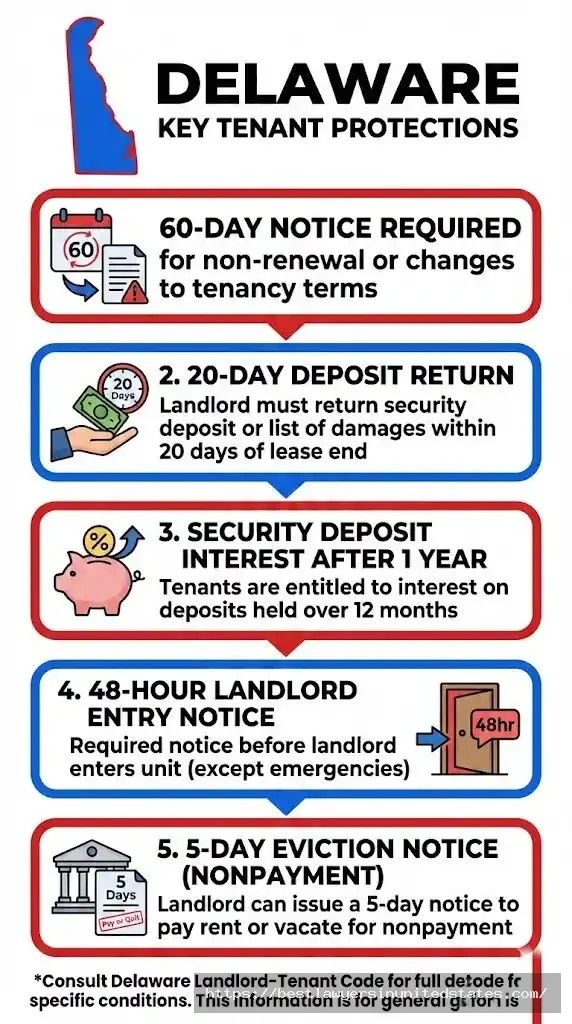
Delaware strikes a moderate balance between landlord and tenant protections. The state has no rent control laws, but offers tenant-friendly features like mandatory security deposit interest and lengthy notice periods that give renters time to plan.
Understanding the Delaware Landlord-Tenant Code (Title 25)
Title 25 of the Delaware Code, Chapter 53, governs all residential landlord-tenant relationships in the state. This law is called the Residential Landlord-Tenant Code and covers security deposits, evictions, repairs, lease agreements, and tenant rights.
The code applies to all rental housing in Delaware, including apartments, houses, mobile homes, and condominiums. Both landlords and tenants must follow these rules, and courts use this law to resolve disputes.
How to Access the Delaware Landlord-Tenant Code
You can read the full text of Delaware’s landlord-tenant law online at the Delaware General Assembly website. The law is organized into sections covering specific topics like security deposits (§5514), evictions (§5701-5718), and habitability (§5301-5308).
The Delaware State Housing Authority and Delaware Community Legal Aid Society also provide plain-language summaries of tenant rights. These resources help renters understand the law without reading dense legal text.
Delaware Security Deposit Laws (Complete Guide)
Delaware limits security deposits to one month’s rent for unfurnished units, plus an additional pet deposit if you have pets. Landlords must return your deposit within 20 days of move-out, along with an itemized statement of any deductions.
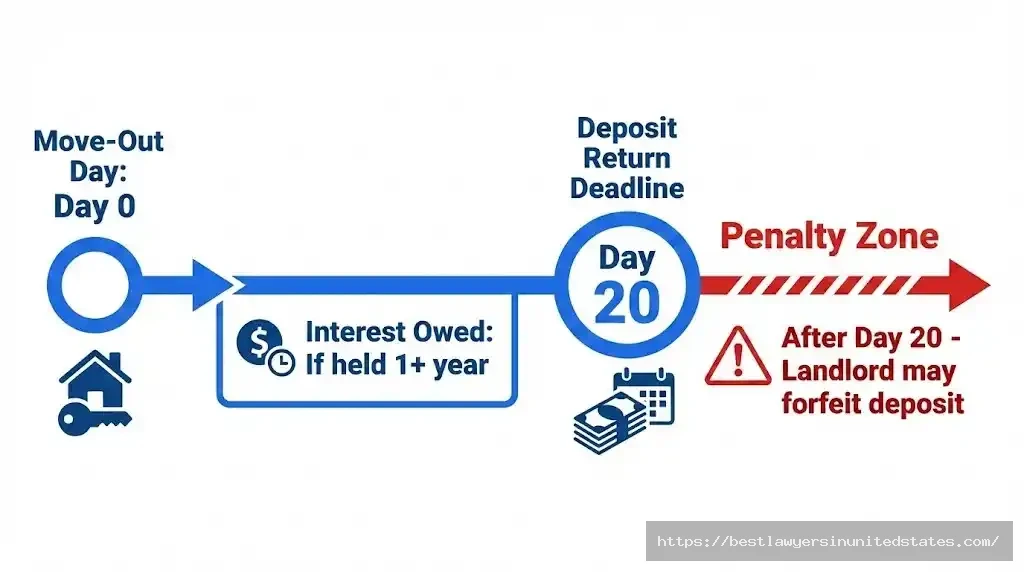
One unique feature of Delaware law is the requirement that landlords pay interest on security deposits held for more than one year. The interest rate equals the Federal Reserve discount rate and must be paid annually or when you move out.
What Is the Security Deposit Limit in Delaware?
Quick rule: Delaware landlords can charge up to one month’s rent as a security deposit for unfurnished units. Additional pet deposits are allowed for tenants with pets.
| Unit Type | Maximum Deposit | Example (Monthly Rent: $1,500) |
|---|---|---|
| Unfurnished | 1 month’s rent | $1,500 |
| Unfurnished + Pet | 1 month’s rent + pet deposit | $1,500 + pet deposit |
| Furnished | 1 month’s rent | $1,500 |
Some landlords may charge both a security deposit and a separate pet deposit. Delaware law does not set a specific limit on pet deposits, but they must be reasonable.
How Long Does My Landlord Have to Return My Deposit in Delaware?
Quick Answer: Delaware landlords must return security deposits within 20 days of move-out, along with an itemized statement showing any deductions.
If your landlord fails to return your deposit or provide an itemized statement within 20 days, they may forfeit the right to withhold any amount. You can sue for the full deposit amount plus court costs and attorney fees in Delaware Justice of the Peace Court.
Delaware law requires landlords to mail the deposit and statement to your last known address. Make sure to provide a forwarding address when you move out.
Do Delaware Landlords Pay Interest on Security Deposits?
Yes. Delaware requires landlords to pay interest on security deposits held for more than one year. The interest rate equals the Federal Reserve discount rate as of December 31st of each year.
Interest must be paid annually or when you move out, whichever comes first. This makes Delaware one of the few states requiring security deposit interest, similar to Connecticut’s tenant-friendly security deposit laws.
Example: You rent an apartment for $1,200/month with a $1,200 security deposit. After 18 months, your landlord owes you the deposit plus interest calculated at the Federal Reserve discount rate for the period held.
What Can Landlords Deduct From My Security Deposit?
Delaware landlords can only deduct from your security deposit for specific reasons allowed by law.
Allowed deductions:
- ✅ Unpaid rent
- ✅ Damage beyond normal wear and tear
- ✅ Cleaning costs to restore the unit
- ✅ Unpaid utility bills (if stated in lease)
- ✅ Costs to replace lost keys or remotes
NOT allowed:
- ❌ Normal wear and tear
- ❌ Routine carpet cleaning
- ❌ Repainting after normal use
- ❌ Minor scuffs or marks
- ❌ Repairs for pre-existing damage
Normal wear and tear includes faded paint, worn carpet from regular use, minor wall scuffs, and small nail holes from hanging pictures. Landlords cannot charge you for these conditions.
Can Delaware Landlords Use Surety Bonds Instead of Deposits?
Yes. Delaware law allows landlords to accept a surety bond instead of a cash security deposit. The bond must equal the amount of the required deposit.
Surety bonds work like insurance. You pay a premium (usually 17-25% of the bond amount annually), and the bonding company guarantees payment to the landlord if you cause damage. You don’t get the premium back, but it frees up cash you would have paid as a deposit.
This option works well for tenants who need to preserve cash for moving expenses. However, you’re still liable for damages, and the bonding company can pursue collection if they pay a claim.
Calculate Your Security Deposit Rights in Delaware
Moving out soon? Use our free calculator to determine if your landlord owes you a security deposit refund and by what deadline. This calculator uses Delaware’s specific security deposit laws including the 20-day return timeline, interest calculations, and penalty provisions.
🏠 Security Deposit Calculator
All 50 States + DC
Calculate max legal deposits, return deadlines, and penalties for violations.
📋 Enter Your Information
Special Conditions (if applicable)
✓ Results for
Based on current state law. Always verify with local regulations.
Calculator features:
- Delaware-specific deposit limits and 20-day timeline
- Interest calculation for deposits held over 1 year
- Deduction legality checker based on Delaware law
- Penalty calculation for late returns
- Next steps if your landlord violates Delaware law
Questions about your security deposit or need legal help?
[Find Tenant Rights Lawyers in Delaware – Free Consultation]
Email: [email protected]
Eviction Laws in Delaware: Timeline and Process
Delaware requires landlords to follow strict eviction procedures through the Justice of the Peace Court system. Landlords must give written notice before filing an eviction lawsuit, and the entire process typically takes 30-60 days from initial notice to sheriff enforcement.
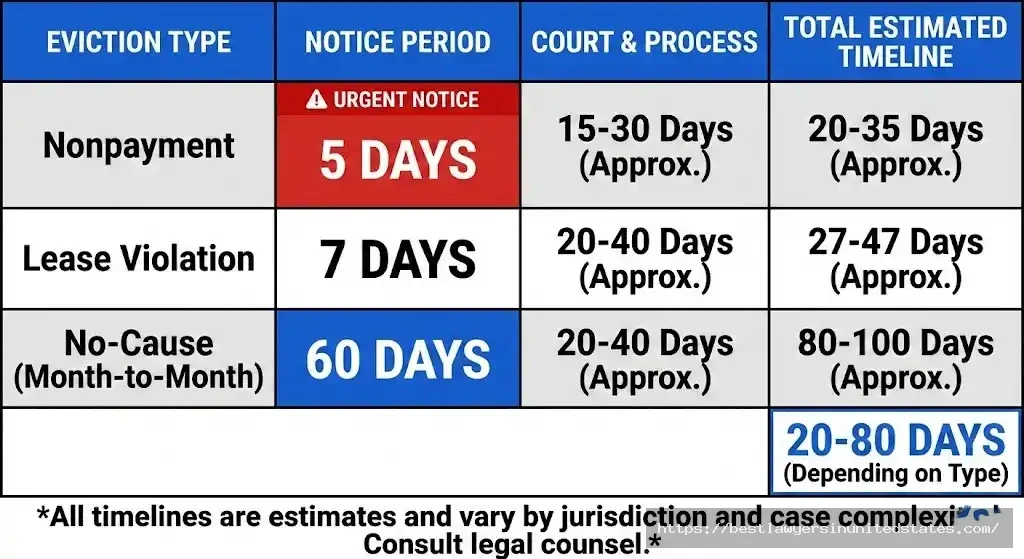
The eviction timeline depends on the reason for eviction. Nonpayment of rent requires only 5 days’ notice, while lease violations require 7 days’ notice. Month-to-month tenants facing no-cause eviction must receive 60 days’ notice.
What Are the Eviction Notice Requirements in Delaware?
Delaware law requires specific notice periods based on the eviction reason:
| Eviction Reason | Notice Period | Details |
|---|---|---|
| Nonpayment of Rent | 5 days | Must specify amount owed |
| Lease Violation | 7 days | Must describe violation |
| No-Cause (Month-to-Month) | 60 days | No reason required |
| Illegal Activity | Immediate | With court order |
The notice must be in writing and properly served. Landlords typically use certified mail or personal delivery by a process server. The notice period begins when you receive the notice, not when the landlord mails it.
How Long Does the Eviction Process Take in Delaware?
Quick Answer: The complete eviction process in Delaware takes 30-60 days from initial notice to sheriff lockout, depending on the eviction reason and whether you contest the case.
Here’s the typical timeline:
For Nonpayment of Rent:
- Day 1-5: 5-day notice period
- Day 6: Landlord can file eviction lawsuit
- Day 21-26: Court hearing (15-20 days after filing)
- Day 31-41: Sheriff enforcement (10-15 days after judgment)
- Total: 30-40 days minimum
For Lease Violations:
- Day 1-7: 7-day notice period
- Day 8: Landlord can file eviction lawsuit
- Day 23-28: Court hearing
- Day 33-43: Sheriff enforcement
- Total: 32-42 days minimum
For No-Cause (Month-to-Month):
- Day 1-60: 60-day notice period
- Day 61: Landlord can file eviction lawsuit
- Day 76-81: Court hearing
- Day 86-96: Sheriff enforcement
- Total: 85-95 days minimum
These timelines assume no delays. Tenant defenses, continuances, and appeals can extend the process by several weeks or months. Understanding Delaware’s eviction timeline compared to Alabama’s faster process shows how protective Delaware’s longer notice periods are for tenants.
What Happens During a Delaware Eviction Court Hearing?
Delaware eviction hearings take place in Justice of the Peace Court in the county where you rent. Both you and your landlord must appear, and each side presents evidence.
The judge will hear testimony, review documents, and issue a decision the same day or within a few days. If the landlord wins, you typically have 10 days to move out before the sheriff enforces the eviction.
Important: You have the right to raise defenses like improper notice, landlord retaliation, or uninhabitable conditions. Bring all evidence including photos, communications, and receipts.
Can I Stop an Eviction in Delaware?
Yes. You can stop or delay an eviction in Delaware by:
- Paying all owed rent and fees before the court hearing (for nonpayment cases)
- Fixing the lease violation within the notice period (for violation cases)
- Raising legal defenses such as improper notice, retaliation, or discrimination
- Filing an appeal if you lose at the Justice of the Peace level
- Requesting emergency assistance from Delaware State Housing Authority
Delaware law prohibits landlords from using “self-help” evictions like changing locks, shutting off utilities, or removing your belongings. Only a sheriff can enforce an eviction order after a court judgment.
What Are Illegal Eviction Tactics in Delaware?
Delaware law makes it illegal for landlords to evict tenants without a court order. Prohibited “self-help” eviction tactics include:
- ❌ Changing locks or lockouts
- ❌ Removing doors or windows
- ❌ Shutting off utilities (heat, water, electricity)
- ❌ Removing tenant’s belongings
- ❌ Threatening or harassing tenants
- ❌ Filing false eviction claims
If your landlord uses illegal eviction tactics, you can sue for damages, get a court order to be let back in, and potentially recover attorney fees. Delaware takes illegal evictions seriously and provides strong remedies for tenants.
Calculate Your Eviction Timeline in Delaware
Facing eviction? Know exactly how long the process takes and your rights at each stage. Our calculator provides a detailed timeline based on Delaware’s eviction laws, including notice periods, court timelines, and appeal windows.
⏱️ Eviction Timeline Calculator
All 50 States + DC
Get step-by-step breakdown of eviction process, notice requirements, and your legal rights.
📋 Enter Your Situation
Enter the date you received the eviction notice to see projected dates
📅 Eviction Timeline for
Estimated timeline for
📍 Step-by-Step Timeline
Calculator features:
- Stage-by-stage eviction timeline for Delaware
- Notice requirements (5-day, 7-day, or 60-day)
- Court filing to sheriff lockout dates
- Tenant defense deadlines
- Appeal window calculations
Facing illegal eviction?
[Get Immediate Legal Help from Delaware Tenant Rights Lawyers]
Email: [email protected]
Delaware Notice Requirements: The 60-Day Rule Explained
Delaware requires 60 days’ written notice to terminate a month-to-month lease, one of the longest notice periods in the United States. This applies to both landlords ending tenancies and tenants moving out.
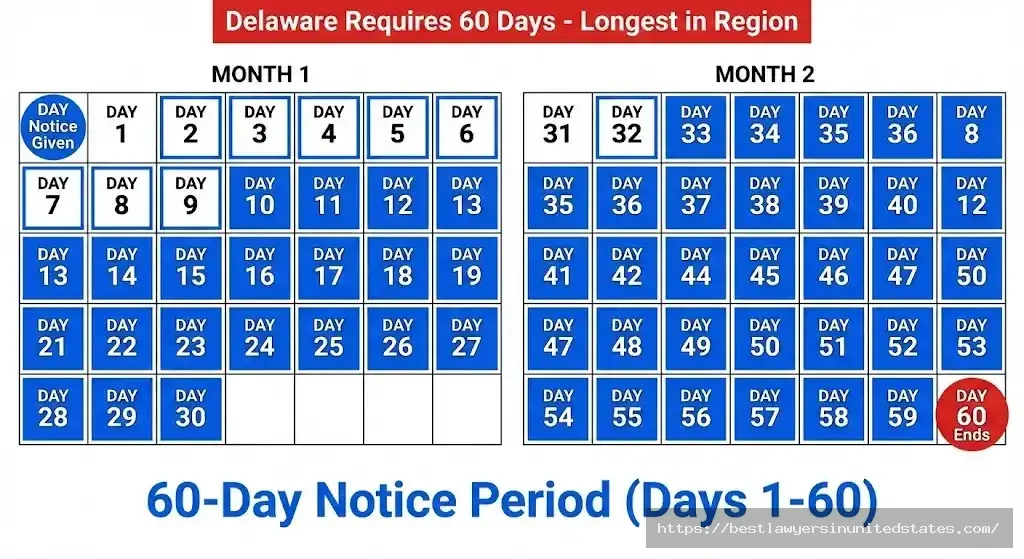
The 60-day rule protects tenants by giving them two months to find new housing. Most states require only 30 days’ notice, making Delaware’s law more tenant-friendly.
When Does the 60-Day Notice Rule Apply?
Quick Answer: Delaware’s 60-day notice requirement applies to month-to-month rental agreements when either party wants to end the tenancy without cause.
The 60-day notice period applies to:
- ✅ Month-to-month leases without a fixed end date
- ✅ Yearly leases that have converted to month-to-month
- ✅ Verbal month-to-month agreements
- ✅ Either landlord or tenant ending the tenancy
The 60-day notice does NOT apply to:
- ❌ Fixed-term leases (these end on the specified date)
- ❌ Evictions for cause (nonpayment, violations use shorter notice)
- ❌ Mutual agreement to end early
- ❌ Week-to-week tenancies (7-day notice required)
How Do I Give Proper Notice in Delaware?
Delaware law requires written notice to terminate a lease. Verbal notice does not satisfy the legal requirement.
Proper notice must include:
- Written format (letter, email may work if lease allows)
- Clear termination date (must be at least 60 days from notice)
- Signature from the party giving notice
- Delivery proof (certified mail recommended)
Example: You give notice on January 15th. The earliest your lease can end is March 16th (60 days later). If your rent is due on the 1st of each month, you’d typically terminate effective April 1st to align with your rent cycle.
What Happens If I Don’t Give 60 Days’ Notice?
If you move out without giving 60 days’ notice, your landlord can hold you responsible for rent through the 60-day notice period. Your security deposit may be applied to cover this unpaid rent.
Example: You give 30 days’ notice instead of 60. Your landlord can charge you for an additional 30 days of rent beyond your move-out date.
Some landlords will accept shorter notice, especially if they can quickly re-rent the unit. Always try to negotiate in writing if you need to leave sooner than 60 days.
Can My Lease Require More Than 60 Days’ Notice?
Yes. Delaware law sets 60 days as the minimum, but your lease can require longer notice. Read your lease carefully to see if it specifies a different notice period.
However, a lease cannot require less than 60 days’ notice for month-to-month tenancies. Any lease provision requiring less notice would be void and unenforceable.
Calculate Notice Periods in Delaware
Need to move out or wondering how much notice your landlord must give? Our calculator determines the exact notice period required based on your lease type and Delaware law, including notice to vacate, lease termination, and landlord entry notice requirements.
📬 Notice Period Calculator
All 50 States + DC
Find required notice periods for lease termination, rent increases, and landlord entry.
📋 Select Your Situation
What type of notice do you need? *
Select your role first
To calculate when notice must be given
Some states require longer notice for longer tenancies
✓ Notice Requirements for
📊 All Notice Periods for
| Notice Type | Tenant | Landlord |
|---|
Calculator features:
- Notice requirements by lease type (month-to-month, fixed-term)
- Move-out notice deadlines (60-day calculation)
- Landlord entry notice rules (48-hour requirement)
- Rent increase notice periods
- Lease termination timelines
Questions about your lease?
[Speak with Delaware Housing Attorneys Today]
Email: [email protected]
What a Landlord Cannot Do in Delaware (10 Prohibited Actions)
Delaware law prohibits specific landlord actions that violate tenant rights. Violating these rules can result in lawsuits, penalties, and in some cases, criminal charges.
1. Retaliate Against Tenants for Exercising Rights
Prohibited under: Delaware Code Title 25, §5516
Landlords cannot retaliate against tenants who:
- Report code violations to authorities
- Request needed repairs
- Join a tenant organization
- Exercise any legal right under Delaware law
Retaliatory actions include rent increases, eviction notices, or reducing services within 90 days of the protected activity. If you prove retaliation, the court can dismiss the eviction and award damages.
2. Enter Without Proper Notice
Prohibited under: Delaware Code Title 25, §5509
Landlords must give 48 hours’ written notice before entering your rental unit, except for emergencies. The notice must specify the date, time, and purpose of entry.
Emergency exceptions include:
- Fire or flood
- Gas leak or other safety hazard
- Abandoned unit (tenant moved out)
Delaware’s 48-hour notice requirement is longer than California’s 24-hour standard, providing tenants more privacy protection.
3. Shut Off Utilities to Force Tenant Out
Prohibited under: Delaware Code Title 25, §5516
Landlords cannot shut off heat, water, electricity, or other utilities to force you to move out. This is considered an illegal “self-help” eviction.
If your landlord shuts off utilities, you can:
- Sue for damages and attorney fees
- Get a court order restoring services
- Withhold rent until services are restored
- Terminate the lease and move out
4. Change Locks or Lockout Tenants
Prohibited under: Delaware Code Title 25, §5516
Only a sheriff can physically remove a tenant after a court eviction order. Landlords who change locks, remove doors, or block entry commit illegal eviction.
Delaware law allows tenants to call police to regain entry if locked out illegally. You can also sue for damages including the cost of temporary housing, lost wages, and emotional distress.
5. Charge Excessive or Unreasonable Late Fees
Limited by: Delaware Code Title 25, §5501(d)
While Delaware law doesn’t set a specific dollar limit on late fees, they must be “reasonable.” Courts look at whether the fee reflects the landlord’s actual administrative costs or is punitive.
Example: A $5 late fee on $1,000 rent is likely reasonable. A $200 late fee is likely excessive and unenforceable. Many Delaware landlords charge 5% of monthly rent as a reasonable late fee.
6. Discriminate Based on Protected Classes
Prohibited under: Fair Housing Act + Delaware Fair Housing Act
Delaware law prohibits housing discrimination based on:
- Race or color
- National origin
- Religion
- Sex (including sexual orientation and gender identity)
- Familial status (children under 18)
- Disability
- Age
- Marital status
- Source of income (including Section 8 vouchers)
Discrimination can include refusing to rent, different terms, or harassment based on these characteristics. File complaints with the Delaware Division of Human Relations or U.S. Department of Housing and Urban Development.
7. Include Illegal Lease Provisions
Prohibited under: Delaware Code Title 25, §5512
Certain lease clauses are illegal and unenforceable in Delaware, even if you sign them:
- ❌ Waiving right to notice before landlord entry
- ❌ Waiving right to habitable housing
- ❌ Waiving right to sue landlord
- ❌ Requiring tenant to pay landlord’s attorney fees in all cases
- ❌ Allowing landlord to confess judgment against tenant
- ❌ Waiving tenant’s right to jury trial
If your lease contains illegal provisions, those specific clauses are void. The rest of the lease remains valid.
8. Refuse Reasonable Accommodations for Disabilities
Required by: Fair Housing Act
Landlords must make reasonable accommodations for tenants with disabilities. This includes:
- Allowing service animals or emotional support animals (even in “no pets” buildings)
- Permitting accessible parking spaces
- Allowing tenant to install grab bars or other accessibility modifications
- Adjusting policies that disadvantage disabled tenants
Landlords can require documentation of disability and need for accommodation. However, they cannot charge extra fees for reasonable accommodations (though they can require you to restore modifications when you move out).
9. Fail to Maintain Habitable Housing
Required by: Delaware Code Title 25, §5303
Delaware law requires landlords to maintain rental units in habitable condition. This includes:
Required standards:
- ✅ Working heat (October 1 – May 31)
- ✅ Hot and cold running water
- ✅ Working electricity and safe wiring
- ✅ Functional plumbing and sewage
- ✅ Weatherproof roof and exterior walls
- ✅ Working smoke detectors and carbon monoxide detectors
- ✅ Pest-free conditions
- ✅ Secure locks on doors and windows
- ✅ Trash removal facilities
If your landlord fails to maintain habitability, you can use the repair-and-deduct remedy or withhold rent after following proper procedures.
10. Withhold Security Deposit Without Itemized Statement
Prohibited under: Delaware Code Title 25, §5514
Landlords who withhold any portion of your security deposit must provide an itemized, written statement within 20 days. The statement must detail each deduction with dollar amounts.
If your landlord keeps your deposit without providing an itemized statement, they may forfeit the right to keep any amount. You can sue in Justice of the Peace Court for the full deposit plus court costs and attorney fees.
Tenant Rights and Protections in Delaware
Delaware tenants have specific legal rights beyond security deposits and eviction protections. These include the right to habitable housing, privacy, and remedies when landlords violate the law.
Right to Habitable Housing
Delaware’s implied warranty of habitability requires landlords to maintain rental units in livable condition. This warranty applies automatically to all residential leases, even if not written in your lease agreement.
Landlords must make repairs within a reasonable time after receiving notice of problems. “Reasonable time” depends on the severity of the issue. Emergency repairs like no heat in winter require immediate attention, while minor issues may take longer.
Repair and Deduct Remedy
If your landlord fails to make needed repairs after proper notice, Delaware law allows you to make the repairs yourself and deduct the cost from rent.
To use repair-and-deduct:
- Give written notice of the problem to your landlord
- Wait reasonable time for landlord to fix (typically 7-14 days)
- Hire licensed contractor to make repairs
- Keep all receipts and documentation
- Deduct cost from rent (up to one month’s rent or $500, whichever is greater)
- Provide written notice of deduction with next rent payment
This remedy only works for health and safety issues covered by the habitability warranty. You cannot use it for cosmetic repairs or improvements.
Rent Withholding Process
Delaware law allows tenants to withhold rent for serious habitability violations, but you must follow strict procedures.
Step-by-step rent withholding:
- Give written notice describing the problem
- Wait 7-14 days for landlord to respond
- Continue paying rent into escrow account (savings account in your name)
- File complaint with Delaware Public Health Department or local housing inspector
- Await inspection and official determination
- Maintain escrow until repairs are completed
Never simply stop paying rent. You must continue depositing rent into escrow and be prepared to prove you followed all procedures. Courts can dismiss your defense if you don’t have proper documentation.
Retaliation Protections
Delaware law protects tenants from landlord retaliation for exercising legal rights. Landlords cannot retaliate by:
- Increasing rent
- Decreasing services
- Filing eviction
- Threatening eviction
- Making life difficult for tenant
Retaliation is presumed if adverse action occurs within 90 days of you exercising a protected right. The landlord must prove they had a legitimate, non-retaliatory reason for the action.
Privacy Rights and Landlord Entry
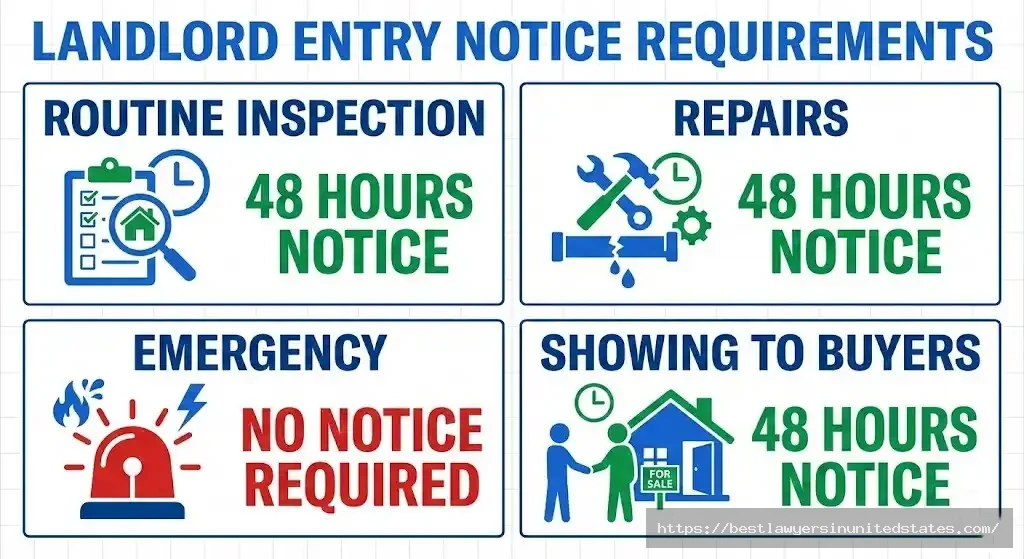
Delaware law protects tenant privacy by requiring 48 hours’ written notice for landlord entry. This gives you time to be present during inspections or repairs.
| Entry Reason | Notice Required | Details |
|---|---|---|
| Routine Inspection | 48 hours | Must specify date and time |
| Repairs/Maintenance | 48 hours | Unless emergency |
| Showing to Buyers | 48 hours | Reasonable times only |
| Emergency | None | Fire, flood, gas leak, etc. |
Landlords who enter without proper notice violate your privacy rights. You can sue for damages, though it’s often more effective to document violations and use them as defense in any eviction case.
Landlord Obligations and Responsibilities in Delaware
Delaware law imposes specific duties on landlords beyond basic habitability requirements. Understanding these obligations helps you know when your landlord is violating the law.
Maintain Habitable Premises
Landlords must keep rental units in habitable condition throughout the tenancy. This includes making repairs, maintaining common areas, and addressing safety hazards.
Specific obligations include:
- Maintaining heating systems (October 1 – May 31)
- Repairing plumbing and water leaks
- Fixing electrical problems
- Addressing pest infestations
- Repairing roof leaks
- Maintaining smoke and carbon monoxide detectors
- Securing exterior doors and windows
Landlords cannot pass these responsibilities to tenants through lease provisions. Any lease clause making tenants responsible for major repairs is void under Delaware law.
Make Timely Repairs
When you report a repair need, your landlord must respond within a reasonable time. Delaware law doesn’t specify exact deadlines, but courts consider:
- Emergency repairs: Same day or within 24 hours (no heat, no water, gas leak)
- Urgent repairs: 3-7 days (broken refrigerator, clogged toilet, broken locks)
- Standard repairs: 14-30 days (minor leaks, cosmetic issues, non-essential items)
Always give written notice of repair needs and keep copies. This documentation proves you notified the landlord and protects your right to use repair remedies if they fail to act.
Provide Essential Services
Landlords must provide essential services included in the rent or required by law. These typically include:
- Water and sewage
- Trash removal
- Heat (if landlord pays utilities)
- Common area maintenance
- Any service promised in the lease
If your landlord stops providing promised services, you may have grounds to withhold rent or break the lease. Document the failure and give written notice before taking action.
Respect Tenant Privacy
The 48-hour entry notice requirement applies to all non-emergency situations. Landlords who repeatedly violate this rule create a pattern of harassment that can justify lease termination or damage claims.
Landlords cannot:
- Enter without notice except emergencies
- Harass or disturb tenants
- Allow third parties to enter without notice
- Use entry rights to intimidate tenants
Keep a log of improper entries with dates, times, and circumstances. This evidence helps if you need to prove harassment or defend against eviction.
Return Security Deposits Properly
The 20-day return deadline and interest requirement represent strict landlord obligations. Landlords who miss the deadline or fail to provide itemized statements may forfeit their right to keep any portion of the deposit.
Landlords must also store security deposits separately from operating funds and pay interest calculated at the Federal Reserve discount rate for deposits held over one year.
Delaware Lease Agreement Requirements
Delaware law regulates what landlords can and cannot include in lease agreements. Some provisions are required, while others are prohibited even if both parties agree.
Required Lease Disclosures
Delaware landlords must disclose certain information before or at lease signing:
Mandatory disclosures:
- Owner or property manager contact information
- Security deposit amount and terms
- Pet deposit or fees (if applicable)
- Lead paint disclosure (for pre-1978 housing)
- Bed bug history (if any in past year)
- Shared utility arrangement details
- Any additional fees beyond rent
Landlords who fail to make required disclosures may face penalties and could be prohibited from enforcing certain lease terms.
Prohibited Lease Provisions
Delaware Code §5512 lists lease provisions that are illegal and void:
- Tenant waives right to legal notice
- Tenant waives right to habitable housing
- Tenant agrees to pay landlord’s attorney fees in all circumstances
- Landlord can confess judgment against tenant
- Tenant waives right to jury trial
- Landlord is not liable for any negligence
If your lease contains these provisions, they’re unenforceable. The rest of the lease remains valid, but you can ignore the illegal clauses.
Month-to-Month vs. Fixed-Term Leases
Delaware law treats these lease types differently for notice and termination purposes:
| Lease Type | Termination Notice | Rent Increase Notice | Notes |
|---|---|---|---|
| Month-to-Month | 60 days | 60 days | Either party can end |
| Fixed-Term (1 year) | Not required | Cannot increase during term | Ends on specified date |
| Week-to-Week | 7 days | 7 days | Uncommon in Delaware |
Fixed-term leases automatically convert to month-to-month after the term expires unless either party gives notice or signs a new lease. The same rent and terms continue until modified with proper notice.
Early Lease Termination Rights
Delaware law allows tenants to break leases early in specific situations without penalty:
Protected reasons for early termination:
- Military deployment (Servicemembers Civil Relief Act)
- Domestic violence victim (with documentation)
- Uninhabitable conditions (after landlord refuses repairs)
- Landlord harassment or illegal activity
- Landlord violates lease terms
You must give written notice and usually provide supporting documentation. For domestic violence situations, a protective order or police report typically satisfies the requirement.
Rent Increases and Rent Control in Delaware
Delaware has no statewide rent control laws. Landlords can increase rent to any amount as long as they follow proper notice requirements and don’t violate anti-retaliation or anti-discrimination laws.
Notice Requirements for Rent Increases
Delaware requires 60 days’ written notice for rent increases on month-to-month leases. This matches the notice period for lease termination.
Rent increase rules:
- ✅ 60 days’ notice for month-to-month leases
- ✅ Cannot increase during fixed-term lease without tenant consent
- ✅ Must be in writing
- ✅ Cannot be retaliatory
- ❌ No limit on increase amount under state law
If you receive a rent increase notice, you have options:
- Accept the increase and stay
- Give 60 days’ notice and move
- Negotiate a lower increase
- Challenge if you believe it’s retaliatory
Is There Rent Control in Delaware?
No. Delaware has no state or local rent control laws. Wilmington, Newark, Dover, and other Delaware cities do not limit rent increases.
This makes Delaware more landlord-friendly than states like California with strong rent control protections. However, Delaware’s 60-day notice requirement gives tenants more time to respond than many other states.
Retaliatory Rent Increases
While Delaware has no rent control, landlords cannot increase rent in retaliation for tenants exercising legal rights. A rent increase within 90 days of filing a complaint, requesting repairs, or joining a tenant organization is presumed retaliatory.
If you believe a rent increase is retaliatory, document:
- The protected activity you engaged in
- The date of that activity
- The date of the rent increase notice
- Any statements from the landlord suggesting retaliation
This evidence can help you prove retaliation in court if needed.
Repairs and Maintenance: Who’s Responsible?
Delaware law divides repair responsibilities between landlords and tenants based on the nature of the issue and what caused it.
Landlord’s Repair Duties
Landlords must maintain structural components and systems that affect habitability:
Landlord responsibilities:
- Structural repairs (roof, walls, foundation)
- Plumbing and sewage systems
- Electrical systems and fixtures
- Heating and air conditioning (if provided)
- Appliances provided with unit
- Common areas (hallways, stairs, elevators)
- Exterior maintenance
- Pest control (unless tenant caused infestation)
These duties exist regardless of lease terms. Landlords cannot shift these responsibilities to tenants through lease provisions.
Tenant’s Maintenance Obligations
Tenants must keep the unit clean and avoid causing damage beyond normal wear and tear:
Tenant responsibilities:
- Keep unit clean and sanitary
- Dispose of trash properly
- Use appliances and fixtures properly
- Change air filters (if specified in lease)
- Replace light bulbs
- Test smoke and CO detectors monthly
- Report repair needs promptly
- Avoid damage beyond normal use
You’re liable for damage you, your family, or guests cause. Normal wear and tear like faded paint or worn carpet is not your responsibility.
Emergency Repair Procedures
For emergency repairs that threaten health or safety, Delaware law allows tenants to take immediate action if the landlord is unavailable.
Emergency situations include:
- No heat in winter (below 60°F indoors)
- No running water
- Gas leak
- No electricity
- Sewage backup
- Broken locks on exterior doors
- Roof leak causing interior damage
Contact your landlord immediately by phone and follow up in writing. If you cannot reach the landlord and the situation is truly an emergency, you may make repairs and deduct from rent, but keep detailed records and receipts.
Repair and Deduct Process
Delaware allows tenants to deduct repair costs from rent under specific conditions:
Step-by-step process:
- Give landlord written notice describing the problem
- Wait reasonable time for landlord to respond (7-14 days for urgent issues)
- Get written estimate from licensed contractor
- Make repairs only after landlord fails to act
- Keep all receipts and contractor invoices
- Deduct cost from next rent (up to 1 month’s rent or $500, whichever is greater)
- Provide notice and receipts with rent payment
This remedy works best for urgent health and safety issues. Courts may not support repair-and-deduct for cosmetic issues or improvements.
Rent Withholding Rules
Delaware allows rent withholding for serious habitability violations, but requires strict compliance with procedures:
When you can withhold rent:
- Health or safety code violations
- Lack of essential services (heat, water, electricity)
- Structural defects affecting safety
- Serious pest infestations
- Multiple unaddressed repair issues
Required procedures:
- Give written notice to landlord
- Contact Delaware Division of Public Health or local code enforcement
- Continue depositing rent into separate escrow account
- Maintain escrow until repairs completed
- Provide landlord with evidence of escrow account
Never simply stop paying rent. You must prove you deposited rent into escrow and followed all legal procedures. Otherwise, the landlord can evict you for nonpayment.
Small Claims Court for Repairs
If your landlord refuses to make needed repairs, you can sue in Delaware Justice of the Peace Court for:
- Cost of repairs you made
- Reduced rent value due to uninhabitable conditions
- Moving costs if you had to relocate
- Damages from landlord’s negligence
Delaware small claims courts handle cases up to $25,000. This provides a realistic option for most tenant repair disputes. You don’t need a lawyer for small claims, though legal advice helps.
How Long Does It Take to Evict a Tenant in Delaware?
The complete eviction process in Delaware averages 30-60 days from initial notice to sheriff enforcement. The timeline depends on the eviction reason, whether you contest the case, and court scheduling.
Eviction Timeline by Type
| Eviction Type | Notice Period | Court Process | Total Timeline |
|---|---|---|---|
| Nonpayment | 5 days | 15-20 days | 20-25 days |
| Lease Violation | 7 days | 15-20 days | 22-27 days |
| No-Cause (Month-to-Month) | 60 days | 15-20 days | 75-80 days |
| Holdover (Lease Ended) | None | 15-20 days | 15-20 days |
These timelines represent minimum periods when tenants don’t contest the eviction. Tenant defenses, continuances, and appeals can add weeks or months to the process.
Court Filing to Sheriff Enforcement
After the notice period expires, landlords file an eviction lawsuit in Justice of the Peace Court. Here’s what happens next:
Day 1-3: Landlord files complaint and pays filing fee ($45-$75)
Day 4-7: Court serves tenant with summons and complaint
Day 15-20: Court hearing scheduled (10-15 days from filing)
Day of hearing: Both parties present evidence; judge issues decision
10 days after judgment: Sheriff can enforce eviction if tenant doesn’t move
Total court process: 25-30 days from filing to sheriff enforcement
Tenants can request continuances to prepare defenses, which extends the timeline. The court typically grants one reasonable continuance request.
Factors That Extend Eviction Timeline
Several factors can delay eviction beyond the standard timeline:
- Tenant contests the case: Adds 30-60 days for additional hearings
- Landlord fails to follow procedures: Court dismisses case; landlord must start over
- Tenant files bankruptcy: Federal automatic stay halts eviction (temporary)
- Tenant appeals to Superior Court: Adds 60-90 days
- Court backlog: High volume delays hearing dates
- Sheriff scheduling: Limited enforcement days extend final step
The eviction timeline in Delaware is significantly longer than some states due to the 60-day notice requirement for month-to-month tenancies. This gives Delaware tenants more time to find alternative housing compared to states with 30-day notice periods.
Is Delaware a Landlord-Friendly or Tenant-Friendly State?
Delaware strikes a moderate balance between landlord and tenant protections. The state has some tenant-friendly features but lacks the strong rent control and just-cause eviction laws found in states like California and New York.
Pro-Landlord Features
Factors favoring Delaware landlords:
- No statewide rent control (landlords can set market rents)
- No just-cause eviction requirement (can end month-to-month leases without reason)
- Relatively quick eviction for nonpayment (5-day notice)
- No caps on security deposits beyond reasonableness
- No requirement to pay relocation assistance
These features make Delaware more landlord-friendly than heavily regulated states. Landlords have flexibility to adjust rents and end tenancies with proper notice.
Pro-Tenant Features
Factors favoring Delaware tenants:
- 60-day notice requirement (double the national standard)
- Security deposit interest after 1 year (rare among states)
- 48-hour landlord entry notice (longer than many states)
- Strong repair remedies (repair-and-deduct, rent withholding)
- Anti-retaliation protections
- 20-day security deposit return deadline
Delaware’s 60-day notice rule gives tenants significant protection compared to Arizona’s more landlord-friendly 30-day standard. The security deposit interest requirement also sets Delaware apart from most states.
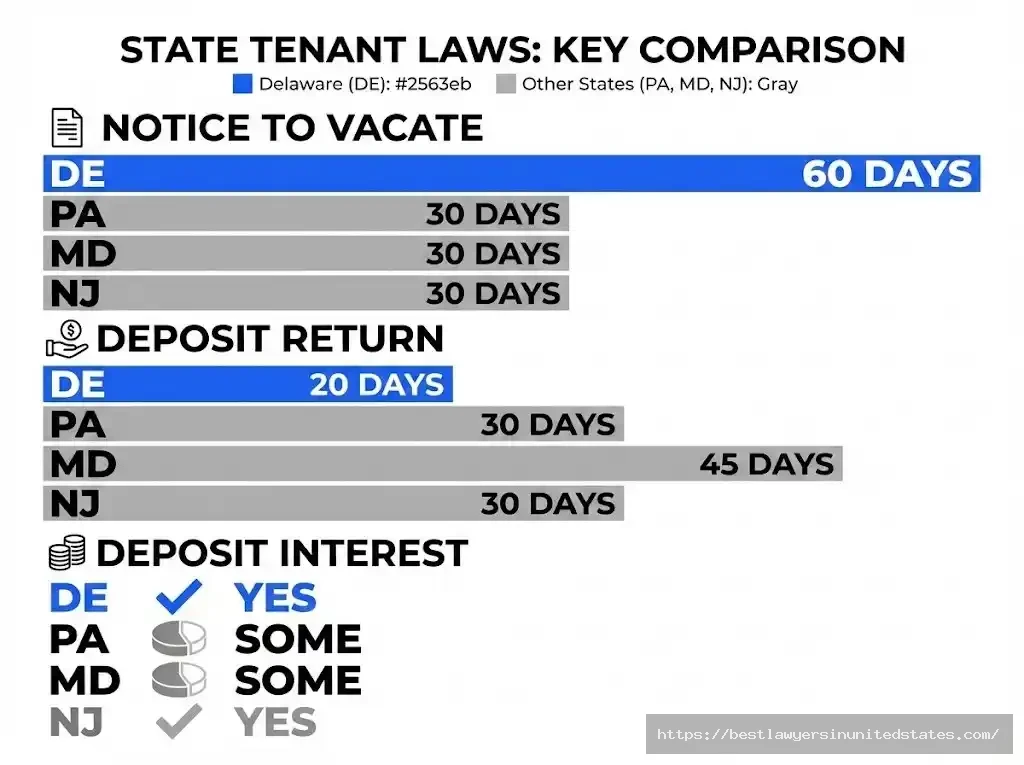
Comparison to Neighboring States
| Feature | Delaware | Pennsylvania | Maryland | New Jersey |
|---|---|---|---|---|
| Notice to Vacate | 60 days | 30 days | 30 days | 30 days |
| Deposit Return | 20 days | 30 days | 45 days | 30 days |
| Deposit Interest | Yes | Some counties | Some counties | Yes |
| Rent Control | No | Limited cities | Limited cities | Yes |
| Just-Cause Eviction | No | No | No | Some cities |
Delaware’s 60-day notice requirement is the strongest tenant protection compared to neighboring states. However, Delaware lacks the rent control and just-cause eviction laws found in parts of New Jersey and Pennsylvania.
Overall Assessment
Delaware leans moderately tenant-friendly compared to the national average. The state provides stronger protections than landlord-friendly states like Texas or Georgia, but fewer protections than California or New York.
Delaware works well for tenants who:
- Value longer notice periods for stability
- Want security deposit protections
- Need time to find new housing
- Appreciate privacy rights
Delaware works well for landlords who:
- Want flexibility to adjust rents to market rates
- Prefer clear eviction procedures
- Can end problem tenancies with proper notice
- Operate in a predictable legal environment
Local Delaware Tenant Rights by City
While Title 25 Delaware Code applies statewide, some Delaware cities and counties have additional tenant protections. Understanding local rules helps you know all your rights.
Wilmington Tenant Rights
Wilmington is Delaware’s largest city and has additional rental housing regulations beyond state law.
Wilmington-specific rules:
- Rental license requirement: All rental properties must be licensed with the city
- Lead paint inspection: Required for pre-1978 housing
- Minimum housing standards: City code enforcement inspects rental units
- Business license: Landlords must register with city
Wilmington tenants can report code violations to the Department of Licenses & Inspections. The city investigates complaints and can order landlords to make repairs or face fines.
Wilmington resources:
- Department of Licenses & Inspections: (302) 576-3160
- Code enforcement: Report violations online or by phone
- Tenant assistance: Delaware Community Legal Aid Society
Newark Tenant Rights
Newark is a college town home to the University of Delaware. The city has rental regulations addressing student housing and neighborhood concerns.
Newark-specific considerations:
- Occupancy limits: Maximum number of unrelated occupants per unit
- Parking regulations: Limited street parking in residential areas
- Noise ordinances: Quiet hours enforced in residential zones
- Rental registration: Landlords must register with city
Newark’s large student population means many landlords cater to university renters with September-to-May leases. Student tenants should understand their rights regarding summer subletting and lease terms.
Newark resources:
- City Code Enforcement: (302) 366-7030
- University of Delaware Off-Campus Housing: Student resources
- Newark Police (noise complaints): (302) 366-7111
Dover Tenant Rights
Dover is Delaware’s state capital and second-largest city. Tenants have access to state government resources in addition to city services.
Dover-specific resources:
- Proximity to Delaware State Housing Authority headquarters
- Access to state tenant rights workshops
- Community mediation services
- Legal aid services in Kent County
Dover tenants can file complaints with the city’s Code Enforcement Division for housing code violations. The city inspects rental properties and requires landlords to maintain minimum standards.
Dover resources:
- Code Enforcement: (302) 736-7025
- Delaware State Housing Authority: (302) 739-4263
- Kent County Community Legal Aid: (302) 674-8500
New Castle County Enhanced Protections
New Castle County (which includes Wilmington) has additional tenant protections through the county code.
County-level protections include:
- Housing code enforcement
- Rental inspection programs
- Tenant-landlord mediation services
- Fair housing enforcement
New Castle County Code, Chapter 2, Article XIX provides additional tenant protections beyond state law in unincorporated areas. Check whether you live in incorporated Wilmington (city rules apply) or unincorporated county (county rules apply).
New Castle County resources:
- Community Services: (302) 395-5600
- Code Enforcement: (302) 395-5555
- Fair Housing: (302) 395-5340
Fair Housing and Anti-Discrimination Laws in Delaware
Federal and Delaware fair housing laws prohibit discrimination in rental housing. Understanding these protections helps you recognize illegal discrimination and take action.
Protected Classes Under Delaware Law
Delaware prohibits housing discrimination based on:
Federal protected classes (Fair Housing Act):
- Race or color
- National origin
- Religion
- Sex (including sexual harassment)
- Familial status (families with children under 18)
- Disability
Additional Delaware protected classes:
- Age (40 and older)
- Marital status
- Sexual orientation
- Gender identity
- Source of income (including Section 8 vouchers)
Delaware’s source of income protection means landlords generally cannot refuse to rent to you solely because you use a housing voucher. This protection goes beyond federal law.
What Constitutes Housing Discrimination?
Illegal discrimination can occur at any stage of the rental process:
Examples of discrimination:
- Refusing to rent or show available units
- Lying about availability
- Setting different terms or conditions
- Providing different services or facilities
- Steering tenants to certain buildings or units
- Harassing tenants based on protected characteristics
- Retaliating against discrimination complaints
- Refusing reasonable accommodations for disabilities
Discrimination isn’t always obvious. Sometimes landlords use code words or pretexts to hide discriminatory intent. Trust your instincts if you suspect discrimination.
Reasonable Accommodation for Disabilities
Landlords must make reasonable accommodations and modifications for tenants with disabilities under both federal and Delaware law.
Common accommodations include:
- Allowing service animals or emotional support animals
- Permitting accessible parking spaces
- Waiving no-pet policies for assistance animals
- Adjusting lease terms or policies
- Allowing structural modifications (tenant may pay for restoration)
Landlords can request documentation of disability and the disability-related need for the accommodation. However, they cannot ask about the nature or extent of the disability itself.
How to File a Discrimination Complaint
If you experience housing discrimination in Delaware, you have options:
File with Delaware Division of Human Relations:
- Online: Work.delawareworks.com
- Phone: (302) 761-8200
- Timeline: File within 365 days of discrimination
- Process: Investigation, mediation, possible hearing
File with U.S. Department of Housing and Urban Development (HUD):
- Online: HUD.gov/fairhousing
- Phone: 1-800-669-9777
- Timeline: File within 1 year of discrimination
- Process: Federal investigation and enforcement
You can file with both agencies simultaneously. Delaware and HUD have worksharing agreements to avoid duplicate investigations.
Special Tenant Protections in Delaware
Delaware law provides extra protections for tenants in specific situations. These protections help vulnerable tenants facing unique challenges.
Domestic Violence Victim Protections
Delaware law protects domestic violence victims by allowing early lease termination and lock changes without landlord permission.
Protections include:
- Early lease termination: Allowed with protective order or police report
- Lock changes: Victim can change locks and exclude abuser
- No penalty: Landlord cannot charge early termination fees
- Confidentiality: Landlord cannot disclose victim’s new address
To exercise these rights, provide your landlord with:
- Copy of protective order, OR
- Police report documenting domestic violence, OR
- Court record of domestic violence conviction
Give 30 days’ notice even though standard notice is 60 days. Delaware law shortens the notice period for domestic violence victims.
Military Servicemember Rights (SCRA)
The federal Servicemembers Civil Relief Act (SCRA) provides special protections for active-duty military members.
SCRA protections include:
- Lease termination for deployment or PCS orders
- Rent cap at 3% interest on pre-service debts
- Stay of eviction proceedings during active duty
- Protection against default judgments
To terminate a lease under SCRA, provide:
- Copy of deployment or PCS orders
- Written notice to landlord
- One month’s notice
Delaware landlords familiar with Dover Air Force Base and military families usually understand SCRA rights. Always provide written notice and keep copies.
Senior and Disabled Tenant Protections
Delaware doesn’t have specific additional protections for seniors beyond fair housing laws. However, seniors and disabled tenants can access:
- Delaware Assistive Technology Initiative (DATI)
- Delaware Division of Services for Aging and Adults with Physical Disabilities
- Senior housing assistance programs
- Reasonable accommodation rights under fair housing law
Many Delaware communities have senior housing with age restrictions (55+). These communities can legally limit residency by age as an exception to fair housing law.
Section 8 and Housing Voucher Holders
Delaware’s source of income protection means landlords generally cannot refuse to rent to Section 8 voucher holders. However, landlords can:
- Refuse to participate in Section 8 program entirely (controversial)
- Apply same screening criteria to all applicants
- Reject applicants who don’t meet credit/background requirements
Delaware State Housing Authority administers Section 8 vouchers. If you believe a landlord discriminated based on your voucher, contact:
- Delaware State Housing Authority: (302) 739-4263
- Delaware Division of Human Relations: (302) 761-8200
How to Enforce Your Tenant Rights in Delaware
Knowing your rights means little without understanding how to enforce them. Delaware provides multiple paths for tenants to assert their legal protections.
Document Everything
Successful enforcement starts with documentation. Keep records of:
- Lease agreement: Original signed copy
- All communications: Emails, texts, letters, call notes
- Repair requests: Written notices with dates
- Photos/videos: Conditions, damages, repairs needed
- Receipts: Rent payments, security deposit, repairs
- Witness statements: Anyone who saw violations
- Government complaints: Copies of code enforcement complaints
Store these records in a safe place outside your rental unit. Digital copies in cloud storage provide backup access.
Send Written Notices
Delaware law requires written notice for most tenant actions. Verbal communication doesn’t satisfy legal requirements.
Use certified mail with return receipt for:
- Repair requests
- Lease termination notices
- Complaint letters
- Demand letters
- Any communication asserting legal rights
The return receipt proves your landlord received the notice. This evidence matters in court if disputes arise.
File Complaints with Government Agencies
Delaware has multiple agencies that investigate landlord violations:
Delaware Division of Public Health:
- Housing code violations
- Health and safety hazards
- Lead paint issues
- Phone: (302) 744-4700
Delaware Division of Human Relations:
- Housing discrimination
- Fair housing violations
- Phone: (302) 761-8200
Local Code Enforcement:
- Building code violations
- Occupancy standards
- Property maintenance
- Contact your city/county office
Government investigations can force landlords to make repairs and comply with laws. Agencies can also fine landlords for violations.
Small Claims Court Process
Delaware Justice of the Peace Courts handle tenant disputes up to $25,000. This limit covers most security deposit and repair cases.
Small claims process:
- File complaint: JP Court in county where rental is located ($45-$75 filing fee)
- Serve defendant: Court serves landlord with summons
- Prepare evidence: Organize documents, photos, receipts
- Attend hearing: Present your case to judge (no jury in small claims)
- Receive decision: Judge issues ruling same day or within days
- Collect judgment: Use sheriff or wage garnishment if you win
You don’t need a lawyer for small claims, though legal advice helps. Bring organized evidence and present facts clearly. For tenant rights guidance, exploring Colorado’s tenant-friendly enforcement procedures shows different approaches to similar protections.
When to Hire a Tenant Rights Lawyer
Some situations require professional legal help:
Hire a lawyer when:
- Facing eviction with complex defenses
- Landlord sues you for significant damages
- Discrimination case with substantial evidence
- Illegal eviction causing damages
- Habitability issues landlord refuses to fix
- Retaliation requiring restraining order
Delaware Community Legal Aid Society provides free legal help to low-income tenants. Contact them at (302) 575-0660 or visit declasi.org.
For tenants who don’t qualify for free legal aid, many Delaware attorneys offer free consultations. Discuss your case and get fee estimates before hiring representation.
Delaware Tenant Rights FAQs (2026 Updated)
What are my rights as a tenant in Delaware?
Quick Answer: Delaware tenants have the right to habitable housing, 20-day security deposit return with interest after 1 year, 60-day notice for lease termination, 48-hour notice before landlord entry, and protection from illegal eviction and retaliation.
Your rights are protected under Title 25 Delaware Code, Chapter 53. You can enforce these rights through small claims court, government agencies, or by using tenant remedies like repair-and-deduct.
How long does my landlord have to return my security deposit in Delaware?
Quick Answer: Delaware landlords must return security deposits within 20 days of move-out, along with an itemized statement of any deductions. Landlords must also pay interest on deposits held for more than one year.
If your landlord misses the 20-day deadline, they may forfeit the right to withhold any portion. You can use our security deposit calculator to determine your exact rights and any penalties owed.
How do I calculate if my landlord owes me my security deposit?
Quick Answer: Use our free security deposit calculator designed specifically for Delaware law. Input your move-out date, deposit amount, and how long you rented to calculate return deadlines, interest owed, and penalties for late return.
The calculator accounts for Delaware’s 20-day return requirement, interest calculations for deposits held over 1 year, and penalty provisions when landlords violate the law.
How long does the eviction process take in Delaware?
Quick Answer: Delaware evictions take 30-60 days on average from initial notice to sheriff enforcement. Nonpayment cases take 20-25 days minimum, lease violations take 22-27 days, and no-cause evictions of month-to-month tenants take 75-80 days.
Use our eviction timeline calculator to see the exact timeline for your situation based on notice type and court procedures.
How much notice does my landlord need to give me in Delaware?
Quick Answer: Delaware landlords must give 60 days’ written notice to terminate month-to-month leases without cause. For evictions with cause, notice is 5 days for nonpayment and 7 days for lease violations.
Delaware’s 60-day notice requirement is one of the longest in the U.S., giving you substantial time to find new housing. Calculate your exact notice deadline with our notice period calculator.
Can a landlord refuse a month-to-month lease in Delaware?
Quick Answer: Yes, landlords can refuse to offer month-to-month leases and can require fixed-term leases instead. However, if your fixed-term lease expires and continues, it automatically becomes month-to-month with 60-day notice rights.
Once you’re on a month-to-month lease, both you and your landlord must give 60 days’ written notice to end the tenancy.
What can I sue my landlord for in Delaware?
Quick Answer: You can sue Delaware landlords for illegal security deposit retention (up to twice the deposit amount), illegal eviction, failure to make repairs, breach of lease, invasion of privacy, discrimination, and retaliation.
Delaware Justice of the Peace Courts handle cases up to $25,000. You don’t need a lawyer for small claims, but complex cases benefit from legal representation.
Can a landlord enter without notice in Delaware?
Quick Answer: No. Delaware law requires 48 hours’ written notice before landlord entry except for emergencies like fire, flood, or gas leaks.
Landlords who enter without proper notice violate your privacy rights. Document unauthorized entries and consider them as potential harassment or retaliation if other conflicts exist.
How do I break my lease early in Delaware?
Quick Answer: You can legally break a Delaware lease early if you’re a military member with deployment orders, a domestic violence victim with a protective order, the unit becomes uninhabitable, or the landlord violates the lease.
Otherwise, breaking your lease makes you responsible for rent until the landlord re-rents the unit or the lease term ends. Always try to negotiate with your landlord first.
What is the maximum late fee in Delaware?
Quick Answer: Delaware doesn’t set a specific dollar limit on late fees, but they must be “reasonable” and reflect the landlord’s actual administrative costs. Courts typically consider 5% of monthly rent reasonable.
Excessive late fees are unenforceable. A $200 late fee on $1,000 rent would likely be deemed excessive, while a $50 fee might be acceptable.
Is Delaware a landlord-friendly or tenant-friendly state?
Quick Answer: Delaware is moderately balanced, leaning slightly tenant-friendly. The state has no rent control (landlord-friendly) but requires 60-day notice and security deposit interest (tenant-friendly).
Delaware offers stronger tenant protections than states like Texas or Arizona but fewer protections than California or New York. The 60-day notice requirement is Delaware’s strongest tenant protection.
Can my landlord increase my rent in Delaware?
Quick Answer: Yes, with 60 days’ written notice for month-to-month leases. Landlords cannot increase rent during a fixed-term lease without your consent, and cannot increase rent in retaliation for exercising your rights.
Delaware has no rent control, so landlords can set any rent amount. However, increases must follow proper notice procedures and cannot be discriminatory or retaliatory.
What if my landlord doesn’t make repairs in Delaware?
Quick Answer: After giving written notice and waiting a reasonable time (7-14 days), you can use repair-and-deduct (up to 1 month’s rent or $500, whichever is greater) or withhold rent by depositing it in escrow while reporting violations to health authorities.
Always document repair requests in writing and keep receipts. Never simply stop paying rent without following proper withholding procedures.
What are tenant rights regarding habitability in Delaware?
Quick Answer: Delaware landlords must provide working heat (October-May), hot and cold water, electricity, plumbing, weatherproof structure, working smoke/CO detectors, pest-free conditions, and secure locks.
If your landlord fails to maintain habitability, you have legal remedies including repair-and-deduct, rent withholding, lease termination, or suing for damages.
Can I withhold rent in Delaware?
Quick Answer: Yes, but only after following strict procedures: give written repair notice, wait for landlord to fail to act, contact Delaware Public Health or code enforcement, and deposit rent into escrow account (not just stop paying).
Never simply stop paying rent. You must prove you followed all legal procedures and deposited rent into a separate account. Courts will side with landlords if you don’t have proper documentation.
Delaware Tenant Rights Resources
Delaware offers multiple resources to help tenants understand and enforce their rights. These organizations provide legal help, mediation services, and housing assistance.
Legal Aid and Tenant Assistance
Delaware Community Legal Aid Society (CLASI)
Provides free legal help to low-income Delaware tenants
- Phone: (302) 575-0660
- Website: declasi.org
- Services: Eviction defense, discrimination cases, security deposit disputes
- Eligibility: Income-based (typically 125% of federal poverty level)
Delaware State Housing Authority (DSHA)
State agency administering housing programs and assistance
- Phone: (302) 739-4263
- Address: 18 The Green, Dover, DE 19901
- Services: Section 8 vouchers, emergency rental assistance, housing counseling
- Website: destatehousing.com
Delaware Volunteer Legal Services
Connects low-income tenants with volunteer attorneys
- Phone: (302) 478-8850
- Website: dvls.org
- Services: Legal advice clinics, brief service, full representation for eligible cases
Housing Courts and Enforcement
Delaware Justice of the Peace Courts
Handle eviction cases and small claims up to $25,000
- New Castle County: (302) 323-3510
- Kent County: (302) 739-4405
- Sussex County: (302) 856-5830
- Website: courts.delaware.gov/JP
Delaware Division of Public Health
Investigates housing code violations and health hazards
- Phone: (302) 744-4700
- Services: Housing inspections, lead paint testing, health hazard complaints
- Website: dhss.delaware.gov/dph
Fair Housing and Discrimination
Delaware Division of Human Relations
State agency handling fair housing complaints
- Phone: (302) 761-8200
- Address: 4425 N. Market Street, Wilmington, DE 19802
- Services: Discrimination investigations, mediation, enforcement
- Website: work.delawareworks.com
U.S. Department of Housing and Urban Development (HUD)
Federal fair housing enforcement
- Phone: 1-800-669-9777
- Online: HUD.gov/fairhousing
- Services: Federal discrimination complaints, enforcement actions
Mediation and Dispute Resolution
Delaware Mediation Program
Free mediation services for landlord-tenant disputes
- Phone: Contact your local Justice of the Peace Court
- Services: Mediation before eviction hearings, security deposit disputes
- Cost: Free or low-cost
Community Services Centers
Local organizations providing tenant assistance
- New Castle County: (302) 395-5340
- Kent County: (302) 739-4263
- Sussex County: (302) 856-5340
Download Delaware Landlord-Tenant Code
Access the full text of Delaware’s landlord-tenant law:
- Delaware General Assembly: legis.delaware.gov
- Search: “Title 25 Delaware Code Chapter 53”
- PDF version available for download
This comprehensive legal resource contains all Delaware tenant rights, landlord obligations, and enforcement procedures.
Conclusion
Delaware tenant rights in 2026 provide strong protections in key areas like security deposits, notice requirements, and eviction procedures. The state’s 60-day notice rule, mandatory security deposit interest, and 20-day deposit return deadline give renters more security than many other states.
Understanding your rights helps you avoid exploitation and take action when landlords violate the law. Use Delaware’s tenant remedies like repair-and-deduct, rent withholding, and small claims court to enforce your protections.
Our three free calculators help you understand your specific rights and timelines under Delaware law. Whether you’re moving out, facing eviction, or planning to terminate your lease, these tools provide instant guidance based on Delaware’s unique requirements.
Know your rights, document everything, and don’t hesitate to seek help from Delaware’s legal aid organizations when needed. Delaware law is on your side when you follow proper procedures and assert your protections.