
Pete and Gerry’s Organics — the New Hampshire-based company behind Nellie’s Free Range Eggs — has faced multiple major lawsuits over more than six years, spanning false advertising claims and a serious food safety recall linked to a deadly Listeria outbreak.
These cases have reshaped how egg companies market their products and what “free range” legally means to consumers. If you purchased Nellie’s Free Range Eggs or consumed Pete and Gerry’s hard-cooked eggs during the recall period, here’s everything you need to know about your legal rights, what these lawsuits involved, and what has been resolved.
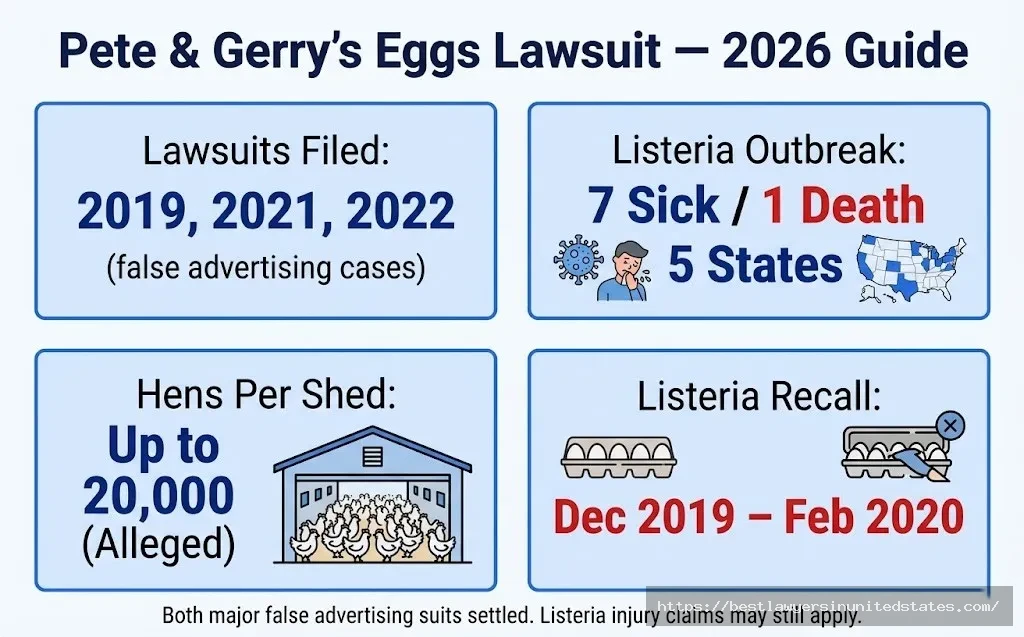
Quick Answer: Pete and Gerry’s Organics has been involved in two major categories of lawsuits. First, a series of class action false advertising suits (filed 2019–2022) alleged that Nellie’s Free Range Eggs misled consumers about hen living conditions. Both major cases settled and were dismissed. Second, a product liability/food safety lawsuit arose from a 2019–2020 Listeria recall of hard-cooked eggs processed at Almark Foods’ Gainesville, Georgia facility, which sickened at least 7 people in 5 states and caused one death. Individual personal injury claims related to the Listeria recall may still be viable depending on your state’s statute of limitations. An attorney should be consulted immediately.
What Are the Pete and Gerry’s Eggs Lawsuits About?
The Two Major Legal Battles Explained
There are two distinct lawsuits involving Pete and Gerry’s eggs, and they are completely separate legal matters — each targeting a different type of harm.
The first is the false advertising class action series, where consumers alleged that Pete and Gerry’s mislead buyers of Nellie’s Free Range Eggs into believing their hens lived in open, humane conditions with regular outdoor access. Shoppers paid a significant premium for these eggs based on that belief. The packaging showed hens “frolicking in elysian pastures,” as one federal judge described it. Investigators found a very different reality.
The second is the Listeria food safety recall and personal injury lawsuits stemming from a December 2019 outbreak. Hard-cooked eggs processed at a third-party facility in Georgia were contaminated with Listeria monocytogenes. Pete and Gerry’s products were among those recalled, and people who consumed these eggs — particularly vulnerable populations including pregnant women, the elderly, and the immunocompromised — faced serious health risks.
Here is a quick overview of both lawsuits side by side:
Pete and Gerry’s Eggs Lawsuit Overview Table
| Category | Details |
|---|---|
| Company | Pete and Gerry’s Organics, LLC |
| Brand Affected | Nellie’s Free Range Eggs |
| Headquarters | Monroe, New Hampshire |
| Lawsuit Type 1 | False Advertising / Consumer Deception Class Action |
| Lawsuit Type 2 | Food Safety / Listeria Product Recall Personal Injury |
| Primary Courts | U.S. District Court, Southern District of New York |
| Status (False Ad) | Both major class actions settled and dismissed |
| Status (Listeria) | Individual injury cases may still be filed depending on state |
| Governing Law | NY General Business Law §§ 349 & 350; Federal Food Safety Law |
Background: Who Is Pete and Gerry’s Organics?
Pete and Gerry’s became the first certified humane egg producer in the United States in 2003, and a decade later became the first egg producer in the world to achieve certified “benefit corporation” status. The Monroe, New Hampshire company works with approximately 130 family farms and positions itself as a leader in ethical egg production. Nellie’s Free Range Eggs is its flagship brand, sold in major retailers including Whole Foods nationwide.
That certification — and its heavy use in marketing — became the foundation of the legal disputes. Critics, backed by PETA investigators, argued the gap between the marketing imagery and the actual farm conditions on the ground was substantial enough to deceive reasonable consumers. Medication Error Lawsuit
The False Advertising Lawsuits: A Full Timeline
Timeline of the Pete and Gerry’s False Advertising Lawsuits
| Date | Event | Details |
|---|---|---|
| 2018 | PETA undercover investigation | Footage from a Nellie’s supplier showed roughly 20,000 hens in a single overcrowded shed |
| March 9, 2019 | First class action filed | Lugones et al. v. Pete and Gerry’s Organics, Case No. 1:19-cv-02097, SDNY |
| 2019 (Fall) | PETA releases consumer reaction video | Whole Foods shoppers watch undercover footage; express shock |
| February 2020 | Federal judge partially dismisses first case | Some claims survive; false advertising claims allowed to proceed |
| May 2020 | First case settled and dismissed | Confidential settlement; case closed |
| April 21, 2021 | Second class action filed | Mogull v. Pete and Gerry’s Organics, Case No. 7:21-cv-03521, SDNY |
| 2022 | Judge denies motion to dismiss (Mogull case) | Judge Briccetti rules “free range” is a factual claim, not mere puffery |
| March 2022 | Third follow-on lawsuit filed | New case proceeds based on PETA precedent |
| April 2023 | Mogull case settled and dismissed | Second major false advertising case resolved |
| 2024 | Additional lawsuits continue | New plaintiffs’ bar embraces PETA’s legal theory |
Who Filed the False Advertising Lawsuits?
Plaintiffs Michelle Lugones, Marcus Siezing, Tricia Rizzi, and Claudia Vassallo filed the first class action lawsuit against Nellie’s Free Range Eggs and Pete and Gerry’s Organics LLC, claiming the egg sellers misrepresented their hens as being treated with “love and kindness” when they were actually cruelly treated.
Lugones is a veterinarian, and Siezing grew up on a farm, so animal welfare was at the forefront of their purchasing decisions. Both say they purchased Nellie’s eggs multiple times between 2017 and 2018 from a Whole Foods in New York, based on the packaging images of hens depicted as “happy” and “enjoying themselves in green fields.”
The second major false advertising case was brought by Constance Mogull in 2021, represented by attorneys at Bursor & Fisher, PA. Mogull sued Pete and Gerry’s Organics LLC in 2021 in the US District Court for the Southern District of New York, alleging the company duped retail purchasers who would think the eggs come from hens able to move freely and roam outdoors, when they’re actually kept in overcrowded sheds.
What Were the Key Allegations?
The lawsuits alleged a dramatic difference between the Nellie’s Free Range Eggs marketing and the reality on the ground. Key allegations included:
- Pete and Gerry’s hens were crammed into sheds up to 20,000 at a time, preventing them from extending their wings, foraging, or making their way to the outdoor space advertised so prominently.
- Hens were not provided the outdoor time as advertised on Nellie’s Free Range packaging and were instead kept inside during the winter, inclement weather, and during the night and morning hours. To get outside, hens had to escape through small hatches along the sides of the shed.
- The hatches were closed all winter and during inclement weather and, in pleasant weather, closed at night until 1:00 p.m. the next day.
- Consumers paid a premium price for these eggs specifically because of the free-range and humane claims.
- Both lawsuits challenged the claim that hens had outdoor access and the companies’ use of industry-standard practices including chick killing, beak cutting, and sale for slaughter.
Birds in PETA’s eyewitness video footage had just 1.2 square feet of floor space each — barely larger than their bodies — and the tips of their beaks were seared or cut off to prevent aggression.
The Listeria Recall Lawsuits: A Separate, Serious Matter
What Happened With the Pete and Gerry’s Listeria Recall?
This is a completely different type of lawsuit — and far more serious in terms of direct personal harm. It centers on food contamination, hospitalization, and death, not marketing language.
The Almark Foods Egg lawsuit centers on Listeria contamination in hard-boiled egg products that led to multiple illnesses and one death across several states. These legal actions allege that Almark Foods failed to maintain proper safety standards in their Gainesville, Georgia facility, resulting in dangerous contamination of their products.
The recall, initiated on January 9, 2020, was linked to an outbreak at their production facility in Gainesville, Georgia. This incident led to multiple hospitalizations and one death, involving products supplied by Almark Foods.
Timeline of the Listeria Recall
| Date | Event | Details |
|---|---|---|
| December 19, 2019 | CDC announces multi-state Listeria outbreak | 7 illnesses confirmed across 5 states |
| December 23, 2019 | Almark Foods expands nationwide recall | All hard-boiled eggs from Gainesville, GA facility recalled |
| January 9, 2020 | Pete and Gerry’s issues own recall | Select hard-cooked egg products recalled |
| January 2020 | Multiple brand recalls follow | Nellie’s, Trader Joe’s, Kroger, and 80+ products affected |
| March 4, 2020 | CDC announces outbreak is over | All recalled products past “best by” date |
| 2020–Ongoing | Individual injury lawsuits filed | Personal injury claims in multiple states |
| February 2025 | FDA releases updated food safety guidelines | New Listeria monitoring requirements published |
Who Was Affected by the Listeria Recall?
National brands affected by the recall included Eggland’s Best, Pete and Gerry’s, Rainbow Farms, and Vital Farms. Hard-boiled eggs and egg salads were recalled from major food retailers including Trader Joe’s, Kroger, Walmart, Costco, and ShopRite.
The key identifying feature of recalled products: Affected products have a “Best If Used By” date that starts with a G, which means the product was manufactured at the Gainesville facility and should not be consumed.
At least seven people in five states were affected by the Listeria outbreak. Of those affected, four required hospitalization, and one person died from complications related to the infection. The states involved were Texas, South Carolina, Pennsylvania, Maine, and Florida. Nike Lawsuit 2026
Who Is Eligible for a Listeria-Related Lawsuit?
Eligibility Checklist for Pete and Gerry’s Listeria Personal Injury Claims
| Requirement | Details | Documentation Needed |
|---|---|---|
| Consumed recalled product | Pete and Gerry’s hard-cooked eggs with “Best By” date starting with “G” | Receipt, product packaging, photo of date code |
| Consumption window | December 2019 – early February 2020 | Approximate date and store of purchase |
| Diagnosed with Listeria | Medical confirmation of Listeria monocytogenes | Hospital records, lab results, doctor’s diagnosis |
| Suffered harm | Hospitalization, illness, pregnancy complication, death of family member | Medical bills, lost wage documentation |
| Within statute of limitations | Typically 1–3 years from date of illness; varies by state | Date of diagnosis records |
You may qualify for a Pete and Gerry’s egg recall lawsuit if you purchased any recalled Pete and Gerry’s hard-cooked eggs, the product has a “Best if Used By” date starting with the letter “G” (indicating production at Almark Foods’ Gainesville, Georgia facility), and you consumed the recalled eggs between December 2019 and February 2020.
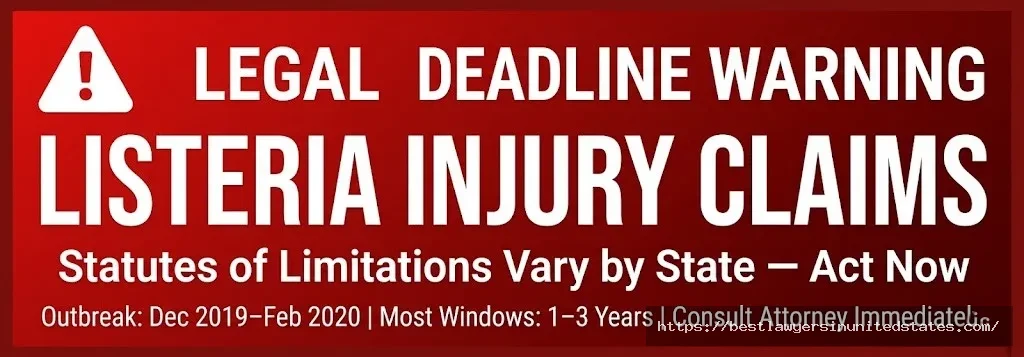
Important note on timing: Most state statutes of limitations for food poisoning lawsuits run 2 to 3 years from the date of illness. If you were sickened in late 2019 or early 2020, you may still have legal options under the discovery rule in some states — but you need to consult an attorney now. Don’t wait.
Damages You Can Pursue
Victims of Listeria contamination from Pete and Gerry’s recalled eggs may be entitled to compensation for medical expenses including hospital stays, treatments, medications, and ongoing care costs; lost wages for missed work due to illness; pain and suffering damages for physical pain and emotional distress; loss of enjoyment as compensation for reduced quality of life; and punitive damages in cases of gross negligence.
The False Advertising Settlement Outcomes
What Happened to the PETA-Backed Cases?
Both of the major false advertising class actions against Pete and Gerry’s were ultimately resolved through private settlement.
First Case (Lugones, 2019): Three months after a federal judge threw out claims alleging false advertising by Pete and Gerry’s Organics, the case was settled and dismissed. The settlement terms were not publicly disclosed. The case against Nellie’s was resolved via a negotiated settlement following the Southern District of New York’s decision permitting the plaintiffs’ claims to move forward.
Second Case (Mogull, 2021): A consumer’s deception claims against the producer of Nellie’s Free Range eggs were dismissed following a settlement. Her proposed class suit advanced after Judge Vincent L. Briccetti said reasonable consumers might not understand the meaning of “free range.”
The court’s refusal to dismiss these cases — ruling that “free range” is a factual claim rather than non-actionable puffery — was a landmark outcome. Because PETA Foundation lawyers’ theory of these cases has been upheld by the courts, it has been embraced by the broader plaintiffs’ bar. Additional similar lawsuits against Nellie’s have been filed since.
The Legal Precedent Set: Why This Matters
The judge’s ruling in the Mogull case was significant for the entire egg industry. The court found that because a reasonable consumer could interpret product descriptions as factual claims on which they could rely, defendant’s alleged misrepresentations are not non-actionable puffery.
In other words: if a company puts “free range,” “roams outdoors,” and shows pastoral imagery on its packaging, courts now recognize these as factual claims a consumer can sue over — not just vague promotional language. This precedent has driven a new wave of similar lawsuits across the egg industry.
What the False Advertising Lawsuits Mean for Consumers Today
Even though both major false advertising class actions against Pete and Gerry’s have been settled, the cases changed the legal landscape. Here is what you need to know in 2026:
Is there an open claim period for the false advertising settlements? No. Both cases settled confidentially and there is no active open claim period for consumers to file for compensation. If you purchased Nellie’s Free Range Eggs and believe you were harmed, your option is to consult an attorney about whether any new individual or class claims are viable.
Are new lawsuits still being filed? A federal judge has allowed a new class-action lawsuit against the company to move forward in New York, based on the legal arguments and precedent established in the PETA Foundation case. So yes — additional litigation continues.
What did Pete and Gerry’s say? Nellie’s CEO Jesse Laflamme responded: “There are 300 million egg-laying hens in terrible conditions nationally, and we’re one of the few companies that does not keep a single hen in a cage.” He added that Nellie’s is Humane Certified.
How Much Compensation Can Victims Get?
For the food safety/Listeria personal injury claims, there is no fixed settlement fund. These are individual cases where damages depend entirely on how severely you were harmed.
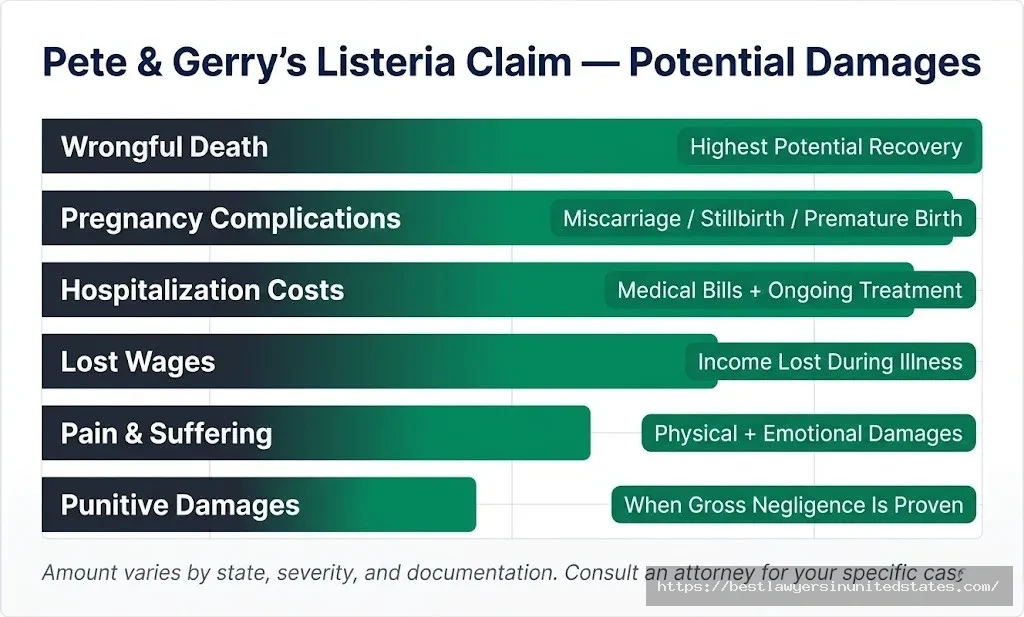
Compensation Factors in Pete and Gerry’s Listeria Injury Claims
| Damage Category | What It Covers | Typical Range |
|---|---|---|
| Medical Expenses | Hospital stays, medications, ongoing treatment | Actual costs (documented) |
| Lost Wages | Income missed due to illness | Documented income loss |
| Pain and Suffering | Physical pain, emotional trauma | Varies widely |
| Pregnancy Complications | Miscarriage, stillbirth, premature delivery | Significant damages |
| Wrongful Death | Death of family member | Estate and dependent damages |
| Punitive Damages | When gross negligence is proven | Multiplied damages possible |
Individual compensation varies based on illness severity, medical costs, and other factors. Completing a successful claim under the law can lead to settlements ranging from thousands to significant amounts for affected consumers in Listeria foodborne illness cases.
For the false advertising claims, since those class actions are settled with no open claim period, there is no current compensation available to general consumers.
Current Status and Latest Developments (2026)
Where Things Stand Right Now
The Pete and Gerry’s eggs legal story is not fully closed. Here is the current state of each legal action:
False Advertising Lawsuits: Both major PETA-backed class actions (Lugones 2019; Mogull 2021) have been settled and dismissed. However, follow-on lawsuits using the same legal arguments are still active in New York federal courts. The legal theory — that “free range” labeling with idyllic farm imagery misleads consumers — has been firmly validated by multiple federal judges. No open class action settlement currently accepts new claims from the public.
Listeria Recall Injury Claims: The 2019–2020 Listeria outbreak is over, but individual victims who suffered serious harm may still be able to file lawsuits depending on their state’s statute of limitations and discovery rule. With statutes of limitations typically ranging from 1–3 years — and some states applying a discovery rule from when you learned your illness was linked to the eggs — time-sensitive advice from a food poisoning attorney is essential.
FDA and Food Safety Landscape: In February 2025, the FDA released new guidelines for food safety practices in response to Listeria outbreaks, emphasizing the importance of monitoring food products for contamination. This is part of ongoing federal efforts to tighten oversight of hard-cooked egg processors.
Recent Developments Timeline
| Date | Development |
|---|---|
| April 2023 | Mogull v. Pete and Gerry’s settled and dismissed |
| 2024 | New follow-on false advertising lawsuits filed against Nellie’s by broader plaintiffs’ bar |
| February 2025 | FDA releases updated Listeria food safety guidelines |
| 2025–2026 | Individual Listeria injury cases may still proceed depending on state law |
| March 2026 | Multiple law firms still accepting potential Listeria claimant reviews |
Comparison: Pete and Gerry’s Lawsuits vs. Similar Cases
How This Compares to Other Egg Industry Lawsuits
Pete and Gerry’s is not alone. The legal precedent it set has sparked action across the egg industry. Greenies Lawsuit
Egg Industry Lawsuit Comparison
| Lawsuit | Type | Company | Allegation | Outcome |
|---|---|---|---|---|
| Lugones v. Pete and Gerry’s (2019) | False advertising | Pete and Gerry’s / Nellie’s | “Free range” misrepresentation | Settled & dismissed |
| Mogull v. Pete and Gerry’s (2021) | False advertising | Pete and Gerry’s / Nellie’s | “Free range” misrepresentation | Settled (April 2023) |
| Usler v. Vital Farms (2022) | False advertising | Vital Farms | “Pasture-raised” misrepresentation | Still active |
| Follow-on Nellie’s lawsuit (2022+) | False advertising | Pete and Gerry’s / Nellie’s | Based on PETA precedent | Active |
| Almark/Pete and Gerry’s Listeria (2020) | Product liability | Almark Foods / Pete and Gerry’s | Listeria contamination, one death | Individual cases ongoing |
| Eggland’s Best (separate) | False advertising | Eggland’s Best | “25% less saturated fat” claim | Separate ongoing litigation |
What Makes the Pete and Gerry’s Cases Unique
A few things set the Pete and Gerry’s litigation apart from typical false advertising cases. First, the company held a “certified humane” status — making the gap between its marketing and the alleged reality more striking legally. Second, the PETA Foundation drove the original litigation strategy, building an unusually strong evidentiary record including undercover video footage. Third, the courts explicitly ruled that “free range” on egg packaging is a factual claim — not vague promotional puffery — which created precedent protecting consumers in all future egg marketing cases.
The Listeria component adds a tragic dimension: people were killed and hospitalized from a food product, and the supply chain accountability questions raised by that recall continue to influence FDA policy.
Do You Need a Lawyer?
Quick Answer: For the Listeria food safety claims — yes, you absolutely need an attorney, especially given statute of limitations concerns. For the false advertising cases, there is no active class action claim period open, but an attorney can assess whether you have any remaining individual options.
When You Should Call an Attorney Immediately
You should contact a food poisoning or product liability lawyer right now if:
- You were diagnosed with Listeria in late 2019 or 2020 after consuming hard-cooked eggs with “Best By” dates starting with “G”
- You were hospitalized or suffered serious illness after eating recalled Pete and Gerry’s hard-cooked eggs during this period
- You experienced a pregnancy complication (miscarriage, premature birth, stillbirth) after consuming recalled products
- A family member died after consuming these recalled eggs
These are serious, potentially life-altering personal injury cases. Don’t try to handle them alone.
For False Advertising Claims
If you bought Nellie’s Free Range Eggs believing the hens were genuinely free-range and you paid a premium for that belief, your best option is to consult an attorney to see whether any new active class actions or individual claims are available. The settled cases no longer have open claim periods, but the legal landscape continues to evolve.
Free Case Evaluation Resources
Many food poisoning and consumer rights law firms offer free, no-obligation consultations for Listeria cases. Contact a licensed attorney in your state. You can also reach out to attorney referral services or contact consumer protection offices in your state for guidance.
Frequently Asked Questions
What is the Pete and Gerry’s eggs lawsuit?
Quick Answer: There are two separate sets of lawsuits. First, a series of false advertising class actions alleged Nellie’s Free Range Eggs misled consumers about hen living conditions. Both major suits settled. Second, individual personal injury lawsuits arose from a 2019–2020 Listeria contamination in Pete and Gerry’s hard-cooked eggs, which sickened at least 7 people and killed one.
Are there currently any open claims I can file for the false advertising settlement?
Quick Answer: No. Both major class action false advertising cases have been settled and dismissed. There is no active open claim period for general consumers to file. If new class actions are filed and certified, class members would typically be notified by mail or published notice.
Who is eligible for the Listeria recall lawsuit?
Quick Answer: You may be eligible if you consumed Pete and Gerry’s hard-cooked eggs with “Best By” dates starting with “G” between December 2019 and February 2020, were diagnosed with Listeria monocytogenes, and suffered documented harm. Consult an attorney immediately — statutes of limitations vary by state and may be running out.
What brands were affected by the Listeria recall?
Products were sold under brand names including Nellie’s, Pete and Gerry’s, Eggland’s Best, Kirkland Signature, Kroger, Trader Joe’s, Vital Farms, and many others — all sourced from Almark Foods’ Gainesville, Georgia facility.
How do I know if my eggs were part of the Listeria recall?
Affected products have a “Best If Used By” date that starts with a G, which means the product was manufactured at the Gainesville facility. If your package had a “Best By” date beginning with the letter G, it was included in the recall.
How many people got sick from the recalled eggs?
At least seven people in five states were affected by the Listeria outbreak. Of those affected, four required hospitalization, and one person died from complications related to the infection. The states affected were Texas, South Carolina, Pennsylvania, Maine, and Florida.
What is Listeria and why is it dangerous?
Symptoms of Listeria infection include fever, nausea, muscle aches, and diarrhea. If the infection spreads to the nervous system, symptoms may include loss of balance, convulsions, stiff neck, headaches, and confusion. Symptoms can show up between a few days and 30 days after ingesting the bacteria. Listeria is especially dangerous for pregnant women, people over 65, and those with weakened immune systems.
Why did the courts allow the false advertising cases to move forward?
The court found that because a reasonable consumer could interpret the disputed product descriptions as factual claims on which they could rely, defendant’s alleged misrepresentations are not non-actionable puffery. The judge said “free range” is a factual promise — not just marketing fluff — and consumers have the right to sue when that promise is broken.
What exactly did PETA find at Nellie’s farms?
PETA eyewitness video footage from a Nellie’s egg supplier revealed that around 20,000 hens were crammed into a single crowded shed with severely restricted access to the outdoors — which they could reach only by fighting their way to hatchways.
Did Pete and Gerry’s admit wrongdoing?
No. Both false advertising class actions settled on confidential terms without any admission of liability. Pete and Gerry’s maintained throughout the litigation that its marketing was accurate and that it is a leader in humane egg production.
What did the courts say about “free range” as a marketing term?
According to the court, “free-range” is an affirmative claim about a product’s qualities — that the eggs were produced by hens with extended access to indoor and outdoor space — and is not an exaggeration or overstatement expressed in broad, vague, and commendatory language. Because a reasonable consumer could interpret the disputed product descriptions as factual claims on which they could rely, the court denied the request for dismissal.
Are more lawsuits still coming for Pete and Gerry’s?
Yes. Because PETA Foundation lawyers’ theory of these cases has been upheld by the courts, it has been embraced by the broader plaintiffs’ bar, and additional similar lawsuits have been filed by lawyers for other plaintiffs.
What happened to Almark Foods after the Listeria outbreak?
Almark Foods has discontinued the production of hard-boiled eggs at its Gainesville facility. The company shut down that plant following the outbreak.
Can I still file a Listeria lawsuit today in 2026?
It depends heavily on which state you are in. Most states have statutes of limitations of 1–3 years for food poisoning lawsuits, though many apply a “discovery rule” that starts the clock from when you knew or should have known your illness was linked to the contaminated product. Given that the outbreak occurred in late 2019–early 2020, traditional limitations periods have likely expired in many states. However, some states have longer windows, and the discovery rule can extend them. You need to speak to a food poisoning attorney in your state today.
What is “humane washing” and why does it matter?
“Humane washing” is when a food company uses misleading imagery and language to suggest better animal welfare than actually exists — the same way “greenwashing” involves false environmental claims. The Pete and Gerry’s cases helped establish that humane washing is legally actionable under consumer protection law, not just an ethical complaint.
What should I do if I still have recalled eggs?
Do not consume them. Discard the product, and if you still have the packaging, preserve it as potential documentation if you are pursuing a legal claim. Wash and sanitize any surfaces in your refrigerator where the eggs were stored.
How is this lawsuit different from other food recalls?
Most food recalls result in product refunds. What sets the Listeria outbreak cases apart is that people were seriously harmed — hospitalized and in one case killed. These cases go well beyond a simple product exchange. They involve personal injury lawsuits seeking compensation for the actual medical harm suffered, which can include medical costs, lost wages, pain and suffering, and in deaths, wrongful death claims.
Were other major brands involved in the same Listeria recall?
Yes. The expanded recall included popular brands and organic fare including Eggland’s Best, Pete and Gerry’s, and Vital Farms. Trader Joe’s egg and potato salads were recalled too, because Almark Foods provided broken egg whites used in their production.
What should consumers look for when buying “free range” eggs after these cases?
These lawsuits have put the entire egg industry on notice. When buying eggs, look for third-party audited certifications rather than relying on packaging imagery alone. The cases show that terms like “free range” can be used even when outdoor access is minimal. Certifications from organizations with published, auditable standards offer more reliable information than marketing claims alone.
Key Takeaways for 2026
The Pete and Gerry’s eggs lawsuits represent two very different types of consumer harm — and two very different legal paths.
The false advertising class actions have largely run their course. They settled. They changed the law. They put “humane washing” on the legal map. But if you are hoping to file a claim for a refund on Nellie’s eggs today, there is no active settlement to join.
The Listeria recall cases are a different story. If you or a family member was seriously harmed after consuming recalled Pete and Gerry’s hard-cooked eggs in late 2019 or early 2020, personal injury claims may still be possible — but the window may be closing fast depending on where you live.
The biggest mistake you can make is waiting. Whether you want information about ongoing false advertising litigation or believe you have a Listeria injury claim, speaking to a consumer protection or food poisoning attorney costs nothing for an initial consultation and could make a significant financial difference to you and your family.
