
Apple faces multiple class action lawsuits in 2026, and millions of customers could receive settlement payments ranging from $25 to $500 or more. If you own an iPhone, use Apple Pay, or downloaded apps from the App Store, you might have money waiting for you.
This guide covers every active Apple lawsuit in 2026. You will learn which cases are accepting claims right now. You will see exactly how much money people are getting.
The biggest case involves Apple Pay fees. It could pay out over $100 million to affected users.
Here is everything you need to know about eligibility, deadlines, filing instructions, and realistic payout expectations. Some deadlines hit as early as spring 2026. Do not miss your chance to claim what you are owed.
Apple Class Action Lawsuit
An Apple class action lawsuit is a legal case where many people sue Apple together as one group. Instead of thousands of individual lawsuits, one case represents everyone harmed by the same Apple practice or product defect.
These lawsuits happen when Apple allegedly breaks consumer protection laws. Common reasons include deceptive advertising, privacy violations, product defects, and anticompetitive business practices.
| Lawsuit Type | Common Claims | Typical Payout Range |
|---|---|---|
| Product Defect | Battery issues, screen failures | $50 to $300 |
| Privacy Violation | Data collection, Siri recordings | $25 to $150 |
| Antitrust/Fees | App Store fees, Apple Pay fees | $100 to $500 |
| False Advertising | Storage claims, performance claims | $25 to $100 |
Class action lawsuits benefit consumers who suffered small individual losses. Hiring a lawyer for a $50 problem makes no sense. But when millions of people lost $50 each, a class action becomes powerful.
Apple has paid out billions of dollars in class action settlements over the past decade. The company continues facing new cases in 2026 across multiple legal fronts.
You do not need to hire a lawyer to participate. Settlement administrators handle everything. You just need to file a claim before the deadline.
Apple Pay Class Action Lawsuit
The Apple Pay class action lawsuit alleges Apple forces banks and merchants to pay excessive fees for mobile payment transactions. These costs get passed down to consumers through higher prices.
Apple charges card issuers 0.15% on credit card transactions processed through Apple Pay. This fee structure allegedly violates antitrust laws by exploiting Apple’s dominant market position.
The lawsuit, filed in federal court, claims Apple maintains a monopoly over mobile payments on iOS devices. iPhone users cannot choose alternative payment systems. They are locked into Apple Pay if they want tap-to-pay convenience.
Key allegations include:
- Apple blocks competing mobile wallets from using iPhone NFC chips
- Banks pass Apple Pay fees to consumers through higher interest rates
- Merchants raise prices to cover the additional transaction costs
- Apple earns billions annually from these allegedly anticompetitive fees
Settlement negotiations are ongoing in 2026. Legal experts estimate the settlement fund could reach $100 million to $250 million depending on final court approval.
If you used Apple Pay between 2019 and 2024, you likely qualify for this lawsuit. No proof of specific transactions is required for most claimants.
Class Action Lawsuit Against Apple
Filing a class action lawsuit against Apple requires meeting strict legal standards. The case must show Apple harmed a large group of people in a similar way through the same conduct.
Courts certify class actions when individual lawsuits would be impractical. A judge must approve the “class” before the lawsuit can proceed on behalf of everyone.
| Requirement | What It Means |
|---|---|
| Numerosity | Too many plaintiffs for individual suits |
| Commonality | Same legal questions apply to everyone |
| Typicality | Lead plaintiffs have typical claims |
| Adequacy | Class representatives will protect everyone’s interests |
Apple fights class certification aggressively. The company employs top law firms to argue each case should be handled individually. This strategy works sometimes but fails when the harm is clearly widespread.
Once a class gets certified, Apple faces enormous pressure to settle. Trial risks billions in potential damages. Most Apple class actions settle before trial.
Recent class actions against Apple include:
- App Store fee overcharges to developers and consumers
- Siri voice assistant privacy violations
- iPhone battery throttling without disclosure
- MacBook butterfly keyboard defects
- Apple Watch heart rate sensor accuracy claims
The federal court in Northern California handles most major Apple lawsuits. Judge Yvonne Gonzalez Rogers has overseen several high-profile cases against the company.
Key Takeaway: Apple faces class action lawsuits across product defects, privacy violations, and anticompetitive practices, with settlements potentially reaching hundreds of millions in 2026.
Apple Lawsuit Settlement 2026
Apple lawsuit settlements in 2026 include several active cases with approved or pending payouts. Some settlements reached final approval while others await court confirmation.
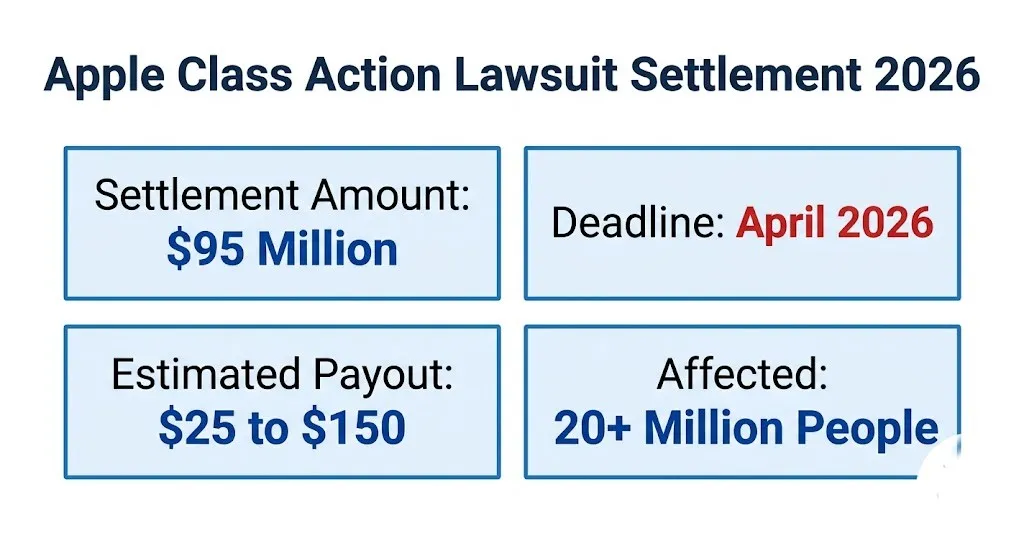
The largest 2026 settlement involves the Siri privacy lawsuit, which reached a $95 million settlement for claims that Siri recorded conversations without user consent. Apple denied wrongdoing but agreed to pay eligible class members.
| Settlement | Amount | Status | Expected Payment Date |
|---|---|---|---|
| Siri Privacy | $95 million | Final Approval Pending | Mid-2026 |
| App Store Fees | $100 million | Claims Open | Late 2026 |
| MacBook Keyboard | $50 million | Payments Processing | Early 2026 |
| Apple Pay Fees | TBD | Negotiations Ongoing | 2026-2027 |
Settlement funds get divided among all valid claimants. The more people who file claims, the smaller each individual payment becomes. Filing early does not increase your payout.
Attorney fees typically take 25% to 33% of the total settlement. Administrative costs consume another portion. The remaining money goes to class members.
Apple settlements usually require court approval through a multi-step process. Preliminary approval comes first. Then class members receive notice. Finally, a fairness hearing determines if the settlement adequately compensates everyone.
You should file claims for every settlement you qualify for. Many Apple customers are eligible for multiple payouts in 2026.
How to File Apple Lawsuit Claim
Filing an Apple lawsuit claim takes about 10 to 15 minutes for most people. You need basic information about your Apple purchases and a few minutes to complete online forms.
Each lawsuit has its own settlement website run by a court-appointed administrator. You cannot file claims directly with Apple. The settlement administrator verifies eligibility and processes payments.
Step-by-step filing process:
- Identify qualifying lawsuits by checking settlement administrator websites
- Gather your Apple ID email and approximate purchase dates
- Visit the official claim form page for each settlement
- Enter your contact information and answer eligibility questions
- Provide purchase documentation if required
- Submit the claim before the deadline
- Save your confirmation number for tracking purposes
Some claims require proof of purchase. Others only need your sworn statement that you owned the qualifying Apple product during the class period.
| Documentation Level | What You Need | Example Settlements |
|---|---|---|
| No Proof Required | Just your word | Siri Privacy, some App Store claims |
| Basic Proof | Apple ID confirmation | Apple Pay claims |
| Full Documentation | Receipts or repair records | MacBook Keyboard, Battery cases |
Filing false claims is fraud. Settlement administrators cross-reference claims against Apple’s sales records. They reject suspicious submissions and may refer fraud cases for prosecution.
Apple Lawsuit Payout Amount
Apple lawsuit payout amounts vary dramatically based on the specific case and your qualifying purchases. Individual payments range from $25 for simple claims to $500 or more for product defect cases with documented repairs.
The Siri privacy settlement offers approximately $20 per device for claimants who can show they owned qualifying devices. With the $95 million fund, payments could reach this level if claim rates stay moderate.
| Lawsuit Type | Low Estimate | High Estimate | Factors Affecting Payout |
|---|---|---|---|
| Privacy Cases | $20 | $150 | Number of devices, opt-in vs. default claims |
| Product Defects | $50 | $500 | Repair costs, replacement expenses |
| Fee Overcharges | $25 | $300 | Purchase volume, spending history |
| Data Breaches | $100 | $5,000 | Documented harm, identity theft |
Claim rates heavily influence final payouts. When only 10% of eligible people file claims, individual payments increase. When 50% file, payments shrink proportionally.
Documented damages always pay more. If you paid for repairs Apple should have covered, include those receipts. If you lost data or time dealing with product failures, describe those losses.
Pro tip: File claims for every Apple settlement you qualify for. These payments add up. Someone eligible for three different lawsuits could receive $300 to $800 total in 2026.
Key Takeaway: Individual Apple lawsuit payouts typically range from $25 to $500, with total potential earnings exceeding $500 for people eligible for multiple active settlements in 2026.
Am I Eligible for Apple Lawsuit
You are likely eligible for at least one Apple class action lawsuit if you owned Apple products or used Apple services during specific time periods. Most lawsuits cover purchases made between 2017 and 2024.
Eligibility depends on three factors: what Apple product you owned, when you owned it, and where you purchased it. U.S. residents qualify for most settlements. Some include international customers.
Quick eligibility checklist:
- Do you have or have you had an iPhone, iPad, Mac, or Apple Watch?
- Did you use Apple Pay for purchases between 2019 and 2024?
- Have you downloaded apps or made in-app purchases from the App Store?
- Did you experience product defects requiring repair or replacement?
- Did you use Siri voice assistant on any Apple device?
If you answered yes to any question, you probably qualify for at least one settlement.
| Settlement | Qualifying Products | Class Period | Geographic Scope |
|---|---|---|---|
| Siri Privacy | iPhone, iPad, Apple Watch, HomePod | 2014-2019 | United States |
| App Store Fees | Any iOS device | 2016-2024 | United States |
| Apple Pay Fees | iPhone with Apple Pay | 2019-2024 | United States |
| MacBook Keyboard | MacBook Pro 2016-2019 | 2016-2019 | United States |
You do not need to prove you were personally harmed to join most class actions. Simply owning the qualifying product during the class period creates eligibility.
Check your Apple purchase history through your Apple ID account. This shows every device registered to your account and when you bought it.
Apple Pay Lawsuit Claim
The Apple Pay lawsuit claim process focuses on proving you used Apple’s mobile payment service during the relevant period. Unlike product defect cases, you do not need receipts for specific transactions.
This lawsuit alleges Apple’s payment processing fees inflate consumer costs. Everyone who used Apple Pay absorbed these hidden expenses through higher merchant prices and banking fees.
What you need to file:
- Your Apple ID email address
- Confirmation you used Apple Pay between 2019 and 2024
- Your current mailing address for payment
- Optional: estimate of your Apple Pay transaction volume
The settlement administrator can verify Apple Pay usage through Apple’s records. Your Apple ID links to all Apple Pay transactions. This makes documentation easier than physical product cases.
| Claim Tier | Apple Pay Usage | Expected Payout |
|---|---|---|
| Light User | Under 50 transactions | $25 to $50 |
| Regular User | 50-200 transactions | $50 to $150 |
| Heavy User | Over 200 transactions | $150 to $300 |
Heavy Apple Pay users may receive larger payments. Some settlement structures reward people who used the service frequently because they absorbed more fees.
The exact claim deadline depends on court approval timing. Watch for official notice emails from the settlement administrator starting in early 2026.
Lawsuit Against Apple
A lawsuit against Apple can target the company for product liability, consumer fraud, antitrust violations, securities fraud, privacy breaches, or employment practices. Different legal theories apply to different Apple misconduct.
Consumer lawsuits make up the largest category. These target Apple products that failed, services that underperformed, or practices that overcharged customers.
Current lawsuit categories against Apple:
- Antitrust: App Store fees, Apple Pay monopoly, smartphone market dominance
- Privacy: Siri recordings, location tracking, third-party data sharing
- Product Liability: Battery issues, keyboard failures, display problems
- Securities Fraud: Investor claims about hidden problems affecting stock price
- Employment: Contractor treatment, wage disputes, discrimination claims
Government lawsuits represent the most serious threat to Apple. The Department of Justice filed an antitrust case in 2024 that continues through 2026. This case could force Apple to change how the App Store operates.
| Lawsuit Source | Potential Impact | Timeline |
|---|---|---|
| Individual Class Actions | Settlements, refunds | 1-3 years |
| State Attorneys General | Fines, policy changes | 2-5 years |
| Federal Government | Major business changes | 3-7 years |
| International Regulators | Market access, fines | Ongoing |
Private lawsuits and government enforcement actions often overlap. A successful government case can support private claims by establishing Apple’s wrongdoing.
Key Takeaway: Lawsuits against Apple come from consumers, government regulators, and competitors, with class actions offering the fastest path to settlement payments for everyday users.
Apple Lawsuit Deadline 2026
Apple lawsuit deadlines in 2026 span from early spring through late fall depending on the specific settlement. Missing these dates means losing your right to payment permanently.
The Siri privacy settlement claim deadline is expected in April 2026. This gives class members several months to file after final approval. Court schedules can shift these dates slightly.
| Settlement | Expected Claim Deadline | Final Payment Date |
|---|---|---|
| Siri Privacy | April 2026 | August 2026 |
| App Store Fees | July 2026 | December 2026 |
| MacBook Keyboard | Claims Closed | Payments in Progress |
| Apple Pay Fees | TBD (Late 2026) | 2027 |
Critical dates to watch:
- Preliminary Approval: Court accepts settlement terms
- Notice Period: Class members receive notification (60-90 days typically)
- Claim Deadline: Last day to submit your claim
- Objection Deadline: Last day to oppose the settlement
- Fairness Hearing: Court decides if settlement is adequate
- Final Approval: Settlement becomes binding
- Payment Distribution: Checks or deposits sent to claimants
Set calendar reminders for each deadline. Settlement administrators send email notices, but these sometimes land in spam folders. Do not rely solely on email notification.
You can check deadlines at any time by searching “[settlement name] claim deadline” or visiting the official settlement website.
Apple Antitrust Lawsuit
The Apple antitrust lawsuit attacks how Apple controls the iOS ecosystem. The Department of Justice and multiple state attorneys general argue Apple maintains an illegal monopoly over smartphone markets.
The core allegation: Apple deliberately makes it hard to switch from iPhone to Android. The company also blocks competing services from accessing iPhone features that Apple’s own apps use freely.
Specific antitrust claims:
- Apple Pay gets exclusive access to iPhone NFC chips
- iMessage creates “green bubble” stigma to discourage switching
- App Store rules prohibit alternative payment systems
- Apple Watch works poorly with non-iPhone devices
- Cloud services lock users into Apple ecosystem
This case differs from consumer class actions. The government seeks to change Apple’s behavior, not just pay damages. Potential remedies include forcing Apple to open the iPhone to competing services.
| Antitrust Issue | What Apple Does | Proposed Remedy |
|---|---|---|
| NFC Access | Blocks competing wallets | Open NFC to all payment apps |
| App Store Payments | Forces Apple payment system | Allow alternative payment options |
| iMessage | Degrades Android messages | Open messaging protocol |
| Smartwatch | Limits Android pairing | Enable cross-platform features |
The DOJ antitrust case will take years to resolve. Trial is not expected until 2027 or later. However, settlement pressure may produce changes sooner.
Consumer benefits from this case are indirect. If Apple must open its platforms, competing services could lower prices and improve options for everyone.
Apple Privacy Lawsuit 2026
Apple privacy lawsuits in 2026 focus on how the company collects, stores, and uses customer data. Despite Apple’s marketing emphasis on privacy, several cases allege the company violated user trust.
The Siri privacy settlement addresses claims that Apple recorded conversations through Siri, even when users did not activate the assistant. Third-party contractors allegedly reviewed these recordings.
Privacy issues in current lawsuits:
- Siri recording private conversations without consent
- App tracking continuing despite privacy settings
- Location data collection beyond stated purposes
- Third-party data sharing for advertising
- Biometric data handling for Face ID and Touch ID
| Privacy Case | Core Allegation | Settlement Status |
|---|---|---|
| Siri Recording | Unauthorized listening | $95 million settlement |
| App Tracking | Deceptive privacy settings | Ongoing litigation |
| Location Data | Excessive collection | Pending class certification |
| Third-Party Sharing | Undisclosed data sales | Early litigation stage |
Apple denies wrongdoing in most privacy cases. The company argues its data practices comply with privacy policies users accepted. However, settlements suggest exposure Apple wants to eliminate.
If you care about data privacy, these lawsuits offer both compensation and accountability. Your claim participation tells Apple that customers expect actual privacy protection.
Key Takeaway: Apple faces antitrust and privacy lawsuits that could change how the company operates while also paying substantial settlements to affected customers in 2026.
Claim Apple Lawsuit
To claim an Apple lawsuit payment, you must complete the official claim form for each settlement you qualify for. There is no central portal covering all Apple lawsuits. Each settlement operates independently.
Start by identifying which settlements you are eligible for. Check the class period dates against your Apple purchase history. Then visit each settlement’s official website.
Common claim form questions:
- Your full legal name and current address
- Email address associated with your Apple ID
- What qualifying Apple products you owned
- When you purchased those products
- Whether you experienced the specific problem alleged in the lawsuit
- Your signature confirming the information is accurate
Most claims are submitted online. Some settlements offer paper claim forms for people without internet access. Call the settlement administrator for paper form requests.
| Claim Method | Processing Time | Best For |
|---|---|---|
| Online Form | 1-2 minutes to submit | Most people |
| Paper Form | 2-3 weeks to process | No internet access |
| Phone Claim | 10-15 minutes | Disability accommodations |
After submitting, save your confirmation number. This lets you check claim status and proves you filed before the deadline.
Claim review takes several weeks. Settlement administrators verify eligibility before approving payments. You will receive status updates by email.
Apple Lawsuit Claim Requirements
Apple lawsuit claim requirements vary by settlement but follow predictable patterns. Understanding these requirements helps you prepare documentation before claim forms open.
Most settlements divide claimants into tiers based on documentation level. People with strong proof receive larger payments. Those filing based on declarations receive smaller amounts.
Typical requirement categories:
| Documentation Level | What You Provide | Payment Tier |
|---|---|---|
| No Proof Required | Sworn statement only | Lowest payout |
| Basic Proof | Apple ID confirmation, serial number | Mid-level payout |
| Moderate Proof | Purchase receipt, repair record | Higher payout |
| Full Documentation | All receipts plus damage evidence | Maximum payout |
For product defect cases, repair records dramatically increase payments. If Apple replaced your MacBook keyboard three times, those service records prove you suffered the problem.
Where to find your Apple purchase documentation:
- Apple Store receipts in your email
- Apple Account purchase history online
- Credit card statements showing Apple purchases
- Apple repair service records
- Carrier records for iPhone purchases
You do not need perfect records for most claims. Approximate purchase dates and product descriptions often suffice for basic claim levels.
How Much Will I Get From Apple Lawsuit
Your Apple lawsuit payment depends on which cases you qualify for, how many people file claims, and what documentation you provide. Realistic expectations help avoid disappointment.
For the Siri privacy settlement, individual payments will likely range from $20 to $100 per device. The $95 million fund must cover attorney fees, administration costs, and all valid claims.
Payment estimate scenarios:
| Scenario | Claims Filed | Your Share (Single Device) |
|---|---|---|
| Low participation | 500,000 claims | $75 to $100 |
| Moderate participation | 2 million claims | $30 to $50 |
| High participation | 5 million claims | $15 to $25 |
These numbers are estimates based on typical settlement distributions. Actual payments depend on final claim numbers and court decisions.
Maximizing your total payout:
- File for every settlement you qualify for
- Provide documentation when available
- Claim for each qualifying device separately
- Watch for new settlements throughout 2026
- Do not miss any deadlines
Someone who owned three iPhones, used Apple Pay regularly, and had a MacBook keyboard failure could qualify for three or four different settlements. Combined payments might reach $300 to $600.
Payment methods vary by settlement. Most offer direct deposit or paper check options. Direct deposit is faster and more reliable.
Key Takeaway: Realistic individual payouts range from $20 to $150 per settlement, but claiming multiple lawsuits can generate total payments of $300 or more in 2026.
Apple Class Action Lawsuit List 2026
The complete Apple class action lawsuit list for 2026 includes settlements currently accepting claims, cases awaiting approval, and lawsuits in early litigation stages.
This list covers the most significant cases affecting consumers. Smaller or specialized lawsuits exist but affect fewer people.
Active settlements accepting claims in 2026:
| Case Name | Issue | Fund Size | Claim Status |
|---|---|---|---|
| Siri Privacy Settlement | Unauthorized recordings | $95 million | Claims opening early 2026 |
| App Store Developer Settlement | Excessive commission fees | $100 million | Claims open |
| Butterfly Keyboard Settlement | MacBook keyboard defects | $50 million | Payments processing |
Cases awaiting settlement approval:
| Case Name | Issue | Expected Fund | Timeline |
|---|---|---|---|
| Apple Pay Antitrust | Payment processing fees | $100-250 million | Settlement negotiations 2026 |
| iPhone Battery Throttling II | Performance reduction claims | TBD | Class certification stage |
| Apple Watch Heart Rate | Sensor accuracy claims | TBD | Early litigation |
Government enforcement actions:
- DOJ Antitrust Case (filed 2024, ongoing through 2027+)
- EU Digital Markets Act compliance
- Multiple state AG investigations
Check back throughout 2026 as new settlements reach approval. Apple continuously faces new lawsuits, and settlements in early stages today may pay claims later this year or in 2027.
Your best strategy: bookmark settlement notification websites and check monthly for new claim opportunities.
Frequently Asked Questions
How much money can I get from the Apple class action lawsuit in 2026?
Most Apple class action settlements pay between $25 and $150 per claim.
Your exact payout depends on which lawsuits you qualify for and how many people file claims.
Filing for multiple settlements could result in combined payments of $300 to $600 or more.
What is the deadline to file an Apple lawsuit claim?
Deadlines vary by settlement, with major 2026 deadlines falling between April and October.
The Siri privacy settlement deadline is expected around April 2026.
Always verify current deadlines on the official settlement administrator website.
Do I need a receipt to join the Apple class action lawsuit?
Most settlements do not require receipts for basic claims.
Your Apple ID account history and a sworn statement often satisfy documentation requirements.
Providing receipts or repair records qualifies you for higher payment tiers.
How do I know if I qualify for the Apple Pay lawsuit?
You qualify if you used Apple Pay on an iPhone between 2019 and 2024 in the United States.
The settlement administrator can verify your Apple Pay usage through Apple’s transaction records.
No specific transaction receipts are required to file a claim.
When will Apple lawsuit settlement payments be sent out?
Most 2026 Apple settlement payments will be distributed between mid-2026 and early 2027.
Payment timing depends on final court approval dates and claim processing periods.
Direct deposit payments typically arrive 2 to 4 weeks before paper checks.
Take Action on Your Apple Lawsuit Claims
You now know which Apple class action lawsuits could put money in your pocket in 2026. The Siri privacy settlement, App Store fee case, and Apple Pay lawsuit represent real opportunities for compensation.
File your claims before deadlines close. Start with the settlements closest to their deadline. Work through each case you qualify for.
Keep checking for new settlements throughout 2026. Apple faces ongoing legal pressure that will produce additional claim opportunities. Your vigilance today means money tomorrow.
