
The TurboTax lawsuit has already put money in the pockets of millions of Americans who were tricked into paying for tax software that should have been free. If you used TurboTax between 2016 and 2024 and paid for services you didn’t need, you might still be owed money.
Intuit, the company behind TurboTax, agreed to a $141 million settlement with all 50 state attorneys general. That’s separate from other legal actions, including a data breach lawsuit that could mean more compensation for some users.
Here’s the surprising part: about 4.4 million people qualified for automatic payments, but many still haven’t claimed what they’re owed. This guide covers everything you need to know about the turbo tax lawsuit in 2026, including who qualifies, how much you’ll get, and the deadlines that matter.
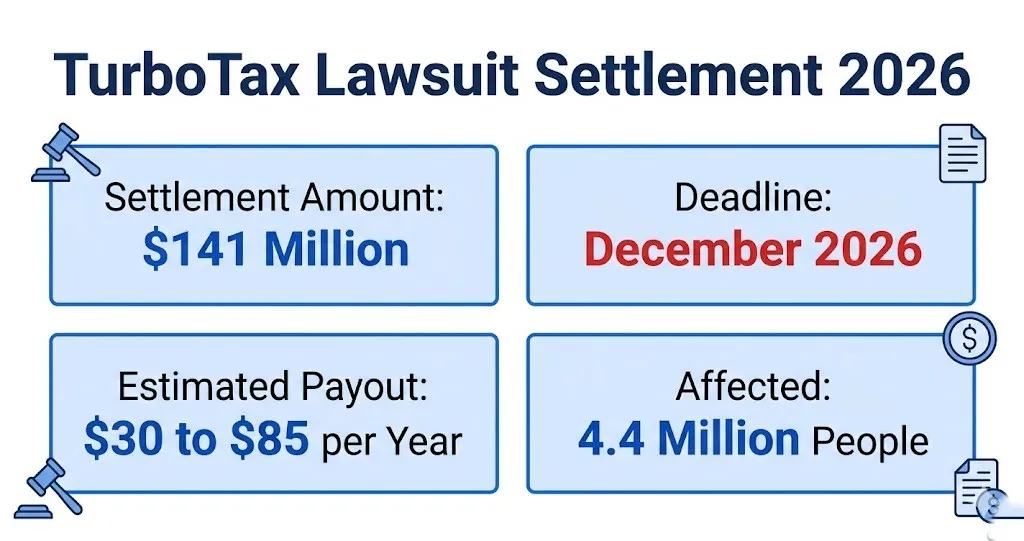
What Is the TurboTax Lawsuit About
The TurboTax lawsuit centers on deceptive marketing practices by Intuit that steered low-income Americans away from free tax filing options. State attorneys general from all 50 states accused the company of deliberately hiding its free product while aggressively promoting paid versions.
The core issue is simple. TurboTax participated in the IRS Free File program, which required them to offer free tax preparation to people earning under $73,000 annually. Instead of making this option easy to find, Intuit buried it.
| Lawsuit Element | Details |
|---|---|
| Defendant | Intuit Inc. |
| Settlement Amount | $141 million |
| Affected Users | 4.4 million people |
| Tax Years Covered | 2016 through 2022 |
| Lead Investigators | 50 State Attorneys General |
The company used tactics like hiding free options from search engines. They created confusing product names. They funneled eligible users toward paid products through misleading website design.
New York Attorney General Letitia James led the multistate investigation. Her office found that Intuit’s practices caused real financial harm to people who could least afford it.
TurboTax Class Action Lawsuit Explained
The TurboTax class action lawsuit is a legal mechanism that allows millions of affected consumers to seek compensation together rather than filing individual cases. This approach gives ordinary people power against a billion-dollar corporation.
Class action status means one lawsuit represents everyone who was harmed the same way. You don’t need your own lawyer. You don’t pay legal fees upfront. The settlement covers everyone who meets the eligibility criteria.
The class includes anyone who:
- Qualified for free IRS Free File services
- Was directed to paid TurboTax products instead
- Actually paid for tax preparation between 2016 and 2022
- Earned $73,000 or less during those tax years
Think of it like a neighborhood organizing against a landlord who overcharged everyone. One legal action, many beneficiaries, shared victory.
The difference between this and the state AG settlement matters. The state settlement resulted in automatic payments to most victims. A separate federal class action could provide additional compensation for some users.
TurboTax Settlement 2026: Latest Updates
The TurboTax settlement in 2026 has entered its distribution phase, with most automatic payments already sent to eligible consumers. New developments this year focus on unclaimed funds and extended claim periods.
Here’s what changed in 2026:
Payment Status:
- Initial automatic payments of $30 went out in 2023
- Second round payments increased amounts for multi-year filers
- Unclaimed fund redistribution began in early 2026
| 2026 Milestone | Status |
|---|---|
| Automatic Payments | Complete |
| Additional Claims | Open for some categories |
| Unclaimed Fund Distribution | In progress |
| Appeal Period | Closed |
| Final Accounting | Expected Q4 2026 |
The settlement administrator continues processing new claims from people who were missed in the original distribution. If you never received payment but believe you qualify, a late claim process exists.
Some states have dedicated portals for residents to check their individual status. New York, California, and Texas have the largest numbers of affected consumers.
How Much Will I Get from the TurboTax Lawsuit
Most people receive between $30 and $85 per tax year from the TurboTax lawsuit, depending on how many years they were affected. The total payout depends on your specific filing history and which products you purchased.
Your payment calculation works like this. Each qualifying tax year gets credited separately. Someone who paid for TurboTax in 2016, 2017, and 2018 when they should have filed free could receive roughly $90 to $255 total.
Payment Breakdown by Scenario:
| Years Affected | Estimated Total Payment |
|---|---|
| 1 year | $30 to $85 |
| 2 years | $60 to $170 |
| 3 years | $90 to $255 |
| 4 or more years | $120 to $340+ |
The exact amount varies based on the settlement fund allocation and total number of claimants. Early projections suggested higher per-person amounts, but the large class size spread the fund across more people.
Your payment arrives by check or direct deposit. The settlement administrator uses the contact information Intuit had on file from your tax returns.
TurboTax Lawsuit Payout Per Person Breakdown
The TurboTax lawsuit payout per person averages around $30 for each qualifying tax year, though some claimants received more based on their specific circumstances. The $141 million fund divided among 4.4 million people explains this amount.
Key Takeaway: The TurboTax settlement has distributed over $100 million to affected consumers, with per-person payouts ranging from $30 to $85 annually based on filing history and products purchased.
Do the math yourself. $141 million divided by 4.4 million people equals about $32 per person as a baseline. Multi-year filers and those who purchased premium products saw higher amounts.
Some factors that increased individual payouts:
- Filing in multiple qualifying years
- Purchasing higher-priced TurboTax products
- Having clear documentation of payments
- Being in a state with additional settlement terms
The payout per person disappointed some consumers who expected more. But remember, this settlement returned money that was wrongly taken without requiring you to hire a lawyer or prove anything complex.
People who filed six or seven years of taxes through TurboTax while qualifying for free options saw the largest checks. A few claimants reported total payments exceeding $400.
Can You Get $2,500 from the TurboTax Lawsuit
The $2,500 figure circulating online does not reflect actual settlement payouts from the primary TurboTax lawsuit. This number likely comes from confusion with the separate data breach case or exaggerated social media claims.
Let’s clear this up. The maximum realistic payout from the state AG settlement caps around $500 to $600 for someone affected every single year from 2016 to 2022. That’s still real money, but nowhere near $2,500.
| Claim Type | Maximum Realistic Payout |
|---|---|
| State AG Settlement (1 year) | $85 |
| State AG Settlement (all years) | $400 to $600 |
| Data Breach Claim (if applicable) | Varies widely |
| Combined Maximum | Potentially $1,000+ |
Where might $2,500 come from? The data breach lawsuit has different compensation structures. Identity theft victims with documented losses could potentially recover larger amounts.
If you saw ads promising $2,500 from TurboTax, be skeptical. Some third-party claim services exaggerate potential payouts to collect your information. Stick to official settlement channels.
TurboTax Lawsuit Eligibility Requirements
TurboTax lawsuit eligibility requires that you paid for TurboTax services during tax years 2016 through 2022 while qualifying for the free IRS Free File program. Income level and the product you used determine whether you’re in the class.
You likely qualify if:
- Your adjusted gross income was $73,000 or less
- You started using the TurboTax Free Edition but were “upgraded”
- You paid for TurboTax Deluxe, Premier, or Self-Employed
- You filed federal or state returns through TurboTax
- You were an active duty military member (automatic qualification)
Key Takeaway: Eligibility centers on income under $73,000 and paying for TurboTax products when free options existed. Active duty military members automatically qualify regardless of income.
The settlement automatically identified most eligible consumers using Intuit’s own records. If you qualified, you should have received notice by mail or email.
However, the system wasn’t perfect. Some people fell through the cracks. If you believe you qualify but never received notification, you can still check your eligibility through the settlement administrator.
State variations exist. Some states negotiated slightly different terms. California residents, for example, had additional protections that may affect their specific eligibility.
How to File a TurboTax Lawsuit Claim
Filing a TurboTax lawsuit claim is straightforward for most consumers because the settlement was designed to require minimal effort. The majority of eligible people received automatic payments without filing anything.
Here’s how the process works in 2026:
For Automatic Payment Recipients:
- Check your records for payment received in 2023 or 2024
- If you received it, no action needed
- If not received, contact the settlement administrator
For People Missed by Automatic Distribution:
| Step | Action Required |
|---|---|
| Step 1 | Gather tax records from 2016 to 2022 |
| Step 2 | Confirm your income was under $73,000 |
| Step 3 | Document what you paid for TurboTax |
| Step 4 | Submit late claim through official portal |
| Step 5 | Wait for verification and payment |
You do not need a lawyer. You do not pay fees. The settlement administrator handles everything.
Contact the settlement administrator by phone or their official website. Have your Social Security number ready for identity verification. They can look up whether you were included in the original distribution.
TurboTax Lawsuit Claim Process Step by Step
The TurboTax lawsuit claim process follows a clear path from eligibility verification to payment receipt. Understanding each step helps you track your claim and troubleshoot any issues.
Step 1: Determine Your Eligibility
Pull your tax records from 2016 to 2022. Check if your AGI was under $73,000. Confirm you paid for TurboTax products.
Step 2: Check if You Already Received Payment
Look through bank statements and mail from 2023 and 2024. Payments came from “Intuit Settlement” or “TurboTax Settlement Administrator.”
Step 3: Contact Settlement Administrator if Needed
If you qualify but never received payment, reach out directly. Have your tax years and personal information ready.
Step 4: Submit Documentation
For late claims, you may need:
- Tax returns showing income level
- Bank or credit card statements showing TurboTax payments
- Email confirmations from Intuit
Step 5: Receive Your Payment
Processing takes 8 to 12 weeks for new claims. Payment arrives by check unless you provided direct deposit information.
Key Takeaway: Most eligible consumers received automatic payments, but late claims remain possible in 2026 for those missed in initial distributions.
TurboTax Lawsuit Deadline You Need to Know
The primary TurboTax lawsuit deadline for filing claims has passed, but limited windows remain open for specific categories of affected consumers in 2026. Missing these final deadlines means forfeiting your compensation.
Critical Deadlines:
| Deadline Type | Date | Status |
|---|---|---|
| Original Claim Deadline | November 2023 | Closed |
| Automatic Payment Distribution | December 2023 | Complete |
| Late Claim Submission | Varies by state | Some still open |
| Unclaimed Funds Request | June 2026 | Open |
| Final Settlement Closing | December 2026 | Approaching |
The settlement will officially close in late 2026. After that point, no additional claims will be accepted for any reason.
If you believe you were incorrectly excluded, act now. The settlement administrator reviews cases individually, but they need time to process before final closing.
Some states extended their individual deadlines. Check your state attorney general’s website for state-specific information about remaining claim windows.
What Proof Is Required for the TurboTax Lawsuit
Proof requirements for the TurboTax lawsuit are minimal for most claimants because Intuit’s own records identified eligible consumers. You generally don’t need to dig up old receipts.
The automatic payment system used:
- Intuit’s customer database
- IRS Free File eligibility records
- Payment histories from TurboTax accounts
For late claims or disputes, you may need to provide:
| Document Type | Why It Helps |
|---|---|
| Tax returns | Proves income level |
| Bank statements | Shows payment to TurboTax |
| Email receipts | Confirms product purchased |
| TurboTax account history | Details years of use |
Most people won’t need any documentation. The settlement administrators already have access to Intuit’s records showing who paid for what.
If you’re filing a late claim, screenshots from your TurboTax account showing past returns can speed up the process. Your filing history is often still accessible through your Intuit account.
TurboTax Free File Lawsuit Background
The TurboTax Free File lawsuit stems from Intuit’s participation in a program designed to help low-income Americans file taxes for free, which the company allegedly sabotaged for profit. This background explains why the settlement exists.
Key Takeaway: Intuit promised the IRS it would offer free filing while simultaneously hiding that option from the people who qualified for it, putting profits over the program’s public benefit mission.
In 2002, major tax software companies made a deal with the IRS. They would provide free tax filing to Americans earning below certain income thresholds. In exchange, the IRS agreed not to create its own free filing system.
TurboTax technically complied. They offered a free product. But they:
- Hid the free version from search engines using code
- Created confusingly named products
- Designed websites that pushed users toward paid options
- Used aggressive upselling during the filing process
ProPublica’s investigative journalism exposed these tactics in 2019. State attorneys general launched their investigation shortly after. The evidence was overwhelming.
Internal Intuit documents showed executives knew they were steering eligible customers away from free options. Emails discussed strategies to maximize “conversion” from free to paid products.
TurboTax Deceptive Advertising Lawsuit Details
The TurboTax deceptive advertising lawsuit specifically targeted Intuit’s marketing claims that prominently featured “free” while burying the actual conditions and limitations. The FTC also brought separate action on this front.
Deceptive Practices Documented:
- TV ads saying “free free free” without explaining qualifications
- Website design using dark patterns to confuse users
- Hiding the legitimate free option from Google searches
- Adding fees late in the filing process after users invested time
- Automatic upgrades to paid products without clear consent
| Advertising Claim | Reality |
|---|---|
| “Free for all” | Only free for simple returns |
| “Free guaranteed” | Fees applied for many common situations |
| “Start for free” | Upgrade required to complete filing |
| “Absolute zero” | Zero only applied to specific products |
The FTC ordered Intuit to stop these practices permanently. Future TurboTax advertising must clearly disclose who actually qualifies for free filing.
This case set a precedent. Other companies using similar dark pattern tactics now face increased regulatory scrutiny. The deceptive advertising claim was central to both the state AG action and federal oversight.
Intuit TurboTax Settlement Terms
The Intuit TurboTax settlement terms required the company to pay $141 million and fundamentally change how it advertises and delivers free tax filing options. Money was only part of the remedy.
Financial Terms:
| Component | Amount |
|---|---|
| Consumer Payments | $141 million |
| State Costs | Included in total |
| Administrative Fees | Deducted from fund |
Behavioral Changes Required:
Intuit must now:
- Make free filing options easily discoverable
- Stop hiding products from search engines
- Clearly disclose who qualifies for free services
- End deceptive upselling practices
- Submit to monitoring for compliance
The company did not admit wrongdoing. That’s standard in settlements. But the size of the payment and required changes tell their own story.
Key Takeaway: Beyond the $141 million payout, Intuit must permanently change its advertising and make free filing genuinely accessible to qualifying consumers.
Future violations could trigger additional penalties. State attorneys general retained oversight authority to ensure Intuit follows through on its commitments.
TurboTax Lawsuit Status Update for 2026
The TurboTax lawsuit status in 2026 shows a case nearing final resolution, with most payments distributed and remaining administrative matters wrapping up. Here’s where everything stands.
Current Status by Component:
| Case Element | 2026 Status |
|---|---|
| State AG Settlement | Distribution 95% complete |
| FTC Action | Monitoring ongoing |
| Data Breach Claims | Separate timeline |
| Appeals | All exhausted |
| Compliance Monitoring | Active through 2027 |
Intuit’s appeal attempts failed. The settlement stands as originally structured. The company has been paying out as required.
The settlement administrator reports that over 4 million payments have been processed. Remaining funds will go to people who filed late claims or were initially missed.
State attorneys general released progress reports in early 2026 showing high satisfaction rates among recipients. Most eligible consumers who were reachable received their money.
Regulatory oversight continues. The FTC monitors Intuit’s advertising quarterly. Any backsliding could trigger additional enforcement action.
When Will TurboTax Lawsuit Payments Arrive
TurboTax lawsuit payments have largely already arrived for eligible consumers, with most automatic distributions completed between late 2023 and mid-2024. Late claims filed in 2026 see processing times of 8 to 12 weeks.
Payment Timeline:
| Payment Phase | Timeframe |
|---|---|
| Initial Automatic Payments | November 2023 to January 2024 |
| Second Round Distributions | March to May 2024 |
| Late Claim Processing | 8 to 12 weeks from submission |
| Unclaimed Fund Distribution | Throughout 2026 |
| Final Payments | By December 2026 |
If you filed a late claim this year, expect your check within three months of submission. The administrator processes claims in batches rather than individually.
Payment arrives by:
- Check mailed to your address on file
- Direct deposit if you provided banking information
- State-issued payment card in some jurisdictions
Key Takeaway: Most payments already went out. Late claimants in 2026 should expect 8 to 12 weeks processing time, with all payments completing by year end.
Update your address with the settlement administrator if you’ve moved. Undeliverable checks go into the unclaimed fund.
TurboTax Data Breach Lawsuit: Separate Case
The TurboTax data breach lawsuit is completely separate from the deceptive marketing settlement and involves different claims, different eligibility, and potentially different compensation amounts. Many consumers don’t realize these are distinct cases.
What Happened:
In 2022 and 2023, criminals accessed TurboTax accounts through credential stuffing attacks. They obtained sensitive tax information including:
- Social Security numbers
- Financial account information
- Income details
- Personal identification data
Intuit faced lawsuits alleging inadequate security measures. The company argued the breaches resulted from users reusing passwords, not system failures.
| Data Breach Case | Marketing Lawsuit |
|---|---|
| Security failure claims | Deceptive advertising claims |
| Identity theft compensation | Overcharge refunds |
| Eligibility: breach victims only | Eligibility: overpayers |
| Status: ongoing litigation | Status: settled |
| Potential payout: varies | Actual payout: $30 to $85/year |
If your TurboTax account was compromised, you may have claims in both cases. The data breach litigation follows a different timeline and has separate filing requirements.
Some data breach victims suffered identity theft or fraudulent tax returns filed in their names. These claimants may recover significantly more than the marketing settlement provides.
Check if you received data breach notification letters from Intuit. These would indicate eligibility for the security-related lawsuit rather than the deceptive marketing case.
Frequently Asked Questions
How do I know if I qualify for the TurboTax lawsuit settlement?
You qualify if you earned under $73,000 and paid for TurboTax between 2016 and 2022.
Check if you received automatic payment notification by mail or email.
Active duty military members qualify automatically regardless of income level.
How much money will I get from the TurboTax class action lawsuit?
Most people receive $30 to $85 per qualifying tax year.
Total payments range from $30 for single-year filers to $400+ for multi-year filers.
The exact amount depends on your filing history and the products you purchased.
What is the deadline to file a TurboTax lawsuit claim in 2026?
The original claim deadline passed in November 2023.
Limited late claim windows remain open through mid-2026.
The settlement closes permanently in December 2026, so act now if you believe you qualify.
Do I need receipts or proof to file a TurboTax lawsuit claim?
Most claimants need no documentation because Intuit’s records identified eligible consumers.
Late claims may require tax returns or bank statements showing TurboTax payments.
Your TurboTax account history often contains sufficient verification.
Is the TurboTax data breach lawsuit different from the free file lawsuit?
Yes, these are completely separate legal actions with different eligibility requirements.
The free file lawsuit covers deceptive marketing and already settled for $141 million.
The data breach lawsuit involves security failures and remains in active litigation with different compensation structures.
Get Your Money Before Time Runs Out
The TurboTax lawsuit has already returned over $100 million to consumers who were overcharged. If you qualify but haven’t received payment, the window closes in late 2026.
Check your eligibility now. Contact the settlement administrator if you were missed. Don’t leave money on the table that’s rightfully yours.
For data breach victims, monitor the separate litigation for updates. That case could bring additional compensation for those affected by security failures.
