The Oregon voter data lawsuit dismissed ruling means plaintiffs cannot proceed with their privacy claims against state election officials. A federal judge in Portland tossed the case, finding that voters failed to prove they suffered real harm from how Oregon handles registration data.
This decision affects every registered voter in Oregon. The state automatically registers people when they get a driver’s license. That process transfers personal information between agencies.
You will learn exactly why the court rejected this lawsuit. We cover the standing requirements, privacy implications, and whether any legal options remain for concerned voters.
Over 3 million Oregonians are registered through this system. The ruling sets a precedent that could shape voter data privacy cases nationwide.
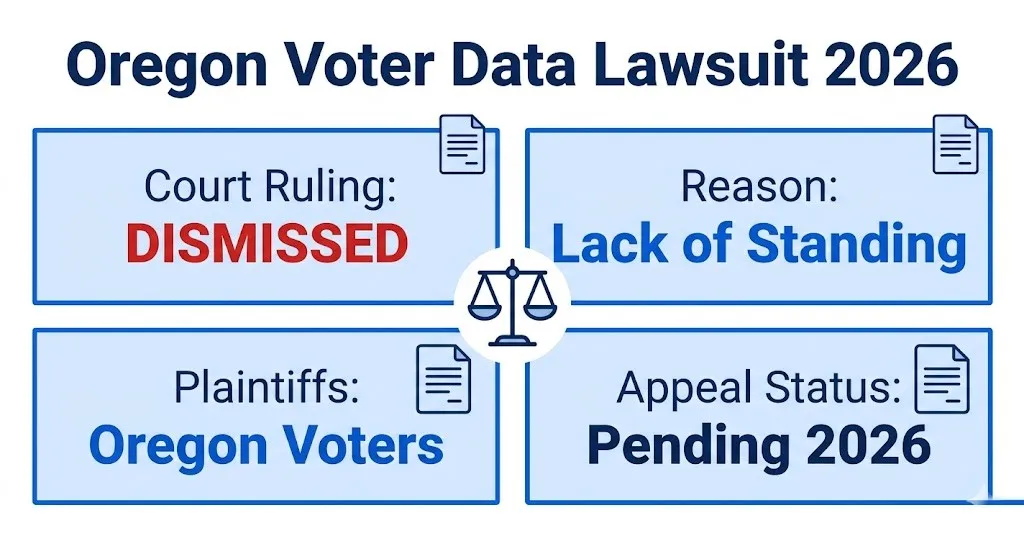
Oregon Voter Data Lawsuit Dismissed
The Oregon voter data lawsuit dismissed ruling came down from the U.S. District Court for the District of Oregon in early 2026. The federal judge determined that plaintiffs lacked Article III standing to bring their claims.
Standing is the legal right to sue. Courts require plaintiffs to show they suffered a concrete, actual injury. The Oregon voters in this case could not meet that bar.
| Case Detail | Information |
|---|---|
| Court | U.S. District Court, District of Oregon |
| Ruling Date | January 2026 |
| Outcome | Dismissed for lack of standing |
| Plaintiffs | Oregon registered voters |
| Defendant | Oregon Secretary of State |
The dismissal does not mean the court found Oregon’s data practices acceptable. It simply means these specific plaintiffs could not prove personal harm.
This is a procedural loss, not a ruling on the merits. The judge never examined whether Oregon actually violated privacy laws. That question remains unanswered.
Think of it like getting kicked out of a restaurant before you can order. You never got to make your case because you could not prove you had a reservation.
Oregon Voter Data Lawsuit
The Oregon voter data lawsuit challenged how the state collects and shares voter registration information. Plaintiffs argued that Oregon’s automatic voter registration system violates privacy rights.
Oregon became the first state to adopt automatic voter registration in 2016. When you visit the DMV, your information transfers to the elections office unless you opt out.
The lawsuit claimed this system:
- Shares personal data without meaningful consent
- Transfers information between agencies improperly
- Creates public records from private DMV transactions
- Exposes voters to unwanted contact and potential data breaches
Quick Facts Box:
- Filed: 2024
- Plaintiffs: Multiple Oregon voters
- Core Claim: Privacy violations through automatic registration
- Relief Sought: Injunction and declaratory judgment
The case raised important questions about modern voter registration. Every state with automatic registration faces similar concerns.
Plaintiffs did not seek monetary damages. They wanted the court to declare the system unlawful and stop certain data practices.
Why Was Oregon Voter Data Lawsuit Dismissed
The Oregon voter data lawsuit was dismissed because plaintiffs failed to demonstrate concrete injury. Federal courts cannot hear cases where no real harm occurred.
Article III of the U.S. Constitution limits federal courts to actual “cases or controversies.” This means you cannot sue just because you dislike a government policy.
The judge found three standing problems:
- No actual injury: Plaintiffs showed their data was shared but not that sharing harmed them
- Speculative harm: Fears about future misuse are not enough
- No traceability: Even if harm occurred, plaintiffs did not connect it to Oregon’s practices
| Standing Requirement | Plaintiff Argument | Court Finding |
|---|---|---|
| Injury in fact | Data shared without consent | Too abstract |
| Causation | Oregon’s system caused harm | Not proven |
| Redressability | Court order would fix problem | Speculative |
The ruling echoes other privacy cases where courts reject “mere exposure” claims. Just because your data exists in a government database does not mean you can sue.
Courts want to see something tangible. Did someone steal your identity? Did you receive threatening mail? Did you lose money? Without specifics, lawsuits fail.
Key Takeaway: The Oregon voter data lawsuit, voter registration lawsuit, and federal case all collapsed because plaintiffs could not prove they suffered real, measurable harm from data sharing practices.
Oregon Voter Registration Data Lawsuit
The Oregon voter registration data lawsuit specifically targeted how personal information flows from the DMV to the Secretary of State’s office. This automatic transfer sits at the heart of the case.
When you get or renew an Oregon driver’s license, you provide your name, address, birthdate, and signature. Oregon’s Motor Voter law sends this information to the elections division automatically.
You have 21 days to opt out. If you do nothing, you become a registered voter. Plaintiffs argued this passive consent system violates privacy expectations.
The data in question includes:
- Full legal name
- Residential address
- Date of birth
- Last four digits of Social Security Number
- Signature image
- DMV transaction date
Oregon voter registration records are partially public. Anyone can request voter rolls showing names, addresses, party affiliations, and voting history. The lawsuit objected to this public access.
The Privacy Paradox:
Your DMV visit is private. But the registration record it creates becomes public. This transformation troubled plaintiffs.
Oregon argued that federal Motor Voter laws require this data sharing. States must maintain voter rolls, and DMV records are the most accurate source for that purpose.
Federal Judge Dismisses Oregon Voter Lawsuit
A federal judge dismisses Oregon voter lawsuit with a ruling that strictly applied Supreme Court standing precedents. The decision followed recent high court guidance on data privacy cases.
U.S. District Judge issued the dismissal order in January 2026. The ruling was not lengthy. Standing failures mean courts do not need to examine the actual legal claims.
The judge cited TransUnion v. Ramirez, a 2021 Supreme Court case. That ruling established tight limits on data privacy standing. Plaintiffs must show harm beyond the mere existence of incorrect or shared information.
| Case Comparison | TransUnion v. Ramirez | Oregon Voter Data Lawsuit |
|---|---|---|
| Issue | Credit report errors | Voter data sharing |
| Standing Result | Limited to those with actual dissemination | Dismissed entirely |
| Harm Required | Concrete, not abstract | Same standard applied |
The federal court did not rule Oregon’s practices legal. It ruled that these plaintiffs could not bring the challenge.
Procedural vs. Substantive:
Procedural dismissals feel frustrating. You prepared for a trial that never happens. But courts cannot ignore standing requirements, even for sympathetic claims.
This ruling does not prevent future lawsuits. Different plaintiffs with different facts might succeed. Someone who experienced identity theft tied to voter data could potentially meet the standing bar.
Oregon Voter Data Lawsuit Standing Requirements
Oregon voter data lawsuit standing requirements proved insurmountable for plaintiffs. Understanding these requirements explains why the case failed and what future plaintiffs would need.
Federal courts demand three elements for standing:
1. Injury in Fact
You must suffer an actual, concrete harm. Feeling uncomfortable about data sharing is not enough. Courts want evidence of real-world impact.
2. Causation
The injury must trace directly to the defendant’s conduct. You cannot sue Oregon for harms caused by third parties who happened to access public records.
3. Redressability
A court order must be able to fix your problem. If stopping Oregon’s data practices would not remedy your injury, standing fails.
| Element | What Plaintiffs Needed | What Plaintiffs Had |
|---|---|---|
| Injury | Identity theft, harassment, financial loss | General privacy concerns |
| Causation | Direct link to Oregon’s sharing | Speculation about potential misuse |
| Redressability | Proof that injunction would help | Theoretical benefit |
The standing bar has risen significantly in recent years. Supreme Court decisions have made data privacy litigation harder. Courts now skeptically examine whether information exposure alone creates standing.
What Would Work:
A plaintiff who received threatening messages at their home address, traced to someone who obtained voter rolls, might have standing. A plaintiff who suffered identity theft using their voter registration data might qualify.
Key Takeaway: Standing requirements, the federal judge’s ruling, and constitutional limits all combined to end this lawsuit before plaintiffs could argue their privacy claims on the merits.
Oregon Voter Data Privacy Case
The Oregon voter data privacy case raised broader questions about how states balance transparency and personal information protection. Though dismissed, these issues remain unresolved.
Oregon operates under conflicting pressures. Public records laws favor transparency. Privacy advocates want data protection. Federal election laws require certain information sharing.
The case highlighted several tensions:
- Transparency vs. Privacy: Voter rolls are public so citizens can verify elections, but that publicity exposes personal details
- Federal vs. State Law: The National Voter Registration Act mandates certain practices that states must follow
- Consent Models: Oregon’s opt-out system differs from opt-in registration in other states
Public Records Reality:
Anyone in Oregon can request voter registration data. Political campaigns, researchers, journalists, and regular citizens access these files legally.
The data includes names, addresses, party affiliations, and voting history. It does not include Social Security Numbers or how someone voted in specific elections.
Plaintiffs wanted courts to find this public access unconstitutional. The dismissal means that argument never got a hearing.
| What’s Public | What’s Private |
|---|---|
| Name | Full SSN |
| Address | Specific ballot choices |
| Party affiliation | DMV records directly |
| Voting history | Signature (restricted use) |
Privacy advocates argue the public data enables harassment. Election officials counter that transparency ensures integrity. Courts have generally sided with transparency.
Voter Registration Data Sharing Oregon
Voter registration data sharing Oregon practices follow both federal requirements and state laws. Understanding these frameworks shows why legal challenges face steep obstacles.
The National Voter Registration Act (NVRA) of 1993 governs voter registration nationwide. It requires states to:
- Register voters at DMV offices
- Maintain accurate voter rolls
- Share information between agencies for list maintenance
- Provide voter files for legitimate purposes
Oregon went further with its 2016 automatic registration law. This created the data flow plaintiffs challenged.
How Data Moves in Oregon:
- You visit the DMV
- Your information transfers to the Elections Division
- You receive a postcard to confirm or opt out
- After 21 days, you become registered
- Your record enters the public voter file
The sharing happens automatically unless you act. This differs from most states where you must affirmatively register.
Oregon shares voter data with:
- Political parties (for campaigning)
- Candidates (for voter contact)
- Researchers (for studies)
- Media (for election coverage)
- Other states (for roll maintenance)
Each category has different access levels. Campaigns get more data than the general public. But names and addresses flow freely to anyone who pays a small fee.
Oregon Voter Data Privacy Rights
Oregon voter data privacy rights exist under state and federal law, but those rights have limits that disappointed plaintiffs. Knowing your rights helps you make informed choices.
What You Can Do:
- Opt out of automatic registration: You have 21 days after DMV notification
- Request confidential voter status: Victims of domestic violence, stalking, or certain crimes can shield their address
- Access your own record: You can see exactly what information Oregon maintains
- Correct errors: Mistakes in your registration can be fixed
| Privacy Option | Who Qualifies | Effect |
|---|---|---|
| Opt out | Any eligible voter | Prevents registration transfer |
| Address confidentiality | Crime victims, certain professions | Hides address from public file |
| Party designation change | Any voter | Updates public record |
What You Cannot Do:
- Remove your basic information from the public voter file (if registered)
- Prevent campaigns from contacting you using voter data
- Stop researchers from including you in aggregate studies
- Delete your voting history
Oregon’s Address Confidentiality Program (ACP) provides strong protection for eligible individuals. Participants get a substitute address that shields their actual location.
The Reality:
If you want complete privacy, you cannot register to vote in Oregon. Registration inherently creates a public record. This tradeoff frustrates many privacy-conscious citizens.
Key Takeaway: Oregon voter data privacy rights, privacy case outcomes, and existing protections show that current law favors transparency over individual data control for registered voters.
Can Oregon Voters Sue for Data Breach
Can Oregon voters sue for data breach if their registration information is misused? Yes, but success depends heavily on the specific facts and provable harm.
The dismissed lawsuit involved data sharing, not a breach. A breach involves unauthorized access or theft. Different legal theories apply.
Data Breach vs. Data Sharing:
| Type | Definition | Legal Path |
|---|---|---|
| Data Breach | Unauthorized access to records | Negligence, state breach notification laws |
| Data Sharing | Authorized transfer under policy | Constitutional claims, policy challenges |
If Oregon experienced an actual security breach exposing voter data, affected individuals might sue under:
- Oregon’s Consumer Identity Theft Protection Act
- Common law negligence
- State data breach notification requirements
- Potential federal claims depending on breach circumstances
Standing remains challenging even in breach cases. Courts increasingly require proof that stolen data was actually misused, not just exposed.
What Would Help a Breach Case:
- Evidence hackers accessed voter records
- Proof the breach caused identity theft
- Documentation of financial losses
- Medical records if stalking resulted from address exposure
Oregon has not experienced a major voter database breach. But the theoretical question matters as cyber threats to election infrastructure increase.
The Current Reality:
Oregon voters harmed by data misuse have legal options. But those options require specific, documented harm. General anxiety about data exposure is not enough to prevail in court.
What Happens After Oregon Voter Lawsuit Dismissed
What happens after Oregon voter lawsuit dismissed depends on whether plaintiffs pursue appeals or new cases. The dismissal ended this round, but legal options remain.
Immediate Effects:
- Oregon continues current data practices unchanged
- No court oversight of voter registration procedures
- Secretary of State claims validation of existing system
- Plaintiffs must decide whether to appeal
The dismissal carries no binding precedent outside Oregon’s federal district. It does not prevent other states from facing similar challenges.
Possible Next Steps:
| Option | Likelihood | Timeline |
|---|---|---|
| Appeal to 9th Circuit | Moderate | 12-18 months |
| New lawsuit with different plaintiffs | Possible | Anytime |
| Legislative advocacy | Ongoing | 2026 session |
| No further action | Possible | Immediate |
Plaintiffs could appeal to the Ninth Circuit Court of Appeals. That court might view standing differently. However, appeals on standing dismissals rarely succeed without new facts.
A new lawsuit with a plaintiff who suffered concrete harm could fare better. Someone who experienced identity theft or harassment traceable to voter data would present a stronger case.
Legislative Path:
Oregon lawmakers could change the rules without court involvement. Bills to strengthen voter data privacy appear periodically. The dismissed lawsuit may energize those efforts.
Oregon Voter Data Case Appeal
An Oregon voter data case appeal would go to the Ninth Circuit Court of Appeals in San Francisco. Plaintiffs face long odds but the option exists.
Appeal deadlines run approximately 60 days from the dismissal order. Filing an appeal does not guarantee review. The Ninth Circuit could affirm the dismissal with a brief order.
Appeal Challenges:
- Standing decisions receive deferential review
- The district judge followed established precedent
- No new evidence can be presented on appeal
- Legal arguments already rejected once
| Appeal Factor | Assessment |
|---|---|
| Standard of review | De novo for legal questions |
| Precedent alignment | District court followed Supreme Court standards |
| Circuit leanings | Ninth Circuit sometimes expansive on standing |
| Success probability | Low to moderate |
The Ninth Circuit has occasionally taken broader views of data privacy standing. This gives plaintiffs a narrow path forward.
What an Appeal Requires:
Plaintiffs must argue the district judge misapplied the law. They cannot simply repeat that they dislike the outcome. Legal error must be demonstrated.
Timeline Realities:
Ninth Circuit cases take 12 to 24 months typically. A decision in 2027 or later would keep this issue alive but delay any resolution.
If the appeal fails, plaintiffs could petition the Supreme Court. The Court rarely takes standing cases unless circuit courts disagree.
Key Takeaway: After dismissal, appeal options, and 2026 updates all point toward continued uncertainty while Oregon maintains current voter data practices pending any appellate reversal.
Oregon Voter Privacy Lawsuit Updates 2026
Oregon voter privacy lawsuit updates 2026 show the case dismissed with no immediate successor litigation filed. However, the underlying issues continue generating attention.
2026 Status:
| Development | Status |
|---|---|
| Original lawsuit | Dismissed January 2026 |
| Appeal filed | Decision pending |
| New lawsuits | None filed as of mid-2026 |
| Legislative action | Bills introduced but not passed |
Privacy advocates have shifted focus to the Oregon Legislature. Several bills addressing voter data protection appeared in the 2026 session.
Proposed Legislative Changes:
- Expand Address Confidentiality Program eligibility
- Require affirmative consent before DMV data transfer
- Limit commercial access to voter files
- Create penalties for voter data misuse
None of these bills have passed yet. Political resistance comes from campaigns and parties who rely on voter data access.
National Context:
Other states watch Oregon’s situation. Automatic voter registration exists in over 20 states now. Each faces similar privacy questions.
A successful lawsuit or legislative change in Oregon would influence other states. The dismissal preserves the status quo but does not end the debate.
Tracking Updates:
Interested voters should monitor the Secretary of State’s office for policy changes. Court docket systems show any new filings. The legislature publishes bill status during sessions.
Oregon Secretary of State Voter Data
Oregon Secretary of State voter data management follows established protocols that the dismissed lawsuit targeted. Understanding these practices clarifies what information the state maintains.
The Secretary of State’s Elections Division maintains the statewide voter registration database. This centralized system connects to all 36 county election offices.
Data the Secretary Maintains:
- Full voter registration records
- Voting history (which elections, not how you voted)
- Party affiliation changes over time
- Address history
- Registration source (DMV, online, paper)
| Data Category | Retention Period | Public Access |
|---|---|---|
| Active registrations | Ongoing | Yes |
| Voting history | Permanent | Yes |
| Canceled registrations | 5 years | Limited |
| Signature images | Until updated | Restricted |
Data Access Rules:
Political purposes receive broadest access. Campaigns and parties get comprehensive voter files including contact information and voting history.
Commercial purposes face restrictions. Oregon prohibits using voter data for commercial solicitation unrelated to elections.
Security Measures:
Oregon employs cybersecurity protections for voter data. Encryption, access controls, and monitoring aim to prevent breaches. No major breach has occurred.
The Secretary of State defended the dismissed lawsuit, arguing current practices comply with all applicable laws. The dismissal did not validate those arguments but ended the court challenge.
Oregon DMV Voter Data Lawsuit
The Oregon DMV voter data lawsuit component focused on how personal information transfers from the Department of Motor Vehicles to election officials. This transfer mechanism sparked the legal challenge.
Oregon’s automatic voter registration begins at the DMV. When you apply for or renew a driver’s license or ID card, you provide information that flows to the Elections Division.
The DMV Data Pipeline:
- Customer provides information for license/ID
- DMV verifies identity documents
- Citizenship question answered (Oregon does not require proof)
- Data packet sent to Secretary of State
- Registration notification mailed to address on file
| DMV Data Element | Transferred to Elections? |
|---|---|
| Name | Yes |
| Address | Yes |
| Date of birth | Yes |
| SSN last 4 digits | Yes |
| Citizenship response | Yes |
| Photo | No |
| Height/weight | No |
Plaintiffs argued this transfer happens without meaningful consent. The opt-out window requires affirmative action to prevent registration.
The DMV’s Role:
DMV officials simply process license applications. They do not verify voter eligibility. That responsibility belongs to the Elections Division.
This division of labor created concerns about registration accuracy. Some non-citizens have been registered through the system, though Oregon maintains procedures to identify and remove such registrations.
Voter Data Lawsuit Oregon 2026
Voter data lawsuit Oregon 2026 developments position this as an evolving legal and political issue. The dismissal closed one chapter, but the story continues.
2026 Landscape:
| Factor | Current Status |
|---|---|
| Court case | Dismissed, appeal possible |
| Legislative reforms | Under consideration |
| Public awareness | Increased post-dismissal |
| Data practices | Unchanged |
Oregon’s experience reflects national tensions around voter data. States increasingly automate registration while citizens grow more privacy-conscious.
Potential Developments:
- Ninth Circuit appeal ruling expected late 2026 or 2027
- 2027 legislative session may revisit privacy bills
- New plaintiffs with concrete injuries could file
- Federal legislation on voter data privacy (unlikely but discussed)
Practical Advice for Oregon Voters:
If voter data privacy concerns you, take available steps now:
- Check your registration at the Secretary of State website
- Consider Address Confidentiality Program if eligible
- Opt out of automatic registration if you prefer manual control
- Contact legislators about privacy legislation
The Bigger Picture:
This lawsuit represents early skirmishes in what may become a larger legal battle. As data privacy law evolves, voter registration practices will face continued scrutiny.
Courts may eventually establish clearer rules about when data exposure creates standing. Congress could preempt state practices with federal standards. Technology changes may reshape how voter data flows.
Key Takeaway: The 2026 lawsuit, Oregon Secretary of State practices, and DMV data transfers all remain subject to ongoing legal and political challenges despite this dismissal.
Frequently Asked Questions
Why was the Oregon voter data lawsuit dismissed in 2026?
The federal court dismissed the lawsuit because plaintiffs lacked standing.
They could not prove they suffered concrete, actual harm from Oregon’s data sharing practices.
Courts require real injury, not just discomfort with government data collection.
Can Oregon voters still sue over their registration data being shared?
Yes, but only if they can demonstrate specific harm.
Someone who experienced identity theft or harassment traceable to voter data might have standing.
General privacy concerns without concrete injury will likely fail under current precedent.
What data does Oregon share from voter registration records?
Oregon shares names, addresses, party affiliations, and voting history through public voter files.
Political campaigns, researchers, journalists, and citizens can request this information.
Social Security Numbers and specific ballot choices remain confidential.
Is there an appeal pending in the Oregon voter data case?
Plaintiffs have the option to appeal to the Ninth Circuit Court of Appeals.
As of mid-2026, the appeal process is underway with a decision expected in late 2026 or 2027.
Success on appeal remains uncertain given the strong standing precedent applied.
How can Oregon voters protect their registration information?
Eligible voters can apply for the Address Confidentiality Program to hide their address.
Anyone can opt out of automatic registration within 21 days of DMV notification.
Voters can also request copies of their records to verify accuracy and report concerns.
What You Should Do Now
The Oregon voter data lawsuit dismissal means current practices continue unchanged. Your registration information remains accessible under existing rules.
Check your voter registration record through official channels. Verify the information is accurate. Consider privacy options available to you if exposure concerns you.
Stay informed about appeals and legislative changes. This issue will evolve throughout 2026 and beyond. Your engagement influences how Oregon balances transparency with privacy.