
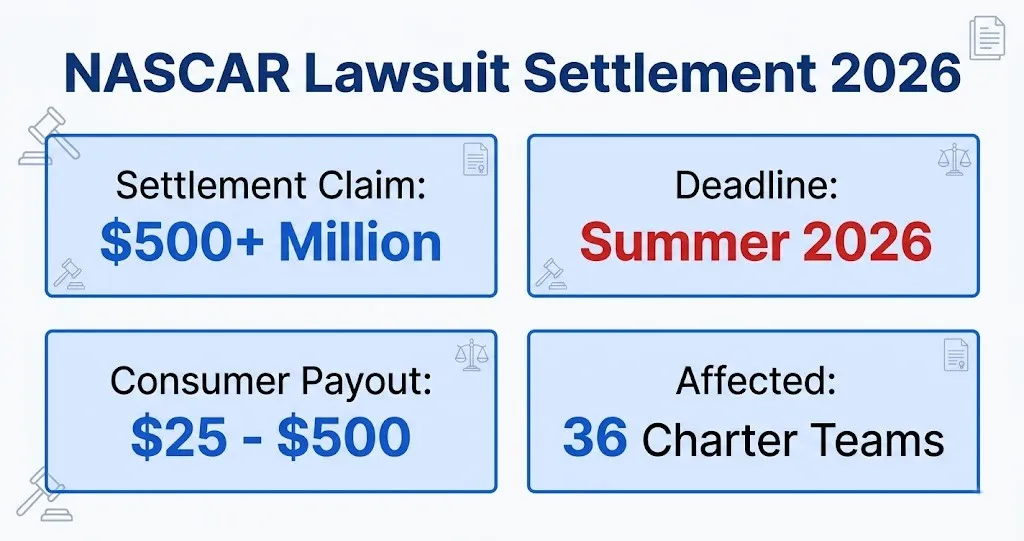
NASCAR faces several active lawsuits in 2026 that could reshape professional racing and put money in the pockets of affected parties. The biggest case involves a $500 million antitrust lawsuit filed by racing teams 23XI Racing and Front Row Motorsports.
This legal battle challenges NASCAR’s charter system. Teams argue the organization operates as an illegal monopoly that controls team values and limits competition.
You’re here because you want answers. Maybe you bought tickets to a cancelled event. Perhaps you’re a racing team owner feeling squeezed. Or you’re just a fan wondering how this shakes out.
This guide covers every NASCAR lawsuit active in 2026. You’ll learn who’s suing, why it matters, potential settlement amounts, filing deadlines, and whether you qualify for any compensation.
One stat to keep in mind: teams claim NASCAR’s charter restrictions have cost them over $1 billion in suppressed team values since 2016.
What Is the NASCAR Lawsuit About
The NASCAR lawsuit refers to multiple legal actions targeting America’s largest stock car racing organization. The primary case centers on antitrust violations related to NASCAR’s charter system that governs how racing teams operate and earn money.
At its core, plaintiffs argue NASCAR acts like an illegal monopoly. They claim the organization uses its market power to suppress team valuations, control revenue distribution, and prevent fair competition.
| Lawsuit Type | Primary Claim | Key Plaintiffs |
|---|---|---|
| Antitrust | Monopoly power abuse | 23XI Racing, Front Row Motorsports |
| Charter Dispute | Unfair contract terms | Multiple racing teams |
| Consumer Claims | Event cancellations | Ticket purchasers |
The antitrust case filed in late 2024 remains the most significant. It seeks over $500 million in damages under federal law.
Teams owning charters must agree to restrictive terms. These agreements limit their ability to sell, transfer, or increase the value of their racing operations.
Think of it like owning a restaurant franchise where the corporate office controls your menu, your prices, and whether you can ever sell the business. That’s what teams say NASCAR does to them.
Key Takeaway: The NASCAR lawsuit centers on claims that NASCAR illegally controls team economics through restrictive charter agreements, with damages potentially exceeding $500 million.
NASCAR Lawsuit 2026 Status and Timeline
The NASCAR lawsuit 2026 status shows the antitrust case moving toward critical pretrial phases. As of early 2026, discovery is ongoing and both sides are exchanging documents and depositions.
Key dates in the current timeline:
- October 2024: 23XI Racing and Front Row Motorsports file original complaint
- January 2025: NASCAR files motion to dismiss (denied)
- March 2025: Discovery phase begins
- September 2025: Teams file preliminary injunction for 2026 charter rights
- February 2026: Court grants temporary charter protection
- Summer 2026: Trial date expected to be set
The case sits in the U.S. District Court for the Western District of North Carolina. Judge selection and scheduling remain fluid.
Both teams continue racing in 2026 while litigation proceeds. The court granted temporary protections allowing them to compete under existing charter terms.
| Milestone | Date | Status |
|---|---|---|
| Complaint Filed | October 2024 | Complete |
| Motion to Dismiss | January 2025 | Denied |
| Discovery | March 2025 | Ongoing |
| Trial Setting | Summer 2026 | Pending |
| Expected Resolution | 2027 | Projected |
Settlement talks have occurred but produced no agreement. NASCAR reportedly refuses to restructure its charter system, which plaintiffs consider non-negotiable.
NASCAR Antitrust Lawsuit Explained
The NASCAR antitrust lawsuit alleges the organization violates the Sherman Antitrust Act by maintaining monopoly control over professional stock car racing in America.
Antitrust law exists to prevent companies from unfairly dominating markets. When one entity controls an entire industry and uses that power to harm competitors, it breaks federal law.
Here’s what the teams claim NASCAR does wrong:
- Controls market entry: New teams cannot enter Cup Series racing without purchasing expensive charters from existing owners
- Suppresses valuations: Charter restrictions artificially limit what teams can sell for
- Dictates revenue: NASCAR determines how broadcast and sponsorship money gets divided
- Prevents competition: No rival racing series can realistically compete with NASCAR’s dominance
The lawsuit seeks treble damages under antitrust law. That means any proven damages get tripled. A $200 million harm becomes $600 million in court.
Think about it like this. Imagine if the NFL controlled all football stadiums, all player contracts, and all team sales while telling owners they couldn’t form a competing league. That’s the NASCAR situation according to plaintiffs.
Antitrust cases are notoriously difficult to win. But when plaintiffs succeed, the payouts can be massive. The NCAA recently lost a similar case resulting in billions in settlements for college athletes.
23XI Racing Lawsuit Against NASCAR
The 23XI Racing lawsuit represents the most prominent legal challenge NASCAR has faced in decades. Team owners Michael Jordan and Denny Hamlin lead this fight against the racing giant.
23XI Racing launched in 2020 with significant fanfare. Michael Jordan became the first Black majority team owner in Cup Series history since 1973. The team brought fresh investment and high expectations.
But the charter system created immediate problems. Here’s what 23XI claims:
- Paid inflated prices to acquire charters necessary for racing
- Faced restrictions on selling or transferring team assets
- Received unfavorable revenue sharing compared to team contributions
- Got pressured to sign new charter agreements with worse terms
The team operates two full-time cars in the Cup Series. Tyler Reddick and Bubba Wallace drive for 23XI in 2026.
| 23XI Racing Facts | Details |
|---|---|
| Founded | 2020 |
| Owners | Michael Jordan, Denny Hamlin |
| Cars | 2 (Numbers 23 and 45) |
| Charters Owned | 2 |
| Lawsuit Filed | October 2024 |
Jordan reportedly invested over $150 million in the team. The lawsuit claims NASCAR’s practices prevent him from ever realizing fair value on that investment.
Hamlin remains an active Cup Series driver for Joe Gibbs Racing while co-owning 23XI. This dual role gives him unique insight into both driver and owner perspectives.
Key Takeaway: Michael Jordan’s 23XI Racing leads the antitrust charge, claiming NASCAR’s charter system trapped the team’s investment and suppresses its ability to grow or sell at fair market value.
Front Row Motorsports Lawsuit Details
Front Row Motorsports joined 23XI Racing as a co-plaintiff in the NASCAR antitrust lawsuit. Owner Bob Jenkins built this team from scratch starting in 2004.
Unlike 23XI’s celebrity ownership, Front Row represents a traditional racing family operation. Jenkins grew the team over two decades from a single-car effort to a competitive multi-car organization.
Front Row’s claims parallel 23XI’s complaints but add historical context:
- Witnessed charter system implementation in 2016
- Saw team valuations plateau despite on-track success
- Faced pressure to accept unfavorable charter renewal terms
- Lost potential buyers due to charter transfer restrictions
The team currently fields two cars in the Cup Series. Michael McDowell and Todd Gilliland drive for Front Row in 2026.
Front Row achieved notable success despite limited resources. McDowell won the 2021 Daytona 500, proving smaller teams can compete. But wins don’t translate to higher team valuations under current rules.
| Front Row Motorsports Facts | Details |
|---|---|
| Founded | 2004 |
| Owner | Bob Jenkins |
| Cars | 2 (Numbers 34 and 38) |
| Notable Win | 2021 Daytona 500 |
| Lawsuit Role | Co-plaintiff |
Jenkins reportedly tried selling the team multiple times. Potential buyers walked away after seeing charter restrictions. This trapped investment forms a central lawsuit claim.
The combination of Jordan’s star power and Jenkins’ racing credibility creates a formidable plaintiff team.
NASCAR Charter Lawsuit Breakdown
The NASCAR charter lawsuit centers on the charter system NASCAR introduced in 2016. Charters guarantee teams a starting spot in each race and a share of broadcast revenue.
Before charters, teams raced based purely on qualifying speed. Fast cars raced. Slow cars went home. It was simple but financially brutal for team owners.
Charters changed that model. Here’s how the system works:
- 36 chartered teams receive guaranteed starting positions
- Chartered teams share approximately 25% of NASCAR’s broadcast revenue
- Charters can theoretically be bought, sold, or leased
- Non-chartered teams must qualify and receive minimal revenue
The problem? Plaintiffs say NASCAR controls charter terms too tightly.
| Charter System Pros | Charter System Cons |
|---|---|
| Guaranteed starting spots | Restrictive transfer rules |
| Revenue sharing | Suppressed team values |
| Financial stability | NASCAR controls terms |
| Easier sponsorship sales | Take-it-or-leave-it contracts |
Teams must sign lengthy charter agreements with NASCAR. The latest proposed agreement would run through 2031 with terms plaintiffs call exploitative.
Refusing to sign means losing charter status. Losing charter status means losing guaranteed revenue and race entries. It’s a classic “sign or die” situation that plaintiffs argue violates fair dealing.
Current charter values reportedly range from $30 million to $40 million each. Teams claim true market value would exceed $100 million without NASCAR’s restrictions.
Is NASCAR a Monopoly
NASCAR operates as the dominant force in American stock car racing. Whether that dominance constitutes an illegal monopoly is the central legal question in the antitrust lawsuit.
Legally, monopoly status alone isn’t illegal. Companies can legally dominate markets through superior products, better service, or smarter strategy. What’s illegal is using monopoly power to harm competition.
Evidence suggesting NASCAR holds monopoly power:
- Controls 100% of major stock car racing in the United States
- Owns most major racetracks through NASCAR’s parent company
- Determines all sporting rules unilaterally
- Sets revenue distribution without team negotiation
- Prevents formation of competing series through exclusive contracts
The Sherman Antitrust Act requires proving two things. First, that NASCAR has monopoly power. Second, that NASCAR used that power anticompetitively.
| Monopoly Test | NASCAR Situation |
|---|---|
| Market Control | Dominates stock car racing |
| Entry Barriers | Charters required for competition |
| Pricing Power | Sets charter values and terms |
| Exclusive Deals | Controls tracks and broadcast |
Compare NASCAR to other sports leagues. The NFL, NBA, and MLB face similar market dominance claims. But they operate under collective bargaining with player unions.
NASCAR has no such union or collective bargaining. Team owners negotiate individually against the full power of the organization. Plaintiffs call this an unfair fight.
Key Takeaway: NASCAR clearly dominates stock car racing, and the lawsuit will determine whether that dominance crosses the line into illegal monopoly conduct under federal antitrust law.
NASCAR Class Action Lawsuit Options
NASCAR class action lawsuits represent potential avenues for regular consumers to seek compensation. While the main antitrust case involves racing teams, separate consumer claims exist.
A class action allows many people with similar claims to sue together. One lawsuit handles everyone’s complaint rather than thousands of individual cases.
Current and potential NASCAR class action categories:
- Event cancellation claims: Fans who lost money on cancelled races
- Ticket refund disputes: Purchasers denied full refunds
- Merchandise claims: Consumers who bought products with misleading claims
- Subscription services: Streaming or membership service disputes
As of 2026, no major consumer class action against NASCAR has achieved certification. But attorneys continue investigating potential claims.
| Class Action Type | Status | Potential Participants |
|---|---|---|
| Cancelled Events | Under Review | Ticket holders |
| Refund Disputes | Investigation | Affected purchasers |
| Merchandise Claims | Not Filed | Product buyers |
| Fantasy/Gaming | Monitoring | Platform users |
The COVID-era race cancellations generated the most consumer complaints. Many fans received credits instead of cash refunds. Some never received anything.
If you lost money on NASCAR tickets, merchandise, or services and never received proper compensation, document everything. Save receipts, emails, and bank statements. This evidence matters if a class action moves forward.
NASCAR Settlement Possibilities
NASCAR settlement discussions have occurred but produced no resolution through early 2026. The organization reportedly refuses terms that would fundamentally change the charter system.
Settlement remains possible at any litigation stage. Most civil cases settle before trial. The question is what settlement would look like.
Potential settlement components:
- Cash payments to plaintiff teams
- Charter system reforms
- Increased revenue sharing percentages
- Relaxed transfer restrictions
- Guaranteed long-term charter rights
The antitrust case complicates settlement. Federal law encourages treble damages specifically to punish anticompetitive conduct and deter future violations.
| Settlement Scenario | Likelihood | Impact |
|---|---|---|
| Cash-only deal | Moderate | No structural change |
| System reform | Low | Changes NASCAR model |
| Hybrid approach | Moderate | Some reforms plus cash |
| Trial verdict | Possible | Judge decides outcome |
NASCAR faces pressure from multiple directions. Team owners beyond the plaintiffs reportedly support charter reform. Sponsors want stability. Fans want competitive racing.
A settlement that reforms the charter system could benefit all 36 chartered teams. That’s leverage plaintiffs can use in negotiations.
Industry observers estimate settlement value between $200 million and $400 million if NASCAR avoids trial. Trial losses could cost far more.
NASCAR Lawsuit Payout Estimates
NASCAR lawsuit payout estimates vary widely depending on case outcomes and participant categories. Team plaintiffs stand to gain the most from the antitrust case.
For 23XI Racing and Front Row Motorsports, potential payouts include:
- Direct damages: Lost revenue and suppressed team values
- Treble damages: Federal antitrust law triples proven damages
- Legal fees: Losing party typically pays winner’s attorneys
- Injunctive relief: Court-ordered charter system changes
Conservative estimates suggest each plaintiff team suffered $50 million to $100 million in damages. Trebling brings that to $150 million to $300 million per team.
| Damage Category | Estimated Range | Trebled Amount |
|---|---|---|
| Suppressed value | $30M-$60M | $90M-$180M |
| Lost revenue | $10M-$25M | $30M-$75M |
| Future losses | $10M-$15M | $30M-$45M |
| Total per team | $50M-$100M | $150M-$300M |
Consumer class action payouts would be smaller individually but potentially affect more people. Typical consumer class settlements pay $25 to $500 per claimant depending on loss documentation.
Past sports-related class actions provide context. The NCAA settlement paid college athletes based on market value calculations. NFL concussion settlements paid based on injury severity.
Actual payouts depend on settlement terms or trial outcomes. Nothing is guaranteed until checks clear.
Key Takeaway: Team plaintiffs could receive $150 million to $300 million each if they prove antitrust violations, while consumers in any related class action would likely see individual payments of $25 to $500.
NASCAR Lawsuit Settlement Amount Projections
The NASCAR lawsuit settlement amount could reach $500 million or more based on current claims and federal antitrust multipliers. Multiple factors influence final numbers.
Settlement amounts depend on:
- Proven damages at trial
- Negotiating leverage of each party
- Court decisions on preliminary motions
- Public pressure and sponsor concerns
- Risk tolerance of NASCAR leadership
Current projections by case type:
| Case Component | Low Estimate | High Estimate |
|---|---|---|
| 23XI Racing damages | $150M | $300M |
| Front Row damages | $100M | $200M |
| Charter reform value | Priceless | Priceless |
| Attorney fees | $20M | $50M |
| Combined total | $270M | $550M |
NASCAR generates approximately $3 billion annually in revenue. A $500 million settlement represents significant but manageable financial exposure.
The organization carries substantial insurance coverage for legal claims. Insurers may pressure settlement to limit their exposure.
For comparison, recent major sports settlements include:
- NCAA: Over $2.7 billion for athlete compensation
- NFL concussions: Exceeded $1 billion in payouts
- FIFA corruption: Hundreds of millions in fines and settlements
NASCAR’s case is smaller than these precedents. But it follows similar legal theories about organizational power and fairness.
Who Can Sue NASCAR
Who can sue NASCAR depends on your relationship with the organization and what harm you suffered. Different categories of plaintiffs face different legal standards.
Current categories of potential NASCAR plaintiffs:
Racing Teams: Teams with charters who signed restrictive agreements may have antitrust claims. Non-chartered teams facing entry barriers might also qualify.
Drivers: Individual drivers generally cannot sue NASCAR directly for business practices. Their employment relationships run through teams, not NASCAR.
Track Owners: Independent tracks forced into unfavorable agreements with NASCAR might have claims. Most major tracks are NASCAR-owned, complicating this category.
Consumers: Ticket buyers, merchandise purchasers, and service subscribers can potentially sue over specific transactions where they lost money.
| Potential Plaintiff | Can Sue? | Basis |
|---|---|---|
| Charter teams | Yes | Antitrust, contract |
| Non-charter teams | Maybe | Entry barriers |
| Individual drivers | Unlikely | No direct relationship |
| Independent tracks | Maybe | Contract issues |
| Ticket buyers | Yes | Consumer protection |
| Merchandise buyers | Yes | Consumer protection |
Suing NASCAR requires meeting legal standing requirements. You must show specific, concrete harm from NASCAR’s actions. General dissatisfaction with the sport doesn’t qualify.
Anyone considering legal action should document their losses thoroughly. Receipts, contracts, communications, and financial records all matter.
NASCAR Lawsuit Eligibility Requirements
NASCAR lawsuit eligibility requirements differ based on which legal action you’re considering. The main antitrust case has narrow eligibility while potential consumer actions are broader.
Antitrust Case Eligibility:
This case involves racing teams only. To join as a plaintiff, you would need:
- Ownership or controlling interest in a NASCAR Cup Series team
- Direct harm from charter system restrictions
- Standing to bring federal antitrust claims
Regular fans and consumers cannot participate directly in this case. But its outcome affects everyone.
Potential Consumer Class Action Eligibility:
If consumer class actions develop, eligibility typically requires:
- Proof of purchase or transaction with NASCAR
- Documentation of financial loss
- Falling within the defined class period
- Meeting the class definition set by the court
| Eligibility Factor | Antitrust Case | Consumer Claims |
|---|---|---|
| Who qualifies | Team owners | Ticket/product buyers |
| Proof needed | Team ownership | Purchase receipts |
| Loss required | Charter harm | Financial loss |
| Time period | 2016-present | Case-specific |
Quick Eligibility Checklist for Consumers:
- Did you buy NASCAR tickets for a cancelled event?
- Did you pay for merchandise or services you didn’t receive?
- Did NASCAR deny you a promised refund or credit?
- Do you have documentation of your purchase and loss?
If you answered yes to any of these, keep your records organized. Class action eligibility depends on case developments throughout 2026.
Key Takeaway: Racing team owners can participate in the current antitrust lawsuit, while regular consumers may become eligible for separate class actions if courts certify them based on ticket, merchandise, or service losses.
NASCAR Lawsuit Deadline Information
NASCAR lawsuit deadline information varies by claim type. Missing deadlines can permanently bar your ability to participate or file.
Current Key Deadlines:
| Deadline Type | Date | Applies To |
|---|---|---|
| Antitrust discovery | August 2026 | Team plaintiffs |
| Statute of limitations (antitrust) | 4 years from harm | New claims |
| Statute of limitations (consumer) | Varies by state | Consumer claims |
| Class action opt-out | TBD | Future classes |
Antitrust Deadlines:
The Sherman Antitrust Act carries a four-year statute of limitations. Teams must file within four years of when they knew or should have known about the harm.
For charter-related claims, this clock likely started when teams signed restrictive agreements. Some claims may already be time-barred depending on interpretation.
Consumer Deadlines:
Consumer claims follow state statute of limitations laws. These typically range from two to six years depending on the state and claim type.
Contract claims usually get longer windows than fraud claims. Written contracts often have longer limitations than oral agreements.
What to Do Now:
- Identify when your harm occurred
- Research your state’s limitation periods
- Gather documentation immediately
- Consult with an attorney before deadlines pass
Don’t assume you have unlimited time. Courts strictly enforce filing deadlines. An otherwise valid claim becomes worthless one day past the deadline.
How to File a NASCAR Lawsuit Claim
How to file a NASCAR lawsuit claim depends on whether you’re joining an existing case or starting a new one. The process differs for teams versus consumers.
For Racing Team Owners:
If you own or control a NASCAR team and want to join the antitrust litigation:
- Contact attorneys representing current plaintiffs
- Provide documentation of charter restrictions and harm
- Determine whether joining as a plaintiff makes strategic sense
- Consider timing and potential retaliation concerns
Most teams prefer waiting for case outcomes rather than becoming direct plaintiffs. Winners in the lawsuit could open the door for follow-on claims.
For Consumers:
No open consumer class action exists for NASCAR claims in early 2026. But if one opens:
- Watch for class action notices
- Register with the settlement administrator when announced
- Submit required documentation (receipts, proof of loss)
- Choose whether to opt out and file individually
| Filing Step | Team Owners | Consumers |
|---|---|---|
| Step 1 | Contact plaintiff attorneys | Monitor for class notice |
| Step 2 | Provide harm documentation | Register your claim |
| Step 3 | Join as plaintiff or wait | Submit proof of purchase |
| Step 4 | Participate in discovery | Wait for settlement |
Documenting Your Claim:
Regardless of your category, documentation matters. Save:
- Purchase receipts and confirmations
- Communication with NASCAR
- Bank or credit card statements
- Photos of merchandise or tickets
- Correspondence about refunds or credits
Strong documentation significantly increases your potential payout.
NASCAR Lawsuit Update for 2026
The NASCAR lawsuit update for 2026 shows the antitrust case progressing through federal court while all parties continue racing operations.
January-February 2026 Developments:
The court granted 23XI Racing and Front Row Motorsports temporary relief allowing continued charter participation for the 2026 season. NASCAR’s attempt to revoke their charters failed.
This preliminary win boosted plaintiff credibility. Courts don’t grant temporary relief unless plaintiffs show likelihood of success.
Discovery Phase Progress:
Both sides are deep in document exchange. Key discovery targets include:
- Internal NASCAR communications about charter values
- Financial projections for team revenues
- Emails discussing competitive restrictions
- Board meeting minutes on charter strategy
Discovery often produces smoking gun evidence. Internal emails have decided many antitrust cases.
| 2026 Update Category | Status |
|---|---|
| Preliminary relief | Granted to plaintiffs |
| Discovery | Ongoing |
| Settlement talks | Stalled |
| Trial date | Not yet set |
| 2026 racing | Teams competing |
Racing Season Impact:
Despite litigation, 23XI Racing and Front Row Motorsports continue full 2026 Cup Series participation. Their cars race every week while lawyers fight in court.
This dual track gives plaintiffs leverage. Winning on the track while winning in court creates maximum pressure on NASCAR.
The case remains months from resolution. Expect significant developments through late 2026 and into 2027.
Key Takeaway: The NASCAR lawsuit gained momentum in early 2026 when courts protected the plaintiff teams’ charter rights, suggesting judges see merit in antitrust claims while discovery continues producing evidence.
NASCAR Legal News and Future Cases
NASCAR legal news extends beyond the primary antitrust case to include multiple legal fronts the organization monitors or actively defends.
Active and Potential Legal Matters:
Beyond the 23XI/Front Row lawsuit, NASCAR faces exposure in several areas:
- Employment disputes: Former employees and contractors occasionally file workplace claims
- Personal injury: Track incidents sometimes generate litigation
- Intellectual property: Ongoing enforcement and defense of NASCAR trademarks
- Venue disputes: Independent track relationships remain contentious
| Legal Category | Activity Level | Risk Assessment |
|---|---|---|
| Antitrust | High | Severe |
| Employment | Moderate | Manageable |
| Personal Injury | Low | Normal |
| IP/Trademark | Ongoing | Defensive |
| Consumer Claims | Monitoring | Unknown |
Future Case Predictions:
If plaintiffs win the antitrust case, expect follow-on litigation. Other teams may file similar claims seeking their share of damages.
Consumer class actions could develop depending on antitrust outcomes. Proving NASCAR violated antitrust law could support consumer claims about inflated ticket prices.
Industry Watching Closely:
Other sports leagues monitor this case carefully. A NASCAR loss could encourage similar litigation against MLB, NHL, or MLS. The NCAA settlement already changed college sports permanently.
NASCAR’s legal troubles reflect broader tensions in professional sports. Organizations holding concentrated power face increasing challenges from participants demanding fair treatment.
The racing industry may look dramatically different by 2030 depending on how these cases resolve.
Frequently Asked Questions
How much money could I get from a NASCAR lawsuit settlement?
Individual consumer payouts in class actions typically range from $25 to $500 per claimant.
Your exact amount depends on documented losses and settlement terms.
Team plaintiffs could receive $150 million or more if they win their antitrust claims.
Is there a class action lawsuit against NASCAR I can join?
No certified consumer class action against NASCAR exists as of early 2026.
Attorneys continue investigating potential claims related to ticket refunds and merchandise issues.
Monitor lawsuit news to learn when filing opportunities open.
What is the deadline to file a NASCAR lawsuit claim?
Federal antitrust claims have a four-year statute of limitations from when harm occurred.
Consumer claims follow state laws ranging from two to six years.
Gather documentation now regardless of specific deadlines.
Why are racing teams suing NASCAR?
Teams claim NASCAR operates as an illegal monopoly that controls team values through restrictive charter agreements.
23XI Racing and Front Row Motorsports argue they cannot sell their teams at fair market value.
The lawsuit seeks over $500 million in damages.
Will the NASCAR antitrust lawsuit change how the sport operates?
A plaintiff victory would likely force NASCAR to restructure its charter system.
Teams could gain more control over their business operations and transfer rights.
Changes might increase competition and team valuations across the sport.
What Happens Next
The NASCAR lawsuit represents a pivotal moment for professional stock car racing. Michael Jordan and his co-plaintiffs are betting that courts will agree NASCAR crossed legal lines in controlling team economics.
Whether you’re a racing fan, a team owner, or someone who lost money on NASCAR tickets, this case matters. Keep your documentation ready.
Watch for class action announcements throughout 2026. The antitrust case will reach critical stages by late 2026 or early 2027. Settlement remains possible at any time.
Your next step: gather any NASCAR purchase records and save them. If compensation opportunities open, you’ll be ready to file.
