
The Palworld lawsuit between Nintendo, The Pokemon Company, and Pocketpair remains one of gaming’s biggest legal battles in 2026. This patent infringement case has kept millions of players wondering if their favorite survival game faces an uncertain future.
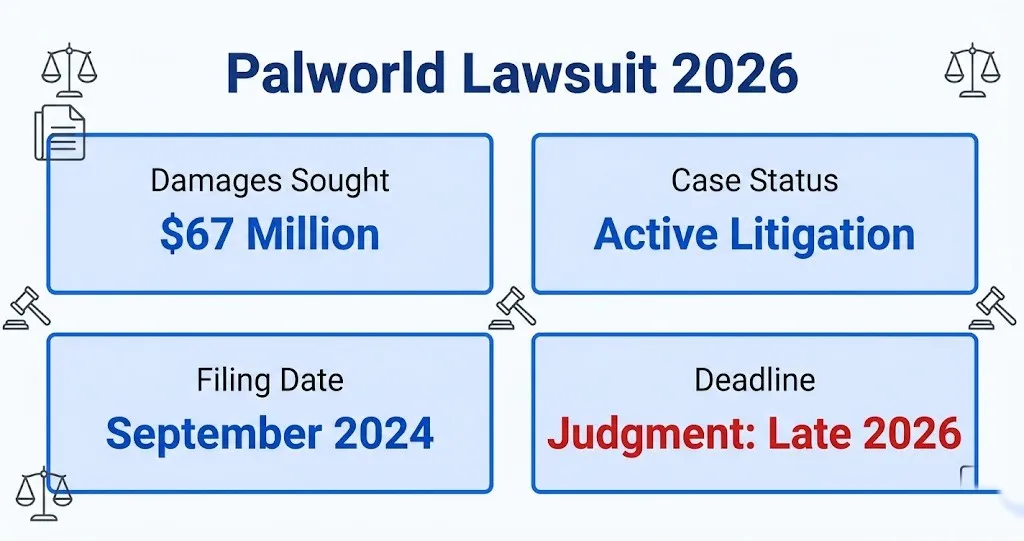
Nintendo and The Pokemon Company filed suit against Pocketpair in September 2024. They claimed Palworld violated multiple game mechanic patents. The case is being heard in Tokyo District Court.
Palworld sold over 25 million copies before the lawsuit hit. That staggering success made it a target. This article covers every major development, explains the patent claims in plain terms, and breaks down what each possible outcome means for you as a player.
You will learn the current case status, recent court proceedings, damage amounts sought, and whether Palworld could actually disappear from your library.
What Is the Palworld Lawsuit
The Palworld lawsuit is a patent infringement case filed by Nintendo and The Pokemon Company against Pocketpair Inc. The plaintiffs claim that Palworld’s core gameplay mechanics violate patents they hold in Japan.
This is not a copyright case about creature designs. Many people confuse this point. Nintendo chose to pursue patent infringement, which focuses on how the game works rather than how it looks.
The suit was filed in Tokyo District Court on September 18, 2024. Nintendo seeks both monetary damages and injunctive relief. Injunctive relief could force changes to Palworld or potentially halt its sale.
| Key Case Details | Information |
|---|---|
| Plaintiffs | Nintendo Co. Ltd., The Pokemon Company |
| Defendant | Pocketpair Inc. |
| Court | Tokyo District Court |
| Filing Date | September 18, 2024 |
| Case Type | Patent Infringement |
| Relief Sought | Damages and Injunctive Relief |
Pocketpair is a small Japanese developer based in Tokyo. They released Palworld in early access on January 19, 2024. The game became an instant phenomenon.
The core accusation centers on game mechanics, not the Pal designs that sparked internet debates. Nintendo holds patents on certain creature-catching and battle systems. They believe Palworld copies these protected mechanics.
Palworld Lawsuit 2026: Where Things Stand Now
The Palworld lawsuit in 2026 has moved into active litigation with both parties presenting evidence and arguments to the Tokyo District Court. Preliminary hearings concluded in late 2025, and the case now awaits substantive rulings.
Neither side has achieved a decisive victory yet. The court has not issued any preliminary injunctions. Palworld remains available for purchase and play across all platforms during proceedings.
Court documents filed in early 2026 reveal Nintendo identified three specific patents allegedly infringed. These relate to creature capture mechanics, creature management systems, and certain battle interaction patents.
Pocketpair has maintained its position that Palworld does not infringe any valid patents. Their legal team filed counter-arguments challenging the scope and validity of Nintendo’s patent claims.
| 2026 Case Status | Details |
|---|---|
| Current Phase | Active Litigation |
| Preliminary Injunction | Not Granted |
| Game Availability | Still on Sale |
| Number of Patents Cited | 3 |
| Next Major Hearing | Expected Mid-2026 |
The case timeline has extended beyond initial estimates. Patent litigation in Japan typically takes 12 to 18 months. This case appears headed toward the longer end of that range.
Legal observers note that Nintendo’s decision to pursue patents over copyrights suggests they want to establish broader protections. A patent victory would affect how future games can implement similar mechanics.
Palworld Lawsuit Update: Recent Developments
The most recent Palworld lawsuit update involves Pocketpair filing a challenge to the validity of one of Nintendo’s cited patents in February 2026. This move could delay proceedings but potentially weaken Nintendo’s case.
Patent validity challenges are a common defense strategy. If Pocketpair can prove that Nintendo’s patent should never have been granted, the infringement claim fails. The Japan Patent Office will review this challenge separately.
Court filings from January 2026 revealed that Nintendo’s damage calculation exceeds initial estimates. The company seeks compensation based on per-copy royalties for all 25 million plus units sold.
Pocketpair’s CEO Takuro Mizobe released a statement in late 2025 reaffirming the company’s commitment to fighting the lawsuit. He expressed confidence in their legal position while acknowledging the financial strain of prolonged litigation.
Recent Timeline of Events:
- February 2026: Pocketpair files patent validity challenge
- January 2026: Nintendo submits revised damage calculations
- December 2025: Preliminary hearings conclude
- October 2025: Both parties complete discovery phase
- September 2024: Original lawsuit filed
Settlement discussions have reportedly occurred behind closed doors. Neither company has confirmed these talks publicly. Industry analysts believe a negotiated resolution remains possible.
The gaming community continues to watch closely. Palworld maintains an active player base despite the legal cloud. Monthly updates to the game have continued without interruption.
Key Takeaway: The Palworld lawsuit remains unresolved in 2026, with both parties presenting arguments while the game stays available for purchase and play.
Current Palworld Lawsuit Status
The current Palworld lawsuit status is “active litigation pending judgment” in Tokyo District Court as of 2026. No final ruling has been issued. The case remains in the evidence presentation and legal argument phase.
Tokyo District Court handles intellectual property cases through specialized divisions. Judge assignments in Japanese patent cases typically involve panels with technical expertise. This ensures complex gaming mechanics receive informed evaluation.
Both legal teams have submitted extensive documentation. Nintendo’s filings include technical analyses of game code. Pocketpair’s responses include expert testimony challenging the patent interpretations.
| Status Category | Current State |
|---|---|
| Case Status | Active, Pending Judgment |
| Injunctions | None Issued |
| Settlement | Not Reached |
| Game Operations | Unaffected |
| Player Access | Full Access Maintained |
The court has not set a specific judgment date. Japanese patent litigation rarely concludes within a single calendar year. Most cases require 18 to 24 months from filing to final judgment.
Appeals are virtually guaranteed regardless of the initial ruling. Either party can appeal to the Intellectual Property High Court of Japan. This could extend the total case timeline to three years or more.
Pocketpair continues to operate normally during litigation. The company released Palworld on PlayStation 5 in September 2024, just days after the lawsuit was filed. This showed their willingness to proceed despite legal challenges.
Palworld Nintendo Lawsuit Explained
The Palworld Nintendo lawsuit centers on allegations that Pocketpair’s game infringes patents held by Nintendo covering specific gameplay mechanics used in Pokemon games. Nintendo is co-plaintiff alongside The Pokemon Company.
Nintendo rarely pursues litigation against other game developers. This makes the Palworld case unusual. The company typically protects its IP through licensing agreements and cease-and-desist letters.
The decision to file suit suggests Nintendo views Palworld as a significant threat. The game’s explosive popularity clearly caught their attention. Selling 25 million copies in months put Palworld on their radar fast.
Patents in question relate to the “capture” mechanic. When players throw objects to catch creatures, they engage with systems Nintendo claims to have patented. The throwing arc, success calculation, and creature containment all potentially fall under these patents.
What Nintendo Claims:
- Creature capture mechanics mirror patented Pokemon systems
- Battle integration with captured creatures copies protected methods
- Creature management interfaces replicate patented designs
Nintendo’s motivation extends beyond Palworld itself. A successful case establishes precedent. Future games with similar mechanics would need licenses or risk litigation.
The company has invested billions in Pokemon over nearly three decades. Protecting that investment requires aggressive IP defense. Palworld represented the first major challenger to capture mainstream attention.
Critics argue Nintendo’s patents are too broad. Game mechanics, they say, should not receive such extensive protection. This debate will likely influence how courts interpret the claims.
Palworld Pokemon Lawsuit: Why It Matters
The Palworld Pokemon lawsuit matters because it could reshape how game developers approach creature-collection mechanics and establish new boundaries for gaming patents. The outcome affects far more than just Pocketpair.
Pokemon has dominated the creature-catching genre for decades. Few games have directly challenged that dominance. Palworld did exactly that by combining creature capture with survival crafting and shooter elements.
The Pokemon Company joined Nintendo as co-plaintiff. This entity manages the Pokemon franchise across games, anime, merchandise, and more. Their involvement signals the stakes are high.
| Stakeholder | Why This Case Matters |
|---|---|
| Pocketpair | Company survival, game future |
| Nintendo | Patent portfolio value, precedent |
| Game Developers | Freedom to use mechanics |
| Players | Game availability, genre variety |
| Investors | Indie game risk assessment |
If Nintendo wins, other developers may abandon creature-catching projects. The chilling effect on innovation could be substantial. Nobody wants to face Nintendo’s legal team.
If Pocketpair wins, it validates that core mechanics cannot be monopolized. Other developers would gain confidence to create competing games. The creature-collection genre could see an explosion of new entries.
The case also tests Japanese patent law’s application to video games. How courts interpret “game mechanics” as patentable subject matter will influence future filings. Legal scholars worldwide are watching the proceedings closely.
Key Takeaway: The Palworld Nintendo lawsuit filed in 2024 now tests whether game mechanics can be effectively monopolized through patents, with implications reaching across the entire gaming industry.
Palworld Lawsuit Who Won
The Palworld lawsuit has not yet produced a winner as of 2026 because the case remains in active litigation without a final court judgment. Neither Nintendo nor Pocketpair has achieved victory.
This answer disappoints many searchers looking for closure. The reality is that patent cases take time. Japanese courts prioritize thorough examination over speedy resolution.
Current proceedings favor neither party definitively. Each side has scored minor procedural wins. No substantive ruling on the patent claims has been issued.
| Victory Status | Current Assessment |
|---|---|
| Nintendo Win | Not Yet |
| Pocketpair Win | Not Yet |
| Settlement | Not Announced |
| Dismissal | Not Granted |
| Preliminary Injunction | Denied |
The denial of preliminary injunction counts as a small Pocketpair victory. This allowed the game to remain on sale. Nintendo wanted immediate restrictions on distribution.
Nintendo secured favorable rulings on discovery requests. Pocketpair was required to produce certain game development documents. This gave Nintendo more ammunition for their arguments.
Legal experts remain divided on the likely outcome. Some believe Nintendo’s patents are strong enough to prevail. Others argue the patents are too broad to survive scrutiny.
The gaming community largely supports Pocketpair. Social media sentiment shows players view Nintendo as overreaching. Public opinion does not influence court decisions, but it affects brand perception.
Palworld Lawsuit Outcome Possibilities
The Palworld lawsuit outcome could take several forms ranging from full Nintendo victory to complete Pocketpair vindication to a negotiated settlement that changes how the game operates. Each scenario carries different consequences.
Outcome 1: Nintendo Wins Fully
The court rules all cited patents valid and infringed. Pocketpair pays damages and modifies or discontinues Palworld. This would be devastating for the small developer.
Outcome 2: Pocketpair Wins Fully
The court rules patents invalid or not infringed. Pocketpair continues operations unchanged. Nintendo’s patent portfolio in gaming mechanics loses significant value.
Outcome 3: Split Decision
Some patents found valid and infringed, others not. Pocketpair pays limited damages and makes targeted changes. Both sides claim partial victory.
Outcome 4: Settlement
Parties negotiate privately. Pocketpair likely pays licensing fees. Specific terms remain confidential. Game continues with or without modifications.
| Outcome | Likelihood | Impact on Game |
|---|---|---|
| Full Nintendo Win | 25% | Major changes or shutdown |
| Full Pocketpair Win | 20% | No changes needed |
| Split Decision | 30% | Some modifications required |
| Settlement | 25% | Likely continues with license |
Settlement remains the most practical outcome. It avoids prolonged appeals and provides certainty. Both companies can move forward without years of additional litigation.
The appeal process extends timelines significantly. Even a clear trial court victory faces challenge. Final resolution could take until 2028 or beyond.
Pocketpair Lawsuit Defense Strategy
Pocketpair’s lawsuit defense strategy combines challenging patent validity, arguing non-infringement, and highlighting differences between Palworld’s mechanics and Nintendo’s patented systems. Their legal team has been aggressive.
The company hired experienced IP litigation counsel immediately after the filing. They recognized the existential threat this case poses. Resources have been dedicated to mounting a comprehensive defense.
Primary Defense Arguments:
- Nintendo’s patents are overly broad and should be invalidated
- Palworld’s mechanics differ substantially from patented systems
- Prior art exists that predates Nintendo’s patents
- Game mechanics should not be patentable subject matter
The patent validity challenge filed in early 2026 targets Nintendo’s core capture mechanic patent. If successful, this removes a pillar of Nintendo’s case. The Japan Patent Office review runs parallel to court proceedings.
Pocketpair has also emphasized timing. Their development began before certain patents were granted. This prior development could demonstrate independent creation rather than copying.
| Defense Element | Strategy Detail |
|---|---|
| Patent Validity | Challenge grants with prior art |
| Non-Infringement | Demonstrate mechanical differences |
| Independent Development | Document creation timeline |
| Public Relations | Maintain community support |
The company has avoided public mudslinging. Statements remain professional and focused on legal merits. This approach maintains credibility with the court and public.
Financial strain remains a concern. Litigation costs can overwhelm small developers. Pocketpair’s strong Palworld sales provide a war chest, but resources are not unlimited.
Key Takeaway: Pocketpair’s defense challenges patent validity and argues that Palworld’s mechanics differ enough from Nintendo’s patents to avoid infringement, with the outcome still undetermined.
Palworld Patent Infringement Claims
The Palworld patent infringement claims focus on three specific Japanese patents covering creature capture mechanics, creature management systems, and certain battle interaction elements that Nintendo argues Palworld copied.
Understanding these patents requires knowing what they actually cover. Nintendo does not claim Palworld copied Pokemon’s art or characters. The claims are purely mechanical and systemic.
Patent 1: Creature Capture System
This patent covers the method of throwing an object to initiate a capture sequence. The calculation determining success or failure based on creature status also falls under this patent. Palworld uses similar throwing mechanics.
Patent 2: Creature Management Interface
This covers how captured creatures are organized, stored, and accessed by players. The box system for storing creatures potentially infringes this patent. Palworld’s Pal management shares functional similarities.
Patent 3: Battle Integration Methods
This patent addresses how captured creatures participate in combat. The switching mechanics and command systems may be covered. Palworld allows Pals to fight alongside players.
| Patent Area | What It Covers | Palworld Feature |
|---|---|---|
| Capture System | Throwing mechanic, success calculation | Pal Sphere throws |
| Management | Storage, organization interface | Pal Box system |
| Battle Integration | Combat participation methods | Pal combat assistance |
Pocketpair argues these patents describe basic game functions. Every creature-collection game uses some version of these systems. Allowing monopoly control over them would harm the entire genre.
The breadth of these patents is genuinely unusual. Most game mechanics patents focus on very specific implementations. Nintendo’s appear to cover broader conceptual approaches.
Palworld Lawsuit Settlement Chances
The Palworld lawsuit settlement chances have increased throughout 2026 as both parties face the costs and uncertainties of prolonged litigation. Industry sources suggest behind-the-scenes discussions have occurred.
Settlement makes financial sense for both sides. Nintendo avoids the risk of losing and weakening their patent portfolio. Pocketpair avoids potentially devastating damages and gains operational certainty.
Factors Favoring Settlement:
- Litigation costs mounting for both parties
- Uncertainty of final judgment
- Potential for mutually acceptable licensing terms
- Desire to avoid setting unfavorable precedent
Factors Against Settlement:
- Nintendo’s desire to establish deterrent precedent
- Pocketpair’s belief in their defense strength
- Public relations considerations for both companies
- Gap between damage demands and acceptable payments
| Settlement Factor | Assessment |
|---|---|
| Overall Probability | Moderate (40-50%) |
| Most Likely Structure | Licensing agreement |
| Timing | Possible before final judgment |
| Public Disclosure | Unlikely if settled |
A licensing agreement would allow Palworld to continue unchanged. Pocketpair would pay ongoing royalties to Nintendo. This mirrors how other companies license Nintendo technology.
The sticking point is likely the amount. Nintendo’s damage calculations based on per-copy royalties yield enormous sums. Pocketpair cannot pay hundreds of millions in damages.
Any settlement would probably remain confidential. Neither company benefits from public disclosure of terms. Players would simply notice the lawsuit quietly disappearing from headlines.
Palworld Lawsuit Latest News
The Palworld lawsuit latest news from early 2026 centers on Pocketpair’s patent validity challenge and upcoming procedural hearings scheduled for the coming months. The case continues to generate industry attention.
February 2026 Updates:
Pocketpair formally filed a patent invalidation request with the Japan Patent Office. This challenges the foundational grant of Nintendo’s capture mechanic patent. The review process takes approximately six months.
January 2026 Updates:
Nintendo submitted updated damage calculations to the court. The revised figures reportedly exceed 10 billion yen based on Palworld’s sales figures. This translates to approximately $67 million USD.
Court documents revealed additional details about the patents in question. Specific claim numbers were referenced for the first time. Legal analysts began detailed examinations of each claim’s scope.
| News Item | Date | Significance |
|---|---|---|
| Patent Challenge Filed | Feb 2026 | Could invalidate key claim |
| Damage Calculation Updated | Jan 2026 | Sets stakes of case |
| Technical Expert Reports | Dec 2025 | Supports both arguments |
| Discovery Phase Completed | Oct 2025 | Evidence gathering ended |
Pocketpair continues releasing Palworld updates during litigation. Version 1.0 launched in late 2024. Continued development signals confidence in the game’s future.
Gaming media coverage has declined from the initial frenzy. The slow pace of litigation does not generate constant headlines. Major developments still receive significant attention.
Key Takeaway: The latest Palworld lawsuit developments in 2026 include Pocketpair’s patent challenge that could weaken Nintendo’s case and updated damage demands potentially exceeding $67 million.
Palworld Lawsuit Timeline
The Palworld lawsuit timeline spans from Palworld’s January 2024 launch through ongoing 2026 proceedings, with key dates marking each significant development in this high-profile gaming litigation.
Complete Timeline of Events:
January 19, 2024: Palworld launches in early access on Steam and Xbox. The game becomes an immediate sensation. It sells 5 million copies in three days.
January-February 2024: Internet debates rage about Pal designs resembling Pokemon. The Pokemon Company acknowledges awareness but takes no immediate action.
September 18, 2024: Nintendo and The Pokemon Company file patent infringement lawsuit in Tokyo District Court. The gaming world reacts with surprise.
September 19, 2024: Pocketpair releases official statement expressing surprise at the lawsuit. CEO Takuro Mizobe pledges to fight the claims.
September 24, 2024: Palworld launches on PlayStation 5 despite ongoing legal threats. Pocketpair shows no intention of backing down.
October 2024: Both parties begin formal discovery process. Document requests and interrogatories exchanged.
December 2024: Preliminary hearings begin in Tokyo District Court.
October 2025: Discovery phase concludes. Both sides have gathered evidence.
December 2025: Preliminary hearings conclude. Case moves toward substantive arguments.
January 2026: Nintendo files updated damage calculations.
February 2026: Pocketpair files patent validity challenge.
| Phase | Timeframe | Status |
|---|---|---|
| Filing | Sept 2024 | Complete |
| Discovery | Oct 2024-Oct 2025 | Complete |
| Preliminary Hearings | Dec 2024-Dec 2025 | Complete |
| Main Proceedings | 2026 | Ongoing |
| Expected Judgment | Late 2026-2027 | Pending |
The case has moved faster than some predicted. Japanese IP courts have improved efficiency in recent years. Still, final resolution likely extends into late 2026 or 2027.
Palworld Lawsuit Court Date Information
The Palworld lawsuit court date information shows multiple hearings scheduled throughout 2026 in Tokyo District Court, with the main evidentiary phase expected to conclude by late summer and judgment potentially following by year end.
Tokyo District Court schedules hearings periodically rather than holding continuous trials. Each session addresses specific procedural or substantive matters. This explains why the case progresses in stages.
Upcoming Court Dates:
The court has scheduled hearings for March, May, and July 2026. These sessions will address patent claim interpretation, expert testimony presentation, and damage calculation disputes.
Court Procedure in Japanese Patent Cases:
Japanese courts handle patent cases differently than American courts. There are no jury trials. Judges with technical expertise evaluate complex evidence directly.
| Court Activity | Expected Timing |
|---|---|
| Patent Interpretation Hearing | March 2026 |
| Expert Witness Sessions | May 2026 |
| Damage Arguments | July 2026 |
| Final Submissions | September 2026 |
| Judgment | Late 2026 or Early 2027 |
The patent validity challenge adds complexity to scheduling. If the Japan Patent Office acts quickly, their decision could influence court proceedings. This creates interdependent timelines.
Either party can request expedited proceedings. Nintendo has not done so. This suggests they are comfortable with the current pace. Faster resolution would not necessarily benefit them.
Observers should watch for any settlement announcements between scheduled dates. Cases often settle when trial dates approach. The pressure of imminent judgment motivates compromise.
Palworld Lawsuit Damages Sought
The Palworld lawsuit damages sought by Nintendo and The Pokemon Company reportedly exceed 10 billion yen, approximately $67 million USD, calculated based on per-copy royalties for Palworld’s 25 million plus sales.
This figure represents one of the largest damage demands in gaming litigation history. The calculation assumes every copy sold infringed Nintendo’s patents. Pocketpair disputes both the methodology and the underlying infringement.
How Nintendo Calculates Damages:
Nintendo’s approach multiplies total sales by a reasonable royalty rate. They argue that Pocketpair would have paid this royalty had they properly licensed the patented mechanics.
| Damage Calculation Element | Value |
|---|---|
| Total Units Sold | 25+ million |
| Estimated Royalty Rate | 2-3% per copy |
| Average Game Price | $30 |
| Total Demand | ~$67 million USD |
Japanese patent law allows for increased damages in willful infringement cases. Nintendo may argue Pocketpair knew about the patents and proceeded anyway. This could increase the final award.
Pocketpair’s Counter-Arguments:
- Not all sales involved infringing features
- The royalty rate claimed is excessive
- Non-infringing alternatives would have achieved similar results
- The patents contributed minimally to Palworld’s success
The damage amount will likely change during proceedings. Settlement negotiations often start from inflated positions. The final number, whether from judgment or settlement, will be lower.
Even reduced damages could threaten Pocketpair financially. The company is profitable but small. Paying tens of millions would severely impact their operations and future projects.
Key Takeaway: Nintendo seeks approximately $67 million in damages based on Palworld’s 25 million sales, though Pocketpair contests both the infringement claims and the damage calculations.
Will Palworld Be Shut Down
Palworld will most likely not be shut down entirely even if Nintendo wins the lawsuit because multiple resolution paths exist that preserve the game while addressing patent concerns. Complete removal is the least likely outcome.
Players understandably worry about losing access. Their purchased games could theoretically become unplayable. This fear, while understandable, probably exceeds the actual risk.
Why Complete Shutdown Is Unlikely:
Courts prefer remedies that address harm without destroying businesses. Ordering Palworld’s removal would eliminate a successful company employing dozens of people. Judges consider proportionality.
More practically, Nintendo wants money and precedent. They achieve neither by simply killing Palworld. Ongoing royalty payments and a clear legal precedent serve their interests better.
| Scenario | Probability | Player Impact |
|---|---|---|
| Game Removed Entirely | 5% | Lose access |
| Major Mechanic Changes | 20% | Gameplay changes |
| Minor Modifications | 25% | Minimal impact |
| Settlement with License | 40% | No changes |
| Pocketpair Wins | 10% | No changes |
If modifications become necessary, Pocketpair could alter infringing mechanics. The capture system might change slightly. The core survival crafting experience would remain.
Your existing purchase is probably safe regardless of outcome. Even in the worst scenarios, platforms typically allow access to previously purchased games. New sales might stop, but libraries remain.
Pocketpair has shown no intention of abandoning Palworld. They continue development, release updates, and engage with the community. The company clearly believes in the game’s future.
Frequently Asked Questions
Who won the Palworld lawsuit in 2026?
Nobody has won the Palworld lawsuit yet as of 2026.
The case remains in active litigation in Tokyo District Court.
A final judgment is expected in late 2026 or early 2027.
What patents did Nintendo claim Palworld infringed?
Nintendo claims Palworld infringes three Japanese patents covering creature capture mechanics, creature management systems, and battle integration methods.
These patents focus on how the game works, not creature designs.
Pocketpair has challenged the validity of at least one of these patents.
Can I still play Palworld during the lawsuit?
Yes, you can still play Palworld without any restrictions during the lawsuit.
The court has not issued any injunctions stopping sales or gameplay.
The game remains available on Steam, Xbox, and PlayStation.
How much money is Nintendo seeking in damages?
Nintendo is seeking approximately 10 billion yen, which equals roughly $67 million USD.
This calculation is based on per-copy royalties for over 25 million units sold.
Pocketpair disputes both the amount and the underlying calculations.
Will Palworld be removed from Steam if Nintendo wins?
Complete removal from Steam is highly unlikely even if Nintendo wins.
More probable outcomes include licensing agreements or mechanic modifications.
Players who already own the game would likely retain access regardless.
Moving Forward
The Palworld lawsuit continues to hang over one of gaming’s biggest recent success stories. Stay informed as 2026 brings more hearings, potential rulings, and possible resolution.
Your best move is watching for major announcements from either company. Court decisions typically come with official statements. Gaming news outlets will cover any significant developments immediately.
Palworld remains playable and enjoyable right now. The legal battle affects corporate balance sheets more than your gaming experience. Enjoy the game while the lawyers sort out the rest.
