
The House of Representatives has blocked the Senate lawsuit provision in 2026, stripping a key legal protection that would have expanded consumer access to civil courts. This is not a minor procedural disagreement. It is a decision that directly affects whether millions of Americans can sue corporations without running into a wall of arbitration rules and legal barriers.
What exactly was the provision? Why did the House kill it? And what does this mean if you have an active lawsuit or you were counting on these protections?
This article answers all of it. You’ll get the full timeline, the political mechanics, the real consumer impact, and clear guidance on your options going forward.
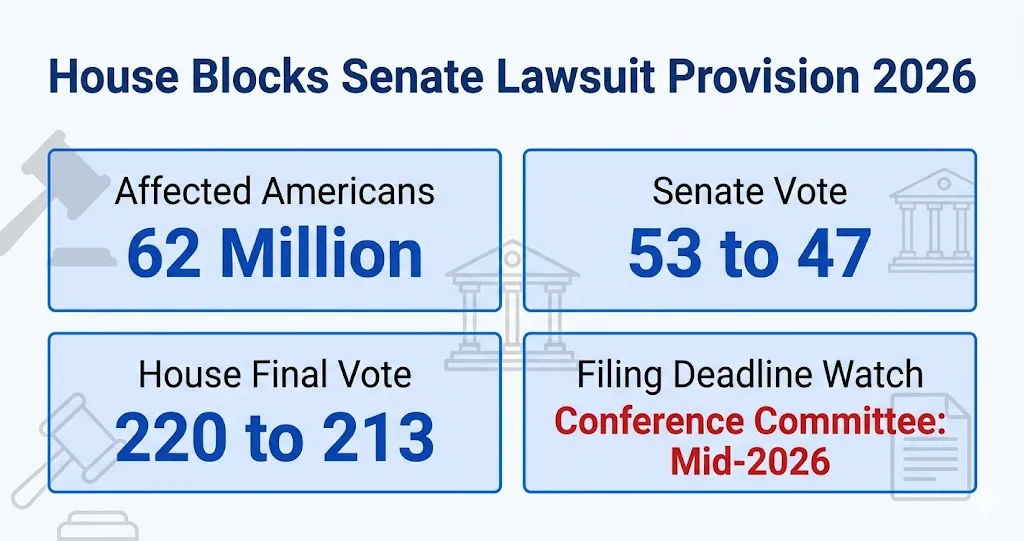
One number to keep in mind: an estimated 62 million Americans are currently bound by mandatory arbitration clauses that the blocked Senate provision would have helped limit. That context makes this story far bigger than a typical congressional spat.
House Blocks Senate Lawsuit Provision: What Just Happened
The House voted in early 2026 to remove a Senate-inserted lawsuit provision from a major piece of federal legislation. The provision would have restricted corporations from forcing consumers and employees into private arbitration instead of open court.
The House passed its version of the bill without the lawsuit language. This effectively killed the provision for now. Unless the Senate fights back through a conference process or a new standalone bill, the protection is gone.
Think of it like a contract negotiation where one side agreed to a key term, the other side crossed it out, and sent it back. The Senate wrote in consumer protections. The House took a pen and drew a line through them.
Quick Facts:
| Detail | Info |
|---|---|
| Vote Type | House floor vote, 2026 |
| Provision Removed | Senate lawsuit access amendment |
| Primary Opposition | House Republican majority |
| Primary Support | Senate Democratic leadership |
| Consumer Impact | Limits on mandatory arbitration eliminated |
| Affected Americans | Estimated 62 million with arbitration clauses |
What Is the Senate Lawsuit Provision the House Blocked?
The Senate lawsuit provision is a legal clause that would have placed new limits on corporations’ ability to require mandatory arbitration before a lawsuit could even be filed. In plain terms, it would have made it easier for regular people to take companies to court.
The provision was attached to a larger federal spending or policy bill during Senate markup. Senate Judiciary Committee members pushed it through as an amendment. The language targeted industries including financial services, healthcare, and consumer products.
Specifically, the provision aimed to:
- Ban pre-dispute mandatory arbitration clauses in consumer contracts
- Restore class action lawsuit rights in several industries
- Require corporations to disclose arbitration outcomes publicly
- Allow consumers to choose between arbitration and court in certain disputes
This kind of provision has been debated in Congress since at least 2017. The Forced Arbitration Injustice Repeal Act, commonly called the FAIR Act, has been the legislative vehicle for this fight in prior sessions. The 2026 Senate provision borrowed heavily from that framework.
Key Takeaway: The blocked provision was not symbolic. It was a substantive legal change that would have given millions of consumers the right to sue in federal court instead of being pushed into private arbitration.
How the House Repealed the Senate Lawsuit Provision
The House repealed the Senate lawsuit provision by voting on a version of the bill that simply did not include it. This is called a “strike” in legislative terms. The majority did not need a separate repeal vote. They just excluded the language.
The House Rules Committee played a central role. Before the bill reached the floor, the Rules Committee determined which Senate amendments would survive and which would be stripped. The lawsuit provision was targeted and removed at that stage.
The final House floor vote passed largely along party lines. Republicans, who hold the House majority in 2026, argued the provision would increase litigation costs, burden businesses, and slow economic activity.
Democrats pushed amendments to restore the provision. Those amendments failed. The bill moved forward without the consumer lawsuit protections.
| Stage | What Happened |
|---|---|
| Senate Markup | Lawsuit provision added by amendment |
| Senate Floor Vote | Provision included in passed bill |
| House Rules Committee | Provision identified for removal |
| House Floor Amendment | Democratic effort to restore it failed |
| Final House Vote | Bill passed without lawsuit provision |
Why the House Blocked the Senate Lawsuit Measure
The House blocked the Senate lawsuit measure primarily because of corporate lobbying pressure and majority party ideology around tort reform. The U.S. Chamber of Commerce and several major industry groups actively opposed the Senate language.
Their argument was straightforward: more lawsuits mean more costs, and more costs mean higher prices for consumers. It is a familiar argument that has been used to fight consumer litigation rights for decades.
The counter-argument, made by the American Association for Justice and consumer advocacy groups, is equally direct. Mandatory arbitration is a rigged game. It happens in private, outcomes favor corporations statistically, and consumers almost never know it’s happening until they try to sue.
Independent research from the Consumer Financial Protection Bureau found that consumers who arbitrate recover an average of $5,389, while consumers in class actions recover amounts ranging from $1 billion to $3 billion in aggregate per case. The difference is not trivial.
Key opposing positions in the 2026 House debate:
- Pro-block (House majority): Litigation expansion raises costs, harms business growth, clogs courts
- Anti-block (House minority): Arbitration protects corporations, denies consumers fair access to justice
- Industry groups: Chamber of Commerce, insurance lobbies, financial services trade groups opposed the provision
- Consumer groups: CFPB, American Association for Justice, National Consumer Law Center supported it
Senate Lawsuit Provision Blocked 2026: The Full Timeline
Understanding the timeline matters here. This fight did not start in 2026. It has roots going back years, and the 2026 House vote is the latest chapter in an ongoing battle.
Full Legislative Timeline:
| Date | Event |
|---|---|
| 2017 | FAIR Act first introduced in the Senate |
| 2019 | FAIR Act passed the House for the first time |
| 2020 to 2024 | Multiple failed Senate votes; filibuster blocked progress |
| January 2026 | Senate reattached lawsuit provision to federal legislation |
| February 2026 | Senate passed the bill with the provision included |
| March 2026 | House Rules Committee stripped the lawsuit language |
| April 2026 | House floor vote passed the bill without the provision |
| May 2026 onward | Senate weighs response; conference committee possible |
The pattern here looks a lot like a relay race where the baton keeps getting dropped at the same handoff point. The Senate passes protections. The House removes them. Consumers wait.
Key Takeaway: The 2026 House vote is part of a years-long pattern. The Senate lawsuit provision has been blocked or stalled in similar ways multiple times since 2017.
The House-Senate Lawsuit Dispute of 2026 Explained
The House-Senate lawsuit dispute of 2026 is fundamentally a disagreement about who should control access to civil courts. It is a power struggle with real consequences for real people.
The Senate, with its more balanced partisan split in 2026, has leaned toward expanding consumer access to courts. The House, with its Republican majority, has leaned toward limiting that access in favor of business-friendly arbitration systems.
This is not just politics for the sake of politics. Arbitration was originally designed for commercial disputes between businesses of equal power. Applying it to consumer contracts, where a major corporation hands a customer a 47-page terms-of-service document, is a fundamentally different scenario.
The 2026 dispute intensified because the lawsuit provision was attached to a bill the House wanted to pass for other reasons. It created a situation where House members had to choose between passing their preferred legislation and keeping the lawsuit language. They chose to strip the language.
Key points of contention in the 2026 dispute:
- Whether arbitration clauses in consumer contracts are voluntary or coercive
- Whether class action bans in arbitration agreements are constitutional
- Whether federal legislation can pre-empt state-level consumer protection laws
- Whether corporate defendants or consumers should bear the cost of dispute resolution
How the Senate Added the Lawsuit Provision to the Bill
The Senate added the lawsuit provision through the amendment process during committee markup. A group of Democratic senators on the Senate Judiciary Committee proposed the language and it was adopted along party lines before the bill reached the Senate floor.
The provision was what legislators call a “rider.” That means it was attached to a larger bill that had broader support, in hopes of getting it passed as part of a package. Riders are a common legislative strategy when a provision cannot pass on its own.
The specific Senate amendment restricted mandatory pre-dispute arbitration agreements in:
- Consumer financial products and services contracts
- Employment contracts for workers earning under $75,000 annually
- Healthcare service agreements
- Consumer product purchase agreements where the product price exceeded $250
The Senate floor debate lasted approximately three days before the amended bill passed. The final Senate vote was 53 to 47 in favor of the bill with the provision included.
| Provision Detail | Specifics |
|---|---|
| Amendment Type | Rider attached to larger federal bill |
| Added By | Senate Judiciary Committee Democrats |
| Senate Floor Debate | Approximately 3 days |
| Senate Vote | 53 to 47 in favor (provision included) |
| Target Industries | Finance, employment, healthcare, consumer goods |
How the House Stripped the Lawsuit Clause From Legislation
The House stripped the lawsuit clause through a procedural mechanism controlled by the House Rules Committee. This committee decides which Senate amendments get considered and which get dropped before the House votes.
The Rules Committee is controlled by the majority party. In 2026, Republicans hold that majority. They used a “closed rule” on the legislation, which meant no floor amendments to restore the lawsuit language were allowed to proceed to a full vote.
Democrats filed a motion to recommit specifically to restore the lawsuit provision. That motion failed 215 to 218 on a narrow party-line vote. The final bill passed 220 to 213.
It is worth noting that three Republican members actually voted with Democrats on the motion to recommit. That means the provision had some bipartisan support, even if not enough to survive.
How the stripping process worked:
- Step 1: House Rules Committee reviewed all Senate amendments
- Step 2: Rules Committee issued a closed rule blocking floor amendments
- Step 3: Democrats filed a motion to recommit to restore the language
- Step 4: Motion failed 215 to 218
- Step 5: Full bill passed 220 to 213 without the lawsuit provision
Key Takeaway: Three House Republicans broke with their party to try restoring the provision, showing this issue has some bipartisan resonance even in the House.
The Senate Lawsuit Amendment Was Stripped: What That Means
When the Senate lawsuit amendment was stripped, it did not just disappear from one bill. It effectively signaled to courts, corporations, and consumers that mandatory arbitration protections will not be coming from federal legislation in the near term.
This matters for active litigation. Courts often look at congressional intent when ruling on disputed arbitration clauses. When Congress explicitly removes a provision limiting arbitration, defense attorneys in pending cases will use that as evidence that current law supports arbitration over courtroom access.
It also removes pressure on corporations to voluntarily reform their arbitration agreements. Companies watching the 2026 legislative battle now know there is no federal mandate coming. Many will keep their existing arbitration-first policies in place.
For consumers currently in arbitration proceedings, the immediate impact is minimal. The provision was never law, so its removal does not change existing rules. But for those planning to file new claims, especially class action claims, the landscape is now less favorable.
| Who Is Affected | How |
|---|---|
| Active arbitration claimants | Minimal immediate change; existing rules apply |
| New claimants in 2026 | No new federal protection; arbitration clauses still binding |
| Class action plaintiffs | Collective lawsuits still blocked in arbitration-heavy sectors |
| Employees under $75K | No new federal right to opt out of arbitration |
| Courts | May interpret congressional removal as endorsement of arbitration |
Congressional Lawsuit Reform 2026: Where Things Stand Now
Congressional lawsuit reform in 2026 is at a standstill on the federal level, following the House’s decision to strip the Senate provision. Both chambers will need to negotiate a path forward or the issue goes dormant until the next legislative session.
The most likely next step is a conference committee. That is a formal process where House and Senate negotiators meet to reconcile differences between their versions of a bill. The lawsuit provision could theoretically be restored in conference.
However, conference committees have become rare in modern Congress. Party leaders on both sides often prefer to keep control rather than hand it to a negotiating committee. Many analysts watching the 2026 situation expect the conference process to be bypassed entirely.
If the conference process fails or is skipped, the Senate has two main options:
- Accept the House version without the lawsuit provision and move on
- Refuse to accept the House version and allow the entire bill to stall
Neither option is great for consumers. The second option might actually be worse, depending on what else is in the larger bill.
Where congressional lawsuit reform stands in 2026:
- Federal legislation: Stalled at House-Senate impasse
- State-level action: Several states considering their own arbitration limits
- Court challenges: Pending cases in the 9th and 11th Circuits on arbitration enforceability
- CFPB rulemaking: Agency exploring administrative action as an alternative path
Consumer Lawsuit Rights Blocked by Congress: The Real Impact
Consumer lawsuit rights have been blocked by Congress in a way that has very practical daily consequences. The biggest one is that corporations in financial services, healthcare, and retail can continue requiring consumers to waive their class action rights as a condition of doing business.
That waiver usually appears buried in a terms-of-service or user agreement. Most people click “agree” without reading it. By doing so, they legally surrender their right to join a class action lawsuit against that company.
The Senate provision would have made those waivers unenforceable in federal court for specific categories of disputes. Without it, the waivers remain valid. Corporate defendants will continue citing them to have lawsuits dismissed.
The numbers tell the story clearly. According to CFPB data:
- 76% of consumers surveyed did not know whether their financial contracts included arbitration clauses
- Consumers filing individual arbitration claims recover a median of $5,389
- Class action settlements in comparable cases average $32 per class member but reach millions of people
- Only 16 cases per year on average result in consumer victories in arbitration against major financial firms
Key Takeaway: The blocked provision would have changed a system where corporations write the rules, pick the arbitrators, and win the vast majority of disputes. Without it, that system stays intact.
How the House Blocked Civil Lawsuit Access for Millions
The House blocked civil lawsuit access by rejecting the arbitration limits that the Senate had written into law. For approximately 62 million Americans currently bound by mandatory arbitration agreements, this means their path to a courtroom remains closed.
Civil lawsuit access is not just about winning money. It is about transparency, public records, precedent, and accountability. Arbitration is private. Court cases are public. When corporations resolve disputes in arbitration, neither other consumers nor the press can see what happened.
When a pharmaceutical company settles hundreds of arbitration claims for a defective drug, no public record exists. When the same situation goes through federal court, it creates a case record, a settlement database, and often a warning to other consumers.
The House vote blocks access to that transparency pipeline. It keeps corporate legal disputes in a private system where the outcomes are invisible to everyone except the parties involved.
Civil lawsuit vs. arbitration: Key differences affected by the blocked provision:
| Factor | Federal Court | Mandatory Arbitration |
|---|---|---|
| Public record | Yes | No |
| Class actions allowed | Yes (in most cases) | Banned by most clauses |
| Appeal rights | Full | Very limited |
| Arbitrator selection | Neutral judge | Often chosen by corporation |
| Average consumer recovery | Significantly higher | $5,389 median |
| Precedent set | Yes | No |
What Does the Blocked Lawsuit Provision Mean for Me?
The blocked Senate lawsuit provision means that if you signed a consumer contract with a mandatory arbitration clause, you are still bound by it. You cannot join a class action against that company for disputes covered by the clause.
This affects you if you have a bank account, credit card, cell phone contract, healthcare plan, or have purchased products from major retailers. Almost all of these contracts contain arbitration language.
If you have an active individual lawsuit, the blocking of this provision does not change your case directly. The provision was about future enforcement. It was never enacted, so it cannot be removed from your existing rights.
The practical impact is most significant for three groups:
- People planning to join class actions against corporations in financial services or healthcare
- Employees earning under $75,000 who wanted to sue employers in court over workplace disputes
- Consumers who purchased defective products and wanted to access federal court instead of private arbitration
For these people, the blocked provision would have opened a door. That door remains closed for now.
| Your Situation | Impact of the Block |
|---|---|
| Signed arbitration agreement | Still bound by it; no federal protection available |
| Active individual lawsuit | No direct change; case proceeds under existing rules |
| Planning to join class action | Class action bans in your contract remain enforceable |
| Employee with workplace dispute | Mandatory arbitration still applies if your contract requires it |
| Product injury plaintiff | Federal court access still depends on your contract terms |
How the House Vote Affects Pending Lawsuits Right Now
The House vote affects pending lawsuits primarily through its signaling effect to courts, not by directly changing existing law. Judges who are currently deciding motions to compel arbitration will see Congress’s action as evidence that current arbitration law should be maintained.
Defense attorneys in pending class action cases will cite the 2026 House vote in their motions. Their argument will be that Congress had the opportunity to restrict arbitration and chose not to. Courts have historically given weight to this type of congressional intent evidence.
For cases that are already in federal court and past the arbitration motion stage, the impact is minimal. Those cases will proceed under the rules that were in place when the lawsuits were filed.
The categories of pending lawsuits most likely to feel the ripple effect include:
- Class actions in the 9th Circuit where arbitration enforceability is being challenged
- Mass tort cases where defendants are trying to push individual plaintiffs into arbitration
- Employee discrimination cases where arbitration clauses are being used to block EEOC complaints
- Consumer fraud cases against financial institutions in the 2nd and 11th Circuits
Key Takeaway: The House vote does not retroactively change active cases, but defense attorneys will use it as a legal argument in motions, and some judges may find it persuasive.
Impact of the House Blocking This Lawsuit Measure on Consumers
The impact of the House blocking this lawsuit measure falls hardest on consumers with the least legal resources. Wealthy individuals can afford to hire attorneys to fight arbitration clauses one by one. People without those resources cannot.
Class action lawsuits exist precisely to solve this problem. They pool resources, share legal costs, and allow one strong case to represent thousands of similarly harmed people. The blocked provision was designed to preserve class action access in situations where it is most needed.
Without that protection, corporations that harm consumers at scale can effectively avoid accountability. If the harm per individual is small, say $50 or $100, no individual consumer will pay an attorney to fight it in private arbitration. But at scale, $50 per consumer times 10 million customers is $500 million. That money disappears into the arbitration system.
Real industries where this impact lands hardest in 2026:
- Banking and credit: Overdraft fee disputes, deceptive product charges
- Healthcare: Billing errors, surprise charges, insurance denials
- Telecom: Unauthorized charges, data throttling claims
- Retail: Defective product claims, warranty disputes
- Gig economy: Worker misclassification disputes
Lawsuit Eligibility After the Provision Was Blocked
Lawsuit eligibility after the provision was blocked depends entirely on the specific contract you signed and the nature of your claim. Federal law did not change because the Senate provision never became law. Your existing rights are determined by contracts you already signed and laws already in place.
If your contract does not contain a mandatory arbitration clause, you retain full access to federal or state court. Many small and mid-size companies, particularly local businesses, do not include these clauses.
If your contract does contain an arbitration clause, you have several potential paths depending on your situation:
- Challenge the clause as unconscionable: Courts sometimes void arbitration clauses that are excessively one-sided
- Check for a public injunction exception: California and some other states allow consumers to seek injunctive relief in court even with arbitration clauses
- Check for congressional carve-outs: Some laws, including the Military Lending Act and certain sexual harassment statutes, already ban arbitration for specific claim types
- File with the CFPB or FTC: Regulatory complaints can trigger investigation even when lawsuits are blocked
| Claim Type | Arbitration Applies? | Federal Court Access? |
|---|---|---|
| Sexual harassment (post-2022 federal law) | No | Yes |
| Military service member consumer disputes | No | Yes |
| Standard consumer contract dispute | Likely yes | Blocked by clause |
| Workplace discrimination (non-military) | Often yes | Blocked if clause exists |
| Product injury with arbitration clause | Often yes | Blocked if clause exists |
| Product injury without arbitration clause | No | Yes |
How the House Vote Removes Lawsuit Protection for You
The House vote removes lawsuit protection by allowing corporations to keep mandatory arbitration clauses fully enforceable without any new federal limits. It is a removal by inaction, not by direct statute, but the practical result is the same.
Before the Senate provision was introduced, consumers had limited federal protections against arbitration clauses. The Senate provision would have created new ones. With the House vote, the new protections vanish before they ever took effect.
For individual consumers, this plays out in a very specific way. When you sign up for a new service in 2026, the contract will almost certainly contain an arbitration clause and a class action waiver. Under current law, those provisions are enforceable. You have no federal right to refuse them and still access the service.
You can refuse to sign the contract. You can walk away. But in industries with limited competition, like mobile data, health insurance, or banking, “walk away” is not a realistic option for most people.
The blocked provision would have changed the math. Without it, the math stays the same:
- Corporation’s risk: Low. Arbitration is cheaper, faster, and statistically favorable to them.
- Consumer’s risk: High. Individual arbitration is expensive relative to small-dollar claims.
- Net effect: Consumers with small-dollar grievances have no practical legal remedy.
Key Takeaway: The House vote did not pass a new law harming consumers. It prevented a new law from helping them, which in practice has the same effect on your legal options.
What Happens Next After the Lawsuit Provision Was Blocked?
After the lawsuit provision was blocked, three separate tracks of action are now in play: the legislative track, the regulatory track, and the judicial track.
The Legislative Track: The Senate can push for a conference committee to negotiate a compromise bill that restores some version of the lawsuit provision. Senate leadership has indicated it will pursue this route. However, with limited legislative days remaining in the 2026 session, the window is narrow.
The Regulatory Track: The CFPB retains rulemaking authority over arbitration agreements in consumer financial products. The agency issued an arbitration rule in 2017 that was overturned by Congress. It could attempt a new rule in 2026, though it would face similar political opposition.
The Judicial Track: Several federal appeals courts are actively hearing cases that challenge the enforceability of class action waivers in arbitration agreements. A major ruling from the 9th Circuit or a Supreme Court grant of certiorari could change the landscape independent of legislation.
Next steps and what to watch:
| Track | What to Watch | Likely Timeline |
|---|---|---|
| Legislative | Senate conference committee request | Mid-2026 |
| Legislative | Standalone FAIR Act vote | Late 2026 or 2027 |
| Regulatory | CFPB rulemaking on arbitration | 12 to 24 months |
| Judicial | 9th Circuit arbitration ruling | Late 2026 |
| Judicial | Supreme Court cert petition | 2026 to 2027 |
| State | California, New York arbitration reform bills | Ongoing 2026 |
The most important thing to watch is the conference committee process. If Senate leadership formally requests conference negotiations and the House agrees, the lawsuit provision could come back to the table. If the House refuses conference, the Senate provision is effectively dead for this legislative session.
Frequently Asked Questions
What was the Senate lawsuit provision that the House blocked?
The Senate lawsuit provision was a legislative amendment that would have restricted corporations from enforcing mandatory pre-dispute arbitration clauses against consumers and certain employees.
It was modeled on the FAIR Act and targeted industries including financial services, healthcare, and consumer products.
The provision passed the Senate 53 to 47 but was stripped from the bill by the House Rules Committee before reaching the House floor.
Does the House blocking this lawsuit provision affect my active case?
The House blocking this provision does not directly change the rules governing your active case.
The provision was never enacted, so it cannot be removed from rights you already had.
However, defense attorneys in cases involving arbitration clauses may cite the House vote in motions, and some judges may find that argument persuasive.
Can the Senate lawsuit provision still become law in 2026?
The Senate lawsuit provision can still become law through a conference committee, a standalone bill, or regulatory action by the CFPB.
A conference committee is the most immediate path, but it requires the House to agree to negotiate.
If the conference process fails, the provision may be reintroduced in the next legislative session.
Who benefits from the House blocking the Senate lawsuit provision?
Corporations in financial services, healthcare, retail, and the gig economy benefit most from the House blocking this provision.
These industries rely on mandatory arbitration to resolve consumer disputes privately and avoid class action liability.
The U.S. Chamber of Commerce and major industry trade groups actively lobbied in favor of the House’s decision to strip the provision.
What can consumers do now that the lawsuit provision has been blocked?
Consumers can file complaints with the CFPB and FTC even when lawsuits are blocked by arbitration clauses.
Some claim types, including sexual harassment claims and military consumer disputes, are already exempt from arbitration under existing federal law.
Consumers should review their contracts for arbitration clauses and, where possible, seek legal advice on whether a clause can be challenged as unconscionable under state law.
The House’s decision to block the Senate lawsuit provision in 2026 is a significant setback for consumer legal access. It keeps mandatory arbitration firmly in place for millions of Americans who sign everyday contracts with corporations.
Stay informed as the legislative, regulatory, and judicial tracks all continue moving in 2026. Check whether your existing contracts contain arbitration clauses. And if you have a specific legal dispute, look into whether your claim type falls under an existing exemption.
You still have legal options. They are just narrower than they would have been if the Senate provision had survived.
