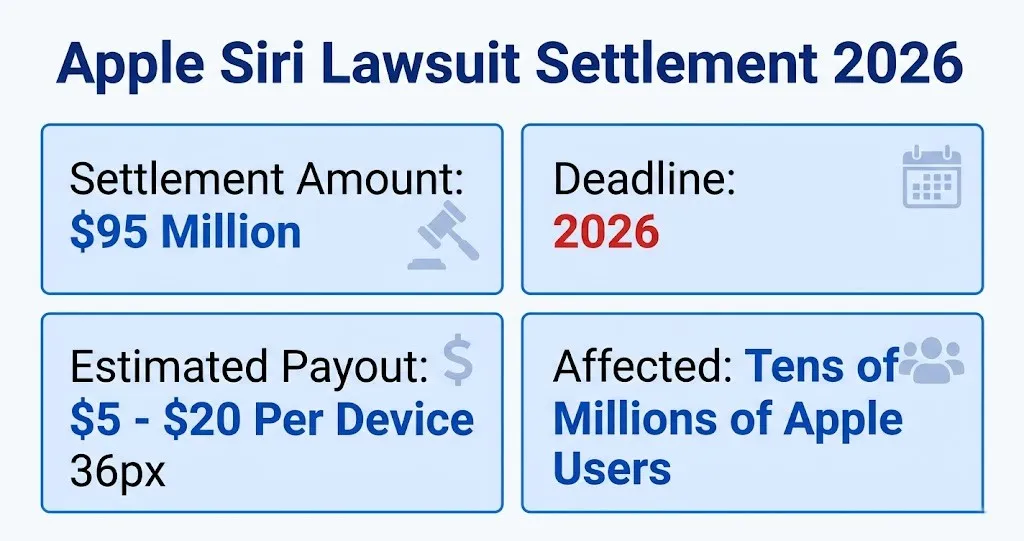
The Apple Siri lawsuit resulted in a $95 million settlement after Apple was accused of letting Siri record private conversations without user consent. If you owned a Siri-enabled device between September 17, 2014, and December 31, 2024, you may be owed money.
This case changed how we think about voice assistants and privacy. Apple allegedly used third-party contractors to listen to recordings captured by accidental Siri activations. Some of those recordings included sensitive medical conversations, private arguments, and even intimate moments.
In this article, you’ll find the current 2026 status of the settlement, exactly how to file a claim, which devices qualify, realistic payout estimates, and every deadline that matters. Tens of millions of Apple users are potentially eligible, but most haven’t filed.
The window to act is narrowing. Here’s everything you need to know.
Apple Siri Lawsuit
The Apple Siri lawsuit is a class action privacy case filed in federal court accusing Apple of recording users through Siri without proper consent. The case is officially known as Lopez et al. v. Apple Inc., Case No. 19-cv-04577, filed in the U.S. District Court for the Northern District of California.
The lawsuit started after a 2019 report by The Guardian revealed that Apple hired third-party contractors to listen to Siri recordings. These weren’t just “Hey Siri” requests. Many recordings happened when Siri activated by accident.
Contractors reportedly heard drug deals, doctor visits, couples being intimate, and business negotiations. None of the people recorded had any idea their voices were being reviewed by strangers.
| Detail | Info |
|---|---|
| Case Name | Lopez et al. v. Apple Inc. |
| Case Number | 19-cv-04577 |
| Court | U.S. District Court, N.D. California |
| Settlement Amount | $95 million |
| Class Period | September 17, 2014 to December 31, 2024 |
Apple denied wrongdoing but agreed to pay $95 million to resolve the claims. The company also made changes to its Siri data practices following the controversy.
The case matters because it set a precedent for how tech companies handle voice data. It’s one of the largest voice assistant privacy settlements ever reached.
Apple Siri Class Action Lawsuit
The Apple Siri class action lawsuit lets millions of affected device owners seek compensation through a single legal action. Instead of each person filing their own case, one lawsuit represents everyone who was harmed by the same corporate behavior.
Class action status was granted because the alleged privacy violations affected a massive group of people in the same way. Every person with a Siri-enabled Apple device was potentially exposed to unauthorized recordings during the class period.
The named plaintiffs argued that Apple’s conduct violated federal and state wiretapping laws. They also claimed Apple breached its own privacy policies by sharing recordings with contractors without telling users.
What makes this a class action:
- Millions of people were affected by the same practice
- The harm was uniform across the class (unauthorized recording)
- Individual claims would be too small to pursue alone
- A single resolution is more efficient for the court system
Think of it like a neighborhood pothole that damages everyone’s tires. Rather than each driver suing the city separately, one case covers all of them. That’s how this works.
You don’t need to have hired a lawyer or joined the case early. If you qualify, you’re automatically part of the class unless you previously opted out.
Apple Settles Siri Privacy Lawsuit
Apple settled the Siri privacy lawsuit for $95 million in January 2025. The settlement resolved allegations that Apple violated users’ privacy by allowing Siri to record conversations and sharing those recordings with third-party contractors.
The settlement was a significant moment for digital privacy. Apple did not admit guilt or liability. The company maintained that Siri recordings were used only to improve the voice assistant’s accuracy.
But the evidence told a different story. Former contractors went public describing what they heard in accidental Siri recordings. The details were disturbing enough to generate worldwide media coverage and regulatory scrutiny.
Key settlement terms:
- $95 million total settlement fund
- Up to $20 per Siri-enabled device for qualifying claimants
- Maximum of 5 devices per household
- Apple agreed to permanently delete Siri audio recordings obtained during the class period
- Apple must confirm that Siri responses are not stored by default unless users opt in
The deletion requirement is actually one of the most important parts of this deal. It means Apple can’t keep using those improperly collected recordings for any purpose going forward.
Key Takeaway: The Apple Siri class action lawsuit produced a $95 million settlement after Apple was caught letting contractors listen to private Siri recordings, and any Apple device owner from the class period may qualify for up to $20 per device.
Apple Siri Lawsuit Claim
An Apple Siri lawsuit claim is the formal request you submit to receive your share of the $95 million settlement fund. You must file a valid claim form to get paid. Money doesn’t show up automatically.
This is where most people drop off. They hear about the settlement on the news, assume they’ll get a check, and never actually submit the paperwork. That’s not how class action settlements work.
Filing a claim requires basic information about your Apple devices and the time period you owned them. You do not need receipts, serial numbers, or proof that Siri recorded you specifically.
What you need to file:
- Your full legal name and mailing address
- Email address associated with your Apple ID
- The types of Siri-enabled devices you owned during the class period
- The approximate dates you owned each device
- A declaration under penalty of perjury that the information is accurate
The settlement administrator verifies claims against Apple’s records. If your Apple ID matches device ownership data, your claim will likely be approved.
You can file online through the official settlement website or mail a paper form. Online filing is faster and creates a digital record for your reference.
How to File an Apple Siri Lawsuit Claim
Filing an Apple Siri lawsuit claim takes about 10 minutes if you have your device information ready. The process is straightforward, but you need to follow each step correctly to avoid having your claim rejected.
Step-by-step filing process:
- Visit the official settlement website (the URL was included in your class notice)
- Click “Submit a Claim” or “File a Claim”
- Enter your personal information (name, address, email)
- List each Siri-enabled device you owned between September 17, 2014, and December 31, 2024
- Select the device type from the dropdown menu (iPhone, iPad, Apple Watch, etc.)
- Enter approximate ownership dates for each device
- Sign the electronic declaration confirming your information is truthful
- Submit and save your confirmation number
| Step | Action | Time Needed |
|---|---|---|
| 1 | Access settlement site | 1 minute |
| 2 | Enter personal details | 2 minutes |
| 3 | List qualifying devices | 3 minutes |
| 4 | Confirm ownership dates | 2 minutes |
| 5 | Sign and submit | 2 minutes |
Keep your confirmation number somewhere safe. If there’s a dispute about your claim, that number is your proof of submission.
If you can’t remember exactly which devices you owned, check your Apple ID purchase history. Your Apple account keeps records of every device registered to your account.
Apple Siri Lawsuit Payout Per Person
The Apple Siri lawsuit payout per person is estimated at $20 per qualifying device, with a maximum of 5 devices per household. That means the highest possible individual payout is roughly $100.
But here’s the catch that no one talks about. The $20 figure is the maximum. Actual payouts depend on how many people file valid claims.
The settlement fund totals $95 million. After attorney fees (typically 25% to 33%) and administrative costs, the fund available for claimants shrinks considerably. If millions of people file, each person gets less.
Realistic payout breakdown:
| Scenario | Estimated Claims Filed | Payout Per Device |
|---|---|---|
| Low claim volume | Under 1 million | $15 to $20 |
| Medium claim volume | 1 to 5 million | $7 to $15 |
| High claim volume | Over 5 million | $3 to $7 |
The math works like this. If attorney fees take $28 million and admin costs take $5 million, about $62 million remains. Divide that among 5 million claims at one device each, and you get roughly $12.40 per person.
Class action payouts are rarely life-changing for individuals. The real punishment comes from the total amount Apple pays and the policy changes forced by the settlement.
Key Takeaway: While the maximum payout is $20 per device and $100 per household, the realistic amount each person receives depends entirely on how many total claims are filed against the $95 million fund.
Apple Siri Lawsuit: How Much Will I Get?
Most claimants in the Apple Siri lawsuit will receive between $5 and $20 per device after the settlement fund is divided. Your exact amount depends on three factors: the number of devices you claim, the total number of claims filed, and the final amount remaining after legal fees.
It’s not a lottery ticket. It’s more like splitting a restaurant bill with a very large table. The more people who show up, the smaller each share becomes.
Factors affecting your payout:
- Number of valid claims filed across all class members
- Number of devices you personally list on your claim
- Attorney fee percentage approved by the court
- Administrative and notice costs deducted from the fund
- Whether any claims are rejected or challenged
If you owned five qualifying devices and claim all five, you’re in a better position than someone who only owned one iPhone during the class period.
Some class members who can show documented harm beyond the standard claim may receive higher payments. For example, if Siri recorded a conversation that was later shared or misused, you might have grounds for a separate individual claim outside the class settlement.
For most people, expect a modest payment. The settlement is more about holding Apple accountable than making individuals rich.
Apple Siri Settlement Update 2026
As of 2026, the Apple Siri settlement has moved into its distribution phase. The court granted final approval of the $95 million settlement, and the claims period has either closed or is nearing its final deadline.
Here’s where things stand right now. Settlement checks and electronic payments are expected to be processed and sent to approved claimants during 2026. The exact distribution timeline depends on whether any appeals were filed after final approval.
2026 Settlement Timeline:
| Milestone | Status |
|---|---|
| Preliminary Approval | Granted (2025) |
| Notice to Class Members | Completed |
| Claim Filing Period | Closing or closed |
| Final Approval Hearing | Completed |
| Objection/Appeal Period | Passed or pending |
| Payment Distribution | Expected mid-to-late 2026 |
If no appeals were filed, payments should arrive faster. Appeals can delay distribution by 12 to 18 months in some cases.
The settlement administrator will send payments via check or electronic transfer, depending on what you selected when filing your claim. If you moved since filing, update your address with the administrator immediately.
Check the official settlement website periodically for status updates. They post notices when payments are being processed.
Apple Siri Lawsuit Deadline 2026
The Apple Siri lawsuit deadline for filing claims was set during the settlement approval process, and the final date falls in 2026. If you haven’t filed yet, time is running out.
Class action deadlines are strict. Once the claim submission window closes, there is typically no way to file a late claim. Courts enforce these cutoffs to keep the process moving toward payment distribution.
Critical dates to know:
- Claim filing deadline: Check the settlement notice for the exact date (typically 60 to 120 days after final approval)
- Objection deadline: Already passed for most class members
- Opt-out deadline: Already passed
- Payment distribution: Expected after all claims are processed in 2026
If you received a class notice by email or mail, the deadline was printed directly on it. Don’t ignore that date.
What if you missed the deadline? In rare cases, courts allow late claims if you can show “good cause” for missing the cutoff. This might include military deployment, hospitalization, or not receiving the class notice. But these exceptions are uncommon and hard to win.
The safest approach is to file now if the window is still open. Even if you’re unsure whether you qualify, submitting a claim costs nothing.
Key Takeaway: The claim filing deadline for the Apple Siri lawsuit falls in 2026, and once it passes, there is almost no way to submit a late claim, so filing immediately is the smartest move.
Apple Class Action Lawsuit Siri
The Apple class action lawsuit over Siri is part of a larger wave of privacy litigation targeting tech companies that collect voice data. This case specifically targets Apple’s practice of using third-party contractors to review Siri recordings without user knowledge.
What sets this case apart from other tech privacy lawsuits is the nature of the recordings. These weren’t search queries or browsing data. They were actual audio recordings of real conversations happening in people’s homes, cars, and bedrooms.
How this case compares to similar lawsuits:
| Case | Company | Settlement | Allegation |
|---|---|---|---|
| Siri Privacy Lawsuit | Apple | $95 million | Unauthorized voice recording |
| Alexa Privacy Case | Amazon | Pending | Voice data retention |
| Google Assistant Suit | $155 million (location) | Data collection practices | |
| Facebook Audio Case | Meta | Settled (undisclosed) | Microphone access claims |
Apple’s case is notable because the company has long marketed itself as a privacy-first brand. The “What happens on your iPhone stays on your iPhone” campaign was running at the same time contractors were listening to Siri recordings.
That disconnect between marketing and reality is what made this lawsuit so damaging to Apple’s reputation, arguably more than the $95 million price tag.
Class Action Lawsuit Apple Siri
The class action lawsuit against Apple over Siri includes all U.S. residents who owned or purchased a Siri-enabled Apple device during the class period. You don’t need to prove that Siri specifically recorded you. Owning a qualifying device during the relevant time frame is enough.
This broad definition is intentional. The plaintiffs argued that every Siri-enabled device had the potential to activate without a trigger phrase and record audio. Since users couldn’t know whether their specific device captured recordings, the class covers all device owners.
Who is automatically included:
- U.S. residents who owned Siri-enabled devices between September 17, 2014, and December 31, 2024
- People who did not previously opt out of the class during the exclusion period
- Device owners regardless of whether they actively used Siri
Who is NOT included:
- People who formally opted out during the exclusion window
- Apple employees above a certain level
- The judge and court staff assigned to the case
- People who filed separate individual lawsuits against Apple over Siri
If you did nothing when you received the class notice, you’re still part of the class. Doing nothing keeps you in. Only people who actively mailed an opt-out request were removed.
Apple Siri Lawsuit Eligible Devices
The Apple Siri lawsuit covers a wide range of eligible devices that had Siri capability during the class period. Almost every Apple product with a microphone and Siri functionality qualifies.
Here’s the full breakdown of devices that count toward your claim.
Eligible device categories:
| Device Type | Models Covered | Siri Available Since |
|---|---|---|
| iPhone | iPhone 4S and later | October 2011 |
| iPad | iPad 3rd generation and later | March 2012 |
| Apple Watch | All models | April 2015 |
| MacBook/iMac | Models with macOS Sierra and later | September 2016 |
| HomePod | HomePod and HomePod Mini | February 2018 |
| iPod Touch | 5th generation and later | September 2012 |
| Apple TV | 4th generation and later | October 2015 |
| AirPods | AirPods with “Hey Siri” support | March 2019 |
You can claim up to 5 devices per household. If your family owned an iPhone, an iPad, an Apple Watch, a HomePod, and a MacBook during the class period, that’s five devices and the maximum claim.
Don’t worry about finding receipts or serial numbers. The claim form asks for device types and approximate ownership periods. Apple’s internal records are used to verify claims against your Apple ID.
Key Takeaway: Nearly every Apple product with Siri functionality is covered by this lawsuit, from iPhones to HomePods, and you can claim up to 5 devices per household for maximum payout.
Lawsuit Against Apple Siri
The lawsuit against Apple over Siri was built on allegations of wiretapping, invasion of privacy, and violations of California’s Invasion of Privacy Act. Plaintiffs argued that Apple turned millions of devices into surveillance tools without telling anyone.
The legal theory was straightforward. When Siri activates accidentally, it records a snippet of audio. Apple then sent those audio clips to contractors for “quality grading.” Users never consented to this. Apple’s privacy policy didn’t clearly disclose it.
The core legal claims:
- Violation of the California Invasion of Privacy Act (CIPA)
- Violation of the federal Wiretap Act
- Violation of state consumer protection laws
- Breach of Apple’s own privacy policies and terms of service
- Unjust enrichment (Apple profited from data collected without consent)
One of the most compelling arguments was about “accidental activations.” Siri doesn’t always wait for “Hey Siri.” A word that sounds similar, a random noise, or even a vibration could trigger recording.
Former Apple contractors testified that they regularly heard recordings where users clearly had no idea Siri was listening. The recordings included medical discussions, legal conversations, and personal moments that should have stayed private.
Apple’s defense centered on the argument that recordings were anonymized and used only to improve Siri. But the plaintiffs showed that the recordings sometimes contained enough context to identify users.
Apple Siri Spying Lawsuit
The Apple Siri spying lawsuit stems from the 2019 revelation that Apple hired contractors to listen to Siri recordings. The term “spying” gained traction because users had no knowledge that real humans were reviewing their voice data.
This wasn’t algorithmic analysis. Real people, sitting in offices, put on headphones and listened to what Siri captured. That’s what made the public reaction so intense.
What contractors reportedly heard:
- Medical consultations discussing diagnoses and medications
- Criminal activity including drug transactions
- Intimate encounters between couples
- Confidential business meetings and negotiations
- Children’s voices during private family conversations
A former Apple contractor told The Guardian in 2019 that accidental activations were a “regular occurrence.” Each contractor reportedly reviewed around 1,000 audio snippets per shift.
Apple initially suspended the grading program after the story broke. The company later restarted a version of the program with an opt-in requirement. Users now must actively choose to share Siri recordings for quality improvement.
Before vs. After the lawsuit:
| Practice | Before Lawsuit | After Settlement |
|---|---|---|
| Recording sharing | Automatic, no consent | Opt-in only |
| Contractor access | Widespread | Eliminated or restricted |
| Data retention | Indefinite | Must be deleted |
| User notification | None | Required disclosure |
The behavioral changes Apple made are arguably more valuable than the money. Every Siri user now has more control over their voice data because this lawsuit forced transparency.
Did Apple Siri Record Conversations?
Yes, Apple Siri did record conversations, often without the user’s knowledge or intentional activation. The recordings occurred when Siri mistakenly activated, a process known as a “false trigger” or “accidental activation.”
Here’s how it worked. Siri is designed to listen for a wake phrase like “Hey Siri.” But the system isn’t perfect. Background noise, similar-sounding words, and even pocket friction could trigger Siri to start recording.
Once activated, Siri captured a short audio clip and sent it to Apple’s servers. Apple then routed some of those clips to contractors through its “grading program” for quality review.
What we know about the recordings:
- Recordings lasted up to 30 seconds per activation
- Some included conversations that happened before the trigger word
- Apple stored recordings with a random identifier, not a user name
- But recordings sometimes contained enough personal detail to identify the speaker
- The grading program operated from at least 2014 until mid-2019
Apple’s position is that the recordings were anonymized and used to make Siri better. But anonymization fell short when a recording included someone saying their own name, address, or phone number during a conversation.
The key legal issue wasn’t just that Siri recorded. It was that Apple never told users their recordings might be heard by strangers. The lack of informed consent is what made this actionable.
Key Takeaway: Apple Siri did record private conversations through accidental activations, and those recordings were reviewed by human contractors without user knowledge or consent, which is the foundation of the entire $95 million settlement.
Apple Lawsuit Siri Claim
The Apple lawsuit Siri claim process was designed to be simple enough for anyone to complete without legal help. You don’t need a lawyer. You don’t need documentation. You just need to know which Apple devices you owned and when.
The settlement administrator handles all claim processing. Their job is to verify your information against Apple’s device registration records, determine your eligibility, and calculate your payment.
Common reasons claims get rejected:
- Filing after the deadline
- Providing false device information
- Claiming devices not registered to your Apple ID
- Submitting duplicate claims under different names
- Claiming more than 5 devices per household
If your claim is rejected, you typically receive a notice explaining why. Some settlement agreements allow you to dispute a rejection, but the window for disputes is usually short.
Claim status tracking:
| Status | What It Means |
|---|---|
| Received | Your claim was submitted successfully |
| Under Review | The administrator is verifying your information |
| Approved | Your claim passed verification |
| Denied | Your claim was rejected (reason provided) |
| Payment Pending | Approved and waiting for fund distribution |
| Paid | Payment has been sent |
Keep checking your claim status through the settlement website. If your status hasn’t changed in several months, contact the settlement administrator directly.
Siri Apple Lawsuit
The Siri Apple lawsuit represents one of the most significant consumer privacy cases of the past decade. It forced the world’s most valuable company to answer for secretly sharing voice recordings with contractors.
This case matters beyond the $95 million payout. It changed how Apple and other tech companies handle voice data going forward. Before this lawsuit, most voice assistant providers operated grading programs with zero transparency.
What this lawsuit changed industry-wide:
- Apple, Google, and Amazon all paused or modified their voice review programs
- New opt-in requirements became standard across the industry
- Public awareness of voice assistant privacy risks increased dramatically
- Regulatory agencies in the EU and U.S. began investigating voice data practices
- Apple added a specific Siri privacy toggle in iOS settings
The settlement also requires Apple to delete all improperly collected Siri recordings from the class period. This destruction of data is a rare and powerful remedy in privacy cases.
For consumers, the takeaway is practical. Check your Siri privacy settings on every Apple device you own. Go to Settings, then Siri and Search, then Siri and Dictation History. You can delete your history and opt out of sharing recordings.
If you haven’t filed your claim yet and the deadline hasn’t passed, do it today. The money may be modest per person, but it’s yours. Apple already agreed to pay it. Someone is going to collect it. That someone should be you.
Frequently Asked Questions
How much money will I get from the Apple Siri lawsuit?
Most claimants will receive between $5 and $20 per qualifying device.
The exact amount depends on how many total claims are filed against the $95 million fund.
You can claim up to 5 devices, so the maximum per household is roughly $100.
Is it too late to file a claim in the Apple Siri settlement?
The claim filing deadline falls in 2026, and the exact date was listed on your class notice.
If the deadline hasn’t passed, you can still file online through the official settlement website.
Late claims are rarely accepted unless you can prove extraordinary circumstances.
Which Apple devices qualify for the Siri privacy lawsuit?
Any Siri-enabled Apple device owned between September 17, 2014, and December 31, 2024 qualifies.
This includes iPhones (4S and later), iPads, Apple Watches, MacBooks, HomePods, iPod Touches, Apple TVs, and AirPods.
You can claim up to 5 devices per household.
What did Apple do wrong with Siri recordings?
Apple used third-party contractors to listen to Siri recordings captured through accidental activations.
Users were never told that real people would hear their private conversations.
The practice violated wiretapping and privacy laws according to the class action complaint.
When will Apple Siri lawsuit payments be sent out?
Settlement payments are expected to be distributed during mid-to-late 2026.
The exact timing depends on whether any appeals were filed after the court granted final approval.
Payments will be sent by check or electronic transfer based on the option you selected when filing.
This settlement is real, the money is set aside, and millions of Apple users qualify. Don’t let the deadline pass without acting.
If the claim window is still open, file today. It takes 10 minutes and costs nothing. Check the settlement website for the latest status updates on payment distribution.
Your voice data was collected without your permission. This is your chance to be compensated for it.