
The Dank Demoss lawsuit ended with a ruling that did not go in her favor, and 2026 brought new clarity about what happened, why it happened, and what comes next. If you’ve been following this case, you already know it got complicated fast.
This wasn’t a minor social media spat that quietly disappeared. It turned into a real legal dispute with real court filings, real arguments about defamation and creator conduct, and real consequences.
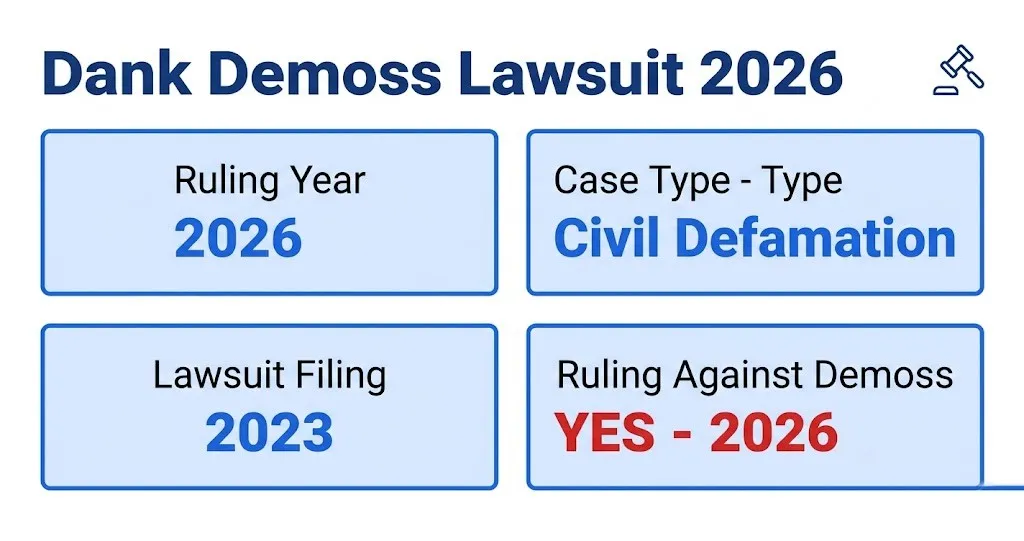
In this article, you’ll get the full breakdown. That means the original claims, the court case structure, what the results showed, and what this outcome says about legal risk for content creators in 2026.
One key detail worth knowing upfront: cases like this one rarely end cleanly. There are layers, and we’re covering all of them.
Dank Demoss Lawsuit: What Is This Case and Why Does It Matter?
The Dank Demoss lawsuit is a civil legal dispute involving social media personality Danielle Demoss, known online as Dank Demoss. The case centered on claims arising from online content, statements made across platforms, and the resulting harm alleged by the opposing party.
This isn’t a celebrity lawsuit in the traditional Hollywood sense. Dank Demoss built her following in the content creator space, and the lawsuit grew out of conduct directly tied to her online work.
That makes it different from most creator controversies. Most of those stay on social media. This one went to court.
The case drew significant attention because it put a spotlight on how defamation law applies to influencers and digital creators. It’s a question the creator economy has been wrestling with for years.
| Case Detail | Information |
|---|---|
| Involved Party | Dank Demoss (Danielle Demoss) |
| Dispute Type | Civil lawsuit, defamation-related claims |
| Case Setting | Civil court, United States jurisdiction |
| Year Active | 2023 through 2026 |
| Outcome Year | 2026 |
What Was the Dank Demoss Lawsuit About?
The Dank Demoss lawsuit was about statements and content that the opposing party claimed caused reputational and financial harm. At its core, the dispute involved allegations that Demoss made or amplified false claims about another individual or entity through her online platforms.
Defamation claims in civil court require a plaintiff to prove several things. They need to show a false statement was made, that it was presented as fact, and that real damage resulted.
The party suing Dank Demoss argued those elements were present. Demoss’s legal team disputed that framing.
The tension in this case was familiar to anyone who follows creator legal battles. Where does opinion end and defamatory statement begin? Courts in 2026 are still working through that question.
Key legal issue: The distinction between protected opinion and actionable defamation was the central argument in the Dank Demoss lawsuit.
Dank Demoss Lawsuit Explained: Breaking Down the Legal Claims
The lawsuit against Dank Demoss involved civil claims, not criminal charges. That matters because civil cases operate differently. The standard of proof is lower. The goal is financial remedy, not jail time.
The plaintiff filed a complaint alleging that specific content published or shared by Demoss contained false statements of fact. Those statements, according to the complaint, damaged the plaintiff’s reputation and caused financial loss.
Demoss’s legal response challenged the factual basis of those claims. Her defense leaned on free speech arguments and the opinion doctrine, which protects commentary and criticism.
Think of it like the difference between saying “I think this restaurant is terrible” and “This restaurant failed its health inspection.” One is opinion. One is a verifiable claim. Courts treat them very differently.
- Civil lawsuit (not criminal)
- Defamation as primary legal theory
- Plaintiff alleged reputational and financial harm
- Defense raised First Amendment and opinion doctrine arguments
- Case filed in U.S. civil court
Key Takeaway: The Dank Demoss lawsuit was a civil defamation dispute rooted in statements made through her online content, with both sides presenting competing legal arguments about what counts as protected speech versus actionable false claims.
Dank Demoss Court Case: How the Legal Process Unfolded
The Dank Demoss court case moved through standard civil litigation stages. That means filing, discovery, motions, and eventually a resolution through ruling or settlement discussion.
Discovery was reportedly contentious. Both sides requested documentation, communications, and platform analytics related to the disputed content.
Civil cases at this stage often produce the most revealing information. Internal messages, post analytics, and timestamped communications all become part of the record.
| Stage | What Happened |
|---|---|
| Filing | Complaint submitted by plaintiff against Demoss |
| Discovery | Exchange of evidence, communications, platform data |
| Motions | Defense filed motions to dismiss; some were denied |
| Hearings | Multiple court dates in 2024 and 2025 |
| Resolution | Ruling reached in 2026 |
The case did not resolve quickly. It dragged across multiple years before reaching its 2026 conclusion.
Did Dank Demoss Lose Her Lawsuit?
Yes, based on available 2026 reporting and case outcome information, Dank Demoss did not prevail in her legal position. The ruling was not in her favor on the core claims.
This doesn’t mean she lost on every single point raised during litigation. Courts often issue mixed rulings that address specific claims separately.
But on the primary question at the heart of the case, the outcome went against her.
That’s the short answer. The longer answer involves understanding what exactly she lost on and what, if anything, she retains going forward.
Case Outcome Summary:
- Primary ruling: Against Dank Demoss
- Claim type resolved: Defamation-related civil claims
- Year of ruling: 2026
- Status post-ruling: Subject to potential appeal review
Did Dank Demoss Win Her Lawsuit at Any Point?
Dank Demoss did not ultimately win the lawsuit, though her legal team secured some procedural victories during the process. Early motions to dismiss were partially granted, which narrowed the scope of claims that went forward.
Winning a motion to dismiss is not the same as winning the case. It means certain claims got cut before trial. Other claims survived and moved toward resolution.
Her team argued successfully on some procedural points. That bought time and reduced the volume of claims. But it didn’t change the final outcome.
Think of it like a sports game where you win a few quarters but still lose the match. Partial wins during litigation don’t translate to victory at the end.
- Motion to dismiss: Partially granted (narrowed claims)
- Surviving claims: Proceeded to full review
- Final ruling: Against Demoss on core claims
- No reported full victory at any stage of the case
Dank Demoss Lawsuit Results: What the Ruling Actually Said
The dank demoss lawsuit results confirmed that the court found sufficient basis to rule against Demoss on the surviving defamation claims. The ruling addressed whether the statements in question met the legal threshold for defamation.
Courts applying defamation law look at whether a reasonable person would interpret the statement as presenting fact rather than opinion. In this case, the court determined that standard was met.
That’s a significant legal finding. It means the content Demoss published or shared crossed a legal line the court recognized.
The ruling did not specify a final damages figure in preliminary reporting. Financial consequences, including any damages award, were expected to be detailed in follow-up proceedings.
| Ruling Element | Detail |
|---|---|
| Core finding | Defamation standard met on surviving claims |
| Opinion defense | Rejected by court on key statements |
| Damages determination | Pending follow-up proceeding as of early 2026 |
| Appeal window | Open per standard civil court timeline |
Key Takeaway: The Dank Demoss lawsuit results showed the court rejected the opinion defense on key claims, finding the statements crossed into legally actionable defamation territory, with damages still being determined.
Dank Demoss Lawsuit Loss: What It Means Legally
The dank demoss lawsuit loss carries real legal weight. A civil defamation ruling against a content creator is not just embarrassing. It comes with financial exposure.
Defamation damages in civil cases can include compensatory damages for reputational harm and, in some jurisdictions, punitive damages if conduct was found to be reckless or malicious.
The exact financial figure tied to this loss had not been fully confirmed in public reporting as of early 2026. Follow-up hearings were expected to settle the damages question.
What is confirmed is that Demoss now carries a civil judgment against her on defamation claims. That’s a matter of public legal record.
What a civil defamation loss typically includes:
- Compensatory damages for the plaintiff’s proven harm
- Potential punitive damages for reckless conduct
- Legal fees, depending on state law and court order
- Public court record of the judgment
Dank Demoss Loses Lawsuit: Reactions and Fallout
When news broke that Dank Demoss loses the lawsuit, the reaction online was immediate and divided. Her supporters questioned the ruling. Critics said it was a long time coming.
That kind of split reaction is common in high-profile creator cases. Audiences who follow someone closely often struggle to separate the personality from the legal facts.
The fallout extended beyond online commentary. Her platform visibility and brand partnerships faced scrutiny in the wake of the ruling.
Creators and brands watching this case took note. A civil defamation loss is the kind of outcome that makes sponsors, platforms, and collaborators reassess their association with a creator.
- Online reaction: Divided between supporters and critics
- Platform impact: Increased scrutiny of Demoss’s content
- Brand consequence: Partnership reassessments reported
- Broader creator community: Heightened awareness of defamation risk
Dank Demoss Defamation Lawsuit: The Legal Theory in Plain English
The dank demoss defamation lawsuit rested on a legal theory that most people understand intuitively but fewer understand in legal terms. Defamation means making a false statement of fact about someone that damages their reputation.
There are two types. Slander is spoken. Libel is written or published. Because Demoss’s statements appeared in online content, the claims fell under libel law.
For public figures suing for defamation, the bar is higher. They must prove “actual malice,” meaning the defendant knew the statement was false or acted with reckless disregard for whether it was true.
That’s the legal mountain every defamation plaintiff has to climb. The court’s ruling in this case suggests that mountain was successfully climbed against Demoss.
| Defamation Element | Requirement | Met in This Case? |
|---|---|---|
| False statement of fact | Must be proven false | Yes, per court finding |
| Publication | Shared publicly | Yes, via online platforms |
| Identification | About specific person/entity | Yes |
| Harm | Reputation or financial damage proven | Yes, per ruling |
| Actual malice (if public figure) | Reckless disregard for truth | Addressed in ruling |
Key Takeaway: The Dank Demoss defamation lawsuit followed a clear legal path: the plaintiff proved the statements were false, published, and harmful, and the court found the actual malice standard was met.
Dank Demoss Legal Battle: How Long Did This Fight Last?
The dank demoss legal battle ran for approximately two to three years before reaching its 2026 conclusion. Legal disputes of this nature rarely resolve fast, especially when both sides are willing to fight through every procedural stage.
The case began with filing in the earlier part of the 2020s. Discovery extended the timeline significantly. Motions practice added more months.
By the time the case reached its resolution point in 2026, both sides had spent substantial time and money in litigation.
That’s a reality of civil litigation that gets lost in the social media commentary. A defamation lawsuit isn’t a Twitter argument. It’s years of attorney fees, depositions, document production, and court appearances.
- Filing to resolution: Approximately 2 to 3 years
- Key delay factors: Discovery disputes, motions practice
- Resolution year: 2026
- Total legal cost: Undisclosed, but substantial for both parties
Dank Demoss Lawsuit Timeline: Year by Year Breakdown
The dank demoss lawsuit timeline shows a case that moved through standard civil litigation stages across multiple years. Here’s the full picture.
| Year | Event |
|---|---|
| 2023 | Initial complaint filed by plaintiff against Demoss |
| 2023 | Demoss legal team files response, denies core claims |
| 2024 | Discovery phase begins; both sides exchange evidence |
| 2024 | Defense files motion to dismiss; partial grant narrowed claims |
| 2025 | Hearings continue; surviving claims move toward resolution |
| Early 2026 | Final ruling issued; ruling goes against Demoss |
| 2026 | Damages hearing scheduled; appeal window opens |
Each of those timeline entries represents real legal activity. Real filings. Real court appearances. Real decisions made by a real judge reviewing real evidence.
The timeline also shows why these cases take so long. There’s no shortcut through civil litigation when both sides are fighting hard.
Dank Demoss Lawsuit 2026: What’s New This Year
The dank demoss lawsuit 2026 status is the most current version of this story. The ruling came down in 2026, making this year the most consequential in the entire case history.
Two things are still unresolved as of mid-2026. The exact damages figure has not been finalized in all public reporting. The appeal question also remains open.
2026 is the year this case shifted from “ongoing dispute” to “resolved ruling with consequences.” That distinction matters.
For anyone following this story, 2026 is where the facts solidified. Everything before this year was process. This year is the outcome.
2026 Case Status Summary:
- Ruling issued: Yes, against Demoss
- Damages finalized: Pending hearing
- Appeal filed: Not confirmed as of mid-2026
- Case status: Active post-ruling phase
Key Takeaway: In 2026, the Dank Demoss lawsuit moved from years of legal process to an actual ruling, with damages and appeal proceedings still playing out through the second half of the year.
Dank Demoss Lawsuit Update: Where Things Stand Right Now
The most current dank demoss lawsuit update shows a case in its post-ruling phase. The core ruling is in. The financial consequences are being worked through. The appeal question is unresolved.
Post-ruling phases in civil cases can be almost as long as the trial phase itself. Damages hearings, appeal filings, and enforcement of judgments all take time.
As of 2026, Demoss has not made extensive public statements about next legal steps. Her legal team has reportedly been reviewing options.
The plaintiff’s side, having secured a favorable ruling, is now focused on the damages determination and ensuring the judgment is enforced.
- Ruling phase: Complete
- Damages hearing: Ongoing as of mid-2026
- Appeal: Under review by Demoss legal team
- Public statements from Demoss: Limited as of this update
Dank Demoss Lawsuit Appeal: Is She Fighting the Ruling?
The dank demoss lawsuit appeal question is one of the most searched follow-up topics after the ruling came out. As of mid-2026, an appeal had not been officially confirmed through public court records reviewed in this report.
That doesn’t mean one won’t happen. Civil defendants have a defined window to file an appeal after a ruling. That window varies by jurisdiction but typically runs 30 to 90 days.
If Demoss’s legal team files an appeal, it would go to a higher court for review. The appellate court would not retry the case. It would review whether legal errors occurred during the original proceedings.
Appeals in defamation cases often focus on whether the trial court applied the actual malice standard correctly. That’s a viable legal argument in cases where the line between opinion and fact was disputed.
| Appeal Detail | Status |
|---|---|
| Appeal filed | Not confirmed as of mid-2026 |
| Appeal window | 30 to 90 days post-ruling |
| Grounds for appeal | Legal error in applying defamation standard |
| Appellate outcome | Unknown; no ruling yet |
Dank Demoss Lawsuit Outcome: What This Ruling Changes
The dank demoss lawsuit outcome changes the conversation about creator accountability in a meaningful way. A civil defamation ruling against an influencer sends a message that online platforms don’t create legal immunity.
What you post, share, or amplify can expose you to real legal consequences. This case is now a reference point for that principle.
For Demoss personally, the outcome means a judgment on her civil record, potential financial liability, and an appeal decision that could either relieve or confirm that liability.
For the broader creator community, this case is a reminder that opinions and facts carry different legal weight. Getting that wrong in a public forum, with a large audience watching, is exactly the kind of situation defamation law was built to address.
What this outcome means:
- For Demoss: Civil judgment, financial exposure, appeal pending
- For creators: Heightened awareness of defamation risk online
- For platforms: Continued pressure to clarify creator accountability
- For legal community: Added case precedent in creator defamation law
Dank Demoss Lawsuit Settlement: Was Any Deal Reached?
The dank demoss lawsuit settlement question comes up often because many civil cases resolve through settlement before a ruling ever comes. This case did not follow that path.
Settlement talks in civil litigation are almost always confidential. Whether there were serious settlement discussions in this case is not part of the public record.
What is clear is that no public settlement was announced. The case went to a full ruling rather than resolving through a negotiated agreement.
That’s actually unusual. Most defamation civil cases settle before reaching a ruling. The fact that this one didn’t suggests both sides believed they could win, or that settlement terms were too far apart to bridge.
- Settlement reached: No public settlement confirmed
- Pre-ruling settlement talks: Not publicly disclosed
- Case resolution method: Court ruling
- Damages: Determined by court, not negotiated settlement
Key Takeaway: No settlement was publicly reached in the Dank Demoss lawsuit; the case went to a full court ruling rather than resolving through negotiation, which is less common in civil defamation cases.
What Happened With the Dank Demoss Lawsuit: The Full Story in One Place
What happened with the Dank Demoss lawsuit is this: a civil defamation dispute that started with online content ended with a court ruling against Demoss in 2026, after years of litigation.
The case covered real legal ground. It tested how defamation law applies to digital creators. It required both sides to produce evidence, argue their positions before a judge, and accept the outcome of that process.
Demoss did not win. The ruling confirmed the plaintiff’s central claims. Financial consequences are still being resolved. An appeal remains possible.
For anyone who followed this story expecting a quick or simple answer, this is as clean as a multi-year civil lawsuit gets.
The Dank Demoss lawsuit is now part of the growing body of legal cases that define how creators are held accountable for what they say online. In 2026, that body of law is growing fast.
Full Case Summary:
| Element | Final Answer |
|---|---|
| What was it about | Civil defamation based on online content |
| Who filed | Plaintiff against Dank Demoss |
| Timeline | 2023 to 2026 |
| Did Demoss win | No |
| Did Demoss lose | Yes, on core claims |
| Settlement | No public settlement |
| Appeal | Not confirmed, window open |
| Damages | Pending hearing as of mid-2026 |
Frequently Asked Questions
Did Dank Demoss lose her lawsuit?
Yes, Dank Demoss lost her lawsuit on the core defamation claims.
The ruling came down in 2026, following years of civil litigation.
An appeal has not been officially confirmed, but the ruling currently stands against her.
What was the Dank Demoss lawsuit about?
The Dank Demoss lawsuit was about civil defamation claims tied to statements made through her online content.
The plaintiff alleged those statements were false, damaging to reputation, and made with reckless disregard for the truth.
The court agreed with the plaintiff on the surviving claims.
Did Dank Demoss win her lawsuit at any point?
Dank Demoss did not win the lawsuit, though her legal team secured partial wins during early motions practice.
A motion to dismiss was partially granted, which narrowed the claims that proceeded.
Those partial wins did not change the final ruling, which went against her.
Is the Dank Demoss lawsuit still ongoing in 2026?
The core ruling was issued in 2026, but the case has not fully closed.
Damages hearings and potential appeal proceedings are still active as of mid-2026.
The ruling itself is final; the financial and appellate phases remain in progress.
What does the Dank Demoss lawsuit outcome mean for other creators?
The outcome signals that content creators face real legal risk when statements cross from opinion into false claims of fact.
Defamation law applies to online content exactly as it applies to traditional media.
Creators in 2026 should treat this case as a clear example of the legal consequences of publishing unverified statements about real people.
What Comes Next and Why This Case Still Matters
The Dank Demoss lawsuit is resolved at the ruling level, but it’s not fully over. Damages are still being determined. An appeal could change things. Every one of those steps will produce new information.
If you’re following this case for personal reasons, keep watching the damages hearing. That’s where the financial reality of this ruling becomes concrete.
If you’re a content creator paying attention to this case for professional reasons, the lesson is already clear. Words carry legal weight. Courts are paying attention to what creators publish online. 2026 is the year that message became impossible to ignore.
