
The $50 million Starbucks lawsuit is a class action case that accuses the coffee giant of lying about fruit ingredients in its popular refresher drinks. If you bought a Mango Dragonfruit, Strawberry Acai, or similar refresher beverage, you might be owed money.
This lawsuit claims Starbucks charged premium prices for drinks marketed as containing real fruit. But plaintiffs say those drinks contained little to no actual fruit. Instead, they relied on flavoring and coloring.
In this guide, you will learn exactly who qualifies for the settlement. You will also find out how much money you could receive. We cover the claim filing process, deadlines, and the latest 2026 updates.
Here is a surprising fact: the named drinks allegedly contain grape juice concentrate as their primary ingredient, not the advertised mango or dragonfruit.
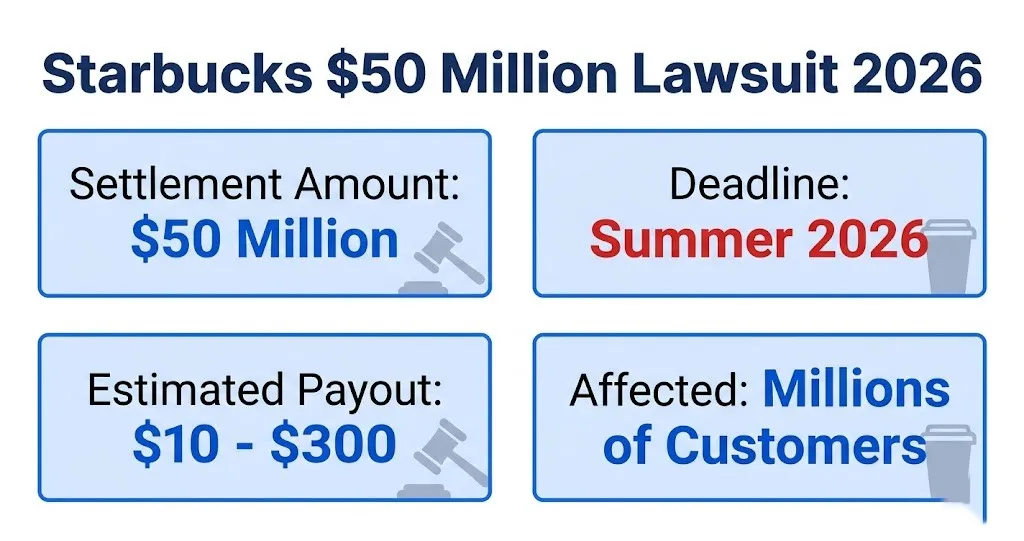
Starbucks Lawsuit $50 Million: What You Need to Know
The Starbucks lawsuit for $50 million is a class action filed against Starbucks Corporation for allegedly deceiving customers about drink ingredients. The case centers on refresher beverages that were marketed with fruit names but allegedly contained minimal or no actual fruit content.
Plaintiffs argue they paid premium prices based on false advertising. A Mango Dragonfruit Refresher, for example, costs around $5 to $6 per drink. Customers believed they were getting real mango and dragonfruit.
The lawsuit was filed in federal court and has gained significant attention since class certification. Millions of Starbucks customers across the United States may be eligible.
| Key Case Details | Information |
|---|---|
| Total Settlement Fund | $50 million |
| Case Type | Class Action Lawsuit |
| Primary Allegation | False advertising of fruit content |
| Drinks Involved | Refresher beverages |
| Geographic Scope | Nationwide (United States) |
The case represents one of the largest false advertising settlements against a major coffee chain. Starbucks has not admitted wrongdoing but agreed to settle to avoid prolonged litigation.
This settlement affects anyone who purchased qualifying drinks during the class period. You do not need to have kept your receipts to file a claim, though having proof of purchase may increase your payout.
Understanding the Starbucks $50 Million Lawsuit
The Starbucks $50 million lawsuit alleges that the company violated consumer protection laws through misleading product names and marketing. The central claim is straightforward: Starbucks called drinks by fruit names when those fruits were barely present.
Take the Mango Dragonfruit Refresher. The name suggests mango and dragonfruit are main ingredients. According to the lawsuit, the primary juice base is actually white grape juice concentrate.
The dragonfruit pieces visible in the drink? Plaintiffs claim they add color but virtually no flavor. The mango content is allegedly negligible.
This matters because Starbucks charged premium prices. Customers paid for what they thought was a fruit forward beverage. They received something quite different.
What the Plaintiffs Claim:
- Drink names created false impressions about ingredients
- Marketing materials reinforced false fruit content claims
- Premium pricing was unjustified based on actual ingredients
- Customers suffered economic harm by overpaying
- Starbucks knew its marketing was misleading
Starbucks has defended its products, stating ingredient lists were always available. But plaintiffs argue the average customer does not read ingredient labels at a coffee counter. They rely on product names.
This case fits a growing trend of food and beverage false advertising lawsuits. Courts have increasingly sided with consumers when product names suggest ingredients that are not substantially present.
Starbucks Lawsuit Payout: How Much Will You Receive
The Starbucks lawsuit payout will vary based on several factors, but most class members can expect between $10 and $100. Heavy purchasers with documentation may receive more, potentially up to $300 or higher.
The total settlement fund is $50 million. However, not all of that goes directly to claimants. Legal fees, administration costs, and other expenses reduce the available pool.
After those deductions, the remaining funds get divided among all valid claims. The more people who file, the smaller each individual payment becomes.
| Estimated Payout Ranges | Criteria |
|---|---|
| $10 to $25 | Claim without proof of purchase |
| $25 to $75 | Claim with partial documentation |
| $75 to $150 | Claim with receipts showing multiple purchases |
| $150 to $300+ | Heavy purchasers with extensive documentation |
Your actual payout depends on how many claims get filed. If millions of customers submit claims, payments will be on the lower end. If fewer people participate, individual payments increase.
The settlement administrator will calculate pro rata shares after the claim deadline passes. You will not know your exact payment until that calculation happens.
Key Takeaway: Most claimants should expect between $10 and $100 depending on purchase history and proof provided.
How Much Will the Starbucks Lawsuit Pay Class Members
How much the Starbucks lawsuit will pay depends on your purchase history, documentation, and the total number of claims submitted. The settlement uses a tiered payment structure to reward those with stronger proof.
Claimants without receipts can still file. The settlement allows claims based on sworn statements about purchase frequency. But those with receipts or credit card statements showing Starbucks purchases will receive priority consideration.
Think of it like a pie being divided. The pie is worth roughly $30 to $35 million after fees. If 500,000 people want a slice, each piece is small. If only 100,000 people claim, each piece gets much bigger.
Factors That Affect Your Payment:
- How many qualifying drinks you purchased
- Whether you have receipts or bank statements
- The total number of claims filed by all class members
- Whether you were a Starbucks Rewards member during the class period
Starbucks Rewards members may have an advantage. Their purchase history is digitally recorded. The settlement administrator can verify these purchases easily, potentially resulting in larger payments.
| Payment Factor | Impact on Payout |
|---|---|
| No proof of purchase | Lower tier payment |
| Some documentation | Medium tier payment |
| Full receipt records | Higher tier payment |
| Rewards member history | Verified higher payment |
Cash payments will be distributed after the final approval hearing and any appeals. Most claimants should expect payments in late 2026 or early 2027, depending on case progression.
Starbucks Lawsuit: Who Qualifies for Compensation
Who qualifies for the Starbucks lawsuit includes anyone who purchased certain refresher drinks during the class period. You do not need to have experienced illness or specific harm. Economic harm from overpaying is sufficient.
The class period covers purchases made during a specific timeframe. This typically spans several years before the lawsuit was filed through a cutoff date set by the court.
You qualify if you bought any of these drinks during the class period:
Drinks Included in the Lawsuit:
- Mango Dragonfruit Refresher
- Mango Dragonfruit Lemonade
- Strawberry Acai Refresher
- Strawberry Acai Lemonade
- Paradise Drink
- Pink Drink
- Dragon Drink
The geographic scope covers the entire United States. You do not need to live in a particular state to qualify. Any purchase at any U.S. Starbucks location counts.
| Eligibility Criteria | Requirement |
|---|---|
| Purchase Location | Any U.S. Starbucks |
| Products Purchased | Listed refresher beverages |
| Time Period | Class period (check official notice) |
| Proof Required | Not required but helpful |
| Age Requirement | Must be 18 or have parent/guardian file |
You are automatically a class member if you meet these criteria. You do not need to sign up or register. However, you must submit a claim to receive payment.
If you do not want to be part of the class, you can opt out. Opting out preserves your right to sue Starbucks individually. Most people should not opt out unless they have significant documented damages worth pursuing separately.
Starbucks Lawsuit: How to File Your Claim
How to file your claim in the Starbucks lawsuit is a straightforward process that takes about 10 to 15 minutes. You can file online or by mail, though online filing is faster and reduces errors.
The settlement administrator manages the claim process. They create a dedicated website where you can submit your information securely. The website address will be listed in the official class notice.
Steps to File Your Claim:
- Visit the official settlement website
- Enter your contact information
- Provide purchase details (dates, frequency, locations)
- Upload any proof of purchase (optional but helpful)
- Sign the claim form electronically
- Submit and save your confirmation number
You will receive a confirmation email after submitting. Keep this email for your records. If you do not receive confirmation within 24 hours, contact the settlement administrator.
| Filing Option | Details |
|---|---|
| Online Filing | Fastest method, instant confirmation |
| Mail Filing | Download form, mail to administrator address |
| Deadline | Check official notice for exact date |
| Required Info | Name, address, purchase history |
Do not pay anyone to file a claim for you. The process is free. Scammers sometimes target class action settlements by offering paid filing services. These are unnecessary.
If you moved since purchasing the drinks, update your address with the settlement administrator. Payments go to the address on file when distribution begins.
Key Takeaway: Filing is free and takes under 15 minutes online; never pay a third party to submit your claim.
Starbucks Lawsuit Deadline: Key Dates for 2026
The Starbucks lawsuit deadline for filing claims is expected to fall in mid to late 2026. Missing this deadline means forfeiting your right to payment. The court sets firm cutoff dates that cannot be extended for individual circumstances.
Several important dates will determine the case timeline. Each milestone affects when you can file, when you can object, and when you will receive money.
Critical 2026 Deadlines:
| Milestone | Expected Date |
|---|---|
| Claim Filing Deadline | Summer 2026 (exact TBD) |
| Objection Deadline | 30 days before final hearing |
| Opt Out Deadline | 30 days before final hearing |
| Final Approval Hearing | Late 2026 |
| Payment Distribution | Late 2026 to Early 2027 |
The claim filing deadline is the most important date for regular class members. After this date passes, you cannot submit a claim regardless of your eligibility.
The objection deadline allows class members to formally object to settlement terms. This is rare and typically only done when someone believes the settlement is unfair.
The opt out deadline is for those who want to exclude themselves from the class. After this date, you cannot opt out and must accept the settlement terms.
Watch for the official class notice. It will be mailed to known class members and published in newspapers. This notice contains all exact dates.
Sign up for updates through the settlement website. You will receive email notifications about deadlines and case developments.
Starbucks Class Action Lawsuit 2026 Status Update
The Starbucks class action lawsuit in 2026 has progressed through preliminary approval and is moving toward final settlement. The case has overcome several legal hurdles that could have derailed it.
As of early 2026, the court has certified the class. This means the judge agreed that common questions of law and fact unite all class members. Individual lawsuits would have been impractical for claims this size.
The settlement negotiations resulted in the $50 million fund. Both sides agreed to terms rather than risk a trial verdict. For Starbucks, settling eliminates uncertainty. For plaintiffs, it guarantees compensation without years of additional litigation.
2026 Case Timeline:
| Stage | Status |
|---|---|
| Lawsuit Filed | Completed |
| Class Certification | Approved |
| Settlement Negotiation | Completed |
| Preliminary Approval | Granted |
| Notice Period | Ongoing |
| Final Approval | Pending |
The final approval hearing is the last major hurdle. At this hearing, the judge reviews objections and decides whether to approve the settlement. Most class action settlements receive final approval if preliminary approval was granted.
Starbucks has not admitted wrongdoing. The settlement agreement explicitly states this. The company maintains its products were properly labeled and marketed.
However, by settling, Starbucks avoids the risk of a larger jury verdict. False advertising cases can result in damages far exceeding settlement amounts if plaintiffs win at trial.
Key Takeaway: The case is on track for final approval in late 2026, with payments expected shortly after.
The Starbucks Refresher Lawsuit Explained
The Starbucks refresher lawsuit specifically targets the refresher beverage line and how these drinks were marketed to consumers. Refreshers are iced, caffeine containing beverages that Starbucks positions as fruity and refreshing alternatives to coffee.
Refreshers contain green coffee extract for caffeine. They are not coffee flavored. Instead, they come in various fruit flavors that form the basis of the lawsuit.
The problem, according to plaintiffs, is naming. Calling a drink “Mango Dragonfruit” implies those fruits are significant ingredients. Customers reasonably expect to taste mango and dragonfruit.
Refresher Beverage Lineup:
| Drink Name | Alleged Issue |
|---|---|
| Mango Dragonfruit Refresher | Little to no mango or dragonfruit |
| Strawberry Acai Refresher | Minimal strawberry or acai content |
| Paradise Drink | Similar ingredient concerns |
| Pink Drink | Marketing versus ingredients |
| Dragon Drink | Dragonfruit content questions |
The lawsuit points to ingredient lists showing white grape juice concentrate as the primary juice component. This is a common, inexpensive filler juice used across the beverage industry.
Plaintiffs argue that if Starbucks wanted to sell grape juice drinks, it should have called them grape juice drinks. By using premium fruit names, Starbucks allegedly charged premium prices without delivering premium ingredients.
The visual appearance of these drinks adds to the deception claims. Many refreshers contain colorful fruit pieces or powder. Plaintiffs say these add visual appeal but minimal actual fruit flavor or content.
Starbucks False Advertising Lawsuit: The Legal Arguments
The Starbucks false advertising lawsuit rests on established consumer protection laws that prohibit deceptive marketing. Plaintiffs cite federal and state statutes that protect consumers from misleading product claims.
The core legal theory is simple: companies cannot name products in ways that create false impressions. If a product name suggests certain ingredients, those ingredients must be meaningfully present.
Legal Foundations of the Case:
- California Consumer Legal Remedies Act
- California False Advertising Law
- State consumer protection statutes nationwide
- Common law fraud and misrepresentation
- Breach of implied warranty
Plaintiffs must prove that a reasonable consumer would be misled by the product name. Courts use the “reasonable consumer” standard. This means someone exercising ordinary care, not someone ignoring all available information.
| Legal Element | Plaintiff Argument |
|---|---|
| False Statement | Drink names imply fruit content |
| Materiality | Fruit content affects purchase decisions |
| Reliance | Customers relied on names when buying |
| Damages | Customers overpaid for drinks |
Starbucks defended itself by pointing to ingredient lists. These lists are available in stores and online. They accurately show what each drink contains.
But plaintiffs counter that expecting customers to investigate ingredient lists defeats the purpose of product naming. Names exist precisely so customers can make quick, informed choices without research.
Similar lawsuits have succeeded against other companies. Vanilla flavored products without real vanilla, berry products without real berries, and fruit juices with minimal fruit have all faced successful legal challenges.
Starbucks Mango Dragonfruit Lawsuit Details
The Starbucks Mango Dragonfruit lawsuit focuses on one of the most popular refresher drinks and its allegedly misleading name. This drink became central to the broader class action because of its popularity and the stark contrast between its name and ingredients.
The Mango Dragonfruit Refresher launched in 2018. It quickly became a customer favorite. The drink features a bright magenta color and contains visible pink dragonfruit pieces.
According to the lawsuit, the dragonfruit pieces are mostly decorative. They add color and texture but minimal dragonfruit flavor. The actual fruit content allegedly comes primarily from grape juice concentrate.
Mango Dragonfruit Refresher Breakdown:
| Advertised | Alleged Reality |
|---|---|
| Mango flavor | Primarily grape juice base |
| Dragonfruit content | Decorative pieces only |
| Premium fruit drink | Standard juice concentrate beverage |
| Worth premium price | Overpriced given ingredients |
Plaintiffs purchased these drinks expecting a mango and dragonfruit experience. They paid between $5 and $7 per drink depending on size and location. That price point suggests premium ingredients.
Starbucks has not publicly disclosed exact ingredient percentages. However, ingredient lists show that water and sugar come before any fruit components. This indicates fruit is not the dominant ingredient by weight.
The vivid color of the drink also faces scrutiny. Plaintiffs suggest the color comes partly from added colorings or the dragonfruit pieces, not from substantial fruit content. The visual appearance allegedly reinforces the false impression created by the name.
Key Takeaway: The Mango Dragonfruit Refresher became the poster child for this lawsuit because its name strongly implies fruit content that allegedly is not there.
Starbucks Refresher No Fruit Lawsuit: The Evidence
The Starbucks refresher no fruit lawsuit presents evidence that these drinks contain little meaningful fruit despite their fruity names and marketing. Plaintiffs compiled ingredient analyses and marketing materials to support their claims.
Independent laboratory testing allegedly showed minimal fruit content. While Starbucks has not released proprietary formulas, ingredient list ordering suggests fruit plays a minor role. Ingredients are listed by weight. When water, sugar, and white grape juice appear first, fruit named in the title is not dominant.
Evidence Presented:
- Ingredient lists from Starbucks website
- Laboratory analysis of fruit content percentages
- Marketing materials emphasizing fruit names
- Price comparisons with similar beverages
- Consumer surveys showing purchasing motivations
The white grape juice issue is central. White grape juice concentrate is a common sweetener and filler. It is much cheaper than mango puree or dragonfruit extract. Using grape juice as a base while marketing drinks by other fruit names creates the alleged deception.
| Evidence Type | What It Shows |
|---|---|
| Ingredient Lists | Fruit named in title appears low on list |
| Lab Testing | Low percentage of advertised fruit |
| Marketing Materials | Emphasis on fruit imagery and names |
| Price Analysis | Premium pricing despite cheap ingredients |
Visual marketing adds to the case. Starbucks promotional photos show these drinks surrounded by fresh fruit. The drinks themselves contain colorful fruit pieces. This visual presentation allegedly reinforces expectations of real fruit content.
Plaintiffs argue this combination of naming, marketing, and pricing creates a coherent deceptive scheme. Each element reinforces the others. Together, they convince customers to pay more than the drinks are worth.
Starbucks Lawsuit Settlement Amount Breakdown
The Starbucks lawsuit settlement amount of $50 million sounds large, but understanding how it breaks down reveals what individual claimants can realistically expect. Not all of that money reaches class members directly.
Class action settlements follow standard distribution patterns. Attorneys receive a percentage for their work. Administrative costs cover claim processing. The remainder goes to class members.
$50 Million Settlement Distribution:
| Allocation | Estimated Amount |
|---|---|
| Attorney Fees (25-33%) | $12.5M to $16.5M |
| Administrative Costs | $2M to $4M |
| Named Plaintiff Awards | $5,000 to $25,000 each |
| Class Member Fund | $30M to $35M |
The class member fund gets divided among all valid claims. If one million people file claims, each person gets about $30 to $35 on average. If 500,000 file, payments double. Fewer claims mean larger individual payments.
Named plaintiffs receive service awards. These are the individuals who agreed to lead the lawsuit. They took on extra responsibilities and risks. Service awards are typically $5,000 to $25,000 per person, approved by the court.
Attorney fees in class actions are controversial but standard. Courts must approve fee requests. Judges regularly reduce fee requests they consider excessive. The 25 to 33 percent range is typical for cases this size.
Administrative costs cover the settlement website, claim processing, payment distribution, and customer service. Settlement administrators are specialized companies that handle these logistics.
Starbucks Drink Lawsuit Update: Latest Developments
The Starbucks drink lawsuit update for 2026 shows the case progressing toward resolution. Several key developments have occurred since the original filing that affect how the settlement will proceed.
The court granted preliminary settlement approval. This means the judge reviewed the settlement terms and found them fair enough to proceed. Preliminary approval triggers the notice period when class members learn about their rights.
Notice distribution is underway. Potential class members receive information through mail, email, and publication. Starbucks Rewards members with email addresses on file get direct notification. Others learn through media coverage and publication notices.
Recent Case Developments:
| Development | Impact |
|---|---|
| Preliminary Approval | Settlement can proceed |
| Notice Period Started | Class members being informed |
| Claim Portal Opened | Filing can begin |
| Objection Period Set | Deadline for challenges established |
No significant objections have derailed the settlement. Class members can object to terms they find unfair. Major objections can delay or modify settlements. So far, the settlement has proceeded smoothly.
Starbucks has begun making changes to its marketing. While not admitting wrongdoing, the company has adjusted some product descriptions. This is common when companies settle false advertising cases.
The final approval hearing date will be announced. This hearing is typically 60 to 90 days after the notice period ends. At the hearing, the judge considers objections and decides whether to grant final approval.
Key Takeaway: The settlement is on track with no major obstacles; claim filing is open, and final approval is expected later in 2026.
Starbucks 50 Million Lawsuit: Final Settlement Terms
The Starbucks 50 million lawsuit final settlement includes terms beyond cash payments that affect how the case concludes. Understanding all terms helps you evaluate whether the settlement is fair.
The $50 million fund is the headline number. But the settlement also includes injunctive relief. This means Starbucks agrees to change certain practices going forward.
Settlement Terms Summary:
| Term | Description |
|---|---|
| Cash Fund | $50 million total |
| Injunctive Relief | Marketing practice changes |
| Release of Claims | Class members release future claims |
| Denial of Liability | Starbucks admits no wrongdoing |
| Claim Period | Limited time to file |
The release of claims is important. By accepting settlement money, you give up the right to sue Starbucks over these products. You cannot later file an individual lawsuit claiming greater damages.
Injunctive relief means Starbucks makes changes. This could include clearer ingredient labeling, modified marketing materials, or adjusted product names. These changes benefit future customers even if they do not provide additional cash compensation.
Starbucks denies wrongdoing throughout the settlement. This is standard in class actions. Companies settle to avoid litigation risk, not because they admit fault. The denial protects Starbucks from using the settlement as evidence of wrongdoing in other cases.
Payment Distribution Details:
- Payments issued after final approval
- Distribution within 90 to 120 days of approval
- Checks valid for 180 days
- Uncashed checks may go to cy pres recipients
Cy pres recipients are charities that receive unclaimed funds. If class members do not cash checks, money goes to consumer protection organizations rather than back to Starbucks.
Frequently Asked Questions
How much money will I get from the Starbucks $50 million lawsuit?
Most class members can expect between $10 and $100.
Your exact payment depends on purchase history, proof provided, and total claims filed.
Those with extensive documentation may receive up to $300 or more.
Who qualifies for the Starbucks refresher drink settlement?
Anyone who purchased qualifying refresher drinks during the class period qualifies.
Eligible drinks include Mango Dragonfruit, Strawberry Acai, Pink Drink, Paradise Drink, and Dragon Drink.
You must have made purchases at U.S. Starbucks locations.
What is the deadline to file a claim in the Starbucks lawsuit?
The claim filing deadline is expected in mid to late 2026.
The exact date will be listed in the official class notice.
Missing the deadline means you cannot receive payment.
Which Starbucks drinks are included in the $50 million lawsuit?
The lawsuit covers refresher beverages marketed with fruit names.
This includes Mango Dragonfruit Refresher, Strawberry Acai Refresher, Pink Drink, Paradise Drink, and Dragon Drink.
Both the base drinks and lemonade versions are included.
Do I need a receipt to file a claim in the Starbucks lawsuit?
No, you do not need a receipt to file a claim.
You can submit a claim based on a sworn statement about your purchases.
However, having receipts, bank statements, or Rewards history may increase your payout.
Closing
The $50 million Starbucks lawsuit gives customers a chance to recover money they allegedly overpaid for refresher drinks. If you bought Mango Dragonfruit, Strawberry Acai, or similar beverages, you likely qualify.
Do not miss the claim deadline expected in 2026. Filing takes only a few minutes and costs nothing. Check the official settlement website for exact dates.
Stay updated on final approval and payment distribution timelines. Your compensation is waiting if you take action before the deadline passes.
