
Divorce costs in the United States typically range from $7,000 to $20,000, with the national average hovering around $15,000 to $17,000 per spouse. However, your actual costs depend heavily on whether your divorce is contested or uncontested, your state’s filing fees, attorney rates in your area, and the complexity of your financial situation.
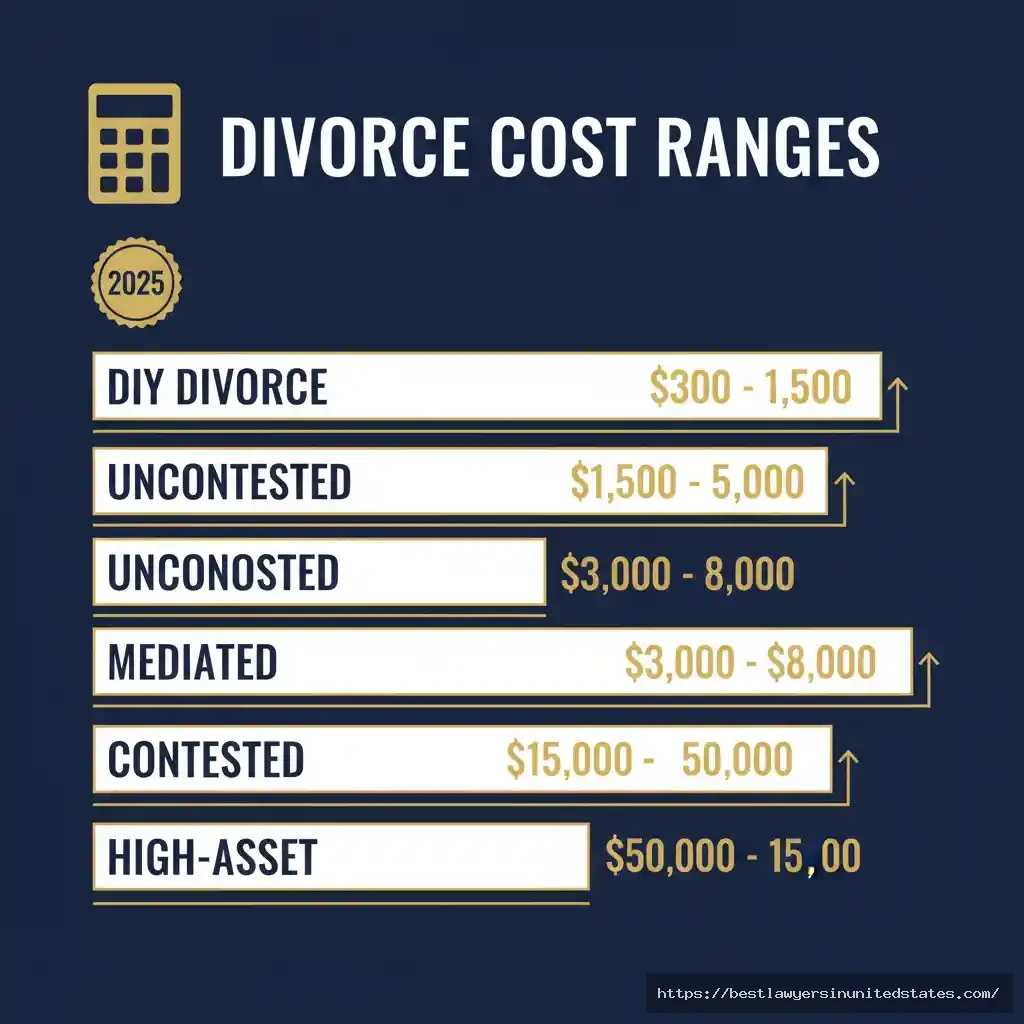
The single biggest factor? Whether you and your spouse agree on major issues. An uncontested divorce where both parties reach agreement can cost as little as $500 to $3,000, while a contested divorce involving custody battles or asset disputes can easily exceed $30,000 to $50,000 per person.
Quick Cost Snapshot:
| Divorce Type | Typical Cost Range | Timeline |
|---|---|---|
| DIY/Online Divorce | $300 – $1,500 | 1-3 months |
| Uncontested (with lawyer) | $1,500 – $5,000 | 2-4 months |
| Mediated Divorce | $3,000 – $8,000 | 3-6 months |
| Contested Divorce | $15,000 – $50,000+ | 12-18+ months |
| High-Asset/Complex | $50,000 – $150,000+ | 18-36 months |
Let’s break down exactly what you’ll pay and where your money goes.
Divorce Cost Calculator
Get an estimated cost for your divorce based on your specific situation
Your Estimated Divorce Cost
Cost Breakdown
📧 Get a Personalized Consultation
Have questions about your specific situation? Contact our legal experts for guidance tailored to your needs.
Contact Us via EmailGet an instant estimate: https://bestlawyersinunitedstates.com/divorce-cost-calculator/
What Determines Your Divorce Cost?
Five primary factors drive divorce expenses:
1. Agreement Level Between Spouses When both parties agree on property division, child custody, and support, you avoid lengthy negotiations and court battles. This single factor can reduce your costs by 70-80%.
2. Children and Custody Disputes Divorces involving minor children cost $3,000 to $10,000 more on average due to custody evaluations, parenting plan development, and child support calculations. If custody becomes contested, add another $10,000 to $30,000 for guardian ad litem fees, psychological evaluations, and expert witnesses.
3. Asset Complexity Simple divorces with minimal shared assets (no real estate, retirement accounts, or businesses) cost significantly less. Complex asset division involving business valuations, pension appraisals, or hidden asset investigations can add $5,000 to $25,000 in professional fees.
4. Geographic Location Attorney rates vary dramatically by state and even by county. Urban attorneys in high-cost areas charge $300 to $500+ per hour, while rural attorneys may charge $150 to $250 per hour. Your state’s filing fees also range from $100 to $435.
5. Attorney Representation The level of legal help you choose impacts costs most directly:
- Full representation: $250-500/hour
- Limited scope (unbundled services): $150-300/hour for specific tasks
- Mediation: $150-400/hour split between parties
- DIY with paralegal help: $500-1,500 flat fee
Divorce Cost Breakdown: Where Your Money Goes
Understanding the cost components helps you budget realistically and identify areas where you can save.
Court Filing Fees
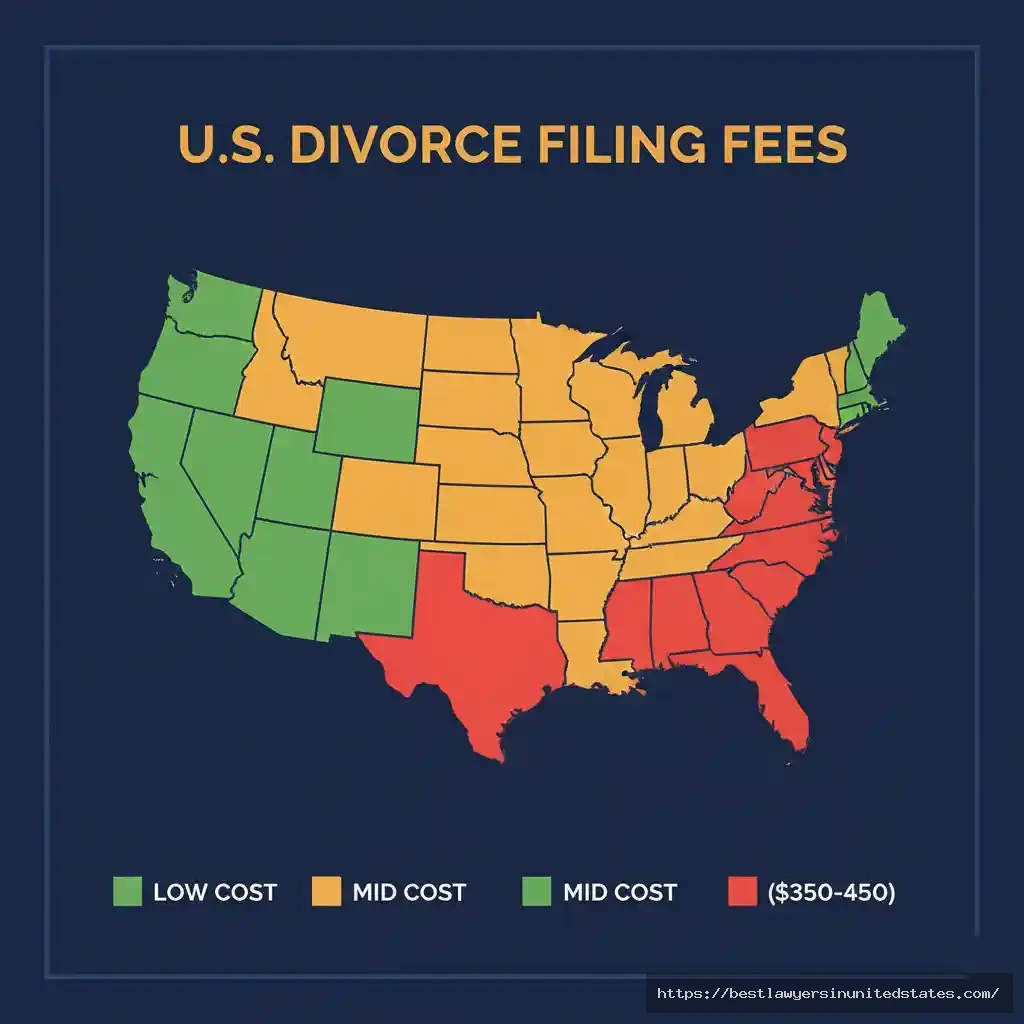
Every divorce requires paying your county’s filing fee when you submit your petition. These fees fund the court system and are non-negotiable (unless you qualify for a fee waiver based on income).
Filing Fee Ranges by Region:
| State Cost Level | Filing Fee Range | Example States |
|---|---|---|
| Low Cost | $100 – $200 | Wyoming, Mississippi, Missouri |
| Mid Cost | $200 – $300 | Texas, Florida, Pennsylvania |
| High Cost | $300 – $435 | California, Illinois, Minnesota |
Additional court costs may include:
- Service of process fees: $40-150
- Document certification: $10-25 per document
- Parenting class fees (if required): $25-100
- Mediation court referral fees: $50-300
Most states offer fee waivers if your household income falls below specific thresholds (typically 125-200% of federal poverty guidelines).
Attorney Fees: The Largest Expense
Attorney costs make up 60-80% of total divorce expenses in represented cases. Most divorce attorneys charge hourly rates and require an upfront retainer deposit.
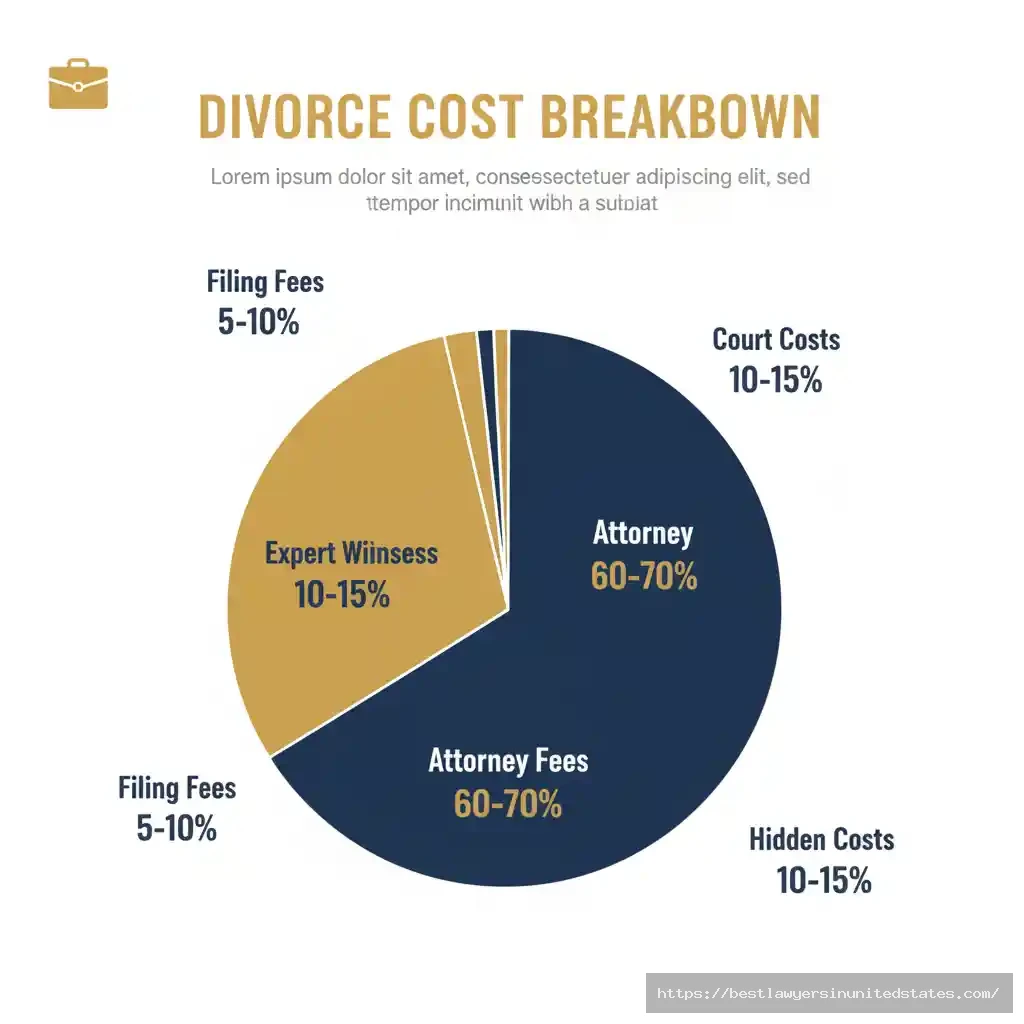
Typical Attorney Cost Structure:
Initial Retainer: $2,500 – $10,000 This upfront deposit sits in a trust account. Your attorney bills against it as work is performed. If the retainer depletes, you’ll need to replenish it.
Hourly Rates by Experience:
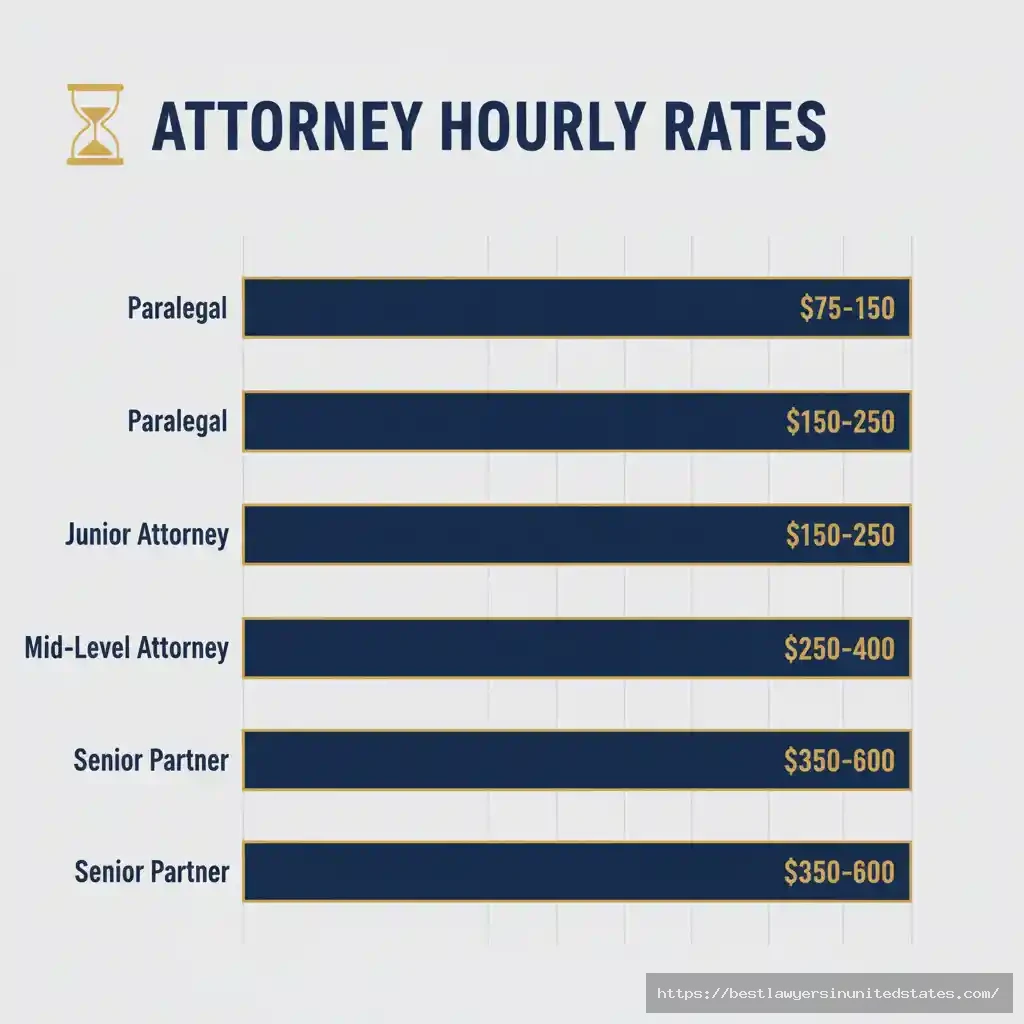
| Attorney Experience | Rate Range |
|---|---|
| Junior Associate (1-3 years) | $150 – $250/hour |
| Mid-Level Attorney (4-10 years) | $250 – $400/hour |
| Senior Partner (10+ years) | $350 – $600/hour |
| Paralegal/Legal Assistant | $75 – $150/hour |
What attorney hours actually cover:
- Client meetings and phone calls
- Document drafting (petitions, motions, settlement proposals)
- Court appearances
- Opposing counsel communications
- Discovery process (interrogatories, depositions)
- Research and case preparation
- Email correspondence (many attorneys bill in 6-minute or 15-minute increments)
A straightforward uncontested divorce typically costs $1,500 to $3,500 in attorney fees (8-15 hours of work), while contested divorces can consume 50 to 200+ hours of attorney time.
Hidden Divorce Costs Most People Overlook
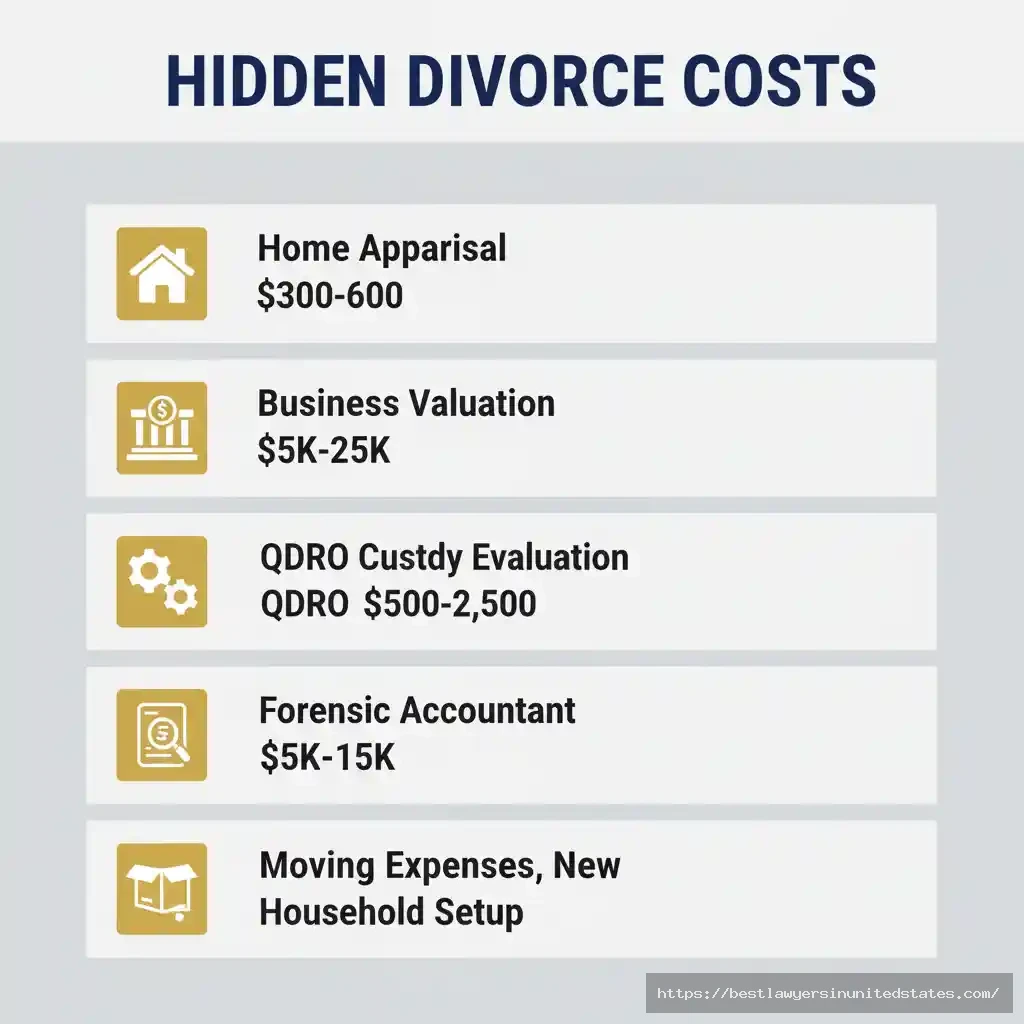
Beyond obvious legal fees, these expenses catch people off guard:
Property-Related Costs:
- Home appraisal: $300 – $600
- Business valuation: $5,000 – $25,000
- Pension/retirement account valuation: $500 – $2,500
- Real estate transfer taxes: Varies by locality
- Mortgage refinancing costs: 2-6% of loan amount
Financial Expert Fees:
- Forensic accountant (asset tracing): $300 – $500/hour
- QDRO preparation (retirement division): $500 – $2,500
- Tax advisor consultation: $200 – $500/hour
- Credit report monitoring: $10 – $30/month
Child-Related Expenses:
- Custody evaluation: $1,500 – $6,000
- Guardian ad litem: $2,000 – $10,000
- Child psychologist consultations: $150 – $350/session
- Parenting coordinator (post-divorce): $150 – $300/hour
Daily Living Increases:
- Establishing second household
- Separate utility deposits
- Additional insurance policies
- Moving expenses
Divorce Costs by Type: Which Path Fits Your Budget?
Your divorce method dramatically impacts both cost and timeline. Here’s what each option actually entails.
DIY Divorce ($300 – $1,500)
Best for: Childless couples with minimal assets, no real property, and complete agreement on all terms.
What you’ll pay:
- Filing fee: $100-435
- Online document service: $150-500
- Notary fees: $10-25
- Service of process: $40-150
Pros: Cheapest option, fastest timeline, full control Cons: No legal guidance, easy to make costly mistakes, not suitable if any disagreement exists
Reality check: True DIY divorces work for about 10-15% of divorcing couples. Most people discover issues during the process that require professional help. If you have children, retirement accounts, or real estate, attempting DIY often backfires.
Uncontested Divorce with Attorney ($1,500 – $5,000)
Best for: Couples who agree on major issues but want legal guidance to ensure proper documentation and protection.
What you’ll pay:
- Attorney flat fee or limited hours: $1,500-3,500
- Filing and court costs: $100-500
- Document preparation: Often included
- Service of process: $40-150
Timeline: 2-4 months depending on state waiting periods
This represents the sweet spot for most amicable divorces. You get professional legal review of your agreement, properly drafted documents, and confidence that your settlement protects your rights—without the expense of litigation.
Many attorneys offer flat-fee packages for uncontested divorces covering all standard documents and court appearances. Typical packages include:
- Initial consultation
- Petition and response drafting
- Settlement agreement preparation
- Parenting plan (if children involved)
- Financial disclosure forms
- Final decree preparation
- Court appearance representation
Mediated Divorce ($3,000 – $8,000)
Best for: Couples willing to negotiate but needing neutral third-party help reaching agreements.
What you’ll pay:
- Mediator fees: $150-400/hour (split between parties)
- Total mediation sessions (4-10 hours): $1,200-4,000
- Consulting attorneys (optional): $500-2,000 each
- Filing and court costs: $100-500
- Financial neutral (if needed): $1,000-3,000
Timeline: 3-6 months
Mediation works when both parties want to avoid court but need help navigating disagreements. The mediator doesn’t represent either person—they facilitate discussion and help you reach mutually acceptable solutions.
Common mediation structure:
- Session 1-2: Information gathering, identifying issues
- Session 3-5: Negotiating property and support
- Session 6-8: Finalizing parenting plans (if applicable)
- Session 9-10: Reviewing final agreements
Many couples also hire “consulting attorneys” who review mediation proposals and provide legal advice without attending sessions. This hybrid approach typically costs $3,000 to $8,000 total—significantly less than full litigation while maintaining legal protection.
Contested Divorce ($15,000 – $50,000+)
Best for: Couples with significant disagreements on custody, assets, or support who need court intervention.
What you’ll pay per spouse:
- Attorney retainer: $5,000-15,000 (initial)
- Additional retainer replenishments: $2,500-10,000 each
- Filing and motion fees: $500-2,000
- Discovery costs: $1,000-5,000
- Expert witnesses: $2,000-10,000
- Deposition costs: $500-1,500 each
- Trial preparation: $5,000-15,000
- Court reporter fees: $300-800 per day
Timeline: 12-18 months (or longer in backlogged courts)
Contested divorces consume massive resources because every disagreement requires attorney time, court motions, and eventually trial preparation. The process typically includes:
Discovery Phase (3-6 months, $5,000-15,000):
- Document requests and production
- Interrogatories (written questions)
- Depositions of parties and witnesses
- Financial disclosure requirements
Motion Practice (ongoing, $1,500-5,000 per motion):
- Temporary orders (custody, support, property use)
- Compel discovery responses
- Protective orders
- Custody modifications
Trial Preparation (2-4 months, $10,000-25,000):
- Witness preparation
- Exhibit preparation
- Expert witness coordination
- Trial strategy development
- Mock trial exercises
Trial (1-5 days, $5,000-15,000):
- Attorney time in court
- Expert witness testimony
- Court reporter transcripts
- Post-trial briefs
In high-conflict cases, one or both parties may spend $30,000 to $75,000. Complex financial situations can push individual costs past $100,000.
Collaborative Divorce ($15,000 – $30,000)
Best for: High-asset couples committed to avoiding court while maintaining professional guidance.
What you’ll pay per spouse:
- Collaborative attorney: $10,000-20,000
- Financial neutral: $3,000-8,000 (split)
- Mental health professional: $2,000-5,000 (split)
- Child specialist (if applicable): $3,000-8,000 (split)
- Filing and finalization: $500-1,000
Timeline: 6-12 months
The collaborative process uses a team approach where both spouses hire specially trained attorneys who contractually agree to settle outside court. If the process fails and litigation begins, both attorneys must withdraw.
The team typically includes:
- Two collaborative attorneys
- One financial neutral (helps with asset division)
- One or two mental health professionals (facilitate communication)
- Child specialist (if children involved)
While expensive upfront, collaborative divorce often costs less than contested litigation and preserves better post-divorce relationships—crucial when co-parenting.
State-by-State Cost Variations
Where you file dramatically impacts what you’ll pay. Here’s how costs break down across the country.
Filing Fees Across the United States
Lowest Filing Fees:
- Wyoming: $70
- Mississippi: $52
- Missouri: $133-163
Highest Filing Fees:
- California: $435-450
- Illinois: $334-388
- Minnesota: $365-400
Most Common Range: $200-300 in 32 states
Beyond filing fees, consider these state-specific cost factors:
Mandatory Requirements That Add Costs:
- Parenting classes (18 states): $25-100
- Mediation attempts (12 states): $200-800
- Financial disclosure filing fees (6 states): $50-150
- Certificate of divorce fees (various): $10-50
Attorney Rate Variations by State:
Urban rates in expensive markets (NYC, San Francisco, Los Angeles, Boston, D.C.):
- $350-600/hour standard
Mid-sized cities (Phoenix, Denver, Seattle, Atlanta):
- $250-400/hour standard
Rural areas and smaller markets:
- $150-250/hour standard
High-Cost vs. Low-Cost States

Most expensive states for average divorce:
- California – Average: $17,500
- Connecticut – Average: $15,500
- New York – Average: $15,000
- Massachusetts – Average: $14,500
- New Jersey – Average: $14,000
Least expensive states for average divorce:
- Wyoming – Average: $7,000
- Montana – Average: $8,500
- Idaho – Average: $8,800
- Arkansas – Average: $9,200
- South Dakota – Average: $9,800
These averages include both contested and uncontested divorces. Individual costs vary widely based on case complexity.
State Cost Comparison:
| State Tier | Average Total Cost | Filing Fee Range |
|---|---|---|
| High-Cost States (CA, CT, NY, MA, NJ) | $14,000 – $17,500 | $350 – $450 |
| Mid-Cost States (TX, FL, IL, PA, OH) | $11,000 – $14,000 | $250 – $350 |
| Low-Cost States (WY, MT, ID, AR, SD) | $7,000 – $10,000 | $50 – $200 |
We’re developing comprehensive cost guides for all 50 states with detailed filing fees, average attorney rates, and state-specific requirements. Check back regularly as we add more state guides.
Divorce Costs by Complexity Level
Not all divorces fit neatly into “contested” or “uncontested” categories. Your specific circumstances create a complexity level that directly impacts costs.
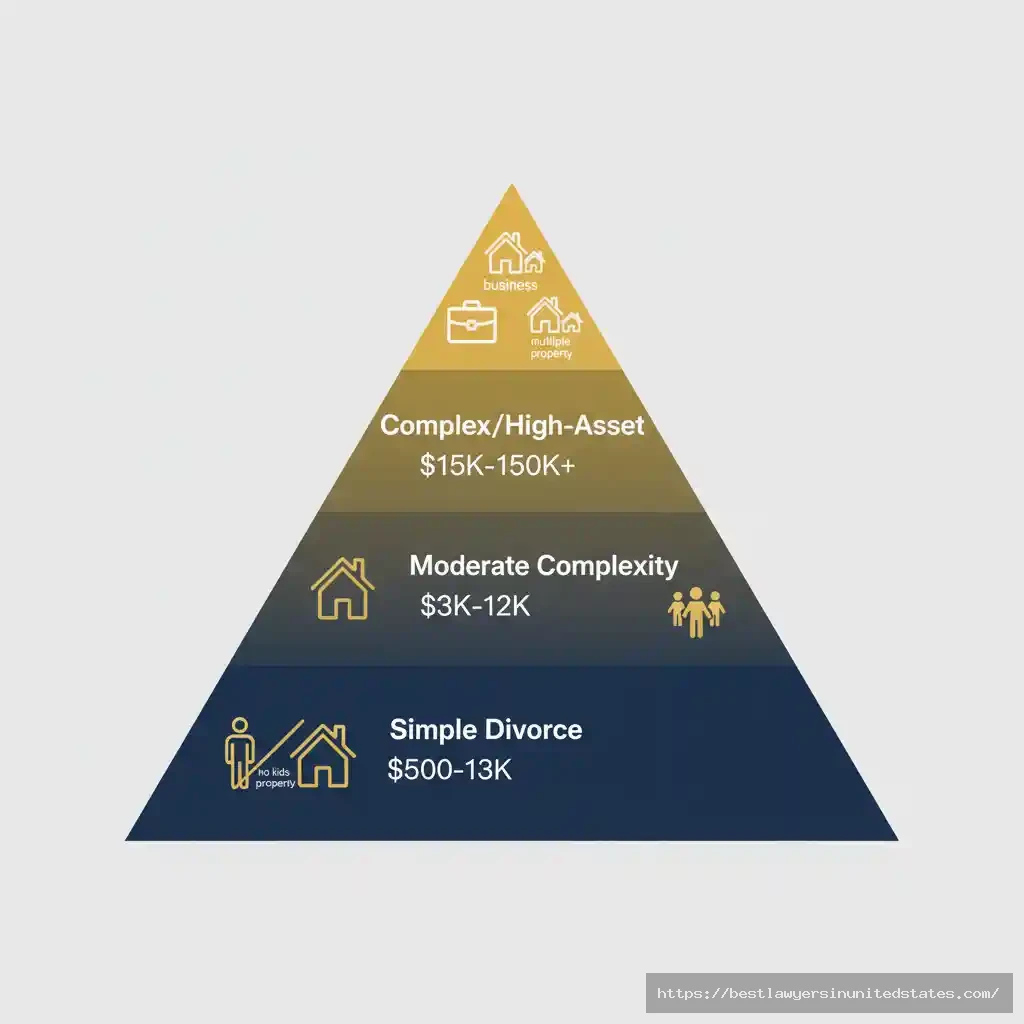
Simple Divorce ($500 – $3,000)
Characteristics:
- Married less than 5 years
- No children
- No real property (no house or land)
- Minimal personal property
- No retirement accounts or pensions
- No businesses
- No debt or manageable debt with clear division
- Both parties agree on everything
Typical costs:
- Filing fee: $100-435
- Attorney review (optional): $500-1,500
- Document preparation service: $200-500
Timeline: 1-4 months (including mandatory waiting periods)
Moderate Complexity ($3,000 – $12,000)
Characteristics:
- Minor children requiring custody arrangement
- OR shared home requiring division/buyout
- OR retirement accounts needing QDRO
- OR moderate debt requiring negotiated division
- Some disagreement but willingness to compromise
- Combined assets under $500,000
Typical costs:
- Attorney fees: $2,500-8,000
- Filing and court costs: $200-600
- Appraisals/valuations: $300-1,500
- QDRO preparation: $500-1,000
- Mediation (if used): $1,000-3,000
Timeline: 4-9 months
These divorces benefit most from limited scope representation or mediation. The cost savings over full litigation can be substantial while still protecting your interests.
Complex Divorce ($15,000 – $50,000+)
Characteristics:
- High-conflict custody dispute
- Multiple properties or valuable real estate
- Business ownership by either spouse
- Substantial retirement accounts ($250,000+)
- Complex debt structures
- Suspected hidden assets
- High income requiring permanent alimony analysis
- Combined assets over $500,000
Typical costs per spouse:
- Attorney fees: $10,000-35,000
- Filing and court costs: $500-2,000
- Business valuation: $5,000-15,000
- Custody evaluation: $2,500-6,000
- Real estate appraisals: $500-1,200 each
- Forensic accounting: $5,000-15,000
- Expert witnesses: $3,000-10,000
- QDRO preparation: $1,500-3,000
Timeline: 12-24 months
Complex cases require specialized expertise. Consider hiring attorneys with specific experience in business valuations, custody evaluations, or forensic accounting depending on your situation.
High-Asset/High-Conflict ($50,000 – $150,000+ per spouse)
Characteristics:
- Combined assets over $2 million
- Multiple businesses or professional practices
- International assets or offshore accounts
- Celebrity or high-profile status
- Extreme conflict with multiple motions
- Allegations of abuse, substance abuse, or parental alienation
- Cross-border custody issues
Typical costs per spouse:
- Attorney fees: $35,000-100,000+
- Expert witnesses (multiple): $15,000-40,000
- Private investigators: $3,000-15,000
- Forensic accountants: $10,000-30,000
- Custody evaluators: $5,000-15,000
- Business valuations: $10,000-50,000
- Trial costs: $10,000-30,000
Timeline: 18-36+ months
These cases often involve multiple attorneys (lead counsel plus specialists), extensive discovery, numerous court appearances, and lengthy trials. The costs reflect the complexity and stakes involved.
Understanding where your case falls helps set realistic budget expectations. Most divorces fall into the moderate complexity range ($3,000-$12,000 per person).
How Attorney Fees Actually Work
Understanding attorney billing prevents surprises and helps you manage costs effectively.
Retainer Agreements Explained
When you hire a divorce attorney, you’ll sign a retainer agreement outlining the financial arrangement. Here’s what that typically includes:
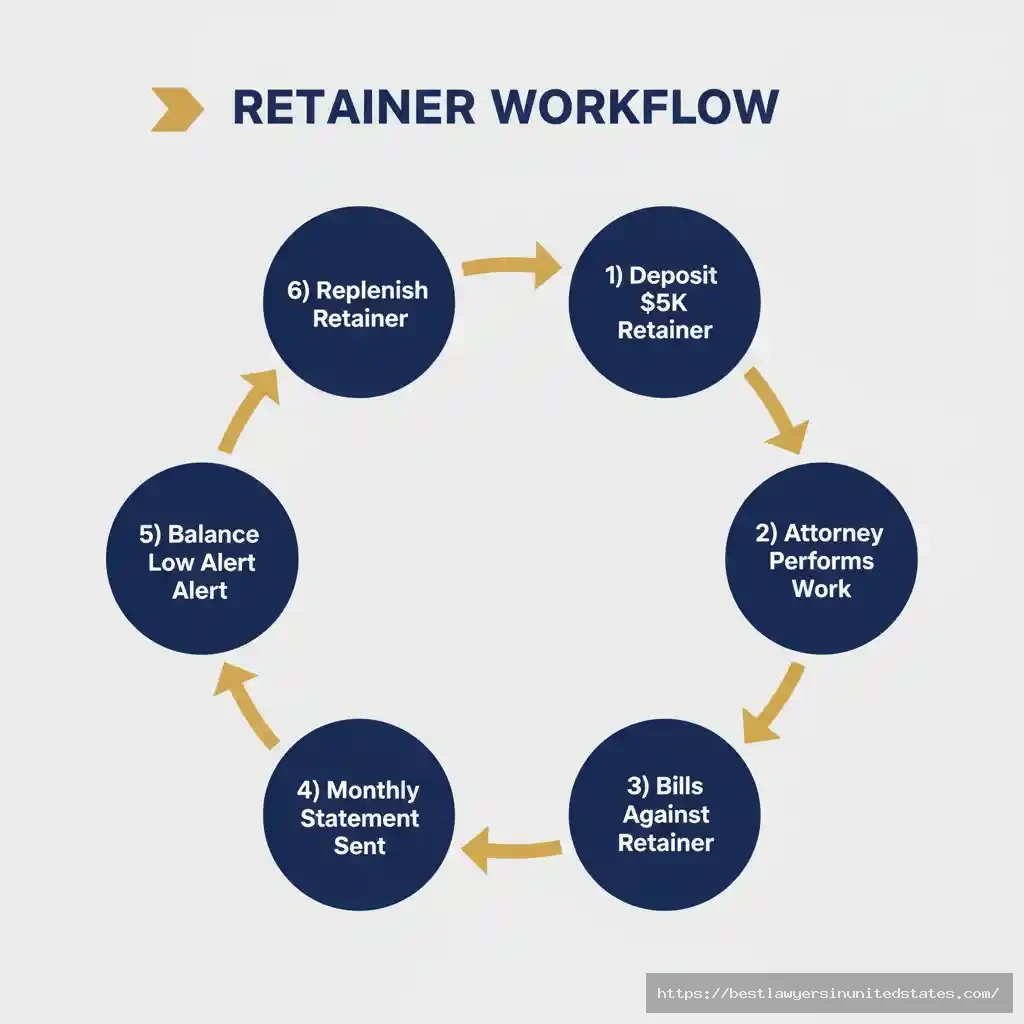
Initial Retainer Deposit: $2,500 – $10,000 This isn’t the total cost—it’s a deposit against which the attorney bills. Think of it like a prepaid debit card for legal services.
How the retainer works:
- You deposit $5,000 in attorney’s trust account
- Attorney performs work and bills at hourly rate
- Bills are deducted from retainer balance
- You receive monthly statements showing activity
- When balance drops to $1,000-2,000, attorney requests replenishment
- You add another $2,500-5,000 to continue representation
What happens to unused retainer: Most retainer agreements specify that unused funds are refunded at case conclusion. However, some attorneys work on a “minimum fee” or “non-refundable retainer” basis—read your agreement carefully.
Hourly Billing vs. Flat Fees
Hourly Billing (most common for contested cases):
- Attorney tracks time in 6-minute or 15-minute increments
- 0.1 hour = 6 minutes
- Brief email? 0.1-0.2 hours ($35-70 at $350/hour)
- Phone call? 0.2-0.5 hours ($70-175 at $350/hour)
- Court appearance? 2-4 hours ($700-1,400 at $350/hour)
What counts as billable time:
- Phone calls (including time waiting on hold)
- Emails and text messages
- Document drafting and review
- Research
- Court time (including travel and waiting)
- Opposing counsel communications
- Paralegal work (billed at lower rate)
Flat Fee Arrangements (common for uncontested cases):
- One price covers all standard services
- Typically $1,500-3,500 for uncontested divorce
- Includes petition, response, settlement agreement, final decree
- May exclude extra services like contested hearings or complex property schedules
Ask these questions about fees:
- How often will I receive billing statements?
- What’s your policy on email/phone billing?
- Do you bill for administrative tasks?
- Will paralegals handle some work at lower rates?
- What happens if case becomes contested?
- Are expert witness fees separate from your retainer?
How to Reduce Attorney Costs
Be organized and prepared:
- Gather financial documents before meetings
- Create spreadsheets of assets and debts
- Write timelines of important events
- Prepare questions in advance rather than calling repeatedly
Use attorney time efficiently:
- Save non-urgent questions for one call/email
- Handle administrative tasks yourself (copying documents, organizing files)
- Respond promptly to attorney requests (delays cost money)
- Accept paralegal help for routine tasks
Consider limited scope representation:
- Hire attorney for specific tasks only
- Handle uncontested portions yourself
- Pay for consultation and document review only
- Represent yourself with attorney coaching
Avoid expensive behaviors:
- Don’t use your attorney as a therapist ($350/hour is expensive counseling)
- Limit emotional venting in communications
- Don’t forward every email from your spouse
- Avoid asking attorney to handle issues you can resolve directly
- Don’t insist on litigating every minor disagreement
Negotiate fee arrangements:
- Ask about flat fees for predictable services
- Request monthly payment plans
- Inquire about sliding scale fees based on income
- Check if attorney offers initial consultation discounts
Payment Options When Money Is Tight
Divorce costs feel overwhelming when finances are already strained. These options help make divorce accessible regardless of income.
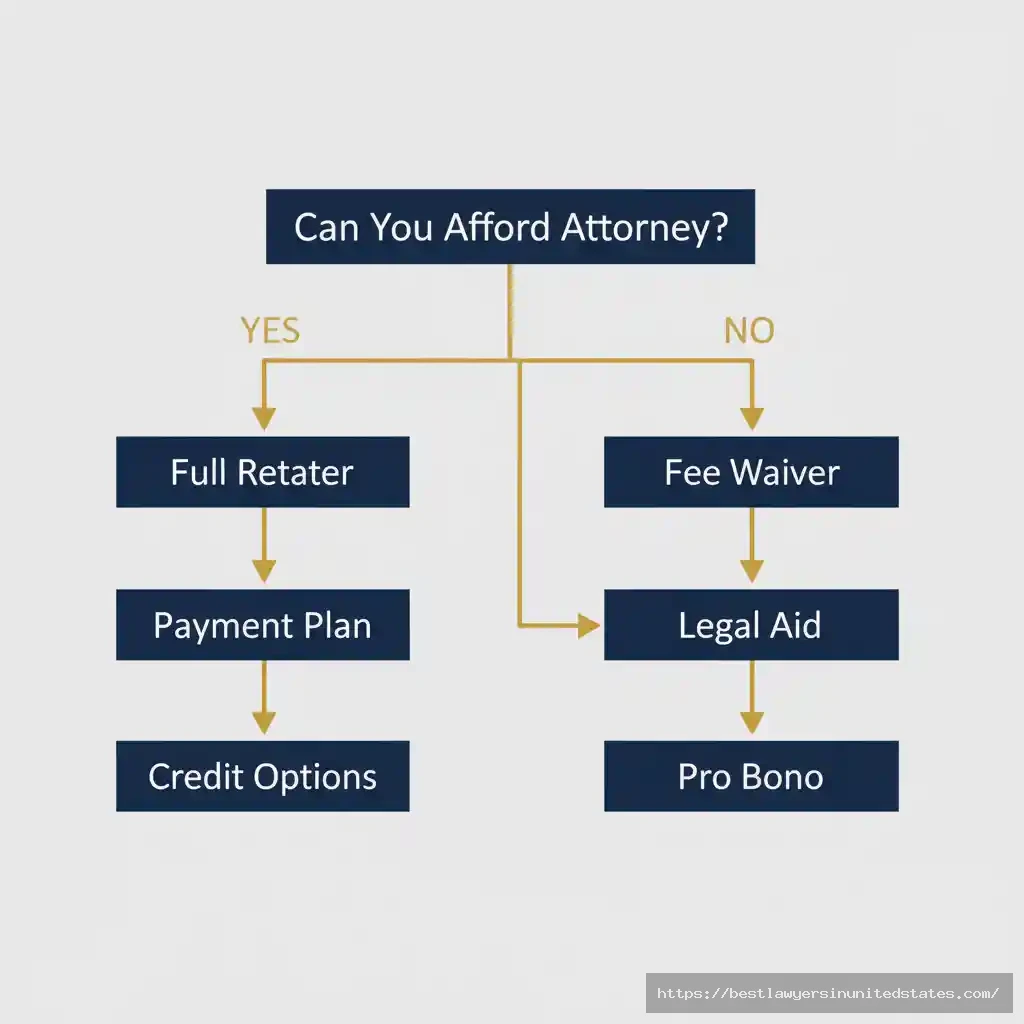
Fee Waivers and Court Cost Reductions
Every state offers fee waivers for low-income filers. If granted, the court waives filing fees, service costs, and sometimes mediation fees.
Typical eligibility criteria:
- Income below 125-200% of federal poverty level
- Receiving public assistance (SNAP, Medicaid, SSI)
- Financial hardship preventing payment
How to apply:
- Complete “Application to Proceed In Forma Pauperis” or similar form
- Provide proof of income (pay stubs, tax returns, benefit statements)
- File with initial divorce petition
- Judge reviews and grants or denies
What fee waivers cover:
- Initial filing fee
- Service of process costs
- Transcript fees
- Some mediation costs (varies by county)
Fee waivers don’t cover attorney fees, but qualifying often makes you eligible for free legal aid services.
Legal Aid and Pro Bono Services
Legal aid organizations provide free legal representation to low-income individuals in civil matters, including divorce.
Eligibility requirements:
- Income typically below 125% of federal poverty level
- May prioritize cases involving domestic violence
- Some programs serve specific populations (elderly, veterans, victims of abuse)
What legal aid provides:
- Full legal representation by staff attorneys
- Document preparation assistance
- Court appearance representation
- Advice and self-help clinics
Finding legal aid in your state:
- Contact your State Bar Association referral service
- Visit LawHelp.org for local resources
- Call 211 for social service referrals
- Search “[Your State] Legal Aid” online
Pro bono programs: Many private attorneys donate time to low-income clients through organized pro bono programs. Bar associations coordinate these initiatives.
Payment Plans and Financing Options
Attorney payment plans: Many divorce attorneys offer payment arrangements, especially for middle-income clients who don’t qualify for legal aid but can’t pay large retainers.
Common structures:
- Monthly installments over 6-12 months
- Credit card payments (may include processing fees)
- Deferred payment until case settlement
- Reduced retainer with payment guarantees
Legal financing companies: Several companies specialize in lawsuit financing, including divorce cases:
- Personal loans for legal fees
- Divorce-specific litigation financing
- Credit lines for legal expenses
Interest rates: 7-36% APR depending on creditworthiness
Caution: Only consider legal financing for cases with substantial marital assets you’ll recover. Borrowing $10,000 to fight over $15,000 in assets rarely makes financial sense.
Credit Cards and Personal Loans
Pros:
- Immediate access to funds
- 0% introductory APR offers available
- Build credit with on-time payments
Cons:
- High interest if not paid during promotional period
- Adds debt during financially stressful time
- May affect mortgage or credit applications post-divorce
Better alternatives to consider first:
- Home equity line of credit (lower interest)
- 401(k) loan (borrow from yourself)
- Family loans with written agreements
- Negotiated payment plans directly with attorney
Free and Low-Cost Resources
Self-help resources:
- Court self-help centers (free document assistance)
- State bar association websites (form libraries)
- Local law library access
- Online document preparation services ($150-500)
Unbundled legal services:
- Pay attorney for specific tasks only
- Document review: $300-800
- Court appearance representation: $500-1,500
- Consultation and strategy: $200-500
- Settlement negotiation: $1,000-2,500
Mediation subsidies: Many courts offer low-cost or free mediation services for custody and support issues:
- Sliding scale fees based on income
- Court-ordered mediation at reduced rates
- Nonprofit mediation services
Special Circumstances That Affect Costs
Certain situations create unique cost considerations.
Military Divorce Costs
Military divorces involve additional complexities that can increase costs by $2,000 to $8,000:
Special considerations:
- Servicemembers Civil Relief Act (SCRA) protections
- Military pension division (requires specific QDRO language)
- Thrift Savings Plan division
- Healthcare benefits continuation
- Survivor Benefit Plan elections
- Jurisdiction issues (residence vs. stationed location)
Cost factors:
- Military pension valuation: $800-2,000
- SCRA compliance review: Included in attorney fees
- Former Spouse Protection Act analysis: Included in attorney fees
- Retired pay division calculations: $500-1,500
Available resources:
- Free legal assistance through JAG offices (limited services)
- Reduced-fee programs for military families
- Specialized military divorce attorneys
Military installations often provide limited legal advice through legal assistance offices, though they cannot represent you in court.
High-Net-Worth Divorces
Cases involving substantial assets ($2 million+) require sophisticated financial analysis:
Additional expert costs:
- Business valuation experts: $10,000-50,000
- Forensic accountants: $10,000-30,000
- Real estate appraisers (multiple properties): $500-1,200 each
- Art/collectible appraisers: $300-2,000 per item
- Pension actuaries: $1,500-4,000
- Tax specialists: $300-600/hour
Why high-asset cases cost more:
- Complex discovery process (multiple businesses, investments, trusts)
- Hidden asset investigations
- Sophisticated tax planning required
- Multiple expert witnesses needed
- Longer trials (3-10 days vs. 1-2 days)
- Appeals more common
Strategic considerations: High-asset divorces benefit from specialized attorneys who regularly handle complex financial cases. Their higher fees ($400-600/hour) often pay for themselves through better property division outcomes.
Divorces Involving Children
Child-related issues add both emotional stress and financial costs:
Standard child-related costs:
- Parenting plan development: Usually included in attorney fees
- Child support calculation: Usually included
- Basic custody stipulation: Usually included
When custody becomes contested:
- Custody evaluation: $2,500-6,000
- Guardian ad litem: $2,000-10,000
- Child psychologist consultations: $150-350/session
- Parent fitness evaluations: $1,500-4,000
- Home studies: $500-1,500
- Child witness interviews (by evaluator): Included in evaluation cost
Ongoing post-divorce costs:
- Parenting coordinator: $150-300/hour
- Custody modification motions: $1,500-5,000
- Supervised visitation (if ordered): $40-100/hour
- Co-parenting classes: $25-150
Most uncontested divorces with children cost $2,500-5,000 when parents agree on custody arrangements. Contested custody cases can easily reach $20,000-40,000 per parent.
Domestic Violence Cases
Divorces involving domestic violence have unique cost considerations:
Protective order costs: Usually free or minimal filing fee ($25-50)
Available resources:
- Domestic violence shelters (legal advocacy services)
- Protection order clinics (free legal help)
- Victim assistance programs (may cover attorney fees)
- Crime Victims Compensation funds (may cover costs)
Potential additional costs:
- Security measures during proceedings
- Separate waiting areas (no additional cost)
- Recorded testimony (if victim fears in-person appearance)
- Expert witness on domestic violence dynamics: $2,000-5,000
Fee shifting opportunities: Many states allow judges to order abusive spouses to pay victim’s attorney fees in domestic violence cases. This doesn’t eliminate upfront costs but may provide eventual reimbursement.
If you’re experiencing abuse, contact the National Domestic Violence Hotline (1-800-799-7233) for immediate help and local resources.
Divorce Timeline and Cost Correlation
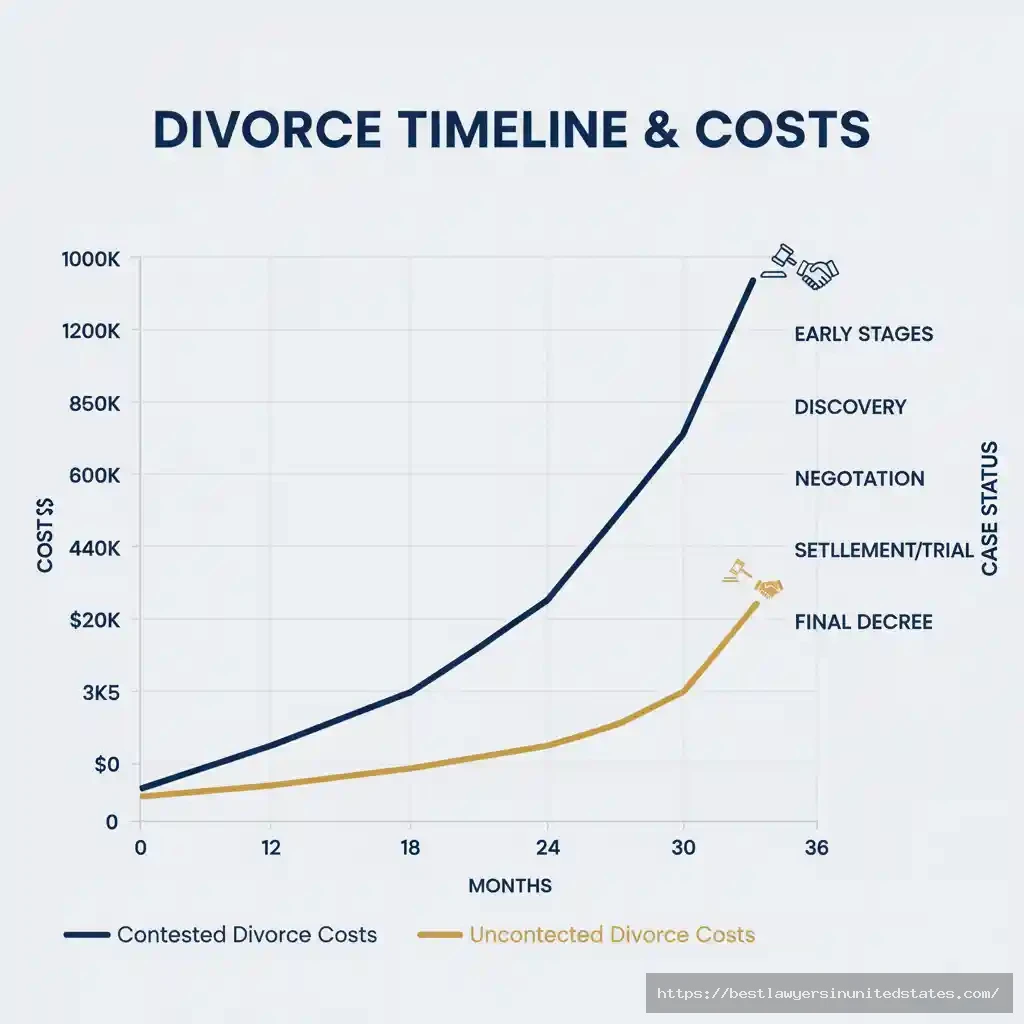
How long your divorce takes directly impacts what it costs. Attorney fees accumulate with time.
Timeline by Divorce Type:
| Divorce Type | Average Timeline | Cost Range |
|---|---|---|
| Uncontested DIY | 1-3 months | $300-1,500 |
| Uncontested with Attorney | 2-4 months | $1,500-5,000 |
| Mediated | 3-6 months | $3,000-8,000 |
| Contested (moderate) | 12-18 months | $15,000-30,000 |
| Contested (complex) | 18-36 months | $30,000-75,000+ |
| High-conflict with trial | 24-48 months | $50,000-150,000+ |
What Extends Divorce Timeline (and Increases Costs)
Mandatory waiting periods: Most states impose minimum waiting periods between filing and finalization:
- Short waiting periods (0-30 days): 8 states
- Medium waiting periods (60-90 days): 28 states
- Long waiting periods (6-12 months): 14 states
These statutory delays affect all divorces equally and don’t add costs beyond normal attorney time.
Court backlogs: Scheduling delays significantly impact contested cases:
- Motion hearings: 2-8 weeks wait
- Temporary orders hearings: 3-6 weeks
- Trial dates: 6-18 months out
- Each continuance: Adds 2-6 months
Every delay means more attorney fees as issues remain unresolved.
Discovery disputes: When parties don’t cooperate with information requests:
- Motions to compel: $1,500-3,000 each
- Court appearances for discovery disputes: $800-2,000 each
- Document production arguments: Ongoing attorney time
Multiple motions: Each motion filed extends timeline and adds costs:
- Motion preparation: 3-8 hours ($900-4,000)
- Response to opponent’s motion: 3-6 hours ($900-3,000)
- Court hearing: 2-4 hours ($700-2,000)
High-conflict cases generate dozens of motions over custody schedules, temporary support, property access, and enforcement issues.
Expert witness coordination: Cases requiring evaluations or appraisals extend timelines:
- Scheduling evaluators: 2-4 weeks
- Completing evaluation: 4-8 weeks
- Receiving and reviewing report: 2-4 weeks
- Deposing expert: 1-2 months to schedule
Appeals: If either party appeals the final judgment:
- Preparing record: 2-4 months
- Briefing schedule: 4-6 months
- Oral argument: 2-6 months wait
- Decision: 3-12 months
- Appeal costs: $15,000-40,000 additional
How to Shorten Timeline and Reduce Costs
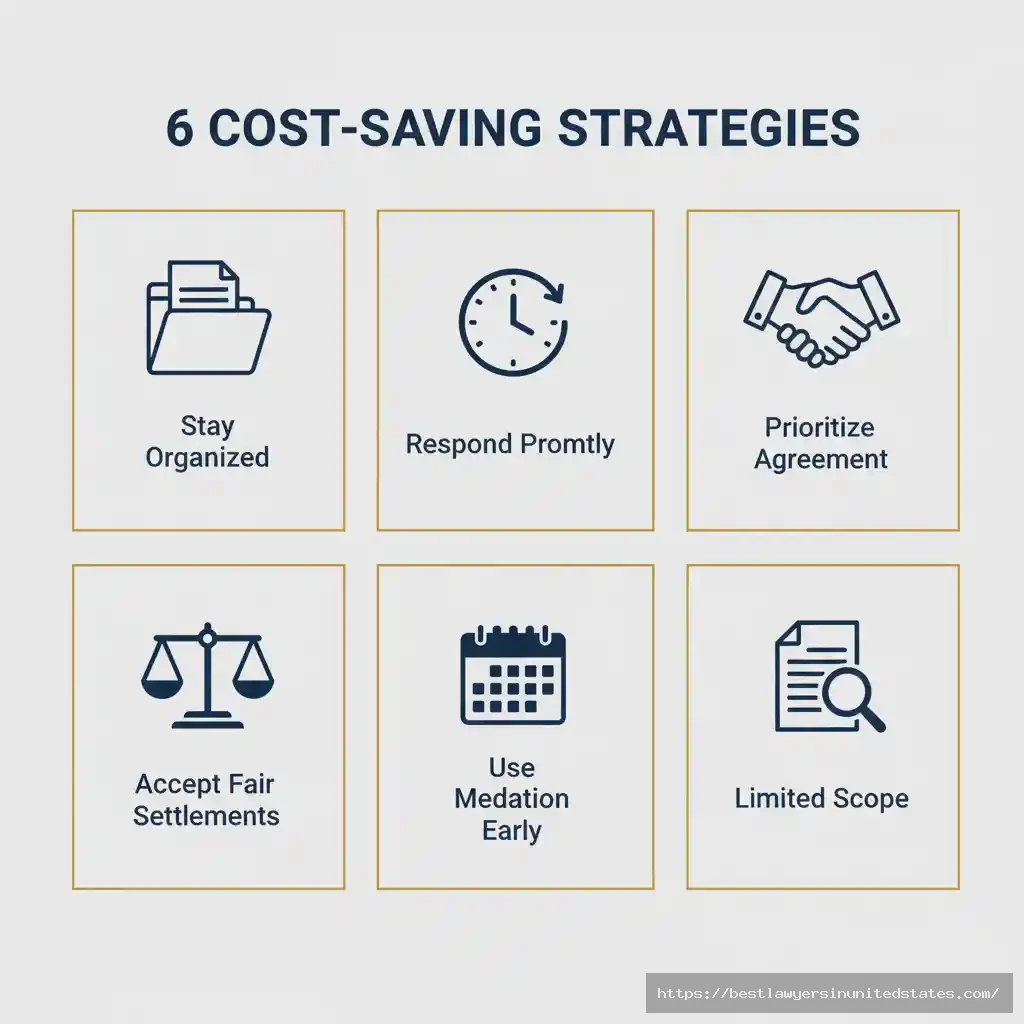
Prioritize agreement: Every issue you resolve without attorney intervention saves $1,000-5,000. Focus negotiation energy on high-value disagreements; compromise on minor issues.
Respond promptly: When your attorney or opposing counsel requests information, provide it immediately. Each delay generates follow-up communications (billable time) and potentially motions to compel.
Stay organized: Create shared spreadsheets for asset lists, debt inventories, and proposed parenting schedules. Clear documentation reduces attorney time spent clarifying information.
Use mediation early: Don’t wait until you’ve spent $20,000 each on attorneys to try mediation. Early mediation (month 2-3) prevents discovery costs and motion practice.
Accept reasonable settlements: Fighting over $5,000 in property when attorney fees will cost $8,000 makes no financial sense. Evaluate each disagreement through a cost-benefit lens.
Choose experienced attorneys: Efficient attorneys who regularly handle divorces complete tasks in half the time less-experienced attorneys require. A $400/hour expert who works efficiently often costs less than a $250/hour generalist.
Cost Comparison: Alternative Approaches
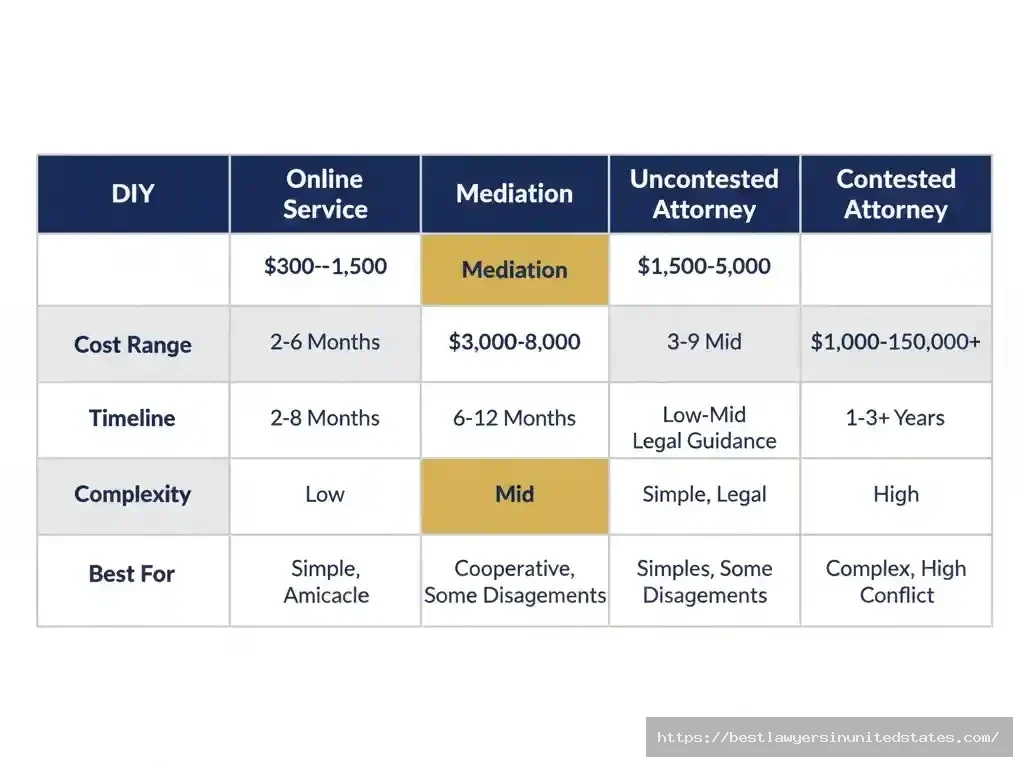
Understanding how different divorce methods compare helps you choose the most cost-effective approach for your situation.
Total Cost Comparison:
| Approach | DIY | Online Service | Mediation | Uncontested Attorney | Contested Attorney |
|---|---|---|---|---|---|
| Filing Fees | $100-435 | $100-435 | $100-435 | $100-435 | $100-435 |
| Professional Fees | $0 | $150-500 | $2,500-7,000 | $1,500-4,000 | $15,000-50,000+ |
| Additional Costs | $50-200 | $50-200 | $500-1,500 | $300-1,000 | $5,000-25,000+ |
| Total Range | $150-835 | $300-1,135 | $3,100-8,935 | $1,900-5,435 | $20,100-75,435+ |
| Timeline | 1-3 months | 1-3 months | 3-6 months | 2-4 months | 12-24+ months |
| Best For | Simple, full agreement | Simple, full agreement | Willing to negotiate | Amicable, want protection | High-conflict, complex |
Online Divorce vs. Traditional Attorney
Online divorce services ($300-1,500 total):
- Document preparation only
- No legal advice
- Templates and form completion
- Some include filing assistance
When online divorce works:
- No children
- Minimal assets (under $50,000)
- No real property
- Both parties completely agree
- Comfortable handling paperwork yourself
When you need an attorney instead:
- Any children involved
- Home or significant real estate
- Retirement accounts exceeding $25,000
- Business ownership
- Spousal support questions
- Any disagreement on major issues
- Complex debt
- Either spouse has significantly more financial knowledge
Even small mistakes in DIY divorces can be expensive to fix later. Incorrectly dividing a retirement account without proper QDRO creates tax penalties costing thousands. Missing support deadlines can forfeit rights to payments.
Mediation vs. Attorney Representation
Mediation advantages:
- Costs split between parties (typically 50/50)
- Faster resolution than litigation
- Preserves better post-divorce relationship
- More control over outcome
- Lower total costs ($3,000-8,000 combined vs. $30,000-100,000 combined)
Attorney representation advantages:
- Someone advocating specifically for your interests
- Legal advice tailored to your situation
- Attorney negotiates on your behalf
- Representation if case goes to trial
- Better for power imbalances or domestic violence situations
Hybrid approach (best value for many): Use mediation with consulting attorneys. Each party:
- Hires attorney for limited scope representation ($1,500-3,000)
- Attends mediation sessions without attorneys present
- Consults attorney between sessions
- Has attorney review final agreement
- Total cost per person: $2,500-5,500
This approach provides legal protection at a fraction of litigation costs while maintaining mediation’s cooperative advantages.
Legal Separation vs. Divorce Costs
Legal separation involves many of the same processes as divorce (property division, custody arrangements, support orders) but you remain legally married.
Cost comparison:
| Aspect | Legal Separation | Divorce |
|---|---|---|
| Filing Fee | $150-400 | $100-435 |
| Attorney Fees | Same as divorce | Same as divorce |
| Timeline | Same as divorce | Same as divorce |
| Can Convert | Yes, to divorce | N/A |
Why choose separation:
- Religious objections to divorce
- Healthcare benefits preservation
- Social Security benefit strategies
- Trial period before finalizing divorce
- Tax filing considerations
Cost reality: If you eventually divorce after separating, you’ll pay twice—once for separation, again for converting to divorce. Total costs often exceed direct divorce by $2,000-5,000.
Most people choose separation for non-financial reasons. From a pure cost perspective, divorce is typically more economical.
Frequently Asked Questions
How much does a divorce cost if both parties agree? When both spouses agree on all major issues (property, custody, support), expect to pay $1,500 to $5,000 total using an attorney for an uncontested divorce, or as little as $500 to $1,500 handling it yourself. The agreement eliminates negotiation costs, discovery expenses, and trial preparation—the three biggest cost drivers in contested cases.
Who pays for the divorce? Each spouse typically pays their own attorney fees and splits court filing costs. However, courts can order one spouse to pay the other’s attorney fees in cases involving significant income disparity, domestic violence, or when one spouse unnecessarily complicates the process. Fee-shifting orders are most common when one spouse has substantially greater financial resources.
What is the cheapest way to get divorced? DIY divorce using your state’s court self-help center or an online document preparation service ($300-1,500) is cheapest if you have no children, minimal assets, no real property, and complete agreement. For most people, a flat-fee uncontested divorce through an attorney ($1,500-3,500) offers the best balance of cost and protection.
Can I get a divorce without a lawyer? Yes. Every state allows self-representation in divorce proceedings. This works best for short marriages with no children, minimal assets, and full agreement. However, mistakes in DIY divorces—particularly regarding retirement account division, tax implications, and support calculations—can cost more to fix than hiring an attorney initially would have cost.
How much does divorce cost without a lawyer? Handling divorce yourself typically costs $500 to $1,500 including court filing fees ($100-435), document preparation service if used ($150-500), service of process ($40-150), notary fees, and miscellaneous costs. This assumes no complications arise. If you need to hire an attorney mid-process to fix mistakes, costs increase substantially.
What are the hidden costs of divorce? Beyond attorney and filing fees, expect to pay for property appraisals ($300-600), retirement account division orders ($500-2,500), business valuations if applicable ($5,000-25,000), custody evaluations ($2,500-6,000), tax advisor consultations ($200-500/hour), credit report fees, certified copies of documents, and establishing a second household. These hidden expenses often add $2,000-10,000 to anticipated costs.
Do both parties have to pay for divorce? Not necessarily. While each person typically pays their own attorney, courts can order the higher-earning spouse to contribute to or fully cover the other’s legal fees. This is especially common when income disparity creates an unfair advantage in affording legal representation. Filing fees are usually split or paid by the filing spouse unless a fee waiver is granted.
How long does a divorce take if both parties agree? Uncontested divorces where both parties agree on all terms typically take 2 to 4 months from filing to finalization. The timeline depends primarily on your state’s mandatory waiting period (ranging from 0 to 6 months) and court processing times. Some states offer expedited procedures for simple, uncontested cases.
How can I afford a divorce if I have no money? Apply for a court fee waiver based on low income, contact legal aid organizations for free representation, seek pro bono services through your state bar association, ask attorneys about payment plans, consider divorce mediation with costs split between spouses, or use limited scope representation where you handle some tasks yourself while paying an attorney for specific services only.
How much does it cost to modify a divorce decree? Post-divorce modifications typically cost $1,500 to $5,000 if both parties agree, or $5,000 to $15,000+ if contested. Common modifications include adjusting child support (due to income changes), modifying custody arrangements, or terminating spousal support. The complexity of requested changes and level of agreement determine final costs.
Does insurance cover divorce costs? Standard insurance policies don’t cover divorce attorney fees. However, legal insurance plans (like LegalShield) may provide discounted rates or limited free consultations. Some employers offer legal benefit plans as part of employee benefits. Additionally, if your divorce involves specific covered events (like domestic violence requiring protective orders), victim assistance programs might cover some costs.
What are the tax implications of divorce costs? Attorney fees related to divorce are generally not tax-deductible. However, fees specifically for tax advice or collecting taxable alimony may be deductible as investment expenses. Property transfers between spouses incident to divorce are typically tax-free, but failing to handle retirement account divisions properly (without QDRO) creates tax penalties. Consult a tax professional about your specific situation.
How much does contested divorce cost? Contested divorces where spouses disagree on major issues average $15,000 to $30,000 per spouse, with complex or high-conflict cases reaching $50,000 to $100,000+ per person. Costs depend on the number of disputed issues, length of marriage, asset complexity, custody conflicts, and willingness of parties to eventually compromise. Trial preparation and court time are the most expensive components.
Are payment plans available for divorce attorneys? Many divorce attorneys offer payment plans, especially for clients who don’t qualify for legal aid but can’t afford large upfront retainers. Common arrangements include monthly installments over 6-12 months, reduced initial retainers with guaranteed monthly payments, or deferred payments until marital assets are divided. Always get payment terms in writing as part of your retainer agreement.
Making Your Decision: Next Steps
Choosing your divorce approach requires balancing cost, complexity, and conflict level in your specific situation.
Assess Your Situation
You might handle divorce yourself if:
- Married less than 5 years
- No children
- Combined assets under $50,000
- No real property
- No retirement accounts
- Both parties completely agree on everything
- Comfortable with paperwork and court procedures
You should use mediation if:
- Children involved but both want to co-parent effectively
- Moderate assets requiring fair division
- Willing to negotiate in good faith
- Want to avoid courtroom battles
- Can afford $3,000-8,000 combined (less than litigation)
You need attorney representation if:
- Children with custody disagreements
- Significant assets (home, retirement accounts, businesses)
- Domestic violence present
- One spouse has much greater financial knowledge
- Substantial income disparity
- Complex debt structures
- Either party hiding assets
- High-conflict communication patterns
Get Cost Estimates
Before committing to any approach:
Contact 3-5 attorneys for consultations:
- Many offer free or low-cost initial meetings ($0-300)
- Ask about their fee structure
- Inquire about payment plans
- Request estimated total costs based on your situation
- Assess whether you’re comfortable with their communication style
Use the divorce cost calculator: Get an instant personalized estimate: Use our divorce cost calculator
Research your state’s specific costs: Filing fees, mandatory waiting periods, and average attorney rates vary significantly by location. Understanding your state’s requirements prevents budget surprises.
Create a Divorce Budget
One-time costs:
- Attorney retainer: $________
- Filing fees: $________
- Service of process: $________
- Mediation (if applicable): $________
- Appraisals/valuations: $________
- Expert witnesses: $________
- Total one-time: $________
Ongoing monthly costs during divorce:
- Additional attorney fees: $________
- Separate housing expenses: $________
- Additional insurance: $________
- Transportation (court appearances, attorney meetings): $________
- Childcare during appointments: $________
- Total monthly during process: $________
Post-divorce ongoing costs:
- Alimony/support payments: $________
- Insurance adjustments: $________
- Housing changes: $________
- Total monthly after finalization: $________
Protect Your Financial Future
During the divorce process:
- Open individual bank account (before filing if possible)
- Establish credit in your own name
- Document all marital assets and debts
- Collect financial records (tax returns, statements, pay stubs)
- Monitor credit reports for unauthorized activity
- Change passwords on individual accounts
- Update beneficiaries on life insurance after finalization
After divorce:
- Update estate planning documents
- Change beneficiaries on retirement accounts
- Refinance or remove name from mortgages as required
- Close joint credit accounts
- Update insurance policies
- File appropriate tax forms
- Implement QDRO for retirement division within required timeframes
Get Started Today
Divorce costs feel overwhelming, but understanding what you’ll actually pay—and why—helps you make informed decisions and avoid financial surprises.
Your next steps:
- Calculate your estimated costs: Get instant estimate
- Understand your state’s requirements: Research filing fees, mandatory waiting periods, and average attorney rates in your area
- Schedule attorney consultations: Even if you plan to mediate or handle divorce yourself, getting professional perspective on your situation helps avoid costly mistakes
- Explore affordability options: If finances are tight, investigate fee waivers, legal aid, and payment plans before assuming divorce is financially impossible
- Gather financial documents: Start collecting tax returns, bank statements, retirement account statements, property deeds, and debt information—you’ll need these regardless of which approach you choose
Remember: the cheapest divorce isn’t always the best divorce. Inadequate legal protection can cost far more in the long run than hiring appropriate help upfront. Focus on finding the right balance of cost-effectiveness and legal protection for your specific circumstances.
Additional Resources:
We’re continuously expanding our divorce cost guides to help you understand expenses specific to your situation. Currently available resources include:
Cost Calculator:
- Divorce Cost Calculator – Get instant personalized estimates
Planning & Process: Coming soon: Comprehensive guides on divorce timelines, filing procedures, and cost-reduction strategies
Coming Soon: We’re developing detailed state-by-state cost guides, divorce type comparisons, attorney fee breakdowns, and affordability resources. Check back regularly for new content as we expand our library to cover all aspects of divorce costs across the United States.
For questions about divorce costs in your specific situation, consult with a qualified family law attorney in your area. Every divorce is unique, and professional guidance ensures you understand the financial implications of your particular circumstances.
