
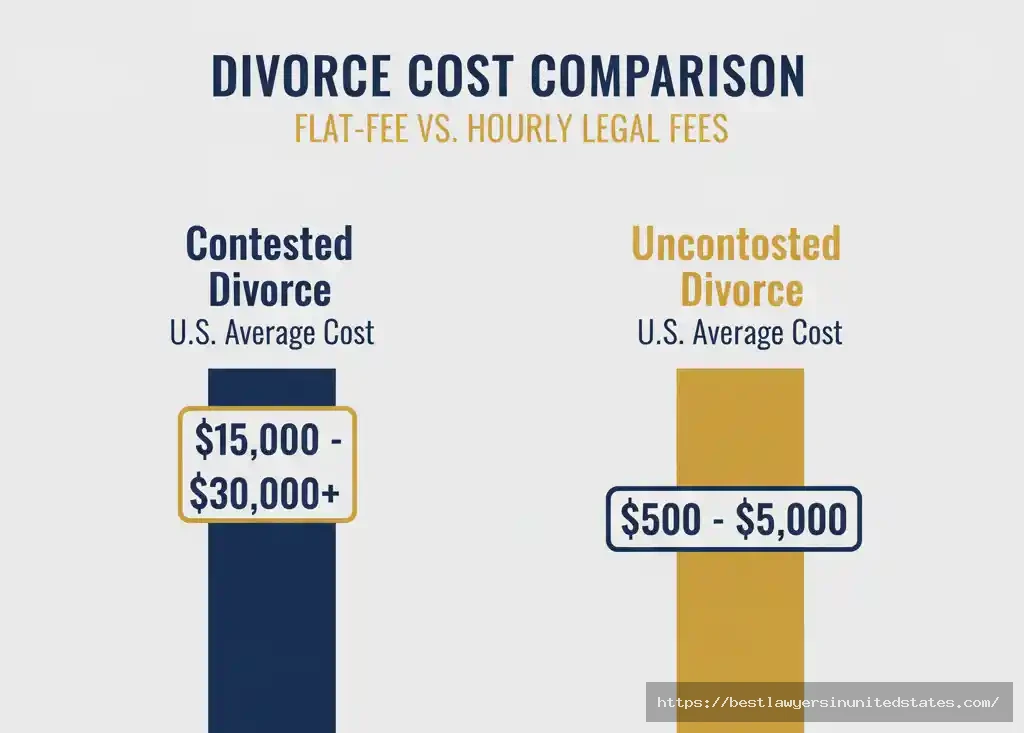
Divorce is expensive—but exactly how expensive depends on where you live, whether you can agree on terms, and how complex your finances are. The national average ranges from $7,000 to $15,000 for an uncontested divorce and $15,000 to $50,000+ for a contested case, but these numbers tell only part of the story.
Divorce Cost Calculator for instant idea, Calculate Now
Divorce Cost Calculator
Get an estimated cost for your divorce based on your specific situation
Your Estimated Divorce Cost
Cost Breakdown
📧 Get a Personalized Consultation
Have questions about your specific situation? Contact our legal experts for guidance tailored to your needs.
Contact Us via Email
Average Divorce Costs by State in 2025
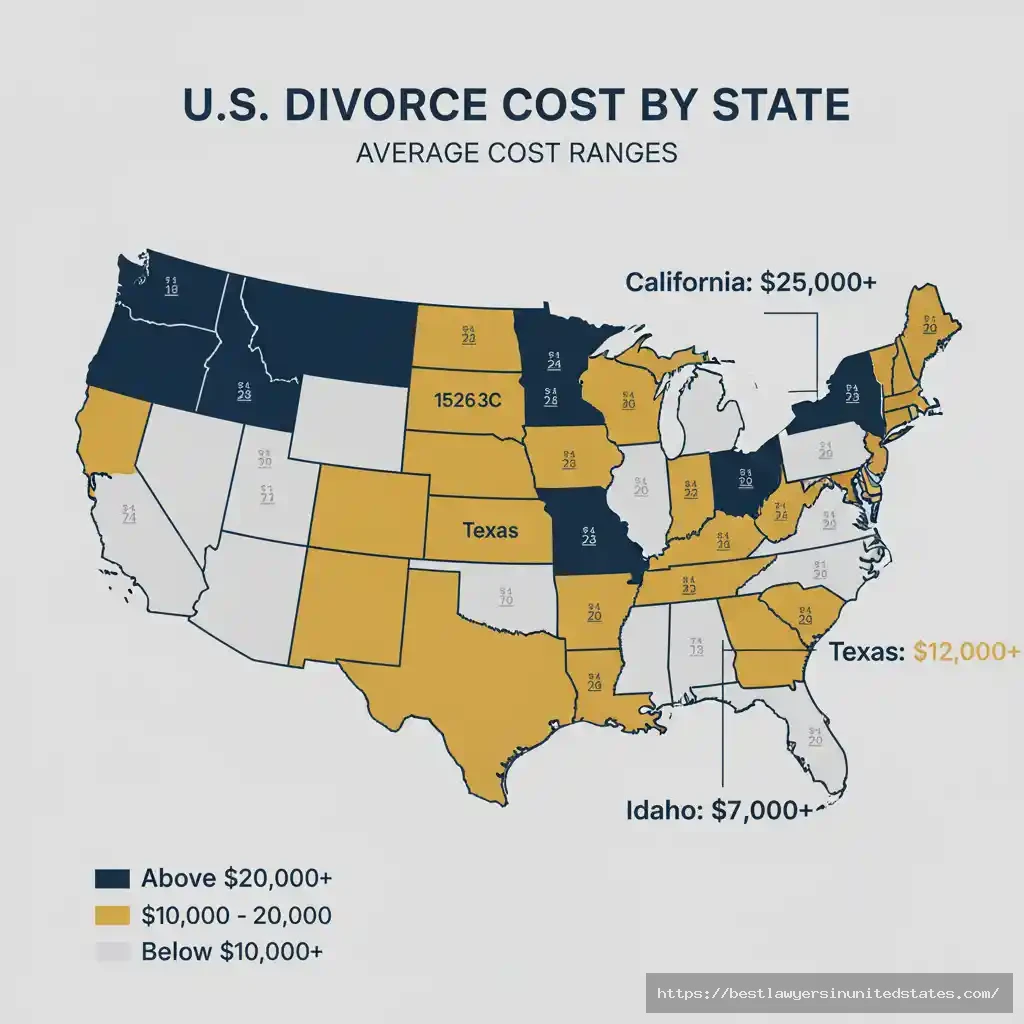
Divorce costs vary dramatically depending on where you file. Here’s what you can expect to pay across the United States:
| State | Filing Fees | Uncontested (DIY) | Uncontested (Attorney) | Contested (Simple) |
|---|---|---|---|---|
| California | $435–$450 | $500–$1,500 | $5,000–$10,000 | $15,000–$30,000 |
| Texas | $250–$350 | $300–$1,000 | $3,000–$7,500 | $10,000–$25,000 |
| Florida | $409 | $400–$1,200 | $4,000–$8,000 | $12,000–$28,000 |
| New York | $335–$360 | $500–$1,500 | $5,500–$12,000 | $17,000–$35,000 |
| Illinois | $334–$388 | $400–$1,300 | $4,500–$9,000 | $13,000–$30,000 |
| Pennsylvania | $300–$360 | $350–$1,200 | $4,000–$8,500 | $11,000–$27,000 |
| Ohio | $175–$350 | $300–$1,000 | $3,500–$7,000 | $9,000–$22,000 |
| Georgia | $200–$220 | $300–$900 | $3,000–$6,500 | $8,000–$20,000 |
| New Jersey | $300 | $500–$1,500 | $5,000–$11,000 | $15,000–$32,000 |
| Michigan | $230–$255 | $350–$1,100 | $3,500–$7,500 | $10,000–$24,000 |
Community property states (California, Texas, Arizona, Nevada, Washington, Idaho, Louisiana, New Mexico, Wisconsin) generally see higher litigation costs because asset division follows strict 50/50 rules that require detailed valuations.
Equitable distribution states (most others) give judges more discretion, which can either speed up settlements or extend battles depending on how reasonable both parties are.
What Actually Drives Your Divorce Cost?
Your final bill depends on five major factors. Understanding these helps you predict expenses and identify where you have control.
Contested vs. Uncontested Divorce
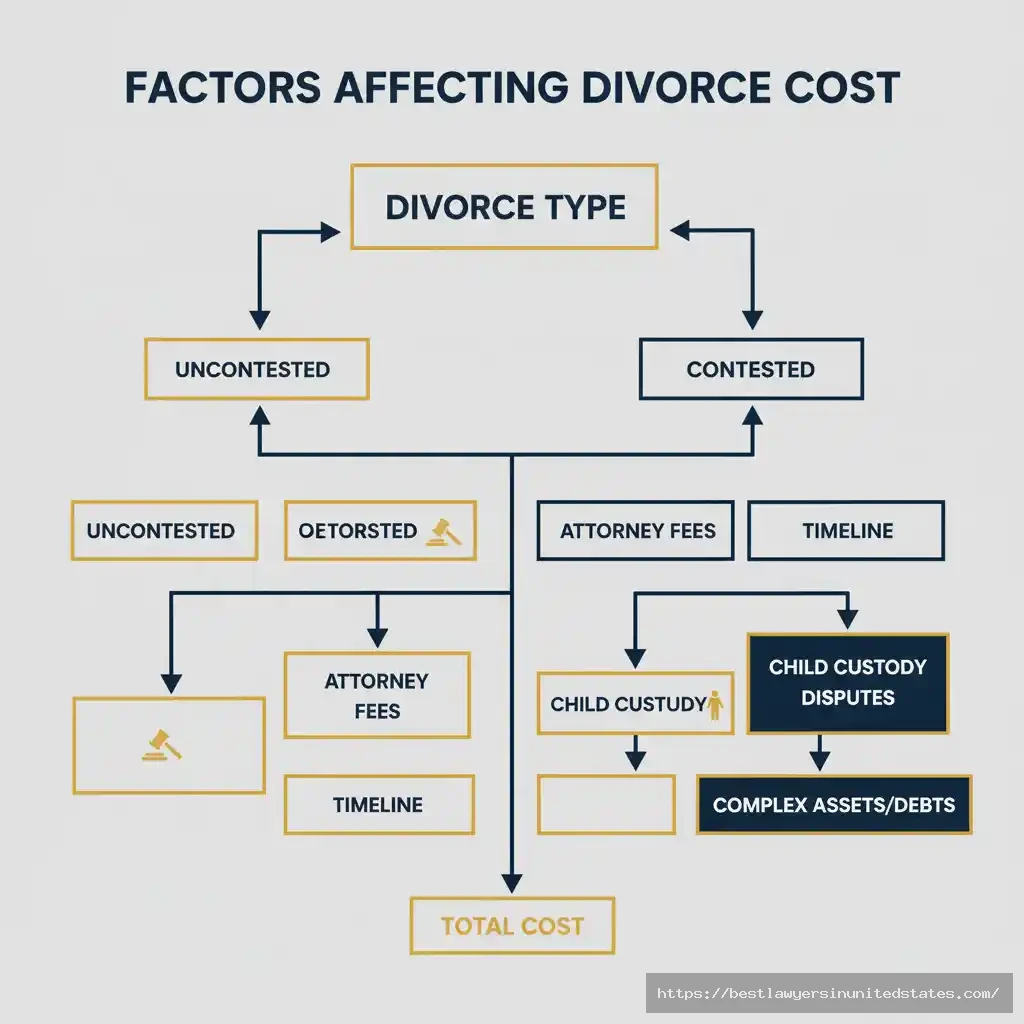
This is the single biggest cost determinant.
Uncontested divorce means you and your spouse agree on everything: property division, custody arrangements, support payments, and debt allocation. You file jointly, the court reviews your agreement, and you’re done. Total time: 2-6 months. Total cost: $500-$10,000 depending on whether you use an attorney.
Contested divorce means you disagree on one or more major issues. Every disagreement adds attorney hours, court filings, and delays. Discovery requests, depositions, expert witnesses, and trial preparation multiply costs quickly. Total time: 6 months to 3+ years. Total cost: $15,000-$100,000+.
The difference isn’t just expense—it’s emotional toll. Contested cases drain you financially and psychologically. If there’s any possibility of negotiating an agreement, even with a mediator’s help, take it.
Attorney Fee Structures

Most divorce attorneys bill in one of three ways:
Hourly billing is most common. Rates range from $150/hour in rural areas to $500+/hour in major cities. Partners at established firms in Manhattan or San Francisco can charge $700-$1,000/hour. Every email, phone call, document review, and court appearance gets billed in 6-minute or 15-minute increments.
Typical hourly rates by market:
- Small towns/rural areas: $150-$250/hour
- Mid-size cities: $250-$400/hour
- Major metros (Chicago, Dallas, Miami): $350-$500/hour
- Elite markets (NYC, LA, SF): $500-$1,000/hour
Retainer fees work like a down payment. You pay $3,000-$10,000 upfront, and your attorney draws from this as work progresses. When the retainer runs low, you replenish it. Unspent funds get refunded at the end (in theory—always get this in writing).
Flat fees cover specific services: $1,500-$3,500 for an uncontested divorce where the attorney handles all paperwork and court filings. This only works when there are no disputes. The moment you disagree on anything substantial, flat fee arrangements fall apart.
Children and Custody Disputes
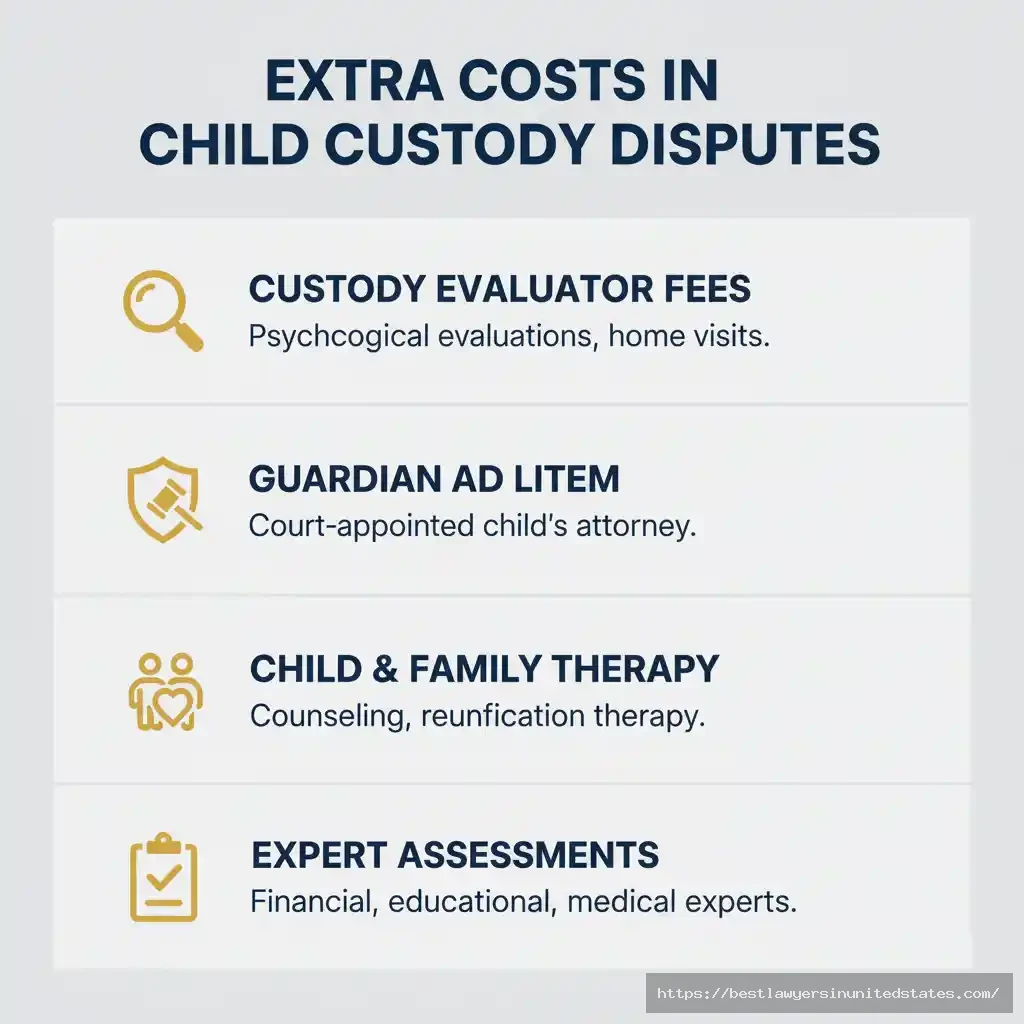
Cases involving minor children automatically cost more because courts require additional documentation:
- Parenting plans detailing custody schedules
- Child support calculations using state guidelines
- Home studies in contested custody cases ($1,500-$5,000)
- Guardian ad litem appointments ($3,000-$10,000+)
- Psychological evaluations if fitness is questioned ($2,000-$8,000)
Child support itself is calculated using state formulas based on both parents’ incomes, but determining “income” for self-employed spouses or business owners requires forensic accounting. That adds $5,000-$15,000 to your bill.
Custody battles are the most emotionally charged part of any divorce, and emotions cost money. If you’re fighting over overnight schedules or summer break arrangements, expect attorneys to spend 20-40 additional hours on your case minimum.
Complex Asset Division
Simple assets are easy to split: bank accounts, cars, and household furniture rarely require professional valuations. Retirement accounts need a QDRO (Qualified Domestic Relations Order) to divide them without tax penalties, which costs $500-$2,500 to prepare.

Complex assets explode costs:
Real estate beyond a primary home (investment properties, vacation homes, rental units) requires professional appraisals ($300-$600 per property) and potentially expert testimony about market conditions, income potential, and tax implications.
Business ownership demands forensic accountants to value the company, trace separate vs. marital contributions, and project future earnings. Cost: $5,000-$25,000 depending on complexity. Closely held businesses with opaque books take longer and cost more.
Stock options, restricted stock units, and equity compensation require specialized valuations because their value depends on vesting schedules, exercise prices, and market volatility.
Pensions are harder to value than 401(k)s because you’re dividing future benefits, not a current balance. Actuaries calculate present value using mortality tables, discount rates, and payout formulas. Cost: $1,000-$3,000.
Inherited assets and separate property create disputes when marital funds were used to maintain or improve them (a concept called “commingling”). Tracing requires forensic accounting to reconstruct years of transactions.
Case Timeline and Duration
Every month your divorce drags on costs money. Here’s why delays happen and what they cost:
Discovery disputes occur when one spouse won’t produce financial documents or answers interrogatories fully. Your attorney files motions to compel, the other side objects, you go to a hearing, the judge orders compliance, repeat. Cost per dispute: $2,000-$5,000 in attorney time plus court filing fees.
Continuances push court dates back months because someone’s attorney has a scheduling conflict or you need more time to gather information. Meanwhile, both attorneys bill for periodic status updates and revised trial prep.
Temporary orders for support, custody, or exclusive use of the marital home require separate hearings early in the case. Each hearing means attorney preparation time, court costs, and often expert witnesses. Cost: $3,000-$8,000 per hearing.
Appeals after an unfavorable ruling can extend your case 12-18 months and add $15,000-$40,000 in appellate attorney fees, transcript costs, and brief preparation.
Simple timeline example:
- Uncontested, cooperative spouses: 3-4 months, $5,000 total
- Contested with one major asset dispute: 8-12 months, $18,000-$30,000
- Contested with custody battle: 12-18 months, $30,000-$60,000
- High-conflict with multiple experts: 18-36 months, $60,000-$150,000+
Complete Breakdown of Divorce Costs
Here’s every expense you might encounter, organized by category.
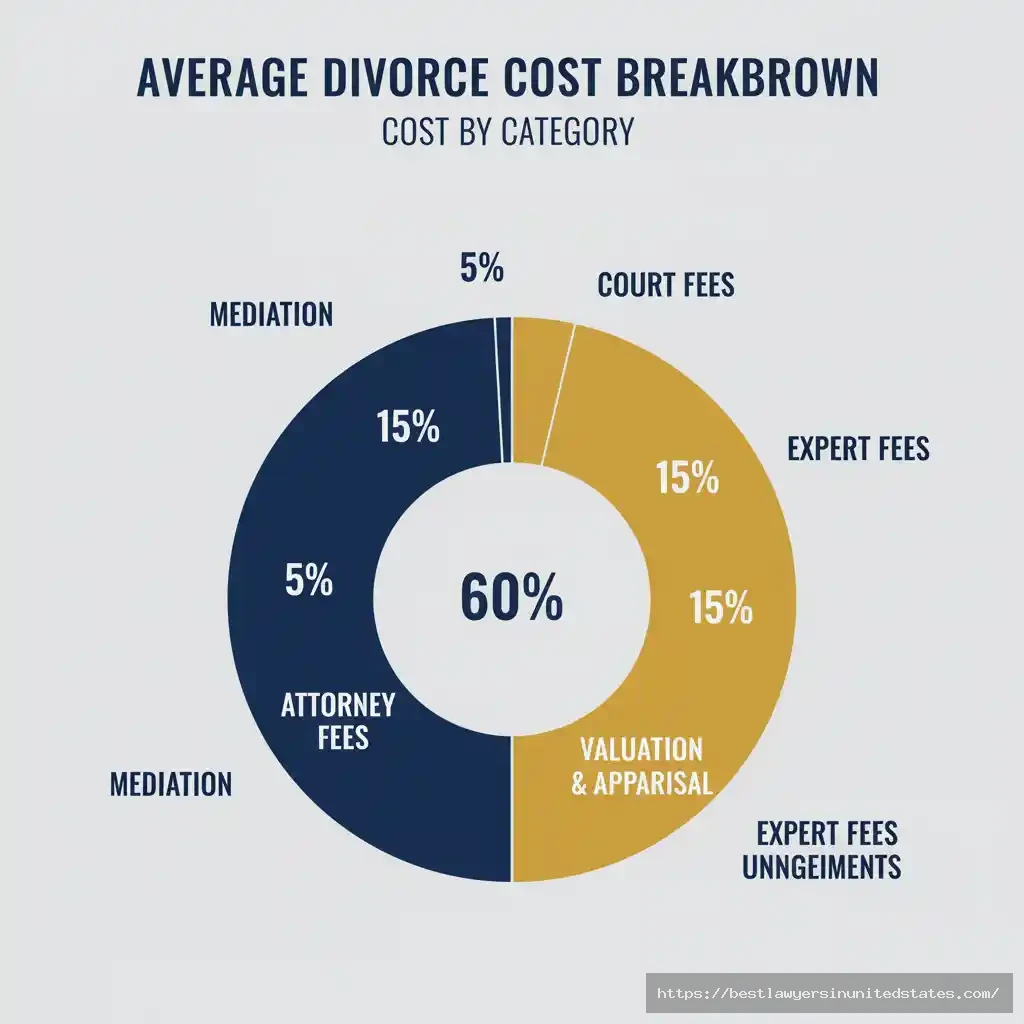
Court and Filing Fees
Divorce petition filing fees range from $150-$450 depending on your state and county. Some states charge extra for electronic filing or certified copies of the final decree.
Service of process fees run $50-$125 to have a process server or sheriff’s deputy officially deliver divorce papers to your spouse. You can’t skip this—proof of service is required before the court proceeds.
Mandatory parenting classes in some states cost $25-$75 per person. Both parents must complete them before any custody order is entered.

Motion filing fees add up when you need court intervention: $50-$100 per motion for temporary support, custody modifications, or contempt proceedings.
Parenting coordinator fees in high-conflict cases can run $150-$300/hour for ongoing dispute resolution about custody schedules and decision-making.
| Fee Type | Cost Range | When Required |
|---|---|---|
| Divorce petition filing | $150-$450 | Always (unless fee waiver granted) |
| Service of process | $50-$125 | Always |
| Answer/response filing | $0-$200 | If you’re served (respondent) |
| Parenting class | $25-$75 per person | Cases with minor children |
| Motion filings | $50-$100 each | When requesting court orders |
| Mediation filing fee | $0-$100 | If court-ordered mediation |
| Trial setting fee | $100-$300 | If case proceeds to trial |
Attorney and Legal Representation Costs
Beyond hourly rates and retainers, attorneys bill for:
Paralegal time at $75-$150/hour for document preparation, filing, and routine correspondence.
Expert witness coordination when your attorney needs to consult with accountants, appraisers, or custody evaluators.
Court appearance time often billed at a higher rate or minimum (3-4 hours even if hearing lasts 20 minutes).
Travel time to hearings in distant counties at 50-100% of standard hourly rate.
Administrative costs like photocopies ($0.10-$0.25/page), postage, courier fees, and long-distance calls. These can add $200-$500 to your final bill if you’re not paying attention.
Mediation and Alternative Dispute Resolution

Private mediation with a retired judge or experienced family law mediator costs $200-$500/hour split between spouses. A typical case needs 3-8 hours of mediation spread across 2-4 sessions. Total: $600-$4,000 per person.
Some counties offer court-sponsored mediation at reduced rates ($50-$100/session) or free for low-income parties. Success rates hover around 60-70% for reaching full agreements, with another 20% reaching partial agreements that narrow contested issues for trial.
Collaborative divorce uses a team approach: each spouse has an attorney, plus shared neutral experts (financial advisor, child specialist, divorce coach). The process is voluntary and confidential, with everyone agreeing not to litigate. Cost: $15,000-$30,000 per person, but almost always less than trial.
Arbitration ($3,000-$10,000 total) lets you hire a private decision-maker instead of waiting for a court trial date. Faster than litigation, but you sacrifice some appeal rights.
Expert Witnesses and Professional Services
Forensic accountants ($200-$400/hour) trace hidden assets, value businesses, and calculate actual income when tax returns don’t tell the full story. They review years of bank statements, credit card records, and business books. Total cost: $5,000-$25,000.
Real estate appraisers ($300-$600 per property) provide formal valuations needed for equitable division or buyout calculations.
Vocational evaluators ($2,000-$5,000) assess earning capacity when one spouse hasn’t worked during the marriage or claims they can’t find appropriate employment.
Child custody evaluators ($3,000-$10,000) conduct interviews, home visits, psychological testing, and background checks before recommending custody arrangements to the court.
Business valuators certified in forensic valuation charge $5,000-$25,000+ to value small businesses, professional practices, or partnership interests.
Actuary services ($1,000-$3,000) calculate the present value of pension benefits for division.
Tax experts (CPAs or tax attorneys at $200-$500/hour) advise on filing status, dependency exemptions, alimony taxation, and capital gains implications of property transfers.
Hidden Post-Divorce Costs Most People Forget
Your divorce decree is signed, but your expenses aren’t over:
Refinancing costs if you’re keeping the house and removing your ex-spouse from the mortgage: $2,000-$5,000 for application fees, appraisal, title search, and closing costs.
Title transfer fees and deed preparation ($200-$800) when real estate changes ownership.
QDRO preparation and approval ($500-$2,500) to actually divide retirement accounts after the divorce is final.
Insurance changes: You’ll need your own health insurance if you were on your spouse’s plan. COBRA continuation coverage costs 102% of the premium your employer was paying—often $500-$1,500/month. Car and homeowner’s insurance policies need updating too.
Credit monitoring and separate accounts since you need to protect yourself from your ex’s future financial decisions.
Moving expenses: Truck rental, deposits on a new apartment or house, utility connection fees, furniture to replace items left behind.
Updated estate planning documents: New will, revised beneficiaries on all accounts, updated power of attorney, and healthcare directives ($500-$2,000 in attorney fees).
Tax preparation complexity for the divorce year when you’re filing separately but splitting deductions and dealing with property transfer reporting.
How to Reduce Your Divorce Costs: 8 Proven Strategies
You can’t eliminate all expenses, but strategic choices dramatically lower your total bill.
Strategy 1: Pursue Mediation Before Litigation
Mediation works best when:
- Both spouses are willing to compromise
- Financial disclosure is voluntary and complete
- Power dynamics are relatively balanced
- No history of domestic violence
Even if you each hire attorneys to review the mediated agreement before signing (smart move), you’ll spend $8,000-$15,000 total instead of $30,000-$100,000+ for full litigation.
One hour of mediation often accomplishes what would take 5-10 hours of attorney back-and-forth. The math is simple: 6 hours of mediation at $400/hour ($2,400 split between you) vs. 30 hours of attorney time at $350/hour ($10,500 per person).
Strategy 2: File Uncontested When Possible
If you and your spouse can agree on everything—or are willing to compromise to get there—file an uncontested divorce. Requirements vary by state but generally you need:
- No disputes over property division
- No disputes over child custody/support
- No disputes over alimony
- Required separation period completed (in states that require it)
Total cost: $1,500-$5,000 including attorney review of your agreement, compared to $15,000-$50,000+ for contested litigation.
The hardest part is getting to agreement. Consider using a mediator ($200-$500/hour) to facilitate negotiations. Even 4-6 hours of mediation is far cheaper than contested litigation.
Strategy 3: Consider DIY Divorce (With Caution)
DIY divorce makes sense when:
- You’ve been married less than 5 years
- No children or children are grown
- Minimal assets (less than $50,000 total)
- No real estate or retirement accounts
- Both spouses employed with similar incomes
- No business ownership
- No disputes whatsoever
Online divorce services like DivorceWriter, CompleteCase, or 3StepDivorce charge $150-$500 to prepare your paperwork. You still pay court filing fees.
When DIY doesn’t work:
- Any significant assets or debts
- Children requiring custody agreements
- Self-employment or complex income
- Real estate or retirement accounts
- Any disagreements about anything
- One spouse hiding assets or income
Even simple-looking cases can have hidden complexity. At minimum, pay an attorney $300-$600 for a one-hour consultation to review your situation before going DIY.
Strategy 4: Negotiate Flat Fee Arrangements
Some attorneys offer flat fees for uncontested divorces: $1,500-$3,500 covers all paperwork, filings, and court representation. This only works if your case truly stays uncontested.
Get clear written terms:
- What’s included (filings, basic revisions, court appearance)
- What costs extra (if spouse contests, if court requires additional documents, if case doesn’t settle)
- Timeline expectations
- Refund policy if attorney withdraws
For contested cases, some attorneys offer “unbundled” or “limited scope” representation: they handle specific tasks (drafting motions, attending hearings) at fixed prices while you do other parts yourself. This reduces costs but requires you to manage the overall case strategy.
Strategy 5: Limit Discovery and Motion Practice
Discovery is where attorneys request documents, send interrogatories (written questions), take depositions, and subpoena third-party records. It’s necessary in complex cases but often overdone in simple ones.
Work with your attorney to:
- Agree on informal document exchange instead of formal discovery
- Limit depositions to essential witnesses only
- Avoid “discovery disputes” by being responsive and reasonable
- Skip the forensic accountant if basic financial disclosure is sufficient
Every interrogatory your attorney sends generates billable hours drafting, reviewing responses, and filing motions when answers are incomplete. Depositions cost $1,500-$5,000 each (attorney time plus court reporter fees).
Similarly, every motion filed means attorney hours drafting, responding to the other side’s opposition, preparing for a hearing, and attending court. Most motions cost $1,500-$3,500 in attorney time.
Strategy 6: Communicate Efficiently With Your Attorney
Your attorney bills for every interaction: phone calls, emails, text messages, office meetings. Reduce these billable hours by:
Batching questions: Instead of calling five times with individual questions, write them down and send one comprehensive email.
Preparing for meetings: Bring organized documents, written timeline of events, and specific questions. An organized client takes 30 minutes to cover what a disorganized client takes 2 hours to discuss.
Responding promptly: When your attorney requests documents or answers, provide them within 48 hours. Delays lead to follow-up emails and calls (all billable).
Avoiding emotional venting: Your attorney is not your therapist. They bill $300-$500/hour for emotional support you can get from friends, family, or an actual therapist at $100-$200/hour.
Reading carefully: Before calling to ask “what does this mean?”, read the document or email twice. Many questions answer themselves.
Strategy 7: Apply for Fee Waivers
Can’t afford filing fees? Every state offers fee waivers for indigent parties. Eligibility is typically:
- Income below 125-200% of federal poverty guidelines
- Currently receiving public benefits (SNAP, SSI, Medicaid)
- Unable to afford basic necessities if required to pay fees
File a fee waiver application (sometimes called “in forma pauperis” or “pauper’s oath”) along with your divorce petition. You’ll need to provide:
- Recent pay stubs or proof of income
- Bank statements
- List of monthly expenses
- Proof of public benefit enrollment if applicable
Approved waivers cover court filing fees but not attorney costs (unless you also qualify for legal aid—see next strategy).
Strategy 8: Utilize Legal Aid and Pro Bono Services
Legal aid organizations provide free or reduced-cost representation to qualifying clients, typically those earning less than 125-200% of federal poverty guidelines.
How to find legal aid:
- Legal Services Corporation directory: www.lsc.gov/find-legal-aid
- State bar association pro bono programs
- Law school clinics (supervised law students handle cases)
- Volunteer lawyer programs in major cities
What they cover: Legal aid typically handles uncontested divorces, domestic violence protective orders, and custody matters. Complex property division or high-conflict litigation rarely qualifies because these organizations have limited resources.
Income limits (2025): For a household of one, 200% of poverty guidelines is roughly $30,000/year. For a household of four, it’s about $62,000/year. Limits vary by program and state.
Some private attorneys offer “sliding scale” fees based on income or accept payment plans. Ask during your initial consultation.
Understanding Asset Division: What Really Happens to the “50/50 Split”
The most persistent divorce myth: the wife automatically gets half of everything. Here’s the reality.
Community Property vs. Equitable Distribution States
Community property states (9 total: Arizona, California, Idaho, Louisiana, Nevada, New Mexico, Texas, Washington, Wisconsin) start with a presumption that all marital property splits 50/50 regardless of whose name is on the title or who earned the income.
Equitable distribution states (all others) divide property “fairly” based on multiple factors, which doesn’t always mean equally. Courts consider:
- Length of marriage
- Each spouse’s income and earning capacity
- Who has primary custody of children
- Contributions as homemaker or parent
- Age and health of each spouse
- Separate property each brought to the marriage
- Economic circumstances after divorce
Neither system is inherently better or worse—just different frameworks for achieving fairness.
What Counts as Marital Property
Marital property includes everything acquired during the marriage regardless of whose name is on it:
- Income from either spouse’s employment
- Real estate purchased during marriage
- Retirement account contributions made during marriage
- Business interests established or grown during marriage
- Vehicles, household items, bank accounts
Separate property stays with whoever owned it:
- Assets owned before marriage
- Inheritances received (even during marriage)
- Gifts given to one spouse individually
- Personal injury settlements
The trouble starts when separate and marital property mix. If you used your inheritance to make mortgage payments on the marital home, you may have “commingled” separate funds. Tracing becomes necessary, which means forensic accountants and legal fees.
Gender-Neutral Division Laws
Courts don’t consider gender when dividing assets. The stereotype of the wife “taking half” ignores reality:
In high-earning wife/stay-at-home husband situations, the husband often receives spousal support and a larger share of assets to compensate for career sacrifices made during the marriage.
Courts care about economic dependency and earning capacity, not gender. A spouse who stayed home for 15 years to raise children while the other built a career has reduced earning power regardless of whether that spouse is male or female.
Pension and Retirement Account Division
401(k)s, IRAs, and similar accounts get divided using a QDRO (Qualified Domestic Relations Order), which allows transfer of funds without tax penalties or early withdrawal fees. Your attorney drafts it, both parties sign, the judge approves, you submit to the plan administrator.
Pensions are trickier because you’re dividing future payments, not a current balance. The non-employee spouse typically receives a percentage of benefits calculated based on years married while the pension was accruing.
Example: You were married 15 years. Your spouse worked for the same employer for 30 years and will receive a $3,000/month pension. You’re entitled to 50% of the “marital portion,” which is 15/30 = 50%. So you receive 50% × 50% × $3,000 = $750/month when your spouse retires.
Social Security benefits can’t be divided by divorce decree, but if you were married at least 10 years, you’re entitled to claim spousal benefits based on your ex’s work record (without reducing their benefit). This is a federal entitlement, not a divorce settlement term.
Mediation vs. Lawyer vs. Trial: Complete Cost Comparison
Here’s what you actually pay at each level of dispute resolution, from most cooperative to most adversarial.
| Method | Timeline | Your Cost | Spouse’s Cost | Total Combined |
|---|---|---|---|---|
| DIY (both agree) | 2-4 months | $300-$1,000 | $300-$1,000 | $600-$2,000 |
| Mediation only | 3-6 months | $1,500-$4,000 | $1,500-$4,000 | $3,000-$8,000 |
| Attorney-assisted settlement | 4-8 months | $5,000-$15,000 | $5,000-$15,000 | $10,000-$30,000 |
| Collaborative divorce | 6-12 months | $15,000-$30,000 | $15,000-$30,000 | $30,000-$60,000 |
| Contested (settles before trial) | 8-18 months | $15,000-$40,000 | $15,000-$40,000 | $30,000-$80,000 |
| Contested (goes to trial) | 12-36 months | $30,000-$100,000+ | $30,000-$100,000+ | $60,000-$200,000+ |
What makes mediation work: Both parties voluntarily disclose all financial information, both are willing to compromise, no pattern of domestic violence or intimidation, relatively equal bargaining power.
When mediation fails: One spouse hides assets, one refuses to negotiate reasonably, power imbalance makes true agreement impossible, complex legal issues need court interpretation.
Cost example—typical contested case that settles:
- Initial retainer: $5,000 each
- 40 hours attorney time at $350/hour: $14,000 each
- Court filing and service: $500 each
- Shared appraiser for house: $600 total ($300 each)
- Shared forensic accountant for business: $8,000 total ($4,000 each)
- Individual CPAs for tax advice: $1,500 each
- Mediation sessions: $2,400 total ($1,200 each)
- Total per person: $26,500
Cost example—case going to trial:
- Initial retainer: $7,500 each
- 80+ hours attorney time at $400/hour: $32,000 each
- Court costs and filing fees: $1,200 each
- Discovery costs (depositions, document production): $5,000 each
- Expert witnesses (custody evaluator, business valuation, forensic accountant): $15,000 each
- Trial preparation and court time: $10,000 each
- Total per person: $70,700
Costly Divorce Mistakes to Avoid
Some mistakes are emotional. Others are strategic. All of them cost money.
Mistake 1: Moving Out of the Marital Home Prematurely
This is so common it deserves its own section. Moving out can hurt your case in multiple ways:
Property rights: In some states, voluntarily abandoning the marital home can affect your claim to it in the property settlement. Courts may view your departure as implicit agreement that your spouse should keep it.
Custody implications: If you have children and move out while they stay with your spouse, you’re creating a status quo arrangement that courts are reluctant to disrupt. Suddenly you’re the “noncustodial parent” arguing for shared custody rather than the 50/50 presumption you’d have if you’d stayed.
Negotiating leverage: The spouse who keeps the house during the divorce process has a stronger bargaining position. You’re paying for a new residence while still covering mortgage, taxes, and insurance on the house your spouse lives in.
Temporary support orders: If you move out and your spouse files for temporary spousal or child support, courts often grant these orders to maintain the status quo—which now means you supporting two households.
Better approach: If the marriage is over, consult an attorney before moving out. In high-conflict situations, you may need to file for divorce and request a hearing on temporary possession of the home. If you absolutely must leave immediately (domestic violence, unbearable hostility), document everything and file for divorce within days, not weeks.
Mistake 2: Hiding Assets or Income
Courts have seen every trick. Forensic accountants know where to look. Getting caught hiding assets results in:
Sanctions: Courts can order you to pay your spouse’s attorney fees for having to discover what you should have disclosed voluntarily. Add $5,000-$15,000 to your bill.
Adverse inference: Judges presume hidden assets are worth more than they actually are, often awarding your spouse a larger share of everything else to compensate.
Contempt: Lying under oath or ignoring court orders can result in contempt findings, fines, or even jail time.
Destroyed credibility: Once you’re caught lying about one asset, the judge won’t believe anything else you say. Every future dispute tilts against you.
Forensic accountants trace hidden assets by:
- Analyzing cash deposits and withdrawals
- Reviewing credit card statements for lifestyle expenses exceeding reported income
- Comparing tax returns to loan applications
- Investigating transfers to friends, relatives, or business accounts
- Examining lifestyle purchases (vehicles, jewelry, vacations) inconsistent with claimed income
The cost of hiring a forensic accountant is always less than the consequences of being caught.
Mistake 3: Refusing Reasonable Settlement Offers
Every month your divorce continues costs $2,000-$5,000 in attorney fees. If your spouse offers a settlement that’s 80% of what you want, rejecting it to fight for 100% often costs more than you’d gain.
Do the math: If the settlement gap is $50,000 worth of assets, and going to trial will cost each of you $40,000 more in attorney fees, you’re spending $40,000 to potentially gain $50,000. You need to win decisively at trial to come out ahead—and trial outcomes are never guaranteed.
Emotional vs. financial decisions: “It’s the principle” is expensive. “They don’t deserve that much” costs money. “I want my day in court” often results in regret when the bill arrives.
Your attorney can help you evaluate settlement offers objectively: What’s the best-case trial outcome? What’s the worst-case? What’s most likely? What will it cost to get there? What’s the settlement offer worth after accounting for additional legal fees?
Mistake 4: Poor Communication With Your Attorney
This goes beyond just reducing billable hours. Poor communication leads to missed deadlines, incomplete responses to discovery, and unprepared court hearings.
Missed deadlines result in sanctions, adverse rulings, or dismissed claims. Courts don’t care that you “didn’t understand” the deadline or “forgot” to send those documents to your attorney.
Incomplete financial disclosure forces last-minute scrambling before hearings, giving your attorney insufficient time to prepare your case properly.
Surprise information revealed at trial undermines your credibility and puts your attorney in an impossible position.
Better practices:
- Return calls and emails within 24 hours
- Provide complete, organized documentation when requested
- Tell your attorney everything relevant, even embarrassing details
- Ask questions when you don’t understand something
- Keep a timeline of events with dates and key facts
- Save all relevant emails, texts, and documents
Financing Your Divorce: When You Can’t Pay Upfront
Divorce creates a financial bind: you need legal representation but don’t have $5,000-$10,000 available for a retainer. Here are your options.
Attorney Payment Plans
Many divorce attorneys offer payment plans for creditworthy clients:
- Pay 50% retainer upfront, remainder over 3-6 months
- Monthly payment arrangements against future billings
- Reduced retainer with higher hourly rate
- Draw against anticipated property settlement or support award
Ask about payment options during initial consultations. Attorneys would rather work out a payment plan than turn away a good client or deal with collection issues later.
Divorce Loans and Personal Financing
Several companies specialize in divorce lending:
Balance Financial offers divorce loans from $5,000-$100,000 based on creditworthiness and anticipated settlement value. Interest rates run 8-15% depending on credit score. You repay from your settlement proceeds or over time if settlement is delayed.
**Home equity linesof credit (HELOCs)** let you borrow against home equity at lower interest rates (currently 7-10%) than personal loans. But this only works if you have equity and sufficient income to qualify. Risk: If you’re keeping the house, you’re adding debt to an asset you’ll need to refinance.
401(k) loans let you borrow up to $50,000 or 50% of your vested balance, whichever is less. You repay yourself with interest, and there are no taxes or penalties if you follow the rules. Risk: If you lose your job during the divorce, the loan becomes due immediately or converts to a taxable distribution.
Credit cards are a last resort. Interest rates of 18-28% make this extremely expensive, but it’s accessible if other options aren’t. Use 0% balance transfer offers strategically if your credit is good enough to qualify.
Personal loans from banks or online lenders range from $5,000-$50,000 at rates of 8-20% depending on credit score. Repayment terms are typically 3-5 years.
Family loans avoid interest charges but create complicated dynamics. Put everything in writing: loan amount, repayment terms, interest rate (even if 0%), and what happens if you can’t repay on schedule.
Fee Waiver Eligibility by State
Each state sets its own income thresholds for fee waivers. Here are current guidelines for common states:
California: Household income below $23,100 (single) or $31,200 (couple) automatically qualifies. Above those limits, you can still qualify if you can’t afford fees while paying basic living expenses.
Texas: Income below 125% of federal poverty guidelines (approximately $18,000 single, $24,000 couple) qualifies. Currently receiving SNAP, TANF, or Medicaid is automatic qualification.
Florida: Must be receiving public assistance (TANF, poverty-related Medicaid, SSI, Food Stamps) or demonstrate inability to pay without hardship to self or dependents.
New York: Household income below $37,650 (single) or higher limits for families automatically qualifies. Above that, court reviews your complete financial situation.
Illinois: Income below 125% of federal poverty guidelines or currently receiving means-tested public benefits.
Application forms are available at your county clerk’s office or court website. You’ll need to provide:
- Proof of income (pay stubs, tax returns, unemployment benefits statement)
- Bank account statements (last 2-3 months)
- List of monthly expenses with supporting documentation
- Proof of public benefits enrollment if applicable
Fee waivers cover court filing fees, service costs, and sometimes mediation fees. They don’t cover attorney costs (that’s what legal aid is for).
Legal Aid and Pro Bono Services
Legal aid organizations serve clients earning less than 125-200% of federal poverty guidelines (roughly $18,000-$30,000 for a single person, $37,000-$62,000 for a family of four).
Services typically include:
- Uncontested divorce representation
- Domestic violence protective orders
- Basic custody and support matters
- Document preparation and court filing assistance
Legal aid rarely handles complex property division, contested custody trials, or high-asset cases due to limited resources.
How to apply:
- Contact your local legal aid office (find via www.lsc.gov/find-legal-aid)
- Complete intake questionnaire (online or by phone)
- Provide proof of income and household size
- Attend screening interview
- If accepted, get assigned to an attorney or paralegal
Wait times vary from immediate service for emergencies (domestic violence) to 2-6 months for routine divorce matters.
Pro bono programs through state bar associations match volunteer private attorneys with qualifying clients. These programs have similar income requirements to legal aid but may have more flexibility for complex cases.
Law school clinics offer free or low-cost representation by law students supervised by licensed attorneys. Quality is generally good, but cases move slower due to the educational component.
Alimony and Spousal Support: What It Costs (For Both Sides)
Spousal support (called “alimony” or “maintenance” depending on your state) adds complexity to divorce costs because it’s both a short-term expense (calculating and negotiating it) and a long-term financial obligation.
How Alimony Is Calculated
No universal formula exists. Some states use guidelines similar to child support calculations, while others leave it entirely to judicial discretion.
Common factors courts consider:
- Length of marriage (longer marriages = more likely/longer support)
- Income disparity between spouses
- Standard of living during marriage
- Age and health of both spouses
- Earning capacity and employability
- Contributions as homemaker or to other spouse’s career
- Separate property and assets each receives
- Child custody arrangements
Typical duration formulas:
- Short marriages (0-5 years): Support rarely awarded unless extreme circumstances
- Medium marriages (5-15 years): Support duration often equals 30-50% of marriage length
- Long marriages (15+ years): May result in permanent/indefinite support, especially if recipient spouse is near retirement age
California example: Many judges use a rule of thumb that support lasts half the length of the marriage for marriages under 10 years. Marry at 25, divorce at 35, expect 5 years of support. Amounts often range from 30-40% of the income gap between spouses.
Texas example: Spousal maintenance is difficult to obtain. Recipient must prove either: (1) marriage lasted 10+ years and they lack sufficient property to provide for minimum reasonable needs, or (2) spouse was convicted of domestic violence within 2 years of filing, or (3) spouse or child has a disability.
New York example: Courts consider standard of living during marriage and aim to continue it as much as practical. High-income cases often result in substantial support awards.
Tax Implications After 2019 Changes
Critical change: For divorces finalized after December 31, 2018, alimony is no longer tax-deductible to the payor or taxable income to the recipient. This fundamentally changed alimony negotiations.
Pre-2019: High earner in 35% tax bracket paying $50,000/year in alimony saved $17,500 in taxes, making the real cost $32,500. Recipient paid taxes on the $50,000 but at a lower rate (perhaps 22%), netting $39,000. Both sides had incentive to agree to higher alimony amounts.
Post-2019: Same $50,000 payment costs the payor the full $50,000 (no deduction), and recipient keeps the full $50,000 (no tax). Payors now resist higher amounts since there’s no tax benefit.
Property division workaround: Since property transfers in divorce remain tax-free, many couples now negotiate larger property settlements to the lower-earning spouse instead of ongoing alimony payments.
Modification and Enforcement Costs
Modification petitions (requesting increase or decrease in support) cost $1,500-$5,000 in attorney fees each time. You must show a substantial change in circumstances: job loss, serious illness, recipient’s cohabitation with a new partner, or significant income increase/decrease.
Enforcement actions when payments aren’t made cost $1,500-$3,000 to file contempt proceedings. Courts can order wage garnishment, seizure of tax refunds, suspension of driver’s or professional licenses, and jail time for willful nonpayment.
Arrears interest accumulates on unpaid support obligations at rates set by state law (typically 9-12% annually). These arrears don’t go away—they survive until paid in full.
High-Net-Worth Divorces: When Costs Multiply

Once marital assets exceed $1 million, everything becomes more complex and expensive.
Forensic Accounting: Why It’s Necessary
High-income spouses often have complicated financial situations:
- Multiple income sources (W-2 salary, bonuses, stock options, partnership distributions, rental income)
- Business ownership with discretionary spending
- Deferred compensation arrangements
- International assets
- Trusts and estate planning structures
- Tax strategies that obscure true income
What forensic accountants do:
- Analyze 3-5 years of tax returns, bank statements, credit card records
- Trace cash flow through business and personal accounts
- Identify personal expenses run through businesses
- Calculate actual income available for support
- Value business interests
- Uncover hidden assets or income
- Provide expert testimony at trial
Cost: $5,000-$25,000 depending on complexity. A small business with straightforward books might need 20-30 hours ($5,000-$7,500). A multi-entity business structure with international components might require 100+ hours ($25,000-$40,000).
Business Valuation Methods and Costs
Three standard approaches exist for valuing privately held businesses:
Income approach: Projects future cash flows and discounts them to present value. Most common for profitable operating businesses. Requires analysis of historical financials, industry trends, competitive positioning, and economic forecasts.
Market approach: Compares the business to similar businesses that have sold recently or to publicly traded companies in the same industry. Limited by availability of truly comparable transactions.
Asset approach: Values all business assets (equipment, inventory, real estate, intellectual property) and subtracts liabilities. Used for holding companies or businesses without significant operating income.
Cost: $7,500-$25,000 for a small business (under $5 million value), $15,000-$50,000 for mid-size businesses, $50,000+ for complex businesses worth over $20 million.
Professional practices (medical, dental, legal, accounting) require specialized valuation methods that account for goodwill—both personal goodwill (attributable to the individual practitioner, not divisible in divorce) and enterprise goodwill (attributable to the business itself, divisible as marital property). This distinction alone generates extensive litigation.
Complex Asset Division Expenses
Stock options and restricted stock units (RSUs): Must determine which grants are marital property (granted during marriage for past or future services), calculate present value despite uncertain future exercise/vesting, and account for tax implications. Valuation experts charge $5,000-$15,000 to properly analyze complex equity compensation.
Executive deferred compensation plans: Often subject to forfeiture provisions, vesting schedules, and employer discretion. Determining present value requires actuarial analysis and understanding of plan documents. Cost: $3,000-$8,000.
Cryptocurrency holdings: Require blockchain analysis to trace transactions and verify balances. Forensic accountants with cryptocurrency expertise charge premium rates. Cost: $5,000-$15,000.
International assets: Properties, bank accounts, or businesses held overseas require local counsel, appraisers familiar with foreign markets, and currency valuation experts. Add $10,000-$50,000+ in costs depending on number of countries involved.
Art, collectibles, and luxury assets: Fine art, wine collections, classic cars, and jewelry require specialized appraisers. Cost per appraisal: $500-$5,000. High-value collections may need authentication experts and market specialists.
Intellectual property: Patents, copyrights, trademarks, and royalty streams need specialized valuation considering market potential, remaining legal protection period, and commercialization prospects. Cost: $10,000-$30,000+.
Real Divorce Cost Case Studies
Here are actual cost examples (details anonymized) showing how different factors drive expenses up or down.
Case 1: Simple Uncontested
- Married 4 years, no children, renting apartment
- Combined assets: $35,000 in bank accounts and retirement
- Both employed with similar incomes
- Agreed on 50/50 split before filing
- Used online divorce service for paperwork ($299)
- Each reviewed with separate attorneys ($500 consultations)
- Filed jointly, no court appearances required
- Total cost per person: $800 | Timeline: 3 months
Case 2: Mediated with Children
- Married 11 years, two children (ages 7 and 9)
- Combined assets: $180,000 (house equity $100,000, retirement $80,000)
- One debt: $25,000 car loan
- Wife stayed home for 5 years, recently returned to work part-time
- Disagreed on custody schedule and house disposition
- 8 hours of mediation over 3 sessions ($3,200 total, split equally)
- Each spouse hired attorneys to review mediated agreement ($2,000 each)
- Filed joint petition with settlement agreement
- Total cost per person: $3,600 | Timeline: 5 months
Case 3: Contested, Settled Before Trial
- Married 16 years, three children (ages 12, 10, 6)
- Combined assets: $850,000 (house $450k equity, retirement $300k, savings $100k)
- Husband owned small business
- Disputed custody, business valuation, and spousal support amount
- Initial retainers: $7,500 each
- Discovery phase: Financial disclosures, business document production (15 hours attorney time)
- Business valuation: $12,000 (split equally)
- Custody evaluation: $6,000 (split equally)
- Settlement negotiations: 4 mediation sessions ($4,800 split equally)
- Total attorney hours per side: 45 hours at $325/hour
- Total cost per person: $30,525 | Timeline: 14 months
Case 4: High-Conflict Custody Trial
- Married 8 years, one child (age 5)
- Combined assets: $220,000 (modest estate)
- Both parents wanted primary custody
- Allegations of substance abuse (father) and mental health issues (mother)
- Court-ordered custody evaluation: $8,500 (split equally)
- Each parent hired expert witnesses (psychologist, character witnesses): $6,000 each
- Extensive discovery: Depositions of family members, teachers, therapists: $8,000 each
- Guardian ad litem appointed: $4,000 (split equally)
- Trial preparation and 4-day trial: 60 hours attorney time at $350/hour
- Total cost per person: $47,250 | Timeline: 22 months
Case 5: High-Net-Worth Business Division
- Married 23 years, two adult children
- Combined assets: $4.2 million (business $2.1M, real estate $1.3M, retirement/investments $800k)
- Husband owned manufacturing business, wife had not worked outside home for 18 years
- Disputed business valuation and wife’s entitlement to future business growth
- Forensic accountant: $28,000 (split equally)
- Business valuation expert: $35,000 (split equally)
- Real estate appraisals (3 properties): $2,100 (split equally)
- Vocational evaluator for wife: $4,500 (husband paid per court order)
- Extensive discovery and depositions: $15,000 per side
- Settlement reached week before trial
- Total attorney hours per side: 120 hours at $450/hour
- Total cost per person: $110,050 (husband paid $114,550) | Timeline: 26 months
2025 Divorce Law Updates: What’s Changed
Several states have implemented significant changes to divorce laws in 2024-2025 that affect both process and cost.
No-fault expansion: More states have eliminated or reduced mandatory separation periods before filing no-fault divorce. Minnesota reduced its waiting period from 180 days to 120 days. This speeds up divorces and reduces the time you’re paying attorney retainers.
Alimony reform: Florida completely eliminated permanent alimony in 2023, causing retroactive modification requests that are still working through courts. Massachusetts updated its alimony statute with clearer durational limits tied to marriage length. These changes reduce uncertainty and can lower negotiation costs.
Shared custody presumptions: Over a dozen states now start with a presumption that 50/50 custody is in the child’s best interest unless evidence shows otherwise. This shifts litigation strategy and can reduce custody evaluation costs when both parents are fit.
Electronic filing mandates: Most courts now require electronic filing of all documents, which speeds processing and reduces administrative delays. This saves attorney time previously spent on physical filing trips.
Remote hearings: Many courts continue to offer Zoom/virtual hearings for routine matters established during COVID. This reduces attorney travel time and associated billing.
Expedited uncontested procedures: Several states created simplified “dissolution” procedures for marriages under 5-8 years with minimal assets and no children. Filing fees are reduced and processing is faster.
Check your state bar association website or consult with a local family law attorney to learn about recent changes in your jurisdiction.
When to Hire a Divorce Lawyer (And When You Can DIY)
Not every divorce needs an attorney, but most do. Here’s how to decide.
DIY Divorce Makes Sense When:
✓ You’ve been married less than 5 years
✓ No children, or children are grown and independent
✓ Minimal assets: Less than $50,000 in combined assets
✓ No real estate owned
✓ No retirement accounts requiring division
✓ Both spouses employed with similar incomes
✓ No business ownership or complex investments
✓ No significant debt (under $10,000 total)
✓ Both spouses agree on ALL terms
✓ Neither spouse suspects hidden assets
✓ No history of domestic violence
✓ Both spouses are capable of completing legal paperwork
Best approach for DIY: Use an online divorce service ($150-$500) to prepare documents correctly, then file jointly with the court. Consider paying an attorney $300-$600 for a one-hour consultation to review your agreement before signing.
You NEED an Attorney When:
✗ Any disagreement exists about property, custody, or support
✗ Real estate is involved (houses, investment properties, land)
✗ Retirement accounts need to be divided
✗ Either spouse owns a business
✗ Combined assets exceed $100,000
✗ Significant debt needs to be allocated
✗ Minor children require custody and support arrangements
✗ One spouse stayed home or has significantly lower income
✗ You suspect hidden assets or income
✗ History of domestic violence, substance abuse, or mental health issues
✗ One spouse is pressuring the other to sign without legal advice
✗ Complicated tax situations or international assets
Red Flags That Require Immediate Legal Representation:
🚩 Your spouse hired an attorney but you haven’t
🚩 Your spouse presented you with papers to sign “just to get started”
🚩 Your spouse controls all financial accounts and information
🚩 Your spouse is threatening custody consequences if you “don’t cooperate”
🚩 Your spouse’s attorney sent you documents directly
🚩 You’re being rushed to sign anything
🚩 Your spouse refuses to provide financial documentation
Never sign anything without legal advice when you’re uncertain. A $500 attorney consultation can save you $50,000 in mistakes.
Unbundled Legal Services: The Middle Ground
“Limited scope representation” or “unbundled services” let you hire an attorney for specific tasks while handling other parts yourself. This dramatically reduces costs.
Common unbundled services:
- Document review only: $300-$800
- Drafting specific motions or responses: $500-$1,500 per document
- Coaching for court hearings: $500-$1,000
- Negotiation assistance: $1,500-$3,000
- Settlement agreement drafting: $1,000-$2,500
You handle routine tasks (gathering documents, filing papers, communicating with your spouse) while getting professional help for complex legal issues. Total cost typically ranges from $2,000-$5,000 instead of $10,000-$20,000 for full representation.
Not all attorneys offer unbundled services, and not all cases are suitable. Courts may require full representation in complex litigation.
Frequently Asked Questions
How much does the average divorce cost?
The average uncontested divorce costs $1,500-$5,000 when you hire an attorney, or $500-$1,500 for DIY with document preparation services. Contested divorces average $15,000-$30,000 per person but can exceed $100,000 in high-conflict cases with extensive litigation, expert witnesses, and trials. Your actual cost depends primarily on whether you can reach agreements without court intervention.
What is the cheapest way to get divorced?
The cheapest option is an uncontested DIY divorce where both spouses agree on all terms, complete forms themselves or use an online service ($150-$500), and file jointly with the court. Total cost including filing fees: $400-$1,000. This only works for simple cases with minimal assets, no children, and complete agreement. Any disputes require legal representation and costs increase significantly.
Can I get a divorce without paying upfront?
Yes, through several options: (1) Apply for a court fee waiver if your income is below poverty guidelines—this eliminates filing fees; (2) Seek legal aid representation if you qualify based on income; (3) Negotiate payment plans with private attorneys who may accept monthly installments instead of full retainer upfront; (4) Use divorce loans or personal financing; (5) Borrow from 401(k) without tax penalty.
Who pays for the divorce fees?
Each spouse typically pays their own attorney fees and splits court costs 50/50. However, courts can order the higher-earning spouse to pay some or all of the other spouse’s attorney fees if there’s a significant income disparity and it’s necessary to “level the playing field.” This is most common when one spouse stayed home during the marriage and has limited funds for legal representation.
Is divorce free after 5 years of separation?
No. Legal separation (living apart) does not automatically result in divorce regardless of duration. You must file divorce papers and complete the legal process. However, some states have simplified procedures for long-separated couples with minimal assets. Court filing fees still apply unless you qualify for a fee waiver based on income. The “5 year” confusion may stem from some states’ requirement that you live separately for a period before filing for no-fault divorce.
How do I calculate my divorce settlement?
Settlement calculations depend on your state’s laws. Community property states (9 states) typically divide marital assets 50/50. Equitable distribution states divide assets fairly based on factors like marriage length, income disparity, custody arrangements, and contributions to the marriage. Calculate by: (1) Identifying all marital vs. separate property; (2) Valuing each asset; (3) Determining applicable division method; (4) Calculating child support using state guidelines; (5) Estimating spousal support if applicable. Online calculators provide rough estimates, but complex cases need attorney guidance.
What is the 70/30 rule in divorce?
The “70/30 rule” is an informal concept, not a legal standard. It suggests that in some equitable distribution states, courts may award the primary caregiver parent up to 70% of marital assets when that parent sacrificed career advancement for childcare. This accounts for reduced earning capacity and future financial vulnerability. However, no official statute mandates 70/30 splits—judges have discretion to divide property based on multiple factors including length of marriage, economic circumstances, and contributions as homemaker.
Does my wife automatically get 50% in a divorce?
Not automatically. In community property states (California, Texas, Arizona, Nevada, Washington, Idaho, Louisiana, New Mexico, Wisconsin), marital property is presumed to be split 50/50, but courts can deviate based on circumstances. In equitable distribution states (all others), courts divide property “fairly” based on factors like marriage duration, income disparity, custody arrangements, and contributions—which doesn’t always mean equally. Gender is irrelevant; courts consider earning capacity and economic dependency regardless of whether the higher earner is male or female.
Why is moving out of the house a costly mistake?
Moving out voluntarily can hurt your case by: (1) Creating custody status quo—if children stay with your spouse, courts resist disrupting established routines; (2) Weakening property claims—courts may view departure as implicit agreement your spouse should keep the house; (3) Reducing negotiating leverage—the spouse in the house has stronger bargaining position; (4) Increasing expenses—you’re now funding two residences while still responsible for marital home costs. If you must leave, consult an attorney first and file for divorce immediately to establish your legal rights.
What are the new divorce rules in 2025?
Recent state-level changes include: Several states shortened mandatory separation periods before no-fault divorce; Florida eliminated permanent alimony in 2023; Multiple states adopted shared custody presumptions favoring 50/50 arrangements; Most courts now mandate electronic filing; Remote/virtual hearings continue for routine matters; Some states created expedited procedures for short marriages with minimal assets. Changes vary significantly by state. Consult your state bar association website or a local family law attorney for current laws in your jurisdiction.
Next Steps: Getting Professional Help
If you’ve determined you need legal representation, here’s how to find the right attorney:
Research and referrals:
- State bar association lawyer referral services
- Recommendations from recently divorced friends (if their case was similar to yours)
- Online reviews on Avvo, Martindale-Hubbell, or Google (read carefully—both very happy and very angry clients are overrepresented)
- Law firm websites showing attorney experience, case results, and credentials
Initial consultations: Most divorce attorneys offer free or low-cost ($50-$150) initial consultations lasting 30-60 minutes. Come prepared with:
- Timeline of marriage and key events
- List of assets and debts with approximate values
- Information about children (ages, current custody)
- Income information for both spouses
- Questions about process, strategy, and costs
- Goals for the divorce outcome
Questions to ask:
- How many divorce cases have you handled?
- What percentage goes to trial vs. settles?
- What’s your approach to negotiation and settlement?
- How do you communicate with clients (email, phone, portal)?
- What’s your hourly rate and typical retainer amount?
- Will associates or paralegals work on my case?
- How are costs and billing handled?
- What timeline do you expect for my case?
Red flags:
- Guarantees specific outcomes (no ethical attorney can guarantee results)
- Encourages unnecessary conflict or litigation
- Won’t provide clear fee structure in writing
- Poor communication during consultation
- Discourages reasonable settlement discussions
- No experience with cases like yours
Trust your instincts: You’ll be working closely with this person during a stressful time. Choose someone who communicates clearly, shows empathy, and seems genuinely interested in your goals—not just running up billable hours.
