
If you’re reading this, you’re probably asking yourself the most practical question: “What’s this actually going to cost me?” Let’s cut straight to it.
Quick Answer: A divorce in Illinois costs anywhere from $289 (DIY uncontested with no kids) to $30,000+ (high-conflict contested with significant assets). The average Illinois divorce with an attorney runs between $15,000-$20,000 total.
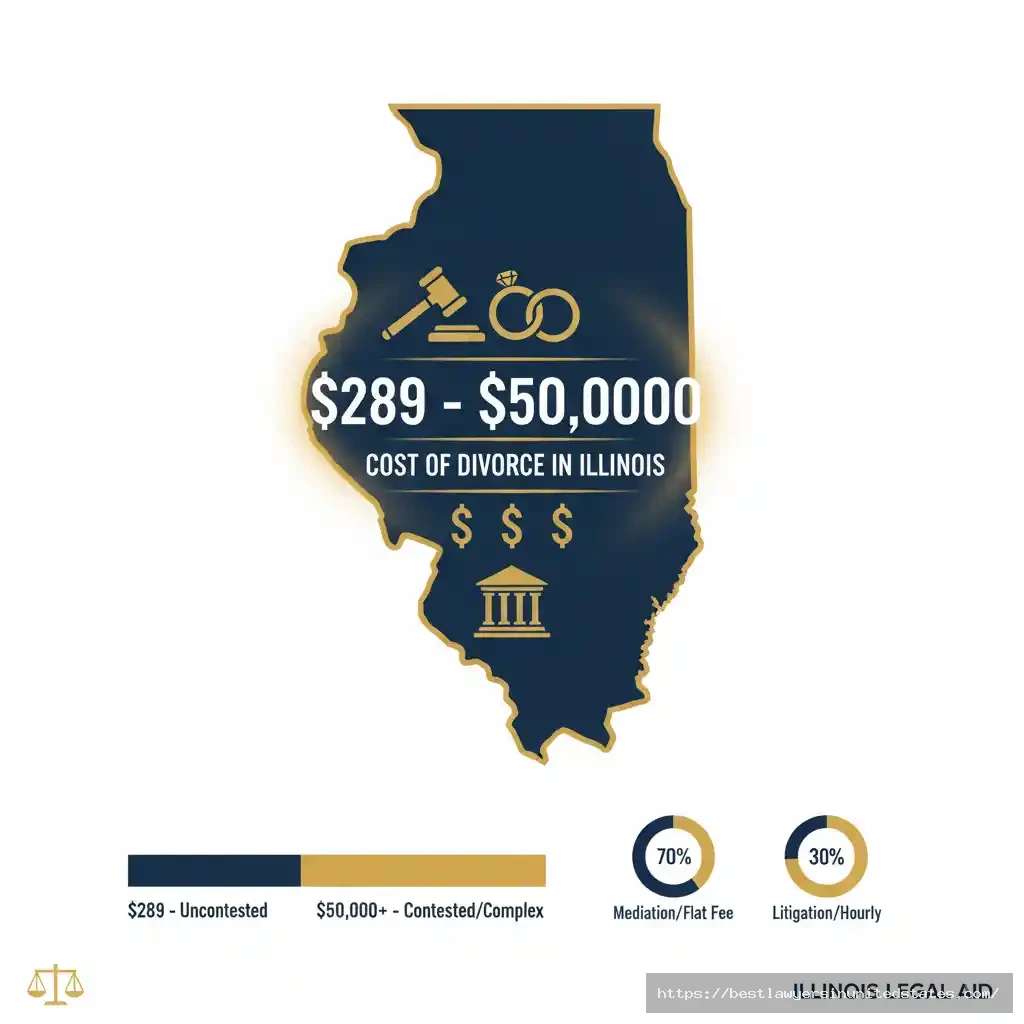
But your situation isn’t “average,” and that range is useless without context. This guide breaks down every expense you’ll face, gives you real county-specific numbers, and shows you exactly where your case falls on the cost spectrum.
What’s the Bottom Line? Illinois Divorce Cost by Type
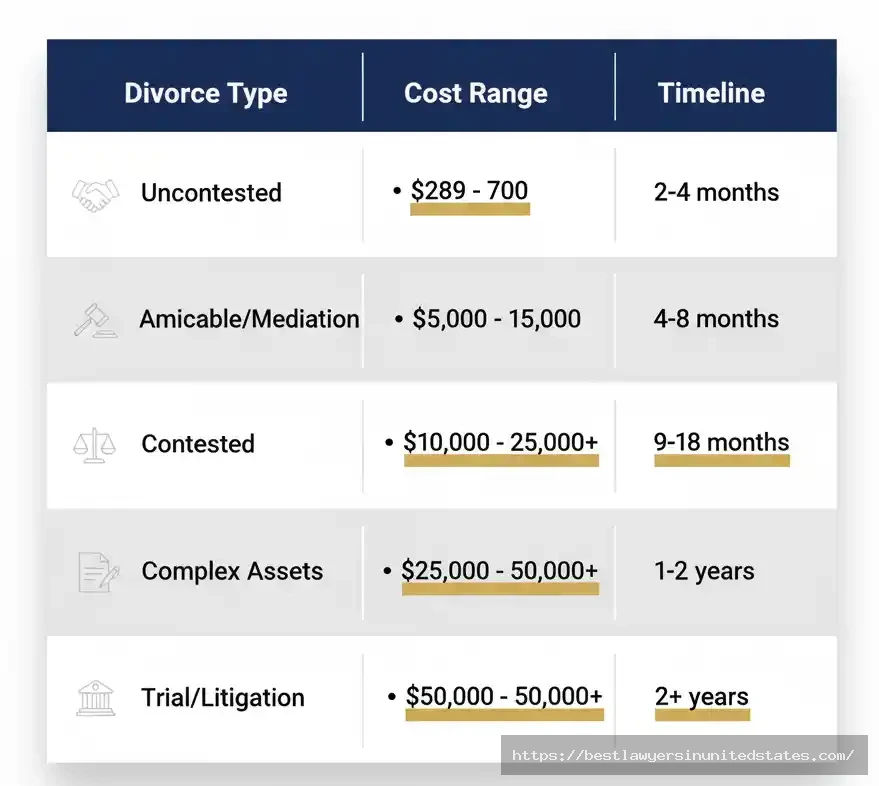
Here’s what you’re actually looking at, depending on your situation:
| Divorce Type | Total Cost Range | Timeline |
|---|---|---|
| DIY Uncontested (no kids, simple assets) | $289 – $500 | 6-9 months |
| Uncontested with Attorney | $1,500 – $5,000 | 6-12 months |
| Mediated Divorce | $3,000 – $8,000 | 6-12 months |
| Contested (moderate complexity) | $15,000 – $25,000 | 12-24 months |
| High-Conflict Contested (trial, experts) | $25,000 – $50,000+ | 18-36 months |
Why such a big range? Three factors drive the cost: whether you agree on terms, how complex your finances are, and whether you hire professionals.
How Much Does It Cost to File for Divorce in Illinois?
Before anything else happens, you’re paying a filing fee to the court. This isn’t negotiable unless you qualify for a fee waiver (we’ll cover that shortly).
Statewide average: $289-$388

But Illinois counties set their own fees. Here’s what you’ll actually pay in the state’s largest counties:
| County | Filing Fee (2025) | Population Rank |
|---|---|---|
| Cook County | $388 | #1 |
| DuPage County | $337 | #2 |
| Lake County | $337 | #3 |
| Will County | $327 | #4 |
| Kane County | $312 | #5 |
| McHenry County | $312 | #6 |
| Madison County | $289 | #7 |
Cook County note: You’re filing at the Richard J. Daley Center (50 W. Washington St., Chicago) if you live in Chicago or most Cook County suburbs. The $388 fee covers your Petition for Dissolution of Marriage filing.
If you and your spouse both file separate petitions (uncommon but it happens), you’re each paying the full fee. Most couples avoid this by having one person file and the other respond (which has no fee if uncontested).
Can’t afford the filing fee? Keep reading—fee waivers can reduce this to $0 if you qualify.
What Do Illinois Divorce Attorneys Actually Charge?
This is where costs diverge dramatically. Some people spend nothing on attorneys. Others spend $40,000+.
Retainer Fees: What You Pay Upfront
Most divorce attorneys in Illinois work on retainer. Think of it like a deposit—you pay upfront, and the attorney bills against it as they work.
Typical retainer ranges:
- Uncontested divorce: $1,500 – $3,000
- Contested divorce: $3,000 – $7,500
- High-conflict/complex cases: $10,000 – $15,000
The retainer doesn’t mean that’s your total cost. It’s just the starting amount. If your case takes 20 hours and the attorney charges $300/hour, you’ve used $6,000 of a $5,000 retainer—you’ll owe another $1,000.
If you don’t use the full retainer, you get the unused portion back. If you exceed it, you’ll be asked to replenish.
Hourly Rates: The Real Cost Driver
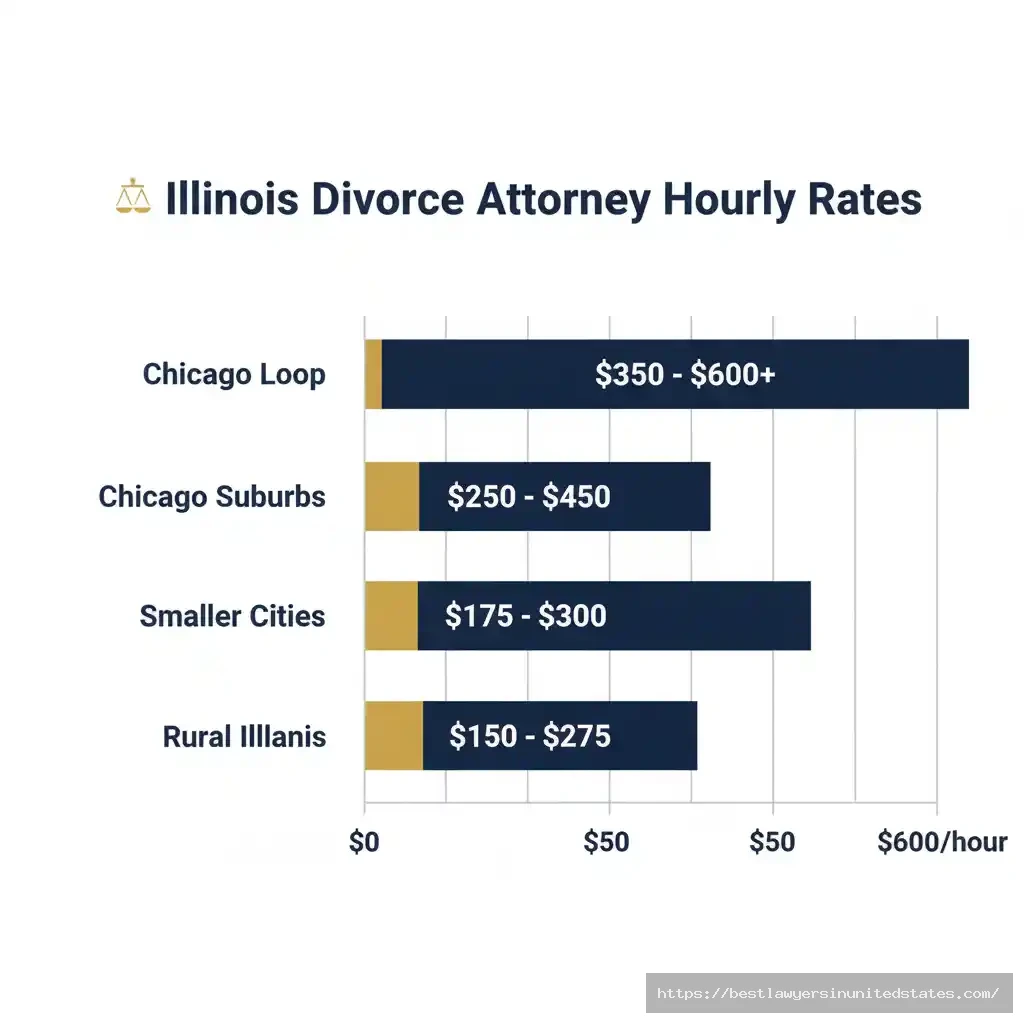
Illinois divorce attorneys typically charge by the hour. Rates vary wildly by location and experience:
| Region | Hourly Rate Range |
|---|---|
| Chicago (downtown/Loop) | $350 – $600/hour |
| Chicago suburbs (North Shore, Naperville) | $300 – $450/hour |
| Smaller cities (Peoria, Springfield, Rockford) | $200 – $325/hour |
| Rural Illinois | $175 – $275/hour |
What burns through hours fast?
- Court hearings (2-4 hours minimum per appearance)
- Discovery disputes (subpoenas, depositions, document requests)
- Trial preparation (10-20 hours for a 2-day trial)
- Emails and phone calls with opposing counsel
- Revising settlement agreements multiple times
Reality check: A “simple” contested divorce where you can’t agree on one asset can still rack up $10,000-$15,000 in attorney fees if it drags on for 12 months.
Flat-Fee Divorce: When It Makes Sense
Some Illinois attorneys offer flat-fee packages for uncontested divorces only. You’ll see offers like:
- “Uncontested divorce: $1,500 flat fee”
- “Simple dissolution package: $2,500 all-inclusive”
What’s typically included:
- Drafting and filing the Petition for Dissolution
- One Marital Settlement Agreement (MSA)
- Appearance at the final prove-up hearing
What’s NOT included:
- Court filing fees (you pay separately)
- Service of process costs
- Any contested issues that arise
- Modifications after the decree is entered
Flat fees work if you’ve already agreed on everything: custody, property division, support. The moment disagreement enters the picture, you’re switching to hourly billing.
For a comprehensive breakdown of attorney fee structures, see our complete guide to divorce lawyer costs.
How Much Does an Uncontested Divorce Cost in Illinois?
An uncontested divorce means you and your spouse agree on everything: division of property, custody arrangements (if you have kids), child support, and spousal maintenance.
Total cost breakdown:
| Expense | Cost |
|---|---|
| Court filing fee | $289 – $388 (varies by county) |
| Attorney (flat fee package) | $1,500 – $3,500 |
| Service of process | $0 (if spouse accepts service) or $50-$100 (sheriff/process server) |
| Total with attorney | $1,839 – $3,988 |
DIY uncontested (no attorney): Just the filing fee ($289-$388) if you complete all paperwork yourself using Illinois Legal Aid forms.
Timeline: Even when uncontested, Illinois has a mandatory waiting period. From the date your spouse is served or appears, you must wait at least 30 days before the court can finalize your divorce. Realistically, most uncontested cases take 6-9 months due to court scheduling.
When uncontested makes sense:
- You’ve been married less than 10 years
- No significant retirement accounts or real estate
- No minor children, or you’ve already agreed on custody
- Both parties are employed and self-sufficient
What Does a Contested Divorce Cost in Illinois?
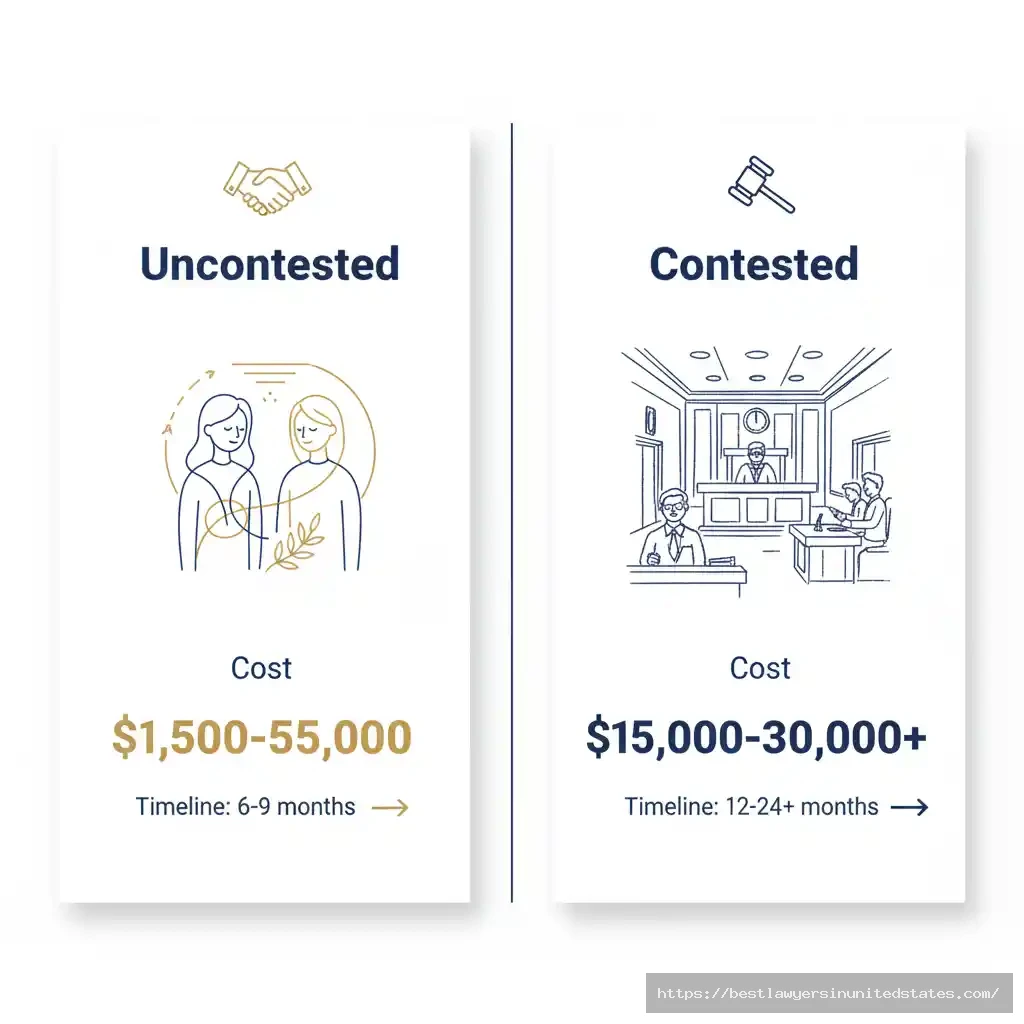
Contested means you can’t agree on one or more major issues: property division, custody, support amounts, or even whether to divorce at all (though Illinois is a no-fault state, so the latter is rare).
Average contested divorce cost: $15,000 – $30,000
But “contested” is a spectrum. Some couples disagree on one issue and settle after mediation ($8,000-$12,000 total). Others fight over everything and go to trial ($35,000-$50,000+ each).
What Makes a Contested Divorce Expensive?
1. Discovery Process
Your attorney needs to find out what assets your spouse has, especially if you suspect hidden money. This involves:
| Discovery Tool | Purpose | Typical Cost |
|---|---|---|
| Interrogatories | Written questions under oath | Included in attorney fees |
| Requests for Production | Demanding financial documents | Included in attorney fees |
| Depositions | In-person questioning, transcribed | $500-$1,500 per deposition |
| Subpoenas | Forcing third parties (banks, employers) to provide records | $100-$300 per subpoena |
If your spouse owns a business or has complex investments, discovery alone can cost $5,000-$10,000.
2. Expert Witnesses
Certain issues require outside professionals:
- Business valuations: $5,000 – $15,000 (if one spouse owns a company)
- Real estate appraisals: $400 – $600 per property
- Forensic accountants: $3,000 – $10,000 (to trace hidden assets or dissipated funds)
- Vocational evaluators: $2,000 – $5,000 (to assess earning capacity for support calculations)
- Child custody evaluators: $3,000 – $8,000 (psychologists who assess best interests of children)
3. Trial Costs
If you can’t settle and your case goes to trial, expect:
- Trial preparation: 15-30 attorney hours ($4,500-$15,000)
- Court reporter: $500-$1,000 per day
- Exhibit preparation: $500-$1,500
- Expert witness testimony fees: $1,500-$3,000 per expert per day
Most trials last 1-3 days. A 2-day trial can easily add $10,000-$20,000 to your bill.
4. Motions and Court Hearings
Every time your attorney goes to court, you’re paying. Common contested case hearings:
- Temporary orders hearing (custody, support during divorce): 4-6 hours prep + hearing
- Emergency motions: 2-3 hours minimum
- Status conferences: 1-2 hours
At $300/hour, a single emergency motion hearing can cost $900-$1,800.
How Much Does Mediation Cost in Illinois?
Mediation is the middle ground: you hire a neutral third party (often a family law attorney or retired judge) to help you negotiate a settlement.
Mediator hourly rates: $150 – $400/hour
Total mediation cost: $1,500 – $5,000
You’ll typically need 3-6 mediation sessions, each lasting 2-3 hours. Both spouses split the mediator’s fee (so if the mediator charges $300/hour and you have a 3-hour session, each of you pays $450).
Why mediation saves money:
Instead of paying two attorneys to fight in court ($15,000-$30,000 combined), you’re paying one mediator and possibly two “consulting attorneys” who review the settlement but don’t litigate ($5,000-$8,000 combined).
When mediation works best:
- You can be in the same room civilly
- You’re willing to compromise
- No domestic violence or power imbalances
- Finances are disclosed (not hidden)
Many Illinois judges now require mediation before allowing contested cases to go to trial, especially for custody disputes.
What Other Costs Should I Expect in an Illinois Divorce?
The filing fee and attorney are the big ones, but here are hidden expenses that catch people off guard:
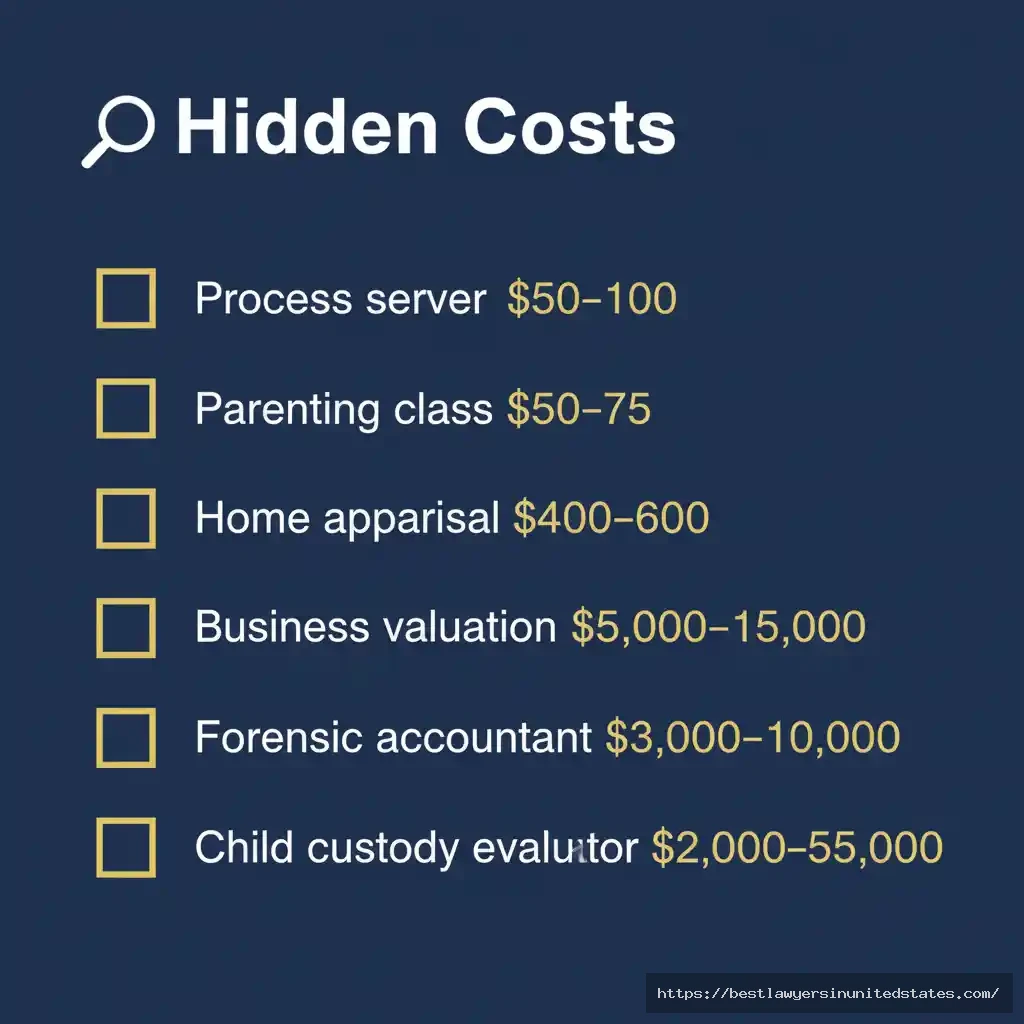
Mandatory Parenting Classes
If you have minor children, Illinois courts require both parents to complete an approved parenting education program before finalizing the divorce.
Cost: $50 – $75 per parent
Duration: 4 hours (usually online or one evening class)
This is non-negotiable. The court won’t sign your divorce decree without the completion certificate.
Service of Process
After you file your Petition, your spouse must be formally “served” with the papers.
Options:
- Sheriff service: $50-$75 (most common)
- Private process server: $75-$150 (faster, more reliable)
- Special process server (if spouse is avoiding service): $200-$500+
If your spouse accepts service voluntarily (signs an Acceptance of Service form), this costs $0.
Home Appraisal
If you own real estate and can’t agree on its value, you’ll need an appraisal.
Cost: $400 – $650 for a standard single-family home
If you have multiple properties or commercial real estate, multiply accordingly.
QDRO Preparation (Retirement Account Splitting)
If you’re dividing a 401(k), pension, or other retirement account, you need a Qualified Domestic Relations Order (QDRO).
Attorney fee to draft QDRO: $500 – $1,500
Plan administrator processing fee: $200 – $500
QDROs are complex legal documents. Getting it wrong can cost you thousands in taxes and penalties. Don’t DIY this.
Post-Divorce Modifications
The divorce doesn’t always end at the decree. If circumstances change, you might need to modify:
- Child support amounts
- Custody arrangements
- Spousal maintenance
Modification petition: $1,500 – $5,000 in attorney fees (if uncontested)
Contested modification: $5,000 – $15,000+
Can I Get a Divorce in Illinois Without a Lawyer?
Yes. Illinois allows “pro se” (self-represented) divorce. You’ll handle all paperwork, filings, and court appearances yourself.
When DIY makes sense:
- Short marriage (under 5 years)
- No children
- Minimal assets (no real estate, small retirement accounts)
- Both parties agree on everything
- No domestic violence or safety concerns
Where to get forms: Illinois Legal Aid Online provides free, court-approved forms for uncontested divorces.
Step-by-Step: Filing for Divorce in Illinois Without a Lawyer
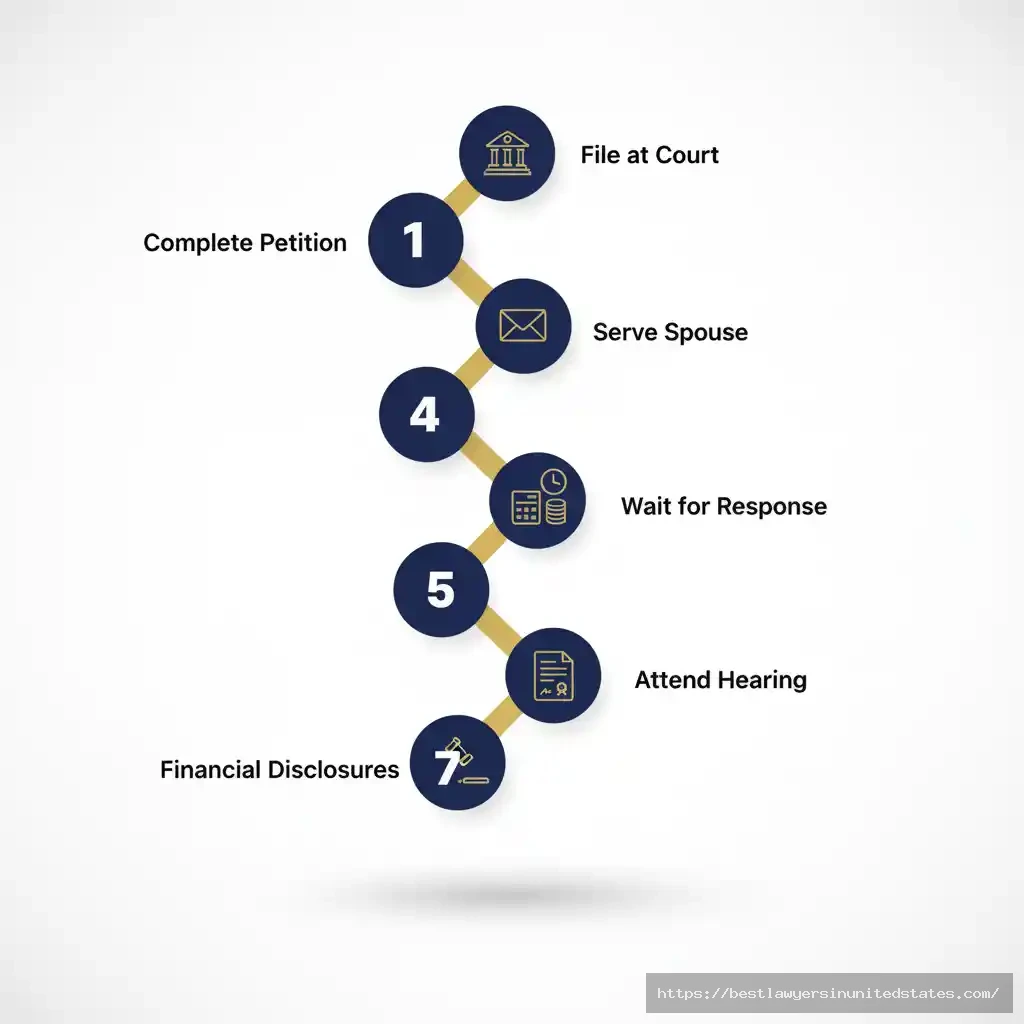
Step 1: Complete the Petition for Dissolution of Marriage
This is your main filing document. You’ll need to include:
- Your name, spouse’s name, and marriage date
- Statement that you’ve lived in Illinois for 90+ days
- Statement of irreconcilable differences
- Your requests (custody, property division, support)
Step 2: File at Your County Circuit Court
Take your completed Petition to the Circuit Clerk in the county where you or your spouse lives. Pay the filing fee ($289-$388).
Step 3: Serve Your Spouse
You cannot hand-deliver the papers yourself. Options:
- Sheriff’s office ($50-$75)
- Private process server ($75-$150)
- Your spouse signs an Acceptance of Service (free)
Step 4: Wait for Response
Your spouse has 30 days to file a response. If they don’t respond, you can proceed with a default divorce.
Step 5: Complete Financial Disclosures
Both parties must exchange:
- Financial Affidavit
- Statement of Assets and Liabilities
- Tax returns (last 3 years)
Step 6: Draft Marital Settlement Agreement (MSA)
This document outlines how you’re dividing everything. Templates are available through Illinois Legal Aid, but they require customization.
Step 7: Attend Final Prove-Up Hearing
After the 30-day waiting period, the court schedules a brief hearing (10-15 minutes) where the judge reviews your agreement and signs the divorce decree.
Total DIY time investment: 20-40 hours (research, paperwork, court appearances)
Red Flags: When You Should NOT Go Pro Se
⚠️ Your spouse hired an attorney. You’re now at a massive disadvantage. They have someone who knows the rules; you’re guessing.
⚠️ You own a home together. Property division with real estate involves deeds, title transfers, and equity calculations. Mistakes here can cost you tens of thousands.
⚠️ Either spouse has a pension or 401(k) over $50,000. Retirement account division requires a QDRO. DIY QDROs get rejected by plan administrators 60-70% of the time.
⚠️ You have minor children and can’t agree on custody. Child custody disputes are emotionally charged and legally complex. Courts scrutinize these heavily.
⚠️ You suspect your spouse is hiding assets. You need discovery tools (subpoenas, depositions) that only attorneys can effectively use.
⚠️ There’s domestic violence. Your safety comes first. Legal aid organizations offer free representation in DV cases.
Smart middle ground: Pay an attorney $300-$500 for a consultation to review your documents before you file. This isn’t full representation, but it catches expensive mistakes.
How Do I File for Divorce in Cook County, Illinois?
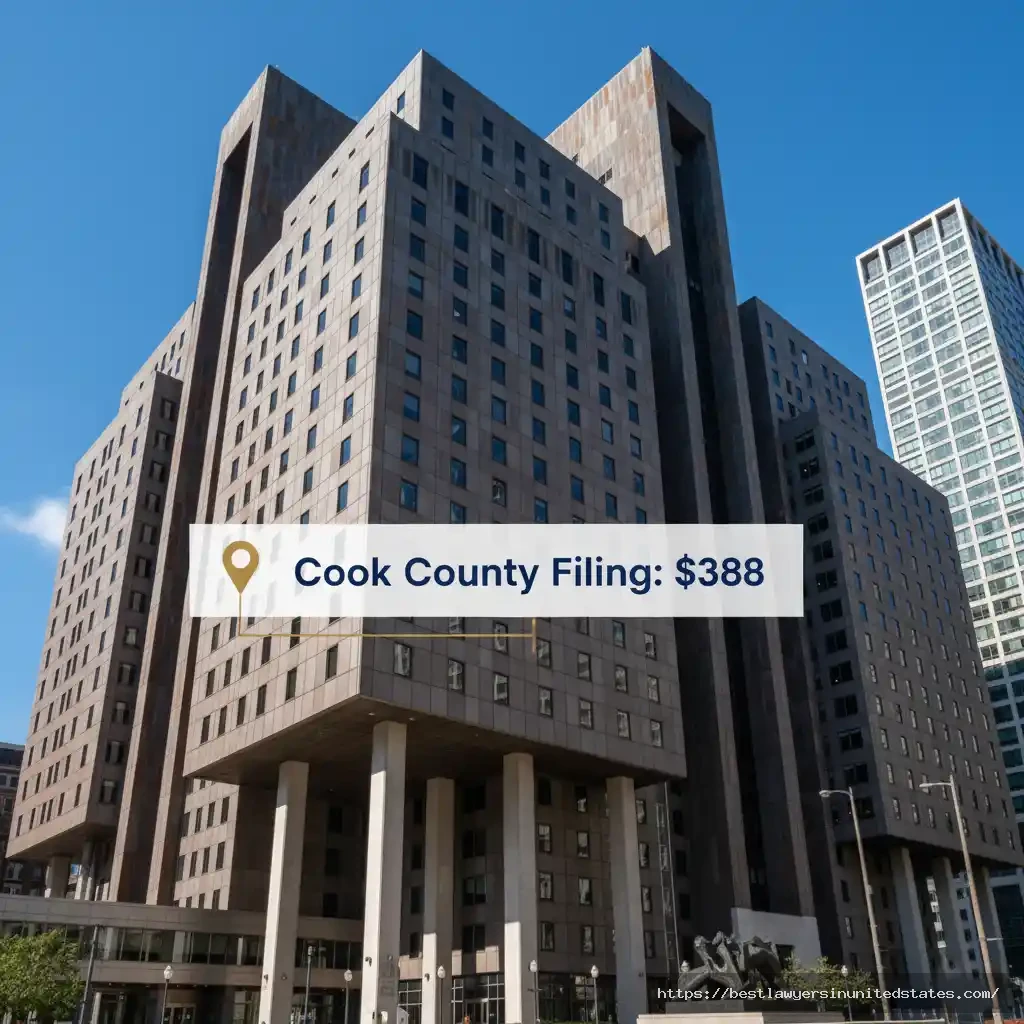
Cook County is Illinois’s largest county (home to Chicago) and handles more divorces than any other jurisdiction in the state.
Where to file: Richard J. Daley Center, 50 W. Washington St., Chicago, IL 60602
Filing fee: $388
Cook County-Specific Details
Online filing available: Cook County uses an e-filing system. You can file your Petition electronically through the Illinois e-file portal (though first-time pro se filers often find this confusing—in-person filing is simpler).
Courtroom assignment: After filing, your case is assigned to a specific judge and courtroom. Check your case number online at cookcountyclerkofcourt.org.
Self-help resources: Cook County has a Self-Help Center at the Daley Center (Room 602) where court staff (not attorneys) can answer procedural questions. They cannot give legal advice, but they can explain how to fill out forms.
Average processing time: Uncontested divorces in Cook County take 6-12 months from filing to final decree, depending on court backlog.
Expedited hearings: If there’s domestic violence, you can request an emergency Order of Protection, which typically gets a hearing within 14-21 days.
What If I Can’t Afford a Divorce in Illinois?
Financial stress doesn’t mean you’re trapped in a marriage. Illinois has several affordability options.
Fee Waivers: How to Qualify
If paying the $289-$388 filing fee would cause financial hardship, you can request a fee waiver.
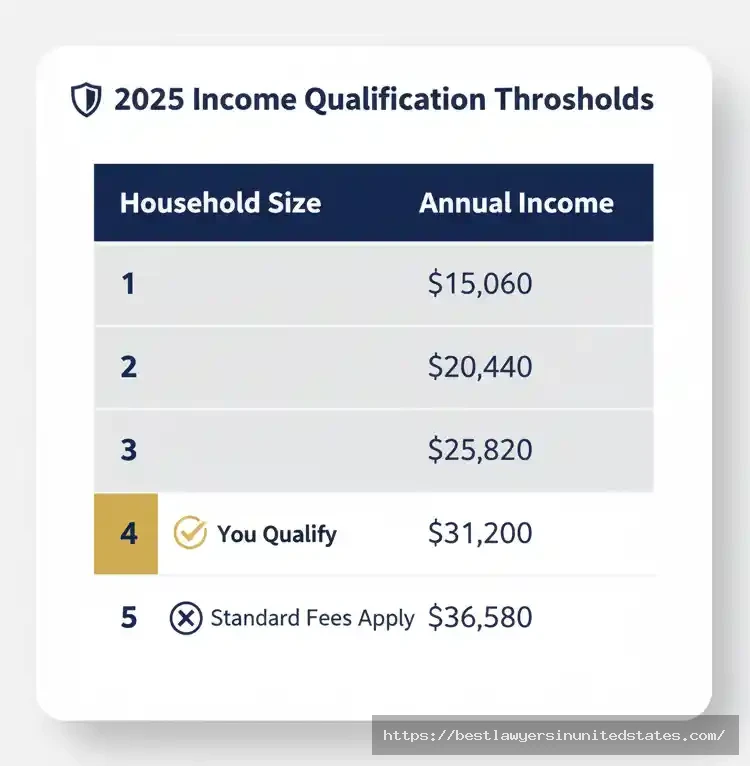
Who qualifies:
- You receive public assistance (SNAP, Medicaid, SSI, TANF)
- Your household income is at or below 138% of the federal poverty level
- You can demonstrate that paying the fee would prevent you from affording necessities (rent, food, utilities)
2025 Income thresholds for automatic qualification (138% of poverty level):
| Household Size | Annual Income |
|---|---|
| 1 person | $20,783 |
| 2 people | $28,207 |
| 3 people | $35,631 |
| 4 people | $43,055 |
| 5 people | $50,479 |
How to apply:
- Complete the Application for Waiver of Court Fees (form available at the Circuit Clerk’s office or online)
- File it at the same time you file your Petition for Dissolution
- The judge reviews it (usually within 7-14 days)
- If approved, you pay $0 for filing and other court costs (service of process, certified copies, etc.)
Important: A fee waiver doesn’t cover attorney fees. It only waives court costs.
Legal Aid Organizations in Illinois
If you can’t afford an attorney, these organizations provide free or low-cost legal help:
Prairie State Legal Services
Serves low-income residents in central and southern Illinois
www.pslegal.org
Income limit: Generally 125% of federal poverty level
Land of Lincoln Legal Aid
Serves 65 counties in central and southern Illinois
www.lincolnlegal.org
Legal Aid Chicago
Serves Cook County residents
www.legalaidchicago.org
Cabrini Green Legal Aid
Focuses on family law, including divorce and custody
www.cgla.net
What they offer:
- Free consultations
- Full representation in some cases (domestic violence, cases with children)
- “Unbundled” limited-scope representation (attorney handles specific parts of your case)
- Workshops on completing paperwork
Eligibility: Most programs serve households at or below 125-200% of the federal poverty level. If you’re working full-time at minimum wage, you likely qualify.
Law School Clinics
Several Illinois law schools operate family law clinics where law students handle cases under attorney supervision.
DePaul University College of Law – Family Law Clinic
Chicago
Free representation for low-income Cook County residents
University of Illinois College of Law – Family Law Clinic
Champaign
Serves Champaign County residents
Loyola University Chicago School of Law – ChildLaw Clinic
Focuses on child custody and support issues
Students work slower than private attorneys, but the quality is high (heavily supervised by experienced professors). Cases can take 12-18 months.
Payment Plans with Private Attorneys
Some Illinois family law attorneys offer payment plans, especially for middle-income clients who earn too much for legal aid but can’t afford a large retainer.
Typical arrangement:
- Initial retainer: $1,000-$2,500
- Monthly payments: $200-$500 until balance is paid
Not all attorneys offer this, but it doesn’t hurt to ask during consultations. Be upfront about your financial situation.
Who Pays for the Divorce in Illinois?
Default rule: Each spouse pays their own attorney fees and shares court costs.
But Illinois law allows judges to order one spouse to contribute to the other’s attorney fees if there’s a significant income disparity.
When the Court Orders Fee Contributions
Illinois courts consider:
- Income and property of each party
- Reasonableness of the attorney fees
- Whether one party unnecessarily prolonged the case
Example scenario:
Spouse A earns $180,000/year and has $400,000 in separate property.
Spouse B is a stay-at-home parent with no income.
The court might order Spouse A to pay $5,000-$10,000 toward Spouse B’s attorney fees so both parties can afford competent representation.
When it’s denied:
If both spouses have similar incomes and assets, you’re each paying your own way.
How Can I Reduce the Cost of My Illinois Divorce?
You’re not powerless here. Strategic choices can save you $10,000-$20,000.
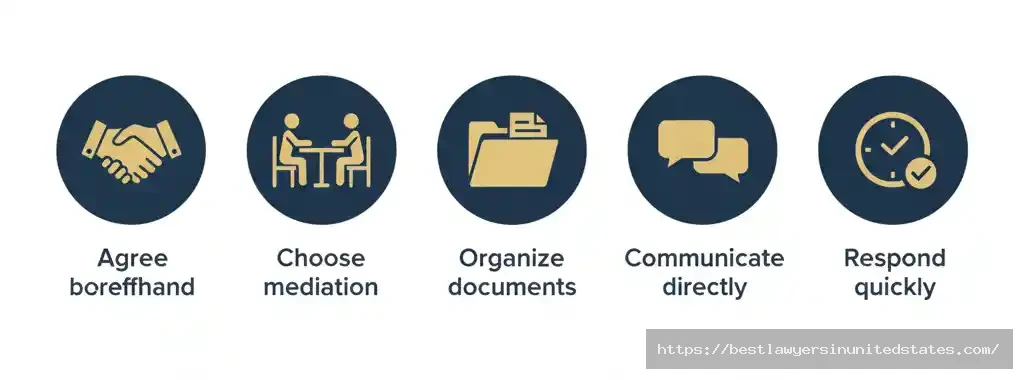
✅ Agree on the Major Issues Before Filing
Every hour your attorneys spend negotiating is billable. If you and your spouse can have calm conversations and agree on custody, property division, and support before hiring attorneys, you’re converting a contested divorce into an uncontested one.
What this saves: $10,000-$25,000
✅ Choose Mediation Over Litigation
Mediation costs $1,500-$5,000 total (split between both parties). Litigation costs $15,000-$30,000 per person.
Even if mediation doesn’t resolve everything, settling 80% of issues through mediation and litigating the remaining 20% is far cheaper than fighting over 100%.
✅ Organize Your Financial Documents Yourself
Attorneys charge $300-$500/hour. Don’t pay them to dig through your filing cabinet.
Before your first meeting, gather:
- Last 3 years of tax returns
- Recent pay stubs
- Bank statements (last 12 months)
- Mortgage statements
- Credit card statements
- Retirement account statements (401(k), IRA, pension)
- Vehicle titles
- Deed to your home
Put everything in a labeled folder (physical or digital). This saves 5-10 billable hours ($1,500-$5,000).
✅ Communicate Directly When Possible
If you can email or text your spouse about scheduling, minor decisions, or exchanging documents, do it. Don’t route every communication through attorneys.
Example of unnecessary attorney involvement:
You: Email to attorney asking them to ask opposing counsel if you can swap weekends with the kids.
Your attorney: Emails opposing counsel ($0.3 hours).
Opposing counsel: Emails your spouse ($0.3 hours).
Your spouse: Emails back yes ($0.3 hours).
Opposing counsel: Emails your attorney ($0.3 hours).
Your attorney: Emails you ($0.3 hours).
Total cost for a simple scheduling swap: $450 (1.5 hours × $300/hour × 2 attorneys)
Better approach: Text your spouse directly: “Can we swap weekends?” Total cost: $0.
Obviously, this doesn’t work in high-conflict cases, but if you can manage logistical conversations directly, do it.
✅ Respond to Your Attorney Quickly
Every time your attorney has to follow up with you (“Did you find those bank statements I asked for?”), you’re getting billed.
Set reminders. Return calls and emails within 24 hours. Provide requested documents immediately.
What this saves: 2-5 hours of administrative back-and-forth ($600-$2,500)
✅ Avoid Unnecessary Court Motions
Every motion your attorney files triggers a court hearing and opposing counsel’s response.
Before filing a motion, ask: “Is this necessary, or can we resolve this another way?”
Example of avoidable motion: Filing an emergency motion to modify parenting time by 2 hours. Cost: $1,500-$3,000. Better approach: Discuss with your co-parent first.
When Will I Actually Pay? Divorce Cost Timeline
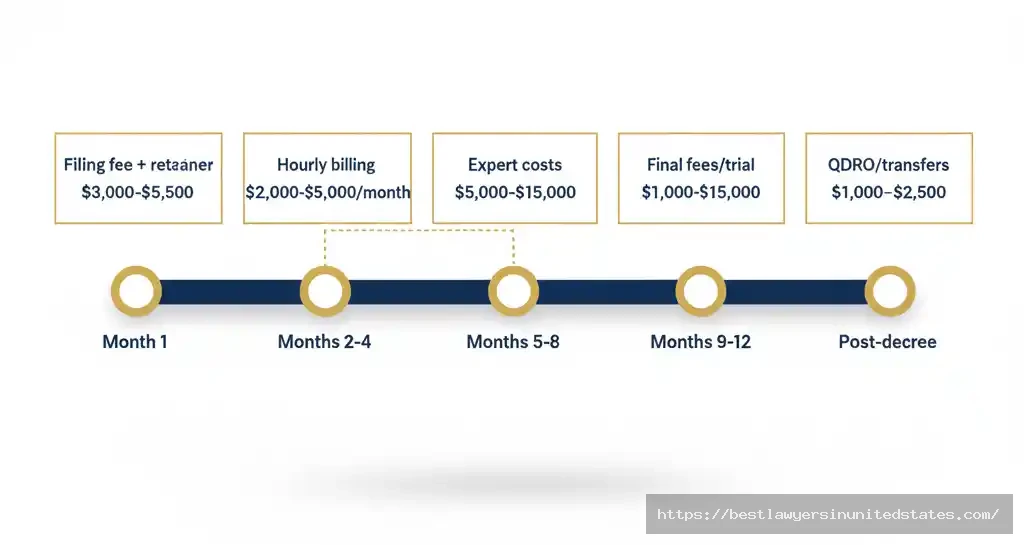
Costs don’t hit all at once. Here’s the typical payment schedule:
Month 1: Initial Costs
- Court filing fee: $289-$388 (paid when filing)
- Attorney retainer: $2,500-$5,000 (paid before work begins)
- Service of process: $50-$100
Months 2-4: Discovery and Negotiation
- Attorney draws down retainer (hourly billing)
- If you exhaust retainer, you’ll be asked to replenish ($2,000-$5,000 additional)
- Discovery costs (depositions, subpoenas): $500-$2,000
Months 5-8: Expert Costs (if applicable)
- Home appraisal: $400-$600
- Business valuation: $5,000-$15,000 (paid to expert directly)
- Custody evaluation: $3,000-$8,000 (paid to evaluator)
Months 9-12: Trial Preparation or Settlement
- If settling: Final attorney bill (usually $1,000-$3,000 remaining)
- If going to trial: Additional $5,000-$15,000 in trial prep and court time
Post-Decree (Months 12+)
- QDRO preparation: $700-$2,000
- Deed transfer (if transferring real estate): $300-$500
- Any post-decree modifications: $1,500+ per issue
Payment strategy: Most people use a combination of savings, credit cards, and family loans. Some attorneys accept credit cards (though 3% processing fees apply). Avoid using retirement accounts to fund your divorce—early withdrawals trigger 10% penalties plus income tax.
Real Cost Examples: 3 Illinois Divorce Scenarios
Let’s make this concrete with real-world examples.
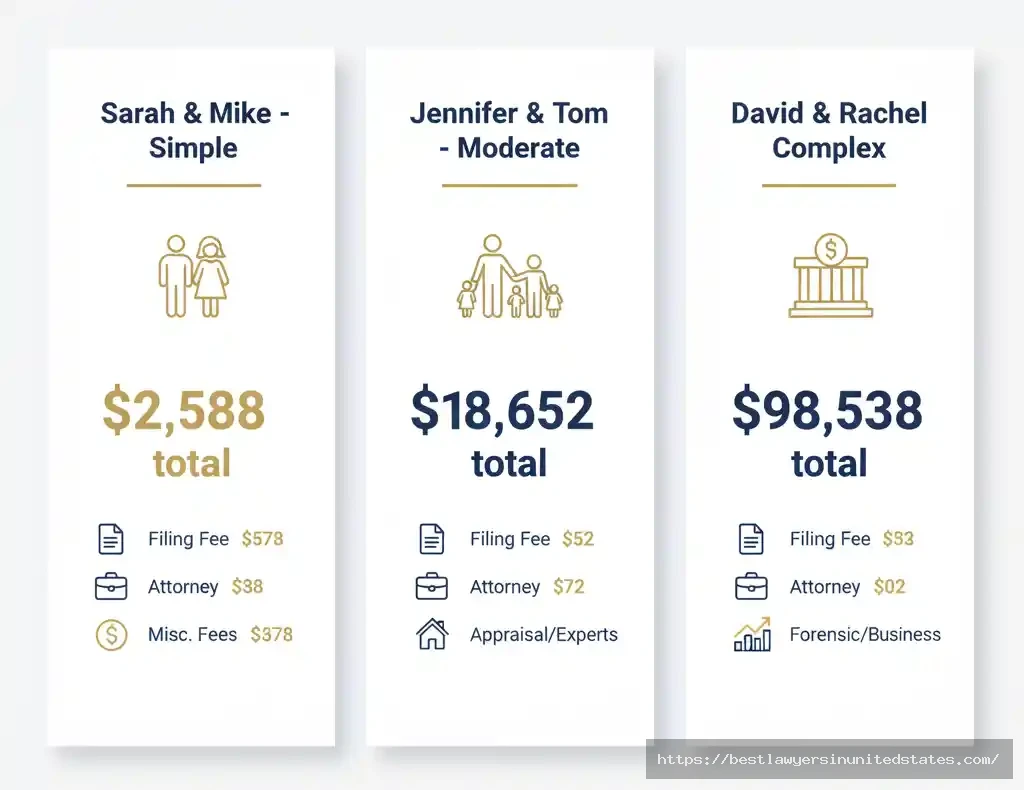
Scenario 1: Sarah & Mike – Simple Uncontested Divorce
Background:
- Married 4 years, no children
- Rent an apartment (no real estate)
- Each has their own car (owned outright)
- Small 401(k) accounts (less than $20,000 each)
- Both employed with similar incomes ($45,000-$50,000/year)
- Agree on everything
Cost breakdown:
| Expense | Cost |
|---|---|
| Cook County filing fee | $388 |
| Flat-fee attorney (uncontested package) | $2,200 |
| Service of process (spouse accepted service) | $0 |
| Total | $2,588 |
Timeline: 7 months from filing to final decree
Why it was cheap: No disagreements, no kids, minimal assets. Attorney drafted the Petition and Marital Settlement Agreement, appeared at the prove-up hearing, and that was it.
Scenario 2: Jennifer & Tom – Moderate Contested Divorce
Background:
- Married 12 years, two children (ages 8 and 10)
- Own a home worth $350,000 with $200,000 mortgage
- Tom has a 401(k) worth $120,000
- Jennifer paused career to raise kids, now works part-time ($28,000/year)
- Tom earns $95,000/year
- Disagree on custody schedule and spousal support amount
Cost breakdown (Jennifer’s side):
| Expense | Cost |
|---|---|
| DuPage County filing fee | $337 |
| Initial attorney retainer | $5,000 |
| Additional attorney fees (30 hours at $325/hour) | $9,750 |
| Mediation (4 sessions, split cost) | $1,800 |
| Home appraisal | $500 |
| Parenting class | $65 |
| QDRO preparation | $1,200 |
| Jennifer’s Total | $18,652 |
Tom’s cost: Similar, around $16,000 (he needed less attorney time since he had more organized finances)
Timeline: 14 months from filing to final decree
Why it cost more: Custody disputes require more negotiation. Mediation helped them avoid trial, but they still needed substantial attorney involvement. The home and 401(k) required professional valuations and a QDRO.
Silver lining: By using mediation instead of going to trial, they saved an estimated $15,000-$20,000 each.
Scenario 3: David & Rachel – High-Conflict Contested Divorce
Background:
- Married 18 years, three children (ages 6, 10, 14)
- Own a home worth $625,000 with $300,000 mortgage
- David owns a small business (medical practice)
- Rachel worked in the business but wasn’t on payroll (now claiming hidden income)
- Combined retirement accounts: $450,000
- David moved out and got a separate attorney immediately
- High conflict—accused each other of hiding assets and parental alienation
Cost breakdown (David’s side):
| Expense | Cost |
|---|---|
| Cook County filing fee | $388 |
| Initial attorney retainer | $10,000 |
| Additional attorney fees (120 hours at $400/hour) | $48,000 |
| Forensic accountant (to value business) | $12,000 |
| Business valuation expert | $8,500 |
| Child custody evaluator | $6,500 |
| Home appraisal | $550 |
| Depositions (3 depositions) | $2,100 |
| Trial costs (2-day trial) | $8,000 |
| QDRO preparation (2 accounts) | $2,500 |
| David’s Total | $98,538 |
Rachel’s cost: Approximately $85,000 (she had a slightly lower hourly rate but similar hours)
Timeline: 26 months from filing to final decree
Why it was so expensive: Business ownership requires forensic accounting and valuation experts. Custody disputes triggered a $6,500 evaluation. Discovery involved multiple depositions. The case went to a 2-day trial. Every step was contested.
Could it have been avoided? If they’d gone to mediation early and agreed to use a jointly-hired business valuator, they might have settled for $30,000-$40,000 each. But emotions ran too high.
What Are the Hidden Costs of Divorce That Nobody Warns You About?
Beyond filing fees and attorneys, watch for these expenses:
Lost work time: Taking days off for court hearings, mediation sessions, and meetings with attorneys. If you’re hourly, this is direct lost income.
Moving costs: If one spouse moves out, expect $1,500-$5,000 for movers, security deposits, utility hookups, and furnishing a new place.
Refinancing the home: If one spouse keeps the house and needs to refinance to remove the other from the mortgage, closing costs run $3,000-$7,000.
Health insurance: If you’re on your spouse’s employer health plan, you’ll lose coverage after the divorce. COBRA continuation is expensive ($600-$1,200/month for family coverage). Individual marketplace plans vary.
Tax consequences: Divorce changes your filing status. You might lose tax credits or deductions. Consult a CPA before finalizing your settlement.
Credit score impact: If joint debts aren’t paid on time during the divorce, both credit scores suffer. Missed mortgage payments drop scores by 100+ points.
Therapist or counselor: Divorce is emotionally brutal. Many people see a therapist during the process ($100-$200/session, often weekly for 6-12 months = $2,400-$9,600).
Post-decree enforcement: If your ex doesn’t follow the divorce decree (doesn’t pay support, withholds parenting time), you’ll need to file a Petition for Rule to Show Cause or Contempt. Attorney fees: $1,500-$5,000.
Budget for these hidden costs: Add 15-20% to your estimated divorce cost to cover surprise expenses.
How Does a Divorce Cost Calculator Work?
A divorce cost calculator helps you estimate your total expenses based on your specific situation.
Divorce Cost Calculator
Get an estimated cost for your divorce based on your specific situation
Your Estimated Divorce Cost
Cost Breakdown
📧 Get a Personalized Consultation
Have questions about your specific situation? Contact our legal experts for guidance tailored to your needs.
Contact Us via EmailMost calculators ask:
- Your county (determines filing fee)
- Contested or uncontested?
- Do you have children?
- Do you own real estate?
- Estimated complexity (simple, moderate, complex)
The calculator then estimates:
- Court filing fees
- Attorney fees (based on average regional rates and estimated hours)
- Additional costs (appraisals, experts, mediation)
Accuracy: These are estimates. Your actual costs depend on how cooperative your spouse is, how many assets you have, and whether you go to trial. But calculators give you a ballpark number for budgeting.
For a personalized estimate, use our Illinois Divorce Cost Calculator.
What’s the Cheapest Way to Get Divorced in Illinois?
If minimizing cost is your top priority, here’s the playbook:
1. File Pro Se (Represent Yourself)
Save $1,500-$50,000 in attorney fees by handling paperwork yourself. Only works if your divorce is truly uncontested and simple.
2. Apply for a Fee Waiver
If you qualify (income below 138% of poverty level or receiving public assistance), your $289-$388 filing fee drops to $0.
3. Use Free Legal Aid Resources
Organizations like Illinois Legal Aid Online provide free forms and instructions. Some even offer free consultations.
4. Have Your Spouse Accept Service
If your spouse signs an Acceptance of Service form, you avoid the $50-$100 sheriff fee.
5. Skip the Attorneys Entirely (If Possible)
If you and your spouse agree on everything and have no kids or complex assets, you can complete a divorce for just the filing fee.
Absolute minimum divorce cost in Illinois: $0 (with fee waiver) to $289 (smallest county filing fee)
Realistic minimum for most people: $289-$500
When cheap isn’t smart: If you have substantial assets (home, retirement accounts, business), paying $2,000-$5,000 for attorney guidance can save you $20,000-$50,000 in mistakes. Don’t be penny-wise and pound-foolish.
How Much Does It Cost to Get a Divorce in Illinois If Both Parties Agree?
When you both agree on everything—custody, property, support—you’re looking at an uncontested divorce.
Total cost if both parties agree:
| Scenario | Cost |
|---|---|
| DIY (no attorney) | $289 – $388 (filing fee only) |
| With flat-fee attorney | $1,500 – $3,500 + filing fee = $1,789 – $3,888 |
Timeline: 6-9 months minimum (Illinois requires a 30-day waiting period after service, but court scheduling usually stretches it to 6+ months)
What you’re agreeing on:
- How to divide all property and debts
- Custody schedule (if children)
- Child support amount
- Spousal maintenance (if applicable)
Pro tip: Even when you agree, having an attorney draft the Marital Settlement Agreement is smart. Vague language (“we’ll split the retirement accounts fairly”) causes problems later. An attorney ensures the decree is clear and enforceable.
For more context on national divorce costs, see our complete guide to divorce costs across the U.S.
What Factors Make an Illinois Divorce More Expensive?
Not all divorces cost the same. Here’s what drives up the bill:
🔴 Factor 1: Number of Disputed Issues
Each issue you can’t agree on adds $1,000-$5,000 in attorney fees.
- Custody dispute: +$5,000-$15,000
- Child support disagreement: +$1,000-$3,000
- Spousal maintenance fight: +$2,000-$8,000
- Property division battle: +$3,000-$10,000
🔴 Factor 2: Business Ownership
If either spouse owns a business, you need a professional valuation. The business’s income, expenses, and value must be determined for property division.
Business valuation cost: $5,000-$15,000
🔴 Factor 3: Retirement Accounts Over $100K
Dividing large retirement accounts requires a QDRO (Qualified Domestic Relations Order). If you have multiple accounts (401(k), pension, IRA), you need multiple QDROs.
QDRO cost: $700-$1,500 per account
🔴 Factor 4: Suspicion of Hidden Assets
If you believe your spouse is hiding money, your attorney will need to conduct extensive discovery:
- Subpoena bank records
- Hire a forensic accountant to trace funds
- Depose your spouse and third parties
Forensic accounting: $3,000-$10,000
🔴 Factor 5: High-Conflict Personalities
Some couples fight over everything—who gets the dishes, what time exchanges happen, whether the kids can have a dog. Attorneys call these “high-conflict” cases.
These divorces take 2-3x longer than normal contested cases and cost 2-3x as much.
🔴 Factor 6: Out-of-State Complications
If your spouse lives in another state, you’ll deal with:
- Service of process across state lines (more expensive)
- Coordinating court appearances (travel costs)
- Jurisdictional issues (which state’s laws apply?)
Add $2,000-$5,000 for out-of-state complications.
What Is Illinois’s New Divorce Law?
As of 2025, Illinois follows the Illinois Marriage and Dissolution of Marriage Act (750 ILCS 5/), which has been amended several times in recent years.
Key changes that affect cost:
1. Mandatory Mediation in Custody Cases
Many Illinois counties now require mediation before contested custody cases can go to trial. This is cost-neutral or slightly cost-saving, as mediation is cheaper than trial.
2. Spousal Maintenance Formula
Illinois uses a formula to calculate spousal maintenance (alimony) in cases where combined income is under $500,000/year:
(Payor’s gross income × 33.33%) – (Recipient’s gross income × 25%) = Annual maintenance
This reduces disputes over maintenance amounts, saving attorney time.
3. No-Fault Divorce Only
Illinois eliminated all fault-based grounds for divorce in 2016. You can no longer cite adultery, cruelty, or abandonment as reasons. The only ground is “irreconcilable differences.”
Cost impact: Slightly cheaper, as there’s no need to prove fault (no investigations, no evidence gathering).
Do I Have to Split My 401(k) in a Divorce in Illinois?
Yes, retirement accounts are marital property in Illinois and subject to division.
How Illinois divides retirement accounts:
Illinois follows “equitable distribution,” which means fair but not necessarily 50/50. Courts consider:
- Length of marriage
- Contributions each spouse made
- Each spouse’s economic circumstances
What gets divided:
Only the portion of the retirement account earned during the marriage is marital property.
Example:
You had $50,000 in your 401(k) when you got married. During the 10-year marriage, it grew to $200,000. The marital portion is $150,000. Your spouse would typically be entitled to 50% of that $150,000 = $75,000.
The pre-marital $50,000 is yours alone (separate property).
How division works:
You don’t withdraw cash and hand it over. That triggers taxes and penalties. Instead, the court issues a Qualified Domestic Relations Order (QDRO), which tells the 401(k) plan administrator to split the account.
Your spouse’s portion is transferred to their own retirement account (tax-free, no penalties if done correctly via QDRO).
QDRO cost: $700-$1,500 (attorney drafts it, plan administrator reviews and approves it)
Don’t skip this step: If your divorce decree says “each party keeps their own retirement accounts” but you actually have $200,000 and your spouse has $20,000, that’s not equitable distribution—and your spouse can come back later to enforce the division.
Is Illinois a 50/50 State for Divorce?
No. Illinois is an equitable distribution state, not a community property state.
What this means:
Property isn’t automatically split 50/50. Instead, the court divides marital property “equitably” (fairly), which might be 60/40, 70/30, or any split the judge deems fair.
Factors Illinois courts consider:
- Length of marriage
- Each spouse’s income and earning potential
- Contributions each spouse made (including homemaking)
- Age and health of each party
- Child custody arrangements
- Tax consequences of property division
- Dissipation of assets (if one spouse wasted money)
Common split: In long marriages (10+ years) with similar contributions, courts often land close to 50/50. In shorter marriages or where one spouse brought significant separate property, the split can be more uneven.
Separate property isn’t divided:
Property you owned before marriage, inheritances, and gifts remain yours (unless you commingled them with marital property).
Compare this to states like California or Texas, which follow stricter community property rules.
How Long Do You Have to Be Separated Before Divorce in Illinois?
You don’t have to be physically separated at all to file for divorce in Illinois.
Residency requirement: One spouse must have lived in Illinois for at least 90 days before filing.
Waiting period after filing: After your spouse is served (or appears in court), there’s a mandatory 30-day waiting period before the court can finalize the divorce.
“Separated” vs. “living apart”:
Illinois doesn’t require legal separation. You can live under the same roof during the divorce process (though it’s emotionally difficult).
Some couples file for Legal Separation (a separate legal process) instead of divorce if they’re not ready to end the marriage but want to divide property and set support terms. Legal separation costs are similar to divorce costs.
Timeline reality: Even uncontested divorces take 6-9 months in Illinois due to court scheduling. Contested divorces average 12-24 months.
Frequently Asked Questions
How much does it cost to get a divorce if both parties agree in Illinois?
If both parties agree on all terms (uncontested divorce), costs range from $289 (DIY, just the filing fee) to $3,888 (flat-fee attorney package + filing fee). Most people with an attorney pay $1,800-$3,500 total.
What is the cheapest way to file for divorce in Illinois?
Apply for a fee waiver if your income qualifies, then file pro se (represent yourself) using free forms from Illinois Legal Aid Online. Total cost: $0-$289. Only works if your case is simple and uncontested.
How much does a divorce cost without a lawyer in Illinois?
Without a lawyer, you pay only the court filing fee ($289-$388 depending on county) plus minor costs like service of process ($0-$100). Total: $289-$488. Only advisable for very simple uncontested divorces with no children or significant assets.
Do I need a lawyer to get a divorce in Illinois?
Legally, no—you can represent yourself. Practically, you should hire a lawyer if you have children, own a home, have retirement accounts over $50,000, or if your spouse hired a lawyer. Mistakes in property division or custody orders can cost far more than attorney fees.
How much does a divorce lawyer cost in Illinois?
Hourly rates range from $200-$600/hour depending on location and experience. Most divorces require 20-100 hours of attorney time. Average total cost: $15,000-$20,000 for a moderate contested case, $1,500-$3,500 for an uncontested flat-fee package.
How much does it cost to file for divorce in Cook County?
The filing fee in Cook County is $388 (highest in Illinois). You file at the Richard J. Daley Center in downtown Chicago. This fee can be waived if you qualify based on low income or public assistance receipt.
Who pays attorney fees in an Illinois divorce?
Typically, each spouse pays their own attorney. However, if there’s a large income disparity, the higher-earning spouse can be ordered to contribute to the other’s attorney fees to level the playing field.
Can I get a divorce if I can’t afford one?
Yes. Options include: (1) Apply for a fee waiver, (2) Use free legal aid services, (3) Represent yourself pro se, (4) Ask the court to order your spouse to contribute to your fees, or (5) Find an attorney who offers payment plans.
How much does a contested divorce cost in Illinois?
Contested divorces average $15,000-$30,000 per person but can exceed $50,000 if the case goes to trial or involves complex assets. The cost depends on how many issues are disputed and whether you settle or litigate.
How long does an Illinois divorce take?
Uncontested: 6-9 months minimum (30-day waiting period + court scheduling).
Contested: 12-24 months average.
High-conflict/trial cases: 18-36 months.
What is the 30-day rule in Illinois divorce?
After your spouse is served with divorce papers (or appears in court), you must wait at least 30 days before the court can enter a final divorce decree. This is a mandatory “cooling off” period required by Illinois law.
Do I have to go to court for an uncontested divorce in Illinois?
Yes, but only once for a brief “prove-up” hearing (10-15 minutes). The judge asks basic questions to confirm you meet residency requirements and have a valid settlement agreement, then signs the decree.
Can I get a free divorce in Illinois?
If you qualify for a fee waiver (income below 138% of poverty level or receiving public assistance) and represent yourself, your divorce costs $0. However, “free” doesn’t mean easy—you’re responsible for all paperwork and court procedures.
How much does mediation cost in Illinois?
Mediators charge $150-$400/hour. Most couples need 3-6 sessions (2-3 hours each). Total mediation cost: $1,500-$5,000, split between both spouses. Still far cheaper than litigation.
What happens to my house in an Illinois divorce?
Your home is marital property if purchased during the marriage. Options: (1) Sell and split proceeds, (2) One spouse buys out the other, or (3) One spouse keeps it and other assets are adjusted to balance the division. Requires appraisal ($400-$600) if value is disputed.
Next Steps: Getting Started with Your Illinois Divorce
You now know what to expect financially. Here’s how to move forward:
If your divorce is uncontested:
- Download free forms from Illinois Legal Aid Online
- Complete the Petition for Dissolution of Marriage
- File at your county circuit court
- Or hire an attorney for a flat-fee package ($1,500-$3,500)
If your divorce might be contested:
- Schedule consultations with 2-3 family law attorneys (most offer free 30-minute consultations)
- Ask about their experience with cases like yours
- Get fee estimates in writing
- Consider mediation before full litigation
If you can’t afford an attorney:
- Apply for a fee waiver when you file
- Contact legal aid organizations in your area
- Look into law school clinics
- Consider “unbundled” legal services (attorney handles specific tasks, you handle the rest)
Red flags to watch for:
- Your spouse suddenly moves money around
- Your spouse hires an aggressive attorney while you’re unrepresented
- You’re being pressured to sign documents you don’t understand
- You’re in a domestic violence situation
If any of these apply, get legal help immediately—even if it means borrowing money or maxing out credit cards. Bad divorce agreements follow you for decades.
Understanding Your Options Beyond Illinois
Divorce costs vary significantly by state. If you’re comparing what you might pay in Illinois versus where a spouse might file:
Each state has different filing fees, attorney rates, and property division rules.
Final Thoughts: What You Really Need to Know
Divorce in Illinois costs anywhere from $289 to $50,000+—but most people with moderate assets and some cooperation land between $8,000-$20,000 total.
The single biggest factor in your cost? Whether you can agree with your spouse. Every issue you fight over multiplies attorney hours and expenses.
Your smartest financial move: Try to settle. Mediate. Compromise on the things that don’t matter long-term. Save your fight (and money) for issues that truly impact your future—custody of kids, fair division of retirement accounts, adequate support.
And if you’re stuck in a high-conflict divorce watching bills pile up? You’re not alone. Thousands of Illinois couples navigate this every year. Focus on getting through it with your sanity and financial stability intact.
Need personalized cost estimates based on your specific situation? Use our Illinois Divorce Cost Calculator for a detailed breakdown.
For help understanding what an attorney will actually charge, read our complete guide to divorce lawyer costs.
This article provides general information about divorce costs in Illinois. It is not legal advice. For advice about your specific situation, consult a licensed Illinois family law attorney.
