
If you’re searching for divorce costs in Ohio, here’s the straight answer: expect to pay anywhere from $1,500 to $25,000 or more, depending on whether your divorce is uncontested or contested. An uncontested divorce typically runs $1,500-$5,000, while a contested case can easily exceed $25,000.

This guide breaks down every expense you’ll face, from filing fees in your specific county to attorney costs and hidden charges most people don’t see coming. Whether you’re just starting to consider divorce or ready to file, you’ll find the exact numbers you need to budget properly.
Ohio Divorce Costs at a Glance:
- Uncontested divorce: $1,500-$5,000
- Contested divorce: $15,000-$25,000+
- Dissolution of marriage: $1,000-$3,000
- DIY divorce: $200-$500
- Filing fees: $200-$350 (varies by county)
Divorce Cost Calculator
Get an estimated cost for your divorce based on your specific situation
Your Estimated Divorce Cost
Cost Breakdown
📧 Get a Personalized Consultation
Have questions about your specific situation? Contact our legal experts for guidance tailored to your needs.
Contact Us via Email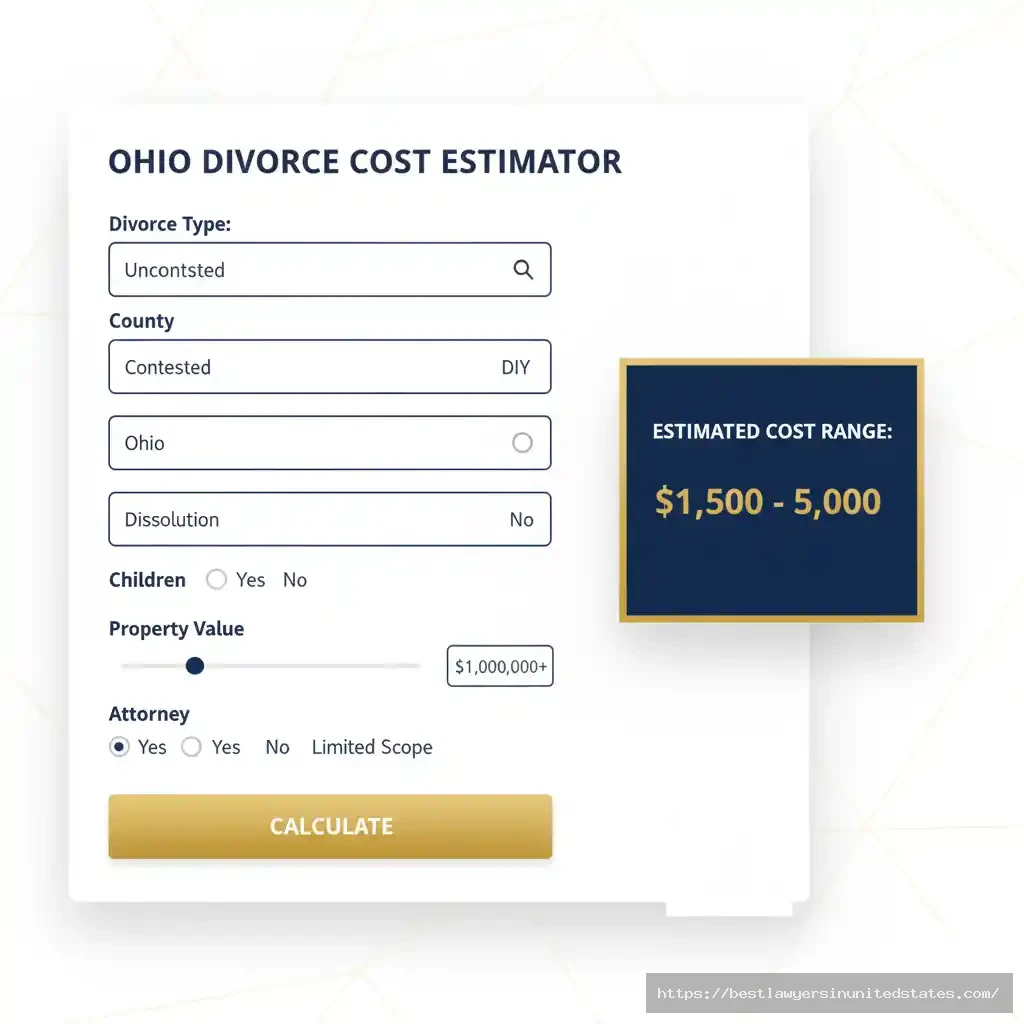
What Type of Divorce Will You Have? Understanding Your Costs
The type of divorce you pursue makes the biggest difference in your final bill. Ohio recognizes several paths to end a marriage, and each comes with its own price tag.
How Much Does an Uncontested Divorce Cost in Ohio?
An uncontested divorce in Ohio typically costs between $1,500 and $5,000 when you hire an attorney. This assumes you and your spouse agree on everything: property division, debt allocation, child custody, and spousal support.
Here’s what you’re paying for:
- Court filing fees: $200-$350
- Attorney fees: $1,000-$3,500 (often flat fee)
- Service of process: $50-$125
- Document preparation and filing
The timeline matters because time equals money. Most uncontested divorces wrap up in 30-90 days, which means fewer billable hours if you’re paying hourly.
When uncontested makes sense: You’ve been married less than 10 years, have minimal assets, no children, or have already divided everything informally. Both parties are motivated to end things quickly and fairly.
How Much Does a Contested Divorce Cost in Ohio?

A contested divorce in Ohio runs $15,000 to $25,000 on average, but complex cases easily top $50,000. The reason? Every disagreement requires attorney time, and contested cases involve:
- Multiple court hearings
- Discovery process (depositions, interrogatories)
- Expert witnesses
- Trial preparation
- Actual trial time
Ohio divorce attorneys charge $150-$400 per hour depending on location and experience. A typical contested case requires 50-100+ billable hours. Do the math: 75 hours at $250/hour equals $18,750 in attorney fees alone.
Cost escalators in contested cases:
- Child custody disputes (add $5,000-$15,000)
- Business valuation needs (add $2,500-$10,000)
- Hidden asset investigations (add $3,000-$8,000)
- Appeals (add $5,000-$15,000+)
Dissolution of Marriage: Ohio’s Budget-Friendly Option
Ohio offers dissolution of marriage as an alternative to traditional divorce. Cost range: $1,000-$3,000 total. That’s a fraction of what contested divorces cost.
The catch? You must agree on absolutely everything before filing. Both spouses submit a separation agreement covering property, debts, children, and support. No disputes allowed.
Dissolution vs. divorce key differences:
- Joint petition (you file together)
- No fault allegations needed
- One court hearing minimum
- 30-90 day timeline typically
- Significantly lower attorney fees
Many Ohio attorneys offer flat-fee dissolution services for $500-$2,000 since the work is predictable. Add court filing fees, and you’re still under $3,000.
Learn more about family law options and costs to understand what services you might need.
DIY Divorce: What Does It Really Cost to File Yourself?
A DIY (pro se) divorce in Ohio costs $200-$500 if you handle everything yourself. You’re paying for:
- Filing fees: $200-$350
- Service of process: $50-$125
- Certified copies: $15-$30
- Notary fees: $10-$20
Online divorce services charge $300-$500 and handle document preparation. You still pay court costs separately.
When DIY works: Short marriage, no children, minimal assets, both parties cooperating fully, and you’re comfortable with legal paperwork.
When DIY fails: Any disagreement, children involved, complex assets, business ownership, or domestic violence concerns. The money you save can cost you significantly in unfavorable settlements.
| Divorce Type | Filing Fee | Attorney Cost | Total Range | Timeline |
|---|---|---|---|---|
| Uncontested | $200-$350 | $1,000-$3,500 | $1,500-$5,000 | 30-90 days |
| Contested | $200-$350 | $15,000-$25,000+ | $15,500-$30,000+ | 6-18 months |
| Dissolution | $200-$350 | $500-$2,000 | $1,000-$3,000 | 30-90 days |
| DIY | $200-$350 | $0 | $200-$500 | 30-60 days |
Ohio Divorce Filing Fees by County: What You’ll Pay Where You Live

Filing fees vary significantly across Ohio’s 88 counties. Your county of residence determines these costs, and they’re non-negotiable unless you qualify for a fee waiver.
| County | Filing Fee | Service Fee | Certified Copy | Total Upfront |
|---|---|---|---|---|
| Franklin (Columbus) | $350 | $75 | $3/page | ~$428 |
| Hamilton (Cincinnati) | $325 | $60 | $2/page | ~$387 |
| Cuyahoga (Cleveland) | $330 | $65 | $3/page | ~$398 |
| Lucas (Toledo) | $310 | $50 | $2/page | ~$362 |
| Summit (Akron) | $320 | $55 | $2/page | ~$377 |
| Montgomery (Dayton) | $315 | $60 | $2/page | ~$377 |
| Stark (Canton) | $300 | $50 | $2/page | ~$352 |
| Butler (Hamilton) | $310 | $55 | $2/page | ~$367 |
| Lorain (Elyria) | $305 | $50 | $2/page | ~$357 |
| Mahoning (Youngstown) | $295 | $45 | $2/page | ~$342 |
| Lake (Painesville) | $315 | $55 | $2/page | ~$372 |
| Warren (Lebanon) | $320 | $60 | $2/page | ~$382 |
| Clermont (Batavia) | $300 | $50 | $2/page | ~$352 |
| Medina | $310 | $50 | $2/page | ~$362 |
| Trumbull (Warren) | $290 | $45 | $2/page | ~$337 |
Note: Fees current as of 2025. Contact your county’s Domestic Relations Court to confirm exact amounts.
Where Can I Find My County’s Exact Filing Fees?
Every Ohio county maintains a Domestic Relations or Family Court division within the Court of Common Pleas. Court clerk websites list current fee schedules.
Direct contacts for major counties:
- Franklin County: (614) 525-3500
- Hamilton County: (513) 946-5600
- Cuyahoga County: (216) 443-8560
- Lucas County: (419) 213-4778
- Summit County: (330) 643-2310
Most counties accept cash, money orders, cashier’s checks, or credit cards (with processing fees). Personal checks may not be accepted for filing fees.
Can You Get a Fee Waiver in Ohio?
Yes. Ohio courts grant fee waivers if you meet income requirements. Generally, you qualify if your household income falls at or below 125% of the federal poverty guidelines.
2025 poverty guidelines (125% threshold):
- Individual: $18,562 annually
- Family of 2: $25,187
- Family of 3: $31,812
- Family of 4: $38,437
To apply for a fee waiver:
- Complete an “Affidavit of Indigency” form (available at courthouse or online)
- Provide proof of income (pay stubs, tax returns, benefit statements)
- Submit bank statements showing account balances
- File the affidavit with your divorce complaint
The judge reviews and approves or denies. If approved, you file for free. If denied, you must pay standard fees before your case proceeds.
How Much Do Divorce Attorneys Cost in Ohio?
Attorney fees represent the largest expense in most Ohio divorces. Understanding how lawyers charge helps you budget and negotiate.

What Do Ohio Divorce Lawyers Charge Per Hour?
Hourly rates vary by location, attorney experience, and case complexity:
Major Ohio cities:
- Columbus: $200-$350/hour
- Cincinnati: $180-$330/hour
- Cleveland: $190-$340/hour
- Toledo: $150-$280/hour
- Akron: $175-$320/hour
- Dayton: $170-$300/hour
Rural Ohio: $150-$250/hour
Partners at established firms charge the higher end. Associates and newer attorneys charge less. Don’t assume cheaper means worse—sometimes a $200/hour attorney outperforms a $350/hour one.
What affects hourly rates:
- Years of experience
- Firm size and overhead
- Specialty certifications
- Local market competition
- Case complexity expectations
Understanding Attorney Retainer Fees
Most Ohio divorce attorneys require a retainer: a upfront deposit against future hourly work. Typical retainers run $2,500-$5,000 for uncontested cases and $5,000-$10,000 for contested matters.
How retainers work:
- You pay $5,000 upfront
- Attorney bills time against that balance
- When balance runs low, you “replenish” the retainer
- Unused funds get refunded when the case closes
Get the retainer agreement in writing. Understand what activities count as billable time (phone calls, emails, document review, court appearances, travel time).
Pro tip: Ask if the attorney charges for administrative tasks like copying and filing. Some firms bill paralegal time at $75-$125/hour for routine tasks.
Flat Fee vs. Hourly Billing: Which Costs Less?
Many Ohio attorneys offer flat fees for uncontested divorces: typically $1,500-$3,500. You pay one price regardless of time spent (within reason).
What flat fees typically include:
- Initial consultation
- Document preparation
- Filing with court
- Service of process arrangement
- One court appearance
- Final decree preparation
What flat fees often exclude:
- Contested issues
- Multiple court hearings
- Discovery processes
- Negotiations with opposing counsel
- Child custody disputes
Read the fee agreement carefully. Some “flat fee” arrangements convert to hourly if complications arise.
Hourly billing pros:
- Only pay for time actually used
- Better for unpredictable cases
- More flexibility
Flat fee pros:
- Budget certainty
- No surprise bills
- Incentivizes efficiency
For information on attorney fees beyond divorce, see our guide on cost of divorce lawyers.
What Are Unbundled Legal Services?
Unbundled services (limited scope representation) let you hire an attorney for specific tasks only. Cost savings: 30-50% versus full representation.
Common unbundled services:
- Document review only: $500-$1,000
- Court appearance only: $1,000-$2,500
- Consultation and advice: $300-$800
- Mediation representation: $800-$2,000
- Final hearing representation: $1,500-$3,000
You handle some work yourself and get professional help where you need it most. Perfect for people comfortable with paperwork but nervous about court appearances.
Best candidates for unbundled services: College-educated, organized individuals with straightforward cases and cooperative spouses.
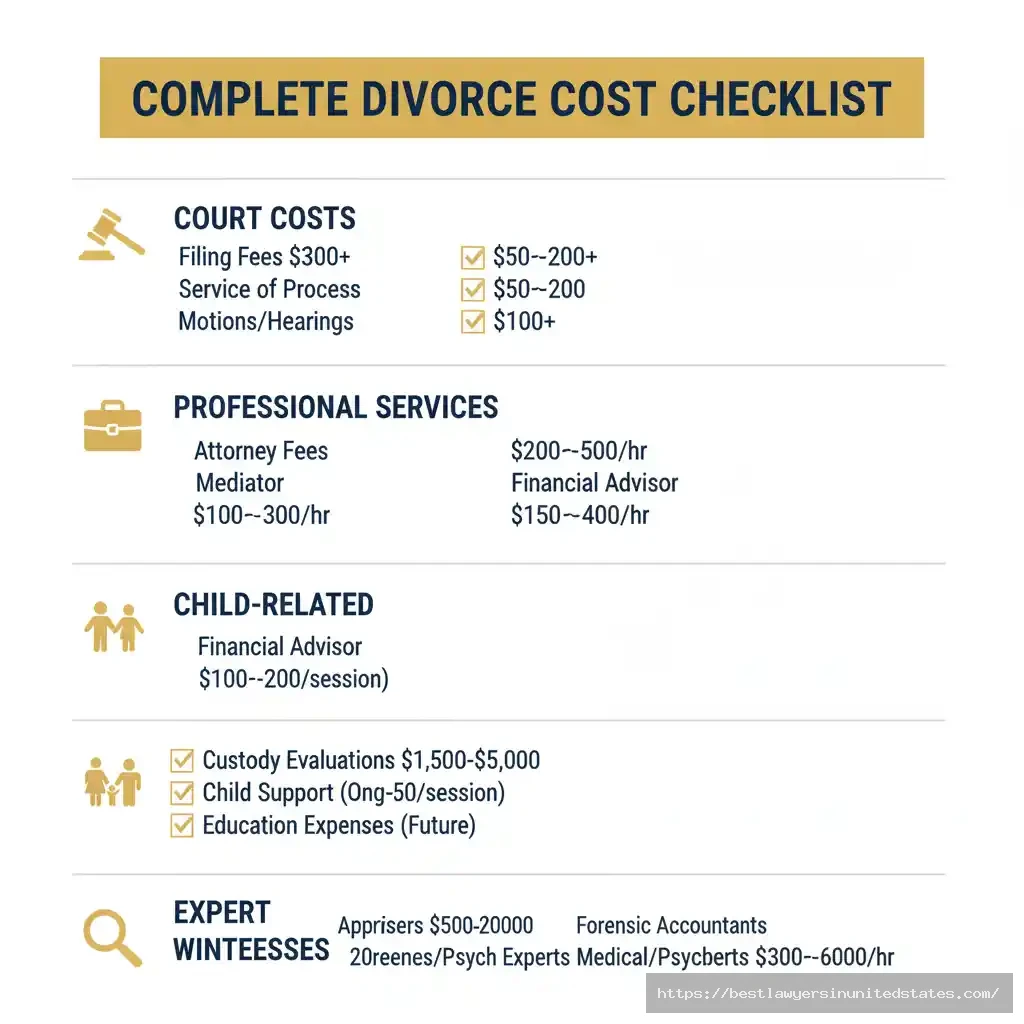
The Complete Divorce Cost Checklist: Hidden Expenses You Need to Know
Most people budget for filing fees and attorney costs, then get blindsided by additional expenses. This checklist covers everything.
Court-Related Costs
Beyond the initial filing fee, courts charge for various services throughout your divorce:
- ☑ Filing fee: $200-$350 (one-time)
- ☑ Process server: $50-$125 (to serve your spouse)
- ☑ Certified copies: $2-$3 per page (you’ll need multiple)
- ☑ Court reporter: $300-$500 (depositions and hearings)
- ☑ Transcript fees: $3-$5 per page (if you need hearing transcripts)
- ☑ Motion filing fees: $25-$50 each (for temporary orders, modifications)
Cost-saving tip: Some counties allow service by certified mail ($8) instead of process server. Check your local rules.
Professional Services That Add Up
Complex divorces require expert opinions, and experts don’t work cheap:
- ☑ Mediator: $100-$300/hour (typically 2-6 hours = $200-$1,800)
- ☑ Real estate appraisal: $300-$500 per property
- ☑ Business valuation: $2,500-$10,000+ (for business owners)
- ☑ Pension valuation: $500-$1,500 (for retirement asset division)
- ☑ Financial advisor consultation: $200-$400/hour
- ☑ Tax advisor: $200-$500 (understanding tax implications)
When you need these: Marital home, businesses, complex retirement accounts, significant assets, or tax concerns.
Child-Related Expenses
When children are involved, courts may require additional services:
- ☑ Guardian ad litem (GAL): $1,500-$5,000 (represents children’s interests)
- ☑ Parenting coordinator: $150-$300/hour (helps resolve disputes)
- ☑ Custody evaluation: $2,500-$5,000 (psychologist assessment)
- ☑ Child psychologist evaluation: $500-$2,000
Ohio courts appoint GALs in high-conflict custody cases. Parents typically split the cost equally, though courts can assign payment differently based on income.
Expert Witnesses for Contested Cases
Contested divorces often require expert testimony:
- ☑ Financial expert: $300-$500/hour (forensic accountants)
- ☑ Vocational expert: $250-$400/hour (earning capacity assessments)
- ☑ Real estate expert: $250-$450/hour
- ☑ Expert report preparation: $1,000-$3,000 (written reports)
Expect minimum commitments of 10-20 hours per expert. A forensic accountant searching for hidden assets might bill $5,000-$8,000 total.
Post-Divorce Costs Nobody Warns You About
The divorce decree doesn’t end potential legal expenses:
- ☑ Modification motions: $500-$3,000 (changing custody, support)
- ☑ Contempt/enforcement actions: $1,000-$5,000 (when ex violates orders)
- ☑ Appeal costs: $5,000-$15,000+ (if you appeal the judgment)
Smart planning: Build a $2,000-$3,000 emergency fund for post-divorce legal issues. Ex-spouses don’t always comply with court orders voluntarily.
Understanding Ohio Divorce Rules That Affect Your Costs
Ohio’s court rules create specific procedures and timelines that directly impact your expenses. Knowing these helps you budget accurately.

What Is Rule 75 in Ohio Divorce?
Ohio Civil Rule 75 governs all divorce and dissolution procedures in the state. It sets mandatory requirements that affect your timeline—and therefore your costs.
Key Rule 75 provisions:
- Requires specific information in divorce complaints
- Mandates financial disclosure statements
- Sets hearing requirements
- Establishes service of process rules
How this affects costs: Rule 75’s disclosure requirements mean you must compile detailed financial information. If you’re disorganized, expect to pay your attorney more hours to help gather documents. Organized clients save 5-10 billable hours ($1,000-$2,500).
The rule also requires both parties to attend parenting classes when children are involved. Cost: $50-$75 per parent. Factor this into your budget.
What Is Rule 58 in Ohio Divorce?
Ohio Civil Rule 58 controls when your divorce becomes final. It requires a 14-day waiting period after the judge signs the divorce decree.
The Rule 58 waiting period:
- Judge signs decree
- 14 days pass
- Decree becomes “final and appealable”
- You’re officially divorced
Cost implications: This waiting period rarely adds attorney fees since most work is complete. However, if your attorney charges for decree preparation and filing, expect $200-$500 for this final step.
If either party appeals, Rule 58 starts the clock for appeal deadlines (30 days from final judgment entry).
Is Ohio a 50/50 Divorce State?
No. Ohio uses “equitable distribution,” not equal (50/50) division. Courts divide marital property fairly, which may or may not be equal.
What this means for costs:
When everything isn’t split 50/50, expect negotiations. More negotiation = more attorney time = higher costs.
Factors Ohio courts consider:
- Length of marriage
- Each spouse’s income and earning capacity
- Assets and debts each brought to marriage
- Contributions to household (including homemaker contributions)
- Tax consequences of property division
- Custody arrangements
Cost impact: If your spouse earned significantly more or brought more assets to the marriage, you might argue for more than 50%. This requires financial documentation, expert testimony, and attorney argument—adding $2,000-$5,000+ to costs.
Couples who agree to 50/50 splits avoid this expense entirely.
No-Fault vs. Fault Divorce: How It Impacts Costs
Ohio allows both no-fault and fault-based divorces. Your choice dramatically affects expenses.
No-fault grounds in Ohio:
- Incompatibility (most common)
- Living separate and apart for one year
Fault grounds in Ohio:
- Adultery
- Extreme cruelty
- Gross neglect of duty
- Habitual drunkenness
- Imprisonment
Why fault claims cost more: You must prove fault with evidence. Proving adultery might require private investigators ($500-$3,000), email/text discovery, witness testimony, and additional court time.
Fault divorces increase costs by 30-50% on average compared to no-fault cases. Most Ohio divorce attorneys recommend no-fault grounds unless fault affects property division or custody.
Check out divorce costs in other states to see how Ohio compares nationally.
Who Pays for Divorce Fees in Ohio?
One of the most common questions: “Who pays the attorney fees in a divorce?” The answer depends on your specific situation.

Five Common Fee Payment Scenarios
Scenario 1: Equal Cost Split
Most common in uncontested divorces where spouses have similar incomes.
Example: Mark and Lisa both work and earn comparable salaries. They agree to divorce amicably. Total costs: $4,000. Each pays $2,000.
When this works: Similar financial positions, no children, mutual agreement to end the marriage.
Scenario 2: Higher Earner Pays All
Ohio law allows courts to order one spouse to pay the other’s attorney fees when there’s significant income disparity.
Example: Tom earns $150,000 annually as a surgeon. His wife Sarah stayed home for 15 years raising children and has no income. The court orders Tom to pay Sarah’s attorney fees ($8,000) plus his own.
Ohio law on fee shifting: Courts consider each party’s financial resources and ability to pay. The goal is ensuring both spouses can afford competent representation.
How to request: Your attorney files a motion for attorney fees, providing evidence of income disparity and financial need.
Scenario 3: Court-Ordered Fee Reimbursement
When one spouse engages in bad faith litigation (unnecessary motions, discovery abuse, frivolous claims), courts can order that spouse to pay the other’s attorney fees.
Example: Jennifer files 12 motions over 8 months, all denied, purely to harass her ex-husband David. The court orders Jennifer to reimburse David $7,500 in attorney fees incurred defending against baseless motions.
Bad faith indicators:
- Hiding assets
- Refusing reasonable settlement offers
- Filing meritless motions
- Violating discovery orders
- Disobeying court orders
Scenario 4: Each Party Pays Their Own
Standard in contested divorces where both parties have similar incomes and resources.
Example: Both spouses work professional jobs earning $75,000-$85,000. Each hires their own attorney. Mike pays his attorney $18,000; Stephanie pays hers $16,500. No fee shifting occurs.
When this happens: Equal earning capacity, sufficient resources on both sides, and no bad faith conduct.
Scenario 5: Legal Aid Coverage
Low-income Ohioans may qualify for free legal representation through legal aid societies.
Example: Maria earns $23,000 annually working retail. She qualifies for free representation from Legal Aid Society of Columbus. Total cost to her: $0 for attorney fees (she still pays filing fees unless waived).
Income limits vary by county and household size. See the legal aid section below for eligibility requirements.
Can My Spouse Be Ordered to Pay My Attorney Fees?
Yes, Ohio courts can order your spouse to pay your attorney fees. Success depends on several factors:
Legal standard in Ohio: The court must find that:
- You lack sufficient resources to pay
- Your spouse has ability to pay
- Fee award is equitable under circumstances
What you need to prove:
- Income disparity (pay stubs, tax returns)
- Lack of liquid assets
- Spouse’s financial ability (their income and assets)
- Case complexity requiring representation
Success rates: Courts grant fee requests in approximately 40-60% of cases where significant income disparity exists. Higher success rates when:
- Stay-at-home parent vs. working spouse
- One spouse controlled marital finances
- Domestic violence present
- Spouse hiding assets
Your attorney files a “Motion for Attorney Fees” with supporting financial affidavits. The court may order fees paid upfront, throughout the case, or at final judgment.
For guidance on finding the right representation, visit our family and divorce lawyers directory.
Eight Proven Ways to Reduce Your Ohio Divorce Costs
You don’t need to choose between expensive full-service representation and risky DIY. These strategies cut costs significantly.
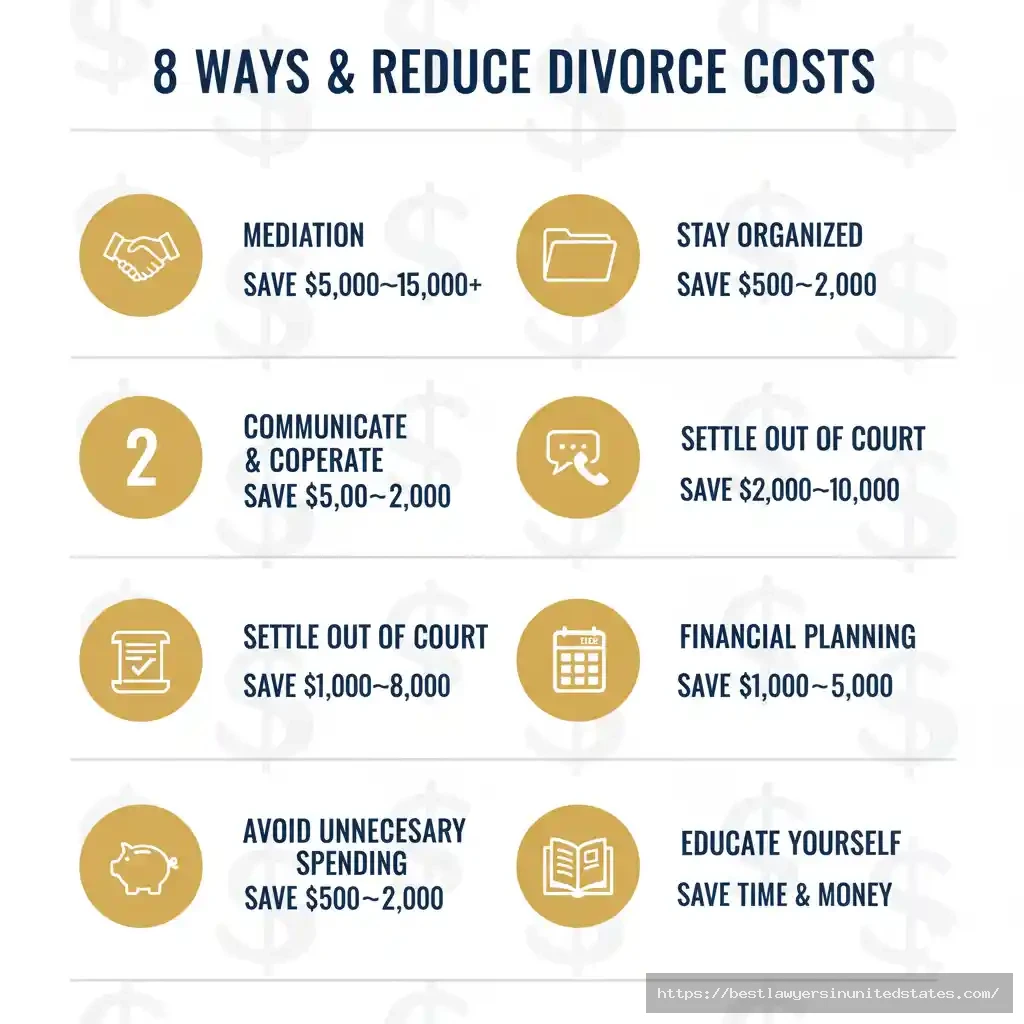
Strategy #1: Choose Mediation First
Cost comparison:
- Traditional litigation: $15,000-$25,000+
- Mediation: $500-$3,000 total
Mediation involves a neutral third party helping you and your spouse reach agreements. When successful, you file an agreed divorce or dissolution—avoiding months of litigation.
Success rates: 60-80% of divorces that start with mediation settle without trial.
When mediation works best:
- Both parties willing to negotiate
- No domestic violence
- Reasonable communication possible
- Children involved (judges prefer parental agreements)
Ohio mediation costs: $100-$300 per hour. Most cases resolve in 4-8 hours of mediation = $400-$2,400. Add attorney time for review and filing = $500-$1,000. Total: $1,000-$3,500 versus $15,000+ for litigation.
Strategy #2: Use Unbundled Legal Services
Save 30-50% by hiring attorneys for specific tasks only.
Best tasks to unbundle:
- Initial consultation and strategy ($300-$500)
- Document review before filing ($500-$800)
- Court appearance coaching ($300-$600)
- Final hearing representation ($1,500-$2,500)
How to find limited-scope attorneys: Ohio State Bar Association referral service or search “unbundled legal services Ohio” online. Not all attorneys offer this, so ask specifically.
Who benefits most: People comfortable with paperwork, organized, with straightforward cases and some legal aptitude.
Strategy #3: Get Organized to Reduce Attorney Hours
Every hour you save your attorney is $150-$350 back in your pocket.
Do this before your first meeting:
- ☑ List all assets with values and documentation
- ☑ List all debts with balances and account numbers
- ☑ Gather 3 years of tax returns
- ☑ Collect recent pay stubs (both spouses)
- ☑ Compile bank statements (6-12 months)
- ☑ Document retirement account balances
- ☑ Create timeline of marriage events
- ☑ Write out custody preferences with reasoning
Time saved: 5-15 billable hours = $750-$5,000
Disorganized clients pay attorneys to track down documents, make multiple calls to financial institutions, and piece together financial pictures. Don’t be that client.
Strategy #4: Communicate Directly with Your Spouse
Every email your attorney sends to opposing counsel costs you $50-$150. If your attorney bills in 6-minute increments, even a quick email review is $15-$30.
Communication alternatives:
- OurFamilyWizard app ($99-$180/year per parent)
- Talking Parents app (free basic version)
- Direct text/email (if communication is civil)
What to communicate directly:
- Schedule changes
- Routine child-related decisions
- Property division agreements
- Document exchanges
What requires attorney communication:
- Legal positions
- Settlement offers
- Court-related matters
- Disputed issues
Savings potential: $1,000-$3,000 in reduced attorney-to-attorney communication costs.
Strategy #5: Consider Dissolution Instead of Divorce
Ohio’s dissolution process costs $10,000-$20,000 less than contested divorce.
Dissolution requirements:
- Complete agreement on all issues
- Joint petition filing
- Separation agreement drafted
- Both parties appear at hearing
- No trial needed
What you must agree on:
- Property and debt division (everything)
- Child custody and parenting time
- Child support amounts
- Spousal support (if any)
Many couples negotiate informally for months, reach agreements, then file dissolution. The court simply approves what you’ve decided.
Attorney fees for dissolution: $500-$2,000 for document preparation and court appearance.
Learn about domestic partnership vs marriage if you’re considering alternatives.
Strategy #6: Settle Early—Every Month Costs Money
Litigation expenses compound. Each month of conflict adds $2,000-$5,000 in costs.
What drives monthly costs:
- Attorney time on motions and responses
- Discovery requests and document production
- Depositions ($300-$800 each)
- Expert consultations
- Court appearances
- Communication with opposing counsel
Settlement incentives: Ohio courts often order mediation before trial. If you settle at mediation (after $15,000 spent), you’ve wasted money you could have saved settling earlier.
How to propose settlement: Your attorney can make offers any time. Early settlement shows good faith and often gets better terms than judge-imposed orders.
Strategy #7: Use Online Services for Simple Cases
Online divorce services cost: $300-$500
Popular services: Ohio Online Divorce, DivorceWriter, 3StepDivorce
What they provide:
- State-specific form completion
- Document preparation
- Filing instructions
- Customer support
What they don’t provide:
- Legal advice
- Court representation
- Negotiation help
- Contested case support
When online services work:
- No children or children adults
- Minimal assets (under $50,000)
- No retirement accounts needing division
- Both parties cooperating
- No complex issues
You still pay court filing fees ($200-$350) plus service costs. Total: $500-$850 versus $1,500-$3,000 with attorney for simple uncontested divorce.
Strategy #8: Apply for Fee Waiver or Legal Aid
Fee waiver income thresholds (2025):
- 1 person: $18,562/year
- 2 people: $25,187/year
- 3 people: $31,812/year
- 4 people: $38,437/year
Legal aid income limits: Typically 125-200% of poverty level, varying by program.
Application process:
- Contact your county’s legal aid office
- Complete intake questionnaire
- Provide income documentation
- Attend interview (if selected)
- Receive assignment (if approved)
What legal aid covers: Full representation at no cost if eligible. This includes all attorney services, though you may still pay court filing fees (or get those waived too).
See the resources section below for legal aid contacts in your county.
Ohio Legal Aid and Free Divorce Resources
If you’re facing divorce with limited income, multiple resources exist to help.

County-by-County Legal Aid Contacts
Legal Aid Society of Columbus (Franklin County)
- Phone: (614) 241-2001
- Serves: Franklin, Madison, Pickaway, Union counties
- Income limit: 200% of poverty level
Legal Aid Society of Greater Cincinnati (Hamilton County)
- Phone: (513) 241-9400
- Serves: Hamilton, Butler, Clermont, Warren counties
- Income limit: 125% of poverty level
Legal Aid of Western Ohio (Lucas, Montgomery counties)
- Phone: Toledo (419) 241-4701, Dayton (937) 535-4511
- Serves: 10 counties in northwest and west-central Ohio
- Income limit: 200% of poverty level
Legal Aid Society of Cleveland (Cuyahoga County)
- Phone: (216) 687-1900
- Serves: Cuyahoga, Ashtabula, Lake, Geauga counties
- Income limit: 125% of poverty level
Southeastern Ohio Legal Services (Athens, Hocking, others)
- Phone: (740) 594-3558
- Serves: 32 counties in southeast Ohio
- Income limit: 125% of poverty level
Community Legal Aid (Akron/Summit County)
- Phone: (330) 535-4191
- Serves: Summit, Medina, Portage, Stark counties
- Income limit: 125% of poverty level
Ohio State Legal Services Association
- Website: ohiolegalservices.org
- Central directory of all legal aid programs statewide
Court Self-Help Centers
Most Ohio counties operate self-help centers providing:
- Free court forms
- Filing instructions
- Limited procedural guidance
- Referrals to legal resources
Major county self-help centers:
Franklin County Domestic Relations Court
- Location: 373 S. High St., 18th Floor, Columbus
- Phone: (614) 525-3535
- Walk-in hours: Monday-Friday, 8:00 AM – 4:30 PM
Hamilton County Pro Se Assistance
- Location: 1000 Main St., Room 350, Cincinnati
- Phone: (513) 946-5656
- Walk-in hours: Monday-Thursday, 8:00 AM – 3:00 PM
Cuyahoga County Resource Center
- Location: 1200 Ontario St., Cleveland
- Phone: (216) 443-8694
- Walk-in hours: Monday-Friday, 8:30 AM – 4:00 PM
Important: Self-help center staff cannot give legal advice. They provide forms and procedures only.
Pro Bono Attorney Programs
Ohio State Bar Association Lawyer Referral Service
- Phone: (800) 282-6556
- Website: ohiobar.org
- First 30-minute consultation: $50 or less
Local Bar Association Programs:
- Columbus Bar Association: Free legal advice clinics
- Cincinnati Bar Association: Volunteer Lawyers Program
- Cleveland Metropolitan Bar: Pro Bono Committee
- Dayton Bar Association: Lawyer Referral Service
Law School Clinics:
- Ohio State University Moritz College of Law (Columbus)
- University of Cincinnati College of Law
- Cleveland State University Cleveland-Marshall College of Law
- University of Akron School of Law
Law school clinics provide free representation in selected cases. Students handle cases under professor supervision.
Online Resources
Ohio Legal Help (ohiolegalhelp.org)
- Free legal information and forms
- Guided interviews for document completion
- County-specific filing instructions
Ohio Supreme Court Self-Help Resources
- Website: supremecourt.ohio.gov
- Divorce forms and instructions
- Custody and support guidelines
- Plain-language legal explanations
LawHelp.org/OH
- National legal aid directory
- Ohio-specific resources
- Topical legal guides
If you need help with related family law matters, check out our resources on annulment lawyers and military divorce.
How Much Does It Cost to Get a Divorce If Both Parties Agree in Ohio?
When both spouses agree on everything, you have two options: uncontested divorce or dissolution of marriage. Costs run $1,000-$5,000 total.
Uncontested divorce with attorney: $1,500-$5,000
- Filing fees: $200-$350
- Attorney fees: $1,000-$3,500
- Service costs: $50-$125
- Miscellaneous: $100-$200
Dissolution of marriage with attorney: $1,000-$3,000
- Filing fees: $200-$350
- Attorney fees: $500-$2,000
- Service costs: $0 (joint filing)
- Miscellaneous: $50-$100
DIY uncontested divorce: $200-$500
- Filing fees: $200-$350
- Service costs: $50-$125
- Forms/copies: $15-$50
The key word is “everything.” Agreement means:
- How property gets divided (every asset)
- Who pays which debts (every liability)
- Child custody schedule (if applicable)
- Child support amount (if applicable)
- Spousal support terms (if applicable)
One disagreement transforms “uncontested” into “contested”—and costs jump accordingly.
Can You File for Divorce for Free in Ohio?
Sort of. While court filing fees are mandatory, you can get them waived if you meet income requirements.
Fee waiver eligibility:
- Income at or below 125% of federal poverty level
- Receiving public assistance (SNAP, TANF, Medicaid, SSI)
- Unable to pay fees without hardship to family
How to request fee waiver:
- Complete “Affidavit of Indigency” (Form 1)
- Attach proof of income or benefit letters
- Include bank statements
- File with your divorce complaint
- Judge reviews and grants or denies
If approved: No filing fees, service costs, or certified copy fees. You still need to serve your spouse (court waives process server fees too).
If denied: Pay full filing fees before case proceeds.
Free attorney representation: Separate from fee waivers. Legal aid programs provide free attorneys if you meet income limits (typically 125-200% of poverty level).
Truly free divorce: Fee waiver approved + legal aid representation + DIY paperwork = $0 cost divorce. Available to Ohio’s lowest-income residents.
Compare Ohio costs with divorce costs in neighboring Pennsylvania or divorce costs in Illinois.
How Much Does a Contested Divorce Cost in Ohio?
Contested divorces in Ohio typically cost $15,000-$25,000, but complex cases exceed $50,000 regularly.
Why contested costs so much more:
Discovery phase: $3,000-$8,000
- Interrogatories (written questions)
- Requests for production (documents)
- Depositions ($300-$800 each)
- Subpoenas for records
Expert witnesses: $2,500-$15,000
- Business valuations
- Real estate appraisals
- Custody evaluators
- Vocational experts
- Forensic accountants
Court appearances: $1,000-$5,000
- Temporary order hearings
- Pre-trial conferences
- Settlement conferences
- Motion hearings
Trial preparation: $5,000-$12,000
- Witness preparation
- Exhibit compilation
- Trial strategy
- Legal research
Trial itself: $3,000-$10,000
- Court time (1-5 days typically)
- Attorney preparation
- Witness fees
- Expert testimony
Factors that increase costs further:
- High-value assets requiring multiple valuations
- Child custody disputes (add $5,000-$15,000)
- Hidden asset investigations (add $3,000-$10,000)
- Interstate issues (add $2,000-$5,000)
- Appeals (add $5,000-$15,000+)
Most expensive contested divorce factors:
- Business ownership valuation disputes
- Custody battles with multiple experts
- Complex asset tracing (inheritances, separate property)
- International assets or child custody
- False allegations requiring extensive defense
Smart contested divorce strategy: Negotiate hard but settle before trial. Trial adds $5,000-$15,000 minimum to your costs.
Who Pays the Attorney Fees in a Divorce?
Standard rule: Each party pays their own attorney. However, Ohio law allows exceptions.
Five scenarios that change who pays:
1. Income disparity: Courts can order the higher-earning spouse to pay part or all of the other spouse’s attorney fees. Required showing: financial need + ability to pay.
2. Bad faith conduct: When one spouse unnecessarily complicates the case, courts can order that spouse to reimburse the other’s attorney fees. Examples: hiding assets, filing frivolous motions, refusing discovery.
3. Marital funds: Both spouses might use marital money (joint accounts) to pay their respective attorneys during the case. Settlement or court order addresses reimbursement at final judgment.
4. Spousal support arrangements: Sometimes the higher earner agrees to pay attorney fees in exchange for lower or shorter spousal support.
5. Property division trade: “I’ll give you an extra $10,000 from home equity if you pay your own attorney fees.”
What judges consider when ordering fee payment:
- Each party’s income and assets
- Case complexity
- Each attorney’s billing practices
- Whether either party unnecessarily increased costs
- Length of marriage
- Custody arrangements
Typical outcome in practice: In uncontested divorces with similar incomes, each pays their own ($1,500-$2,500 each). In contested cases with income disparity, higher earner often pays 60-80% of total legal costs.
How Much Does a Dissolution of Marriage Cost in Ohio?
Dissolution of marriage in Ohio costs $1,000-$3,000 total when using an attorney, or $200-$500 DIY.
Cost breakdown with attorney:
- Filing fee: $200-$350
- Attorney for document preparation: $500-$2,000
- Parenting class (if children): $50-$75 per parent
- Miscellaneous (copies, notary): $50-$100
Total: $1,000-$3,000
Why dissolution costs less than divorce:
- No contested issues
- Minimal court time (one hearing)
- Predictable timeline (30-90 days)
- Joint filing (no service needed)
- Less attorney time required
Dissolution requirements:
- Complete agreement on all issues
- Both parties sign separation agreement
- Both attend hearing together
- No trial or extensive court proceedings
Many Ohio attorneys offer flat-fee dissolution services: $800-$1,500 for document preparation, filing, and court appearance. This represents excellent value compared to contested divorce costs.
Dissolution vs. divorce comparison:
| Factor | Dissolution | Divorce |
|---|---|---|
| Agreement required | 100% (everything) | No (court decides) |
| Court appearances | 1 (together) | Multiple (separate) |
| Timeline | 30-90 days | 30 days – 18+ months |
| Average cost | $1,000-$3,000 | $1,500-$30,000+ |
| Attorney required | No (but recommended) | Highly recommended |
Best candidates for dissolution: Couples who communicate well, have negotiated agreements, want to minimize cost and conflict, and can collaborate on paperwork.
Check our detailed comparison of divorce costs in California to see how different states compare.
What Is the Cheapest Way to Get Divorced in Ohio?
The absolute cheapest divorce in Ohio: DIY dissolution with fee waiver = $0 to $50
Cheapest route step-by-step:
1. Pursue dissolution (not divorce) – Saves attorney fees by requiring complete agreement upfront.
2. Apply for fee waiver – If income-eligible (under $18,562/year for individual), file Affidavit of Indigency to waive $200-$350 filing fee.
3. Use free court forms – Download from your county’s website or get from court clerk. No cost.
4. Self-prepare documents – Complete forms yourself using instructions. Takes 3-5 hours but costs $0.
5. Self-file – Take completed forms to courthouse, file yourself. Clerk assists with procedural questions.
6. Attend hearing together – Both appear at scheduled hearing (30-60 days after filing). Judge approves agreement. Done.
Total cost if fee waiver approved: $0-$50 (just copy/notary costs)
Other low-cost options:
Online divorce services: $300-$500 + filing fees = $500-$850 total
- Easier than pure DIY
- Form completion assistance
- Still requires agreement on everything
Mediation + DIY filing: $500-$2,000 + filing fees = $700-$2,350 total
- Mediator helps reach agreements
- You file paperwork yourself
- Good for couples who need help negotiating
Unbundled attorney services: $500-$1,500 + filing fees = $700-$1,850 total
- Attorney reviews documents
- You handle filing and court
- Safety net for complex situations
Legal aid representation: $0 (if eligible)
- Full attorney representation
- Income must be 125-200% of poverty level
- Limited availability
What makes divorce expensive: Attorney fees for contested issues. Avoid disagreement, avoid high costs.
For prenuptial planning to avoid future divorce costs, see our guide on prenuptial agreement lawyers.
Do I Need a Lawyer for an Uncontested Divorce in Ohio?
Legally, no. Practically, it depends on your situation.
When you can safely go without a lawyer:
- Short marriage (under 3 years)
- No children or children are adults
- Minimal assets (under $25,000 total)
- No real estate owned
- No retirement accounts
- Both parties cooperating fully
- No domestic violence
When you should hire a lawyer even if “uncontested”:
- Children under 18 (custody and support issues)
- Marital home to divide or sell
- Retirement accounts requiring QDROs
- Business ownership
- Significant debt allocation
- Spousal support considerations
- One spouse handled all finances (you don’t know full picture)
- Any suspicion of hidden assets
Middle ground option: Hire attorney for consultation only ($300-$500). They review your separation agreement, identify issues, then you file yourself.
Risks of DIY uncontested divorce:
- Unfavorable property division you didn’t understand
- Missing QDRO (retirement division order)
- Incorrect child support calculations
- Waiving rights unknowingly
- Forms completed incorrectly (case dismissed)
- Tax implications you didn’t anticipate
Real example: Sarah filed DIY divorce, agreed to let ex-husband keep his 401(k) if she got the marital home. Seemed fair—home equity $80,000, 401(k) $90,000. Years later she learned: 401(k) grows pre-tax, house equity taxed when sold. After taxes, she received $60,000 effective value while he got $90,000. An attorney would have explained tax implications.
Cost-benefit analysis: Spending $1,500 on an uncontested divorce attorney might save $10,000+ in unfavorable terms or future legal fees fixing mistakes.
How Long Does a Divorce Take in Ohio?
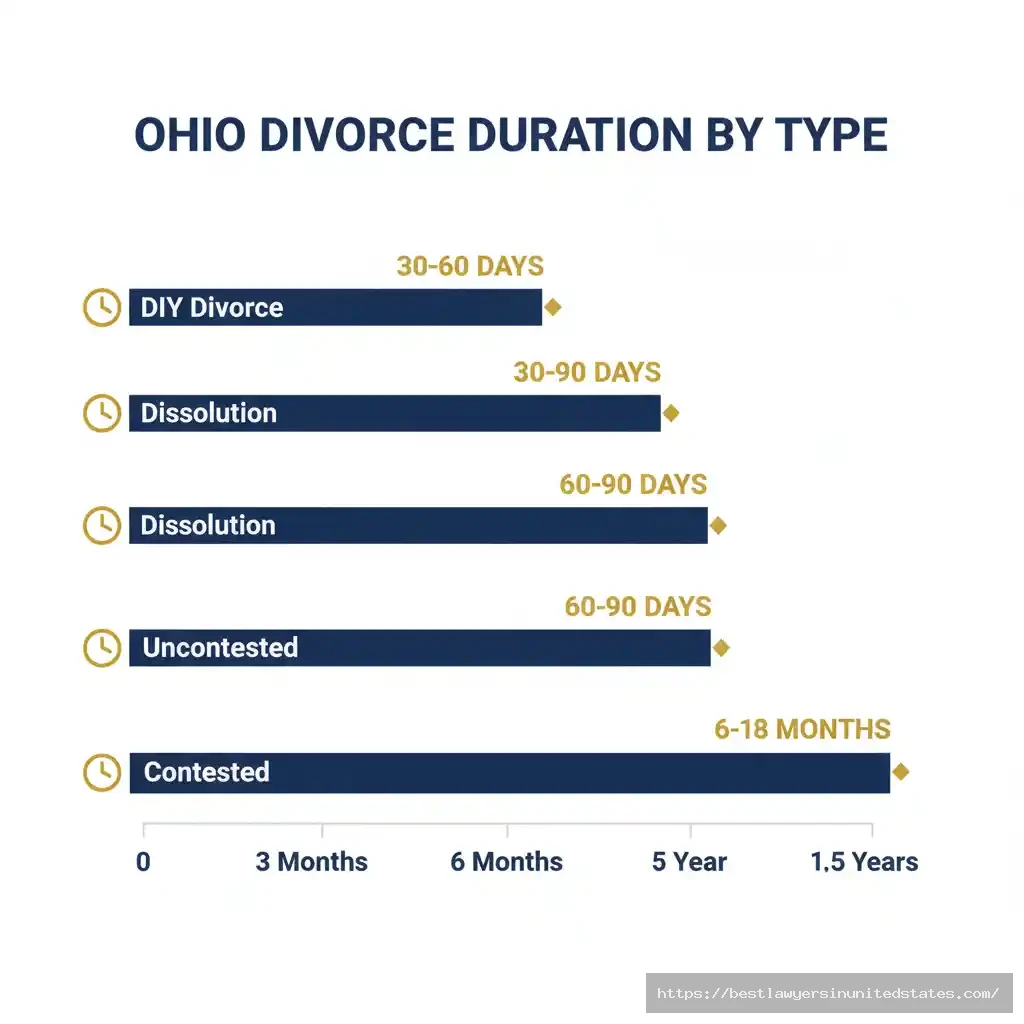
Ohio divorces take 30 days minimum to 18+ months depending on type and complexity.
Minimum timeline: 30 days from service of complaint to final hearing (Ohio Revised Code requires 30-day waiting period).
Typical timelines by divorce type:
DIY/Online uncontested: 30-60 days
- File complaint
- Wait 30 days minimum
- Attend final hearing
- Receive decree
Attorney-handled uncontested: 60-90 days
- Attorney prepares documents (1-2 weeks)
- File complaint
- Wait 30 days minimum
- Negotiate any minor issues (2-4 weeks)
- Final hearing
- Receive decree
Dissolution: 30-90 days
- Both parties file joint petition
- Wait 30-90 days for hearing date
- Attend hearing together
- Receive decree (effective 14 days later per Rule 58)
Contested divorce: 6-18 months
- File complaint (month 1)
- Temporary orders hearing (months 1-2)
- Discovery phase (months 2-6)
- Mediation attempt (months 4-7)
- Pre-trial conferences (months 6-10)
- Trial (months 8-18)
- Final decree (trial date + 2-8 weeks)
Factors that extend timeline:
- High conflict between parties (add 6-12 months)
- Custody disputes requiring evaluations (add 3-6 months)
- Complex asset division (add 3-6 months)
- Business valuations needed (add 2-4 months)
- Discovery disputes (add 2-6 months)
- Court backlog in your county (add 1-6 months)
- Appeals (add 12-24 months)
Why timeline matters for costs: More time = more attorney fees. Each month of contested divorce adds $2,000-$5,000 in costs. A case that drags from 8 months to 14 months costs an additional $12,000-$30,000.
Fastest Ohio divorce: DIY dissolution with complete agreement, immediate filing, first available hearing date = 30-40 days, under $500.
Slowest Ohio divorce: High-conflict custody battle with business valuation, asset tracing, multiple motions, trial, and appeal = 24-36 months, $75,000-$150,000+.
See how Ohio compares to divorce costs and timelines in Texas or Florida.

What Is Rule 75 in Ohio Divorce?
Ohio Civil Rule 75 governs divorce, dissolution, legal separation, and annulment procedures statewide. Understanding Rule 75 helps you anticipate process steps and associated costs.
Key Rule 75 provisions:
Filing requirements: Complaints must include specific information (grounds for divorce, length of residence, children, property/debt details). Incomplete complaints get rejected—wasting your filing fee.
Residence requirements: At least one spouse must have lived in Ohio for six months before filing. Reduces out-of-state forum shopping.
Service of process: How your spouse receives notice of the divorce. Rule 75 requires personal service or certified mail in most cases. Cost: $50-$125.
Mandatory disclosures: Both parties must complete financial disclosure forms listing all income, assets, debts, and expenses. Failure to disclose accurately can result in sanctions.
Parenting class requirement: When minor children are involved, both parents must complete a court-approved parenting program. Cost: $50-$75 per parent. Proves you’re addressing children’s needs during divorce.
Temporary orders: Rule 75 allows emergency hearings for temporary custody, support, or restraining orders while divorce is pending.
How Rule 75 affects your costs:
Organized clients save money: Having required information ready (financial disclosures, child information, residence proof) reduces attorney time. Disorganized clients pay attorneys to gather information. Difference: $750-$2,500.
Compliance matters: Violating Rule 75 requirements (missing disclosures, skipping parenting class) delays your case. More delay = more attorney fees.
Strategic use: Understanding Rule 75 temporary order provisions can protect you financially. File early for temporary support if needed—don’t wait months while your case proceeds.
For related legal matters in Ohio, our resources on Ohio legal compliance may prove helpful.
Is Ohio a 50/50 Divorce State?
No. Ohio practices “equitable distribution,” not “community property” (50/50 split). Courts divide marital property fairly, considering multiple factors.
What equitable means: Fair, not necessarily equal. Might be 50/50, might be 60/40, might be 70/30.
Factors courts consider (Ohio Revised Code § 3105.171):
- Duration of marriage
- Assets and liabilities each brought to marriage
- Desirability of awarding family home to spouse with custody
- Liquidity of property
- Economic circumstances of each party
- Tax consequences
- Costs of sale (if property must be sold)
- Any other relevant factors
How this affects costs:
Simple 50/50 splits: Couples who agree to equal division avoid litigation. Saves $5,000-$15,000 in attorney fees arguing over percentages.
Argued equitable splits: If you believe you deserve more than 50%, you must prove it. Requires:
- Financial expert testimony ($2,000-$5,000)
- Detailed asset tracing
- Evidence of contributions
- Attorney argument time
Example: Maria and Tom married 20 years. Maria stayed home 15 years raising children while Tom built a business now worth $500,000. Maria argues she deserves 65% of marital assets due to her contributions as homemaker enabling Tom’s career growth. This argument requires attorney time, expert testimony, and trial—adding $8,000-$15,000 to divorce costs. Without this argument (accepting 50/50), costs stay lower.
Separate property exceptions: Property owned before marriage, inheritances, and gifts remain separate (not divided). Proving what’s separate versus marital can cost $2,000-$8,000 in attorney and accountant fees.
Most common outcome: Couples with similar contributions over similar marriage lengths get close to 50/50 splits. Significant disparities (one spouse sacrificed career, inheritance issues, business built during marriage) lead to different percentages.
Next Steps: Getting Started with Your Ohio Divorce
You’ve learned what divorce costs in Ohio. Now what?
Immediate action steps:
1. Gather financial documents:
- Last 3 years tax returns (joint and individual)
- Current pay stubs (both spouses)
- Bank statements (6-12 months, all accounts)
- Credit card statements (all accounts)
- Retirement account statements (401k, IRA, pension)
- Mortgage statements and property deeds
- Vehicle titles and loan documents
- Business financial statements (if applicable)
2. Create asset and debt lists:
- Every asset you own (estimated values)
- Every debt you owe (current balances)
- Who brought what to the marriage
- What was acquired during marriage
3. Determine your divorce type:
- Can you agree on everything? → Dissolution
- Can you agree on most things? → Uncontested divorce
- Significant disagreements? → Contested divorce
- Need help reaching agreements? → Mediation first
4. Assess your attorney needs:
- Simple case, good cooperation → Consider DIY or unbundled services
- Children, property, retirement → Hire attorney at least for consultation
- High conflict, complex assets → Full representation needed
- Low income → Apply for legal aid
5. Budget for total costs:
- Estimate based on your divorce type (use tables above)
- Add 20% buffer for unexpected costs
- Consider payment plans with attorneys
- Explore legal aid if income-eligible
6. Consult with attorneys:
- Many offer free initial consultations
- Interview 2-3 before deciding
- Ask about fees, approach, timeline
- Confirm availability and communication style
7. Review county-specific requirements:
- Check your county court’s website
- Note filing fee amounts
- Download forms if going DIY
- Identify court locations and hours
8. Consider impact on children:
- Think through custody preferences
- Research parenting plans
- Plan how to tell children
- Line up counseling if needed
9. Protect yourself financially:
- Monitor joint accounts
- Document current asset values
- Consider credit freeze if concerned about new debt
- Consult tax advisor about filing status
10. Take care of your wellbeing:
- Line up emotional support
- Consider therapy or counseling
- Join support groups
- Focus on self-care
Ready to move forward? Find experienced Ohio divorce attorneys in your county through our lawyer directory. Many offer free initial consultations to discuss your specific situation and provide customized cost estimates.
Compare Ohio with divorce costs in New York to understand regional differences.
