
Quick Answer Box
- What this case is: Civil legal proceedings and threatened legal action arising from the leak of Shedeur Sanders’s private cell phone number during the 2025 NFL Draft, plus legal commentary on whether his draft positioning supports separate claims against NFL teams.
- Who may be affected: Shedeur Sanders as the primary claimant, NFL team personnel and organizations as potential defendants, and the NFL as an institution whose duty-of-care obligations are under scrutiny.
- What it may be worth: Privacy violation and emotional distress claims under federal and California law can yield $10,000 to $500,000 or more per plaintiff, with punitive damages potentially multiplying that figure if malice is established.
Case Snapshot
| Detail | Information |
|---|---|
| Primary Subject | Shedeur Sanders, 2025 NFL Draft quarterback prospect |
| Draft Outcome | Selected by Cleveland Browns, Round 5, Pick 144, April 2025 |
| Incident | Private cell phone number leaked; thousands of unsolicited calls received during draft |
| Jurisdiction | Most likely U.S. District Court (N.D. Ohio or applicable federal district) or California Superior Court |
| Case / Docket Number | No confirmed public docket number as of publication |
| Filing Date | No confirmed formal complaint filed as of early 2026 |
| Status | Reported legal review; no confirmed active federal litigation |
| Settlement Fund | No confirmed settlement fund as of 2026 |
| Applicable Law | 18 U.S.C. Section 2511 (ECPA), California Penal Code Section 632, IIED, invasion of privacy tort |
The Shedeur Sanders lawsuit is one of the most legally significant sports controversies to emerge from the 2025 NFL Draft season. The leak of his private cell phone number during the draft, and his dramatic fall to the fifth round after near-universal projections placed him in the first, created two distinct legal questions that courts and attorneys have been analyzing since April 2025.
Neither question has a simple answer. The phone leak implicates federal wiretapping statutes, state privacy law, and tort claims. The draft positioning question raises more complex theories involving tortious interference and potential discriminatory treatment within a framework governed by a collective bargaining agreement.
What makes this matter legally serious is the documented scale of the phone leak. Public reporting confirmed Sanders received thousands of calls from unknown numbers during the draft broadcast. NFL team personnel were reported among those who shared or used the number without authorization.
The sections below apply the specific statutes, legal theories, and damages frameworks that any sports litigation attorney would assess before advising Sanders on whether and where to file.
Shedeur Sanders Lawsuit: What the Core Dispute Actually Involves
The Shedeur Sanders lawsuit refers to civil legal action threatened or under evaluation arising from two separate but related events during the 2025 NFL Draft: the unauthorized leak of his private cell phone number, and his selection in the fifth round despite widespread first-round projections.
These are legally distinct claims. They would be filed under different statutes, require different proof, and produce different damages. An attorney advising Sanders would evaluate each independently before deciding whether to pursue one, both, or neither in civil court.
The phone leak is the stronger and more straightforward legal claim. The draft positioning claim is more complex and faces significant procedural obstacles under the NFL’s collective bargaining agreement.
Core disputes at a glance:
| Dispute | Legal Category | Primary Statute / Theory |
|---|---|---|
| Phone number leaked during draft | Privacy, federal wiretapping | 18 U.S.C. Section 2511, Cal. Penal Code Section 632 |
| Thousands of unsolicited calls received | IIED, harassment | California Civil Code / IIED tort |
| Fifth-round selection vs. projected first round | Tortious interference, discrimination | CBA-governed, difficult threshold |
| NFL team personnel implicated in leak | Vicarious liability, respondeat superior | California / Ohio tort law |
Attorney Insight: Attorneys evaluating multi-theory claims in sports litigation consistently advise filing on the strongest, most documentable theory first, because a loss on a weaker theory can color judicial perception of the stronger one.
Shedeur Sanders NFL Draft Lawsuit 2026: Where the Case Stands
The Shedeur Sanders NFL draft lawsuit in 2026 remains in a pre-litigation or early legal review posture. No confirmed federal complaint with a public docket number has been filed as of publication. That does not mean no legal action has been initiated.
Demand letters, NFLPA grievance proceedings, and private arbitration filings are not automatically reflected in public federal dockets. Any grievance filed through NFLPA channels would be governed by the 2020 NFL Collective Bargaining Agreement and processed through a private arbitration system that does not produce public court records.
The Cleveland Browns selected Sanders at Pick 144 in the fifth round of the April 24-26, 2025 NFL Draft held in Green Bay, Wisconsin. His selection came after he went undrafted through four rounds, a result that contradicted the consensus of multiple pre-draft analyst boards placing him in the top 10 to 15 picks.
2026 Legal Status Summary:
- No confirmed public docket number
- No confirmed settlement announcement
- NFLPA grievance filing: status not publicly confirmed
- Phone leak: documented in public reporting, legal review reported
- Cleveland Browns: no confirmed party to any filed complaint
- NFL as institution: no confirmed defendant in any filed complaint
Attorney Insight: Attorneys in sports law note that the absence of a public filing often means active private negotiation or arbitration is occurring, particularly when a high-profile athlete and a major sports league are involved.
Shedeur Sanders Phone Number Leak Lawsuit: The Core Privacy Claim
The Shedeur Sanders phone number leak lawsuit is the most legally solid claim arising from the 2025 NFL Draft controversy. The leak of a private cell phone number to unauthorized parties, resulting in thousands of unsolicited calls to the owner, supports a clear civil privacy violation under both federal and California law.
Public reporting confirmed the leak occurred during the live NFL Draft broadcast in April 2025. Sanders received thousands of calls from strangers. NFL team personnel were identified in reports as having shared or accessed the number without authorization.
This is not a gray area. Unauthorized disclosure of a private phone number, combined with the resulting harassment, meets the threshold for civil action under multiple legal theories simultaneously.
Documented facts supporting the claim:
- Private cell phone number leaked during a nationally televised event
- Thousands of unsolicited, unwanted calls received
- NFL personnel implicated in the disclosure
- Psychological distress publicly reported by Sanders
- Public statements from Deion Sanders confirming the situation
Attorney Insight: Attorneys evaluating phone leak cases note that the combination of unauthorized disclosure and resulting contact creates a layered claim that is stronger than either element alone, because the harassment provides the documented harm that privacy claims sometimes lack.
Litigation Watch: The phone number leak is the strongest legal foundation in the Shedeur Sanders dispute. Federal wiretapping statutes and state privacy law both apply, creating overlapping avenues for civil recovery that a plaintiff’s attorney would pursue simultaneously.
What Legal Claims Apply to the Shedeur Sanders Draft Situation
Multiple legal claims apply to the Shedeur Sanders draft situation, and they fall into two distinct categories: claims arising from the phone leak, and claims arising from the draft positioning itself.
The phone leak claims are procedurally accessible and factually documented. The draft positioning claims face significant obstacles because the NFL draft process is governed by collective bargaining and league rules that courts typically treat as matters for private arbitration, not civil litigation.
Applicable legal claims by category:
| Claim | Basis | Strength |
|---|---|---|
| Invasion of privacy (intrusion upon seclusion) | Unauthorized access to private number | Strong |
| ECPA violation (18 U.S.C. 2511) | Unauthorized interception/disclosure | Moderate to strong |
| IIED | Extreme conduct, documented distress | Moderate |
| California Invasion of Privacy Act | Cal. Penal Code 632 | Strong if CA nexus |
| Tortious interference with prospective advantage | Draft positioning | Weak, CBA obstacles |
| Racial discrimination in NFL draft | Title VII / Section 1981 | Complex, high threshold |
Attorney Insight: Attorneys working in sports privacy litigation point to invasion of privacy by intrusion upon seclusion as the most straightforward theory here, because California courts have applied it to unauthorized disclosure of private contact information in analogous fact patterns.
Shedeur Sanders Invasion of Privacy NFL Draft: The Privacy Tort Analysis
Shedeur Sanders’s invasion of privacy claim under California tort law refers to the legal theory that an individual’s private information was intentionally disclosed in a manner that a reasonable person would find highly offensive. California courts recognize this as a standalone tort.
California’s constitutional right to privacy (California Constitution, Article I, Section 1) provides broader protection than federal law. Any person whose private information was disclosed without consent in California can pursue a civil claim. The fact that Sanders was at the draft in Wisconsin does not eliminate a California nexus if the disclosure originated from a California-based NFL team or its personnel.
Twelve NFL teams have headquarters, training facilities, or draft war rooms with California connections. If the leak originated from any California-based operation, California law applies.
California invasion of privacy elements:
- The plaintiff had a reasonable expectation of privacy
- The defendant intentionally intruded upon that privacy
- The intrusion would be highly offensive to a reasonable person
- The plaintiff suffered actual harm
Applying each element to Sanders’s situation:
| Element | Application |
|---|---|
| Reasonable expectation of privacy | Private cell number not publicly listed: yes |
| Intentional intrusion | Sharing or leaking number without consent: yes |
| Highly offensive to reasonable person | Mass prank calls during a career-defining event: yes |
| Actual harm | Documented distress, disruption to draft experience: yes |
Attorney Insight: Attorneys pursuing California privacy tort claims note that all four elements appear satisfied on the documented facts, which would allow a California court to deny a motion to dismiss and proceed to discovery.
Federal Wiretapping Claim: Shedeur Sanders Phone Leak Under 18 U.S.C. Section 2511
The Electronic Communications Privacy Act (ECPA), codified at 18 U.S.C. Section 2511, prohibits the intentional interception, use, or disclosure of wire, oral, or electronic communications without authorization. A civil cause of action under 18 U.S.C. Section 2520 allows any person whose communication was intercepted to sue for damages.
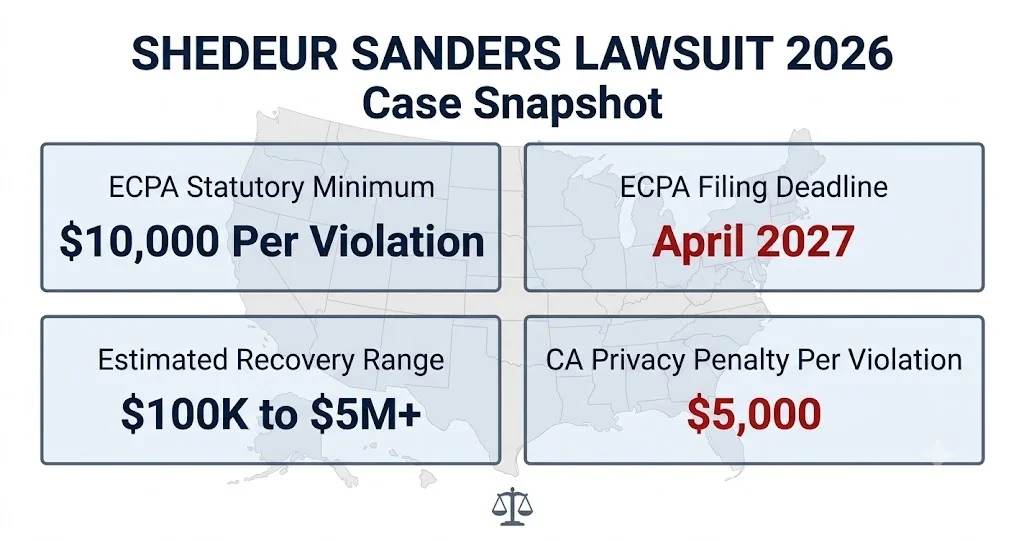
The statutory damages available under Section 2520 are significant. Plaintiffs can recover the greater of actual damages or $100 per day of violation, with a minimum of $10,000. Courts can award punitive damages and attorney fees if the violation was willful.
The critical legal question is whether sharing a private phone number constitutes “disclosure” of an “electronic communication” under ECPA. Federal courts have addressed analogous situations. The majority position is that intentional, unauthorized disclosure of private contact information used to initiate electronic communication falls within ECPA’s scope when the disclosure facilitates unauthorized contact.
ECPA civil remedy framework:
| Recovery Type | Amount |
|---|---|
| Minimum statutory damages | $10,000 |
| Per-day damages (alternative) | $100 per day |
| Punitive damages | Available for willful violations |
| Attorney fees | Recoverable by prevailing plaintiff |
| Actual damages | If higher than statutory minimum |
Attorney Insight: Attorneys litigating ECPA claims note that the $10,000 statutory minimum removes the burden of proving specific monetary harm, making these cases viable even when direct financial loss is difficult to quantify precisely.
Litigation Watch: Federal ECPA claims provide Sanders with a statutory minimum recovery of $10,000 without requiring proof of specific monetary loss, and willful violations open the door to punitive damages that could substantially increase total recovery.
Can Shedeur Sanders Sue the NFL?
Shedeur Sanders can pursue legal action against the NFL, but the procedural path depends on which claim he asserts and which defendant he names. The NFL as an institution, individual team organizations, and team personnel each present different legal and procedural landscapes.
Individual team personnel who disclosed the phone number can be sued in civil court as private individuals. Vicarious liability under respondeat superior would attach to their employing NFL franchise if the disclosure occurred within the scope of their employment duties.
Suing the NFL itself is more complex. The NFL is a private association governed by its own bylaws and the collective bargaining agreement with the NFLPA. Claims that touch the CBA or NFL draft rules are generally subject to mandatory arbitration under Section 301 of the Labor Management Relations Act, 29 U.S.C. Section 185.
Defendant analysis:
| Defendant | Legal Path | Obstacle |
|---|---|---|
| Individual NFL personnel | Civil court, state or federal | Identify specific actors |
| NFL team franchise | Vicarious liability, civil court | Respondeat superior showing |
| NFL as institution | Arbitration likely required | CBA mandatory arbitration |
| Multiple teams (if conspiracy) | Federal court, civil conspiracy | High evidentiary threshold |
Attorney Insight: Attorneys advising plaintiffs in NFL-related disputes consistently recommend naming individual personnel as defendants alongside team organizations, because respondeat superior is easier to establish than direct institutional liability under CBA-governed frameworks.
Shedeur Sanders Discrimination NFL Draft Legal Claim
The discrimination claim arising from Shedeur Sanders’s draft positioning is the most legally complex theory in this case. It requires proving that NFL teams passed on Sanders because of his race, his father’s profile, or other protected characteristics rather than football evaluation.
42 U.S.C. Section 1981 prohibits racial discrimination in the making and enforcement of contracts, including employment contracts. NFL draft selections are functionally contract-making decisions. A Section 1981 claim would require Sanders to show that his race was a but-for cause of his draft positioning.
The evidentiary threshold is formidable. Sanders would need to produce comparative evidence showing similarly situated white quarterbacks received better draft positions without proportional differences in performance metrics, combine results, or team needs. Internal team communications, draft board records, and scouting reports become essential discovery targets.
Discrimination claim elements under Section 1981:
- Membership in a protected class (established)
- Intent to make a contract (NFL draft selection: established)
- Discriminatory intent in the decision (must be proven)
- But-for causation between race and draft positioning (difficult threshold)
Attorney Insight: Attorneys who have litigated Section 1981 claims in sports contexts note that comparative quarterback draft data from the last five to ten years would be the first document request in discovery, because statistical outliers in draft positioning by race create circumstantial evidence of discriminatory intent.
Shedeur Sanders Cleveland Browns Legal Standing
Shedeur Sanders’s legal standing relative to the Cleveland Browns is distinct from any claim against the NFL or other teams. The Browns selected him at Pick 144 in Round 5. That selection created a contractual relationship governed by the NFL Collective Bargaining Agreement and the rookie salary scale.
The Browns’ selection of Sanders does not insulate them from liability for pre-draft conduct if their personnel participated in the phone leak. If a Browns scout, executive, or staff member shared or distributed Sanders’s private number during the draft process, the Browns organization faces direct vicarious liability.
Sanders’s status as a Browns player also affects litigation strategy. Pursuing aggressive litigation against his own employer creates professional complications that any attorney would factor into the risk analysis before filing.
Cleveland Browns legal exposure framework:
| Theory | Applicable If | Risk to Sanders’s Career |
|---|---|---|
| Vicarious liability for phone leak | Browns personnel implicated | Moderate professional risk |
| Direct negligence | Browns failed to secure draft communications | Lower career impact |
| Contract claims re: draft positioning | Draft positioning was Browns’ decision | High career risk |
Attorney Insight: Attorneys in sports law note that players routinely hold legal claims against their own teams in abeyance until after their playing careers, structuring demand letters and tolling agreements to preserve rights without triggering immediate professional consequences.
Litigation Watch: Sanders’s status as a Cleveland Browns player creates a professional calculus that directly affects litigation timing. Most sports attorneys would advise preserving claims through tolling agreements rather than filing active litigation against a current employer.
NFL Draft Phone Number Leak Lawsuit Damages: What Courts Award
Damages in the Shedeur Sanders phone number leak lawsuit fall into three categories: statutory damages under federal law, compensatory damages under state tort law, and punitive damages if willful misconduct is proven.
Federal ECPA statutory damages begin at $10,000 minimum per plaintiff per violation. California Invasion of Privacy Act violations carry civil penalties of $5,000 per violation under California Penal Code Section 637.2. Each unauthorized disclosure can constitute a separate violation.
Compensatory damages for IIED require proof of severe emotional distress, supported by medical records, psychological treatment documentation, and testimony about disruption to daily life. In high-profile cases with documented distress, California juries have awarded $50,000 to $500,000 in IIED compensatory damages.
Damages framework summary:
| Damages Type | Legal Basis | Range |
|---|---|---|
| ECPA statutory minimum | 18 U.S.C. Section 2520 | $10,000 minimum |
| California privacy civil penalty | Cal. Penal Code Section 637.2 | $5,000 per violation |
| IIED compensatory damages | California tort law | $50,000 to $500,000+ |
| Punitive damages | Willful ECPA or IIED violations | 2x to 10x compensatory |
| Attorney fees | ECPA prevailing party | Actual fees recoverable |
Attorney Insight: Attorneys calculating damages in cases involving multiple defendants and multiple disclosure events multiply per-violation statutory penalties by the number of separately identifiable unauthorized acts, which can dramatically increase the baseline recovery figure.
Shedeur Sanders IIED Claim Explained
Intentional infliction of emotional distress is a recognized cause of action in California, Ohio, and most U.S. jurisdictions. The Shedeur Sanders IIED claim refers to the allegation that the phone leak, conducted during the most professionally significant event of his life to that point, constitutes conduct so extreme and outrageous that any reasonable person would suffer severe emotional distress.
California courts apply a four-part test for IIED: (1) the conduct was extreme and outrageous, (2) the defendant intended to cause or recklessly disregarded the probability of causing distress, (3) the plaintiff suffered severe emotional distress, and (4) the defendant’s conduct was the actual and proximate cause of that distress.
The “extreme and outrageous” standard is the most contested element. Courts have found outrageous conduct in situations involving deliberate public humiliation during a professional event. A coordinated phone leak during a nationally televised career-defining moment presents a strong factual argument for meeting that standard.
IIED elements applied to Sanders’s situation:
| Element | Applied Facts | Assessment |
|---|---|---|
| Extreme and outrageous conduct | Leak during national broadcast, career event | Strong argument |
| Intent or reckless disregard | Leak was intentional act | Likely met |
| Severe emotional distress | Publicly stated distress, professional disruption | Requires documentation |
| Causation | Direct link from leak to calls to distress | Documentable |
Attorney Insight: Attorneys pursuing IIED claims note that public statements made by the plaintiff contemporaneously with the events, particularly on social media or in interviews, serve as admissible evidence of distress even before medical documentation is obtained.
Who Is Liable in the Shedeur Sanders Phone Leak?
Liability in the Shedeur Sanders phone leak follows a chain that may include individual actors, their employing NFL teams, and potentially the NFL itself if league-level systems were used to distribute draft materials containing the number.
Under respondeat superior, an employer is liable for an employee’s tortious act if the act occurred within the scope of employment. An NFL scout or executive who accessed Sanders’s private number through league draft systems and then shared it was acting within a professional context. That connection supports vicarious liability for the employing franchise.
If multiple team personnel from different franchises participated in the leak, a civil conspiracy theory becomes available. Civil conspiracy requires proving two or more persons agreed to commit a tort and acted to carry it out. Each conspirator is jointly and severally liable for the resulting harm.
Liability chain analysis:
| Actor | Theory of Liability | Strength |
|---|---|---|
| Individual NFL personnel | Direct tortfeasor | Strong if identified |
| NFL team franchise | Respondeat superior, vicarious liability | Strong if scope of employment shown |
| Multiple teams | Civil conspiracy | Moderate, requires coordination evidence |
| NFL league office | Negligent data security | Moderate, requires showing league controlled the data |
Attorney Insight: Attorneys handling multi-defendant privacy cases note that subpoenas to NFL league offices for draft communication systems and access logs are typically the first discovery move, because those records identify which individuals accessed the private number and when.
Litigation Watch: Joint and several liability under a civil conspiracy theory could make every NFL franchise whose personnel participated in the leak fully responsible for the total damages, not just a proportional share.
What Type of Attorney Handles NFL Draft Lawsuits?
NFL draft lawsuits require an attorney with experience across at least two practice areas: sports law and civil litigation. The specific claims in the Sanders situation also require familiarity with federal privacy statutes, which adds a third specialty dimension.
This is not a personal injury case in the conventional sense. The correct attorney type depends on which claim is being pursued.
Attorney type by claim:
| Claim | Attorney Specialty Required |
|---|---|
| ECPA federal wiretapping claim | Federal civil litigation, privacy law |
| California invasion of privacy tort | California civil litigation attorney |
| IIED claim | Personal injury / civil litigation attorney |
| Section 1981 discrimination claim | Civil rights, employment discrimination attorney |
| CBA grievance (NFL) | Sports law attorney, labor law specialist |
| Civil conspiracy, multi-defendant | Complex civil litigation attorney |
Sports law attorneys with federal civil litigation experience are the correct starting point. Many work on contingency for high-damages cases involving identifiable defendants. Sanders’s documented profile and the public nature of the incident make this a case with commercial appeal for plaintiff’s firms.
Attorney Insight: Attorneys with sports law and privacy litigation experience note that the multi-theory nature of the Sanders claims requires either a law firm with practice depth across all relevant areas or a coordinating team of specialists working under a single lead counsel.
Shedeur Sanders Lawsuit Filing Deadline and Statute of Limitations
The statute of limitations is the non-negotiable deadline for filing a civil lawsuit. Missing it extinguishes the claim regardless of merit. The deadlines in the Shedeur Sanders situation vary by claim type and jurisdiction.
The 2025 NFL Draft occurred on April 24-26, 2025. That date is the reference point for calculating most applicable statutes of limitations.
Statute of limitations by claim:
| Claim | Limitations Period | Deadline (Based on April 2025) |
|---|---|---|
| ECPA civil claim (18 U.S.C. 2520) | 2 years | April 2027 |
| California invasion of privacy tort | 2 years (CCP 335.1) | April 2027 |
| IIED (California) | 2 years (CCP 335.1) | April 2027 |
| Section 1981 discrimination | 4 years (28 U.S.C. 1658) | April 2029 |
| California privacy civil penalty | 3 years (CCP 338) | April 2028 |
The ECPA two-year window is the most pressing deadline for the phone leak claim. If no tolling agreement has been executed, the filing deadline for that claim falls in April 2027.
Attorney Insight: Attorneys in federal privacy litigation routinely seek tolling agreements from defendants early in the process, which pause the statute of limitations clock while negotiations proceed, preserving the plaintiff’s rights without triggering immediate litigation.
NFL Draft Lawsuit Evidence and Proof Standards
Evidence in the Shedeur Sanders NFL draft lawsuit must meet the civil preponderance of evidence standard: more likely true than not. That is a lower bar than criminal proof beyond a reasonable doubt, but the evidentiary categories required are specific.
For the phone leak claim, the core evidence includes: records of who had access to Sanders’s number through NFL draft systems, call logs showing the volume and origin of calls received, communications among NFL personnel sharing the number, and documentation of Sanders’s distress.
NFL draft systems are proprietary, which means subpoenas to the league office are the primary tool for obtaining access logs. Federal courts have authority to compel that production in civil discovery.
Key evidence categories for each claim:
| Evidence Type | Claim It Supports | How Obtained |
|---|---|---|
| NFL draft system access logs | Phone leak, ECPA | Subpoena to NFL |
| Personnel communications (text, email) | Civil conspiracy, phone leak | Subpoena to teams |
| Call logs to Sanders’s number | IIED, harassment | Subpoena to carriers |
| Psychological treatment records | IIED damages | Plaintiff’s own records |
| Draft board and scouting evaluations | Discrimination claim | Subpoena to teams |
| Statistical quarterback draft comparisons | Section 1981 claim | Expert witness analysis |
Attorney Insight: Attorneys in high-profile privacy cases note that preservation letters should be sent to the NFL and all implicated teams immediately upon retaining counsel, because electronic records are often deleted or overwritten under routine IT protocols absent a litigation hold.
State Court vs Federal Court for Shedeur Sanders Lawsuit
Federal court is the correct initial forum for the Shedeur Sanders lawsuit. The ECPA claim under 18 U.S.C. Section 2511 is a federal statute that creates federal question jurisdiction in U.S. District Court under 28 U.S.C. Section 1331. Federal courts also have supplemental jurisdiction over the related California state law claims under 28 U.S.C. Section 1367.
Filing in federal court provides procedural advantages in a case with multiple defendants located in different states. Federal rules of civil procedure give plaintiffs broader discovery tools, including the ability to subpoena witnesses and records nationwide without state-line complications.
If the ECPA claim is not pursued, a California state court filing at Los Angeles Superior Court or the applicable California Superior Court would be the correct venue for invasion of privacy and IIED claims with a California nexus.
Forum selection analysis:
| Scenario | Correct Forum | Why |
|---|---|---|
| ECPA claim as primary theory | U.S. District Court | Federal question jurisdiction |
| California privacy tort primary | California Superior Court | State law claim, CA nexus |
| Section 1981 discrimination | U.S. District Court | Federal question jurisdiction |
| CBA grievance | Private arbitration | CBA mandatory provision |
| Multi-theory (ECPA plus state claims) | U.S. District Court | Supplemental jurisdiction |
Attorney Insight: Attorneys consistently recommend federal court for multi-theory cases involving both federal statutory claims and state tort claims, because consolidating all theories in one forum reduces cost and avoids inconsistent rulings from parallel proceedings.
How Much Could Shedeur Sanders Recover in a Lawsuit?
Total recovery in the Shedeur Sanders lawsuit depends on which claims proceed, how many defendants are named, and whether willful misconduct is proven sufficient to support punitive damages. The figures vary significantly across scenarios.
The statutory floor under ECPA is $10,000 minimum. California privacy civil penalties add $5,000 per violation, and each separate unauthorized disclosure event can constitute an independent violation. If 50 NFL personnel shared or used the number without authorization, that is $250,000 in California civil penalties alone before any IIED or punitive damages are calculated.
In comparable federal privacy cases with documented distress and willful violations, total settlements and verdicts have ranged from $100,000 to $5 million depending on the number of defendants, the severity of harm, and the wealth of the defendants.
Recovery range by scenario:
| Scenario | Estimated Total Recovery |
|---|---|
| Single defendant, limited proof | $10,000 to $75,000 |
| Multiple defendants, documented distress | $100,000 to $750,000 |
| Civil conspiracy, multiple teams, punitive damages | $1,000,000 to $5,000,000+ |
| Settlement with NFL prior to discovery | Confidential; estimated $250,000 to $2,000,000 |
Attorney Insight: Attorneys note that the presence of large institutional defendants, like NFL franchise organizations with documented revenues exceeding $400 million annually, significantly affects jury sympathy and settlement calculations, because defendants with deep pockets face greater pressure to resolve before trial.
Frequently Asked Questions
What is the Shedeur Sanders lawsuit about?
The Shedeur Sanders lawsuit refers to civil legal action arising from the leak of his private cell phone number during the April 2025 NFL Draft and his controversial fifth-round selection after widespread first-round projections.
The phone leak created potential claims under federal wiretapping law, California privacy statutes, and intentional infliction of emotional distress.
The draft positioning raises separate and more complex theories involving potential discriminatory treatment and tortious interference.
Was a formal lawsuit filed by Shedeur Sanders against the NFL?
No confirmed formal civil complaint with a public docket number has been filed as of early 2026.
Legal review has been reported in public media, and pre-litigation demand letters or NFLPA grievance proceedings may be occurring privately without public court records.
The statute of limitations for the primary ECPA claim does not expire until April 2027, leaving time for negotiation before formal filing is required.
What federal laws apply to the Shedeur Sanders phone number leak?
The Electronic Communications Privacy Act, codified at 18 U.S.C. Section 2511, prohibits unauthorized interception and disclosure of private electronic communications.
The civil remedy provision at 18 U.S.C. Section 2520 allows Sanders to sue for a minimum of $10,000 in statutory damages per violation, plus punitive damages for willful violations.
California’s Invasion of Privacy Act under Penal Code Section 632 provides a parallel state-law claim with $5,000 in civil penalties per violation.
Can Shedeur Sanders sue the NFL for how he was treated in the draft?
Sanders can pursue claims against individual NFL team personnel and their employing franchises for the phone leak under vicarious liability principles.
A direct lawsuit against the NFL as an institution for draft positioning faces significant obstacles because the CBA subjects most draft-related disputes to mandatory arbitration under the Labor Management Relations Act.
A Section 1981 racial discrimination claim is legally available but requires proof that race was a but-for cause of the draft positioning decision, a high evidentiary threshold.
What type of attorney would handle a lawsuit like the Shedeur Sanders case?
A sports law attorney with federal civil litigation experience and familiarity with the Electronic Communications Privacy Act is the correct starting point.
For the discrimination theory, a civil rights attorney with Section 1981 experience would need to be involved, either as lead counsel or co-counsel.
Many plaintiff-side firms in this space work on contingency for high-profile cases with documented defendants and strong statutory damages floors.
What is the statute of limitations for Shedeur Sanders to file a lawsuit?
The ECPA civil claim must be filed within two years of the violation, placing the deadline at approximately April 2027.
California invasion of privacy tort claims carry a two-year limitations period under California Code of Civil Procedure Section 335.1, with the same approximate deadline.
The Section 1981 discrimination claim has a four-year federal limitations period under 28 U.S.C. Section 1658, extending the deadline to approximately April 2029.
The Sanders Case and What Comes Next in 2026
The Shedeur Sanders situation is not a closed chapter. The statute of limitations on the primary phone leak claims runs through 2027. Legal review is ongoing. The documented facts, federal statutes, and damages frameworks all support viable civil claims if litigation counsel determines that proceeding serves Sanders’s interests.
The professional calculus of suing a current or future employer adds complexity that pure legal analysis does not fully capture. That tension is why tolling agreements and private demand processes are the most likely immediate tools.
Anyone who believes they have a claim connected to similar NFL draft conduct, unauthorized disclosure of private information, or comparable privacy violations should consult a federal civil litigation attorney with sports law or privacy law experience before any applicable deadline passes.
