Quick Answer Box
- The Venezuelan TPS lawsuit is a federal challenge to DHS’s attempt to end Temporary Protected Status early for Venezuelan nationals.
- Venezuelan TPS holders under the 2021 and 2023 designations are covered, though eligibility depends on which track and documents they hold.
- This case does not involve money. It decides legal status, work authorization, and protection from removal for hundreds of thousands of people.
Case Snapshot
| Detail | Info |
|---|---|
| Court | U.S. District Court for the Northern District of California, on appeal to the Ninth Circuit and Supreme Court |
| Case Number | No. 3:25-cv-01766 (district court); No. 25A326 (Supreme Court stay order) |
| Filing Date | February 19, 2025 |
| Status | Ninth Circuit ruled for plaintiffs; Supreme Court stay currently keeps termination in effect pending further review |
| Settlement Fund | Not applicable. This is injunctive relief litigation over immigration status, not a monetary settlement |
Venezuelan TPS holders have spent more than a year inside a legal tug of war that most explainers flatten into a single headline.
The Venezuelan TPS lawsuit, formally National TPS Alliance v. Noem, has already reached the Supreme Court twice. Roughly 300,000 to 600,000 people have status riding on the outcome, depending on which designation track applies.
Courts keep ruling one way. The Supreme Court keeps pausing that outcome. That gap between “who’s right” and “what’s in effect right now” is the entire story here.
This article walks through the real docket, the real dates, and what Venezuelan TPS holders should actually rely on today.
What Is the Venezuelan TPS Lawsuit
The Venezuelan TPS lawsuit is a federal court challenge to DHS’s decision to cut short Temporary Protected Status for Venezuelan nationals.
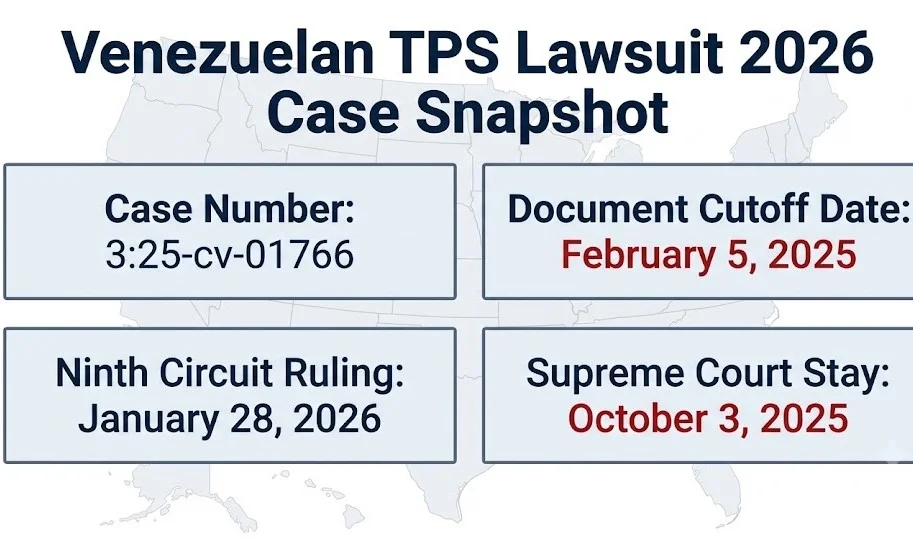
The case is formally titled National TPS Alliance, et al. v. Kristi Noem, et al., filed February 19, 2025, in the Northern District of California. Plaintiffs argue Secretary Noem’s actions violated the Administrative Procedure Act and the Fifth Amendment’s equal protection guarantee.
This is not a class action seeking damages. It is a request that courts set aside DHS’s decision and restore the TPS protections that were already granted.
Attorneys handling these claims point to the unusual pattern of this case reaching the Supreme Court’s emergency docket twice within a single year.
- Filed by: National TPS Alliance and individual Venezuelan TPS holders
- Filed against: DHS Secretary Kristi Noem and related federal officials
- Relief sought: vacating the TPS terminations and restoring prior protections
Venezuelan TPS Class Action Explained
This is structured as a class action for injunctive relief, not for cash compensation.
Plaintiffs represent Venezuelan TPS holders across the country, along with Haitian TPS holders whose case was consolidated on related legal questions. The lawsuit does not ask a jury to award money. It asks a federal judge to reverse an agency decision.
That structure explains why there is no settlement fund, no claim form, and no payout range anywhere in this litigation.
Litigation Watch: The Venezuelan TPS lawsuit seeks status and work authorization, not money, which separates it from typical class action settlements covered elsewhere on this site.
Why DHS Tried to End Venezuelan TPS
DHS Secretary Kristi Noem moved to shorten Venezuelan TPS protections shortly after taking office in January 2025.
Former Secretary Alejandro Mayorkas had extended Venezuela’s TPS designations through October 2, 2026, in one of his final acts. Secretary Noem vacated that extension on February 1, 2025, and later terminated the 2023 designation entirely, moving up the end date to April 2025.
DHS’s position is that the Secretary has broad statutory discretion over TPS determinations. Plaintiffs argue that discretion does not include ignoring the procedures Congress built into the TPS statute.
| Position | Core Argument |
|---|---|
| DHS | Secretary has authority to redetermine whether a country still qualifies for TPS |
| Plaintiffs | Statute requires specific procedures before shortening an already-granted extension |
Who Qualifies for Venezuelan TPS Protection
Coverage depends on which TPS designation track a person registered under, either 2021 or 2023.
The 2021 designation originally ran through September 10, 2025. The 2023 designation, and the redesignation that followed, was extended by Secretary Mayorkas through October 2, 2026, before Secretary Noem’s reversal. Courts have treated these two tracks somewhat differently throughout the litigation.
Attorneys handling these claims point to the specific expiration date on a person’s documents as the fastest way to identify which track applies.
- 2021 Designation: originally set to run through September 10, 2025
- 2023 Designation and redesignation: extended through October 2, 2026 before the reversal
- Affected population: estimated between 300,000 and roughly 600,000 Venezuelan nationals
Venezuelan TPS Lawsuit Eligibility Requirements
Eligibility for the protections at issue in this case requires an existing, valid TPS registration under one of the two Venezuela designations.
Court orders have focused heavily on documentation dates. Specifically, EADs, Form I-797 notices, and Form I-94s issued with an October 2, 2026 expiration date, received on or before February 5, 2025, have been treated as valid pending the litigation’s outcome.
Documents issued after that February 2025 cutoff have faced a harder legal road, since the district court denied relief for that later group.
Bold callout: The February 5, 2025 documentation cutoff is one of the most consequential dates in this entire case.
What the Venezuelan TPS Lawsuit Is Worth
This lawsuit is not worth a dollar amount, since it seeks legal status rather than money.
Its real value to plaintiffs is measured in continued work authorization and protection from removal. For an individual TPS holder, that can mean the difference between a valid job and a lapsed one, or between remaining in the country and facing deportation proceedings.
Comparing this case to a monetary settlement misses the point entirely. Think of it more like a business fighting to keep an operating license than a plaintiff seeking a check.
- What plaintiffs win if successful: restored TPS status and continued work authorization
- What plaintiffs lose if unsuccessful: termination of TPS and loss of associated work permits
Venezuelan TPS Work Authorization Rules
Work authorization tied to Venezuelan TPS currently depends on specific document categories and filing dates, not a blanket rule.
EADs with category A12 or C19, tied to a Card Expires date of April 2, 2025, could be automatically extended for up to 540 days through September 24, 2026, with a timely filed renewal. Separate rules applied to 2021-designation EADs with earlier expiration dates.
Employers are required to reverify certain Venezuelan TPS holders’ work authorization by specific 2026 dates tied to these extensions.
| EAD Category | Extension Rule |
|---|---|
| A12 or C19, Card Expires April 2, 2025 | Extended up to 540 days, through Sept. 24, 2026, with timely renewal |
| 2021-designation EADs (various earlier dates) | Extended until April 2, 2026, if re-registered before Sept. 14, 2025 |
Venezuelan TPS Registration Deadlines
Re-registration deadlines in this case were tied to specific DHS notices rather than a single fixed date for everyone.
Beneficiaries under the 2021 designation needed to have filed to re-register before September 14, 2025, to claim the extended work authorization window described above. Missing that window created real risk of a documentation gap.
Attorneys handling these claims point to missed re-registration deadlines as one of the most common, and most preventable, reasons TPS holders lose protection during active litigation.
Bold callout: Re-registration deadlines in TPS cases do not pause just because litigation is ongoing.
Venezuelan TPS Lawsuit Timeline
This case moved through district court, the Ninth Circuit, and the Supreme Court multiple times in under two years.
The lawsuit was filed February 19, 2025. Judge Edward Chen blocked the termination on March 31, 2025, before the Supreme Court stayed that order on May 19, 2025. Chen then granted summary judgment for plaintiffs on September 5, 2025, and the Supreme Court stayed that ruling too, on October 3, 2025.
| Date | Event |
|---|---|
| February 19, 2025 | Lawsuit filed in N.D. California |
| March 31, 2025 | District court blocks TPS termination |
| May 19, 2025 | Supreme Court stays district court order |
| September 5, 2025 | District court grants summary judgment for plaintiffs |
| October 3, 2025 | Supreme Court stays that ruling as well |
| January 28, 2026 | Ninth Circuit affirms plaintiffs’ win on the merits |
| March 2026 | Ninth Circuit denies rehearing en banc |
Litigation Watch: Every merits ruling in this case has favored the plaintiffs, while every emergency stay has favored the government.
Venezuelan TPS Lawsuit Court and Judge
Senior U.S. District Judge Edward M. Chen has presided over this case from the start, in the Northern District of California.
Judge Chen issued both the original March 2025 postponement order and the September 2025 summary judgment ruling in plaintiffs’ favor. The case then proceeded to the Ninth Circuit Court of Appeals, and separately to the Supreme Court’s emergency docket.
- District Court: U.S. District Court for the Northern District of California
- Presiding Judge: Edward M. Chen
- Appellate Court: U.S. Court of Appeals for the Ninth Circuit
- Emergency Docket: U.S. Supreme Court
Venezuelan TPS Lawsuit Settlement Status
There is no cash settlement in this case, and none is expected, since the dispute concerns agency authority rather than damages.
What exists instead is a live conflict between merits rulings and emergency stays. The Ninth Circuit affirmed that DHS exceeded its authority on January 28, 2026. A Supreme Court stay from October 3, 2025 remains in place, meaning the termination stays in effect until further order.
Bold callout: As of mid-2026, Venezuelan TPS termination remains in effect on paper, even though two rounds of merits rulings found it unlawful.
Venezuelan TPS Lawsuit Appeals and Supreme Court Review
The government can still ask the Supreme Court to review the Ninth Circuit’s merits ruling through a petition for certiorari.
The Supreme Court’s October 2025 stay order explicitly ties itself to that possibility, stating the stay continues pending disposition of any timely certiorari petition. If certiorari is denied, the stay ends automatically. If granted, the stay continues until the Court issues a final judgment.
Attorneys handling these claims point to this stay structure as the reason status can flip again with very little public warning.
| Scenario | Effect on Stay |
|---|---|
| Certiorari denied | Stay terminates automatically |
| Certiorari granted | Stay continues until final Supreme Court judgment |
How to Protect Your Venezuelan TPS Status
The safest step for any Venezuelan TPS holder is confirming exact document dates and filing deadlines rather than relying on general news coverage.
Court orders in this case turn on specific paperwork, including EAD categories, I-797 notice dates, and re-registration filing windows. A missed date can cost protection even while the underlying legal fight continues.
- Confirm your exact TPS designation year (2021 or 2023)
- Check your EAD category and Card Expires date against current USCIS guidance
- Track re-registration and renewal deadlines directly through USCIS and E-Verify updates
Venezuelan TPS Lawsuit by State
This is a nationwide federal case, so protection does not depend on which state a Venezuelan TPS holder lives in.
Because the litigation proceeds through federal court and federal immigration law, eligibility turns on TPS designation and documentation, not residency. A person in Florida and a person in California face identical rules under this case.
State-level resources, community organizations, and local legal aid groups can still matter for practical support, even though the underlying legal question is federal.
| Factor | Nationwide Rule |
|---|---|
| Residency requirement | None |
| Governing law | Federal immigration statute, 8 U.S.C. § 1254a |
| Basis for eligibility | TPS designation year and documentation dates |
Venezuelan TPS Lawsuit Law Firms and Legal Groups Involved
Plaintiffs are represented by the National TPS Alliance along with immigrant advocacy legal organizations, including CARECEN-LA and NDLON.
UCLA’s Center for Immigration Law and Policy has also been involved in litigating and tracking this case. On the government’s side, the case is defended by the U.S. Department of Justice on behalf of DHS and Secretary Noem.
- Plaintiffs’ organizations: National TPS Alliance, CARECEN-LA, NDLON
- Litigation support: UCLA Center for Immigration Law and Policy
- Defendants’ counsel: U.S. Department of Justice, on behalf of DHS
Venezuelan TPS Complaints Beyond This Case
Separate from this specific lawsuit, TPS holders from other countries have filed related but distinct legal challenges.
Haitian TPS terminations were partially addressed within this same case, while Burmese TPS holders won a separate postponement order from a federal court in Illinois in January 2026. Syrian and Haitian TPS terminations have also reached the Supreme Court on related but separate questions.
Readers should not assume a ruling for one designated country automatically applies to another, since each involves its own factual record and timeline.
Bold callout: TPS litigation is now active across several countries at once, and each case has its own docket number and ruling history.
When to Contact an Immigration Attorney About Venezuelan TPS
Contact an immigration attorney if your TPS documents are close to an expiration date or if you are unsure which designation track applies to you.
An attorney can confirm whether your specific EAD, I-797, or I-94 falls within a protected category under current court orders. This matters most for anyone facing an employer reverification request or a pending renewal application.
- Situations that call for a consultation: upcoming EAD expiration, employer reverification notice, uncertainty about which designation year applies
- Situations this litigation does not resolve: individual asylum claims, criminal removal proceedings, and status changes unrelated to TPS
Frequently Asked Questions
Is there still an active Venezuelan TPS lawsuit in 2026?
Yes, National TPS Alliance v. Noem remains active in 2026.
The Ninth Circuit ruled for plaintiffs in January 2026, but a Supreme Court stay still controls what is in effect.
Who qualifies for protection under the Venezuelan TPS litigation?
Coverage depends on registering under the 2021 or 2023 Venezuela TPS designation.
Specific document dates, including a February 5, 2025 cutoff, determine whether a person’s status is currently protected pending the case.
Is Venezuelan TPS currently terminated or still in effect?
As of the Supreme Court’s October 2025 stay, the termination remains in legal effect.
This is true even though lower courts have twice ruled that the termination was unlawful.
What court is deciding the Venezuelan TPS case?
The case originated in the U.S. District Court for the Northern District of California.
It has since been reviewed by the Ninth Circuit Court of Appeals and the U.S. Supreme Court’s emergency docket.
Can the Supreme Court still reverse the Ninth Circuit’s ruling?
Yes, the government may file a petition for certiorari asking the Supreme Court to review the case fully.
If certiorari is denied, the current stay ends automatically; if granted, the stay continues until a final ruling.
Should a Venezuelan TPS holder hire an immigration attorney now?
Anyone with an upcoming TPS document expiration or employer reverification request should consult an attorney now.
This litigation changes quickly, and individual document dates matter more than general news headlines.
The Venezuelan TPS lawsuit shows how a legal win does not always mean immediate protection. Courts have repeatedly sided with TPS holders, yet a Supreme Court stay still controls the ground truth today.
Anyone holding Venezuelan TPS should track their specific document dates rather than general headlines. Speak with an immigration attorney now if a renewal, reverification, or expiration date is approaching.