
Quick Answer
- The Blind Side lawsuit is Michael Oher’s financial exploitation case against Sean and Leigh Anne Tuohy, filed in Tennessee probate court, with the conservatorship already terminated but money claims still pending.
- This case does not have public class eligibility, since it involves one individual plaintiff and two individual defendants, not a group of claimants.
- No confirmed dollar figure or settlement has been publicly verified as of this writing, despite some online claims to the contrary.
| Detail | Info |
|---|---|
| Court | Shelby County Probate Court, Tennessee |
| Case Type | Petition to terminate conservatorship and financial exploitation claim |
| Filing Date | August 14, 2023 |
| Status | Conservatorship terminated; financial claims in discovery as of the most recent verified reporting |
| Settlement Fund | None publicly confirmed; unverified settlement claims exist online |
The Blind Side lawsuit is not a class action, and it never seeks a payout for the public. It is one man’s fight over what he alleges was a decades-long financial deception.
Michael Oher filed his petition in August 2023, alleging Sean and Leigh Anne Tuohy never legally adopted him and instead used a conservatorship to control his finances.
A Tennessee judge ended that conservatorship within weeks. The underlying financial claims, worth potentially millions tied to a $309 million film, are what remains contested.
This piece separates confirmed court facts from unverified online claims about the case’s current status.
The Blind Side Lawsuit
The Blind Side lawsuit refers to Michael Oher’s 2023 petition against Sean and Leigh Anne Tuohy, the couple whose relationship with him inspired the 2009 film. This is a probate court matter, not a class action or mass tort.
Oher alleged the Tuohys never legally adopted him, despite the film’s portrayal, and instead had him sign conservatorship documents shortly after he turned eighteen.
The conservatorship, in place from 2004 until 2023, allowed the Tuohys legal authority over Oher’s business and financial decisions without giving him a familial legal relationship to them.
Quick Facts
- Case type: individual petition, not a class action
- Court: Shelby County Probate Court, Tennessee
- Core allegation: conservatorship used in place of adoption without Oher’s informed consent
Attorneys handling similar conservatorship disputes describe this case as unusual because the underlying arrangement lasted nearly two decades before being challenged.
Blind Side Lawsuit
A Blind Side lawsuit search generally refers to this same underlying case, since no other major litigation shares that name. Confusion sometimes arises because the film and book share the same title as the ongoing legal dispute.
The lawsuit is formally a petition filed in probate court, not a civil complaint filed in a typical trial court, reflecting its origin as a conservatorship matter.
According to court records, the petition ran fourteen pages and detailed how Oher says he discovered the truth about the conservatorship in February 2023.
| Fact | Detail |
|---|---|
| Filed by | Michael Oher |
| Filed against | Sean and Leigh Anne Tuohy |
| Petition length | 14 pages |
| Discovery of alleged deception | February 2023 |
Attorneys handling these claims note that probate court petitions like this one often move differently than standard civil lawsuits, since they originate from oversight of the conservatorship itself.
The Blind Side Lawsuit Update
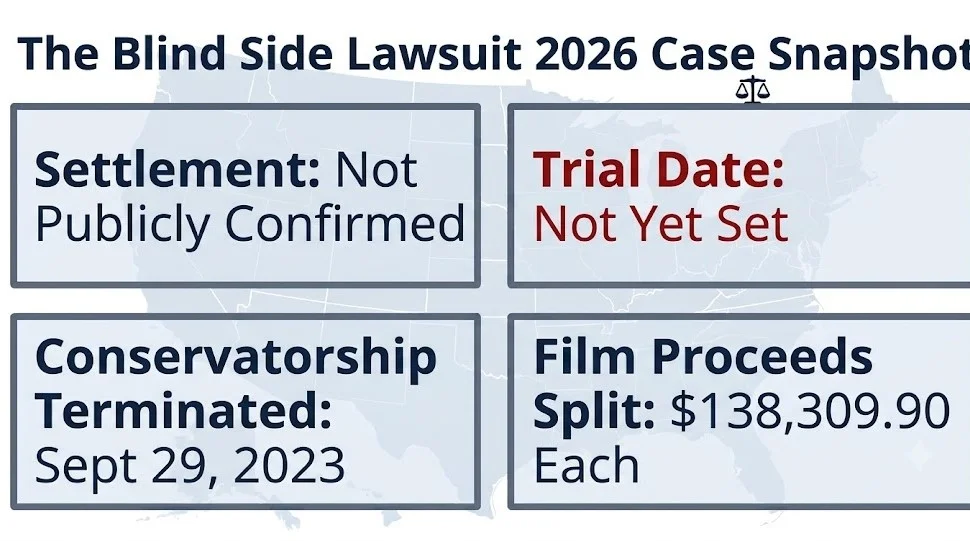
The most recent verified update shows the financial exploitation claims remain in the discovery phase, with no trial date set. This contradicts some online claims that the case has already settled.
According to the most recent dated court reporting reviewed for this piece, from January 2026, both sides remain in discovery, exchanging financial documents and conducting depositions.
Separately, some sites have published claims that the case reached a private settlement in 2026, though these claims are not corroborated by any mainstream news outlet as of this writing.
Bold callout: No mainstream news outlet has confirmed a settlement in this case, despite some sites reporting one as fact.
Attorneys handling similar disputes caution that unverified settlement claims circulating online should not be treated as confirmed legal outcomes without a primary source.
Michael Oher Lawsuit
The Michael Oher lawsuit is the formal name most legal trackers use for this case, since Oher is the petitioner who initiated it. He filed the petition personally, not through a class or organization.
Oher’s petition alleged the Tuohys profited from movie royalties and speaking engagements tied to his story while he received comparatively little, despite his life being the basis for the film.
Court filings show the film’s proceeds were split five ways among Oher and four Tuohy family members, with each receiving $138,309.90, according to a statement of accounting filed in November 2023.
| Party | Reported Film Proceeds Share |
|---|---|
| Michael Oher | $138,309.90 |
| Sean Tuohy | $138,309.90 |
| Leigh Anne Tuohy | $138,309.90 |
| Collins Tuohy | $138,309.90 |
| Sean Tuohy Jr. | $138,309.90 |
Attorneys handling these claims note that an equal proceeds split does not resolve the separate legal question of whether Oher fully understood or consented to the conservatorship terms.
Litigation Watch: The core dispute has moved past the conservatorship itself, since that was terminated in 2023, and now centers entirely on financial exploitation claims still working through discovery.
Michael Oher Tuohy Lawsuit
The Michael Oher Tuohy lawsuit describes the same case from the defendants’ side, naming Sean and Leigh Anne Tuohy as respondents to Oher’s petition. Their legal response has consistently denied the core allegations.
The Tuohys, through attorney Marty Singer, called the allegations “hurtful and absurd” and denied ever profiting improperly from Oher’s story.
In a September 2023 filing, the Tuohys stated there was never an intent to legally adopt Oher, while maintaining they loved him “like a son” in a colloquial, not legal, sense.
- Tuohys deny any financial exploitation occurred
- Tuohys state proceeds were split evenly among all five family members
- Tuohys argue the conservatorship was set up for NCAA eligibility purposes, not profit
Attorneys handling similar disputes note that the “colloquial versus legal” distinction the Tuohys raised is a common defense in cases where informal family language conflicts with formal legal documents.
Blind Side Lawsuit Conservatorship
The conservatorship at the center of this case was a Tennessee legal arrangement giving the Tuohys authority over Oher’s business and financial decisions. It is normally reserved for individuals found to need such assistance.
Oher signed the conservatorship documents in 2004, less than three months after turning eighteen, according to his petition.
A Shelby County probate judge terminated the conservatorship on September 29, 2023, ruling it should never have been granted to a man without a disability requiring it.
| Conservatorship Fact | Detail |
|---|---|
| Established | 2004 |
| Terminated | September 29, 2023 |
| Court | Shelby County Probate Court |
| Basis for termination | No disability requiring the arrangement |
Attorneys handling conservatorship disputes describe termination rulings like this one as relatively swift once a court finds no factual basis for the underlying need.
Who Qualifies for the Blind Side Lawsuit
This specific lawsuit has no public eligibility, since it involves only Michael Oher as petitioner and the Tuohy family as respondents. There is no group claim process to join.
Readers researching this topic are often actually asking a broader question: whether they, personally, have grounds for a similar conservatorship exploitation claim.
Someone in that situation generally needs evidence a conservatorship or similar legal tool was used to control their life or profit from their story without informed consent.
- No public claim process exists for the Oher-Tuohy case specifically
- A similar personal claim generally requires evidence of undisclosed financial exploitation
- Annual conservator accountings, where required, can provide supporting documentation
Attorneys handling these claims note that Tennessee courts require conservators to file annual accountings, which affected individuals have a right to review.
Blind Side Lawsuit Financial Exploitation Claims
The financial exploitation claims allege the Tuohys used their conservatorship authority to profit from Oher’s name, image, and story without adequately compensating or informing him. This is the core legal theory still being litigated.
Oher’s petition specifically sought to stop the Tuohys from continuing to use his name, image, and likeness, in addition to addressing past financial arrangements.
The Tuohys have countered that Oher received an equal share of film proceeds and that no undisclosed profit occurred at his expense.
Bold callout: The Blind Side earned $309 million worldwide, making the underlying financial stakes in this dispute substantial regardless of the final legal outcome.
Attorneys handling these claims note that disputes over name, image, and likeness use have become increasingly common in cases involving public life stories adapted into films or books.
Blind Side Lawsuit Settlement
There is no mainstream news confirmation of a settlement in this case as of this writing, despite some sites reporting one. This distinction matters for anyone trying to understand the actual current status.
The most recently dated, verifiable reporting reviewed for this piece describes the case as still in discovery, with no trial date set as of early 2026.
Readers should treat any settlement claim without a named court filing, attorney statement, or mainstream news citation with real skepticism.
| Claim | Verification Status |
|---|---|
| Conservatorship terminated | Confirmed, September 29, 2023 |
| Case in discovery, no trial date | Confirmed as of most recent verified reporting |
| Case fully settled in 2026 | Not corroborated by mainstream news sources |
Attorneys handling high-profile disputes note that private settlements, when they do occur, are often confirmed by at least one named attorney statement or court filing, not solely by secondary blog coverage.
Blind Side Lawsuit Payout
There is no confirmed payout figure in this case, since the financial exploitation claims remain unresolved as of the most recent verified reporting. Oher’s petition did not specify an exact dollar amount sought.
Court documents do confirm the film’s total proceeds were split five ways, with each of the five parties, including Oher, receiving $138,309.90.
Any additional recovery beyond that documented split would depend on the outcome of the financial exploitation claims still in discovery.
- Documented film proceeds share per person: $138,309.90
- Specific damages sought in the petition: not disclosed publicly
- Confirmed settlement or verdict amount: none as of this writing
Attorneys handling these claims note that undisclosed damages requests are common in petitions like this one, since the exact figure often depends on financial records still being exchanged in discovery.
Blind Side Lawsuit Court Case
The Blind Side lawsuit proceeds in Shelby County Probate Court in Tennessee, the same court that originally granted the conservatorship in 2004. This is a notable detail, since the court overseeing the arrangement is also the one that terminated it.
Oher filed his petition on August 14, 2023, and the court ruled to terminate the conservatorship just weeks later, on September 29, 2023.
The financial exploitation portion of the case remained active well beyond that termination, moving into a document exchange and deposition phase.
| Procedural Step | Date |
|---|---|
| Petition filed | August 14, 2023 |
| Tuohys’ response filed | September 2023 |
| Conservatorship terminated | September 29, 2023 |
| Financial claims in discovery | Ongoing as of most recent verified reporting |
Attorneys handling probate matters note that a court terminating a conservatorship quickly does not necessarily resolve any related financial claims, which can proceed on a separate, longer timeline.
Blind Side Lawsuit Timeline
The Blind Side lawsuit timeline spans from Oher’s 2004 conservatorship signing through ongoing 2026 discovery proceedings. Understanding this sequence clarifies why the case has taken years to resolve.
Oher alleges he did not discover the true nature of the conservatorship until February 2023, nearly two decades after signing it, which delayed the case’s filing significantly.
| Milestone | Date |
|---|---|
| Conservatorship signed | 2004 |
| Alleged discovery of deception | February 2023 |
| Petition filed | August 14, 2023 |
| Conservatorship terminated | September 29, 2023 |
| Financial claims in discovery | Ongoing into 2026 |
Attorneys handling these claims note that a multi-year gap between an alleged deception and its discovery is common in conservatorship cases, since the arrangement itself limits the affected person’s visibility into financial records.
Blind Side Lawsuit Discovery Phase
The discovery phase is where both sides exchange financial documents and take depositions under oath before any trial. This is the stage the financial exploitation claims currently occupy.
According to the most recently dated reporting reviewed, both legal teams have been exchanging records related to movie profits and book royalties tied to the Tuohys’ account of events.
This phase typically takes considerable time in cases involving decades of financial history, which likely explains why no trial date has been set as of early 2026.
- Financial document exchange between both legal teams
- Sworn depositions of relevant parties
- Review of royalty and proceeds records tied to the film and book
Attorneys handling similar financial exploitation cases note that discovery in matters spanning twenty years of records is often the single longest phase of the entire case.
Blind Side Lawsuit Trial Date
No trial date has been set in this case as of the most recent verified reporting reviewed for this piece. The matter remains in discovery, with resolution possible through either settlement or eventual trial.
If the case does not settle, it would proceed to a Tennessee probate court trial or jury proceeding, depending on the specific claims still active at that stage.
Readers should treat any specific trial date circulating online without a named court source as unconfirmed.
| Trial Status Fact | Detail |
|---|---|
| Trial date set | No, as of most recent verified reporting |
| Current phase | Discovery |
| Possible resolution paths | Settlement or eventual trial |
Attorneys handling high-profile probate disputes note that many such cases resolve through negotiated settlement before ever reaching a trial date, given the added public exposure a trial would create for both sides.
Blind Side Lawsuit Attorney
An attorney handling a case like this one typically practices probate and fiduciary litigation, focusing on conservatorships and financial exploitation claims. This differs from a standard personal injury or consumer protection attorney.
Oher has been represented in public statements by attorney Don Barrett, who has spoken to media outlets regarding the case’s developments.
Someone considering a similar claim over their own conservatorship or financial exploitation should look specifically for an attorney experienced in fiduciary duty and elder or vulnerable adult protection law, even if they are not elderly themselves.
- Ask whether the attorney has handled conservatorship termination petitions specifically
- Ask about experience with financial exploitation and fiduciary duty claims
- Ask how document-heavy discovery in these cases typically unfolds
Attorneys handling these claims note that fiduciary duty litigation requires a different skill set than standard personal injury representation, given the heavy reliance on financial and accounting records.
How to File a Conservatorship Exploitation Lawsuit
Filing a conservatorship exploitation claim starts with obtaining the annual accountings a conservator is legally required to file, then documenting any undisclosed financial activity. This mirrors the early steps in Oher’s own case.
Tennessee, like most states, requires conservators to file periodic accountings showing all money received and spent on behalf of the protected person.
An attorney experienced in fiduciary litigation can then help determine whether the facts support terminating the arrangement, pursuing financial recovery, or both.
| Step | What It Involves |
|---|---|
| Request annual accountings | Review money received and spent under the conservatorship |
| Document any undisclosed profit or activity | Compare accountings against known financial events |
| Consult a fiduciary litigation attorney | Determine whether termination, financial claims, or both apply |
Attorneys handling these claims note that a documented gap between what a conservator reported and what actually occurred financially is often the strongest evidence in cases like this one.
Blind Side Lawsuit by State
This specific case is governed by Tennessee probate law, since the conservatorship was established and later terminated in Shelby County. State law significantly shapes how similar cases proceed elsewhere.
Conservatorship rules, required accountings, and termination standards vary by state, meaning a similar case filed in another jurisdiction could follow a different procedural path.
Readers outside Tennessee considering a similar claim should confirm their own state’s specific conservatorship and fiduciary duty statutes with a local attorney.
| Factor | Why State Matters |
|---|---|
| Conservatorship termination standard | Varies by state probate law |
| Required accounting frequency | Set by individual state statute |
| Fiduciary duty claim procedure | Differs across state courts |
Attorneys handling these claims note that Tennessee’s probate court structure directly shaped how quickly this particular conservatorship was terminated once challenged.
Blind Side Lawsuit Deadline
There is no single public filing deadline tied to this case, since it is an individual petition, not a class action with a claims window. Any deadline questions relate specifically to Oher’s own claims.
For someone considering a similar personal claim, the relevant deadline is their state’s statute of limitations for financial exploitation or breach of fiduciary duty, which varies significantly.
Many states apply a discovery rule in these cases, starting the clock when the exploitation was discovered rather than when it began, similar to what Oher alleged in his own petition.
- No public claims deadline exists for this specific case
- A similar personal claim follows the claimant’s own state statute of limitations
- Discovery rules may extend the deadline based on when exploitation was found
Attorneys handling these claims recommend confirming a personal filing deadline promptly, since fiduciary duty claims can be time-barred if not raised within the applicable window.
Frequently Asked Questions
Is the Blind Side lawsuit still active in 2026?
Yes, based on the most recently verified reporting, the financial exploitation claims remain in discovery.
The conservatorship itself was already terminated in September 2023, but the money-related claims continued separately.
What does the Michael Oher lawsuit actually allege?
Oher alleges the Tuohys used a conservatorship, not a legal adoption, to control his finances and profit from his story.
He claims he believed he was signing adoption papers in 2004, only learning the true nature of the arrangement in 2023.
Has the Michael Oher and Tuohy case settled?
No mainstream news source has confirmed a settlement as of this writing.
Some sites report a settlement claim, but it lacks corroboration from a named court filing or attorney statement.
Who qualifies to bring a similar conservatorship exploitation claim?
Someone with evidence a conservatorship was used to control their finances or profit from their story without informed consent may have grounds for a claim.
Reviewing required annual accountings is often the first step in identifying undisclosed financial activity.
Is there a trial date set for the Blind Side lawsuit?
No trial date has been set as of the most recent verified reporting.
The case remains in discovery, and could still resolve through settlement before reaching trial.
What court is handling the Michael Oher lawsuit?
The case is being handled in Shelby County Probate Court in Tennessee.
This is the same court that originally established the conservatorship in 2004 and later terminated it in 2023.
The Blind Side lawsuit has already delivered one clear outcome: a conservatorship a court found never should have existed. The financial exploitation claims remain unresolved.
Anyone facing a similar situation should request their conservator’s required accountings now and consult a fiduciary litigation attorney before any deadline closes.
