
Quick Answer
- A personal lawsuit attorney handles individual civil claims such as injury, malpractice, or wrongful death cases, typically working on contingency rather than an hourly rate.
- Anyone facing a disputed liability claim, a serious or long-term injury, or a lowball insurance offer generally qualifies for a meaningful case review.
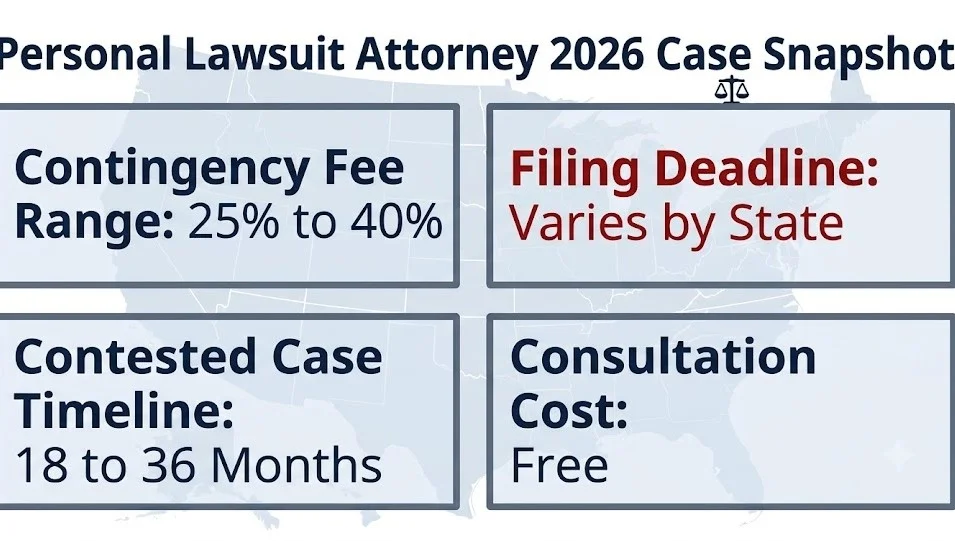
- Fees typically run 25% to 40% of any recovery, and most firms offer a free initial consultation before any commitment is made.
| Detail | Info |
|---|---|
| Practice Area | Personal injury and related individual civil claims, not a single class action or mass tort |
| Common Fee Structure | Contingency fee, typically 25% to 40% of recovery |
| Typical Timeline | Contested cases often run 18 to 36 months from filing to resolution |
| Governing Rules | Vary by state; statutes of limitations and fee arbitration rules differ by jurisdiction |
| Where to Verify Credentials | State bar association attorney licensing records |
Hiring the right personal lawsuit attorney changes more than convenience. It can change whether an insurer treats your claim seriously at all.
That is not an exaggeration. Insurers use claims-evaluation software that scores files partly on whether the attorney behind them actually goes to trial.
This guide breaks down when hiring an attorney actually matters, how fee structures work, and the specific questions that separate a real specialist from a volume-based referral mill.
We also cover timing, since statutes of limitations vary sharply by state and by claim type, and missing one closes the door permanently.
Personal Lawsuit Attorney
A personal lawsuit attorney is a civil litigation lawyer who represents individuals in claims such as injury, malpractice, product liability, or wrongful death. This is distinct from attorneys handling class actions or mass tort litigation on behalf of large groups.
These attorneys typically negotiate with insurance companies first, then file suit only if a fair settlement is not reached through pre-litigation talks.
Because most personal claims involve a single plaintiff, outcomes depend heavily on the specific facts of that individual’s injury, treatment, and financial losses.
Quick Facts
- Individual civil claims, not class or mass tort litigation
- Usually paid on contingency, not by the hour
- Case value depends on the specific facts, not a fixed settlement grid
Attorneys handling these claims describe individual cases as fact-driven rather than formula-driven, unlike class settlements with a fixed payout matrix.
Personal Injury Lawsuit Attorney
A personal injury lawsuit attorney specifically represents people harmed by another party’s negligence, such as car accidents, slip and falls, or defective products. This is the largest subcategory within personal lawsuit representation.
According to state bar guidance, these attorneys assess liability, gather medical records, calculate both economic and non-economic damages, and negotiate directly with insurers.
Attorneys generally recommend hiring one whenever a case involves moderate to serious injury, long-term effects, or a disputed liability question, rather than for minor, clear-fault incidents.
| Injury Severity | Attorney Generally Recommended |
|---|---|
| Minor, undisputed fault, no lasting injury | Often not necessary |
| Moderate injury, some dispute over fault | Recommended |
| Serious, long-term, or disputed liability | Strongly recommended |
Attorneys handling these claims note that liability disputes, not just injury severity, are often the real reason a case needs representation.
When to Hire a Personal Lawsuit Attorney
The right time to hire a personal lawsuit attorney is as soon as an injury requires an emergency room visit, causes missed work, or involves a disputed liability claim. Waiting too long can weaken available evidence.
Cases involving ongoing pain, a large insurance policy on the other side, or an insurer disputing fault entirely tend to benefit most from early legal involvement.
Straightforward, low-value claims with clear fault and minor injury are sometimes manageable without an attorney, though even those benefit from at least one consultation.
- Emergency room visit or hospitalization
- Missed work or ongoing lost income
- Disputed liability or a large insurance policy involved
- Ongoing pain or long-term treatment expected
Attorneys handling these claims generally suggest a consultation immediately after any injury requiring medical treatment, even if hiring counsel is not yet decided.
Litigation Watch: Whether a case needs an attorney depends less on injury severity alone and more on whether liability is disputed and whether the claim involves lasting harm.
How to Find a Personal Lawsuit Attorney
Finding a personal lawsuit attorney starts with narrowing the search to firms that regularly handle your specific type of claim, not general practice attorneys. Personal injury law covers many distinct sub-specialties.
Word-of-mouth referrals from people with direct experience, combined with state bar association verification, remain the most reliable starting point according to legal directories.
A search through your state bar association confirms licensing status and any disciplinary history before you invest time in a consultation.
| Search Method | What It Confirms |
|---|---|
| Word-of-mouth referral | Real client experience |
| State bar association search | Licensing status, discipline history |
| Case-type specific search | Relevant sub-specialty experience |
Attorneys handling these claims recommend treating “personal injury” as an umbrella term and searching specifically for your injury type, such as trucking accidents or medical malpractice.
Personal Lawsuit Attorney Fees
Personal lawsuit attorney fees are typically structured as a percentage of any recovery, not as an upfront hourly charge. This fee arrangement is standard across most personal injury representation.
Fee percentages commonly fall between 25% and 40% of the total settlement or verdict, often increasing if the case proceeds to a filed lawsuit rather than settling pre-litigation.
A written retainer agreement should spell out the exact percentage, how case expenses are handled, and whether the fee changes at different stages of the case.
- Pre-litigation settlement: often lower end of the fee range
- Filed lawsuit or trial: often higher end of the fee range
- Case costs and expenses: should be itemized separately from the fee percentage
Attorneys handling these claims stress that any unclear fee language in a retainer agreement should be clarified in writing before signing.
Personal Lawsuit Attorney Contingency Fee
A contingency fee means the attorney is paid only if the case results in a settlement or verdict, taking a percentage of that recovery instead of hourly billing. If there is no recovery, the client generally owes no attorney fee.
This structure aligns the attorney’s incentive with the client’s outcome, though it can also create pressure to settle quickly in high-volume firms rather than maximize the result.
Clients should ask directly whether the percentage changes if the case moves from negotiation into a filed lawsuit, since many agreements build in that increase.
| Case Stage | Typical Fee Range |
|---|---|
| Pre-suit settlement | Around 25% to 33% |
| After lawsuit is filed | Around 33% to 40% |
| Trial or appeal | May reach the higher end or beyond |
Attorneys handling these claims caution that a firm’s incentive to settle quickly may sometimes conflict with a client’s goal of maximizing total recovery.
Personal Lawsuit Attorney Free Consultation
A free consultation is a no-cost initial meeting where an attorney reviews the basic facts of a case before any retainer agreement is signed. Most personal injury firms offer this as standard practice.
No attorney-client relationship forms during this consultation unless the client chooses to move forward and sign a written retainer agreement afterward.
This meeting is the appropriate time to ask about fee structure, trial experience, and who will actually handle the case day to day.
- Confirm no obligation exists to hire after the consultation
- Ask about fee structure and expense handling in writing
- Ask specifically who manages the case, not just who takes the initial call
Attorneys handling these claims recommend using the free consultation to evaluate fit, not just case value, since you may work with this person for over a year.
Personal Lawsuit Attorney Qualifications
Qualifications worth confirming include state bar licensing status, disciplinary history, and direct experience with your specific type of claim. General reputation alone does not confirm any of these.
A state bar association search reveals licensing status and any public disciplinary record, which is a necessary step before hiring any attorney.
Beyond licensing, ask about the firm’s actual trial record, since insurers evaluate whether a firm regularly goes to court or consistently settles before trial.
| Qualification Check | Where to Verify |
|---|---|
| Active license, no discipline | State bar association |
| Experience with your claim type | Direct question during consultation |
| Trial record, not just settlements | Direct question during consultation |
Attorneys handling these claims note that verdict numbers on a website should never substitute for a direct conversation about case fit.
Personal Lawsuit Attorney Specialties
Personal lawsuit attorneys often specialize within narrower categories rather than practicing generally across all injury types. Matching the right specialty to your case meaningfully affects outcomes.
Common specialties include trucking accidents, medical malpractice, defective medical devices, premises liability, and wrongful death claims, each requiring different evidence and expert testimony.
Choosing a specialist over a general practice attorney often means access to relevant expert witnesses and familiarity with common defense tactics in that specific area.
- Trucking and commercial vehicle accidents
- Medical malpractice and hospital negligence
- Defective products and medical devices
- Premises liability, including slip and fall cases
- Wrongful death claims
Attorneys handling these claims compare specialty selection to choosing a medical specialist, since a general practice attorney may lack the specific expert network a complex claim requires.
Litigation Watch: Fee structure and specialty match are often more predictive of outcome than a firm’s general reputation or advertising presence.
Personal Lawsuit Attorney vs Self Representation
Self-representation can work for straightforward, low-value claims with clear fault and minor injury, but it becomes risky once liability is disputed or damages are significant. The stakes of the specific case should drive this decision.
An attorney assesses liability, gathers medical records, calculates full damages, and negotiates directly with insurance adjusters trained to minimize payouts.
Handling a case alone means facing that same trained adjuster without equivalent leverage, which often results in a lower settlement offer even in valid claims.
| Factor | Self-Representation | Attorney Representation |
|---|---|---|
| Minor injury, clear fault | Often manageable | Optional, still advisable to consult |
| Disputed liability | High risk | Strongly recommended |
| Significant or long-term damages | High risk | Strongly recommended |
Attorneys handling these claims note that insurance adjusters routinely offer lower settlements to unrepresented claimants, regardless of claim validity.
Personal Lawsuit Attorney Red Flags
Red flags include attorneys who guarantee a specific outcome, avoid answering fee questions directly, or show no willingness to discuss trial experience. Any of these should prompt a second opinion.
A firm that always settles before trial may be treated differently by insurers, since an insurer’s first assessment is whether your lawyer will actually litigate if needed.
Vague answers about who handles your case day to day, or unwillingness to put fee terms in writing, are both signs to keep looking.
- Guarantees a specific settlement amount before reviewing your case
- Will not clearly explain fee percentages in writing
- Cannot describe any trial experience or comparable case outcomes
- Unclear about who will actually manage your case
Attorneys handling these claims describe a firm’s willingness to try cases, not just settle them, as a meaningful factor in how insurers value a claim.
Personal Lawsuit Attorney Questions to Ask
The right questions during a consultation reveal whether a firm is actually equipped to handle your specific case, not just interested in signing you as a client. Prepare these before your first call.
Direct questions about experience, fee structure, and case management responsibility separate serious firms from high-volume intake operations.
Bring a written list of your case facts to the consultation so the attorney can give a grounded, rather than generic, initial assessment.
- What kinds of cases do you focus on, and have you handled ones like mine
- How many similar cases have you taken, and how did they resolve
- Who handles my case day to day, you or another attorney
- Do you work on contingency, and exactly how is the fee structured
Attorneys handling these claims note that a firm willing to answer every one of these questions directly is usually a stronger sign than any advertising claim.
Personal Lawsuit Settlement Negotiation
Settlement negotiation is the process where an attorney and the opposing insurer or party attempt to resolve a claim without going to trial. Most personal injury cases resolve at this stage rather than in court.
Attorneys typically build a demand package including medical records, income loss documentation, and sometimes expert reports to support a specific settlement figure.
Insurers use internal scoring systems to evaluate claims, and a well-documented demand package can meaningfully shift how a claim gets valued.
| Negotiation Component | Purpose |
|---|---|
| Demand letter | States the claim and requested settlement amount |
| Medical records | Documents injury severity and treatment |
| Income loss documentation | Supports economic damages calculation |
| Expert reports (when used) | Strengthens complex causation or damages claims |
Attorneys handling these claims describe a strong demand package as the primary tool for overcoming an insurer’s initial lowball offer.
Personal Lawsuit Attorney Timeline
A contested personal lawsuit typically takes 18 to 36 months to resolve from filing to final outcome. Straightforward claims that settle pre-litigation often move considerably faster.
Cases that proceed through formal discovery, depositions, and pretrial motions naturally extend the timeline well beyond an initial settlement demand.
Clients should expect ongoing communication rather than a single quick resolution once a case moves past the initial demand stage into active litigation.
- Pre-litigation settlement: often resolves within several months
- Filed lawsuit with discovery: commonly 18 to 36 months
- Trial or appeal: can extend the timeline significantly further
Attorneys handling these claims caution clients early that a contested case is a marathon, not a quick transaction, especially once litigation begins.
Personal Lawsuit Attorney Cost
The direct cost to a client is usually built into the contingency fee rather than charged upfront, though case expenses are typically handled separately. Understanding both components avoids surprises later.
Contingency fees generally range from 25% to 40% of the recovery, while case costs, such as expert witness fees or filing costs, are often advanced by the firm and repaid from any settlement.
Clients should confirm in writing whether they owe anything if the case does not result in a recovery, since this varies by firm and by agreement.
| Cost Component | Typical Structure |
|---|---|
| Attorney fee | Contingency, 25% to 40% of recovery |
| Case expenses | Often advanced by the firm, repaid from settlement |
| No recovery outcome | Should be clarified in writing before signing |
Attorneys handling these claims recommend getting the full cost structure in writing before signing any retainer agreement.
Personal Lawsuit Statute of Limitations
A statute of limitations is the legal deadline by which a lawsuit must be filed, and it varies significantly by state and by claim type. Missing it generally bars the claim permanently.
Some states apply a discovery rule, starting the clock when the harm was discovered rather than when it occurred, particularly in malpractice or product liability claims.
Because these deadlines differ so widely, confirming the specific timeline for your state and claim type with an attorney is the only reliable approach.
- Deadlines vary by state, not a single national rule
- Claim type affects the deadline, such as malpractice versus general injury
- The discovery rule may extend the deadline in certain circumstances
Attorneys handling these claims stress that confirming your specific deadline early prevents losing a valid claim to a missed filing window.
Personal Lawsuit Attorney by State
State law significantly affects both the attorney search process and the underlying claim, since fee arbitration rules, damage caps, and negligence standards differ across jurisdictions. This is not a one-size-fits-all process.
Comparative negligence rules, for example, determine whether a claimant can recover damages even if partially at fault, and these rules vary meaningfully from state to state.
District and state bar associations also maintain fee arbitration panels to resolve disputes between clients and attorneys, providing a formal path if a fee disagreement arises later.
| State-Level Factor | Why It Matters |
|---|---|
| Comparative negligence rule | Affects recovery even with partial fault |
| Damage caps | Some states limit non-economic damages |
| Fee arbitration panels | Resolve fee disputes through the state bar |
Attorneys handling these claims recommend confirming your state’s specific negligence rule early, since it can directly affect case strategy.
How to File a Personal Lawsuit
Filing a personal lawsuit generally follows attempted settlement negotiation, medical documentation, and a final decision that a fair resolution cannot be reached outside of court. Most cases do not reach this stage.
An attorney typically files a formal complaint in the appropriate court once negotiations stall, initiating discovery and setting the case on a litigation timeline.
From there, the case proceeds through discovery, potential motions, and either a negotiated settlement or trial, depending on how the evidence develops.
| Step | What Happens |
|---|---|
| Pre-suit negotiation | Demand package sent, insurer responds |
| Filing | Attorney files formal complaint in court |
| Discovery | Both sides exchange evidence and testimony |
| Resolution | Settlement or trial, depending on case progress |
Attorneys handling these claims note that filing suit itself often shifts negotiation leverage, even before trial ever becomes necessary.
Frequently Asked Questions
Do I need a personal lawsuit attorney for a minor injury?
Not always, particularly if fault is clear and the injury is minor with no lasting effects.
A free consultation is still worthwhile to confirm the claim does not involve hidden complications.
How much does a personal lawsuit attorney cost?
Most personal lawsuit attorneys work on contingency, meaning no upfront fee is owed.
The fee is typically 25% to 40% of any recovery, with case expenses often handled separately.
What percentage does a personal lawsuit attorney take?
Contingency fees commonly range between 25% and 40% of the total settlement or verdict.
The percentage often increases if the case moves from negotiation into a filed lawsuit.
How long does a personal lawsuit take to settle?
Straightforward pre-litigation settlements can resolve within several months.
A contested case that proceeds through litigation commonly takes 18 to 36 months to fully resolve.
Can I file a personal lawsuit without an attorney?
Yes, though it is generally only advisable for minor, low-value, and undisputed claims.
Any case involving disputed liability or significant damages carries real risk without legal representation.
What is the deadline to file a personal lawsuit?
The deadline depends entirely on your state’s statute of limitations and the specific type of claim.
Confirming this deadline promptly with an attorney is the only reliable way to protect your right to file.
Choosing a personal lawsuit attorney is really a fit decision, not just a search for the biggest name. Fee clarity, specialty match, and trial readiness matter more than advertising.
Anyone facing a disputed claim or a serious injury should use a free consultation now to confirm both the fee structure and the applicable deadline before time runs out.
