Quick Answer Box
- What is this case? Multiple lawsuits allege that Mielle Organics’ Rosemary & Mint Strengthening Hair Oil causes hair loss, scalp inflammation, and permanent follicular damage despite being marketed as a strengthening treatment.
- Who qualifies? U.S. consumers who purchased and used the product and experienced documented hair loss, scalp irritation, thinning, or alopecia-type symptoms may qualify to join or file a related claim.
- What is it worth? No class-wide settlement has been finalized as of mid-2026. Individual claim values in comparable hair product liability cases have ranged from $500 to $75,000+, depending on severity and documentation.
Case Snapshot
| Detail | Information |
|---|---|
| Primary Defendant | Mielle Organics LLC |
| Parent Company | Procter & Gamble Co. (acquired 2022) |
| Product at Issue | Mielle Rosemary & Mint Strengthening Hair Oil |
| Legal Claims Filed In | U.S. District Courts (multiple jurisdictions; no centralized MDL confirmed as of publication) |
| Primary Legal Theories | Strict products liability, negligence, breach of implied warranty, consumer protection statute violations |
| Filing Activity | Individual and putative class action complaints filed; class certification not yet granted |
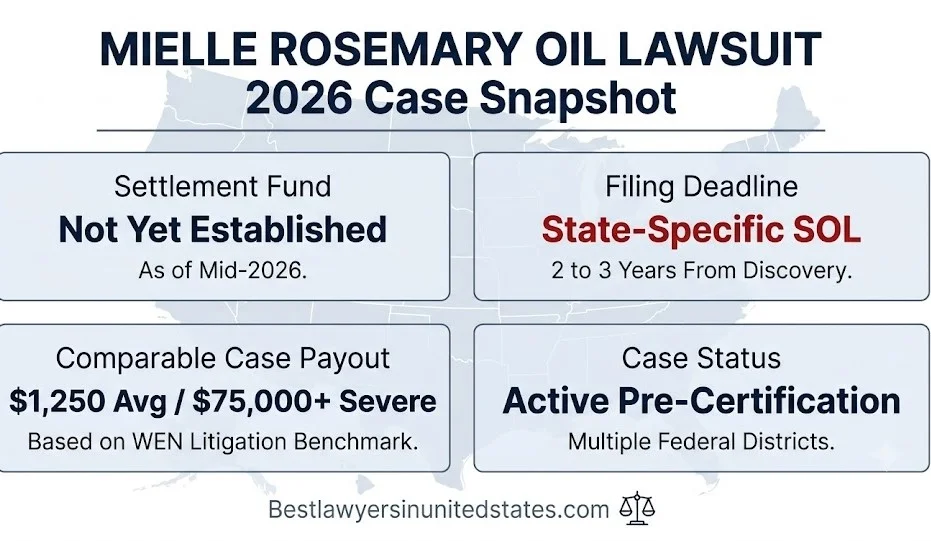
| Settlement Fund | No global settlement fund established as of mid-2026 |
| Case Status | Active litigation; pre-certification phase |
| Regulatory Context | FDA adverse event reporting active; MOCRA (2022) applies to cosmetic safety substantiation |
Introduction
The Mielle rosemary oil lawsuit has drawn sustained legal attention since the first wave of consumer complaints surfaced alleging that the company’s bestselling hair oil caused accelerated shedding, scalp damage, and in documented cases, permanent alopecia. What began as online consumer reports has now translated into formal federal court filings against Mielle Organics LLC and its parent, Procter & Gamble.
As of mid-2026, the litigation remains in active pre-certification phases across multiple jurisdictions. No single multidistrict litigation consolidation has been ordered, though plaintiff attorneys have begun exploring that procedural path.
The case raises questions that extend well beyond any single product. At its center is a legal argument that a cosmetic marketed specifically to strengthen and protect hair may have done the opposite for thousands of consumers, and that neither the label nor the company’s marketing disclosed that risk.
Readers who used this product and experienced hair loss are not simply dealing with a bad consumer experience. They may be sitting on a documentable product liability claim.
What Is the Mielle Rosemary Oil Lawsuit?
The Mielle rosemary oil lawsuit refers to civil legal actions filed against Mielle Organics LLC, alleging that the company’s Rosemary & Mint Strengthening Hair Oil caused physical harm to consumers, specifically hair loss, scalp irritation, follicular damage, and in some cases, diagnosable alopecia.
The lawsuits are not minor disputes over a product that simply underperformed. They are tort-based claims asserting that the product caused physical injury, that Mielle knew or should have known of the risk, and that consumers received no adequate warning.
Plaintiffs contend the product’s formulation, specifically certain synthetic polymer-based conditioning agents combined with penetrating oil carriers, created a scalp environment hostile to healthy hair growth.
Key allegations across filed complaints include:
- Misrepresentation of the product as safe and strengthening
- Failure to warn of documented adverse effects
- Breach of the implied warranty of merchantability
- Violations of state consumer protection statutes
- Negligent product formulation and quality testing
Attorney Insight: Attorneys handling these claims point to the gap between the product’s marketing language, specifically terms like “strengthening” and “nourishing,” and the physical outcomes documented in plaintiff medical records, as a core narrative issue for eventual class certification.
Mielle Organics Lawsuit 2026: Where Things Stand Now
In 2026, the Mielle Organics lawsuit landscape presents a case that is legally active but procedurally unsettled. No federal judge has certified a plaintiff class as of the publication of this article.
That procedural status matters. Without class certification, each plaintiff technically pursues an individual claim. The legal pressure that drives defendants toward settlement increases substantially once a class is certified.
Plaintiff attorneys filed initial complaints in multiple federal district courts beginning in 2023 and continued amending those complaints through 2024 and 2025. The litigation expanded as additional consumers added their documented experiences to the evidentiary record.
2026 Litigation Status Snapshot:
| Milestone | Status |
|---|---|
| Initial complaints filed | Confirmed (2023-2024) |
| Class certification motion filed | Pending in at least one district |
| Multidistrict litigation (MDL) petition | Under consideration |
| Global settlement negotiations | Not yet initiated publicly |
| Discovery phase | Active in lead cases |
| Trial date set | None confirmed as of mid-2026 |
Attorney Insight: Attorneys handling these claims point to the discovery phase as the period most likely to produce internal Mielle or P&G documents related to pre-launch safety testing, which could significantly alter the litigation’s trajectory.
Mielle Rosemary Mint Oil Lawsuit: The Specific Product at Issue
The product at the center of the litigation is the Mielle Rosemary & Mint Strengthening Hair Oil, sold widely through major retail chains including Target, Walmart, CVS, Sally Beauty, and online through Amazon and Mielle’s direct website.
The product surged in popularity on social media platforms beginning in 2022, with viral content recommending it for hair growth. That visibility accelerated its market penetration and simultaneously expanded the pool of people who now report adverse outcomes.
Consumer complaints filed with the FDA’s MedWatch system and with the Better Business Bureau describe outcomes including:
- Sudden and accelerated hair shedding beginning within weeks of first use
- Scalp burning, itching, or inflammation during or after application
- Bald patches developing at temples, crown, and hairline
- Persistent thinning that did not reverse after discontinuing use
- Dermatologist-confirmed alopecia following product use
The product is not a drug. It is classified and regulated as a cosmetic, which means the legal burden of pre-market safety proof was historically lower than for pharmaceutical products. MOCRA, passed in December 2022, has begun to change that regulatory baseline.
Attorney Insight: Attorneys handling these claims point to the product’s cosmetic classification as a double-edged factor, it lowered the company’s pre-launch safety bar, but it also means consumers reasonably expected the product to be safe by default.
Mielle Organics Class Action: How the Case Is Structured
A class action against Mielle Organics is the legal vehicle most plaintiff attorneys are pursuing, as opposed to individual personal injury claims filed separately.
For a class action to proceed, the court must certify it. That means a federal judge must find that the case meets specific legal requirements under Federal Rule of Civil Procedure 23.
The four core Rule 23 requirements:
| Requirement | What It Means for This Case |
|---|---|
| Numerosity | Thousands of consumers report similar harms; this threshold is easily satisfied |
| Commonality | Common questions of law and fact (same product, same alleged defect) must exist |
| Typicality | Named plaintiffs’ claims must be typical of the broader class |
| Adequacy | Named plaintiffs and their attorneys must adequately represent the class |
Courts also weigh whether common questions predominate over individual ones. The individual nature of hair loss, meaning some people suffer permanent damage, others temporary thinning, creates a predominance challenge plaintiff attorneys are actively working to address.
Attorney Insight: Attorneys handling these claims point to the product’s uniform formulation across all units sold as a key argument for commonality, since the alleged defect is in the product itself, not in individual consumer misuse.
Litigation Watch: The class certification motion, the pre-MDL filing activity, and the discovery phase running simultaneously in 2026 represent the three procedural pressure points most likely to force a resolution in this case within the next 12 to 24 months.
Who Qualifies for the Mielle Rosemary Oil Lawsuit?
Qualifying for the Mielle rosemary oil lawsuit requires meeting a threshold that most plaintiff attorneys describe as a combination of product use, documented harm, and timeline.
There is no single national registry or claim portal as of mid-2026. Qualification is assessed case by case or, pending class certification, through a class membership definition set by the court.
General eligibility indicators based on current complaint language:
- Product purchase and use: You purchased and applied Mielle Rosemary & Mint Strengthening Hair Oil to your scalp or hair
- Adverse outcome: You experienced hair loss, shedding, thinning, scalp irritation, or alopecia symptoms following use
- Timeline: Adverse effects occurred within a reasonable period after beginning product use (typically within weeks to a few months)
- Documentation: Medical records, dermatologist reports, photos, purchase receipts, or other contemporaneous records strengthen a claim significantly
- Causal link: No pre-existing condition fully explains the onset of hair loss (though pre-existing conditions do not automatically disqualify a claimant)
Factors that strengthen a claim:
- Dermatologist or physician diagnosis of alopecia or scalp damage
- No prior history of comparable hair loss before product use
- Multiple purchased units or extended use period
- Photographic documentation of hair loss progression
Attorney Insight: Attorneys handling these claims point to the value of medical documentation obtained promptly after the adverse event, since claims supported by contemporaneous physician records are materially stronger than those relying on consumer recollection alone.
Mielle Organics Lawsuit Hair Loss: What the Medical Record Shows
The core physical injury alleged across these lawsuits is hair loss, but “hair loss” in a legal context requires medical specificity that consumer descriptions alone cannot provide.
Dermatologists evaluating plaintiffs in hair product litigation typically document one of several clinical presentations:
Common clinical diagnoses reported in related cases:
| Diagnosis | Description | Significance for Litigation |
|---|---|---|
| Traction alopecia | Hair loss from mechanical pull | Less directly tied to chemical formulation |
| Seborrheic dermatitis | Scalp inflammation causing shedding | May be triggered by product ingredients |
| Contact dermatitis | Allergic or irritant scalp reaction | Directly implicates product chemistry |
| Telogen effluvium | Systemic shedding triggered by stress event | Requires establishing the product as the triggering stressor |
| Scarring alopecia | Permanent follicular destruction | Highest severity; strongest damages argument |
Permanent follicular damage is the most legally significant outcome. Follicles destroyed by chemical insult do not regenerate.
That permanence elevates a claim from a temporary nuisance to a permanent bodily injury, which courts treat differently for both compensatory and potential punitive damages purposes.
Attorney Insight: Attorneys handling these claims point to scalp biopsy results as the most powerful single piece of evidence in these cases, because they provide histological proof of follicular damage that cannot be disputed by citing normal hair cycling patterns.
Mielle Rosemary Oil Hair Loss Claims: Consumer Reports and FDA Activity
Consumer-reported adverse events linked to the Mielle Rosemary & Mint Strengthening Hair Oil appeared in FDA adverse event channels and across major consumer review platforms beginning in late 2022 and accelerating through 2023.
The FDA’s MedWatch system, which historically underrepresented cosmetic adverse events, received a documented uptick in reports involving hair care products in this category following MOCRA’s passage, which expanded mandatory reporting requirements for cosmetic manufacturers.
Documented consumer complaint patterns:
- Hair loss onset reported within two to six weeks of first use in the majority of accounts
- Scalp burning or stinging described as occurring during application
- Shedding described as dramatically above baseline, with some consumers reporting visible bald areas
- Most reports note that shedding did not fully reverse after discontinuing use
The volume of consistent complaints across independent platforms, including Amazon reviews, FDA channels, and dermatologist office reports, is precisely the type of convergent evidence that plaintiff attorneys use to establish that a product’s harm is systemic rather than idiosyncratic.
Attorney Insight: Attorneys handling these claims point to the convergence of adverse event reports across multiple independent data sources as evidence of a pattern that defendant manufacturers will struggle to attribute purely to individual user error or pre-existing conditions.
Litigation Watch: The medical specificity of plaintiff claims, the FDA adverse event record, and the documented permanence of follicular injury in some consumers represent the three evidentiary pillars most likely to determine class certification and damages arguments in this litigation.
Mielle Rosemary Oil Ingredients Lawsuit: What Is in the Product?
The ingredient-based legal argument is one of the more technically complex aspects of the mielle rosemary mint oil lawsuit. Plaintiffs allege the product’s formulation caused harm, which requires scrutinizing what the product actually contains and how those ingredients interact with the scalp.
Mielle Rosemary & Mint Strengthening Hair Oil ingredients of legal interest:
| Ingredient | Function | Alleged Concern |
|---|---|---|
| Mineral Oil | Occlusive sealant | May trap scalp irritants; blocks absorption of beneficial ingredients |
| Polyquaternium-37 | Synthetic conditioning polymer | Associated with scalp buildup and potential follicular occlusion in some formulations |
| Biotin | B-vitamin | Generally safe; present in low concentrations |
| Rosemary Leaf Extract | Botanical stimulant | Generally recognized as safe; not the primary ingredient of concern |
| Peppermint Oil | Active botanical | Can cause irritation or sensitization in some individuals |
| Fragrance (undisclosed blend) | Scent | “Fragrance” as an ingredient can mask dozens of undisclosed compounds under FDA rules |
The undisclosed fragrance blend is a particularly active area of investigation. Under pre-MOCRA cosmetics rules, manufacturers could list “fragrance” on a label without disclosing its constituent compounds, some of which include known allergens and sensitizers.
Attorney Insight: Attorneys handling these claims point to the fragrance disclosure gap as a significant legal vulnerability for the defendant, since post-MOCRA regulatory standards now require more transparency that the product’s original formulation may not have anticipated.
Mielle Organics Procter & Gamble Lawsuit: Who Is the Real Defendant?
Procter & Gamble completed its acquisition of Mielle Organics in January 2022. That transaction has direct legal significance for anyone pursuing a claim.
When a parent corporation acquires a subsidiary, it generally assumes liability for the subsidiary’s products, including products already on the market at the time of acquisition.
P&G is one of the largest consumer goods companies in the world. Its acquisition of Mielle brought the brand’s products, supply chain, and quality control infrastructure under P&G’s corporate umbrella.
Corporate liability structure in this litigation:
| Entity | Role | Liability Exposure |
|---|---|---|
| Mielle Organics LLC | Original manufacturer and brand owner | Direct product liability for pre-and post-acquisition sales |
| Procter & Gamble Co. | Parent company (post-January 2022) | Successor liability; potential direct negligence in quality oversight |
| Retail Defendants | Target, Walmart, CVS, Amazon (potential) | Possible seller liability under strict liability in some states |
P&G’s deep pockets make this litigation materially different from a case against a standalone indie beauty brand. Corporate defendants with P&G’s resources engage in extended discovery battles, but they also have strong institutional incentives to settle class actions before trial.
Attorney Insight: Attorneys handling these claims point to P&G’s post-acquisition quality control responsibility as a separate theory of liability from Mielle’s original formulation decisions, meaning plaintiffs have two distinct corporate targets with potentially overlapping culpability.
Is Mielle Rosemary Oil Safe? The Regulatory and Scientific Record
The question of whether Mielle Rosemary & Mint Strengthening Hair Oil is safe requires a precise answer grounded in regulatory science, not marketing language.
As of 2026, the FDA has not issued a formal recall order for the product. The product remains on retail shelves.
That fact does not, by itself, mean the product is safe. Under pre-MOCRA cosmetics law, the FDA did not have mandatory recall authority over cosmetic products. MOCRA changed that, but implementing regulations are still being finalized.
What the regulatory record shows:
- No FDA recall: Product remains commercially available as of mid-2026
- Adverse event reports: Filed through MedWatch; volume and pattern are relevant to litigation
- No pre-market safety approval required: Cosmetics do not require FDA approval before sale
- MOCRA compliance: Manufacturers are now required to maintain safety substantiation records on file
- EWG Skin Deep database: Certain formulation components flag moderate concern ratings for scalp health
The legal argument is not “the FDA banned it.” The argument is that the product caused harm, that the manufacturer failed to adequately test it, and that consumers were not warned of known or knowable risks.
Attorney Insight: Attorneys handling these claims point to the distinction between regulatory silence and safety validation, emphasizing that the absence of an FDA recall does not constitute proof that the product was properly tested or safe for scalp application.
Litigation Watch: The P&G acquisition structure, the fragrance disclosure gap, and the post-MOCRA regulatory pressure on cosmetic manufacturers collectively represent the strongest legal flanks in this litigation for plaintiffs entering 2026.
Mielle Hair Oil Lawsuit Settlement Amount: What Could a Claim Be Worth?
No confirmed global settlement amount exists in the Mielle rosemary oil litigation as of mid-2026. Any dollar figure presented as a confirmed payout at this stage would be inaccurate.
What can be stated with precision is how damages are typically calculated in analogous hair product liability class actions and personal injury claims.
Compensatory damages categories commonly awarded in hair product cases:
| Damage Category | Description | Typical Range |
|---|---|---|
| Medical expenses | Dermatologist visits, scalp treatments, biopsy costs | $500 to $5,000+ |
| Future medical costs | Ongoing treatment for permanent alopecia | $2,000 to $15,000+ |
| Pain and suffering | Emotional and psychological distress | $1,000 to $25,000+ |
| Lost wages | Career impact (documented cases only) | Case-specific |
| Product refund | Cost of product purchased | $10 to $50 per unit |
| Punitive damages | Available where manufacturer conduct was egregious | Multiplier of compensatory damages |
For context, the WEN hair care product litigation, a directly analogous case involving hair loss caused by a hair care product, resulted in a $26.25 million settlement fund for approximately 21,000 claimants, averaging roughly $1,250 per claimant before attorney fees.
That comparison does not predict what Mielle claimants will receive. It establishes that this category of litigation does produce real monetary outcomes.
Attorney Insight: Attorneys handling these claims point to the severity and permanence of the documented injury as the primary driver of individual claim value, with cases involving scarring alopecia typically commanding significantly higher settlements than cases involving temporary shedding.
Mielle Class Action Settlement Payout: How Distribution Would Work
If a class action settlement is reached in the Mielle litigation, the distribution process follows a structured procedure that courts supervise closely.
Settlement funds in class actions are not simply divided equally. Courts approve a plan of allocation, which assigns claim values based on the nature and severity of each class member’s documented harm.
Typical class action settlement distribution structure:
| Phase | What Happens |
|---|---|
| Settlement agreement signed | Parties agree on total fund and allocation formula |
| Preliminary court approval | Judge grants preliminary approval of settlement terms |
| Class notice issued | Eligible claimants notified by mail, publication, or website |
| Claims filing period | Class members submit claims with supporting documentation |
| Claims administrator review | Third-party administrator verifies and values each claim |
| Final court approval hearing | Judge approves distribution plan |
| Payment issued | Claimants receive checks or electronic payments |
The claims filing period is the critical window. Claimants who do not file by the court-set deadline receive nothing, regardless of the severity of their injury.
Attorney fees in class actions typically range from 25 to 33 percent of the total settlement fund, approved separately by the court. That fee comes out of the total fund before distribution to class members.
Attorney Insight: Attorneys handling these claims point to the importance of filing a complete and documented claim during the claims period, because poorly documented claims are often reduced or rejected by claims administrators, even when the underlying injury is genuine.
Mielle Hair Loss Lawsuit Compensation: Individual Claims vs. Class Membership
Consumers considering this litigation face a concrete choice: participate in a class action if one is certified, or file an individual personal injury lawsuit.
The right path depends on the severity of the injury and the strength of available documentation.
Class action vs. individual claim comparison:
| Factor | Class Action | Individual Lawsuit |
|---|---|---|
| Average payout | Lower; divided among all members | Higher; reflects full individual damages |
| Effort required | File a claim form | Full litigation with depositions and discovery |
| Time to resolution | Typically faster once certified | Slower; may take years |
| Attorney cost | Contingency; no upfront cost | Contingency; no upfront cost typically |
| Best for | Moderate or temporary harm | Permanent, severe, or high-dollar injury |
| Risk level | Lower; settlement likely if certified | Higher; trial is possible |
Consumers with permanent alopecia, significant medical bills, or career-affecting hair loss may recover substantially more through an individual lawsuit than through a class settlement.
That calculation is fact-specific. A product liability attorney with experience in cosmetic injury cases is the appropriate professional to make that assessment for any individual.
Attorney Insight: Attorneys handling these claims point to the permanent vs. temporary distinction as the clearest dividing line between clients best served by individual litigation and those for whom class membership is the more practical path.
Mielle Rosemary Oil Lawsuit How to File: Steps for 2026
Filing a claim in the Mielle rosemary oil litigation in 2026 involves several concrete steps, none of which require filing a document before consulting an attorney.
Step-by-step process for prospective claimants:
- Preserve all documentation. Collect receipts, order confirmations, photos showing hair loss, and any medical records. Photograph current hair condition.
- Seek medical evaluation. Consult a dermatologist if you have not already done so. Obtain a written assessment of your scalp and hair loss condition. A medical record created now is a legal asset.
- File an FDA adverse event report. Submit a MedWatch report documenting your experience. This is free, takes approximately 15 minutes, and creates a federal record of your complaint.
- Consult a product liability attorney. Most attorneys handling these cases work on contingency, meaning no upfront cost. An initial consultation typically costs nothing.
- Do not discard the product. If you still have the product, retain it. Physical product is evidence. Do not throw away the bottle.
- Monitor for class action notice. If a class is certified, you will receive notification. Missing the opt-in or claims period deadline forfeits your right to participate.
Attorney Insight: Attorneys handling these claims point to product preservation as one of the most common mistakes made by potential claimants, noting that a retained original product unit allows for independent laboratory testing that can corroborate claims about ingredient-related harm.
Mielle Rosemary Oil Lawsuit Statute of Limitations: Filing Deadlines by State
The statute of limitations is the single most consequential deadline in any personal injury or product liability case. Miss it, and the claim is permanently extinguished.
For the Mielle rosemary oil lawsuit, the applicable statute of limitations depends on which state the claimant resides in, when the injury was discovered, and which legal theory is being pursued.
Product liability / personal injury statute of limitations by key states:
| State | Standard SOL | Discovery Rule Applies? | Notes |
|---|---|---|---|
| California | 2 years | Yes | Clock runs from discovery of injury |
| New York | 3 years | Yes | Strict products liability claims |
| Texas | 2 years | Yes | From date of injury or discovery |
| Florida | 2 years (as of 2023 reform) | Yes | Recently shortened from 4 years |
| Illinois | 2 years | Yes | Personal injury |
| Georgia | 2 years | Yes | Products liability |
| New Jersey | 2 years | Yes | Discovery rule standard |
| Pennsylvania | 2 years | Yes | Personal injury claims |
The discovery rule is critical in cosmetic injury cases. It means the statute of limitations clock typically starts not when you first used the product, but when you knew or reasonably should have known that the product caused your injury.
For consumers who stopped using the product and assumed their hair loss was coincidental, the discovery rule may preserve their ability to file even now.
Attorney Insight: Attorneys handling these claims point to the discovery rule as one of the most misunderstood protections in product liability law, noting that many potential claimants wrongly assume they are time-barred when the discovery rule may still give them a viable window to file.
Mielle Rosemary Oil Lawsuit Update 2026: What Happens Next
The mielle rosemary oil lawsuit update for 2026 reflects a litigation at an inflection point. The procedural machinery is moving, and the next 12 to 18 months are likely to determine whether this case resolves through class settlement or proceeds toward individual trials.
Key 2026 developments and anticipated milestones:
| Event | Status / Projected Timing |
|---|---|
| Class certification ruling in lead case | Expected: late 2026 or early 2027 |
| MDL petition decision (if filed) | Pending JPML review if petition submitted |
| Defense motion to dismiss rulings | Multiple jurisdictions; decisions expected mid-2026 |
| Discovery completion in lead cases | Ongoing; expected completion late 2026 |
| Expert witness designations | Active phase in lead cases |
| Mediation / settlement talks | No public confirmation; standard practice at this stage |
| Global settlement announcement | Speculative; possible 2027 if certification granted |
The WEN hair care litigation referenced earlier took approximately five years from initial complaints to final settlement approval. Pharmaceutical mass torts have run longer. This timeline is not unusual.
What distinguishes 2026 as a particularly active year is the combination of post-MOCRA regulatory pressure, P&G’s institutional interest in resolving reputational exposure, and the accumulating medical documentation from plaintiff dermatologists.
Attorney Insight: Attorneys handling these claims point to the expert witness phase as the litigation’s most technically significant upcoming stage, because competing expert opinions on causation will directly determine whether the case proceeds to class trial or toward negotiated resolution.
Litigation Watch: The statute of limitations analysis, the class vs. individual claim decision, and the 2026 to 2027 certification and MDL timeline are the three factors that any prospective claimant must understand before deciding how and when to act.
Frequently Asked Questions
What is the Mielle rosemary oil lawsuit about?
The Mielle rosemary oil lawsuit is a product liability legal action alleging that Mielle Organics’ Rosemary & Mint Strengthening Hair Oil caused hair loss, scalp damage, and alopecia in consumers who used it.
Plaintiffs contend the product was defectively formulated, that the company failed to warn of known risks, and that marketing representations about the product’s benefits were materially misleading.
The litigation names Mielle Organics LLC and, in some complaints, its parent company Procter & Gamble as defendants.
Who can join the Mielle rosemary oil class action?
Any U.S. consumer who purchased and applied the Mielle Rosemary & Mint Strengthening Hair Oil and subsequently experienced hair loss, shedding, scalp irritation, or diagnosed alopecia may potentially qualify.
Documentation, including receipts, medical records, and photographs, significantly strengthens a claim.
No class has been formally certified as of mid-2026, so current participation means consulting a plaintiff attorney to assess individual circumstances.
Has there been a Mielle rosemary oil settlement?
No global settlement has been announced or approved in the Mielle rosemary oil litigation as of mid-2026.
Settlement discussions are a normal pre-certification stage in class action litigation, but no confirmed fund amount or distribution plan has been made public.
Claimants should monitor for court-approved settlement notices, which would trigger a formal claims filing period.
How much money could I get from the Mielle lawsuit?
No confirmed per-claimant payout amount exists as of mid-2026.
In the comparable WEN hair care class action, average individual payments from a $26.25 million fund were approximately $1,250 before attorney fees, though claimants with severe documented injuries received substantially more.
Individual lawsuit claimants, as opposed to class members, typically recover higher amounts when permanent hair loss or significant medical costs are documented.
Is it too late to file a Mielle rosemary oil claim?
Whether it is too late depends on the state where the claimant resides and when the injury was discovered, not simply when the product was used.
Most states apply a two to three year statute of limitations that runs from the date the consumer reasonably discovered that the product caused their harm.
A product liability attorney can assess whether the discovery rule preserves filing eligibility in any specific case.
What type of attorney handles the Mielle rosemary oil lawsuit?
Product liability attorneys and mass tort litigators handle these cases. Some also carry personal injury litigation experience.
Most plaintiff firms in this space accept cases on a contingency fee basis, collecting a percentage of any recovery rather than charging upfront.
Consumers with severe or permanent hair loss may also consult attorneys who specialize in consumer protection class actions, depending on the state.
Closing
The Mielle rosemary oil lawsuit is an active, evolving piece of product liability litigation backed by medical documentation, federal adverse event records, and a corporate defendant structure that includes one of the world’s largest consumer goods companies. The legal claims are grounded in established tort doctrine. The procedural machinery is moving.
Consumers who used this product and experienced hair loss have a defined window to act. The statute of limitations does not pause while a class certification decision is pending.
Speaking with a product liability attorney who handles cosmetic injury or class action cases is the appropriate next step for anyone with documented harm. That consultation costs nothing in the contingency-fee model that governs virtually all plaintiff-side litigation of this type.