
Quick Answer Box
- What it is: The CPAP lawsuit targets Philips Respironics over its recalled CPAP, BiPAP, and ventilator devices, alleging that degrading PE-PUR foam released carcinogens and other toxic compounds into users’ airways, causing cancer and serious respiratory disease.
- Who qualifies: Anyone who used a recalled Philips Respironics device, primarily the DreamStation 1 and System One product lines, and developed a qualifying health condition, including lung cancer, thyroid cancer, kidney cancer, or other serious diagnoses.
- What it’s worth: The personal injury settlement tier is funded at $1.1 billion; individual payouts depend on diagnosis severity, years of device use, and claim tier, with serious cancer claims estimated to reach $150,000 or more per claimant.
Case Snapshot
| Detail | Info |
|---|---|
| Court | U.S. District Court, Western District of Pennsylvania |
| MDL Number | MDL 3014 |
| Full Case Name | In re: Philips Recalled CPAP, Bi-Level PAP, and Mechanical Ventilator Products Liability Litigation |
| Presiding Judge | Judge Joy Flowers Conti |
| Initial Recall Date | June 14, 2021 (FDA Class I Recall) |
| Status | Active, settlement distribution ongoing as of 2026 |
| Personal Injury Settlement Fund | $1.1 billion (announced 2023) |
| Medical Monitoring Fund | Separate fund, amount subject to court approval |
| Estimated Affected Devices | Approximately 10.8 million devices in the U.S. |
Introduction
The CPAP lawsuit against Philips Respironics is one of the largest active mass tort litigations in the United States. The case centers on a recalled product line that federal regulators classified as a Class I recall, the most serious designation the FDA issues, affecting an estimated 10.8 million devices in the U.S. market alone.
Philips Respironics acknowledged in 2021 that the polyurethane foam used to reduce sound in its CPAP and BiPAP devices could degrade and release particles and chemical compounds directly into the breathing pathway. For patients using these machines nightly to treat sleep apnea, that exposure was continuous and long-term.
A $1.1 billion personal injury settlement fund has been established. Settlement distribution proceedings are active in 2026. Claimants who have not yet registered with a mass tort attorney may still have options, but time-sensitive deadlines are narrowing that window.
This report covers the current litigation status, who qualifies, how the settlement is structured, and what steps remain for claimants in 2026.
CPAP Lawsuit Update 2026
The CPAP lawsuit in 2026 is in active settlement administration, with the personal injury fund distributing payments to qualifying claimants while residual litigation over unresolved claims and disputed cases continues before Judge Joy Flowers Conti in the Western District of Pennsylvania.
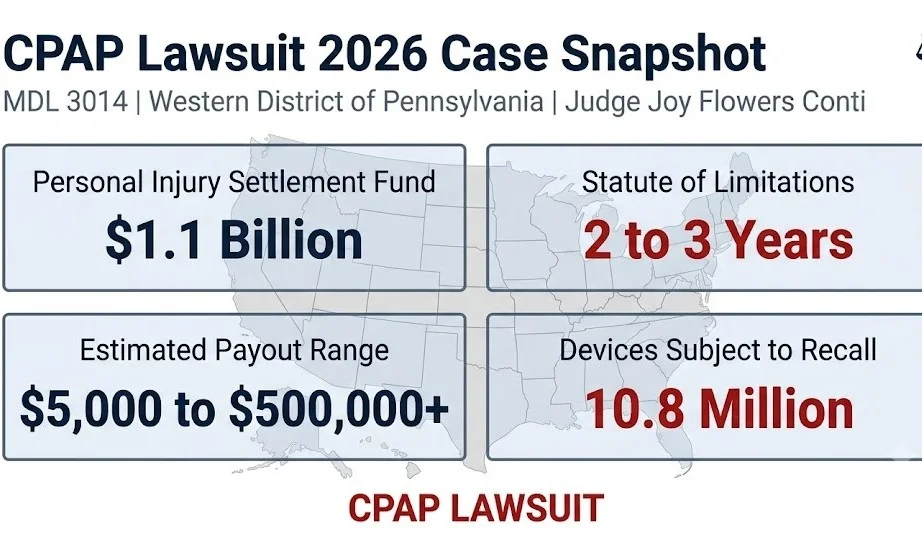
The $1.1 billion personal injury resolution, reached with Philips NV in 2023, was described by the court as a “significant milestone” in MDL 3014. However, that resolution did not end all litigation. Claims involving the most serious cancer diagnoses are proceeding on individual tracks.
Medical monitoring fund negotiations are also ongoing. Millions of device users who have not yet developed a diagnosed condition are pursuing separate medical monitoring relief that would fund regular cancer screenings.
2026 litigation status at a glance:
| Track | Status | Fund |
|---|---|---|
| Personal injury (cancer, serious illness) | Distribution ongoing | $1.1 billion |
| Medical monitoring (asymptomatic users) | Negotiations and court proceedings ongoing | TBD |
| Individual bellwether trials | Scheduled for 2026 | N/A |
| Philips NV criminal/regulatory proceedings | Ongoing DOJ review | N/A |
Attorney Insight: Attorneys handling these claims note that the 2026 bellwether trial schedule is a significant pressure point, because trial results in individual cases will directly affect settlement values across the broader claim pool.
What Is the CPAP Lawsuit About?
The CPAP lawsuit is about Philips Respironics allegedly selling defective breathing devices that exposed millions of sleep apnea patients to carcinogenic and toxic compounds over months or years of nightly use. The legal claims encompass product liability, negligence, failure to warn, and fraudulent concealment.
The company knew about foam degradation concerns as early as 2015, according to internal documents cited in the MDL filings. Despite those internal findings, Philips continued selling the devices and did not issue a public recall until June 2021, following pressure from the FDA.
That six-year delay between internal knowledge and public disclosure is the factual foundation for the fraudulent concealment and punitive damages claims that distinguish this litigation from a simple product defect case.
Core legal theories in MDL 3014:
- Strict products liability: The devices were defective in design and manufacture
- Negligence: Philips failed to exercise reasonable care in product testing and post-market surveillance
- Failure to warn: Users and physicians were not warned of the foam degradation risk despite internal knowledge
- Fraudulent concealment: Philips allegedly concealed known defects to protect market share
- Medical monitoring: Asymptomatic users seek funded surveillance programs
Attorney Insight: Attorneys handling these claims emphasize the fraudulent concealment theory as the most potent avenue for punitive damages, citing the internal 2015 engineering reports as the central evidentiary anchor.
Philips CPAP Recall Lawsuit
The Philips CPAP recall lawsuit originates from the June 14, 2021 FDA Class I recall of Philips Respironics CPAP, BiPAP, and mechanical ventilator products. A Class I recall is the FDA’s most serious classification, reserved for situations where there is a reasonable probability that using the product will cause serious adverse health consequences or death.
Philips NV, the Dutch parent company of Philips Respironics, issued a voluntary recall notice in June 2021 that acknowledged the PE-PUR sound abatement foam could break down and release “black debris or particles” into the device’s air pathway.
The recall covered devices manufactured between 2009 and 2021, a twelve-year window that maximized the potential class of injured users.
Recall scope by the numbers:
- 10.8 million devices subject to recall in the United States
- 15 million devices recalled globally
- $590 million in charges Philips NV recorded in 2021 related to the recall
- June 14, 2021: Official FDA Class I recall designation date
Attorney Insight: Attorneys handling these claims point to the twelve-year manufacturing window as significant, arguing it demonstrates that Philips was aware of the foam’s long-term instability but chose a long production run over a design correction.
Litigation Watch: The Philips recall lawsuit is not a simple defective product case; it carries fraudulent concealment allegations backed by internal documents showing knowledge of the defect years before the recall, and that factual record shapes every tier of the litigation.
PE-PUR Foam Health Risks and Cancer Claims
PE-PUR foam, or polyester-based polyurethane foam, is the specific material at the center of the health injury claims in MDL 3014. When this foam degrades, it can release both particulate matter and volatile organic compounds (VOCs) directly into the breathing circuit of the device.
The VOCs identified in FDA and Philips testing include compounds with known carcinogenic and toxic properties. Among those identified are diethylene glycol, toluene diisocyanate, and N,N-dimethylformamide, each of which carries established health risk data in occupational and toxicological literature.
For CPAP users sleeping six to eight hours per night, the inhalation exposure is not a brief industrial exposure. It is a sustained, nightly intake over years.
Identified PE-PUR foam breakdown compounds:
| Compound | Known Health Effects | Classification |
|---|---|---|
| Diethylene glycol | Kidney and liver toxicity | Industrial hazard |
| Toluene diisocyanate | Respiratory sensitizer, possible carcinogen | IARC Group 2B |
| N,N-dimethylformamide | Liver toxicity, testicular damage | Occupational hazard |
| Particulate matter (foam debris) | Airway irritation, lung inflammation | Physical hazard |
Attorney Insight: Attorneys handling these claims note that the toxicological science connecting PE-PUR breakdown compounds to specific cancer diagnoses is a contested but well-developed area of expert testimony in MDL 3014, and the strength of that science directly affects individual claim values.
Which CPAP Models Are Included in the Lawsuit?
The recalled Philips Respironics devices included in the CPAP lawsuit span multiple product lines sold under the DreamStation, System One, and other brand names. Not all Philips CPAP devices are subject to the recall.
The DreamStation 2, which uses a silicone-based foam rather than PE-PUR foam, is not part of the recall and is not included in the litigation. Claimants must confirm their specific device model against the official recall list before proceeding.
Recalled Philips device models included in MDL 3014:
- DreamStation ASV
- DreamStation ST, AVAPS
- DreamStation CPAP and Auto CPAP
- DreamStation BiPAP (all variants in the recalled series)
- System One ASV4
- System One (50 Series)
- REMstar SE Auto
- Dorma 400 and 500 CPAP
- OmniLab Advanced Plus
- TrilogyEvo and Trilogy 100/200 ventilators
- A-Series BiPAP and ASV devices
Quick check:
| Device | Included in Recall? | Foam Type |
|---|---|---|
| DreamStation 1 (all variants) | Yes | PE-PUR |
| DreamStation 2 | No | Silicone |
| System One (50 Series) | Yes | PE-PUR |
| REMstar SE Auto | Yes | PE-PUR |
| Trilogy 100/200 ventilators | Yes | PE-PUR |
Attorney Insight: Attorneys handling these claims advise clients to retrieve the serial number from their device and cross-reference it against the Philips recall registration database, as model name alone is insufficient for claim validation.
Litigation Watch: Device model confirmation is the threshold step for claim eligibility, and claimants who cannot locate their device must seek purchase records from their durable medical equipment supplier or insurer before any legal filing proceeds.
CPAP Lawsuit Eligibility 2026
CPAP lawsuit eligibility in 2026 requires meeting three core criteria: documented use of a recalled device, a qualifying health condition or sufficient exposure duration for medical monitoring, and filing within the applicable limitation period.
The eligibility framework in MDL 3014 distinguishes between two tracks. Personal injury claimants must have a diagnosed medical condition linked to device use. Medical monitoring claimants are asymptomatic users who seek funded health surveillance.
Eligibility criteria summary:
| Criterion | Personal Injury Track | Medical Monitoring Track |
|---|---|---|
| Device use required? | Yes, recalled model | Yes, recalled model |
| Diagnosis required? | Yes, qualifying condition | No diagnosis required |
| Duration of use | Significant use (months to years) | Any documented use |
| Statute of limitations | Varies by state | Varies by state |
| Documentation needed | Medical records, device serial number | Device records, purchase documentation |
The eligibility cutoff for the personal injury settlement fund has a registration component. Claimants who have not yet registered through a plaintiff’s attorney should do so immediately, as late-submission procedures are limited and court-supervised.
Attorney Insight: Attorneys handling these claims note that “significant use” is not a defined bright-line standard in the MDL; it is evaluated on a case-by-case basis, and claimants with even six months of documented nightly use have been advised to file and let the claims process assess the exposure level.
Who Qualifies for the CPAP Lawsuit?
Qualifying for the CPAP lawsuit requires documented use of a recalled Philips Respironics device and either a diagnosed qualifying health condition or a basis for medical monitoring relief.
The personal injury track targets users who developed specific conditions that the litigation associates with PE-PUR foam exposure. The medical monitoring track covers a broader population of device users who remain asymptomatic but face elevated health risk.
Qualifying health conditions for personal injury claims:
- Lung cancer
- Thyroid cancer
- Kidney cancer
- Bladder cancer
- Nasal or sinus cancer
- Liver cancer
- Leukemia and lymphoma variants linked to VOC exposure
- Pulmonary fibrosis and other serious respiratory conditions
- Tracheal and airway damage
Who specifically may qualify:
- Users of recalled DreamStation or System One devices, particularly those using the device for one year or more
- Patients with a cancer diagnosis received within a reasonable time period following device use
- Surviving family members filing on behalf of deceased users who developed a qualifying condition
- Any user of a recalled device, regardless of current health status, for the medical monitoring track
Attorney Insight: Attorneys handling these claims advise that the strongest personal injury cases involve documented nightly use of a recalled device for two or more years, a qualifying cancer diagnosis, and medical records that postdate the start of device use.
CPAP Lawsuit Settlement Amount 2026
The CPAP lawsuit settlement amount in 2026 is anchored by the $1.1 billion personal injury fund negotiated between Philips NV and plaintiff leadership in 2023. That figure covers qualifying personal injury claimants across all U.S. states.
The $1.1 billion fund does not pay every claimant equally. It is allocated through a points-based grid system that assigns relative values to different diagnosis categories, years of device use, and demographic factors. The exact point allocations are governed by the settlement allocation protocol filed with the court.
Estimated payout ranges by claim tier:
| Claim Category | Estimated Individual Range |
|---|---|
| Serious cancer (lung, kidney, thyroid) | $100,000 to $500,000+ |
| Cancer (lower-severity diagnoses) | $50,000 to $150,000 |
| Serious non-cancer respiratory illness | $25,000 to $75,000 |
| Lesser respiratory conditions | $5,000 to $25,000 |
| Medical monitoring (no diagnosis) | Pro-rata share of separate fund |
These ranges are estimates based on the settlement tier architecture and comparable mass tort resolutions. Final payments depend on total claim volume and the outcome of individual claim scoring.
Attorney Insight: Attorneys handling these claims note that claimants with thorough medical documentation, including sleep study records, prescriptions, and pathology reports, consistently score higher within each tier than those with incomplete records.
Litigation Watch: The $1.1 billion personal injury fund is fixed; higher total claim volume means each individual payment decreases proportionally, making early and complete filing a material financial advantage.
How Much Will the CPAP Settlement Pay Per Person?
The per-person CPAP settlement payment is determined by the claims scoring matrix, not a flat payment schedule. No two claimants automatically receive the same amount, even if they have the same diagnosis, because individual factors including years of use, age, exposure intensity, and documented damages all affect the final score.
Bellwether verdicts in comparable mass torts provide a useful benchmark for understanding how the litigation values serious claims. In MDL proceedings of similar scale, plaintiffs with stage-three lung cancer and documented multi-year device use have received individual verdicts ranging from $500,000 to over $1 million in trial settings.
Settlement payments are typically lower than trial verdicts because claimants accept certainty of payment in exchange for a reduced amount. The trade-off calculation depends heavily on claim strength.
Factors that increase individual payout scores:
- Stage III or IV cancer diagnosis
- Device use exceeding three years
- No confounding risk factors (non-smoker, no prior lung disease)
- Strong medical records establishing causation timeline
- Early registration in the settlement process
- Deceased claimant with surviving dependents (wrongful death enhancement)
Attorney Insight: Attorneys handling these claims advise that claimants should not compare their expected payment to another claimant’s figure, as the grid system produces widely varying results based on medical and factual specifics unique to each claim.
CPAP Lawsuit Medical Monitoring Claims
Medical monitoring claims in MDL 3014 represent a distinct category of relief available to users of recalled Philips devices who have not yet developed a diagnosed condition. These claims do not require a cancer diagnosis or current illness.
The legal theory behind medical monitoring is that a person who has been exposed to a toxic substance through no fault of their own has a present legal interest in funded health surveillance, because early detection of disease reduces mortality and medical costs.
The medical monitoring fund in MDL 3014 is subject to ongoing negotiation. No final allocation figure has been publicly confirmed as of early 2026. The court is evaluating competing proposals from plaintiff leadership and Philips NV.
Medical monitoring claim structure:
| Element | Detail |
|---|---|
| Who can claim | Any user of a recalled Philips device |
| Diagnosis required? | No |
| Type of relief | Funded periodic cancer and respiratory screenings |
| Fund status | Pending court approval as of 2026 |
| Screening types likely covered | Chest CT, thyroid ultrasound, urinalysis, pulmonary function testing |
Attorney Insight: Attorneys handling these claims note that medical monitoring claims carry significant value independent of any current diagnosis, because the funded screenings can detect early-stage cancer that, if left undetected, could become a far more serious personal injury claim in the future.
Litigation Watch: Medical monitoring fund approval in 2026 will expand access to CPAP lawsuit relief for millions of device users who have not yet received a cancer diagnosis but face measurable ongoing health risk.
CPAP Lawsuit Personal Injury Claims
Personal injury claims in the CPAP lawsuit are the primary vehicle for financial compensation for claimants who have received a qualifying health diagnosis. These claims allege that PE-PUR foam exposure directly caused or contributed to the diagnosed condition.
Personal injury claims in MDL 3014 require the claimant to submit a Plaintiff Fact Sheet, a standardized court-supervised document that collects medical history, device use history, and specific injury allegations. That document is the legal foundation of every individual claim in the MDL.
Philips has reserved the right to challenge individual causation arguments, meaning that even with a qualifying diagnosis, claimants may face scrutiny over whether their condition was caused by the device or by pre-existing risk factors.
Plaintiff Fact Sheet core requirements:
- Complete device identification (model, serial number, purchase date)
- Documented use history (dates of use, hours per night, prescribing physician)
- Full medical history for the five years preceding diagnosis
- Pathology and diagnosis reports for the qualifying condition
- Treating physician contact information
- Prior insurance claims for the diagnosed condition
Attorney Insight: Attorneys handling these claims consistently identify the Plaintiff Fact Sheet as the single most important document in the claim, noting that incomplete or inaccurate submissions are the leading cause of claim delays and value reductions.
CPAP Lawsuit Filing Deadline 2026
The CPAP lawsuit filing deadline in 2026 depends on which track a claimant is pursuing and which state’s statute of limitations applies to their individual claim. There is no single universal deadline that covers all claimants.
For personal injury claims, the statute of limitations begins to run from the date the claimant discovered or reasonably should have discovered the connection between the device and their injury. In many states, that clock started running after the June 2021 recall announcement.
Statute of limitations by state (representative examples):
| State | Personal Injury Limitation | Discovery Rule Applied? |
|---|---|---|
| Pennsylvania | 2 years | Yes |
| California | 2 years | Yes |
| Texas | 2 years | Yes |
| New York | 3 years | Yes |
| Florida | 2 years | Yes |
| Ohio | 2 years | Yes |
| Illinois | 2 years | Yes |
For claimants in states with a two-year limitation period who have not yet filed, the 2026 window is critically narrow for claims tied to the June 2021 recall date. However, the discovery rule and tolling arguments have extended filing eligibility for many claimants through their attorney’s formal tolling submissions in MDL 3014.
Attorney Insight: Attorneys handling these claims emphasize that tolling submissions must be made through counsel registered in the MDL, and that a claimant who contacts an attorney after their state limitation period has run faces an uphill challenge that many firms will decline to take.
How to File a CPAP Lawsuit Claim in 2026
Filing a CPAP lawsuit claim in 2026 requires engagement with a mass tort plaintiff’s attorney who is registered in MDL 3014 or can file in the Western District of Pennsylvania on the claimant’s behalf. There is no public online claim portal for personal injury claims.
The filing process for a personal injury claim follows a structured sequence governed by the MDL court’s case management orders.
Step-by-step filing process:
- Identify and document the device: Locate the recalled Philips device, record the model name and serial number, and confirm it appears on the official recall list
- Gather medical records: Collect all records related to the qualifying health condition, including imaging, pathology reports, oncology notes, and surgical records
- Retain a mass tort attorney: Contact a plaintiff’s firm with active MDL 3014 registration; the representation is typically on contingency
- Submit the Plaintiff Fact Sheet: Your attorney prepares and files this document within the MDL’s required timeframe
- Complete expert causation review: The attorney coordinates with medical experts to establish the causal link between device use and diagnosis
- Claim scoring and settlement distribution: Once the settlement administrator receives and scores the claim, payment is processed through the fund
Attorney Insight: Attorneys handling these claims note that the Plaintiff Fact Sheet submission deadline in MDL 3014 is court-supervised, meaning a missed internal deadline can result in claim dismissal that is difficult to reverse.
CPAP Lawsuit Attorney: What Type of Lawyer Do You Need?
The CPAP lawsuit requires a mass tort plaintiff’s attorney, not a personal injury generalist, not a medical malpractice attorney, and not a class action consumer litigator. The distinction matters operationally.
Mass tort litigation is procedurally distinct from both traditional personal injury cases and class actions. In a class action, one set of attorneys represents all members under a single complaint. In MDL 3014, each claimant has their own individual claim, but those claims are coordinated in federal court for pretrial proceedings under unified leadership.
The attorney handling a CPAP claim must be familiar with MDL procedure, Plaintiff Fact Sheet requirements, case management order deadlines, and the settlement allocation matrix.
Attorney selection criteria for CPAP claims:
| Criterion | What to Look For |
|---|---|
| Practice focus | Mass tort and product liability, plaintiff’s side |
| MDL experience | Prior participation in MDL proceedings |
| CPAP-specific experience | Active caseload in MDL 3014 or Philips Respironics litigation |
| Fee structure | Contingency (no upfront cost to claimant) |
| Firm size and resources | Capacity to fund expert witnesses and litigation costs |
| Track record | Prior mass tort recoveries in pharmaceutical or device litigation |
Contingency fee arrangements in mass tort cases typically run between 33% and 40% of the recovery, with litigation costs deducted separately. Attorney’s fees in the MDL are subject to a common benefit fund assessment that is applied to all firms participating in the litigation.
Attorney Insight: Attorneys handling these claims advise potential claimants to ask specifically whether the firm is formally registered in MDL 3014 or has a co-counsel arrangement with a registered MDL firm, as that registration is procedurally required to access the settlement fund.
Litigation Watch: The choice of attorney in MDL 3014 directly determines claim quality, filing timeliness, and ultimate recovery, because the Plaintiff Fact Sheet, expert coordination, and settlement scoring process require MDL-specific procedural knowledge that general practitioners do not possess.
MDL 3014 Philips CPAP Lawsuit Court Status
MDL 3014, formally captioned In re: Philips Recalled CPAP, Bi-Level PAP, and Mechanical Ventilator Products Liability Litigation, is pending before Judge Joy Flowers Conti in the U.S. District Court for the Western District of Pennsylvania in Pittsburgh.
The MDL was established in October 2021 following the consolidation of hundreds of individual federal complaints. As of early 2026, the MDL encompasses tens of thousands of individual claimant registrations, making it one of the largest active product liability MDLs in the federal court system.
MDL 3014 procedural timeline:
| Date | Milestone |
|---|---|
| June 14, 2021 | FDA Class I recall issued |
| October 2021 | MDL 3014 established, Western District of Pennsylvania |
| 2022 | Plaintiff Fact Sheet process initiated; discovery begins |
| 2023 | $1.1 billion personal injury resolution announced |
| 2024 | Settlement implementation proceedings begin |
| 2025 to 2026 | Distribution ongoing; bellwether trials scheduled; medical monitoring fund negotiations continuing |
The DOJ has also conducted an investigation into Philips Respironics related to the recall, and Philips NV has disclosed ongoing regulatory exposure in its financial reporting. That parallel regulatory track adds background pressure to the civil litigation.
Attorney Insight: Attorneys handling these claims note that Judge Conti’s active management of the MDL, including strict case management order enforcement, has accelerated the claim processing timeline relative to similarly-sized MDLs from prior decades.
State-by-State CPAP Lawsuit Filing Options
CPAP lawsuit claimants across the United States can participate in MDL 3014 regardless of their home state, because the MDL’s federal jurisdiction consolidates claims from all 50 states. However, state law still governs key elements including the statute of limitations, the discovery rule, and certain damages categories.
Some states offer more favorable conditions for CPAP claimants than others. New York’s three-year statute of limitations, for example, provides more runway than California or Texas’s two-year standard.
State-specific filing landscape:
| State | Limitation Period | Punitive Damages Available? | Notable Features |
|---|---|---|---|
| Pennsylvania | 2 years | Yes | MDL home state; strong product liability framework |
| New York | 3 years | Yes | Longest limitation period among major states |
| California | 2 years | Yes | Consumer protection laws supplement tort claims |
| Florida | 2 years | Yes | Strong product liability statute |
| Texas | 2 years | Yes (capped) | Cap on punitive damages under Tex. Civ. Prac. Code |
| Ohio | 2 years | Yes (capped) | Product liability reform applies |
| Georgia | 2 years | Yes | Strong discovery rule application |
| Illinois | 2 years | Yes | Active plaintiffs’ bar in CPAP litigation |
State court filings are also possible for claimants who have state-specific claims or who opt not to participate in the federal MDL. However, most plaintiff’s attorneys with CPAP caseloads direct clients to MDL 3014 because the settlement infrastructure and litigation resources are concentrated there.
Attorney Insight: Attorneys handling these claims in Texas note that while punitive damages are available, the statutory cap limits the ceiling, and claimants in capped states may rely more heavily on compensatory damages calculations that emphasize documented medical costs and lost income.
Frequently Asked Questions
What is the CPAP lawsuit about in 2026?
The CPAP lawsuit in 2026 is about the recalled Philips Respironics CPAP, BiPAP, and ventilator devices that allegedly released carcinogenic compounds from degrading PE-PUR foam into users’ airways during sleep.
The case is consolidated under MDL 3014 before Judge Joy Flowers Conti in the Western District of Pennsylvania, with a $1.1 billion personal injury settlement fund in active distribution.
Which Philips CPAP models are included in the lawsuit?
The primary recalled models include the DreamStation ASV, DreamStation CPAP and Auto CPAP, System One 50 Series, REMstar SE Auto, and the Trilogy 100 and 200 ventilators, all manufactured with PE-PUR foam between 2009 and 2021.
The DreamStation 2 is not included in the recall and is not part of the litigation.
How much money can claimants receive from the CPAP lawsuit settlement?
Individual payments from the $1.1 billion personal injury fund are determined by a points-based scoring matrix, with serious cancer diagnoses estimated to yield between $100,000 and $500,000 or more.
Lesser respiratory conditions and less severe diagnoses receive lower scores and correspondingly lower payments, with estimates ranging from $5,000 to $75,000.
What is the filing deadline for the CPAP lawsuit in 2026?
There is no single universal deadline; the applicable statute of limitations varies by state and ranges from two to three years from the date of discovery, which for most claimants runs from the June 2021 recall announcement.
Claimants in two-year limitation states who have not yet retained an attorney are at serious risk of losing their right to file and should contact a mass tort attorney immediately.
Do I need an attorney to file a CPAP lawsuit claim?
Yes, a mass tort plaintiff’s attorney registered in MDL 3014 is required to file a CPAP personal injury claim through the federal court settlement process.
Representation is typically on a contingency basis, meaning qualifying claimants pay no upfront cost, and the attorney’s fee is a percentage of any recovery.
What cancers and health conditions qualify for the CPAP personal injury settlement?
Qualifying conditions include lung cancer, thyroid cancer, kidney cancer, bladder cancer, nasal and sinus cancers, liver cancer, and certain blood cancers, along with serious respiratory conditions including pulmonary fibrosis.
The condition must be diagnosed and supported by medical records, and the claimant must have documented use of a recalled Philips Respironics device.
Closing
MDL 3014 is an active, high-stakes mass tort with a $1.1 billion personal injury fund in distribution and a medical monitoring fund in negotiation. The litigation is not winding down in 2026; it is resolving, and that resolution window is time-limited.
Any current or former user of a recalled Philips Respironics device who has received a cancer diagnosis or other serious health condition should consult a mass tort plaintiff’s attorney registered in MDL 3014 before any applicable statute of limitations expires.
Attorneys who specialize in this litigation handle CPAP claims on contingency. That means a full claim evaluation costs nothing upfront. The risk of waiting is the loss of filing eligibility. The step forward is a direct conversation with qualified counsel.
