Quick Answer Box
- What this is: Multiple active and recently filed class action lawsuits against Temu (operated by PDD Holdings, Inc.) alleging data privacy violations, deceptive trade practices, RICO violations, and consumer protection breaches affecting tens of millions of U.S. customers.
- Who qualifies: U.S. residents who created a Temu account, downloaded the Temu app, or made purchases on the platform during the defined class period, with enhanced eligibility in states with strong biometric and consumer privacy laws including Illinois, California, and Virginia.
- What it’s worth: Estimated individual payouts range from $35 to $150 per claimant depending on claim type and the total number of valid submissions. Settlement fund amounts in active cases have not yet received final court approval as of 2026 reporting.
Case Snapshot
| Detail | Information |
|---|---|
| Primary Defendant | PDD Holdings, Inc. (operating as Temu) |
| Active Courts | U.S. District Court, N.D. Illinois; U.S. District Court, N.D. Georgia; U.S. District Court, D. Massachusetts |
| Lead Case Reference | In re: Temu Data Privacy and Consumer Protection Litigation (consolidated proceedings) |
| Known Docket References | N.D. Ill. Case No. 1:23-cv-01217 (data privacy); N.D. Ga. filings (RICO and consumer fraud) |
| Filing Date | Initial complaints filed beginning February 2023; amended and consolidated through 2024-2025 |
| Status (2026) | Active litigation; class certification motions pending in lead cases; no final settlement approved |
| Settlement Fund | Not yet court-approved; proposed amounts under negotiation |
| Claimed Damages | Hundreds of millions across consolidated class actions |
| Parent Company | PDD Holdings, Inc. (NASDAQ: PDD) |
Introduction
The Temu class action lawsuit claim form process sits at the center of one of the largest consumer data litigation waves to hit a foreign-operated e-commerce platform in recent U.S. legal history. Tens of millions of American consumers downloaded the Temu app and made purchases without knowing the platform allegedly collected data far beyond what any shopping transaction requires.
PDD Holdings, Temu’s Chinese parent company, faces claims across at least three federal court districts. The allegations span data harvesting, biometric data collection, deceptive pricing, and organized fraud.
No final settlement has received court approval as of 2026. That distinction matters. Some claim portals circulating online are premature or unauthorized. Understanding which cases are legitimate, which courts govern them, and what the actual eligibility standards require is not optional for anyone considering a claim.
What Is the Temu Class Action Lawsuit Claim Form?
The Temu class action lawsuit claim form is the official submission mechanism through which eligible class members assert their right to a share of any settlement fund approved by the presiding court.
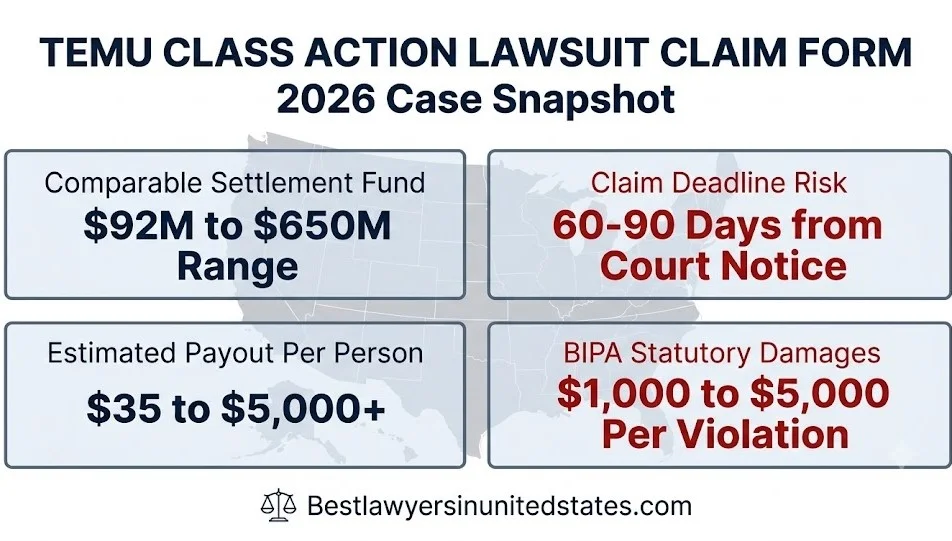
No court-approved claim form has been formally activated across all Temu actions as of early 2026. Class certification is still pending in the lead federal cases. Forms circulating on third-party aggregator sites should be treated with caution until a claims administrator is formally appointed by court order.
When a settlement is approved, the court-appointed claims administrator will publish the official form through a dedicated settlement website. That site URL will appear in the court-issued class notice sent directly to identified class members.
What a legitimate Temu claim form will require:
- Full legal name and current mailing address
- Email address associated with the Temu account
- Approximate dates of account creation or app download
- Purchase history details (if claiming enhanced damages)
- Device type on which the app was installed
- State of residence during the class period
Attorney Insight: Attorneys handling consumer class action claims consistently advise clients to preserve account confirmation emails and purchase receipts before the claim window opens, as documentation accelerates processing and can support higher-tier payout eligibility.
Temu Lawsuit Settlement: What Has Been Agreed to So Far
The Temu lawsuit settlement refers to negotiations between plaintiff class counsel and PDD Holdings that have been ongoing since late 2024, though no agreement has received final judicial approval as of 2026.
Settlement discussions in the Northern District of Illinois data privacy track are the most advanced. Mediations occurred in the second half of 2024 under a private mediator appointed with the court’s acknowledgment.
The Northern District of Georgia RICO track remains further from resolution, with significant disputes over the scope of class membership and the admissibility of expert testimony on data extraction methodology.
Settlement Negotiation Status by Case Track:
| Case Track | Court | Settlement Stage | Estimated Timeline |
|---|---|---|---|
| Data Privacy (BIPA / CCPA) | N.D. Illinois | Mediation ongoing | Possible Q3-Q4 2026 approval |
| RICO / Consumer Fraud | N.D. Georgia | Pre-certification disputes | 2027 or later |
| Consumer Protection | D. Massachusetts | Early stage | No timeline established |
Attorney Insight: Class action attorneys note that multi-track litigation against a single corporate defendant frequently resolves on a rolling basis, with the strongest-evidence track settling first and creating pressure for resolution in remaining tracks.
Temu Class Action Lawsuit Status in 2026
The Temu class action lawsuit status in 2026 is active across multiple federal courts, with the data privacy track in Illinois representing the most procedurally advanced proceedings.
In the Northern District of Illinois, plaintiffs filed an amended consolidated complaint in mid-2024 following early dispositive motion practice. Judge Virginia Kendall, who has presided over complex consumer litigation in prior cases, is overseeing related proceedings in that district.
Class certification briefing in the Illinois track was scheduled for completion in early 2026, with a certification ruling expected before mid-year. That ruling will determine the size and shape of the class entitled to claim.
2026 Procedural Calendar (Projected):
| Milestone | Expected Date | Court |
|---|---|---|
| Class certification ruling | Q1-Q2 2026 | N.D. Illinois |
| Settlement mediation continuation | Q2 2026 | N.D. Illinois |
| Preliminary settlement approval (if reached) | Q3 2026 | N.D. Illinois |
| Class notice distribution | Q4 2026 | N.D. Illinois |
| Claim filing window opens | Late Q4 2026 or Q1 2027 | TBD |
Attorney Insight: Attorneys tracking the litigation note that class certification denial in the Illinois track would not extinguish individual claims but would substantially reduce pressure on PDD Holdings to settle on terms favorable to consumers.
Litigation Watch: The Illinois data privacy track is the most advanced Temu case in 2026, and the class certification ruling expected by mid-year will determine whether tens of millions of consumers can proceed as a unified class or must pursue individual claims.
What Did Temu Do Wrong? The Core Legal Allegations
Temu’s alleged misconduct falls into four legally distinct categories, each of which forms the basis for separate or overlapping claims.
First, plaintiffs allege Temu’s app functioned as spyware, collecting data unrelated to shopping activity. This includes device microphone access, location tracking beyond what delivery logistics require, contact list harvesting, and clipboard content interception.
Second, plaintiffs in states covered by the Illinois Biometric Information Privacy Act allege Temu collected facial geometry or biometric identifiers without the written consent BIPA requires. A single BIPA violation carries statutory damages of $1,000 per negligent violation and $5,000 per intentional violation.
Third, consumer protection claims allege Temu’s “original price” comparisons were manufactured, showing inflated reference prices that created false impressions of discount depth.
Fourth, RICO claims allege Temu and related PDD Holdings entities operated as an organized scheme to defraud American consumers through systematic data monetization without disclosure.
Allegations by Legal Theory:
| Allegation | Legal Theory | Governing Law |
|---|---|---|
| Spyware / data harvesting | Privacy tort, CFAA | Federal + state |
| Biometric data collection | BIPA violation | Illinois 740 ILCS 14/1 |
| False pricing / discounts | Deceptive trade practices | State consumer protection acts |
| Organized fraud scheme | RICO 18 U.S.C. 1962 | Federal |
Attorney Insight: Attorneys emphasize that the BIPA claim track carries the largest per-person statutory damages of any Temu theory, making Illinois residents with Temu app installations particularly valuable plaintiffs.
Temu Data Privacy Lawsuit: Allegations and Evidence
The Temu data privacy lawsuit centers on allegations that the app extracted personal data at a scale and specificity that exceeds any legitimate e-commerce operational purpose.
Independent security researchers at Georgia Tech and the University of Michigan published analyses in 2023 finding that Temu’s app requested permissions inconsistent with its stated shopping function. Those findings were incorporated into multiple federal complaints.
The complaints allege Temu transmitted data to servers in China, potentially subjecting it to access by the Chinese government under the 2017 People’s Republic of China National Intelligence Law. That allegation elevates the national security dimension of what would otherwise be a standard consumer privacy case.
Data Categories Allegedly Harvested:
- Device identifiers (IMEI, MAC address, advertising ID)
- Precise GPS location data, collected continuously
- Clipboard content, including passwords and financial data
- Contact list access
- Browser and app activity history
- Facial and biometric data (Illinois-specific BIPA claim)
- Financial account metadata
Attorney Insight: Consumer data privacy attorneys handling these claims note that the transmission-to-foreign-server allegation strengthens arguments under both the Computer Fraud and Abuse Act and state unfair business practices statutes, because it adds a dimension of unauthorized cross-border data transfer.
Temu RICO Lawsuit: The Organized Fraud Theory
The Temu RICO lawsuit alleges that PDD Holdings, its U.S. subsidiary, and related Pinduoduo entities conducted an organized pattern of racketeering through systematic consumer fraud.
RICO claims require proof of an enterprise, a pattern of racketeering activity (at least two predicate acts), and a nexus between the enterprise and the racketeering conduct. Plaintiffs allege Temu’s systematic misrepresentation of pricing, data practices, and product origins constitutes wire fraud, the most common RICO predicate act in consumer cases.
RICO is a significant escalation over standard consumer protection claims. A successful RICO plaintiff recovers treble damages (three times actual damages) plus attorney fees. That multiplier transforms an individual consumer’s modest actual loss into a potentially substantial recovery.
RICO Claim Structure in Temu Litigation:
| RICO Element | What Plaintiffs Allege |
|---|---|
| Enterprise | PDD Holdings and U.S. subsidiaries operating as coordinated entity |
| Pattern | Multiple acts of wire fraud across millions of transactions |
| Predicate acts | Wire fraud (18 U.S.C. 1343), computer fraud |
| Injury | Financial loss from deceptive pricing and unauthorized data use |
| Treble damages | Three times actual damages if proven |
Attorney Insight: Class action attorneys note that RICO claims against e-commerce defendants are difficult to certify as class actions because individual reliance on misrepresentations can predominate, but the wire fraud predicate theory avoids some of those individualized-proof problems.
Litigation Watch: The RICO track in the Northern District of Georgia carries the largest potential per-plaintiff recovery because treble damages apply to proven losses, but it also faces the highest legal burden of proof and the longest expected timeline to resolution.
Temu Consumer Protection Lawsuit: State Law Claims
The Temu consumer protection lawsuit refers to a collection of state-law claims filed under unfair and deceptive trade practices statutes, which exist in all 50 states and the District of Columbia.
These claims do not require proof of intent to defraud. They require only that Temu engaged in a business practice that was objectively unfair or deceptive to a reasonable consumer. The false-pricing allegations are particularly well-suited to this theory.
States with the most aggressive consumer protection frameworks provide plaintiffs the strongest independent basis for recovery.
Strongest State Consumer Protection Frameworks for Temu Claims:
| State | Statute | Key Provision |
|---|---|---|
| California | CCPA / CLRA / UCL | Private right of action, statutory damages |
| Illinois | Consumer Fraud Act + BIPA | Biometric damages up to $5,000 per violation |
| New York | General Business Law 349 | Actual damages + attorney fees |
| Massachusetts | Chapter 93A | Double or triple damages for willful violations |
| Washington | CPA | Actual damages + attorney fees + injunctive relief |
Attorney Insight: Consumer protection attorneys note that state-law claims can proceed independently even if federal class certification fails, giving plaintiffs in California, Illinois, and Massachusetts particularly strong independent fallback positions.
Who Qualifies for the Temu Class Action?
Qualifying for the Temu class action requires meeting the class definition that the court will approve at the certification stage. Based on complaints filed in the Northern District of Illinois, the proposed class definitions cover several identifiable groups.
The broadest proposed class includes all U.S. residents who downloaded the Temu app or created a Temu account between its U.S. launch in September 2022 and the class certification date.
Narrower subclasses apply heightened eligibility based on specific conduct or state of residence.
Proposed Class and Subclass Structure:
| Class / Subclass | Who It Covers | Legal Basis |
|---|---|---|
| National data privacy class | All U.S. Temu app users, Sept. 2022 forward | Federal privacy claims |
| Illinois biometric subclass | Illinois residents who used facial-recognition features | BIPA (740 ILCS 14) |
| California privacy subclass | California residents with Temu accounts | CCPA / UCL |
| Pricing fraud class | U.S. purchasers who bought items with comparative pricing | State consumer protection |
| RICO class | U.S. purchasers who sustained measurable financial loss | 18 U.S.C. 1962(c) |
Attorney Insight: Attorneys advise that the broadest national class will likely have the most claimants and the smallest per-person payout, while the Illinois biometric subclass, if certified, will carry the largest per-person recovery because BIPA’s statutory damages do not require proof of actual harm.
Temu Lawsuit Eligibility Requirements: What You Must Establish
Temu lawsuit eligibility requirements vary by case track but share a common documentation threshold that courts and claims administrators will apply.
At minimum, claimants must demonstrate they fall within the class period (September 2022 through the certification date) and within the geographic scope (U.S. residents). For subclass claims, additional proof of specific conduct or state residency applies.
Eligibility Checklist by Claim Track:
- National data privacy class: Proof of Temu app download or account creation during class period. Account email confirmation qualifies.
- Illinois BIPA subclass: Must establish Illinois residency during the period of alleged biometric collection. Device location data may be relevant.
- California CCPA subclass: California residency and Temu account during class period.
- Pricing fraud class: Purchase records showing transactions involving products with comparative “original price” displays.
- RICO class: Documented purchase loss attributable to deceptive pricing or unauthorized data use.
Documentation to Preserve Now:
- App download confirmation email or App Store receipt
- Account registration confirmation email
- Purchase order confirmations from Temu
- Bank or credit card statements showing Temu charges
- Screenshots of any pricing representations at time of purchase
Attorney Insight: Attorneys consistently note that the single most common reason for claim rejection is insufficient documentation, and that preserving digital records now, before the claim window opens, is the most actionable step any potential claimant can take.
Litigation Watch: Eligibility across the Temu class action tracks hinges on documentation of account creation, app installation, and purchase history during the class period, with Illinois residents holding the strongest individual claim values under BIPA’s statutory damages framework.
Temu Class Action Settlement Amount: What the Fund Could Reach
The Temu class action settlement amount has not been finalized or court-approved as of 2026. Negotiations are ongoing in the Illinois data privacy track.
Comparable data privacy settlements provide context for the likely range. The Facebook / Meta BIPA settlement reached $650 million in 2022. The Google Location History settlement reached $391.5 million in 2023. TikTok’s U.S. privacy settlement reached $92 million in 2021.
Temu’s U.S. user base exceeds 50 million registered accounts, according to company disclosures. At a settlement fund of $100 million, that equates to approximately $2 per claimant before fees and costs. A fund in the $200 million to $400 million range with a 15 to 20 percent claims rate would produce meaningfully larger per-person distributions.
Comparable Data Privacy Settlement Benchmarks:
| Defendant | Claim Type | Settlement Amount | Approx. Per-Claimant |
|---|---|---|---|
| Facebook (Meta) | BIPA | $650 million | $397 average |
| Location data | $391.5 million | Varied by state | |
| TikTok | Child privacy / data | $92 million | $167 average |
| Zoom | Privacy / wiretap | $85 million | $25 to $150 |
Attorney Insight: Attorneys representing plaintiffs in data privacy cases note that fund size alone does not determine per-claimant recovery; the ratio of claims filed to the total fund is the actual determinant, and encouraging client filing during the claims period matters enormously.
Temu Settlement Payout Per Person: Realistic Expectations
Temu settlement payout per person will depend on three variables: the total settlement fund approved by the court, the number of valid claims filed, and the claimant’s tier of eligibility.
No court has set a per-claimant figure as of 2026. Based on comparable settlements and the user base size, the realistic range for general class members is $35 to $100 per person. Illinois BIPA subclass members with valid biometric claims could see significantly higher amounts if the statutory damages framework is applied.
Projected Payout Scenarios:
| Settlement Fund | Claims Rate | Estimated Claims Filed | Est. Per-Claimant (General) |
|---|---|---|---|
| $100 million | 10% of 50M users | 5,000,000 | ~$14 (before fees) |
| $200 million | 10% | 5,000,000 | ~$28 (before fees) |
| $300 million | 15% | 7,500,000 | ~$28 (before fees) |
| $100 million | 5% (realistic) | 2,500,000 | ~$28 to $35 net |
| BIPA subclass only | Smaller pool | Fewer claimants | $500 to $5,000+ statutory |
Attorney fees in class actions typically represent 25 to 33 percent of the total fund, reducing the claimant-available portion accordingly.
Attorney Insight: Settlement allocation attorneys note that the BIPA statutory damages model operates differently from pro-rata funds because each violation carries a fixed statutory dollar amount, which is why Illinois-specific claimants should be evaluated separately from the broader national class.
Temu Settlement Claim Deadline: When You Must File
The Temu settlement claim deadline has not been set by any court as of early 2026, because no settlement has received preliminary judicial approval.
Once a court grants preliminary approval of a settlement, the class notice period typically runs 60 to 90 days, during which class members can submit claims, opt out, or object to the settlement terms.
Missing the claim deadline is an absolute bar to participation. No exceptions are made after the window closes, regardless of the claimant’s reason for missing it.
Projected Claim Window Timeline (Based on Current Litigation Status):
| Event | Projected Date |
|---|---|
| Class certification ruling | Q1-Q2 2026 |
| Settlement agreement signed (if reached) | Q2-Q3 2026 |
| Court preliminary approval hearing | Q3 2026 |
| Class notice mailed / emailed | Q3-Q4 2026 |
| Claim deadline (60-90 days from notice) | Q4 2026 or Q1 2027 |
| Final approval hearing | Q1 2027 |
| Payout distribution (if approved) | Q2-Q3 2027 |
Attorney Insight: Consumer class action attorneys emphasize that claimants who receive emailed class notice should act within the first two weeks of receiving it, as the deadline passes faster than most recipients anticipate and no extension accommodations are provided.
How to File the Temu Class Action Claim
Filing a Temu class action claim requires waiting for the court-authorized claims process to open, then submitting through the official settlement administrator’s portal.
No legitimate open claim window exists as of early 2026. Third-party sites soliciting claim information before court approval should be viewed skeptically.
When the official claims period opens, the process will follow the standard federal class action claims administration model.
Step-by-Step Filing Process (When Window Opens):
- Receive class notice. The settlement administrator will send notice by email to the address on file with Temu, and by postal mail to last known addresses.
- Locate the official settlement website. The URL will appear in the class notice and in the court’s public docket entry on PACER.
- Access the claim form. The form will be available online and as a printable PDF for postal submission.
- Complete all required fields. Name, address, Temu account email, approximate class period dates, and subclass-specific information.
- Upload supporting documentation. Account confirmation email, purchase receipts, or device records as applicable.
- Submit before the deadline. Online submissions receive a confirmation number. Postal submissions should be sent by certified mail.
- Retain your confirmation. Save or print the submission confirmation for your records.
Attorney Insight: Claims administrators typically allow online submissions to be amended within the claims window if additional documentation becomes available, so filing early leaves time to supplement the submission before the deadline closes.
Temu Class Action Lawsuit Payout Date: When Will Payments Arrive
The Temu class action lawsuit payout date depends on the completion of several sequential court events that have not yet concluded.
Distribution cannot occur until: a settlement is court-approved, the appeals period expires without challenge, the claims administrator processes and validates all submissions, and the court enters a final distribution order.
The appeals period after final approval typically runs 30 days. Professional objectors in large class actions sometimes file appeals that extend the distribution timeline by a year or more.
Realistic Payout Timeline:
| Stage | Projected Date |
|---|---|
| Preliminary settlement approval | Q3 2026 (optimistic) |
| Claim filing window closes | Q4 2026 or Q1 2027 |
| Final approval hearing | Q1 2027 |
| Appeals period expires | Q2 2027 |
| Claims processing complete | Q2-Q3 2027 |
| Distribution to claimants | Q3-Q4 2027 |
If the settlement is appealed after final approval, distribution could extend into 2028.
Attorney Insight: Attorneys routinely caution class members that payout timelines in complex federal class actions are notoriously difficult to predict, and anyone planning financial decisions around an expected class action payment is operating on an unreliable variable.
Litigation Watch: The Temu lawsuit payout date remains tied to a chain of court approvals and a potential appeals process that realistically places distribution no earlier than late 2027 in the most optimistic scenario.
Temu Lawsuit Settlement Payout Date: Separate Case Tracks Have Separate Timelines
The Temu lawsuit settlement payout date will differ across case tracks because the Illinois data privacy action, the Georgia RICO action, and the Massachusetts consumer protection action are in different procedural stages.
A claimant eligible under multiple tracks could receive staggered payments years apart. The Illinois track is most likely to produce the first payout if it settles in 2026 and avoids prolonged appeals.
The RICO track in Georgia, given its unresolved class certification disputes and more complex evidentiary demands, carries a realistic payout timeline of 2028 to 2029 if it settles, or longer if it proceeds to trial.
Payout Timeline by Case Track:
| Case Track | Settlement Likely | Claim Window Opens | Earliest Payout |
|---|---|---|---|
| N.D. Illinois (data privacy) | Q2-Q3 2026 | Q4 2026 | Q3 2027 |
| N.D. Georgia (RICO) | 2027 at earliest | 2028 | 2028-2029 |
| D. Massachusetts (consumer) | No timeline | Not established | Unknown |
Attorney Insight: Attorneys advise class members eligible across multiple tracks to file claims in each separate proceeding, because recoveries are independent and a payout in one track does not preclude recovery in another.
Temu Lawsuit Attorney: Do You Need Legal Representation to File?
Filing a Temu class action claim does not require individual legal representation. Class members participate in the settlement as part of the class, represented collectively by court-appointed class counsel.
However, certain situations warrant consulting a consumer class action attorney before the claim window opens.
If a potential claimant believes their damages are substantially higher than the class-level payout, they may have grounds to opt out of the class settlement and pursue an individual action. Opting out preserves independent claims but requires filing a separate lawsuit before applicable statutes of limitations expire.
When to Consult a Temu Lawsuit Attorney:
- Your documented financial loss from Temu’s pricing fraud or data misuse significantly exceeds the projected per-claimant settlement amount
- You are an Illinois resident with documented biometric data exposure and want to evaluate BIPA claims independently
- You received a specific targeted harm beyond general class membership, such as identity theft or financial account compromise traceable to Temu’s data practices
- You want to understand your opt-out rights and the deadline to preserve them before the class notice period expires
- You are a small business owner who suffered competitive harm from Temu’s alleged systematic pricing fraud
Attorney Types Who Handle These Cases:
| Attorney Type | What They Handle |
|---|---|
| Consumer class action attorney | Class membership, claim filing strategy, opt-out evaluation |
| Data privacy litigator | BIPA, CCPA, CFAA claims, biometric data cases |
| RICO litigator | Organized fraud claims, treble damages pursuit |
| Individual consumer plaintiff attorney | Opt-out plaintiffs pursuing independent actions |
Attorney Insight: Attorneys experienced with large consumer class actions consistently advise that the opt-out decision is one of the most consequential choices a class member faces, and it must be made within the opt-out window specified in the class notice, with no extensions.
Frequently Asked Questions
Is there an official Temu class action lawsuit claim form I can fill out right now?
No official court-approved claim form for any Temu class action settlement is available as of early 2026.
The claim window opens only after a court grants preliminary settlement approval, which has not yet occurred.
Preserve your account records and purchase documentation now so you are ready when the official window opens.
How much will the Temu class action settlement pay per person?
No per-person figure has been set by any court as of 2026.
Based on comparable data privacy settlements, general class members can realistically expect between $35 and $100, while Illinois BIPA subclass members could qualify for statutory damages of $1,000 to $5,000 per violation if that subclass is certified and prevails.
The actual amount depends on the total fund approved and the number of valid claims filed.
What is the Temu class action lawsuit payout date?
No confirmed payout date exists as of 2026 because no settlement has received final court approval.
The earliest realistic distribution date, if the Illinois data privacy track settles in mid-2026, is Q3 to Q4 2027 after claims processing and appeals periods conclude.
The RICO and consumer protection tracks carry later timelines.
Who qualifies for the Temu class action lawsuit?
U.S. residents who downloaded the Temu app, created a Temu account, or made purchases on the platform from September 2022 through the class certification date are the proposed general class.
Illinois residents qualify for the higher-value BIPA biometric subclass if they used features implicating facial or biometric data.
California, New York, Massachusetts, and Washington residents have additional state-law consumer protection claims that may independently support recovery.
What did Temu allegedly do to face these lawsuits?
Temu allegedly collected personal data far exceeding shopping necessity, including device identifiers, location data, clipboard content, and biometric information, without adequate disclosure or consent.
The platform’s comparative pricing was also alleged to be manipulated, showing inflated “original prices” to create false discount impressions.
A separate RICO complaint alleges PDD Holdings and related entities operated a systematic scheme to defraud American consumers.
Do I need a lawyer to file a Temu class action claim?
Individual legal representation is not required to file a standard class action claim, as court-appointed class counsel represents all class members collectively.
An attorney consultation is warranted if your individual damages are significantly higher than the projected class payout, if you are considering opting out to file independently, or if you have documented identity theft or financial harm traceable to Temu’s data practices.
The opt-out decision, once made within the class notice period, cannot be reversed.
Closing
The Temu class action litigation is more legally complex than most consumer settlement cases because it involves multiple courts, multiple legal theories, and a foreign corporate parent operating under a different regulatory regime. The claim form process, when it opens, will require documentation that claimants should be assembling now.
For most consumers, participating in the class settlement is the lowest-effort path. For those with documented substantial losses, particularly Illinois residents with biometric data exposure, a consultation with a consumer data privacy attorney before the opt-out deadline may preserve significantly larger individual recovery rights.
The claim window will open without extended warning. Acting on documentation and legal advice before that window opens, not after, is what separates claimants who maximize their recovery from those who do not.