
Quick Answer
- Class action lawsuit attorneys represent groups of plaintiffs harmed the same way by the same defendant, working under court oversight rather than a private retainer.
- Plaintiffs qualify if their claim is typical of a larger group and the group is too large for individual lawsuits to be practical, per Rule 23 of the Federal Rules of Civil Procedure.
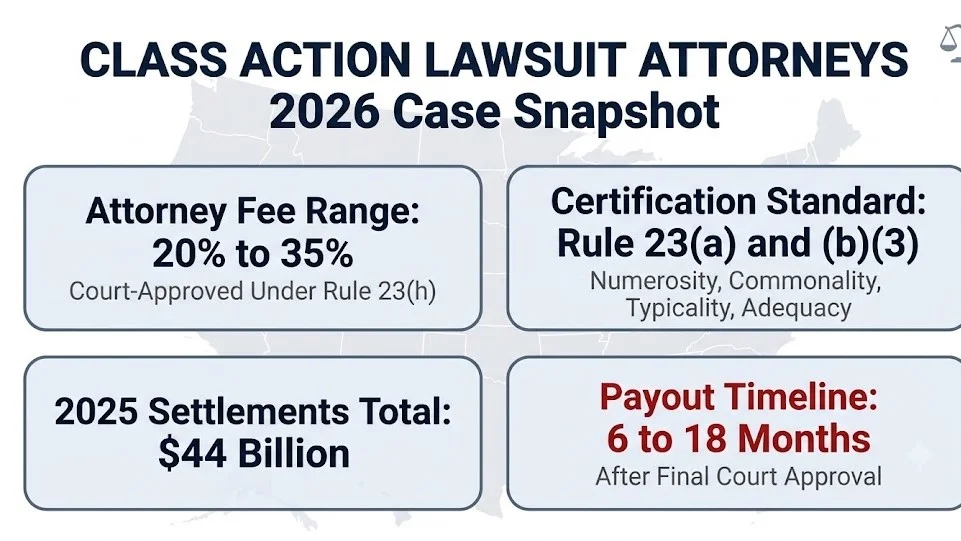
- Attorney fees are court-approved, typically between 20% and 35% of the settlement fund, with no fee paid unless the case wins or settles.
Case Snapshot
| Detail | Info |
|---|---|
| Governing Rule | Federal Rule of Civil Procedure 23 |
| Certification Standard | Rule 23(a) and Rule 23(b)(3) |
| Counsel Appointment Standard | Rule 23(g) |
| Fee Approval Standard | Rule 23(h) |
| Court | Varies by case; certification occurs at the federal district court level |
This topic does not refer to a single pending lawsuit. It covers the legal role, appointment process, and compensation structure of attorneys who handle class action litigation as a practice area in 2026.
Class action attorneys do not operate like a typical personal injury lawyer working for one client. They answer to a federal rule that governs who gets appointed, how they get paid, and how closely a judge reviews their work. That oversight is the single biggest difference between hiring a class action attorney and hiring almost any other kind of lawyer.
Roughly $44 billion in class action settlements closed in the United States in 2025 alone. That volume is part of why understanding how these attorneys are vetted, appointed, and paid matters more than ever in 2026.
Class Action Lawsuit Attorneys
Class action lawsuit attorneys are lawyers who represent a group of plaintiffs harmed in the same way by the same defendant, rather than representing a single client. The group is called a class, and the attorney representing it is called class counsel once a court formally appoints them.
This role carries legal duties that go beyond a normal attorney-client relationship. Class counsel owes a duty to every member of the class, not just the named plaintiff who originally brought the case.
Quick facts:
- Class counsel is appointed by the court, not chosen informally by the named plaintiff alone
- Fees almost always come from a common settlement fund, not from individual client payments
- A single class action can resolve claims for thousands or millions of people in one proceeding
Attorneys handling these claims point to the court appointment requirement as the feature that separates class action work from ordinary civil litigation.
Attorneys For Class Action Lawsuit
Attorneys for a class action lawsuit are typically law firms with experience in complex litigation, not solo practitioners working alone. Courts weigh a firm’s resources and track record heavily before appointment.
Under Rule 23(g), a judge must consider specific factors before naming class counsel. These factors apply whether one firm applies or several firms compete for the role.
What courts must consider under Rule 23(g):
- The work counsel has already done investigating the claims
- Counsel’s experience handling class actions and other complex litigation
- Counsel’s knowledge of the applicable law
- The resources counsel will commit to representing the class
If more than one qualified firm applies, the court must select whichever firm is best positioned to represent the class, not simply the first to file.
Attorneys handling these claims point to the resource requirement as the reason large, well-capitalized firms dominate this practice area.
Class Action Lawsuit Attorneys Near Me
Searching for class action lawsuit attorneys near you returns a mix of local firms and national firms that litigate in courts across the country. Location matters far less in class action work than it does in most other legal practice areas.
Class actions are filed in federal district courts and can draw plaintiffs from every state. A firm based in another state can serve as class counsel for a class action affecting people nationwide.
| Factor | Why It Matters Less for Class Actions |
|---|---|
| Attorney’s physical office location | Most communication happens by phone, email, or video |
| State bar admission | Firms often co-counsel with locally admitted attorneys when required |
| In-person meetings | Rarely required since named plaintiffs represent the group |
What matters more is whether a firm has handled the specific claim type at issue, such as data privacy, product liability, or employment discrimination.
Attorneys handling these claims point to subject matter experience as a far stronger predictor of outcome than physical proximity.
Litigation Watch: Court appointment standards under Rule 23(g), not geography, determine which firms actually end up running major class actions.
How Class Action Lawsuit Attorneys Get Paid
Class action lawsuit attorneys get paid from a percentage of the settlement fund, approved by the court, not from hourly billing to individual clients. This is governed by Rule 23(h), which requires a formal motion and judicial review before any fee is paid.
Fee percentages commonly range from 20% to 35% of the total recovery, though courts scrutinize this figure closely in larger settlements. The U.S. Supreme Court upheld a $667 million fee award to class counsel in the Blue Cross Blue Shield antitrust settlement, about 24.7% of that fund, despite objections from some class members.
How fee approval typically works:
- Class counsel files a fee motion disclosing hours worked and expenses incurred
- The court reviews the request at a fairness hearing
- Class members can object to the proposed fee before approval
- The judge has authority to reduce a fee found excessive
In the PACER Fees class action settlement, the court approved $25 million in total fees and costs out of a $125 million fund, roughly 20% of the total.
Attorneys handling these claims point to the fairness hearing as the formal check that keeps fee requests from going unreviewed.
How To Find A Class Action Attorney
Finding a class action attorney starts with identifying firms that have handled cases matching your specific type of claim. A securities fraud specialist is the wrong fit for a product liability matter, even within the same general practice area.
Existing settlement notices are one of the most reliable starting points. If a class action already exists for a given issue, the notice will name the appointed class counsel directly.
Practical steps for finding the right attorney:
- Check settlement notices or court dockets for the case type you’re researching
- Contact at least two or three firms before deciding
- Ask directly whether the firm litigates cases itself or refers them out for a fee
- Confirm the firm’s experience with your specific claim category
Bold callout: Firms that sign up large volumes of clients only to refer cases elsewhere are sometimes called lawsuit mills, and they add a layer of cost without adding legal expertise.
Attorneys handling these claims point to direct litigation experience, not advertising volume, as the strongest signal of competence.
Who Qualifies For A Class Action Lawsuit
Qualifying for a class action lawsuit means your claim must be typical of a larger group harmed the same way by the same defendant. This standard comes directly from Rule 23(a) of the Federal Rules of Civil Procedure.
A court evaluates four specific requirements before allowing a case to proceed as a class action. Failing even one of these requirements can prevent certification entirely.
| Rule 23(a) Requirement | What It Means |
|---|---|
| Numerosity | The class is too large for individual lawsuits to be practical |
| Commonality | Common questions of law or fact apply across the class |
| Typicality | The named plaintiff’s claim is typical of the class |
| Adequacy | The named plaintiff and counsel can fairly represent the class |
Most consumer class actions also need to satisfy Rule 23(b)(3), known as the predominance requirement, meaning common issues outweigh individual differences.
Attorneys handling these claims point to commonality and predominance as the two requirements most often contested by defense counsel.
Class Action Attorney Fees
Class action attorney fees are subject to direct judicial review under Rule 23(h), unlike most private legal fee arrangements. This is one of the most heavily regulated aspects of the entire process.
Courts use either a percentage-of-fund method or a lodestar method, which multiplies hours worked by a reasonable hourly rate, to evaluate whether a requested fee is fair.
Common 2026 fee benchmarks:
- Federal courts often approve fees between 20% and 25% of settlement funds
- Larger settlements frequently see lower percentages due to scale
- The NCAA NIL settlement resolved at $2.7 billion, with fee requests scrutinized against that scale
- A related healthcare provider settlement allowed fees up to $700 million, or 25% of a $2.8 billion fund
Attorneys handling these claims point to settlement size as the single biggest factor influencing what percentage a court is willing to approve.
Class Certification Requirements
Class certification requirements determine whether a case can legally proceed as a class action at all. Without certification, the case either dismisses or proceeds only as an individual lawsuit.
The process begins when class counsel files a motion for certification, supported by evidence addressing each Rule 23(a) factor and at least one Rule 23(b) category.
The certification sequence:
- Named plaintiff and counsel file a motion for class certification
- The court evaluates numerosity, commonality, typicality, and adequacy
- The court determines which Rule 23(b) category applies
- If certified, the court defines the class and appoints class counsel
- If denied, the court may allow amendment or dismiss the case
A court that is not satisfied the requirements have been met should refuse certification until they are met, rather than granting conditional approval.
Attorneys handling these claims point to the predominance requirement under Rule 23(b)(3) as the step most likely to derail a weak case before it ever reaches a jury.
Litigation Watch: Certification, not the underlying harm itself, is the real legal gatekeeper that decides whether a class action survives.
Lead Counsel Vs Class Counsel
Lead counsel and class counsel are related but distinct roles, and the difference matters most in large, multi-firm litigation. Class counsel is the formal Rule 23(g) appointment tied directly to a certified class.
Lead counsel is a broader leadership term used especially in multidistrict litigation, where many separate cases are coordinated before one judge without necessarily being a single certified class.
| Role | Appointment Basis | Typical Context |
|---|---|---|
| Class Counsel | Rule 23(g), tied to a certified class | Standalone class actions |
| Interim Class Counsel | Rule 23(g)(3), before certification decided | Early-stage putative class actions |
| Lead Counsel | Court discretion, often in MDL proceedings | Multidistrict litigation with many individual and class claims |
| Liaison Counsel | Court appointment for administrative coordination | Large MDLs with many participating firms |
Courts use the same Rule 23(g) factors, experience, resources, knowledge of the law, to guide lead counsel selection even outside formal class actions.
Attorneys handling these claims point to liaison counsel roles as often underappreciated, since they handle the coordination work that keeps sprawling litigation organized.
Class Action Vs Mass Tort Attorney
A class action attorney and a mass tort attorney handle structurally different types of litigation, even though both involve large groups of plaintiffs. A class action results in one collective resolution applied to the entire class.
A mass tort, by contrast, consolidates individual lawsuits for efficiency but generally preserves each plaintiff’s claim and damages calculation separately.
| Feature | Class Action | Mass Tort |
|---|---|---|
| Outcome structure | One judgment or settlement for the whole class | Individual settlements for each plaintiff |
| Certification required | Yes, under Rule 23 | No formal certification requirement |
| Common example | Consumer data breach, antitrust pricing | Pharmaceutical injury, defective medical device |
| Typical coordination | Single certified class | Multidistrict litigation, MDL |
Most large pharmaceutical injury cases proceed as mass torts or MDLs rather than traditional class actions, since individual injury severity varies too much for one common payout structure.
Attorneys handling these claims point to injury severity variation as the main reason pharmaceutical cases rarely qualify as true class actions.
Multidistrict Litigation Attorneys
Multidistrict litigation attorneys coordinate large numbers of related individual lawsuits filed in different federal courts, consolidated before a single judge for pretrial proceedings. This process is overseen by the Judicial Panel on Multidistrict Litigation.
MDLs often include both individual tort claims and putative class actions within the same coordinated proceeding, which courts refer to as a hybrid structure.
Key features of MDL leadership:
- Courts may appoint interim class counsel under Rule 23(g)(3) even before certification is decided
- Leadership structures often include lead counsel, liaison counsel, and a steering committee
- Common benefit work is distributed among appointed leadership and beyond
- Personality, candor, and management skill matter as much as legal credentials in leadership selection
Attorneys handling these claims point to MDL leadership selection as more art than science, since courts weigh cooperation skills alongside legal experience.
Class Action Lawsuit Attorney Reviews
Reviewing a class action attorney’s track record means looking past advertising and toward verifiable case outcomes. Court-appointed leadership roles are a stronger indicator of standing than marketing claims alone.
Public settlement notices, court dockets, and published opinions naming appointed class counsel are all verifiable sources a reader can check directly.
What to look for when evaluating a firm:
- Past appointments as class counsel or lead counsel in similar case types
- Settlement outcomes the firm has actually achieved, not just claimed
- Whether independent legal publications or court opinions reference the firm’s work
- Whether the firm discloses any litigation funding arrangements, an issue under increasing scrutiny in 2026
Attorneys handling these claims point to court-published opinions as a far more reliable source than client testimonials alone.
Litigation Watch: Verifiable court appointments, not advertising volume, separate firms that actually run class actions from firms that simply collect and refer clients.
What Does A Class Action Attorney Do
A class action attorney investigates the underlying harm, files and litigates the case, and represents the interests of the entire class once appointed. The role extends well beyond simply filing a complaint.
Day-to-day responsibilities shift significantly depending on the stage of litigation, from initial investigation through certification, discovery, and eventual settlement or trial.
Core responsibilities across a case lifecycle:
- Investigating whether a pattern of harm affects a large enough group to qualify
- Drafting and filing the certification motion under Rule 23
- Conducting discovery and engaging expert witnesses
- Negotiating settlement terms and presenting them for court approval
- Overseeing distribution of settlement funds through a claims administrator
A 2026 development worth noting is the growing use of third-party litigation funding to finance these cases, which has made it easier for plaintiffs’ firms to take on large corporate defendants but has also drawn proposed federal disclosure requirements.
Attorneys handling these claims point to the certification motion as the single most labor-intensive filing in the entire case.
Class Action Settlement Payout Process
The class action settlement payout process begins only after a court grants final approval, which typically follows a fairness hearing where objections are heard. Payment does not happen automatically the moment a settlement is announced.
A court-appointed settlement administrator, not the attorneys or the defendant, handles claim verification and distribution.
Typical payout sequence:
- Preliminary settlement approval and class notice distribution
- Claim filing period, often 60 to 180 days
- Fairness hearing addressing objections and fee requests
- Final approval order
- Claims administrator verifies and processes payments
- Funds distributed, often six to eighteen months after final approval
Settlement funds that go unclaimed are typically redistributed among filing claimants or directed to a related charity through a cy pres distribution, rather than returned to the defendant.
Attorneys handling these claims point to the claim filing deadline as the step most class members miss entirely, leaving real money unclaimed every year.
When To Hire A Class Action Attorney
The right time to hire a class action attorney is as soon as you suspect a pattern of harm affecting a larger group, not after a case has already been filed by someone else. Early involvement can position you to serve as a named plaintiff if a case does not already exist.
If a class action already exists for your situation, hiring a separate attorney is usually unnecessary. Filing a claim form through the existing settlement administrator is typically sufficient.
Signs it makes sense to consult an attorney directly:
- No existing class action covers your specific situation
- You believe a company’s conduct affected a large number of people the same way
- You signed something that might include an arbitration clause limiting your rights
- You were offered an unusually low individual settlement compared to the scale of harm
Attorneys handling these claims point to arbitration clauses as an increasingly contested issue in 2026, with courts split on whether certain clauses hold up under scrutiny.
Frequently Asked Questions
What does a class action lawsuit attorney actually do?
A class action attorney investigates harm affecting a large group and litigates the case on behalf of that entire group once a court certifies it.
Once appointed as class counsel, the attorney owes a legal duty to every class member, not just the named plaintiff.
How do class action attorneys get paid?
Class action attorneys get paid a court-approved percentage of the settlement fund, typically between 20% and 35%.
No fee is paid unless the case results in a settlement or favorable judgment, and the court must approve the amount under Rule 23(h).
Who qualifies to join a class action lawsuit?
You qualify if you were harmed the same way as a defined group by the same defendant, and the court has certified that class.
Class membership is usually automatic once a class is certified, unless you choose to opt out.
What is the difference between class counsel and lead counsel?
Class counsel is formally appointed under Rule 23(g) for a certified class, while lead counsel is a broader leadership role often used in multidistrict litigation.
Both roles draw on similar experience and resource factors when courts decide who to appoint.
How is a class action different from a mass tort?
A class action resolves claims for an entire certified group under one judgment, while a mass tort consolidates individual lawsuits that keep separate damages calculations.
Mass torts do not require Rule 23 certification, which is why most pharmaceutical injury cases proceed this way instead.
How do I find a class action attorney for my specific claim?
Start by checking existing settlement notices or court dockets, since they name the attorneys already appointed for similar claims.
If no case exists yet, look for firms with verifiable experience in your specific claim type rather than general advertising reach.
Closing
Class action attorneys operate under more court oversight than almost any other type of lawyer, from certification through final fee approval. That oversight exists to protect the class, not just to regulate the lawyers.
If you believe a pattern of harm affects a larger group, the next step is checking whether a case already exists before deciding to seek your own counsel. When none exists and the harm is real, a firm with direct experience in your specific claim type is the one worth contacting first.
