
Quick Answer
- A qui tam lawsuit lets a private citizen sue on behalf of the federal government to recover money lost to fraud, under the False Claims Act.
- Anyone with direct, non-public knowledge of fraud against a federal program can qualify as a relator, provided they file first and avoid the public disclosure bar.
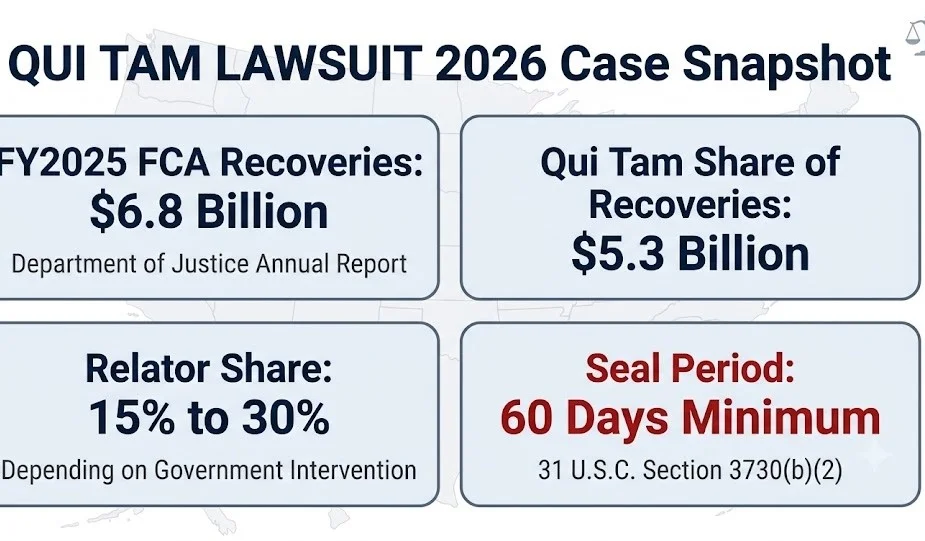
- Recovery shares range from 15% to 30% of whatever the government collects, with FY2025 qui tam recoveries alone reaching $5.3 billion.
Case Snapshot
| Detail | Info |
|---|---|
| Governing Statute | False Claims Act, 31 U.S.C. §§ 3729-3733 |
| Filing Procedure | Complaint filed under seal in federal district court |
| Constitutional Challenge | United States ex rel. Zafirov v. Florida Medical Associates LLC, No. 8:19-cv-01236-KKM-SPF |
| Status | Eleventh Circuit appeal pending after district court ruled qui tam provisions unconstitutional |
| FY2025 Qui Tam Recoveries | $5.3 billion, per DOJ’s January 16, 2026 annual report |
A qui tam lawsuit is not a niche legal curiosity in 2026. It is the engine behind most of the federal government’s fraud recoveries, and it is currently facing its biggest legal threat in decades.
The Department of Justice reported $6.8 billion in total False Claims Act recoveries for fiscal year 2025, the highest single-year total in the statute’s history. Of that figure, $5.3 billion came directly from qui tam cases brought by private whistleblowers, called relators.
At the same time, a federal judge in Florida ruled the entire qui tam mechanism unconstitutional, and that ruling is now under review at the Eleventh Circuit. Two Supreme Court justices have already signaled interest in taking up the question themselves.
Qui Tam Lawsuit
A qui tam lawsuit is a civil action filed by a private citizen on behalf of the United States government to recover money obtained through fraud against federal programs. The term comes from a Latin phrase meaning roughly “who sues on behalf of the king as well as for himself.”
The law authorizing this mechanism is the False Claims Act, codified at 31 U.S.C. §§ 3729-3733. It dates back to 1863, when Congress passed it to combat suppliers defrauding the Union Army during the Civil War.
Quick facts:
- The person who files is called a relator, not a plaintiff in the traditional sense
- The case is brought in the name of the United States government
- The government can choose to take over the case or let the relator pursue it independently
Attorneys handling these claims point to the dual nature of the lawsuit, private citizen and government interest combined, as the feature that makes qui tam practice unlike any other area of civil litigation.
What Is A Qui Tam Lawsuit
A qui tam lawsuit is, at its legal core, a fraud recovery tool that turns private citizens into enforcers of federal law. The government recovers stolen funds, and the relator who exposed the fraud receives a percentage of whatever gets recovered.
This structure exists because the government cannot detect every instance of fraud against its own programs. Employees, contractors, and competitors often have direct knowledge no government auditor could easily uncover.
| Core Element | Legal Basis |
|---|---|
| Who can sue | Any private person with direct knowledge, called a relator |
| What triggers liability | Knowingly submitting a false claim for government funds |
| Where it’s filed | Federal district court, under seal |
| Penalty structure | Treble damages plus per-claim penalties |
Attorneys handling these claims point to the treble damages provision as the reason settlements in this area often reach hundreds of millions of dollars.
Qui Tam Lawsuit Attorney
A qui tam lawsuit attorney is a lawyer who specializes in the procedural complexities of the False Claims Act and has direct experience working with Department of Justice attorneys. This is not a general practice area.
These attorneys typically work on contingency, meaning they take a percentage of the relator’s eventual recovery rather than billing hourly. That arrangement means the relator pays nothing upfront.
What a qualified qui tam attorney typically handles:
- Drafting the detailed complaint and the required written disclosure to the government
- Coordinating with DOJ attorneys during the sealed investigation period
- Advising whether to proceed independently if the government declines to intervene
- Pursuing anti-retaliation claims if the relator faces workplace consequences
Attorneys handling these claims point to DOJ relationships and case-packaging experience as the two factors that most influence whether a case draws government intervention.
File Qui Tam Lawsuit
Filing a qui tam lawsuit requires submitting a detailed complaint under seal in federal court, along with a written disclosure of the supporting evidence. This is a more involved process than filing an ordinary civil complaint.
The relator must serve the complaint and disclosure directly on the U.S. Attorney General and the U.S. Attorney for the relevant judicial district, while the defendant remains unaware the case exists.
Filing requirements:
- A formal complaint detailing the who, what, when, where, and how of the fraud
- A written disclosure of substantially all material evidence
- Filing in camera and under seal in federal district court
- Service on the Attorney General and the relevant U.S. Attorney’s office
Bold callout: The defendant is not served and has no knowledge of the lawsuit until the court lifts the seal.
Attorneys handling these claims point to the quality of the written disclosure as the single factor most likely to determine whether DOJ takes the case seriously.
Litigation Watch: Filing correctly under seal, not simply having a strong fraud claim, is what protects a relator’s ability to recover a share of any eventual settlement.
How Does A Qui Tam Lawsuit Work
A qui tam lawsuit works by giving the government a window to investigate before deciding whether to take over the case. Once filed under seal, the relator’s identity and allegations stay hidden from the defendant during this review period.
The Department of Justice, often working with the FBI and federal agency investigators, may issue Civil Investigative Demands to gather evidence during this stage.
The basic case sequence:
- Relator files complaint under seal with supporting disclosure
- DOJ investigates, often issuing CIDs and interviewing witnesses
- Government decides whether to intervene or decline
- If intervened, DOJ controls the litigation and settlement strategy
- If declined, the relator may proceed independently with their own counsel
Attorneys handling these claims point to the intervention decision as the single biggest factor shaping both the case outcome and the eventual size of the relator’s award.
Who Can File A Qui Tam Lawsuit
Anyone with direct and independent knowledge of fraud against a federal program can generally file a qui tam lawsuit, regardless of citizenship status. The term “private person” under the statute is interpreted broadly.
Two major restrictions limit who can ultimately proceed. The first-to-file rule blocks anyone from bringing a related action once another relator has already filed based on the same facts.
Key eligibility restrictions:
- First-to-file rule: Only the first relator to properly file on a given fraud scheme can proceed
- Public disclosure bar: Cases based on already-public information are barred unless the relator qualifies as an original source
- Original source exception: Requires direct, independent knowledge voluntarily disclosed to the government before filing
The Supreme Court clarified the original source standard in Rockwell International Corp. v. United States, a case still cited in qui tam litigation today.
Attorneys handling these claims point to the first-to-file rule as the reason speed matters as much as evidence quality once a relator decides to come forward.
Qui Tam Relator Share Percentage
The qui tam relator share percentage depends primarily on whether the government intervenes in the case. This is one of the most consequential variables in the entire process.
| Scenario | Relator Share |
|---|---|
| Government intervenes | 15% to 25% of total recovery |
| Government declines, relator proceeds alone | 25% to 30% of total recovery |
| Case based primarily on public information | Maximum 10%, even with intervention |
On top of the percentage, the relator is generally entitled to reimbursement of reasonable litigation expenses and attorney fees, paid separately by the defendant.
Bold callout: Total relator share awards across all FCA matters in FY2025 reached roughly $330 million, the lowest level since FY2021, even as overall recoveries hit a record high.
Attorneys handling these claims point to that gap, record recoveries alongside falling relator awards, as a trend worth watching closely into 2026.
Qui Tam Lawsuit Under Seal
A qui tam lawsuit under seal means the complaint is filed confidentially, hidden from the defendant and the public, while the government investigates. This is a mandatory procedural requirement, not optional confidentiality.
The seal lasts at least 60 days under 31 U.S.C. § 3730(b)(2), though courts routinely grant extensions while DOJ continues its investigation. Some cases remain sealed for years.
Why the seal exists:
- Prevents alerting defendants to a pending federal investigation
- Gives DOJ adequate time to evaluate whether to intervene
- Protects the integrity of any parallel criminal investigation
In one widely cited example, the government requested 18 extensions over eight years before an appellate court flagged the delay as excessive.
Attorneys handling these claims point to the seal period as the most psychologically difficult stretch for relators, since they often wait years without knowing the government’s decision.
Qui Tam Lawsuit Timeline
A qui tam lawsuit timeline typically spans years, not months, from initial filing through final resolution. The sealed investigation period alone can stretch well beyond the statutory 60 days.
| Stage | Typical Duration |
|---|---|
| Initial seal period | At least 60 days, often extended |
| Government investigation | Months to several years |
| Intervention decision | At end of seal period or after extensions |
| Litigation or settlement | Months to years after unsealing |
| Relator share payment | After settlement or judgment proceeds are collected |
Cases that proceed without government intervention often take longer, since the relator’s own counsel must build the case without DOJ’s investigative resources.
Attorneys handling these claims point to patience as a genuine professional requirement in this practice area, given how long even strong cases can remain sealed.
Litigation Watch: The sealed investigation period, often lasting years, is the structural reason qui tam cases move far slower than most civil litigation.
False Claims Act Qui Tam
The False Claims Act’s qui tam provision is the legal foundation that makes private fraud enforcement against the government possible. Without it, fraud against federal programs would depend entirely on government-initiated investigations.
DOJ’s January 16, 2026 annual report confirms how central this provision has become. Whistleblowers filed 1,297 new qui tam suits in fiscal year 2025, a record, compared to 401 new government-initiated investigations.
FY2025 enforcement snapshot:
- Total FCA recoveries: $6.8 billion, the highest in the statute’s history
- Qui tam-driven recoveries: $5.3 billion, about 78% of the total
- Healthcare-related recoveries: $5.7 billion, roughly 83% of all recoveries
- New qui tam filings: 1,297, nearly three times the number of government-initiated matters
Attorneys handling these claims point to the filing pace, nearly four new qui tam suits per business day, as evidence the mechanism remains the government’s primary fraud detection tool.
Qui Tam Whistleblower Protection
Qui tam whistleblower protection refers to anti-retaliation provisions that shield relators from workplace consequences for reporting fraud. This protection exists under 31 U.S.C. § 3730(h), separate from the qui tam filing itself.
Coverage extends beyond traditional employees to contractors and agents, and applies even to internal complaints raised before any lawsuit is filed.
What anti-retaliation protection covers:
- Termination, demotion, suspension, or threats tied to whistleblowing activity
- Internal complaints to management or compliance departments, not just formal lawsuits
- Remedies including reinstatement, double back pay with interest, and damages for reputational harm
Courts have consistently upheld broad interpretations of what counts as retaliatory conduct, reinforcing protection for relators who raise concerns internally before ever filing suit.
Attorneys handling these claims point to the internal complaint protection as frequently overlooked, since many relators don’t realize they were already protected before formally filing.
Qui Tam Lawsuit Settlement Examples
Qui tam lawsuit settlements in 2026 continue to be dominated by healthcare fraud cases, particularly Medicare Advantage matters. Several recent resolutions illustrate the scale involved.
Notable recent settlements:
- Kaiser Permanente affiliates settled Medicare Advantage diagnosis coding allegations for $581 million in January 2026
- A managed care organization agreed to pay up to $98 million over unsupported diagnosis codes
- A wound care company and its executives settled allegations for $309 million
- A historic guardrail defect case, United States ex rel. Harman v. Trinity Industries, resolved for $663 million
These figures reflect both intervened and declined cases, since relators who proceed independently after declination can still secure substantial recoveries.
Attorneys handling these claims point to the growing share of recoveries coming from declined cases as proof that government intervention is no longer the only path to a major settlement.
Qui Tam Lawsuit Constitutionality
The constitutionality of the qui tam mechanism is currently being tested in federal appellate court, making this one of the most consequential open legal questions in this area. The challenge centers on whether relators exercise government authority without proper constitutional appointment.
On September 30, 2024, Judge Kathryn Kimball Mizelle of the U.S. District Court for the Middle District of Florida ruled the qui tam provisions unconstitutional in United States ex rel. Zafirov v. Florida Medical Associates LLC, No. 8:19-cv-01236-KKM-SPF.
The core constitutional argument:
- Relators may exercise “significant authority” sufficient to trigger the Appointments Clause
- Relators may occupy a “continuing position established by law” under the statute’s pre-filing duties
- If relators are officers of the United States, they must be appointed consistent with Article II
The Eleventh Circuit heard oral argument in this case on December 12, 2025, and a ruling is expected to shape qui tam litigation regardless of outcome. Justice Kavanaugh, joined by Justice Thomas, has separately stated that the qui tam provisions raise substantial constitutional questions under Article II that the Court should address in an appropriate case.
Attorneys handling these claims point to this case as one likely to reach the Supreme Court regardless of how the Eleventh Circuit rules.
Litigation Watch: The entire qui tam mechanism, not just individual cases, is now under direct constitutional challenge at the federal appellate level.
Qui Tam Lawsuit Vs Class Action
A qui tam lawsuit and a class action are structurally different tools, even though both allow private citizens to pursue large-scale legal claims. A qui tam case recovers money for the federal government, with the relator receiving a statutory share.
A class action, by contrast, recovers compensation directly for a defined group of harmed individuals, with no government party involved at all.
| Feature | Qui Tam Lawsuit | Class Action |
|---|---|---|
| Who benefits primarily | The federal government | The certified class of plaintiffs |
| Governing rule | False Claims Act, 31 U.S.C. § 3730 | Federal Rule of Civil Procedure 23 |
| Filing procedure | Filed under seal, confidential | Filed openly, public from the start |
| Compensation source | Relator’s statutory percentage share | Pro rata distribution from settlement fund |
The two mechanisms occasionally overlap when fraud against government programs also harms a broader group of consumers, but they proceed under entirely separate legal frameworks.
Attorneys handling these claims point to the confidentiality requirement as the clearest structural difference, since class actions are public from the moment they’re filed.
When To Hire A Qui Tam Attorney
The right time to hire a qui tam attorney is before filing anything, since the quality of the initial complaint and disclosure can determine whether DOJ intervenes at all. Acting early also matters because of the first-to-file rule.
Waiting too long risks losing the case to another relator with similar knowledge, or running into the public disclosure bar if the information becomes public first.
Signs it’s time to consult a qui tam attorney:
- You have direct, non-public knowledge of fraud against a federal program
- You are an employee, contractor, or competitor with documentary evidence
- You are facing potential retaliation for raising internal concerns
- You are unsure whether your situation falls under federal or state false claims law
Attorneys handling these claims point to documentation, emails, billing records, internal memos, as the difference between a case DOJ takes seriously and one that goes nowhere.
Frequently Asked Questions
What is a qui tam lawsuit?
A qui tam lawsuit is a civil action filed by a private citizen, called a relator, on behalf of the federal government to recover money lost to fraud.
It is authorized under the False Claims Act, and the relator can receive a percentage of whatever the government recovers.
Who can file a qui tam lawsuit?
Any private person with direct, independent, non-public knowledge of fraud against a federal program can generally file.
The first-to-file rule and the public disclosure bar both limit who can ultimately proceed once a case is filed.
How much can a whistleblower recover in a qui tam lawsuit?
Relators typically receive between 15% and 25% of the recovery if the government intervenes, or 25% to 30% if they proceed alone.
Cases based primarily on already-public information cap the relator’s share at 10%, even with government intervention.
Why is a qui tam lawsuit filed under seal?
A qui tam lawsuit is filed under seal to give the government time to investigate without alerting the defendant.
The seal lasts at least 60 days and is frequently extended, sometimes for years, while DOJ completes its review.
Is the qui tam provision of the False Claims Act constitutional?
The constitutionality of the qui tam mechanism is currently being litigated and has not been finally resolved.
A federal district court ruled it unconstitutional in 2024, and the question is now pending before the Eleventh Circuit Court of Appeals.
How is a qui tam lawsuit different from a class action?
A qui tam lawsuit recovers money for the federal government under the False Claims Act, while a class action recovers compensation for a defined group of private plaintiffs.
Qui tam cases are filed under seal and stay confidential at first, while class actions are public from the moment they’re filed.
Closing
Qui tam litigation remains one of the federal government’s most effective fraud recovery tools, even as its constitutional foundation faces real legal uncertainty in 2026. The filing mechanics, seal requirements, and relator share rules still apply while that fight plays out.
Anyone sitting on direct evidence of fraud against a federal program should talk to a qui tam attorney before taking any other step. Acting early protects both the strength of the case and the relator’s own legal position.
