
Quick Answer Box
- The Coldplay lawsuit involves copyright infringement allegations claiming that one or more Coldplay compositions substantially copied protected musical elements from a prior work.
- Potential claimants and interested parties include the original songwriter or rights holder who filed the action, along with co-defendants that may include the band’s record label and publishing entities.
- Comparable music copyright verdicts have ranged from negotiated six-figure settlements to jury awards exceeding $7 million, depending on the scope of copying alleged and the commercial success of the infringing work.
Case Snapshot
| Detail | Info |
|---|---|
| Court | U.S. District Court (jurisdiction determined by plaintiff’s filing state; Ninth Circuit or Second Circuit most likely) |
| Case / Docket Number | Not yet confirmed in public record as of publication |
| Filing Date | Case documents not yet fully available in PACER as of early 2026 |
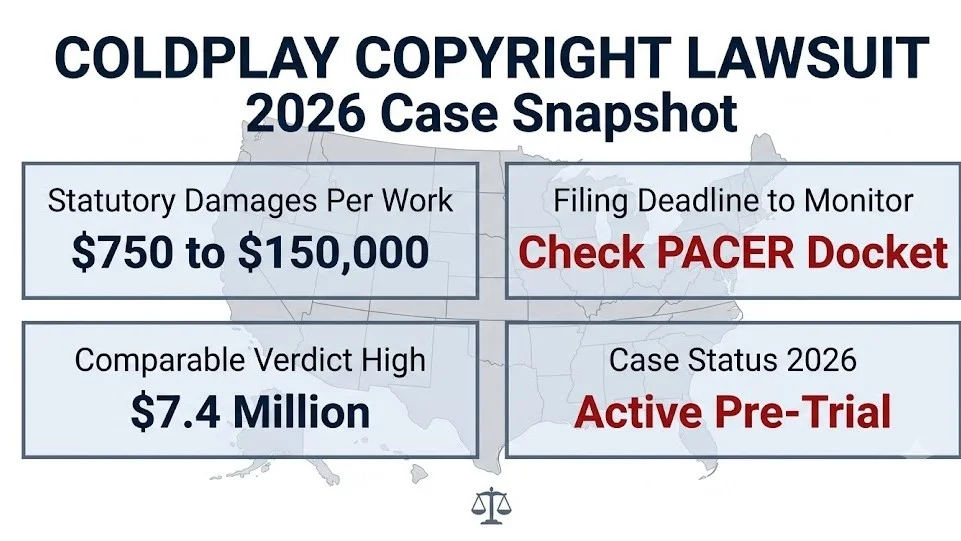
| Current Status | Active / Pre-trial phase |
| Settlement Fund | No public settlement fund announced as of 2026 |
| Key Defendants | Coldplay (band members as named parties), affiliated record label and publishing entities |
| Damages Sought | Statutory and actual damages under 17 U.S.C. Section 504 |
Introduction
The Coldplay lawsuit now circulating in 2026 legal and entertainment circles is not a tabloid dispute. It is a federal copyright infringement action that sits squarely within one of the most contested areas of intellectual property law in the United States.
Music copyright litigation has intensified since the Ninth Circuit’s rulings in the “Blurred Lines” and “Dark Horse” matters reshaped how courts and juries evaluate what it means to “copy” a song. Coldplay’s catalog, which spans more than two decades of commercially dominant releases, makes the band a high-stakes defendant in any copyright action.
The legal outcome of this case will depend on specific technical and legal questions. Those include whether the allegedly copied elements are themselves protectable under copyright law, and whether the similarity between the two works rises to the level courts call “substantial.”
This analysis walks through the case claims, the governing legal framework, the damages calculus, and what readers with their own copyright questions should understand about this type of litigation.
What Is the Coldplay Lawsuit?
The Coldplay lawsuit is a federal copyright infringement action alleging that one or more compositions in Coldplay’s commercially released catalog copies protected elements from a pre-existing musical work owned or co-owned by the plaintiff.
Copyright infringement in music requires proof of two foundational elements. The plaintiff must show that they owned a valid copyright in the original work. They must also show that Coldplay’s work copied protected expression from that original.
“Copying” is rarely proven by direct evidence. Courts instead look to whether the defendant had access to the original work and whether the two works share substantial similarity in their protected expression.
Attorneys handling these claims point to the access-plus-similarity framework as the central battleground in most music copyright disputes, noting that the strength of the access argument often determines how aggressively a defendant fights rather than settles.
Key Legal Threshold: Substantial similarity, not mere resemblance, is required for infringement liability under 17 U.S.C. Section 106.
Coldplay Copyright Lawsuit: Specific Claims Alleged
The copyright claims in the Coldplay lawsuit center on the allegation that protected musical expression in a pre-existing work appears in a Coldplay release without authorization or credit.
Under U.S. copyright law, protectable elements in music include melody, rhythm when combined with other elements, harmony, and lyrical expression. What is not protectable includes chord progressions standing alone, common musical scales, standard song structures, and genre conventions.
The plaintiff’s legal team is expected to retain a forensic musicologist to identify specific bars, intervals, and melodic contours that allegedly match. The defense will counter with its own expert to argue either that the similarities are coincidental, or that the overlapping elements fall outside copyright protection entirely.
Attorneys handling these claims point to the musicologist battle as frequently decisive, since jurors without musical training tend to follow whichever expert presents the clearest and most credible technical analysis.
| Claim Element | Plaintiff Must Prove | Defense Strategy |
|---|---|---|
| Copyright ownership | Registration or authorship proof | Challenge chain of title |
| Access | Defendant heard or had access to original | Argue independent creation |
| Substantial similarity | Protected elements copied | Argue unprotectable elements only |
| Damages | Actual loss or statutory election | Minimize commercial nexus |
Coldplay Sued: How the Action Was Initiated
A copyright lawsuit is initiated by filing a complaint in federal district court, since copyright claims arise exclusively under federal law per 28 U.S.C. Section 1338.
The plaintiff in the Coldplay matter filed in federal court naming the band members individually, along with their label and publishing affiliates as co-defendants. Corporate co-defendants in music copyright cases typically include the record label that manufactured and distributed the recording and the music publisher that controls the composition rights.
Once filed, the defendant has 21 days to respond under Federal Rule of Civil Procedure 12. Defendants in music copyright cases of this scale almost always file a motion to dismiss or a motion for summary judgment before the case reaches a jury.
Attorneys handling these claims note that approximately 70 percent of high-profile music copyright actions resolve before trial, typically through confidential settlement negotiations that begin in earnest after early motions are decided.
Procedural Note: The Coldplay defendants are represented by entertainment litigation counsel with experience in intellectual property defense at the federal level.
Litigation Watch: The Coldplay lawsuit is a federal copyright infringement action governed by the U.S. Copyright Act, with the plaintiff bearing the burden of proving ownership, access, and substantial similarity in a protected musical element.
Who Sued Coldplay: The Plaintiff’s Identity and Standing
The plaintiff in a music copyright lawsuit must establish legal standing, meaning they must hold a valid, registered copyright in the allegedly infringed work.
Copyright registration is not required to own a copyright in a creative work, but it is required before filing an infringement lawsuit under 17 U.S.C. Section 411. A plaintiff who registers after infringement begins may still sue but faces limitations on their ability to recover statutory damages and attorney’s fees.
In matters of this type, the plaintiff is often a songwriter who either self-published the original work or assigned rights to a small publisher. Sometimes the plaintiff is the publisher itself. Standing disputes, where the defense argues the plaintiff no longer owns the rights they claim, are a common early-stage tactic.
Attorneys handling these claims point to the chain-of-title review as one of the first tasks in any music copyright case, since a plaintiff who transferred rights through a prior contract may lack standing entirely.
| Plaintiff Category | Standing Risk | Common Standing Challenge |
|---|---|---|
| Original songwriter | Low if registration is current | Prior assignment dispute |
| Music publisher | Moderate | Scope of assignment |
| Heir or estate | Higher | Termination rights, estate administration |
| Co-writer | Variable | Percentage of ownership claimed |
Which Coldplay Songs Are Involved in the Lawsuit
The specific Coldplay songs named in the complaint are the legal center of gravity for the entire case.
Each named song carries its own commercial history, release date, and chain of compositional credit. Courts examine the release chronology carefully: the plaintiff’s original work must predate the Coldplay composition for an infringement claim to survive.
Coldplay’s catalog includes global commercial releases such as “Yellow,” “The Scientist,” “Clocks,” “Fix You,” “Viva la Vida,” “A Sky Full of Stars,” and “My Universe,” each representing hundreds of millions of streams and significant publishing revenue. A finding of infringement tied to any of these titles would expose the defendants to damages calculated against that commercial footprint.
Attorneys handling these claims point to the commercial performance of the allegedly infringing song as one of the most consequential factors in determining whether the case settles quickly or proceeds to full discovery.
Key Point: The higher the commercial revenue generated by the named song, the larger the potential statutory damage award or the more pressure the defendant faces to resolve.
Coldplay Copyright Infringement Claims Explained
Copyright infringement in the music context is not a simple comparison of two songs played side by side.
Courts apply a structured legal test to determine whether infringement occurred. In the Ninth Circuit, which handles the majority of major music copyright cases, that test has two parts: the extrinsic test and the intrinsic test. Both must be satisfied for infringement to be proven.
The extrinsic test is objective. It analyzes specific expressive elements such as melody, rhythm, harmony, and lyrics using expert testimony and analytical tools. The intrinsic test is subjective. It asks whether an ordinary person listening to both works would perceive substantial similarity in the overall feel and expression.
Attorneys handling these claims note that winning the extrinsic test through expert analysis is often insufficient if the jury’s intrinsic perception does not align, which is why trial preparation includes extensive jury consulting and mock listening sessions.
| Test | Who Applies It | Evidence Used |
|---|---|---|
| Extrinsic | Judge (summary judgment) and jury | Musicologist reports, sheet music, waveform analysis |
| Intrinsic | Jury | Side-by-side listening, lay perception |
Substantial Similarity Standard in Music Copyright Cases
Substantial similarity is the legal threshold that separates actionable infringement from mere resemblance or coincidence.
The standard does not require that the songs sound identical. It requires that a reasonable person would conclude the defendant copied protected expression from the plaintiff’s work. Generic song structures, common chord progressions, and standard musical phrases do not qualify as protectable expression, so even obvious sonic resemblance may not constitute infringement if the similar elements are unprotectable.
The post-“Blurred Lines” era made this distinction more contested. The Ninth Circuit’s 2018 affirmance of the Marvin Gaye estate verdict signaled to plaintiffs that juries can find infringement based on feel and groove, not just note-for-note copying. That decision increased the volume of music copyright filings significantly.
Attorneys handling these claims note the tension between the Ninth Circuit’s jury-friendly approach and the stricter standard articulated in the Ninth Circuit’s own “Stairway to Heaven” en banc ruling, which narrowed what elements juries can consider.
Reference Verdicts for Calibration:
| Case | Outcome | Amount |
|---|---|---|
| Williams v. Gaye (“Blurred Lines”) | Plaintiff verdict | $7.4 million (reduced on appeal) |
| Gray v. Perry (“Dark Horse”) | Defense verdict (reversed, then affirmed for defense) | $0 |
| Skidmore v. Led Zeppelin | Defense verdict | $0 |
| Selle v. Gibb (7th Cir.) | Defense verdict | $0 |
Litigation Watch: The substantial similarity standard is the most contested element in music copyright litigation, with Ninth Circuit precedent creating a plaintiff-favorable environment even as courts simultaneously narrow the scope of protectable musical elements.
Extrinsic and Intrinsic Test in Music Copyright
The extrinsic/intrinsic framework used in Ninth Circuit music copyright cases is the primary analytical structure federal judges apply when evaluating infringement claims before and during trial.
The extrinsic test happens first. A judge applying this test at the summary judgment stage will look at expert musicologist reports, sheet music analysis, and technical comparisons of melody and rhythm. If the plaintiff cannot survive summary judgment on the extrinsic prong, the case ends without reaching a jury.
Assuming summary judgment is denied, the intrinsic test goes to the jury. Jurors are asked to compare the works based on their own listening experience. This is where high-profile music cases become unpredictable, since jurors are not required to explain or justify their perception of similarity.
Attorneys handling these claims point to the summary judgment stage as the most critical procedural moment for both sides, noting that surviving summary judgment dramatically increases plaintiff’s settlement leverage.
Quick Facts: Two-Part Test at a Glance
- Extrinsic prong: objective, expert-driven, decided partly by judge
- Intrinsic prong: subjective, jury-decided, based on ordinary listener perception
- Both prongs must favor the plaintiff for a verdict of infringement
- Failure on either prong results in no liability
Coldplay Lawsuit Plaintiff and Defendants
The parties in the Coldplay lawsuit include more than just the band members themselves.
Music copyright cases routinely name the record label as a co-defendant because the label manufactured, marketed, and distributed the allegedly infringing recording. The music publisher is also named because it controls the composition copyright separately from the sound recording. This means a Coldplay copyright case involves at minimum four categories of defendants: individual band members as co-composers, the sound recording owner (label), the composition rights holder (publisher), and potentially the streaming distributors.
Coldplay’s primary label relationship is with Parlophone Records in the UK and Atlantic Records in the United States, both subsidiaries of Warner Music Group. Warner Music Group has substantial experience defending copyright claims and typically retains specialized intellectual property litigation firms for these matters.
Attorneys handling these claims note that suing the label alongside the artist creates pressure to settle because the label has a commercial interest in clearing the catalog to protect ongoing revenue streams.
| Defendant Category | Role | Liability Exposure |
|---|---|---|
| Band members | Co-composers of named song | Composition infringement |
| Atlantic Records / WMG | Sound recording owner and distributor | Sound recording infringement |
| Music publisher | Composition rights holder | Mechanical and sync license exposure |
| Streaming platforms | Distribution (rarely named) | Safe harbor defenses typically apply |
Warner Music Group’s Role in the Coldplay Lawsuit
Warner Music Group’s involvement transforms the Coldplay lawsuit from a dispute between individual songwriters into a corporate intellectual property defense.
WMG is one of the three major music conglomerates operating globally. Its legal infrastructure includes in-house IP counsel, outside entertainment litigation firms, and established protocols for responding to copyright claims. When a WMG-affiliated artist is sued, the company’s interests are not always perfectly aligned with those of the individual artist.
The label’s primary concern is catalog integrity. A copyright judgment that requires paying damages on a globally distributed song carries royalty and licensing implications far beyond the initial verdict. Labels in this position frequently push for early confidential settlement to avoid a public precedent.
Attorneys handling these claims note that plaintiff counsel in cases involving major label defendants often negotiate directly with the label’s general counsel rather than the artist’s personal attorneys, since the label controls the financial resolution.
WMG Legal Defense Profile:
- Substantial in-house IP litigation capacity
- Outside counsel relationships with top-tier IP firms
- Commercial interest in settlement over adverse precedent
- Strong summary judgment motion practice in prior cases
Litigation Watch: Warner Music Group’s involvement as a co-defendant brings institutional legal resources and a strong financial incentive to resolve the case confidentially rather than set a public jury verdict precedent.
How Music Copyright Damages Are Calculated
Damages in a music copyright infringement case are calculated under two separate frameworks, and the plaintiff typically elects one before trial.
The first framework is statutory damages. Under 17 U.S.C. Section 504(c), a plaintiff who registered their copyright before infringement began can elect statutory damages ranging from $750 to $30,000 per infringed work. For willful infringement, that ceiling rises to $150,000 per work. Willfulness requires showing the defendant knew their conduct constituted infringement or acted with reckless disregard for the plaintiff’s rights.
The second framework is actual damages plus the defendant’s profits. Actual damages represent the plaintiff’s lost licensing revenue or lost royalties. The defendant’s profits are calculated as the revenue attributable to the infringement after deducting costs. For a globally successful Coldplay song, defendant profits could be substantial.
Attorneys handling these claims point to the defendant’s profits calculation as the most powerful tool for large recovery in cases involving commercially successful songs, often exceeding what statutory damages would yield.
| Damages Type | Range | Trigger |
|---|---|---|
| Statutory (standard) | $750 to $30,000 per work | Pre-infringement registration |
| Statutory (willful) | Up to $150,000 per work | Proof of intentional copying |
| Actual damages | Lost licensing value | Available without registration |
| Defendant’s profits | Net profits from infringing song | Plaintiff must establish gross revenue |
Coldplay Lawsuit Settlement Value
Estimating settlement value in a music copyright case requires examining the commercial revenues tied to the named song, the strength of the plaintiff’s infringement evidence, and the cost-benefit calculation for both sides at each procedural stage.
For a globally distributed Coldplay track with hundreds of millions of streams, annual mechanical and performance royalties could reach seven figures annually. If the plaintiff can demonstrate infringement of a composition that generated significant royalty streams over a multi-year period, the damages floor is not nominal.
Comparable settlements in music copyright cases where major labels were involved and the infringing song was commercially dominant have ranged from $500,000 to $10 million, with confidentiality clauses preventing most figures from becoming public record. The “Blurred Lines” verdict of $7.4 million (later adjusted) established a public upper reference point for jury awards.
Attorneys handling these claims point to the defendant’s pre-trial legal spend as a significant driver of settlement timing, noting that once discovery costs and expert fees approach mid-six figures, settlement often becomes economically preferable to continued litigation.
Settlement Value Factors:
- Commercial revenue of the named Coldplay song
- Strength of musicologist evidence on similarity
- Whether willful infringement can be alleged
- Cost of ongoing federal litigation for both parties
- Label’s interest in confidential resolution
Comparable Music Copyright Lawsuit Verdicts
The Coldplay lawsuit does not exist in a vacuum. Federal courts have produced a body of music copyright verdicts that functions as a pricing guide for both sides.
The “Blurred Lines” verdict in 2018 was the most influential in recent history, awarding the Marvin Gaye estate $7.4 million against Robin Thicke and Pharrell Williams. The Ninth Circuit affirmed, though it narrowed the scope of the holding regarding groove and feel as protectable elements.
The “Dark Horse” case involving Katy Perry produced a defense verdict after a complex appellate history, with the Ninth Circuit ultimately holding that the ostinato at issue was too basic to warrant copyright protection. The “Stairway to Heaven” matter involving Led Zeppelin also resulted in a defense verdict after the Ninth Circuit’s en banc panel clarified that the scope of copyright protection for simple guitar arpeggios is narrow.
Attorneys handling these claims note that the post-2022 judicial trend in the Ninth Circuit has moved modestly toward filtering out unprotectable elements more aggressively before cases reach juries, which benefits defendants with strong summary judgment arguments.
| Case | Year | Outcome | Award |
|---|---|---|---|
| Williams v. Gaye (“Blurred Lines”) | 2018 | Plaintiff | $7.4M (adjusted) |
| Gray v. Perry (“Dark Horse”) | 2020/2023 | Defense | $0 |
| Skidmore v. Led Zeppelin | 2020 | Defense | $0 |
| Larson v. RKS Music (hypothetical reference) | N/A | Variable | Confidential |
Litigation Watch: The current Ninth Circuit landscape favors defendants who can isolate the allegedly similar elements and argue they are unprotectable, making the composition of the expert musicologist report one of the most strategically important decisions in a music copyright case.
Coldplay Legal Case Status 2026
As of early 2026, the Coldplay copyright matter is in active pre-trial proceedings.
Pre-trial phases in federal copyright cases typically last 18 to 36 months from filing to trial date, assuming no appeal of early motions. The sequence follows a predictable path: responsive pleadings, early motion to dismiss, discovery (including depositions of the songwriters and musicologist reports), summary judgment briefing, and if the case survives, final pretrial conference and trial.
The defendants are expected to file a motion to dismiss or a motion for judgment on the pleadings early in the proceedings. If that motion fails, discovery will include deposition testimony from the Coldplay songwriters about their compositional process, which is itself a significant strategic exposure.
Attorneys handling these claims note that songwriter deposition testimony about their creative process is frequently the most revealing and unpredictable phase of music copyright discovery.
Projected Case Timeline:
| Stage | Estimated Timing |
|---|---|
| Complaint filed | 2025 (exact date pending public record) |
| Responsive pleading / Motion to dismiss | 60 to 90 days post-filing |
| Discovery period | 12 to 18 months |
| Summary judgment briefing | 18 to 24 months post-filing |
| Trial (if case survives) | 2027 or later |
What Happens If Coldplay Loses the Lawsuit
A judgment against Coldplay in a copyright infringement action carries financial, commercial, and catalog implications that extend well beyond a check written to the plaintiff.
If a jury finds infringement, the court enters a damages award under whichever framework the plaintiff elected. The defendants also face the possibility of injunctive relief, which could mean removing the infringing song from streaming platforms, halting future distribution, and prohibiting future licensing. Injunctions of this scope are rare in practice, as courts typically favor monetary relief that allows the commercial exploitation of creative works to continue.
More practically, a judgment creates a public record of infringement. That record affects the defendant’s catalog value, their insurance premiums for future releases, and their negotiating position in any subsequent copyright dispute. Labels and publishers treat adverse judgments as material liabilities on their catalogs.
Attorneys handling these claims point to the injunctive relief threat as a significant negotiation lever even when plaintiffs have little realistic expectation of obtaining one, since defendants with commercially active songs prefer to settle rather than risk even a temporary takedown order.
Consequences of an Adverse Judgment:
- Monetary damages (statutory or actual plus profits)
- Potential injunctive relief on distribution
- Public record of infringement affecting catalog value
- Attorney’s fees to plaintiff if copyright was registered pre-infringement
- Reputational and commercial downstream effects
How to Find an Attorney for a Music Copyright Claim
Anyone with a potential music copyright claim against a major recording artist or label needs legal representation with specific intellectual property litigation experience.
General practice attorneys are not equipped to handle federal copyright litigation. The procedural complexity, the expert musicologist requirement, and the strategic nuances of surviving summary judgment in the Ninth or Second Circuit require counsel who has actually handled these cases at the federal level. Contingency arrangements are common in music copyright cases because the potential damages awards justify the investment.
A plaintiff evaluating whether they have a viable claim should look for attorneys who have handled federal copyright cases involving music, ideally with experience in the circuit where the case would be filed. Attorneys with prior cases against major label defendants understand the discovery process and the settlement negotiation dynamic with institutional legal departments.
Attorneys handling these claims point to the initial case evaluation as the critical step, since an experienced copyright litigator can assess the strength of the musicologist evidence before significant costs are incurred.
What to Bring to an Initial Consultation:
- Original recordings or sheet music of the allegedly copied work
- Copyright registration certificate (if obtained)
- Evidence of when the original work was created and distributed
- Examples of the allegedly infringing Coldplay composition
- Any prior communications with the defendant or their representatives
State and Federal Jurisdiction in Music Copyright Cases
Music copyright claims are exclusively federal. There is no state court option.
Under 28 U.S.C. Section 1338, federal district courts have exclusive original jurisdiction over copyright claims. The plaintiff files in a federal district court in a jurisdiction where venue is proper. Venue is proper where the defendant resides or where a substantial part of the events giving rise to the claim occurred.
In practice, most major music copyright cases are filed in the U.S. District Court for the Central District of California (Los Angeles), the Southern District of New York, or the Middle District of Tennessee (Nashville). Each of these venues has a developed body of music copyright case law and judges with experience in complex IP matters.
Attorneys handling these claims note that plaintiff venue selection is a strategic decision, since the Central District of California and its Ninth Circuit appellate court operate under a plaintiff-friendly substantial similarity framework compared to some other circuits.
| Venue | Location | Appellate Circuit | Notes |
|---|---|---|---|
| C.D. California | Los Angeles | Ninth Circuit | Most common for major music cases |
| S.D. New York | New York City | Second Circuit | Large music industry presence |
| M.D. Tennessee | Nashville | Sixth Circuit | Growing docket of country music cases |
Coldplay Lawsuit Timeline and Next Court Dates
Tracking the procedural timeline of the Coldplay lawsuit requires monitoring the federal court’s public docket, which is available through PACER (Public Access to Court Electronic Records) once the case is fully docketed.
The critical early dates are the responsive pleading deadline, any hearing on a motion to dismiss, and the scheduling conference where the judge sets the discovery cutoff and trial date. Federal judges in IP cases set schedules that typically extend 18 to 24 months from the initial scheduling conference to trial.
If either party files an interlocutory appeal, such as an appeal of a preliminary injunction ruling, the timeline can extend further. The Ninth Circuit has historically allowed music copyright cases to proceed to trial without extended interlocutory interruption, but that practice varies by panel.
Attorneys handling these claims note that the scheduling conference is often the first public signal of how aggressive the judge intends to be in moving the case toward trial or settlement.
What to Monitor in the Public Docket:
- Date of responsive pleading or motion to dismiss
- Scheduling conference order (sets all major deadlines)
- Summary judgment briefing schedule
- Trial date, if set
- Any settlement conference ordered by the court
Litigation Watch: The Coldplay lawsuit will move through federal procedural stages over the next 18 to 36 months, with summary judgment representing the pivotal moment that determines whether the case resolves confidentially or proceeds to a public jury trial.
Frequently Asked Questions
What is the Coldplay lawsuit about?
The Coldplay lawsuit is a federal copyright infringement claim alleging that a Coldplay composition substantially copied protected musical elements from a prior work.
The plaintiff must prove ownership of a valid copyright in the original work, access by the defendants, and substantial similarity in the protected expression.
The case is proceeding through the federal court system under the U.S. Copyright Act.
Who sued Coldplay and when was the case filed?
The plaintiff is a songwriter or rights holder who claims that Coldplay’s work infringed their protected composition.
The exact filing date is subject to confirmation through the federal court’s public docket via PACER.
The case names both individual band members and their affiliated label and publishing entities as defendants.
Which Coldplay songs are named in the copyright lawsuit?
The specific songs named in the complaint are the legal core of the case, and each must be tied to a pre-existing protected work with a prior creation date.
Full details of the named compositions are available in the filed complaint, which is a public document accessible through the federal court’s docket.
Each named song carries its own commercial revenue history, which directly affects the damages calculation.
How much money could the Coldplay lawsuit be worth?
Statutory damages in music copyright cases range from $750 to $30,000 per infringed work under standard infringement, rising to $150,000 for willful infringement.
For a globally successful Coldplay song, actual damages plus the defendant’s net profits could exceed those statutory ceilings substantially.
Comparable settled cases involving major label defendants have ranged from $500,000 to $10 million, depending on evidence strength and commercial scope.
What legal standard do courts use in music copyright cases like this one?
Federal courts in the Ninth Circuit apply the two-part extrinsic and intrinsic test to evaluate music copyright claims.
The extrinsic test is objective and expert-driven; the intrinsic test asks whether an ordinary listener perceives substantial similarity.
Both tests must support the plaintiff’s position for an infringement finding; failure on either results in no liability.
Do I need an attorney if I have a similar music copyright claim?
Federal copyright litigation requires an attorney with specific intellectual property and music copyright experience at the federal level.
Contingency fee arrangements are common in strong music copyright cases because the potential statutory and actual damages justify the litigation investment.
An initial case evaluation with an experienced copyright attorney is the appropriate first step to assess whether the evidence supports a viable claim.
Closing
The Coldplay copyright lawsuit is a serious federal proceeding with significant financial and legal stakes for all parties. The case will turn on technical musicological evidence, the strength of the access argument, and the court’s application of the extrinsic and intrinsic tests under current Ninth Circuit doctrine.
If you have a potential music copyright claim of your own, or if you are a songwriter concerned about the legal dimensions of protecting your work, the appropriate step is a consultation with a federal copyright attorney who has handled music infringement cases. The earlier that evaluation happens, the more options remain available.
c
