
Quick Answer Box
- The birthright citizenship lawsuit, known as Trump v. Barbara, challenges a 2025 executive order that tried to strip citizenship from certain U.S.-born children.
- Every child born on U.S. soil still qualifies for citizenship right now, since federal courts have blocked the order from taking effect.
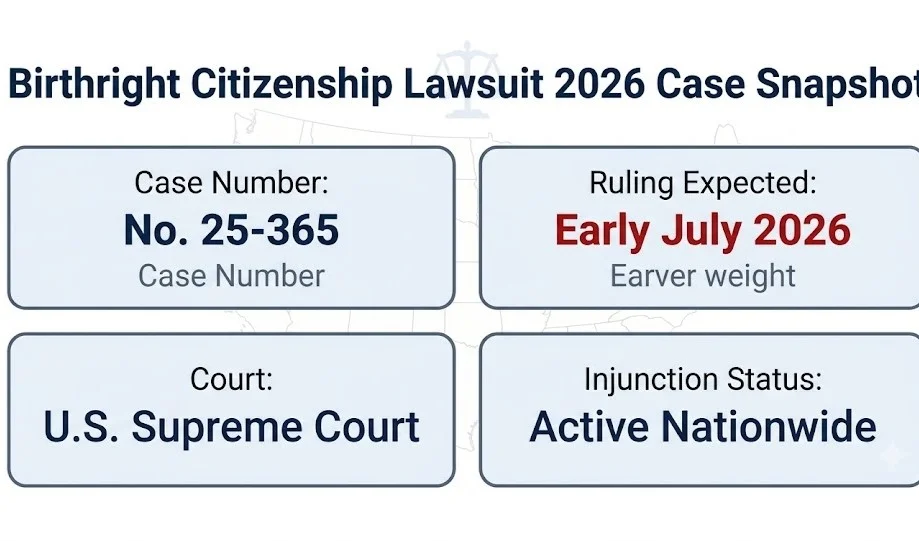
- There is no settlement and no payout in this case. The only outcome at stake is whether the Supreme Court upholds or strikes down the order, with a ruling expected by early July 2026.
| Detail | Info |
|---|---|
| Court | Supreme Court of the United States, on review from U.S. District Court for the District of New Hampshire |
| Case Number | No. 25-365 (Trump v. Barbara) |
| Filing Date | Original suit filed June 27, 2025; certiorari granted December 5, 2025 |
| Status | Pending. Oral argument held April 1, 2026. Ruling expected by early July 2026 |
| Settlement Fund | Not applicable. This is constitutional litigation, not a damages case |
The birthright citizenship lawsuit sitting before the Supreme Court right now is not a class action over money. It is a fight over whether a sitting president can rewrite the Fourteenth Amendment by executive order.
That fight has a name, Trump v. Barbara, and a docket number, No. 25-365. The justices heard arguments on April 1, 2026, and a ruling is expected within days.
An estimated 255,000 children born each year to noncitizen parents have something riding on this case, according to the Migration Policy Institute. That number alone explains why this has become the most closely watched constitutional case of the term.
This article breaks down exactly where the case stands, who is litigating it, and what happens next depending on how the Court rules.
What Is the Birthright Citizenship Lawsuit About
The birthright citizenship lawsuit is a constitutional challenge to Executive Order 14160, signed by President Trump on January 20, 2025. The order tried to deny automatic citizenship to children born in the U.S. when neither parent held citizenship or lawful permanent residency.
Plaintiffs argue the order violates the Fourteenth Amendment’s Citizenship Clause and a federal statute, 8 U.S.C. § 1401(a), that codifies the same guarantee. Every court that has reviewed the order so far has agreed it is likely unconstitutional.
The case now carries the name of its lead plaintiff, identified only as Barbara, a Honduran national who sued under a pseudonym out of fear for her family’s safety.
Quick facts:
- Order signed: January 20, 2025
- Order’s intended effective date: February 19, 2025
- Current enforcement status: blocked nationwide
Attorney Insight: Attorneys handling constitutional challenges to executive orders point to the unusually fast judicial consensus here, with every reviewing court reaching the same conclusion within months.
Trump v. Barbara: The Case Now Before the Supreme Court
Trump v. Barbara is the specific case the Supreme Court is deciding, and it asks one direct question. Does Executive Order 14160 comply with the Citizenship Clause of the Fourteenth Amendment.
The case began the same day the Supreme Court issued its earlier ruling in Trump v. CASA. The ACLU and partner organizations filed Barbara v. Trump in the District of New Hampshire on June 27, 2025, seeking a class-wide injunction.
Judge Joseph Laplante certified the class and issued a preliminary injunction on July 10, 2025. The administration asked the Supreme Court to take the case directly, bypassing the First Circuit, and the Court granted certiorari before judgment on December 5, 2025.
| Stage | Date |
|---|---|
| Lawsuit filed | June 27, 2025 |
| Preliminary injunction granted | July 10, 2025 |
| Government petitions Supreme Court | September 26, 2025 |
| Certiorari granted | December 5, 2025 |
| Oral argument | April 1, 2026 |
Attorney Insight: Litigators tracking the case note that taking it before the First Circuit ruled is itself a signal the Court wanted to resolve the merits quickly, not let it linger in the appellate pipeline.
Birthright Citizenship Executive Order: What It Actually Says
Executive Order 14160 directs federal agencies to stop recognizing citizenship for certain U.S.-born children. The order applies to children born after February 19, 2025, under two specific conditions.
The first condition covers children whose mother was unlawfully present and whose father was neither a citizen nor a lawful permanent resident. The second covers children whose mother held only temporary lawful status, paired with the same paternal condition.
Under the order, agencies including USCIS, the State Department, and the Social Security Administration would have stopped issuing citizenship documents to affected children. A birth certificate alone would no longer prove citizenship.
Bolded callout stat: Roughly 150,000 to 255,000 children born annually would fall within the order’s scope, according to estimates cited by the Migration Policy Institute and court filings.
Attorney Insight: Immigration attorneys flag the documentation problem as the most disruptive piece, since agencies would need new verification systems that do not currently exist.
Who Qualifies for Birthright Citizenship Right Now
Every child born in the United States currently qualifies for citizenship at birth, regardless of their parents’ immigration status. That has been the rule since the Fourteenth Amendment was ratified in 1868, and it remains the rule today.
The executive order has never taken effect. Every injunction issued against it remains in place while the Supreme Court decides the underlying constitutional question.
This means parents do not need to take any special steps right now to secure their newborn’s citizenship. Standard birth registration and a state-issued birth certificate remain sufficient proof.
Who currently qualifies:
- Children born on U.S. soil to undocumented parents
- Children born on U.S. soil to parents on temporary visas
- Children born on U.S. soil to lawful permanent residents or citizens
- Children born on tribal land, protected since the Indian Citizenship Act of 1924
Attorney Insight: Family law and immigration attorneys consistently advise clients that no executive order can alter citizenship status while a court injunction blocks its enforcement.
Litigation Watch: The executive order has never gone into effect for a single child, and current law treats every U.S.-born child exactly as it did before January 2025.
Birthright Citizenship Exceptions Under the Fourteenth Amendment
Birthright citizenship exceptions are narrow and have not changed because of this litigation. The Supreme Court defined them in 1898 in United States v. Wong Kim Ark and they remain controlling law today.
Children of foreign diplomats are excluded, because diplomats are not considered subject to U.S. jurisdiction in the constitutional sense. Children born to members of an occupying enemy force during hostilities fall into the same narrow category.
A third historical exception, children born to members of tribal nations, was eliminated by Congress through the Indian Citizenship Act of 1924. That statutory fix means tribal birth is no longer an exception at all.
| Exception | Still applies in 2026 |
|---|---|
| Children of foreign diplomats | Yes |
| Children of occupying enemy forces | Yes |
| Children born to tribal members | No, eliminated by statute in 1924 |
| Children of undocumented immigrants | No exception exists |
Attorney Insight: Constitutional scholars handling amicus filings in Barbara stress that these exceptions cover a vanishingly small number of births each year, not the hundreds of thousands targeted by the 2025 order.
Which Court Is Hearing the Birthright Citizenship Case
The Supreme Court of the United States is hearing the birthright citizenship case directly, after granting certiorari before judgment. That procedural move let the justices skip the First Circuit Court of Appeals entirely.
The case originated in the U.S. District Court for the District of New Hampshire, where Judge Joseph Laplante issued the operative injunction and class certification. Several related lawsuits were also filed in Washington, Maryland, Massachusetts, California, New York, and the District of Columbia.
Those parallel cases matter because they built the body of consistent rulings the Supreme Court is now reviewing. Every one of them found the executive order likely unconstitutional.
Court chain for Trump v. Barbara:
- Trial court: U.S. District Court, District of New Hampshire
- Skipped: U.S. Court of Appeals for the First Circuit
- Final reviewing court: Supreme Court of the United States, Case No. 25-365
Attorney Insight: Appellate attorneys note that skipping an entire layer of review is rare and reflects how badly both sides wanted certainty before the order’s effective date arrived.
Birthright Citizenship Class Action: How the Class Was Certified
The birthright citizenship class action protects every affected child automatically, without requiring individual families to file separate paperwork. Judge Laplante certified the class on July 10, 2025.
The certified class covers children born or who will be born in the United States who would lose recognized citizenship under Executive Order 14160. Because the class is automatic, no caregiver had to opt in or register to receive its protection.
This class mechanism became critical after the Supreme Court’s earlier ruling in Trump v. CASA limited how far ordinary nationwide injunctions can reach. A certified class survived that limitation where individual lawsuits could not.
Class certification basics:
- Certifying court: District of New Hampshire
- Certification date: July 10, 2025
- Class definition: children affected by EO 14160’s citizenship restriction
- Opt-in required: no
Attorney Insight: Class action attorneys point to this case as a model for how plaintiffs adapted quickly after the Supreme Court narrowed universal injunctions just weeks earlier.
Birthright Citizenship Lawsuit Timeline 2025 to 2026
The birthright citizenship lawsuit timeline runs from the order’s signing through the pending Supreme Court ruling. Tracking the dates helps explain why this case moved faster than most constitutional litigation.
The order was signed in January 2025, blocked within weeks, escalated to the Supreme Court on a separate procedural question by June 2025, and reached full merits argument less than a year later.
| Date | Event |
|---|---|
| January 20, 2025 | Executive Order 14160 signed |
| February 5, 2025 | First preliminary injunction issued (D. Md.) |
| June 27, 2025 | Trump v. CASA decided, limiting universal injunctions |
| June 27, 2025 | Barbara v. Trump filed in New Hampshire |
| July 10, 2025 | Class certified, new injunction issued |
| December 5, 2025 | Certiorari granted in Trump v. Barbara |
| April 1, 2026 | Oral argument held |
| Late June or early July 2026 | Ruling expected |
Attorney Insight: Litigation strategists describe this pace as unusually fast for a Fourteenth Amendment case, driven largely by the order’s own short effective-date window.
Litigation Watch: Every procedural shortcut in this case, from certiorari before judgment to automatic class protection, exists because the original 30-day effective date forced courts to move fast.
When Will the Supreme Court Rule on Birthright Citizenship
The Supreme Court is expected to rule on birthright citizenship before its term ends, sometime in late June or early July 2026. The Court typically clears its remaining argued cases before beginning summer recess.
As of this writing, no decision has been issued. Court watchers note the opinion could arrive at any scheduled opinion release date during this window.
Justices across the ideological spectrum, including some Trump appointees, raised pointed questions during oral argument about the historical basis for the administration’s position.
What to watch for:
- Opinion author, since the assigned justice often signals the outcome’s framing
- Whether the ruling addresses Wong Kim Ark directly or sidesteps it
- Any concurrence addressing the INA’s separate statutory protection
Attorney Insight: Court watchers point to Chief Justice Roberts’ exchange with the Solicitor General, where Roberts rejected the argument that modern immigration justifies reinterpreting the Amendment’s text, as a notable signal of skepticism.
Birthright Citizenship Injunction Status as of 2026
The birthright citizenship injunction remains fully in place as of June 2026. The executive order cannot be enforced anywhere in the country while the Supreme Court’s review continues.
This injunction status has not changed since the class certification order in July 2025. Federal agencies remain legally barred from denying citizenship documents to any affected child.
Multiple separate injunctions from Washington, Maryland, and Massachusetts reinforce the New Hampshire order, creating overlapping protection even before accounting for the certified class itself.
Current injunction status:
- New Hampshire class injunction: active
- Washington state injunction: active
- Maryland injunction: active
- Massachusetts injunction: active
- Order enforcement nationwide: zero, blocked entirely
Attorney Insight: Attorneys advising affected families stress that “blocked” means fully blocked, not partially enforced, and that no agency has lawful authority to act on the order right now.
States Suing Over Birthright Citizenship
Multiple states sued over birthright citizenship independently of the Barbara class action, adding a second legal track to the fight. State attorneys general filed suits in federal courts across several jurisdictions.
These state-led cases proceeded under Trump v. CASA’s preserved exception, which still allows state attorneys general to seek broad injunctive relief even after the Supreme Court limited private nationwide injunctions.
Washington, Maryland, Massachusetts, and other states argued the order imposed direct administrative and fiscal burdens on state agencies, separate from any harm to individual families.
States involved in related litigation:
- Washington
- Maryland
- Massachusetts
- Additional suits filed in California, New York, and the District of Columbia
Attorney Insight: State government litigators emphasize that their standing argument rests on administrative burden, not just constitutional harm, giving the states a separate path to relief.
Trump v. CASA vs Trump v. Barbara: Why People Confuse Them
Trump v. CASA and Trump v. Barbara are two different Supreme Court cases, and confusing them leads to inaccurate reporting. CASA addressed court procedure. Barbara addresses the Constitution itself.
Trump v. CASA, decided June 27, 2025, ruled 6 to 3 that federal district courts generally cannot issue broad nationwide injunctions for private plaintiffs. It said nothing about whether the executive order itself was lawful.
Trump v. Barbara, argued April 1, 2026, picks up where CASA left off. It asks whether the order violates the Fourteenth Amendment, the actual merits question CASA never touched.
| Feature | Trump v. CASA | Trump v. Barbara |
|---|---|---|
| Decided | June 27, 2025 | Pending |
| Question | Can courts issue nationwide injunctions | Is the executive order constitutional |
| Outcome | Limited nationwide injunctions, preserved class actions | Awaiting ruling |
Attorney Insight: Legal commentators repeatedly flag this distinction as the single most misreported detail in coverage of the litigation.
Litigation Watch: Nothing about the Constitution’s protection of birthright citizenship has been decided yet. CASA only addressed which procedural tool courts could use to block the order.
What Happens If Birthright Citizenship Is Overturned
If the Supreme Court rules for the administration, the executive order would likely take effect for births occurring after the ruling, not retroactively. Federal agencies have already prepared implementation guidelines for that scenario.
A U.S. birth certificate alone would stop being sufficient proof of citizenship for affected children. Agencies would instead evaluate parental immigration status before issuing a Social Security number or passport.
Civil rights groups have warned this would create a documentation crisis and risk statelessness for some children, since no other country would necessarily grant them citizenship either.
Likely practical effects of an adverse ruling:
- New verification requirements at birth registration
- Delayed or denied Social Security numbers for affected children
- Increased burden on state agencies tracking birth status
- Continued litigation over implementation details
Attorney Insight: Constitutional litigators expect any adverse ruling to trigger an immediate second wave of lawsuits challenging how agencies implement it.
How to Protect Your Child’s Citizenship Documentation
Parents can protect their child’s citizenship documentation by securing standard records now, before any ruling changes the legal landscape. A certified birth certificate remains the foundational document.
Families with mixed immigration status should also retain proof of the parents’ lawful status, immigration paperwork, and any existing Social Security documentation for the child.
None of this is required by current law, since the order remains blocked. It simply reduces friction if implementation guidance changes quickly after a ruling.
Recommended documentation:
- Certified copy of the child’s birth certificate
- Hospital birth records
- Parents’ immigration status documentation
- Existing Social Security card or number, if issued
Attorney Insight: Immigration attorneys recommend keeping these documents together and accessible rather than waiting until a ruling forces a scramble.
Who Is Litigating the Birthright Citizenship Case
The birthright citizenship case is being litigated by a coalition of civil rights organizations on behalf of the plaintiff class. The lead counsel comes from the ACLU, working alongside several regional and specialized partners.
Co-counsel includes ACLU affiliates in New Hampshire, Maine, and Massachusetts, plus the Legal Defense Fund, the Asian Law Caucus, and the Democracy Defenders Fund. The federal government is represented by the Solicitor General’s office.
This is not a personal injury bar matter. The attorneys involved specialize in constitutional and civil rights litigation, not consumer claims or mass torts.
Organizations representing the plaintiff class:
- American Civil Liberties Union
- ACLU of New Hampshire, Maine, and Massachusetts
- Legal Defense Fund
- Asian Law Caucus
- Democracy Defenders Fund
Attorney Insight: Civil rights litigators note the breadth of this coalition reflects how many distinct legal theories, constitutional, statutory, and administrative, are being argued in parallel.
Do You Need a Birthright Citizenship Lawyer
Most families do not need individual legal representation in this specific case, because the certified class already covers every affected child automatically. Hiring a lawyer becomes relevant in narrower situations.
Families facing an active citizenship dispute right now, such as a denied passport application or a contested birth certificate, should speak with an immigration attorney immediately rather than wait for the Supreme Court’s ruling.
Attorneys who handle constitutional immigration matters can also advise families on documentation strategy if the ruling goes against the plaintiff class.
When to consult an attorney:
- A passport or Social Security application has already been denied or delayed
- An agency has requested unusual documentation for a U.S.-born child
- You believe your specific case falls outside the certified class definition
- You want guidance on what to do immediately after a ruling drops
Attorney Insight: Attorneys in this space generally advise against panic filings before a ruling exists, since the class protection already covers most readers asking this question.
Frequently Asked Questions
What is the birthright citizenship lawsuit called?
The case is formally known as Trump v. Barbara, Supreme Court case No. 25-365.
It originated as Barbara v. Trump in the District of New Hampshire before reaching the Supreme Court.
Has the Supreme Court ruled on birthright citizenship yet?
No, the Supreme Court has not yet issued its ruling as of this writing.
A decision is expected by late June or early July 2026, after oral argument on April 1, 2026.
Who qualifies for birthright citizenship right now?
Every child born on U.S. soil currently qualifies for citizenship at birth.
The executive order attempting to change this has been blocked by court injunctions since early 2025.
What happens if the Supreme Court upholds the executive order?
The order would likely apply going forward to new births, not retroactively to children already recognized as citizens.
Federal agencies have prepared implementation guidance for this scenario, though further litigation over its rollout is expected.
Is birthright citizenship currently blocked nationwide?
The executive order itself is blocked nationwide, not birthright citizenship.
Multiple injunctions, including the certified class protection from New Hampshire, prevent any enforcement while the Supreme Court decides the case.
Do I need a lawyer if I think my child is affected?
Most affected children are already covered by the certified class without needing separate legal action.
You should consult an immigration attorney directly if you face an active denial or dispute involving your child’s documents.
The Bottom Line on This Case
Birthright citizenship remains the law for every child born in the United States today. The executive order behind this entire lawsuit has never taken effect for a single birth.
A Supreme Court ruling is expected within days of this article’s publication. Families facing an active citizenship dispute right now should consult an immigration attorney rather than wait for that decision.
