
Quick Answer
- What is this case? Multiple federal class action lawsuits allege that Ford Motor Company knowingly sold vehicles equipped with defective EcoBoost engines across three primary litigation tracks: the 1.5L coolant intrusion defect, the 2.0L misfire defect, and the 2.7L F-150 rod bearing and oil consumption defect.
- Who qualifies? Current and former owners or lessees of affected Ford vehicles, primarily the Fusion, Escape, Edge, Explorer, and F-150, equipped with EcoBoost engines in model years ranging from 2013 through 2020, depending on which defect track applies.
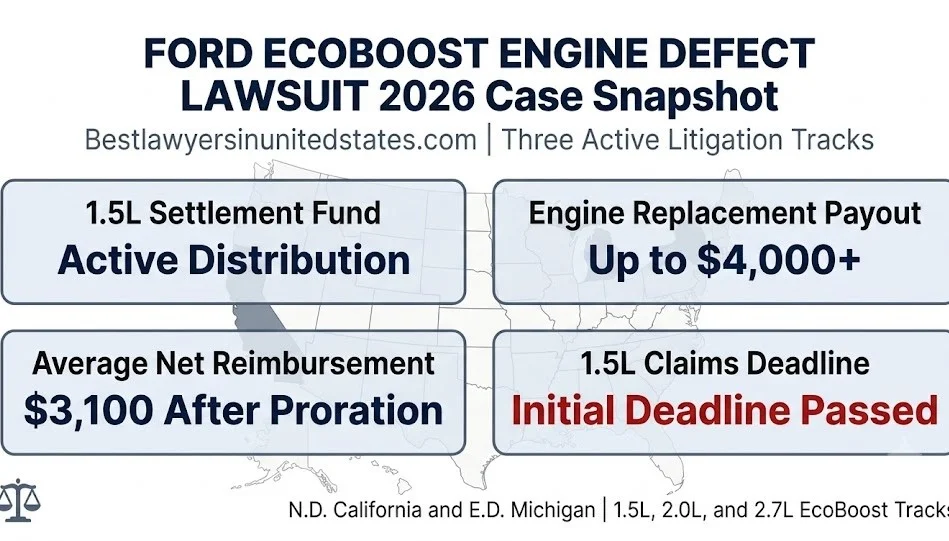
- What is it worth? Settlement and litigation outcomes vary by track. The 1.5L coolant intrusion settlement provides reimbursements ranging from approximately $100 to over $4,000 depending on documented repair costs. The 2.7L F-150 litigation remains active with no announced settlement fund as of 2026.
Case Snapshot
| Detail | Info |
|---|---|
| Primary Defendant | Ford Motor Company (Dearborn, Michigan) |
| 1.5L Coolant Defect Case | Vargas v. Ford Motor Co., related proceedings, N.D. Cal. and consolidated filings |
| Court (1.5L Track) | U.S. District Court, Northern District of California |
| Court (Related Proceedings) | U.S. District Court, Eastern District of Michigan |
| Initial Complaint Filings | 2017 (1.5L track); 2019-2020 (2.7L F-150 track) |
| Presiding Judge (N.D. Cal.) | Varies by assigned docket; N.D. Cal. complex litigation panel |
| 1.5L Settlement Status | Settlement reached; claims administration ongoing through 2026 |
| 2.7L F-150 Litigation Status | Active; no settlement announced as of 2026 |
| 2.0L Misfire Claims Status | Active proceedings; class certification contested |
| NHTSA Investigations | Multiple open and closed investigations across EcoBoost variants |
| Claims Administrator | Court-appointed; varies by settlement proceeding |
Introduction
The Ford EcoBoost engine defect lawsuit is not a single case with a single settlement check. It is a multi-track federal litigation spanning three distinct engine variants, multiple U.S. district courts, and more than a decade of accumulated NHTSA complaints.
Ford Motor Company faces separate class action proceedings alleging it concealed known defects in its 1.5L, 2.0L, and 2.7L EcoBoost engines. Each track involves different vehicles, different failure modes, and different legal postures in 2026.
NHTSA received more than 4,000 complaints across EcoBoost engine variants before Ford issued its first targeted recalls. That complaint volume forms a significant part of the evidentiary record plaintiffs have assembled in these proceedings.
Affected vehicle owners include drivers of the Ford Fusion, Escape, Edge, Explorer, and F-150. The litigation’s reach extends across millions of vehicles sold in the United States between 2013 and 2020.
What Is the Ford EcoBoost Engine Defect Lawsuit?
The Ford EcoBoost engine defect lawsuit refers to a series of federal class action complaints alleging that Ford knowingly sold vehicles with engine defects it failed to disclose to consumers at the point of sale.
The lawsuits assert claims under the Magnuson-Moss Warranty Act, state consumer protection statutes, and common law theories of fraudulent concealment and breach of implied warranty. These are not simple lemon law claims. They allege that Ford possessed internal engineering data documenting the defects before vehicles reached dealerships.
Core legal theories across the EcoBoost litigation:
- Fraudulent concealment of known defect prior to sale
- Breach of implied warranty of merchantability
- Violation of state consumer protection statutes in California, Texas, Michigan, and additional states
- Magnuson-Mass Warranty Act violation for failure to honor warranty obligations
- Unjust enrichment based on premium pricing for defective vehicles
Attorney Insight: Attorneys handling these claims note that the fraudulent concealment theory is the most litigation-significant allegation because it can toll the statute of limitations, allowing owners who purchased vehicles several years ago to remain viable class members despite the passage of time.
Ford EcoBoost Class Action Lawsuit: The Structure of the Litigation
The Ford EcoBoost class action lawsuit is structured as multiple parallel proceedings rather than a single consolidated MDL, which distinguishes it from large automotive defect cases like the Hyundai Theta II engine MDL.
The 1.5L coolant intrusion track produced the most advanced settlement proceedings. The 2.0L and 2.7L tracks remain in active litigation phases as of 2026.
Litigation structure overview:
| Track | Engine | Primary Defect | Litigation Phase (2026) |
|---|---|---|---|
| Track 1 | 1.5L EcoBoost Ti-VCT | Coolant intrusion into combustion chamber | Settlement; claims ongoing |
| Track 2 | 2.0L EcoBoost | Turbocharger condensate misfire | Active; class certification contested |
| Track 3 | 2.7L EcoBoost | Rod bearing failure, oil consumption | Active; no settlement announced |
Each track was initiated by separate named-plaintiff class action complaints filed in different federal districts. Settlement of one track does not affect eligibility or proceedings in the others.
Attorney Insight: Class action practitioners note that the multi-track structure creates an important tactical consideration for affected owners: an owner whose vehicle is covered by both the 1.5L settlement and a separate ongoing proceeding may have concurrent claims requiring separate analysis.
Litigation Watch: The EcoBoost litigation’s multi-track structure means that affected Ford owners face a fragmented claims landscape where their specific engine variant, vehicle model, and documented failure type determine which legal avenue is available to them.
Ford EcoBoost Lawsuit Update 2026: Current Case Status
As of 2026, the three EcoBoost litigation tracks are in materially different procedural postures with distinct near-term implications for affected vehicle owners.
Track 1 (1.5L Coolant Intrusion): Settlement administration is ongoing. The claims submission period closed for initial filers, but the settlement administrator continues processing submitted claims. Distribution of approved payments is active through 2026. Owners who submitted complete documentation before the deadline are receiving or awaiting payments.
Track 2 (2.0L Misfire): Class certification proceedings are contested in the Northern District of California. Ford has challenged the typicality and commonality requirements for class certification. The outcome of the certification motion will determine whether this track proceeds as a class action or fractures into individual cases.
Track 3 (2.7L F-150): Active discovery phase. No settlement has been announced. Plaintiffs’ counsel is pursuing internal Ford engineering documents and communications related to when the company first identified rod bearing failure risk in the 2.7L EcoBoost configuration.
| Track | 2026 Status | Key Development |
|---|---|---|
| 1.5L Coolant | Claims distribution active | Payments being issued to approved claimants |
| 2.0L Misfire | Class certification contested | Motion outcome determines class viability |
| 2.7L F-150 | Discovery phase | Ford internal documents under production order |
Attorney Insight: Litigators monitoring the 2.0L track note that Ford’s challenge to class certification is substantively significant because if the motion succeeds, affected owners would need to file individual suits to recover, raising the cost and complexity threshold considerably.
Ford EcoBoost Lawsuit Court and Docket Details: Where Are These Cases Filed?
The Ford EcoBoost lawsuits are pending in multiple federal district courts, with the Northern District of California serving as the primary venue for the most advanced settlement proceeding.
Northern District of California: The 1.5L EcoBoost coolant intrusion class action was filed here. The Northern District of California handles a high volume of complex consumer class actions and has an established procedural framework for automotive defect litigation.
Eastern District of Michigan: Related Ford engine proceedings involving warranty and consumer protection claims have been filed in the Eastern District of Michigan, where Ford Motor Company is headquartered. Some related EcoBoost complaints were filed there based on Michigan consumer protection statute claims.
Central District of California: Additional named-plaintiff complaints involving EcoBoost misfire and coolant-related allegations were filed in the Central District before transfer or coordination proceedings.
Key court record details:
| Court | Cases Filed | Track |
|---|---|---|
| N.D. California | 1.5L coolant intrusion lead cases | Track 1 (settled) |
| E.D. Michigan | Warranty and Michigan CPA claims | Related Ford engine proceedings |
| C.D. California | Additional EcoBoost misfire complaints | Track 2 related filings |
Attorney Insight: Attorneys who practice in automotive class action litigation note that the absence of a single MDL consolidation for the EcoBoost cases means claimants in different states may be subject to different procedural timelines and different court-specific discovery rules.
Ford 1.5L EcoBoost Coolant Leak Lawsuit: The Core Engineering Defect
The Ford 1.5L EcoBoost coolant leak lawsuit is the most legally advanced of the EcoBoost litigation tracks and the one most likely to produce direct compensation for affected vehicle owners in 2026.
The 1.5L Ti-VCT EcoBoost engine, installed in the Ford Fusion and Ford Escape, was alleged to suffer from a design defect in which coolant could enter the engine’s combustion chamber. This occurs because of a failure in the head gasket assembly or a crack in the cylinder head, which allows coolant to migrate internally.
Engineering failure sequence in the 1.5L defect:
- Coolant breaches the head gasket or enters through a cylinder head crack
- Coolant enters one or more combustion chambers
- Engine experiences rough running, white smoke from exhaust, and eventual hydrolocking
- Hydrolocking occurs when liquid coolant in the cylinder prevents the piston from completing its compression stroke
- Catastrophic engine failure results, often requiring full engine replacement
Callout: Ford’s own internal documents obtained in discovery showed engineering awareness of the 1.5L coolant intrusion risk as early as 2014, before the first consumer complaints reached NHTSA.
The first consolidated class complaint covering the 1.5L defect was filed in 2017. Settlement negotiations advanced through 2022 and 2023, culminating in a court-approved settlement now in the claims distribution phase.
Attorney Insight: Plaintiffs’ attorneys in this track argue that the 2014 internal awareness date, combined with Ford’s failure to issue a recall or disclosure until years later, satisfies the fraudulent concealment standard and substantially extends the limitations period for all class members.
Ford EcoBoost Misfire Class Action: The 2.0L Engine Track
The Ford EcoBoost misfire class action targets the 2.0L EcoBoost engine installed across multiple Ford and Lincoln vehicle lines, including the Ford Escape, Ford Edge, Ford Explorer, and Lincoln MKC.
The alleged defect in the 2.0L engine involves condensate accumulation in the turbocharger intercooler system. When humid air passes through the intercooler, water vapor condenses. That condensate can enter the intake manifold and cylinders during cold starts or heavy acceleration events.
The condensate-to-misfire sequence:
- Condensate accumulates in the intercooler charge pipe during periods of engine-off cooling
- On cold startup, condensate is ingested into the engine intake
- Sudden liquid ingestion causes one or more cylinders to misfire
- Drivers experience a sudden, violent shudder accompanied by engine warning lights
- Diagnostic codes P0300 (random misfire) and related codes appear in the vehicle’s OBD system
Callout: NHTSA received documented complaints citing sudden, severe shuddering at highway speeds in 2.0L EcoBoost vehicles dating back to model year 2013.
The 2.0L misfire class action is currently at the class certification stage in the Northern District of California. Ford has contested whether the plaintiff class meets the commonality and typicality requirements of Federal Rule of Civil Procedure 23.
Attorney Insight: Automotive defect class action attorneys note that the condensate misfire defect presents a particularly strong commonality argument because the failure mode is mechanically identical across all affected vehicles, regardless of individual driving patterns, making it well-suited for class treatment.
Litigation Watch: The three EcoBoost litigation tracks represent distinct engineering failures with separate evidentiary records, different procedural postures in 2026, and materially different timelines for any potential compensation.
Ford 2.7L EcoBoost Engine Problems Lawsuit: The F-150 Allegations
The Ford 2.7L EcoBoost engine problems lawsuit targets the turbocharged V6 engine installed in the Ford F-150, the best-selling vehicle in the United States for more than four decades.
The 2.7L EcoBoost, introduced for the 2015 F-150 model year and continuing through subsequent years, is alleged to suffer from premature connecting rod bearing failure and abnormal oil consumption. Both conditions share a documented failure pathway: insufficient oil film between bearing surfaces during high-load operating conditions.
Alleged failure characteristics of the 2.7L EcoBoost:
- Connecting rod bearing wear beginning at unexpectedly low mileage (some complaints document onset before 60,000 miles)
- Abnormal oil consumption requiring quart additions between standard oil changes
- Engine knock or ticking during cold starts that subsides as oil pressure builds
- Eventual rod bearing seizure, resulting in catastrophic internal engine damage
- Documented cases of engine failure at highway speed in fully loaded truck configurations
This litigation track remains in active discovery as of 2026. Plaintiffs’ counsel is focused on obtaining Ford’s internal validation test data for the 2.7L engine, internal warranty claim aggregation reports, and communications between engineering and legal departments regarding bearing failure complaints.
Attorney Insight: Product liability attorneys handling F-150 claims in this track note that the commercial vehicle use of the F-150, including contractors, tradespeople, and fleet operators, expands the categories of economic damage beyond personal vehicle loss to include lost business income and fleet replacement costs.
Ford F-150 EcoBoost Engine Lawsuit: Why the Truck Cases Are Different
The Ford F-150 EcoBoost engine lawsuit differs meaningfully from the Fusion and Escape EcoBoost cases in both the applicable legal theories and the damages calculation framework.
F-150 owners and commercial operators allege that the 2.7L EcoBoost was marketed as a capable, heavy-duty engine suitable for towing and hauling, while Ford allegedly knew the engine’s bearing design was inadequate for sustained high-load operation.
Why F-150 EcoBoost cases present a distinct legal profile:
- Commercial truck operators can claim consequential business damages in addition to repair costs
- Fleet operators with multiple affected vehicles may have aggregate claims substantially exceeding individual consumer claims
- The marketing representations made for the F-150’s “best-in-class” towing capacity are central to the fraudulent misrepresentation theory
- Texas, Michigan, and other heavy-truck states have consumer protection statutes that specifically address commercial vehicle deception
Potential F-150 claimant damage categories:
| Damage Category | Description |
|---|---|
| Engine repair/replacement cost | Documented repair invoices |
| Towing capacity loss | If vehicle was unable to perform rated function |
| Business income loss | For commercial operators with documented downtime |
| Diminished resale value | Premium paid for “EcoBoost” designation vs. actual value |
| Rental or replacement vehicle costs | During engine repair period |
Attorney Insight: Attorneys handling commercial F-150 claims note that the consequential damages theory, while powerful, requires careful documentation from the outset, including contemporaneous records of work interruptions, rental vehicle receipts, and business income loss attributable to specific vehicle downtime.
Litigation Watch: The F-150 EcoBoost litigation’s commercial damage component, the marketing misrepresentation theory, and the ongoing discovery phase in 2026 make this the most legally complex and potentially highest-value track for individual claimants with documented commercial losses.
Ford EcoBoost Engine Defect Symptoms: What Qualifies as a Covered Event?
The Ford EcoBoost engine defect symptoms that courts and settlement administrators treat as qualifying events are specific and documented, not generic engine complaints.
Understanding which symptoms align with the legal allegations in each track helps vehicle owners assess whether their experience is potentially compensable.
1.5L EcoBoost qualifying symptoms:
- White or gray smoke from the exhaust, particularly on cold starts
- Engine coolant loss without visible external leak
- Sweet smell from the exhaust (indicating coolant combustion)
- Engine misfire codes in conjunction with coolant loss
- Hydrolocking event resulting in engine failure requiring replacement
2.0L EcoBoost qualifying symptoms:
- Sudden, severe engine shudder during cold start or acceleration
- Diagnostic codes P0300, P0301, P0302, P0303, or P0304
- Violent single-event misfire followed by stabilization
- Symptom recurrence across multiple cold-start events
2.7L EcoBoost qualifying symptoms:
- Engine knock or ticking, particularly pronounced during cold starts
- Oil consumption exceeding one quart per 3,000 miles or less
- Metal debris visible in oil at filter change
- Engine bearing noise at highway speed under load
Attorney Insight: Claims reviewers and attorneys processing settlement submissions consistently report that the strongest claims are those supported by dealer service records documenting the specific symptom, the diagnostic code retrieved from the vehicle’s ECU, and the repair performed, not solely owner-reported descriptions of what the vehicle sounded or felt like.
Who Qualifies for the Ford EcoBoost Lawsuit?
Eligibility for the Ford EcoBoost lawsuit depends on which litigation track applies to the specific vehicle and the documented repair or failure history.
For the 1.5L coolant intrusion settlement:
- Current or former owners or lessees of a Ford Fusion or Ford Escape equipped with the 1.5L Ti-VCT EcoBoost engine
- Model years generally 2013 through 2018 (confirm against the official settlement vehicle list)
- Individuals who experienced a documented coolant intrusion event or who paid for a qualifying repair
- Original purchasers and subsequent owners who can document the qualifying repair
For the 2.0L misfire class action (pending certification):
- Owners or lessees of covered models with the 2.0L EcoBoost engine who experienced documented misfire events
- Class membership is not yet finally certified; eligibility is contingent on court certification order
For the 2.7L F-150 litigation (active):
- F-150 owners with documented rod bearing failure, oil consumption issues, or related engine damage in covered model years
- No settlement class has been certified; affected owners should preserve all repair documentation
Used vehicle purchaser eligibility:
The 1.5L settlement does not restrict compensation to original purchasers. Subsequent owners who paid for qualifying repairs on covered vehicles may submit claims with appropriate documentation of vehicle ownership and repair records.
Attorney Insight: Attorneys assisting second-owner claimants note that the critical documentation requirement is a chain of vehicle ownership establishing the claimant’s possession of the vehicle at the time of the qualifying repair, typically satisfied by title records and the repair invoice in the claimant’s name.
Ford EcoBoost Affected Models and Years: The Complete Vehicle List
The Ford EcoBoost affected models span multiple vehicle lines and model year ranges that differ by engine variant and litigation track.
Track 1: 1.5L EcoBoost Coolant Intrusion (Settled)
| Vehicle | Engine | Covered Model Years |
|---|---|---|
| Ford Fusion | 1.5L Ti-VCT EcoBoost | 2013-2018 |
| Ford Escape | 1.5L Ti-VCT EcoBoost | 2014-2018 |
Track 2: 2.0L EcoBoost Misfire (Active)
| Vehicle | Engine | Alleged Covered Years |
|---|---|---|
| Ford Escape | 2.0L EcoBoost | 2013-2018 |
| Ford Edge | 2.0L EcoBoost | 2015-2018 |
| Ford Explorer | 2.0L EcoBoost | 2013-2018 |
| Ford Fusion (select trims) | 2.0L EcoBoost | 2013-2018 |
| Lincoln MKC | 2.0L EcoBoost | 2015-2018 |
Track 3: 2.7L EcoBoost F-150 (Active)
| Vehicle | Engine | Alleged Covered Years |
|---|---|---|
| Ford F-150 | 2.7L EcoBoost V6 | 2015-2020 |
Important note: Covered model years within the same vehicle line may vary by production date and VIN range. Owners should verify their specific vehicle against court-filed vehicle identification materials or consult class counsel directly.
Attorney Insight: Attorneys reviewing vehicle eligibility documentation note that model year is not always the determinative factor; some complaints specifically exclude vehicles manufactured before or after a certain production date within the same model year, based on when Ford altered the relevant engine component design.
Litigation Watch: The covered vehicle list across all three EcoBoost tracks spans millions of units sold in the United States, making this one of the larger automotive defect litigation populations currently active in federal courts.
Ford EcoBoost Settlement Payout Amounts 2026: What Can Claimants Receive?
Settlement payout amounts in the Ford EcoBoost litigation are structured in compensation tiers calibrated to the type and severity of the documented engine event.
1.5L EcoBoost Settlement Compensation Tiers:
| Tier | Qualifying Event | Estimated Reimbursement Range |
|---|---|---|
| Tier 1: Engine Replacement | Full engine replaced due to coolant intrusion failure | Up to $4,000+ (documented cost reimbursement) |
| Tier 2: Head Gasket / Cylinder Head Repair | Major coolant intrusion repair short of full replacement | Up to $2,500 (documented repair costs) |
| Tier 3: Coolant Intrusion Diagnostic and Repair | Qualifying diagnostic and partial repair | $100 to $500 (documented out-of-pocket costs) |
| Tier 4: Extended Warranty | Vehicle covered but no documented failure event | Extended powertrain warranty coverage |
Key payment mechanics:
The settlement fund is a fixed pool. Total valid claims submitted determine the per-claimant reimbursement. If total approved claims exceed the available net fund, individual payments are prorated proportionally.
Callout: According to available claims data from the initial distribution round, claimants with documented engine replacement costs received an average net reimbursement of approximately $3,100 after proration, below the stated maximum, reflecting the fund’s oversubscription.
Attorney Insight: Settlement finance practitioners note that prorated fund mechanics are often underexplained in class notices, leading claimants to expect reimbursement at the stated maximum tier amount when actual payments reflect the prorated share of a finite fund.
Ford EcoBoost Settlement 2026: Fund Details and Structure
The Ford EcoBoost settlement fund for the 1.5L coolant intrusion track is a court-supervised, fixed-pool structure administered under judicial oversight in the Northern District of California.
How the fund is allocated:
- A defined percentage covers class counsel attorney’s fees and costs, subject to court approval
- A separate portion covers settlement administration expenses
- The remaining net settlement fund is available for distribution to approved claimants
Net fund priority order:
- Documented engine replacement claims (highest tier)
- Documented major repair claims
- Diagnostic and minor repair claims
- Extended warranty provisions for covered vehicle owners without documented failures
The 2.0L misfire track and 2.7L F-150 track have no announced settlement funds as of 2026. Owners with claims in those tracks are not yet at the compensation stage. Their path to recovery runs through continued litigation, potential future settlement negotiations, or individual opt-out actions.
Attorney Insight: Litigators handling multi-track automotive class actions note that the existence of a settlement in one track can sometimes accelerate settlement negotiations in parallel active tracks, because the settled track’s resolution provides a precedent for damages valuation that both sides can reference.
The contrast between the settled 1.5L track and the active 2.0L and 2.7L tracks illustrates a broader litigation dynamic. The most fully documented defect, with the clearest engineering causation evidence, typically reaches settlement first.
Ford EcoBoost Lawsuit Filing Deadline 2026: What Are the Critical Dates?
The filing deadline for each EcoBoost track is the single most time-sensitive data point for any affected vehicle owner.
1.5L coolant intrusion settlement deadline status (2026):
The initial claims submission deadline for the 1.5L settlement has passed. The settlement administrator is processing submitted claims. Owners who did not submit before the deadline should contact class counsel immediately to determine whether a late claim or extraordinary circumstances exception applies.
Extended warranty benefits under the 1.5L settlement:
Even for owners who missed the cash reimbursement deadline, the settlement’s extended warranty provision may still be available for future qualifying repair events occurring within the settlement’s coverage period. This provision is separate from the cash reimbursement deadline.
2.0L and 2.7L tracks:
No claims deadlines have been established because no settlements have been reached. Owners with claims in these tracks do not need to file a claim form. They should preserve documentation and monitor litigation developments.
| Track | Claims Deadline | 2026 Action for Owners |
|---|---|---|
| 1.5L Coolant (settled) | Initial deadline passed | Contact class counsel re: late claims or extended warranty |
| 2.0L Misfire (active) | Not yet set | Preserve repair records; monitor class certification outcome |
| 2.7L F-150 (active) | Not yet set | Preserve all repair records; consult attorney if damages are significant |
Attorney Insight: Class action attorneys routinely advise that vehicle owners with potential claims in active litigation tracks should begin assembling documentation now, before any settlement deadline is announced, because the documentation review process can reveal gaps that are easier to remedy while memories and records are fresh.
How to File a Ford EcoBoost Settlement Claim: The Process Explained
Filing a Ford EcoBoost settlement claim in the 1.5L coolant intrusion proceeding requires specific documentation and submission through the court-appointed settlement administrator.
Required documentation for a complete claim submission:
- Official claim form obtained from the settlement administrator’s court-established portal
- Vehicle Identification Number (VIN) confirming the vehicle is a covered model and year
- Proof of ownership or lease during the period of the qualifying repair (title, registration, lease agreement)
- Dealer repair invoices documenting the qualifying repair event, specifying the failure diagnosis and repair performed
- Copies of any insurance claims or extended warranty reimbursement requests related to the qualifying repair
Common reasons claims are delayed or denied:
- VIN not appearing on the official covered vehicle list
- Repair invoice not specifying a qualifying diagnosis (must identify coolant intrusion or related failure)
- Missing proof of ownership at the time of the repair
- Repair performed by a non-dealer service facility without adequate documentation of the diagnosis
- Submission after the claims deadline without court-approved late filing authorization
For owners in the 2.0L and 2.7L tracks:
No claim form exists yet. The appropriate action is to preserve all dealer records, independent repair shop invoices, NHTSA complaint filing numbers, and any written communications with Ford about the engine condition.
Attorney Insight: Attorneys who assist clients in preparing class action claim submissions consistently report that the documentation gap causing the highest rate of initial denials is the absence of a diagnostic record specifically connecting the repair to the alleged defect, as opposed to a general engine repair invoice that does not identify the root cause.
What Type of Lawyer Handles a Ford EcoBoost Lawsuit?
A class action attorney with specific experience in automotive product liability and consumer protection litigation is the appropriate legal professional for Ford EcoBoost claims.
When an attorney is useful despite class membership:
- Evaluating whether opting out of the 1.5L class settlement to pursue individual litigation produces greater net recovery
- Assisting with documentation preparation for higher-tier reimbursement claims
- Pursuing an appeal of a denied or reduced claim through the administrator’s internal review process
- Assessing claims in the 2.0L or 2.7L tracks, which have no settlement and require individual litigation strategy decisions
- Pursuing personal injury claims if an engine failure caused a vehicle accident with bodily harm
Types of attorneys relevant to EcoBoost litigation:
| Attorney Type | Role |
|---|---|
| Class Action Attorney | Advises on class membership, opt-out analysis, claim preparation |
| Product Liability Attorney | Handles individual suits for severe engine failure with significant damages |
| Personal Injury Attorney | Handles bodily injury from engine failure-related accidents |
| Commercial Litigation Attorney | Handles consequential business damage claims for F-150 commercial operators |
| Consumer Protection Attorney | Advises on state-specific warranty and fraud claims |
Attorney Insight: Product liability attorneys handling individual EcoBoost opt-out cases note that the financial threshold for individual litigation to make economic sense is generally higher than most class members’ repair costs, making opt-out most viable for F-150 commercial operators or owners with documented catastrophic engine losses exceeding $15,000.
Attorneys in automotive class actions take cases on a contingency fee basis, meaning no upfront cost for the client. The attorney’s fee is paid from the recovery if the case succeeds.
Frequently Asked Questions
What is the Ford EcoBoost engine defect lawsuit about?
The Ford EcoBoost engine defect lawsuit refers to multiple federal class actions alleging that Ford knowingly sold vehicles with defective engines that suffer from coolant intrusion, misfire events, and premature bearing failure.
Three separate litigation tracks address the 1.5L, 2.0L, and 2.7L EcoBoost engines across the Ford Fusion, Escape, Edge, Explorer, and F-150.
Has the Ford EcoBoost lawsuit settled?
The 1.5L EcoBoost coolant intrusion class action has reached a settlement, and claims distribution is ongoing in 2026.
The 2.0L misfire track and the 2.7L F-150 track remain in active litigation with no settlement announced as of 2026.
Which Ford vehicles are covered by the EcoBoost lawsuit?
The settled 1.5L track covers the Ford Fusion and Ford Escape in model years generally spanning 2013 through 2018.
The active 2.0L track covers the Escape, Edge, Explorer, Fusion, and Lincoln MKC, while the active 2.7L track targets the Ford F-150 in model years 2015 through 2020.
How much money can I get from the Ford EcoBoost settlement?
Engine replacement claimants in the 1.5L settlement may receive reimbursements up to approximately $4,000, though actual payments are prorated based on total valid claims submitted.
Based on initial distribution data, engine replacement claimants received an average net reimbursement of approximately $3,100 after proration.
Can I still file a claim if I missed the Ford EcoBoost deadline?
The initial cash reimbursement deadline for the 1.5L settlement has passed, but extended warranty benefits for future qualifying repair events may still be available.
Contact the settlement administrator or a class action attorney immediately to determine whether a late claim exception or extended warranty provision applies to your specific situation.
What if my Ford EcoBoost engine failure caused an accident or injury?
Personal injury claims arising from EcoBoost engine failures are separate from the class settlement and may not be fully addressed within the class reimbursement framework.
A personal injury or product liability attorney should be consulted separately, as bodily injury claims may support an individual lawsuit against Ford Motor Company independent of the class action proceeding.
Closing
The Ford EcoBoost engine defect lawsuit in 2026 presents three distinct legal situations for affected vehicle owners. The 1.5L track is in distribution. The 2.0L and 2.7L tracks are active. Each requires a different response.
Owners with a Ford Fusion, Escape, or the vehicles covered in the active tracks should assess which litigation applies to their VIN and their documented repair history before any deadline passes. For F-150 commercial operators with significant losses, the case for consulting a product liability attorney is particularly strong.
A class action or product liability attorney who handles automotive defect litigation is the right starting point. That consultation costs nothing under standard contingency arrangements and provides the basis for a calculated decision about your specific legal options.
