
Quick Answer
- What is this case? Multiple federal class action lawsuits against Hyundai Motor America allege defective Theta II and Nu engines that stall or catch fire, a software-exploitable theft vulnerability, and an oil consumption defect across multiple vehicle lines. Two separate MDLs are active in the Central District of California.
- Who qualifies? Current and former owners or lessees of affected Hyundai (and Kia) vehicles, generally model years 2011 through 2022, depending on which defect and which MDL applies to their specific vehicle.
- What is it worth? The engine defect MDL settlement fund totals approximately $200 million. The theft vulnerability MDL settlement is valued at approximately $145 million. Individual payouts vary by tier, documented loss, and claims volume. Some claimants have received reimbursements ranging from $100 to over $6,000 depending on repair costs and engine replacement history.
Case Snapshot
| Detail | Info |
|---|---|
| Primary Court | U.S. District Court, Central District of California |
| Engine Defect MDL Number | MDL No. 2905, In re: Hyundai and Kia Engine Litigation |
| Theft Vulnerability MDL Number | MDL No. 3052, In re: Kia Hyundai Vehicle Theft Marketing, Sales Practices, and Products Liability Litigation |
| Presiding Judge (Both MDLs) | Judge James V. Selna, C.D. Cal. |
| Engine MDL Initial Filing | Consolidated complaint filed 2017 |
| Theft MDL Initial Filing | Consolidated complaint filed 2022 |
| Engine Settlement Fund | Approximately $200 million |
| Theft Settlement Fund | Approximately $145 million |
| Status (2026) | Engine MDL: claims distribution ongoing; Theft MDL: settlement approval proceedings active |
| Claims Administrator | Epiq Class Action and Claims Solutions |
Introduction
The Hyundai class action lawsuit is not a single case. It is a documented, multi-front federal litigation spanning two separate MDLs, more than a dozen consolidated class actions, and over a decade of alleged corporate concealment of known vehicle defects.
At the center of the litigation are two distinct product failures. The first is a mechanical engine defect in Theta II and Nu GDI engines that NHTSA began investigating under Preliminary Evaluation PE16-007. The second is a software-exploitable theft vulnerability that enabled a viral theft method to spread across the United States beginning around 2021.
Combined, the two MDL settlement funds approach $345 million. Tens of millions of Hyundai and Kia vehicles are implicated across both proceedings.
The 2026 status of these cases is active and consequential. Claims processing under the engine settlement continues. The theft MDL settlement is working through court approval. Affected vehicle owners still have legal options that require prompt attention.
What Is the Hyundai Class Action Lawsuit?
The Hyundai class action lawsuit refers collectively to federal consolidated litigation alleging that Hyundai Motor America knowingly sold vehicles with defects it failed to disclose to consumers.
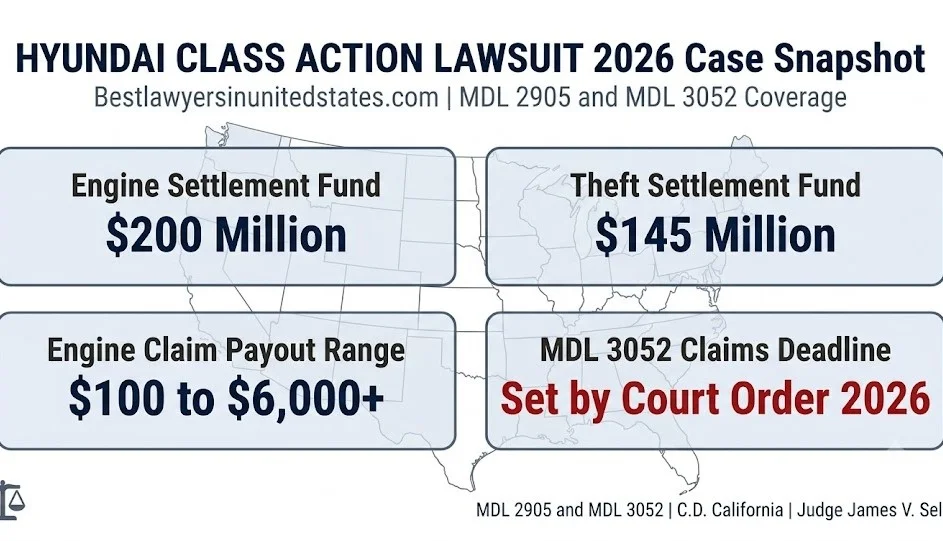
The litigation proceeds on two primary tracks in the Central District of California. MDL No. 2905 covers engine defects. MDL No. 3052 covers the theft vulnerability.
Each MDL consolidates dozens of individual class action complaints that were filed across multiple federal districts and then transferred to the Central District of California for coordinated pretrial proceedings.
What sets these cases apart from a standard product recall:
- Class members can recover economic damages beyond what a recall repair provides
- The lawsuits allege fraudulent concealment, meaning Hyundai knew about defects and hid them
- Plaintiffs assert claims under the Magnuson-Moss Warranty Act and multiple state consumer protection statutes
- The litigation covers both repair costs and diminished vehicle value
Attorney Insight: Attorneys handling these claims note that the fraudulent concealment allegation is central because it extends the statute of limitations, allowing owners who purchased vehicles years ago to still be viable class members.
Hyundai Lawsuit 2026 Update: Where Do These Cases Stand Now?
As of 2026, both MDLs are in active post-settlement or settlement-approval phases with material deadlines that affect claimant eligibility.
MDL 2905 (Engine Defect): The settlement received final approval from Judge Selna. Claims administration is being conducted by Epiq Class Action and Claims Solutions. Distribution of payments to eligible claimants is ongoing, with processing timelines affected by documentation completeness and the volume of submitted claims.
MDL 3052 (Theft Vulnerability): The approximately $145 million settlement received preliminary approval. The final approval hearing and objection period are proceeding through the court’s 2026 calendar. Class members in this MDL should monitor court-posted deadlines carefully.
| MDL | Current Phase | Administrator | Payment Status |
|---|---|---|---|
| MDL 2905 (Engine) | Claims distribution ongoing | Epiq Class Action | Payments issued in tiers |
| MDL 3052 (Theft) | Settlement approval proceedings | TBD per court order | Not yet distributed |
Attorney Insight: Attorneys working with claimants in the engine MDL report that incomplete documentation is the primary reason for delayed or reduced payments, making pre-submission document review with qualified counsel worth the time investment.
Litigation Watch: Two separate MDLs before the same judge, in the same district, covering different defects in overlapping vehicle populations, create a situation where some Hyundai owners may have claims in both proceedings simultaneously.
Hyundai MDL 2905: Court Details and Docket Specifics
MDL No. 2905, formally titled In re: Hyundai and Kia Engine Litigation, is consolidated before Judge James V. Selna in the U.S. District Court for the Central District of California.
The MDL was established after multiple individual class action complaints, filed in districts across the country, were transferred to the Central District for coordinated handling under 28 U.S.C. § 1407. The lead consolidated complaint was filed in 2017.
Key docket milestones for MDL 2905:
| Event | Date/Status |
|---|---|
| MDL transfer order issued | 2017 |
| Consolidated amended complaint filed | 2018 |
| Class certification proceedings | 2019-2020 |
| Settlement agreement executed | 2023 |
| Final approval order entered | 2023-2024 |
| Claims administration | Ongoing through 2026 |
The MDL structure means that individual claimants do not manage their own cases in court. Class counsel, appointed by Judge Selna, negotiates and litigates on behalf of all class members collectively.
Attorney Insight: Practitioners note that MDL claimants who are dissatisfied with the settlement amount retain the right to opt out and pursue individual litigation, though doing so forfeits their share of the class fund and requires retaining separate counsel.
Hyundai Engine Fire Class Action: What Caused These Fires?
The Hyundai engine fire class action arose from a documented mechanical failure mode in which engines manufactured without adequate quality control experienced internal component failures that could ignite engine fires.
NHTSA opened Preliminary Evaluation PE16-007 to investigate engine seizure and stall complaints in Hyundai Sonata and Elantra vehicles. That investigation documented a pattern of engines failing suddenly, without warning, and in some cases igniting.
The documented failure pattern:
- Engine stall or seizure at highway speed, without warning lights
- Connecting rod bearing failure caused by metal debris in the oil
- Post-failure engine fire risk, including fires in parked vehicles
- Failure occurring in vehicles with relatively low mileage
Hyundai issued recalls covering some models, but plaintiffs in MDL 2905 alleged the recall scope was deliberately limited and that millions of additional vehicles remained at risk.
Attorney Insight: Class counsel in MDL 2905 argued, with supporting internal documents obtained in discovery, that Hyundai engineers identified the Theta II defect years before any public disclosure, a core element of the fraudulent concealment theory.
Callout: NHTSA received more than 3,000 complaints related to Theta II engine failure before the first comprehensive recall was issued.
Hyundai Theta II Engine Lawsuit: The Engineering Defect Explained
The Hyundai Theta II engine lawsuit specifically targets a manufacturing defect in the Theta II GDI (Gasoline Direct Injection) engine that was installed across multiple Hyundai and Kia vehicle lines from approximately 2011 through 2019.
The defect originates in the engine assembly process. Metal debris from machining operations contaminated oil passages during manufacturing. That debris damaged connecting rod bearings, which led to progressive engine failure and, in a documented subset of cases, engine fire.
Theta II engine defect facts:
- The Theta II GDI engine was manufactured at plants in Montgomery, Alabama and in South Korea
- The defect is not repairable through routine maintenance; it typically requires engine replacement
- Engine replacement under the settlement is one of the highest compensation tiers
- The related Nu GDI engine also appears in MDL 2905 filings for certain Hyundai models
Settlement compensation for engine replacement claimants:
Owners who documented a qualifying engine failure and replacement may be eligible for reimbursement of engine replacement costs, which can exceed $6,000 depending on the vehicle and repair documentation submitted.
Attorney Insight: Attorneys reviewing engine MDL claims consistently find that owners who kept dealer service records and who documented failure symptoms before any repair have significantly stronger documentation packages than those relying solely on post-repair invoices.
Litigation Watch: The Theta II engine defect, NHTSA’s PE16-007 investigation, and the MDL 2905 fraud concealment theory collectively explain why the settlement fund reached $200 million despite Hyundai having already issued multiple recalls covering portions of the affected fleet.
Hyundai Kia Theft Lawsuit Settlement: The Second Major Case
The Hyundai Kia theft lawsuit settlement is a separate and distinct proceeding from the engine MDL. It addresses a different defect, a different population of vehicles, and involves a different legal theory.
This case, MDL No. 3052, formally titled In re: Kia Hyundai Vehicle Theft Marketing, Sales Practices, and Products Liability Litigation, also proceeds before Judge James V. Selna in the Central District of California.
The litigation arises from the omission of an engine immobilizer from millions of Hyundai and Kia vehicles manufactured for U.S. sale between approximately 2011 and 2022. The absence of this standard anti-theft technology enabled a viral theft method, widely disseminated on social media beginning around 2021, to spread rapidly.
Key facts about the theft MDL:
- Vehicles without immobilizers could be started with a USB cable inserted into the steering column
- The “Kia Challenge” theft method spread across social media platforms in 2021 and 2022
- Theft rates for affected models increased by as much as 1,000 percent in some cities
- Insurance coverage gaps, personal property loss, and in some cases personal injury claims form the basis for damages
Attorney Insight: Consumer protection attorneys working on the theft MDL note that the damages theory extends beyond the vehicle itself to include insurance deductibles, rental car costs, property damaged in stolen vehicles, and diminished resale value.
Hyundai Oil Consumption Defect Lawsuit: The Third Litigation Track
The Hyundai oil consumption defect lawsuit represents a third, less-publicized litigation track distinct from both MDL 2905 and MDL 3052.
This litigation concerns Hyundai vehicles equipped with certain engine configurations that consume oil at an abnormal rate, requiring owners to add quarts of oil between standard oil changes. When owners are unaware of the issue, continued driving on low oil contributes to accelerated engine wear and, in some cases, the same connecting rod failure pattern at issue in MDL 2905.
Separate class actions addressing the oil consumption defect have been filed in California federal courts, with some proceedings consolidated under the Central District umbrella.
Affected engine configurations in oil consumption claims:
- Certain Theta II engine variants
- Select Lambda and Tau V8 configurations in larger Hyundai models
- Hyundai Tucson, Santa Fe, and Sorento vehicles in specified model years
Callout: Some Hyundai owners have documented oil consumption rates of one quart per 1,000 miles, far exceeding industry standards for normal consumption.
Attorney Insight: Plaintiffs’ counsel in oil consumption cases typically rely on expert testimony from mechanical engineers who can establish what “normal” consumption rates are and demonstrate statistically that the affected vehicles fall outside that range.
Who Qualifies for the Hyundai Class Action Settlement?
Eligibility for the Hyundai class action settlement depends on which MDL or proceeding applies to the specific vehicle and the documented harm experienced.
For MDL 2905 (Engine Defect), qualifying class members are:
- Current or former owners or lessees of a covered Hyundai or Kia vehicle
- Vehicles with a Theta II GDI or Nu GDI engine in the covered model years (generally 2011-2019, model-specific)
- Individuals who experienced a qualifying engine failure event or who owned a covered vehicle during the class period even without a failure event
For MDL 3052 (Theft Vulnerability), qualifying class members are:
- Current or former owners or lessees of covered Hyundai or Kia vehicles without standard immobilizers
- Vehicles generally manufactured between 2011 and 2022
- Individuals who suffered documented theft loss, theft-related damage, or insurance consequences
| Settlement | Who Qualifies | Core Requirement |
|---|---|---|
| MDL 2905 (Engine) | Owners/lessees of Theta II or Nu GDI vehicles | Covered model and year; documented failure preferred |
| MDL 3052 (Theft) | Owners/lessees of immobilizer-deficient vehicles | Covered model/year; documented theft loss or insurance impact |
Attorney Insight: Attorneys reviewing eligibility note that class membership for the engine MDL does not require that the engine actually failed, only that the owner held the vehicle during the class period, though documented failure claims receive higher compensation tiers.
Litigation Watch: Eligibility spans two separate MDLs with different vehicle lists, different model year ranges, and different documentation requirements, meaning some owners qualify for both proceedings while others qualify for neither.
Hyundai Class Action Affected Models and Years
The affected vehicle list across both MDLs is extensive. The engine MDL and theft MDL cover overlapping but distinct vehicle populations.
MDL 2905 Engine Defect: Covered Hyundai Models (Representative List)
| Model | Covered Years (Theta II/Nu Engine) |
|---|---|
| Hyundai Sonata | 2011-2019 |
| Hyundai Santa Fe Sport | 2013-2018 |
| Hyundai Tucson | 2011-2016 |
| Hyundai Elantra (select) | 2014-2016 |
| Hyundai Veloster | 2012-2016 |
| Kia Optima | 2011-2019 |
| Kia Sorento | 2011-2018 |
| Kia Sportage | 2011-2016 |
| Kia Soul | 2012-2016 |
MDL 3052 Theft Vulnerability: Representative Affected Models
| Model | Covered Years (No Immobilizer) |
|---|---|
| Hyundai Elantra | 2011-2022 |
| Hyundai Sonata | 2011-2022 |
| Hyundai Accent | 2011-2022 |
| Hyundai Tucson | 2011-2022 |
| Kia Soul | 2011-2022 |
| Kia Rio | 2011-2022 |
| Kia Sportage | 2011-2022 |
Attorney Insight: Owners should verify their specific VIN against the official class notice or NHTSA database, as covered model years vary by trim level and production date within the same model year.
Hyundai Settlement Payout Amounts 2026: What Can Claimants Receive?
Settlement payout amounts under the Hyundai lawsuit settlement are structured in tiers based on the type and severity of harm documented.
MDL 2905 Engine Settlement Compensation Tiers (Approximate):
| Compensation Tier | Qualifying Event | Estimated Payment Range |
|---|---|---|
| Tier 1: Engine Replacement | Engine replaced due to qualifying failure | Up to $6,000+ (reimbursement of documented costs) |
| Tier 2: Engine Repair | Engine repaired but not replaced | Up to $3,500 (documented repair costs) |
| Tier 3: Extended Warranty | Vehicle covered but no failure event | Free extended warranty coverage |
| Tier 4: Resale Loss | Vehicle sold at reduced value after failure | Case-by-case; documented loss required |
| Tier 5: Vehicle Loss | Vehicle destroyed or declared total loss due to fire | Documented actual value; potentially highest payout |
Important payment mechanics:
The settlement fund is a fixed pool. If total valid claims exceed the fund, individual payments may be prorated downward. The reverse is also true: if fewer claims are submitted, individual payments may increase.
Attorney Insight: Attorneys advising claimants emphasize that prorated distribution makes early, complete claim submission critical, because payment amounts are not guaranteed until the total valid claims pool is calculated after the deadline.
Callout: According to claims administration data, engine replacement claimants who submitted complete documentation received an average reimbursement of approximately $3,200 after proration in the initial distribution round.
Hyundai Lawsuit Settlement Fund Details: How the $200 Million Works
The MDL 2905 settlement fund of approximately $200 million is not a simple per-claimant cash payment. It is a structured fund administered under court supervision with specific allocation rules.
How the fund is structured:
- A defined portion covers class counsel attorney’s fees (typically 25-33% in class settlements; subject to court approval)
- A portion covers settlement administration costs (paid to Epiq Class Action and Claims Solutions)
- The remaining funds constitute the net settlement fund available for distribution to claimants
Net fund allocation priorities:
- Vehicle fire and total loss claims (highest priority tier)
- Documented engine replacement claims
- Documented engine repair claims
- Extended warranty provision claims
- Residual fund distribution to claims without documented failure events
Attorney Insight: Settlement finance attorneys note that the practical per-claimant payment is substantially determined by how many class members submit valid claims, not by the gross headline fund amount, which is why low response rates sometimes produce surprisingly high individual payments in later-stage distributions.
The MDL 3052 theft settlement of approximately $145 million follows a similar structure, with fund allocation between attorney’s fees, administration costs, and net claimant distributions, but the payment tiers are calibrated to theft-related losses rather than engine repair costs.
Hyundai Settlement Claim Deadline 2026: What Are the Critical Dates?
The claim filing deadline is the single most important date for any Hyundai class member who wants to receive compensation.
MDL 2905 (Engine) deadline status in 2026:
The initial claims deadline for MDL 2905 has passed. However, certain extended warranty benefits and ongoing reimbursement claims for qualifying repair events occurring after the initial deadline may remain available under the settlement’s extended coverage provisions. Claimants who experienced a qualifying failure after the initial submission window closed should consult class counsel or a private attorney immediately.
MDL 3052 (Theft) deadline status in 2026:
The theft MDL is in its settlement approval phase in 2026. The claims submission period has not yet opened for all class members, pending final court approval. Once final approval is entered, a separate claims deadline will be established by court order.
| MDL | Initial Deadline Status | 2026 Claim Status |
|---|---|---|
| MDL 2905 (Engine) | Initial deadline passed | Extended warranty ongoing; late-event claims review available |
| MDL 3052 (Theft) | Claims period not yet fully opened | Pending final approval; watch for court-set deadline |
Attorney Insight: Class action practitioners note that courts retain discretion to allow late claims in extraordinary circumstances, particularly where a claimant can demonstrate lack of notice or a qualifying event that arose after the original deadline.
Litigation Watch: The divergence in deadline status between the two MDLs means that owners who qualify for only the theft MDL may still have a full claims window available, while engine MDL claimants must focus on extended warranty and post-deadline event provisions.
How to File a Hyundai Settlement Claim: The Process Explained
Filing a Hyundai settlement claim requires specific documentation and submission to the court-appointed claims administrator.
For MDL 2905 (Engine Settlement) claimants:
- Submit the official claim form through the settlement website administered by Epiq Class Action and Claims Solutions
- Provide VIN verification confirming your vehicle is a covered model and year
- Attach documentation of the qualifying repair or failure event (dealer invoices, repair orders, insurance claims)
- Retain copies of all submitted materials
For MDL 3052 (Theft Settlement) claimants:
- Monitor the official settlement website for the claims filing period opening date
- Documentation required will include proof of vehicle ownership or lease, police report for theft claims, insurance records for coverage gaps, and documentation of out-of-pocket losses
Common reasons claims are rejected or reduced:
- Missing or illegible repair invoices
- VIN not appearing on the covered vehicle list
- Failure to document a qualifying triggering event
- Submission of claims by individuals who already opted out of the class
Attorney Insight: Attorneys who assist clients with class claim preparation report that the most frequent documentation gap is the absence of dealer-issued repair orders that distinguish a qualifying failure from a routine maintenance service, a distinction the claims administrator applies strictly.
Hyundai Settlement Check Status: How to Track Your Payment
Checking the status of a Hyundai settlement payment requires contacting or monitoring the claims administrator directly, as individual payment status is not publicly posted in court records.
Epiq Class Action and Claims Solutions is the designated administrator for MDL 2905. Claimants can contact the administrator through the settlement’s official website or the toll-free claims line established by court order.
What affects payment timing:
- Date claim was submitted (earlier submissions are typically processed first)
- Completeness of submitted documentation
- Whether the claim is in the standard tier or has been flagged for supplemental review
- The overall timeline for claims processing, which is set by court order and administrator capacity
What to do if a payment has not arrived:
- Confirm the claim submission was received and assigned a confirmation number
- Verify the mailing or payment address on file with the administrator
- Contact the administrator’s claims support line
- If the claim was denied, request the written denial reason within the administrator’s stated review period
Attorney Insight: Attorneys assisting clients with payment status issues note that denied claims can sometimes be appealed within the settlement’s internal dispute resolution process before any court intervention is required, and that simple documentation deficiencies are often curable at that stage.
Hyundai Lawsuit Update: What Happens Next in These Cases?
The Hyundai lawsuit update for 2026 reflects two cases in different phases with distinct near-term milestones.
MDL 2905 near-term developments:
- Ongoing distribution of payments to claimants whose submissions have been reviewed and approved
- Resolution of any supplemental claims or disputed submissions through the administrator’s internal process
- Potential residual fund distribution if total valid claims fall below the net fund amount
- Court supervision of extended warranty implementation
MDL 3052 near-term developments:
- Final approval hearing before Judge Selna
- Objection period resolution for class members who submitted objections to settlement terms
- Post-approval establishment of the claims submission period and deadline
- Opening of the official claims portal for theft MDL class members
2026 litigation calendar for both MDLs:
| MDL | Key 2026 Milestone | Expected Timeframe |
|---|---|---|
| MDL 2905 | Ongoing payment distribution | Throughout 2026 |
| MDL 2905 | Extended warranty administration | Ongoing through settlement term |
| MDL 3052 | Final approval hearing | 2026 (court calendar dependent) |
| MDL 3052 | Claims period opening | Post-final approval |
Attorney Insight: Litigation analysts monitoring both MDLs note that the theft settlement’s path to final approval has faced objections from some class members who argue the per-vehicle compensation is insufficient relative to documented market value losses, which could delay the final approval timeline.
Litigation Watch: The 2026 posture of both MDLs means that any Hyundai or Kia owner who has not yet assessed their eligibility in either proceeding is operating without complete information about their current legal and financial options.
Hyundai Class Action Lawsuit in the Central District of California: Why This Court?
The Central District of California is the venue for both MDL 2905 and MDL 3052 because the Judicial Panel on Multidistrict Litigation (JPML) selected it as the transferee district for coordinated pretrial proceedings.
The Central District of California, based in Los Angeles, is one of the busiest federal districts in the country and handles a disproportionately large share of complex consumer class action and MDL litigation.
Why MDL centralization matters for claimants:
- All pretrial motions, discovery disputes, and class certification proceedings are handled by a single judge
- Class members do not need to appear in California court; their interests are represented by class counsel
- Settlement negotiations occur in the Central District under Judge Selna’s supervision
- Any objections to the settlement are filed with Judge Selna and resolved in Los Angeles
The JPML’s centralization rationale for these cases:
The panel found that the engine defect claims filed across multiple districts involved common factual questions about the Theta II manufacturing process and Hyundai’s internal knowledge of the defect, making coordinated pretrial proceedings the most efficient resolution path.
Attorney Insight: Attorneys litigating in centralized MDLs note that the single-judge structure allows for more consistent discovery rulings and a more predictable settlement negotiation timeline than parallel individual cases in different districts would produce.
What Type of Lawyer Handles a Hyundai Class Action Lawsuit?
A class action attorney specializing in automotive product liability and consumer protection litigation is the appropriate legal professional for Hyundai settlement matters.
These attorneys operate on a contingency fee basis in class action proceedings. Class counsel, appointed by the court, represents all class members collectively. Individual claimants do not pay attorney’s fees out of pocket for class membership.
When a private attorney is useful despite class membership:
- Evaluating whether opting out of the class and pursuing individual litigation yields more value
- Assisting with documentation preparation for higher-tier claims
- Challenging a claim denial through the administrator’s internal dispute process
- Pursuing a personal injury claim if an engine fire caused bodily harm (separate from the class settlement)
Types of attorneys involved in Hyundai litigation:
| Attorney Type | Role |
|---|---|
| Class Action / MDL Counsel | Represents class collectively; negotiates settlement |
| Product Liability Attorney | Handles individual suits opted out of the class |
| Personal Injury Attorney | Handles bodily injury claims from engine fires |
| Consumer Protection Attorney | Advises on state-law warranty and fraud claims |
Attorney Insight: Product liability attorneys who handle individual opt-out cases in automotive MDLs note that the decision to opt out is rarely advisable for pure economic loss claimants, but becomes worth analyzing for those with documented personal injury arising from an engine fire or vehicle accident connected to an engine failure.
Frequently Asked Questions
What is the Hyundai class action lawsuit about?
The Hyundai class action lawsuit refers to two major federal MDLs alleging defective Theta II engines and a theft vulnerability defect affecting millions of Hyundai and Kia vehicles.
MDL 2905 covers engine fires and failures. MDL 3052 covers the software-exploitable theft defect exposed by the viral “Kia Challenge” theft method.
How do I know if my Hyundai qualifies for the settlement?
Your vehicle’s VIN must appear on the covered vehicle list for either MDL 2905 or MDL 3052, both administered in the Central District of California before Judge James V. Selna.
Generally, Hyundai and Kia models manufactured between 2011 and 2022 with Theta II or Nu GDI engines (for the engine MDL) or without a standard engine immobilizer (for the theft MDL) are potentially covered.
How much money can I receive from the Hyundai settlement?
Engine replacement claimants in MDL 2905 may receive reimbursements up to approximately $6,000, depending on documented repair costs and proration after all valid claims are calculated.
Theft MDL claimants will receive payments calibrated to documented theft losses once the MDL 3052 settlement receives final court approval and the claims period opens.
What is the deadline to file a Hyundai class action claim in 2026?
The initial MDL 2905 engine settlement deadline has passed, but extended warranty benefits and claims for post-deadline qualifying events remain available.
The MDL 3052 theft settlement claims deadline has not yet been set for all class members; it will be established by court order following final approval before Judge Selna.
Can I still file a Hyundai engine settlement claim if I missed the deadline?
Late claims in MDL 2905 may be possible in limited circumstances, particularly for qualifying repair events that occurred after the initial deadline or for claimants who can demonstrate they did not receive adequate class notice.
Consult a class action or product liability attorney to evaluate whether a late claim submission or appeal of a denial is viable in your specific situation.
What if my Hyundai engine fire caused personal injury, not just vehicle damage?
Personal injury claims arising from Hyundai engine fires are distinct from the class settlement and may not be fully compensated within the MDL 2905 framework.
A personal injury or product liability attorney should be consulted separately, as individual injury claims may warrant an opt-out from the class and pursuit of independent litigation against Hyundai Motor America.
Closing
The Hyundai class action lawsuit in 2026 is not a closed matter. Two active MDLs, ongoing claims processing, and a pending final approval hearing in the theft MDL mean that affected vehicle owners still have steps they can take.
Owners who experienced an engine failure or fire, whose vehicles were stolen using the documented theft method, or who are uncertain whether their vehicle qualifies for either settlement should not wait. The claims windows in both proceedings are either closing or approaching.
A class action or product liability attorney who handles automotive defect litigation is the right starting point. That conversation costs nothing under standard contingency arrangements and provides a documented basis for deciding whether class membership, a late claim, or an individual action best protects your interests.
