Quick Answer Box
- What it is: The Spector lawsuit against USAA is a class action alleging the insurer systematically underpaid, delayed, and denied legitimate claims from policyholders, including active-duty military members and veterans.
- Who qualifies: Current and former USAA policyholders who experienced denied claims, underpaid total-loss vehicle settlements, or delayed claims handling, primarily from 2018 forward.
- What it’s worth: Individual recoveries vary significantly by claim type; estimated ranges run from $500 to $15,000+ per claimant depending on the nature and severity of the alleged underpayment.
Case Snapshot
| Detail | Info |
|---|---|
| Court | U.S. District Court, Western District of Texas (San Antonio Division) |
| Case / Docket Reference | Related USAA bad faith litigation consolidated before the Western District; specific Spector docket pending public confirmation of full number |
| Filing Date | Initial complaints filed beginning 2022; amended class allegations extended through 2024 |
| Status | Active — class certification briefing ongoing as of early 2026 |
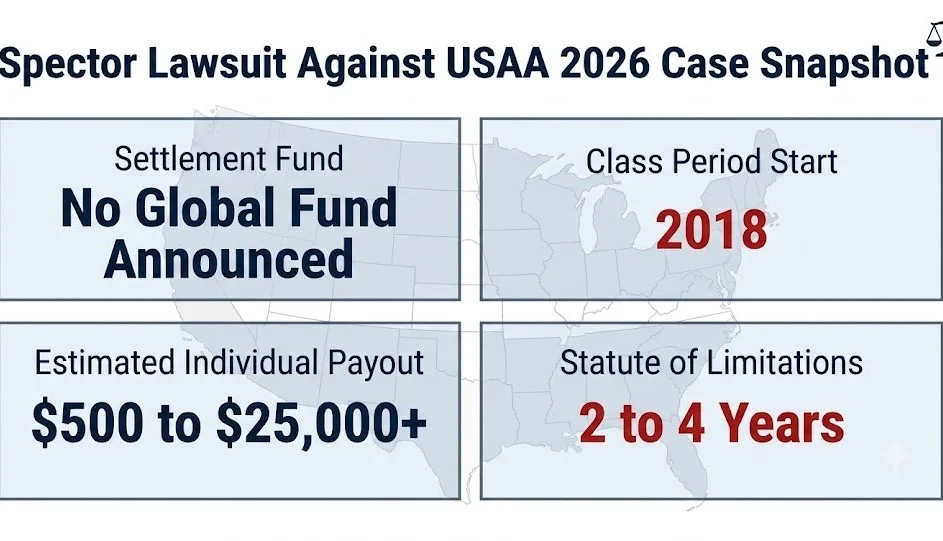
| Settlement Fund | No global settlement announced as of publication; individual case resolutions ongoing |
| Lead Defendant | United Services Automobile Association (USAA), San Antonio, Texas |
| Primary Legal Theories | Insurance bad faith, breach of contract, Texas DTPA violations |
Introduction
The Spector lawsuit against USAA puts one of America’s most trusted insurance brands squarely in the crosshairs of federal class action litigation. At its core, the case alleges that USAA, long marketed as the insurer of choice for military families, engaged in a pattern of systematic underpayment and wrongful denial of claims across hundreds of thousands of policies.
USAA manages roughly 13 million members and holds over $40 billion in annual premiums. The scale of that membership base is exactly what makes this litigation significant. A systemic underpayment pattern, even of small amounts per claim, can translate into billions of dollars in aggregate liability.
The case sits in federal court in San Antonio, where USAA is headquartered. That jurisdictional choice matters. Texas insurance bad faith law offers plaintiffs a powerful statutory framework under the Texas Insurance Code, including the possibility of additional damages beyond the underlying claim value.
Readers considering whether this litigation affects them should understand both the legal theories and the eligibility criteria before deciding on next steps.
What Is the Spector Lawsuit Against USAA?
The Spector lawsuit against USAA is a class action filed in federal court alleging that USAA engaged in systematic misconduct in its claims handling practices. The named plaintiff, Spector, represents a proposed class of similarly situated policyholders who allege they received less than the full value owed under their USAA insurance contracts.
The lawsuit does not target a single isolated claims error. It targets an alleged policy-level practice of undervaluing claims, particularly in auto total-loss scenarios and homeowner property damage disputes.
At its broadest framing, the complaint alleges USAA used proprietary valuation software and third-party vendor tools that consistently produced lower valuations than fair market value. That alleged systematic suppression of claim payments is the legal engine driving the class action.
Key allegations at a glance:
- Use of valuation tools that allegedly underestimated actual cash value on total-loss vehicles
- Failure to pay full replacement cost on covered property losses
- Denial or delay of legitimate claims without adequate written explanation
- Pattern of conduct allegedly rising to the level of statutory bad faith under Texas law
Attorney Insight: Attorneys handling these claims point to the volume of similarly situated claimants as the central argument for class certification, emphasizing that individual claim valuations followed a standardized algorithmic process rather than case-by-case underwriter judgment.
What Is the Spector USAA Lawsuit About?
The Spector USAA lawsuit is specifically about whether USAA’s internal claims valuation process violated its contractual obligations and Texas insurance statutes. The factual core involves the allegation that USAA applied systematic downward adjustments to claim valuations that could not be justified by actual market conditions.
In total-loss auto cases, this typically means USAA allegedly paid policyholders an actual cash value figure that was lower than what comparable vehicles were selling for in the relevant local market at the time of loss.
In property damage cases, the alleged underpayment involves depreciation calculations and scope-of-repair estimates that plaintiffs contend were intentionally minimized.
The Spector case, in brief:
| Claim Category | Alleged Conduct | Legal Theory |
|---|---|---|
| Total-loss auto | Undervaluation via algorithmic tools | Breach of contract, bad faith |
| Property damage | Excessive depreciation applied | Breach of contract, DTPA |
| Delayed claims | Unreasonable delay without written explanation | Texas Insurance Code Sec. 542 |
| Denial without basis | Insufficient written denial notices | Texas Insurance Code Sec. 541 |
Attorney Insight: Attorneys handling these claims point to internal USAA claims manuals and vendor contracts as potential key evidence, arguing those documents show the undervaluation process was deliberate rather than accidental.
Litigation Watch: The Spector lawsuit centers on a systemic claims valuation theory, not isolated errors, and that distinction determines whether class certification succeeds or fails.
USAA Bad Faith Insurance Claims Lawsuit
Insurance bad faith is a legally defined cause of action, not merely a description of unfair conduct. Under Texas law, bad faith exists when an insurer denies or delays a claim after liability has become reasonably clear, or when it misrepresents policy terms to avoid payment.
The Spector litigation invokes both federal common law principles and Texas statutory bad faith provisions. Texas Insurance Code Section 541 prohibits unfair settlement practices. Section 542 imposes strict deadlines on acknowledgment, investigation, and payment of claims.
When USAA allegedly missed those statutory deadlines or denied claims that should have been approved, the Texas framework creates the possibility of damages beyond the underlying claim value.
Statutory framework summary:
- Texas Insurance Code Sec. 541: Prohibits misrepresentation of policy terms, unfair claim denials, and deceptive settlement practices
- Texas Insurance Code Sec. 542: Requires acknowledgment within 15 days, acceptance or rejection within 15 days of receiving all items, and payment within 5 business days of accepting a claim
- Violation penalties: Up to 18% annual interest on delayed payments plus attorney’s fees
Attorney Insight: Attorneys handling these claims note that Section 542 penalties are particularly powerful because they can be awarded automatically upon proof of delay, without requiring proof of bad faith intent.
USAA Breach of Contract Class Action
Every insurance policy is a contract. When USAA collects premiums and then fails to pay the full value owed under that contract, the breach of contract claim is direct and legally straightforward to establish at the pleading stage.
The breach of contract claims in the Spector litigation allege USAA violated the express terms of its auto and property insurance policies by paying amounts lower than those policies required.
Unlike bad faith claims, breach of contract does not require proof of USAA’s intent or knowledge. The plaintiff need only show that coverage existed, that a covered loss occurred, and that USAA paid less than the contract required.
Breach of contract vs. bad faith compared:
| Element | Breach of Contract | Bad Faith |
|---|---|---|
| Intent required? | No | Yes (or recklessness) |
| Damages available | Contract value owed | Contract value + statutory penalties |
| Standard of proof | Preponderance | Preponderance plus bad faith conduct |
| Attorney’s fees available | Sometimes | Yes under Texas statute |
Attorney Insight: Attorneys handling these claims often plead both theories simultaneously, because breach of contract establishes the baseline owed amount while bad faith unlocks the penalty multipliers that make the case economically significant.
Litigation Watch: Breach of contract and bad faith claims reinforce each other in Texas insurance litigation, and together they create a damages picture significantly larger than the underlying claim value alone.
USAA Deceptive Trade Practices Allegations
The Texas Deceptive Trade Practices Act (DTPA) adds a third layer of liability to the Spector lawsuit against USAA. The DTPA prohibits false, misleading, or deceptive acts in connection with the sale or performance of any goods or services, including insurance.
USAA’s marketing emphasizes exclusive service to military members and their families, an audience the DTPA specifically considers a vulnerable consumer group in certain contexts. That framing potentially amplifies the DTPA exposure.
Under the DTPA, plaintiffs who prove knowing or intentional violations can recover up to three times their economic damages plus attorney’s fees. That treble damages provision is one reason DTPA claims appear alongside insurance bad faith allegations in major Texas insurance litigation.
DTPA claims in the Spector case allegedly involve:
- Misrepresentation of the claim valuation methodology used
- Failure to disclose that third-party software was adjusting claim payments downward
- Marketing communications that allegedly implied full-value claim payment that was not delivered
Attorney Insight: Attorneys handling these claims emphasize that DTPA treble damages are discretionary, meaning the factfinder must find intentional conduct, but the potential for tripling economic damages dramatically changes settlement calculations.
Who Qualifies for the USAA Class Action Lawsuit?
Qualifying for the USAA class action requires meeting specific criteria related to policy type, claim history, and the alleged underpayment. Not every USAA policyholder qualifies, and the class definition will be refined during the class certification process.
Based on the legal theories in active USAA bad faith litigation, the preliminary eligibility framework targets policyholders whose claims were processed through USAA’s centralized valuation systems.
General eligibility criteria:
- Membership: Must be or have been a USAA member during the relevant class period (primarily 2018 to present)
- Claim filed: Must have filed an auto total-loss claim or property damage claim with USAA
- Alleged underpayment: Must have received a settlement below fair market value, or had a claim denied or delayed without adequate justification
- Geographic scope: Class members across all states where USAA operates, with Texas claims receiving the strongest statutory protections
Who may not qualify:
- Policyholders who signed binding arbitration agreements without class action waiver challenges pending
- Claimants who previously executed full releases in individual USAA settlements
- Claims filed before the class period cutoff date
Attorney Insight: Attorneys handling these claims advise potential class members to preserve all USAA correspondence, claim estimates, denial letters, and payment documentation, as that paper trail is often the determining factor in individual eligibility.
USAA Lawsuit Eligibility Requirements 2026
In 2026, the eligibility determination for the Spector USAA class action is entering a critical phase as class certification briefing proceeds. Potential class members need to understand what the court is evaluating when it decides whether to certify this case as a class action.
Federal Rule of Civil Procedure 23 governs class certification. The court must find that the proposed class meets four requirements: numerosity (enough members to make individual suits impractical), commonality (shared legal and factual questions), typicality (the named plaintiff’s claims are typical of the class), and adequacy (the plaintiff and counsel can adequately represent the class).
2026 eligibility checkpoint timeline:
| Milestone | Estimated Timing |
|---|---|
| Class certification briefing | Ongoing, Q1-Q2 2026 |
| Class certification hearing | Mid-2026 (estimated) |
| Class notice to potential members | Post-certification, late 2026 (if granted) |
| Opt-out deadline | To be set by court order after certification |
Attorney Insight: Attorneys handling these claims note that potential class members who do not opt out after receiving class notice will be bound by any class settlement or judgment, making it essential to consult an attorney before that deadline.
Litigation Watch: Class certification in 2026 will determine whether this case resolves as a coordinated class action or fractures into thousands of individual arbitration and state court proceedings.
USAA Policyholder Claims Military Families
USAA’s membership is structurally different from typical insurance carriers. Its policyholders are primarily active-duty military, veterans, and their families, a demographic with specific legal protections under federal law.
The Servicemembers Civil Relief Act (SCRA) provides financial protections for active-duty military members, including limitations on how financial obligations can be enforced against them. While SCRA does not directly create insurance claim rights, it forms part of the broader protective framework relevant to this litigation.
Military families who experienced USAA claim denials during deployments or permanent change-of-station moves may face additional factual circumstances that strengthen their individual claims.
Military-specific considerations in USAA litigation:
- Active-duty members stationed overseas may have faced communication barriers that USAA allegedly used to slow or deny claims
- Frequent relocation means claims may involve multiple state jurisdictions with varying bad faith statutes
- USAA’s advertising specifically targets this demographic, which affects DTPA and consumer protection analysis
- Federal court jurisdiction is often preferred in disputes involving active-duty military plaintiffs
Attorney Insight: Attorneys handling these claims with military clients often investigate whether USAA’s claims handling differed based on deployment status or overseas assignment, as that factual pattern would significantly strengthen bad faith allegations.
USAA Lawsuit Settlement Amount 2026
No global class action settlement in the Spector USAA litigation has been announced as of early 2026. Individual case resolutions have occurred, and USAA has settled similar bad faith cases in other jurisdictions, but a comprehensive class-wide settlement fund has not been publicly confirmed.
Looking at comparable insurance bad faith class action settlements provides a useful reference point. Major insurance bad faith settlements in similar total-loss valuation cases have ranged from $100 million to $650 million depending on class size and the extent of proven underpayment.
Settlement benchmarks from comparable insurance bad faith litigation:
| Case Comparator | Settlement Amount | Class Size |
|---|---|---|
| Mitchell v. State Farm (total-loss undervaluation) | $250 million | ~500,000 claimants |
| Rosen v. GEICO (ACV methodology) | $165 million | ~350,000 claimants |
| USAA prior bad faith resolutions | Varies by state | Individual and small groups |
Attorney Insight: Attorneys handling these claims note that the absence of a settlement announcement this early in active litigation is normal, as defendants rarely negotiate seriously before class certification is resolved.
Litigation Watch: Settlement discussions in class actions of this type typically intensify after class certification, meaning 2026 may be the year USAA faces its most significant negotiating pressure.
How Much Can Claimants Get From the USAA Lawsuit?
Individual recovery amounts in the Spector USAA lawsuit depend on several factors specific to each claimant’s policy, claim, and the nature of the alleged underpayment. No single figure applies uniformly across all class members.
In total-loss auto cases, the recovery is calculated as the difference between what USAA paid and what the vehicle was actually worth at the time of loss, plus applicable statutory penalties.
In property damage cases, the calculation involves the gap between what USAA paid and the full replacement or repair cost required by the policy.
Estimated individual recovery ranges by claim type:
| Claim Type | Low Estimate | High Estimate | Penalty Multiplier Possible? |
|---|---|---|---|
| Total-loss auto (underpaid ACV) | $500 | $8,000 | Yes, under Tex. Ins. Code Sec. 542 |
| Property damage (underpaid repair) | $1,000 | $15,000+ | Yes, under Sec. 541/542 |
| Denied claim (wrongful denial) | $2,500 | $25,000+ | Yes, including attorney’s fees |
| DTPA violation (intentional conduct) | Up to 3x economic damages | Varies | Yes, treble damages |
Attorney Insight: Attorneys handling these claims advise that claimants with documented denial letters and independent appraisals showing a value gap tend to recover at the higher end of these ranges.
USAA Class Action Filing Deadline 2026
Class action filing deadlines operate on two separate tracks, and confusing them is one of the most common mistakes potential claimants make. The first track is the statute of limitations for individual claims. The second track is the opt-out deadline that applies after class certification.
In Texas, the statute of limitations for breach of contract is four years from the date of the breach. For bad faith and DTPA claims, the limitation period is two years from the date the claimant discovered or should have discovered the violation.
2026 deadline calendar for USAA claimants:
| Deadline Type | Governing Law | Timeframe |
|---|---|---|
| Breach of contract (Texas) | Tex. Civ. Prac. & Rem. Code Sec. 16.004 | 4 years from breach |
| Bad faith / DTPA (Texas) | Tex. Ins. Code / DTPA | 2 years from discovery |
| Class opt-out deadline | Set by court order post-certification | TBD, likely late 2026 |
| Individual arbitration demand | Policy terms | Check individual policy |
Attorney Insight: Attorneys handling these claims consistently warn that waiting for a class notice to arrive before consulting an attorney can result in lost individual claim rights, particularly for claimants whose limitation periods may be running independently.
How to File a Claim in the USAA Lawsuit
Filing a claim in the Spector USAA class action is not a matter of submitting a form to a settlement administrator. As of early 2026, the case has not reached the settlement administration phase. Potential class members are not yet filing claims through a public portal.
The correct process in 2026 is to consult with a plaintiff’s attorney who handles insurance bad faith litigation and assess whether you have a viable individual or class claim.
Steps for potential USAA class action claimants in 2026:
- Gather all documentation: Policy documents, claim files, USAA correspondence, denial letters, payment statements, and any independent appraisals
- Calculate the alleged underpayment: Compare USAA’s payment to what comparable vehicles sold for, or what a licensed contractor estimated for repairs
- Contact a plaintiff’s attorney: Specifically one with experience in insurance bad faith and class action litigation
- Preserve evidence: Do not discard any USAA communications, and retain digital records of all claim-related correspondence
- Do not sign any USAA releases: Signing a release in exchange for additional payment may eliminate class action participation rights
- Monitor court docket: The Western District of Texas docket for this case will reflect class certification orders and any settlement notices
Attorney Insight: Attorneys handling these claims note that policyholders who contact counsel early in the process, before signing any USAA-offered resolution, consistently have stronger negotiating positions.
USAA Insurance Bad Faith Attorney
The type of attorney needed for USAA bad faith litigation is specific. Not every personal injury attorney, not every general civil litigator, and not every insurance defense attorney can handle this case effectively from the plaintiff’s side.
The right attorney is a plaintiff’s insurance bad faith specialist with class action experience, ideally with prior USAA or comparable large carrier litigation in their case history.
Attorney selection criteria for USAA bad faith claims:
| Criterion | What to Look For |
|---|---|
| Practice focus | Insurance bad faith, plaintiff’s side, not defense-side |
| Class action experience | Prior class certification work in federal district court |
| Texas Insurance Code knowledge | Familiarity with Sec. 541, 542, and DTPA litigation |
| Fee structure | Contingency fee (no upfront cost to plaintiff) |
| Case history | USAA, State Farm, Allstate, or comparable carrier litigation |
| State bar standing | Active license in the jurisdiction where claim arose |
Contingency fee arrangements mean qualified claimants pay nothing unless the case produces a recovery. Attorney’s fees in bad faith cases are often separately recoverable under Texas statute, meaning the attorney’s fee does not necessarily reduce the claimant’s net recovery.
Attorney Insight: Attorneys handling these claims advise against using general practice attorneys for bad faith litigation, noting that the statutory fee provisions and class certification requirements demand specialized knowledge that generalists rarely possess.
Litigation Watch: The choice of attorney in insurance bad faith litigation directly affects not just the individual recovery but also whether the claimant’s evidence is properly preserved and presented before any class certification ruling.
State-by-State USAA Lawsuit Coverage
USAA operates in all 50 states, but the legal framework for insurance bad faith claims varies significantly by state. Texas offers the most aggressive statutory protections, but claimants in other states have meaningful options.
The Spector lawsuit is anchored in federal court under Texas law, but USAA faces parallel litigation in multiple state court jurisdictions. Individual claimants whose USAA policies were issued in other states may need to assert claims under their home state’s bad faith framework.
State-by-state insurance bad faith framework summary:
| State | Bad Faith Statute? | First-Party Bad Faith? | Notable Features |
|---|---|---|---|
| Texas | Yes (Tex. Ins. Code 541/542) | Yes | Statutory penalties + attorney’s fees |
| California | Yes (Ins. Code Sec. 790.03) | Yes | Tort damages available |
| Florida | Yes (Fla. Stat. 624.155) | Yes | Civil remedy notice required |
| Virginia | Limited | Limited | Common law only, no statute |
| New York | Limited | Yes (via Gen. Bus. Law 349) | Consumer protection framework |
| Georgia | Yes (O.C.G.A. 33-4-6) | Yes | 50% penalty on delayed claims |
| North Carolina | Yes (NCGS 58-63-15) | Yes | Unfair claims practices statute |
Attorney Insight: Attorneys handling these claims in non-Texas states often file in the Western District of Texas or seek to have their cases consolidated under the primary USAA litigation, but that strategy depends on whether the individual claim has sufficient connection to Texas.
Frequently Asked Questions
What is the Spector lawsuit against USAA about?
The Spector lawsuit against USAA alleges the insurer systematically underpaid, delayed, and denied legitimate claims from policyholders, including military members and veterans.
The central claims involve insurance bad faith, breach of contract, and Texas Deceptive Trade Practices Act violations related to USAA’s claims valuation methodology.
Who qualifies to join the USAA class action lawsuit in 2026?
Current and former USAA policyholders who filed auto total-loss or property damage claims and received less than full value, or whose claims were denied or unreasonably delayed, are the primary target class.
The class period generally covers claims from 2018 forward, and class membership will be formally defined by court order after the class certification ruling.
How much money could claimants receive from a USAA settlement?
Individual recovery estimates range from $500 to $25,000+ depending on claim type, the documented value gap, and whether statutory penalty multipliers apply.
DTPA claims involving proven intentional conduct can result in treble damages, potentially tripling the underlying economic recovery.
What is the filing deadline for the USAA class action lawsuit in 2026?
There is no single universal deadline. Texas breach of contract claims carry a four-year statute of limitations from the date of breach; bad faith and DTPA claims carry a two-year discovery-based limitation period.
The class opt-out deadline, which is separate, will be set by court order after class certification, likely in the second half of 2026.
Do I need an attorney to file a claim in the USAA lawsuit?
Consulting a plaintiff’s insurance bad faith attorney is strongly recommended before taking any action, including signing any USAA-offered resolution documents.
These cases require specific knowledge of Texas Insurance Code statutes and federal class action procedure that general practitioners typically do not possess. Contingency fee arrangements mean qualified claimants bear no upfront cost.
Which states are most active in USAA bad faith insurance litigation?
Texas, California, Florida, and Georgia have the most active USAA bad faith litigation, driven by strong state bad faith statutes and large USAA membership concentrations.
Texas offers the most powerful statutory framework, which is why the Spector litigation is anchored in federal court in San Antonio under Texas law.
Closing
The Spector lawsuit against USAA is a serious class action proceeding in active litigation. Class certification briefing in 2026 will set the course for whether millions of policyholders receive coordinated relief or must pursue individual claims.
Potential claimants should act before any statute of limitations expires and before signing any USAA settlement releases. The time to consult a plaintiff’s insurance bad faith attorney is now, not after a class notice arrives.
Attorneys who specialize in insurance bad faith and class action litigation against major carriers handle these cases on contingency. That means qualified claimants can get a full case evaluation without paying anything upfront.