
Quick Answer
- What is this case? A federal class action lawsuit alleges that Toyota Motor North America knowingly sold vehicles equipped with a defective 8-speed automatic transmission (Direct Shift 8AT) that exhibits torque converter shudder, harsh engagement, delayed shifting, and abnormal vibration, and that Toyota concealed the defect while issuing Technical Service Bulletins that acknowledged the problem internally.
- Who qualifies? Current and former owners and lessees of Toyota vehicles equipped with the 8-speed Direct Shift automatic transmission, primarily the Camry, RAV4, Avalon, and Highlander in model years 2018 through 2023, depending on production date and trim level.
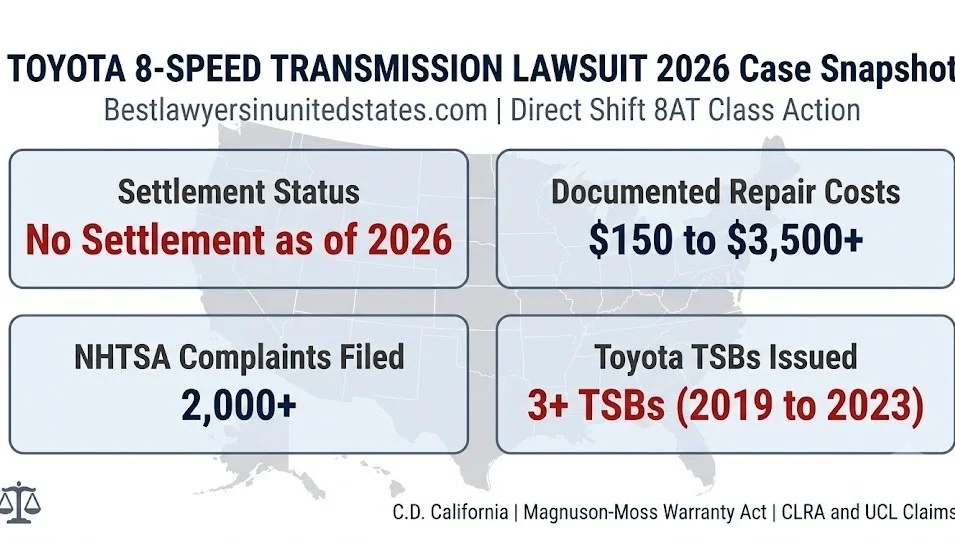
- What is it worth? No final settlement has been announced as of 2026. The case is in active litigation. Documented out-of-pocket repair costs for affected owners range from $150 to over $3,500 depending on the repair performed. Potential settlement compensation, if reached, would likely follow a tiered reimbursement structure calibrated to documented repair expenses and vehicle purchase price.
Case Snapshot
| Detail | Info |
|---|---|
| Primary Defendant | Toyota Motor North America, Inc.; Toyota Motor Sales, U.S.A., Inc. |
| Transmission at Issue | Toyota Direct Shift 8-Speed Automatic Transmission (8AT) |
| Primary Court | U.S. District Court, Central District of California |
| Representative Case | Hicks v. Toyota Motor North America, Inc. (C.D. Cal.; filed 2021-2022) |
| Related NHTSA Complaints | Multiple open investigation complaints across affected models |
| Toyota TSBs Issued | Multiple TSBs issued for 8-speed shudder and harsh engagement (2019-2023) |
| Toyota Special Service Program | SSP issued for transmission fluid replacement on affected vehicles |
| Presiding Judge | Not yet publicly confirmed as of 2026; C.D. Cal. complex civil division |
| Litigation Status (2026) | Active; class certification proceedings ongoing |
| Settlement Fund | Not yet announced; no settlement reached as of 2026 |
| Legal Claims Alleged | Magnuson-Moss Warranty Act; CLRA; UCL; fraudulent concealment; breach of implied warranty |
Introduction
The Toyota 8-speed transmission lawsuit concerns one of the most widely reported automotive defect disputes of the current decade. Across multiple Toyota and Lexus vehicle lines, owners have documented a consistent pattern of transmission shudder, delayed engagement, and harsh gear changes that Toyota’s own Technical Service Bulletins acknowledged as early as 2019.
Federal class action complaints filed in the Central District of California allege that Toyota Motor North America sold vehicles with a known defect while concealing it from purchasers and offering only partial, temporary remedies through dealer service programs.
The litigation has not yet produced a settlement. That means affected owners are in a critical window. Class certification proceedings will determine whether individual owners can recover through collective action or must pursue individual claims.
NHTSA received more than 2,000 documented complaints specifically identifying transmission shudder in Toyota 8-speed equipped vehicles before the first consolidated class complaint was filed. That complaint volume, combined with Toyota’s TSB issuance history, forms the evidentiary core of the plaintiffs’ fraud concealment theory.
What Is the Toyota 8-Speed Transmission Lawsuit?
The Toyota 8-speed transmission lawsuit is a federal class action proceeding alleging that Toyota Motor North America knowingly sold defective vehicles and failed to adequately disclose or remediate a transmission defect it had identified internally.
The lawsuit targets Toyota’s Direct Shift 8-speed automatic transmission (8AT), a transmission design Toyota introduced across multiple high-volume vehicle lines beginning with the 2018 model year. The 8AT was marketed as a fuel-efficiency and performance improvement over prior 6-speed configurations.
Core legal claims in the complaint:
- Fraudulent concealment: Toyota possessed internal engineering knowledge of the shudder defect before vehicles reached consumers but failed to disclose it at the point of sale
- Breach of implied warranty of merchantability: The defective transmission rendered affected vehicles unfit for their ordinary purpose of reliable transportation
- Magnuson-Moss Warranty Act violations: Toyota failed to honor its written warranty obligations for the defect
- California Consumer Legal Remedies Act (CLRA): Deceptive omission of material defect information at the point of sale
- California Unfair Competition Law (UCL): Unfair business practice of selling defective vehicles without disclosure
Attorney Insight: Attorneys handling these claims note that the fraudulent concealment allegation is the most strategically significant because it tolls the statute of limitations and allows class members who purchased vehicles several years ago to remain viable plaintiffs despite the passage of time.
Toyota Transmission Class Action Lawsuit: How the Case Is Structured
The Toyota transmission class action lawsuit is structured as a consumer class action under Federal Rule of Civil Procedure 23, seeking to represent a class of all U.S. purchasers and lessees of Toyota vehicles equipped with the 8-speed Direct Shift automatic transmission.
The complaint consolidates claims from named plaintiffs across multiple states. California law claims dominate the complaint’s structure because California provides plaintiffs with some of the strongest consumer protection remedies available under any state’s law.
Class action structure for the Toyota 8AT case:
| Class Element | Description |
|---|---|
| Class Period | Approximate purchase period from 2018 through present |
| Proposed Class | All U.S. purchasers and lessees of covered Toyota vehicles with 8AT |
| Subclass | California purchasers and lessees (California-specific statutory claims) |
| Class Representatives | Named plaintiffs from multiple states who experienced documented defect events |
| Class Counsel | Plaintiffs’ counsel appointed by the court |
| Defendant | Toyota Motor North America, Inc.; Toyota Motor Sales, U.S.A., Inc. |
The distinction between a nationwide class and a California subclass is procedurally significant. California subclass members have access to the CLRA’s statutory damages and attorney’s fee provisions that are not available to out-of-state class members.
Attorney Insight: Class action practitioners note that the California subclass structure is a deliberate litigation choice because the CLRA’s per-violation statutory damages provisions provide plaintiffs’ counsel with leverage in settlement negotiations that pure contract or warranty claims alone would not support.
Toyota Transmission Lawsuit Update 2026: Current Case Status
As of 2026, the Toyota 8-speed transmission class action is in active proceedings in the Central District of California, with class certification as the central pending motion.
What class certification means for this case:
Class certification is the pivotal procedural moment in any class action. If the court grants certification, Toyota faces liability to potentially hundreds of thousands of vehicle owners collectively. If certification is denied, individual owners must pursue separate suits, which dramatically reduces the economic viability of pursuing claims for most claimants.
Toyota has contested class certification, arguing that individual vehicle conditions, driving patterns, and repair histories make the shudder defect too variable across class members to support common treatment under Rule 23.
2026 litigation timeline:
| Event | Status |
|---|---|
| Initial class action complaint filed | 2021-2022 (C.D. Cal.) |
| Toyota’s motion to dismiss | Contested; partial rulings issued |
| Discovery phase | Active through 2025-2026 |
| Class certification motion | Pending before C.D. Cal. |
| Toyota’s class cert opposition | Filed; contested |
| Settlement discussions | No confirmed settlement as of 2026 |
| Trial date | Not yet set; contingent on certification |
Attorney Insight: Litigation analysts monitoring this case note that Toyota’s internal TSB documentation, compelled through discovery, has become the most contested evidentiary battleground because those documents establish when Toyota first identified the defect and what remediation options were available internally before any public disclosure.
Litigation Watch: The Toyota 8-speed transmission lawsuit’s class certification hearing is the most consequential near-term event in the litigation, because the court’s ruling on that motion will determine whether hundreds of thousands of vehicle owners have a collective path to compensation or must individually retain counsel and file separate actions.
Toyota Transmission Lawsuit Court and Docket Details
The Toyota 8-speed transmission lawsuit is pending in the U.S. District Court for the Central District of California, the same court that handles a disproportionate share of major automotive consumer class actions in the United States.
Court and docket specifics:
The representative case Hicks v. Toyota Motor North America, Inc. was filed in the Central District of California. Related complaints filed in other federal districts have been coordinated before the same court. The Central District of California’s complex civil litigation panel manages cases of this scale and procedural complexity.
Toyota Motor North America, Inc. and Toyota Motor Sales, U.S.A., Inc. are named as defendants. Both are incorporated or registered entities subject to jurisdiction in the Central District.
Why the Central District of California:
- Toyota’s U.S. sales headquarters is located in Plano, Texas, but California is the single largest market for Toyota vehicles and the jurisdiction with the most plaintiff-favorable consumer protection statutes
- California’s CLRA and UCL provide remedies not available under federal law alone
- The Central District has an established complex case management system for multi-state automotive class actions
Key court record details:
| Detail | Information |
|---|---|
| Court | U.S. District Court, Central District of California |
| Division | Western Division (Los Angeles) |
| Case Type | Consumer product liability class action |
| Federal Claims | Magnuson-Moss Warranty Act (15 U.S.C. § 2301 et seq.) |
| State Claims | CLRA (Cal. Civ. Code § 1750); UCL (Cal. Bus. & Prof. Code § 17200) |
Attorney Insight: Practitioners note that the Central District’s complex civil panel assigns experienced judges to automotive class actions and that court’s precedents on class certification in product defect cases provide a relatively predictable analytical framework for assessing the likelihood of certification.
Toyota 8-Speed Automatic Transmission Defect: What Is Actually Wrong?
The Toyota 8-speed automatic transmission defect centers on a specific mechanical failure mode called torque converter shudder, combined with secondary manifestations including harsh gear engagement and delayed shifting response.
The Toyota Direct Shift 8AT uses a torque converter to transfer engine power to the transmission. When the torque converter’s internal clutch surfaces degrade or fail to achieve proper engagement, the clutch surfaces slip against each other in a rapid, repetitive pattern that drivers experience as a vibration or shudder felt through the vehicle floor, seat, and steering wheel.
The engineering failure sequence:
- Transmission fluid degrades or loses its friction-modifying properties earlier than expected
- Torque converter lock-up clutch surfaces experience insufficient lubrication film during engagement
- Clutch surfaces slip intermittently during engagement at specific speeds, typically 30 to 45 mph
- The slippage produces a vibration pattern ranging from mild judder to severe shuddering
- Condition worsens progressively without intervention; fluid replacement provides only temporary relief in many cases
Why Toyota’s own TSB issuance is legally significant:
Toyota issued Technical Service Bulletins directing dealers to replace transmission fluid with a revised formulation as the primary remediation. Plaintiffs argue this TSB strategy represents Toyota’s internal acknowledgment of the defect while simultaneously avoiding the more costly remedy of transmission replacement.
Attorney Insight: Plaintiffs’ attorneys in transmission defect cases consistently identify TSBs as the most powerful documentary evidence of manufacturer knowledge because they are prepared by the manufacturer’s own engineers and circulated to the dealer network without public disclosure.
Toyota Transmission Shudder Lawsuit: Why Shudder Is a Defect, Not a Feature
The Toyota transmission shudder lawsuit specifically targets the torque converter shudder condition as a product defect rather than a normal operating characteristic, a distinction Toyota has contested in its responsive pleadings.
Toyota’s initial position in the litigation characterized the shudder condition as a normal operating characteristic of the direct-shift transmission design. Plaintiffs counter with Toyota’s own TSB issuance history, which directed dealers to perform corrective fluid replacements for this specific condition, directly contradicting the characterization of shudder as normal behavior.
The legal significance of the “normal vs. defect” dispute:
In automotive product liability litigation, a manufacturer’s internal remediation directive to its dealer network is treated by courts as evidence that the condition constitutes an abnormality requiring correction. A manufacturer that instructs dealers to fix a condition has effectively conceded that the condition requires fixing.
Documented shudder complaint statistics:
- NHTSA received more than 2,000 complaints identifying Toyota 8-speed transmission shudder across affected model lines
- Owner complaints specifically document shudder onset in vehicles with fewer than 20,000 miles on the odometer
- Multiple complaints document recurrence of the shudder condition following Toyota’s recommended fluid replacement, supporting the plaintiffs’ argument that the fluid remedy is insufficient
Callout: Toyota issued at least three separate Technical Service Bulletins specifically addressing the 8-speed transmission shudder condition between 2019 and 2023, documenting an internal awareness of the problem spanning multiple model years.
Attorney Insight: Attorneys representing plaintiffs in shudder defect cases note that the recurrence rate after fluid replacement is among the most compelling evidence of a design defect rather than a maintenance issue, because a true maintenance solution does not require repeated application.
Toyota Transmission TSB vs. Recall: The Legal Difference
The distinction between a Toyota transmission TSB and a recall is one of the most legally consequential facts in this lawsuit, and it is consistently underexplained in competing coverage.
A Technical Service Bulletin (TSB) is a document Toyota issues to its authorized dealer network that describes a known vehicle condition and a recommended repair procedure. TSBs are not public safety notices. They do not trigger mandatory owner notification. They do not require Toyota to repair vehicles at no cost unless the vehicle is within warranty. Critically, they do not require Toyota to notify vehicle owners that a problem exists.
A recall, by contrast, is a formal action under the National Traffic and Motor Vehicle Safety Act that requires manufacturer notification to all affected owners, free repair at dealerships, and reporting to NHTSA.
Why this distinction matters in the Toyota lawsuit:
| Document Type | Owner Notification Required | Free Repair Required | NHTSA Reporting Required | Manufacturer Knowledge Documented |
|---|---|---|---|---|
| TSB | No | No (warranty dependent) | No | Yes |
| Recall | Yes | Yes | Yes | Yes |
| Special Service Program (SSP) | Limited | Sometimes | No | Yes |
By issuing TSBs rather than initiating a recall, Toyota fulfilled its dealer-network remediation objective without triggering mandatory owner notification obligations. Plaintiffs argue this is precisely the conduct the fraudulent concealment theory targets.
Attorney Insight: Automotive class action attorneys note that the TSB-versus-recall distinction is often the central factual battleground in these cases because plaintiffs must prove Toyota had an obligation to disclose the defect to consumers, and TSB issuance without owner notification is the documentary evidence that Toyota both knew of the defect and chose not to tell buyers.
Litigation Watch: Toyota’s issuance of multiple TSBs for the 8-speed transmission shudder condition between 2019 and 2023, combined with the absence of a formal recall, provides plaintiffs with documentary evidence of the manufacturer’s internal knowledge that forms the foundation of the fraudulent concealment claim.
Toyota 8-Speed Transmission Defect Symptoms: What Qualifies?
The Toyota 8-speed transmission defect symptoms that courts and attorneys treat as qualifying conditions are specific and documented, not generic complaints about vehicle feel.
Understanding which symptoms align with the legal allegations helps vehicle owners assess whether their experience falls within the scope of the class action.
Primary qualifying symptoms:
- A distinct vibration or shuddering sensation felt through the vehicle’s floor, seat, or steering wheel at highway speeds, typically in the 30 to 45 mph range
- Shudder that intensifies during light acceleration or while maintaining constant speed
- Harsh, abrupt gear engagement when accelerating from a stop
- A delay or hesitation between throttle input and vehicle acceleration response
- Recurrence of shudder following Toyota’s dealer-performed transmission fluid replacement
Secondary symptoms documented in complaints:
- Transmission warning lights or fault codes related to the torque converter clutch
- Reduced fuel economy compared to EPA-rated figures
- Vibration accompanied by a slight RPM fluctuation visible on the vehicle’s tachometer
- Customer service documentation from Toyota dealers acknowledging the condition and performing fluid replacement under warranty or out of warranty
What does NOT qualify on its own:
- General vehicle vibration from road surface conditions
- Vibration caused by tire imbalance or wheel bearing wear unrelated to the transmission
- Normal transmission behavior during cold-start warm-up periods
Attorney Insight: Attorneys reviewing potential class member claims consistently find that the most persuasive documentation is a dealer repair order that specifically identifies the transmission shudder complaint, documents the fluid replacement performed, and notes the vehicle’s mileage at the time of the repair.
Toyota Camry 8-Speed Transmission Lawsuit: The Lead Vehicle in the Case
The Toyota Camry is the highest-volume vehicle in the 8-speed transmission lawsuit because it was the first Toyota production vehicle to receive the Direct Shift 8AT, beginning with the 2018 model year.
The Camry’s volume in the market means it represents the largest single vehicle population within the proposed class. NHTSA complaint records for the Camry’s 8-speed transmission shudder issue exceed those of any other single Toyota model in this lawsuit.
Toyota Camry 8-speed transmission key facts:
| Detail | Information |
|---|---|
| First model year with 8AT | 2018 |
| Trims equipped with 8AT | LE, SE, XSE, XLE, TRD (V6 models use different transmission) |
| NHTSA complaint volume | Among highest of any Toyota 8AT model |
| TSB coverage | Camry specifically identified in Toyota TSBs for shudder remediation |
| Warranty period for 8AT | 5 years / 60,000 miles (powertrain warranty) |
Camry owners whose vehicles were within the powertrain warranty period when shudder symptoms first appeared are in the strongest legal position for reimbursement of dealer-performed repairs. Owners outside the warranty window who paid out-of-pocket for fluid replacement or related repairs present a different but still viable damages theory.
Attorney Insight: Attorneys handling Camry-specific claims within this class action note that the Camry’s extensive dealer service records for this specific condition, accumulated over six-plus model years, provide an unusually strong statistical foundation for demonstrating the defect’s prevalence across the class.
Toyota RAV4 Transmission Lawsuit: The Second Major Vehicle in the Case
The Toyota RAV4 transmission lawsuit component targets the RAV4’s adoption of the 8-speed Direct Shift automatic transmission beginning with the 2019 model year, making it the second highest-volume vehicle in the proposed class.
The RAV4 is the best-selling vehicle in the Toyota lineup overall, meaning that even a one-year lag behind the Camry’s 8AT introduction still produces a substantial class member population across 2019 through 2023 model years.
Toyota RAV4 8-speed transmission key facts:
| Detail | Information |
|---|---|
| First model year with 8AT | 2019 |
| Trims equipped with 8AT | LE, XLE, XLE Premium, TRD Off-Road, Adventure, Limited |
| Documented complaint pattern | Shudder reported at mileage as low as 5,000 to 15,000 |
| RAV4 Hybrid | Uses a different hybrid CVT transmission; not covered in this suit |
| RAV4 Prime | Uses PHEV drivetrain; not covered in this suit |
The RAV4’s inclusion in the lawsuit creates a geographically diverse class member population because the RAV4 sells in high volumes across all 50 states, unlike vehicles whose sales concentrate regionally.
Out-of-pocket repair costs documented by RAV4 owners in class filings range from dealer fluid replacement charges of approximately $150 to $300 to full torque converter replacement costs exceeding $3,500 in cases where fluid replacement did not resolve the shudder condition.
Attorney Insight: Attorneys note that the RAV4’s nationwide sales distribution is procedurally beneficial for class certification because it supports the named plaintiffs’ argument that the defect affects consumers uniformly across state lines, strengthening the commonality and typicality arguments under Rule 23.
Toyota 8-Speed Transmission Affected Models and Years
The Toyota 8-speed transmission affected models extend beyond the Camry and RAV4 to include additional vehicles in the Toyota and Lexus lineup that received the Direct Shift 8AT in subsequent model years.
Complete affected vehicle list (Toyota brand):
| Vehicle | First 8AT Model Year | Alleged Covered Years | Primary Defect Documented |
|---|---|---|---|
| Toyota Camry | 2018 | 2018-2023 | Torque converter shudder; harsh engagement |
| Toyota RAV4 | 2019 | 2019-2023 | Torque converter shudder; delayed engagement |
| Toyota Avalon | 2019 | 2019-2023 | Torque converter shudder |
| Toyota Highlander | 2020 | 2020-2023 | Torque converter shudder; harsh shifts |
Lexus vehicles with shared 8AT platform:
Some Lexus models use the same or closely related 8-speed transmission platform. Whether Lexus vehicles fall within the certified class or are addressed in parallel proceedings depends on the class definition adopted by the Central District court.
Important model exclusions:
- Toyota Camry V6 (uses a 6-speed automatic, not the 8AT)
- Toyota RAV4 Hybrid and RAV4 Prime (use different hybrid drivetrain configurations)
- Toyota Tacoma and Tundra truck lines (use different transmission families)
Attorney Insight: Attorneys reviewing vehicle eligibility note that confirming the specific transmission installed, not just the model and year, is the first verification step because some trim levels within a covered model year use different transmissions, and misidentifying the transmission type is the most common documentation error in early claim submissions.
Who Qualifies for the Toyota Transmission Lawsuit?
Eligibility for the Toyota transmission lawsuit depends on the specific vehicle, the transmission installed, the documented symptom history, and the ownership status at the time of qualifying repairs.
Primary eligibility criteria:
- Current or former owner or lessee of a covered Toyota vehicle equipped with the Direct Shift 8-speed automatic transmission
- Vehicle falls within the covered model year range for the specific model (generally 2018 through 2023)
- Documented experience of qualifying transmission symptoms, specifically torque converter shudder, harsh engagement, or delayed shifting
- Vehicle was located in the United States at the time of purchase or lease
Documentation that strengthens eligibility:
- Dealer repair orders identifying the transmission shudder complaint and the repair performed
- NHTSA complaint submission records showing the owner reported the issue
- Out-of-pocket payment receipts for transmission fluid replacement or related repairs
- Written communications with Toyota or Toyota dealers regarding the transmission condition
Second-owner and subsequent-owner eligibility:
The class definition as alleged in the complaint does not appear to restrict membership to original purchasers. Subsequent owners who experienced the defect and paid for qualifying repairs during their period of vehicle ownership present viable claims based on the same legal theories.
Attorney Insight: Attorneys working with second-owner claimants note that the critical documentation requirement is establishing continuous vehicle ownership records, typically through title documents and the repair invoice in the claimant’s name, to connect the owner to both the covered vehicle and the qualifying repair event.
Toyota 8-Speed Transmission Settlement Payout Amounts 2026
No final Toyota 8-speed transmission settlement has been announced as of 2026. The case is in active litigation at the class certification stage. Compensation amounts are not yet determined.
However, the damages framework in the complaint and comparable automotive transmission settlements from other manufacturers provide a reasonable basis for projecting what a settlement structure would likely include.
Projected settlement tier structure based on comparable automotive cases:
| Tier | Qualifying Event | Projected Reimbursement Range |
|---|---|---|
| Tier 1: Transmission Replacement | Full transmission or torque converter replaced | $1,500 to $3,500+ (documented cost) |
| Tier 2: Major Fluid and Repair | Multiple fluid replacements plus related repairs | $500 to $1,500 (documented costs) |
| Tier 3: Fluid Replacement Only | Single or multiple dealer fluid replacements | $100 to $500 (documented out-of-pocket) |
| Tier 4: Extended Warranty | Covered vehicle; no documented out-of-pocket repair | Extended powertrain warranty or SSP coverage |
| Tier 5: Diminished Value | Vehicle sold at reduced value attributed to defect | Case-by-case; documentation intensive |
What owners should do now while no settlement exists:
- Preserve all dealer repair orders and invoices relating to transmission service
- File a complaint with NHTSA if not already done (creates a timestamped public record)
- Document any recurrence of symptoms following Toyota’s fluid replacement remedy
Attorney Insight: Attorneys advising clients in pre-settlement automotive class actions consistently recommend creating a complete paper file of all dealer service interactions now, because settlement claim forms typically require documentation that becomes harder to obtain years after the repair was performed.
Toyota Transmission Lawsuit Filing Deadline 2026: What Are the Critical Dates?
No claims filing deadline has been established for the Toyota 8-speed transmission lawsuit because the case has not yet settled. Claims deadlines are set by the court only after a settlement receives preliminary approval.
This means that vehicle owners do not currently need to file a claim form. The obligation to file arises only after the court approves a settlement and the settlement administrator opens a claims submission period.
What 2026 deadlines do exist:
The statute of limitations is the most significant time constraint for potential class members in the pre-settlement phase. Owners who experienced qualifying defect events should understand that:
- The fraudulent concealment doctrine in the complaint tolls the limitations period from the date the defect was discovered
- State statutes of limitations for consumer protection claims vary from 2 to 5 years depending on the state
- California’s statute of limitations for CLRA claims is 3 years from discovery of the alleged violation
- Owners who experienced symptoms several years ago should consult counsel promptly to assess whether their individual claims remain timely
Key dates to monitor:
| Event | Timing |
|---|---|
| Class certification ruling | Expected 2026 (C.D. Cal. calendar dependent) |
| Potential settlement announcement | Post-certification; no confirmed timeline |
| Claims submission period opening | After preliminary approval order |
| Claims deadline | Set by court order after preliminary approval |
Attorney Insight: Class action practitioners uniformly advise that waiting for a claims deadline announcement is the correct approach for most class members, but owners with substantial out-of-pocket repair costs exceeding $5,000 should consult a product liability attorney now about whether individual litigation offers better recovery potential.
Litigation Watch: The absence of a settlement deadline in 2026 does not mean inaction is appropriate; it means that vehicle owners should be assembling documentation now and monitoring the class certification ruling, which will either accelerate or significantly complicate the path to any compensation.
How to File a Toyota Transmission Lawsuit Claim
There is no Toyota 8-speed transmission settlement claim form to file as of 2026. The case has not settled. Claim forms do not exist until a court grants preliminary settlement approval.
The correct actions for affected Toyota owners in 2026 are preparatory, not administrative.
What to do now, before any claims period opens:
- Gather and organize all dealer service records related to transmission complaints, including invoices, repair orders, and any written diagnoses from Toyota dealers
- Retrieve your vehicle’s complete VIN and confirm it falls within the covered model and year range
- File a complaint with NHTSA through the SaferCar complaint database if you have not already done so
- Request your vehicle’s complete service history from the Toyota dealer where repairs were performed
- Retain any written communications with Toyota Motor North America regarding the transmission condition
When a settlement is reached, the claim process will typically require:
- Submission of the official claim form through the settlement administrator’s court-established portal
- VIN verification confirming the vehicle is a covered model and year
- Dealer repair invoices documenting qualifying repair events
- Proof of ownership or lease during the period of the qualifying repair
Attorney Insight: Attorneys assisting clients in building pre-settlement documentation files note that the most commonly missing piece is the dealer-issued repair order that specifies the transmission shudder complaint and the specific repair performed, because owners sometimes receive a summary receipt rather than the detailed work order that claims administrators require.
What Type of Lawyer Handles a Toyota Transmission Lawsuit?
A class action attorney with experience in automotive product liability and consumer protection litigation is the appropriate legal professional for the Toyota 8-speed transmission case.
These attorneys operate on a contingency fee basis in class action proceedings. Class counsel, once appointed by the court, represents all class members collectively. Individual class members do not pay attorney’s fees out of pocket.
When an individual product liability or consumer protection attorney adds value:
- Your out-of-pocket transmission repair costs exceed $5,000, making individual litigation economically viable
- You experienced a personal injury or property damage accident attributable to a transmission failure or delayed engagement event
- You want to evaluate whether opting out of the class and pursuing individual litigation would produce greater net recovery
- Your vehicle is a commercial vehicle with documented business income losses from transmission-related downtime
- You need assistance with documentation preparation, NHTSA complaint filing, or Toyota dispute resolution before any settlement opens
Attorney types relevant to this litigation:
| Attorney Type | Role |
|---|---|
| Class Action Attorney | Represents class collectively; monitors settlement negotiations |
| Product Liability Attorney | Handles individual opt-out suits for high-damage claimants |
| Consumer Protection Attorney | Advises on state CLRA, UCL, and warranty claims |
| Personal Injury Attorney | Handles bodily injury if transmission failure caused an accident |
| Lemon Law Attorney | Evaluates whether vehicle qualifies under state lemon law independent of class |
Attorney Insight: Product liability attorneys handling Toyota transmission cases outside the class action framework note that California’s Song-Beverly Consumer Warranty Act, the state lemon law, may provide independent remedies for California owners whose vehicles were repeatedly presented to dealers for the same unresolved transmission condition without a satisfactory repair, potentially including vehicle repurchase or replacement.
Frequently Asked Questions
What is the Toyota 8-speed transmission lawsuit about?
The Toyota 8-speed transmission lawsuit is a federal class action alleging that Toyota knowingly sold vehicles with a defective Direct Shift 8AT transmission that exhibits torque converter shudder, harsh engagement, and delayed shifting.
The case is pending in the U.S. District Court for the Central District of California and alleges fraudulent concealment, breach of implied warranty, and violations of the Magnuson-Moss Warranty Act and California consumer protection statutes.
Which Toyota vehicles are affected by the 8-speed transmission lawsuit?
The primary affected vehicles are the Toyota Camry (2018-2023), Toyota RAV4 (2019-2023), Toyota Avalon (2019-2023), and Toyota Highlander (2020-2023), all equipped with the Direct Shift 8-speed automatic transmission.
RAV4 Hybrid, RAV4 Prime, and V6-equipped Camry models use different drivetrains and are not included in the alleged class definition.
Has the Toyota transmission lawsuit settled?
No. As of 2026, the Toyota 8-speed transmission lawsuit has not settled.
The case is at the class certification stage in the Central District of California; no settlement fund has been established and no claims submission period has opened.
Do I need to file a claim form now for the Toyota transmission lawsuit?
No. Claim forms do not exist because the case has not settled.
The correct action for affected owners in 2026 is to preserve all dealer repair records, file a complaint with NHTSA if not already done, and monitor the class certification ruling for updates.
What is a Toyota TSB and why does it matter for the lawsuit?
A Technical Service Bulletin (TSB) is a document Toyota issues to its dealer network describing a known vehicle condition and a recommended repair procedure, without publicly notifying vehicle owners.
In the Toyota 8-speed transmission lawsuit, multiple TSBs issued by Toyota for the shudder condition serve as evidence that Toyota was aware of the defect before and during the class period, supporting the fraudulent concealment theory at the heart of the case.
What should I do if my Toyota has transmission shudder but I am not sure it qualifies?
Confirm your vehicle’s VIN, model, and model year against the covered vehicle list for the 8-speed Direct Shift automatic transmission.
Gather your dealer repair orders documenting any transmission service, file a complaint with NHTSA to create a timestamped record, and consult a class action or product liability attorney to assess whether your documented repair history supports a claim within the class or through individual litigation.
Closing
The Toyota 8-speed transmission lawsuit is an active federal proceeding with a significant class certification decision pending in 2026. That ruling will shape whether hundreds of thousands of vehicle owners can pursue compensation collectively or must navigate individual claims separately.
Affected owners should not wait for a settlement announcement to begin organizing their documentation. The evidentiary foundation for any successful claim, specifically dealer repair orders that document the shudder condition and the repair performed, is easiest to assemble now.
A class action or product liability attorney who handles automotive defect litigation is the right starting point for any owner with documented out-of-pocket transmission repair costs. The contingency fee structure means no upfront cost, and the statute of limitations clock is running.
