Quick Answer
- The gabapentin lawsuit 2026 landscape covers two separate tracks: a closed federal fraud case over off-label marketing (MDL No. 1629) and a newer, unconsolidated wave of dementia and cognitive injury claims.
- Patients who took gabapentin long-term, especially for off-label pain, anxiety, or insomnia, and later developed dementia, mild cognitive impairment, or memory loss may qualify.
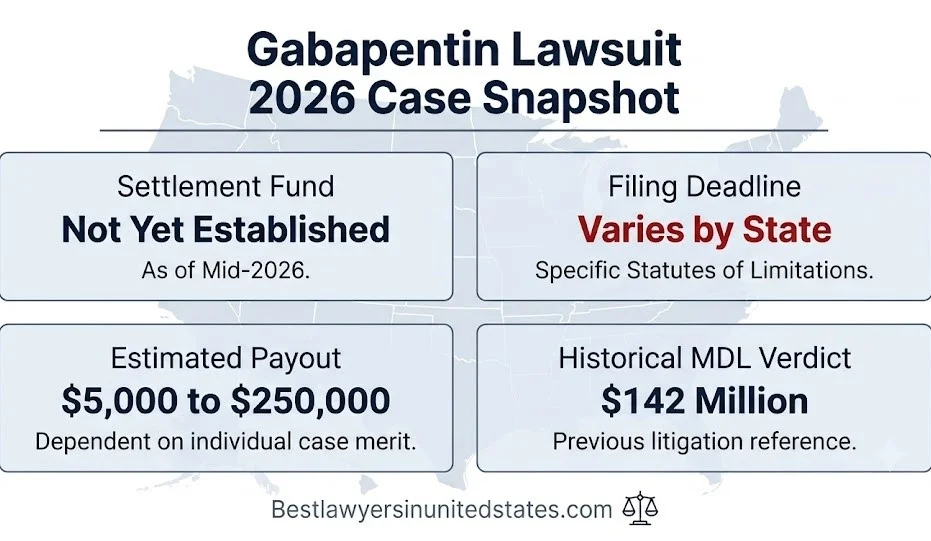
- No global settlement fund exists yet for the dementia claims. Historical Neurontin fraud litigation produced a $142 million jury verdict and a $325 million insurer settlement, which attorneys point to as a sign of what a consolidated dementia case could produce.
| Detail | Info |
|---|---|
| Court (historical marketing MDL) | U.S. District Court, District of Massachusetts (Boston) |
| Case / MDL Number | MDL No. 1629, Civil Action No. 04-10981-PBS |
| Presiding Judge | Patti B. Saris |
| Filing Date | Consolidated in 2004; new dementia claims being filed individually in 2025 to 2026 |
| Status | Marketing fraud MDL closed with verdicts and settlements; dementia claims are active but not yet consolidated |
| Settlement Fund | No dementia settlement fund exists as of July 2026. Historical fraud litigation produced $430 million (2004 DOJ), $325 million (insurer settlement), and a $142 million jury verdict |
Gabapentin litigation did not start this year. It has a two-decade paper trail, and that history is exactly why 2026 matters. A federal court in Massachusetts already found that Pfizer’s predecessor pushed this drug for uses it was never approved to treat, and a jury attached real numbers to that finding.
Now a second wave of claims is forming around a different injury: dementia and cognitive decline tied to long-term use. These are not the same case, and treating them as one blurs what a reader actually needs to know before calling a lawyer.
This piece separates the two. It lays out what the courts already decided, what is still unproven, and what a 2026 filing actually requires to move forward.
Gabapentin Lawsuit 2026
The gabapentin lawsuit 2026 picture is really two tracks running in parallel. Track one is closed. Track two is still forming.
Track one is the historical Neurontin marketing case, MDL No. 1629, decided in federal court in Boston. That litigation produced verdicts, settlements, and a body of case law that current plaintiffs’ attorneys now cite as precedent for corporate knowledge and off-label promotion.
Track two involves patients diagnosed with dementia or cognitive impairment after years of gabapentin use. These claims are being filed individually in state and federal courts in 2026, without a certified class action or an established MDL specific to dementia.
Quick Facts
- Historical MDL: closed, with verdicts on record.
- Current dementia claims: active, individual filings, no consolidation yet.
- Both tracks name Pfizer and its subsidiaries as defendants.
Attorneys handling these claims point to the historical marketing verdicts as evidence Pfizer had internal knowledge of promotion practices that could support the newer injury cases.
Gabapentin Lawsuit
A gabapentin lawsuit is a civil claim alleging the drug’s manufacturer failed to properly warn patients or doctors about risks tied to long-term use. These claims fall under product liability and, in the historical case, fraud and racketeering law.
Gabapentin, sold as Neurontin and in generic form, was approved by the FDA only for epileptic seizures and post-herpetic neuralgia from shingles. For decades it was prescribed well beyond that, for back pain, migraines, bipolar disorder, and anxiety.
That gap between approved use and actual prescribing behavior sits at the center of nearly every gabapentin lawsuit filed to date.
Litigation Watch: The gabapentin lawsuit 2026 landscape splits into a closed marketing-fraud MDL with proven verdicts and a newer, unconsolidated dementia claim track still building its evidentiary record.
Gabapentin Dementia Lawsuit
A gabapentin dementia lawsuit alleges the drug increases the risk of cognitive decline after repeated, long-term use, and that patients were not warned. This is the fastest-growing category of new filings in 2026.
The claims draw on research published in Regional Anesthesia and Pain Medicine, which found patients with chronic low back pain who received six or more gabapentin prescriptions had a measurably higher rate of dementia diagnoses compared to patients who did not.
Attorneys are not treating every case of brain fog as a viable claim. The threshold being applied looks for a documented dementia or mild cognitive impairment diagnosis, not temporary dizziness.
| Injury Category | Currently Being Reviewed by Firms |
|---|---|
| Diagnosed dementia after long-term use | Yes |
| Mild cognitive impairment | Yes |
| Early-onset memory loss | Yes |
| Temporary dizziness or brain fog | Generally no |
Attorneys handling these claims point to the six-prescription threshold in the underlying study as a rough benchmark, though individual case strength depends on full prescribing history.
Who Qualifies for Gabapentin Lawsuit
Qualification depends on how long a patient took gabapentin, why it was prescribed, and what diagnosis followed. There is no single national eligibility rule, since no dementia MDL yet sets a uniform criteria list.
Most firms currently reviewing claims are looking for patients who took gabapentin for six months or longer, often for an off-label condition such as chronic pain, anxiety, or insomnia.
A documented diagnosis matters as much as the prescription history. Without a formal dementia or cognitive impairment finding from a physician, a claim is difficult to support.
- Long-term use, generally six months or more
- Off-label prescribing history (pain, anxiety, insomnia, bipolar disorder)
- A physician-documented dementia or cognitive impairment diagnosis
- Prescription records that can be obtained from a pharmacy or provider
Attorneys handling these claims stress that pharmacy records showing prescription frequency often matter more than the patient’s own memory of dosage.
Gabapentin Lawsuit Eligibility
Eligibility for a gabapentin claim generally requires three things: documented use, a qualifying diagnosis, and a filing made within your state’s statute of limitations. Missing any one of the three weakens a claim significantly.
Documentation is not optional. Courts expect pharmacy fill records, physician notes, and in dementia cases, neurological testing or a formal diagnosis from a treating doctor.
The statute of limitations varies by state and typically runs from either the date of diagnosis or the date a patient reasonably should have connected their condition to the drug, known as the discovery rule.
| Eligibility Factor | What Courts Typically Expect |
|---|---|
| Use duration | Documented six months or more |
| Diagnosis | Formal dementia or MCI diagnosis, not self-reported symptoms |
| Filing window | Varies by state, often two to four years from diagnosis or discovery |
| Records | Pharmacy fills, physician notes, prescribing history |
Attorneys handling these claims typically request pharmacy records before agreeing to take a case, since gaps in prescription history are one of the most common reasons claims get declined.
Gabapentin Cognitive Decline Lawsuit
A gabapentin cognitive decline lawsuit centers on the allegation that repeated use altered nerve signal transmission in ways that affected memory and executive function over time. This is distinct from a full dementia diagnosis, though the two claim types often overlap.
Plaintiffs’ attorneys argue the manufacturer had decades to study long-term neurological effects and did not adequately disclose what it knew, particularly given how widely the drug was prescribed off-label.
Defense counsel is expected to challenge causation directly, arguing that co-occurring conditions like chronic pain, age, and other medications make it difficult to isolate gabapentin as the specific cause.
Bold callout: Millions of patients were prescribed gabapentin off-label over the past two decades, which is exactly why causation, not exposure, will decide most of these cases.
Attorneys handling these claims acknowledge causation will likely be litigated hardest during any future bellwether trials, if consolidation happens.
Gabapentin Lawsuit Settlement Amounts
There is no confirmed settlement amount for the current dementia claims as of July 2026, since no global settlement has been reached. Any figure circulating publicly right now is a projection, not a confirmed payout.
What does exist is a documented history. The historical Neurontin marketing MDL produced a $142 million jury verdict for Kaiser Foundation Health Plan, later upheld on appeal, plus a $325 million settlement covering other insurers and third-party payors.
Attorneys use those historical figures as reference points when projecting what a large-scale dementia settlement could eventually produce, though the injury type and legal theory differ significantly.
| Case | Amount | Status |
|---|---|---|
| Kaiser Foundation Health Plan jury verdict | $142 million | Upheld on appeal |
| Insurer and TPP settlement | $325 million | Finalized |
| 2004 DOJ criminal and civil settlement | $430 million | Finalized |
| Current dementia claims | Not yet determined | No settlement reached |
Attorneys handling these claims caution clients against treating historical figures as a guarantee, since the dementia claims rely on a different legal theory and a still-developing scientific record.
Gabapentin Class Action Lawsuit Payout Per Person
There is no confirmed per-person payout figure for gabapentin claims in 2026, because no class action or settlement grid currently exists for the dementia injuries. Any number quoted online right now is an estimate built on comparable pharmaceutical litigation.
Analysts tracking the litigation have floated a range between $5,000 and $250,000 per claimant depending on injury severity, though this figure is not backed by an actual settlement structure yet.
Individual lawsuits, rather than a class action, are currently seen by many plaintiffs’ attorneys as the stronger path, since a class settlement tends to divide funds evenly rather than weighting them by injury severity.
- Mild cognitive impairment claims: projected lower end of any future range
- Diagnosed dementia with documented care costs: projected higher end
- Wrongful death claims tied to dementia complications: potentially highest, if pursued
Attorneys handling these claims generally advise against comparing this litigation to a fixed settlement matrix until a bellwether trial or formal settlement program actually exists.
Gabapentin Lawsuit Settlement Fund 2026
No settlement fund has been established for gabapentin dementia claims as of July 2026. This is a critical distinction from lawsuit marketing pages that imply a claim form or fund already exists.
The historical marketing fraud case did produce finalized settlement funds, including the $325 million insurer settlement approved by Judge Patti B. Saris in Boston. Those funds, however, closed years ago and do not cover new dementia claims.
Readers researching this topic should treat any current claim form for gabapentin dementia injuries with real scrutiny, since none has been court-approved yet.
Litigation Watch: No settlement fund exists yet for the 2026 dementia claims, and any historical figures reflect a separate, already-closed marketing fraud case rather than the injuries being litigated today.
Attorneys handling these claims recommend confirming whether a firm is filing an individual lawsuit or simply collecting names for a future claim, since the distinction affects how quickly a case actually moves.
Gabapentin Lawsuit MDL
Multidistrict litigation, or MDL, consolidates similar federal lawsuits before one judge for coordinated discovery and pretrial rulings while keeping each case individually resolved. Gabapentin has one historical MDL, and potentially a future one for dementia claims.
MDL No. 1629, the historical Neurontin marketing case, was consolidated in the District of Massachusetts under Judge Patti B. Saris. That MDL is closed, with its major verdicts and settlements already finalized.
As of mid-2026, the U.S. Judicial Panel on Multidistrict Litigation has not created a separate MDL for gabapentin dementia claims. If filing volume increases, consolidation becomes more likely.
| MDL Fact | Detail |
|---|---|
| Historical MDL number | 1629 |
| Court | D. Massachusetts |
| Judge | Patti B. Saris |
| Dementia-specific MDL | Not yet established |
Attorneys handling these claims note that consolidation typically follows, not precedes, a meaningful rise in individual filings across multiple federal districts.
Join Gabapentin Lawsuit
Joining a gabapentin lawsuit currently means filing an individual claim, since no class action or dementia MDL exists to join collectively. This differs from mass tort cases where a claimant simply registers under an existing consolidated docket.
A prospective plaintiff typically starts by consulting an attorney who reviews prescription history, medical records, and the specific diagnosis involved. From there, the attorney determines whether the facts support an individual filing.
Because there is no unified sign-up process, readers should be cautious of any site suggesting a simple form submission guarantees entry into a lawsuit.
- Step one: gather pharmacy and prescription records
- Step two: obtain the formal diagnosis from a treating physician
- Step three: consult an attorney who reviews product liability drug cases specifically
Attorneys handling these claims stress that “joining” right now means building an individual case file, not signing onto an existing class list.
How to File a Gabapentin Lawsuit
Filing a gabapentin lawsuit starts with a documented diagnosis, a full prescription history, and a consultation with an attorney experienced in pharmaceutical product liability. Skipping any of these steps typically slows the case down significantly.
The attorney will usually request pharmacy fill records first, since gaps in continuous use can undercut a long-term exposure argument. Medical records establishing the dementia or cognitive impairment diagnosis come next.
Once records are gathered, the attorney determines the correct court, generally based on the patient’s state of residence or where the prescribing occurred, and files an individual complaint.
| Step | What It Involves |
|---|---|
| 1. Document diagnosis | Obtain formal medical records confirming dementia or cognitive impairment |
| 2. Gather prescription history | Request pharmacy fill records showing duration and frequency |
| 3. Consult an attorney | Choose one with pharmaceutical product liability experience |
| 4. File complaint | Attorney determines proper jurisdiction and files individually |
Attorneys handling these claims typically complete an initial records review before agreeing to file, since incomplete documentation is the most common reason a case stalls early.
Gabapentin Lawsuit Lawyer
A gabapentin lawsuit lawyer is typically a pharmaceutical product liability or mass tort attorney, not a general personal injury attorney. The distinction matters because these cases require experience with FDA labeling standards and causation arguments specific to drug litigation.
Attorneys working this space often already handled or referenced the historical Neurontin marketing MDL, giving them direct familiarity with Pfizer’s litigation history and prior court findings.
Readers should ask a prospective attorney directly whether they are filing individual lawsuits now or simply collecting client names in anticipation of future consolidation.
- Ask whether the firm files individually or waits for consolidation
- Ask how many gabapentin cases the firm has filed to date
- Ask what specific diagnosis and documentation the firm requires
Attorneys handling these claims generally recommend working with counsel who can point to specific filed cases, not just an intake form.
Gabapentin Lawsuit Pfizer Neurontin
Pfizer is the named defendant in gabapentin litigation because it acquired Warner-Lambert, Neurontin’s original manufacturer, in 2000 and inherited the marketing practices at issue. The company’s litigation history with this drug now spans more than two decades.
In 2004, Pfizer agreed to pay $430 million in criminal and civil fines to the Department of Justice for illegally marketing Neurontin for unapproved conditions, including migraines and pain.
That 2004 settlement covered federal fraud claims only. It did not compensate individual patients, which is part of why plaintiffs’ attorneys view the current injury-based claims as a separate, still-open avenue for compensation.
| Pfizer Legal History | Amount | Year |
|---|---|---|
| DOJ criminal and civil settlement | $430 million | 2004 |
| Generic delay settlement (New Jersey federal court) | $190 million | 2004 |
| Insurer and TPP settlement (MDL 1629) | $325 million | Finalized in MDL |
| Kaiser jury verdict, upheld on appeal | $142 million | Post-trial, appellate affirmed |
Attorneys handling current claims frequently cite Pfizer’s 2004 guilty plea as evidence the company had a documented history of off-label promotion well before the current dementia allegations surfaced.
Gabapentin Off Label Marketing Lawsuit
The gabapentin off-label marketing lawsuit refers specifically to the historical fraud case alleging Pfizer promoted Neurontin for conditions the FDA never approved. This is the legal foundation the newer dementia claims often reference for corporate knowledge and intent.
Court records from MDL No. 1629 describe a proposed nationwide class covering consumers and third-party payors who purchased Neurontin for off-label uses between January 1994 and December 2004, when a generic version entered the market.
A federal jury found Pfizer had violated the Racketeer Influenced and Corrupt Organizations Act in connection with its marketing conduct toward Kaiser Foundation Health Plan, a finding upheld on appeal by the First Circuit.
Bold callout: A federal jury found RICO violations tied to Pfizer’s off-label marketing, a finding that survived appellate review.
Attorneys handling the current dementia claims argue this RICO finding demonstrates the company’s marketing conduct was not incidental, but part of a broader promotional strategy.
Gabapentin Lawsuit Timeline
A gabapentin lawsuit’s timeline depends heavily on whether it proceeds as an individual filing or eventually becomes part of a consolidated MDL. Individual product liability cases can take a year or longer to resolve.
The historical marketing MDL took years to move from initial consolidation in 2004 through trial verdicts and final settlement approvals, illustrating how long large pharmaceutical litigation can run even once consolidated.
For today’s dementia claims, the early phase, involving records collection, medical documentation, and initial filing, is the stage where most current cases sit as of mid-2026.
| Phase | Historical MDL 1629 | Current Dementia Claims (2026) |
|---|---|---|
| Consolidation | 2004 | Not yet consolidated |
| Trial verdicts | Multiple, including Kaiser | None yet |
| Settlement | $325 million finalized | None yet |
| Current stage | Closed | Records gathering, individual filings |
Attorneys handling these claims caution clients that even a strong individual case can take well over a year before reaching resolution.
Gabapentin Lawsuit Filing Deadline
The filing deadline for a gabapentin lawsuit is governed by each state’s statute of limitations, not a single national cutoff. This is a critical point readers often miss when a page implies one universal deadline.
Most states apply a discovery rule, meaning the clock generally starts when a patient was diagnosed or reasonably should have connected their condition to gabapentin use, rather than when they first took the drug.
Because deadlines vary so significantly by state and by the specific facts of diagnosis, an attorney review is the only reliable way to confirm how much time remains in a specific case.
- Deadlines are set at the state level, not nationally
- The discovery rule often starts the clock at diagnosis, not first use
- Waiting to confirm a personal deadline risks losing the right to file entirely
Attorneys handling these claims stress that clients should not assume they have years remaining without confirming their specific state’s rule.
Gabapentin Lawsuit by State
Gabapentin lawsuits are being filed in both state and federal courts depending on where the patient lives, where they were prescribed the drug, and where the manufacturer can be sued under that state’s jurisdictional rules. There is no single state handling the bulk of new dementia filings.
States with larger populations and more prescribing volume, including California, Texas, Florida, and New York, are expected to see a higher concentration of filings simply due to scale.
Because state law governs statutes of limitations, evidentiary standards, and damage caps differently, the state where a claim is filed can materially affect both timeline and potential recovery.
| Factor | Why State Matters |
|---|---|
| Statute of limitations | Varies by state, directly affects eligibility |
| Damage caps | Some states cap non-economic damages |
| Court backlog | Affects how quickly a case moves |
| Jurisdiction rules | Determines where Pfizer can be sued |
Attorneys handling these claims generally file in the state where the patient was prescribed and treated, since that is typically where jurisdiction is strongest.
Frequently Asked Questions
Is there a gabapentin lawsuit in 2026?
Yes, gabapentin lawsuits are active in 2026, primarily as individual dementia and cognitive injury claims.
A historical marketing fraud MDL already concluded with verdicts and settlements, but the dementia claims remain unconsolidated as of this writing.
Who qualifies for a gabapentin lawsuit?
Patients who took gabapentin long-term, often for an off-label condition, and later received a formal dementia or cognitive impairment diagnosis may qualify.
Documentation of both prescription history and diagnosis is generally required before an attorney will take a case.
How much money can you get from a gabapentin lawsuit?
There is no confirmed payout figure yet, since no dementia settlement fund exists as of July 2026.
Historical Neurontin marketing litigation produced verdicts and settlements up to $325 million, which attorneys use only as a reference point.
Is gabapentin part of a class action or an MDL?
The historical Neurontin marketing case was MDL No. 1629 in the District of Massachusetts, now closed.
The current dementia claims are not yet part of any class action or dementia-specific MDL.
How long does a gabapentin lawsuit take to settle?
Individual product liability cases like these can take a year or longer to reach resolution.
Consolidated litigation, if it forms, could extend the overall timeline further before any global settlement is reached.
What is the deadline to file a gabapentin lawsuit?
The deadline depends on your state’s statute of limitations, which typically starts at diagnosis under the discovery rule.
There is no single national deadline, so confirming your specific timeline with an attorney is the only reliable approach.
Gabapentin litigation now sits at a real inflection point. The marketing fraud case already proved what a federal jury and appellate court will do with clear evidence of off-label promotion.
The current dementia claims are still building that same kind of record, case by case, without a settlement fund or consolidated docket yet in place.
Anyone with a documented long-term prescription history and a dementia or cognitive impairment diagnosis has a real reason to get prescription and medical records organized now, and to talk to a pharmaceutical product liability attorney before a state filing deadline closes the door.