
Quick Answer Box
- The Bill Belichick UNC hiring lawsuit is a North Carolina open meetings and public records case, not a class action seeking damages.
- Only the named plaintiff, former UNC provost Chris Clemens, had standing to bring these specific claims.
- The case settled in 2026 with no money paid and no fault admitted by either side.
Case Snapshot
| Detail | Info |
|---|---|
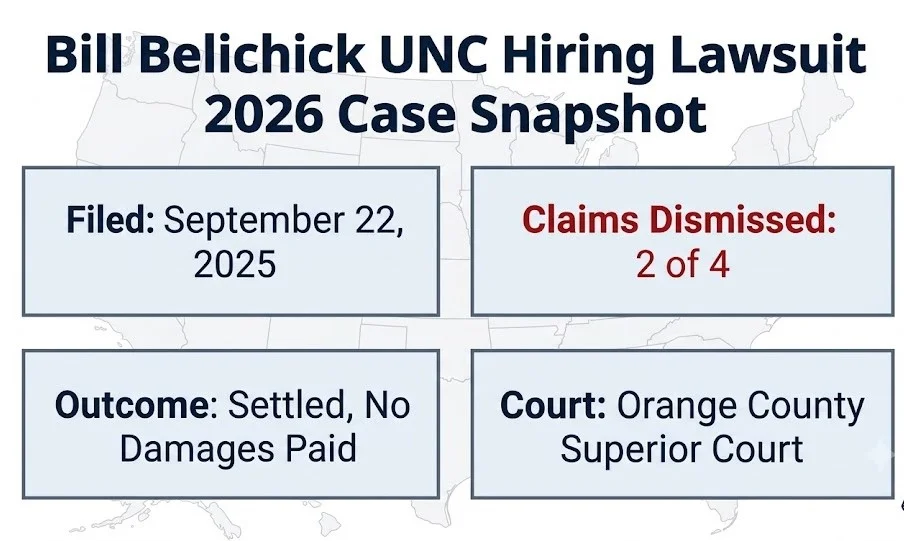
| Court | Orange County Superior Court, North Carolina |
| Case / MDL Number | Not publicly listed in available court reporting as of this writing |
| Filing Date | September 22, 2025 |
| Status | Settled; joint dismissal reported in April 2026 |
| Settlement Fund | Not applicable. The parties settled without any payment or admission of liability |
Bill Belichick’s arrival at UNC came with a contract, a coaching staff, and now a resolved lawsuit over how the school approved all three.
The Bill Belichick UNC hiring lawsuit is not about football. It is a governance case over whether UNC’s Board of Trustees broke North Carolina’s open meetings law.
Former provost Chris Clemens filed the suit in September 2025. He said trustees discussed Belichick’s $10 million annual contract inside a closed, 41-minute emergency session.
By April 2026, the case reached a settlement. No damages changed hands, and neither side admitted wrongdoing.
What Is the Bill Belichick UNC Hiring Lawsuit
This lawsuit is a North Carolina open meetings and public records case tied to how UNC’s board approved Bill Belichick’s hire.
Former Executive Vice Chancellor and Provost Chris Clemens filed the case on September 22, 2025, in Orange County Superior Court. He alleged the Board of Trustees repeatedly used closed sessions to discuss matters state law requires to stay public.
The Belichick hire became the most visible example inside a broader complaint about board secrecy.
Attorneys handling these claims point to the December 12, 2024 emergency meeting as the factual center of the entire dispute.
- Plaintiff: Chris Clemens, former UNC executive vice chancellor and provost
- Defendant: University of North Carolina at Chapel Hill and its Board of Trustees
- Core allegation: closed-session discussion of matters required to be public
UNC Belichick Lawsuit Explained
This case argues that trustees used an emergency closed session to finalize a coaching decision that was already public knowledge.
According to the complaint, the Board of Trustees called an emergency meeting on December 12, 2024, then moved into a 41-minute closed session. That session allegedly covered Belichick’s compensation package and the addition of his sons to the coaching staff.
Clemens argued this was improper because the hiring and pay package were not confidential by that point.
Litigation Watch: The central legal question was never whether Belichick should have been hired. It was whether the board’s process for approving that hire followed state transparency law.
Why Chris Clemens Sued UNC Over the Belichick Hire
Clemens sued after UNC leadership asked him to resign in May 2025, following his criticism of closed-session practices.
Clemens served as UNC’s executive vice chancellor and provost beginning in 2022. University officials said he was asked to step down over “inappropriate disclosure” of closed-session discussions, according to the complaint.
Clemens framed the Belichick meeting as one example within a longer pattern, alongside closed-door debates over faculty tenure and conference realignment.
- Trigger event: Clemens’s May 2025 forced resignation
- Alleged pattern: repeated closed-session handling of public matters
- Named examples: Belichick hiring, tenure debates, ACC realignment discussions
UNC Belichick Lawsuit Claims and Legal Theories
The lawsuit raised four separate legal claims under North Carolina’s Open Meetings and Public Records laws.
Claims included a “pattern and practice” of open meetings violations, “unlawful use of personnel exemption,” “deliberate destruction of public records,” and “unlawful electronic meeting without notice.” Clemens also alleged trustees used Signal and similar apps with auto-delete settings to discuss university business.
Two of these four claims did not survive the university’s motion to dismiss, a detail many summaries of this case leave out entirely.
| Claim | Outcome |
|---|---|
| Pattern and practice of open meetings violations | Allowed to proceed |
| Unlawful use of personnel exemption | Allowed to proceed |
| Deliberate destruction of public records | Dismissed with prejudice |
| Unlawful electronic meeting without notice | Dismissed with prejudice |
Who Can Join the UNC Belichick Lawsuit
No one else can join this specific lawsuit, since it was filed by a single named plaintiff rather than as a class action.
Chris Clemens brought this case in his individual capacity, seeking declaratory and injunctive relief rather than damages for a defined group. The claims are tied to his personal knowledge of board conduct and his own forced resignation.
Attorneys handling these claims point to the distinction between individual public-records litigation and class action lawsuits as a common point of confusion for readers.
Bold callout: This is not a class action, and it never sought a shared damages pool that other people could file into.
UNC Belichick Lawsuit Eligibility and Standing
Standing in this case belonged only to Clemens, based on his direct role as a former UNC executive and his personal access to closed-session information.
North Carolina’s Open Meetings Law allows individuals to seek declaratory judgments and injunctions against public bodies. It does not create a fund that unrelated members of the public could claim from.
Anyone with a separate, personal open-records dispute against a North Carolina public body would need to file their own individual claim.
- Standing basis: Clemens’s role as a former provost with direct knowledge of closed sessions
- Relief sought: declaratory judgment and permanent injunction, not damages
- General public: not eligible to join or claim from this case
What the UNC Belichick Lawsuit Is Worth
This lawsuit was never worth a dollar amount, since it sought transparency remedies rather than compensation.
Clemens asked the court for declaratory judgments finding the board’s conduct unlawful, plus a permanent injunction against future violations. When the case settled in 2026, no money was paid by either party.
Think of this case less like a payout and more like a business seeking a court order to change how another party operates.
Bold callout: According to court filings, the eventual settlement involved no damages and no admission of fault by UNC or the Board of Trustees.
UNC Belichick Lawsuit Timeline
This case moved from filing to settlement in roughly seven months.
Clemens filed the complaint on September 22, 2025. UNC sought partial dismissal on October 23, 2025, and a hearing before Judge Allen Baddour followed on October 15, 2025, over discovery disputes.
| Date | Event |
|---|---|
| September 22, 2025 | Complaint filed in Orange County Superior Court |
| October 15, 2025 | Discovery hearing before Judge Allen Baddour |
| October 23, 2025 | UNC files partial motion to dismiss |
| December 2025 | Judge Currin dismisses two of four claims with prejudice |
| January 9, 2026 | Joint motion filed for a 45-day settlement stay |
| March 2026 | Parties report they are finalizing a settlement |
| April 2026 | Settlement confirmed, case headed toward dismissal |
UNC Belichick Lawsuit Court and Judges
Two different judges handled distinct pieces of this case inside Orange County Superior Court.
Judge S. Thomas Currin ruled on UNC’s motion to dismiss in December 2025, dismissing two claims with prejudice while allowing two others to proceed. Judge Allen Baddour separately handled discovery disputes, including denying Clemens’s request for forensic imaging of trustees’ devices.
Attorneys handling these claims point to this split docket as typical in complex public-records cases involving both merits motions and discovery fights.
- Court: Orange County Superior Court, North Carolina
- Motion to dismiss ruling: Judge S. Thomas Currin
- Discovery disputes: Judge Allen Baddour
Litigation Watch: By the time the case reached settlement talks, it had already survived a partial motion to dismiss on its two core claims.
UNC Belichick Lawsuit Motion to Dismiss Ruling
UNC’s partial motion to dismiss succeeded on two of four claims and failed on the other two.
Judge Currin dismissed the “deliberate destruction of public records” and “unlawful electronic meeting without notice” claims with prejudice in December 2025. He allowed the “pattern and practice” and “personnel exemption” claims to continue toward discovery and potential trial.
UNC had argued that four meetings over two years did not amount to a pattern, and that Clemens never proved a formal records request had been denied.
| UNC’s Argument | Court’s Ruling |
|---|---|
| Four meetings over two years is not a “pattern” | Claim allowed to proceed anyway |
| Clemens never proved a denied records request | Related destruction claim dismissed |
UNC Belichick Lawsuit Discovery Disputes
Discovery in this case turned contentious quickly, centered on trustees’ personal devices and messaging apps.
Clemens sought expedited discovery, a records preservation order, and forensic imaging of devices belonging to trustees and School of Civic Life and Leadership Dean Jed Atkins. Judge Baddour denied the forensic imaging request, since Clemens had not first filed a public records request for allegedly deleted messages.
The judge did order UNC to continue preserving all records connected to the case pending further proceedings.
- Requested: expedited discovery, device preservation, forensic imaging
- Denied: forensic imaging of trustees’ devices
- Granted: an order requiring continued record preservation
UNC Belichick Lawsuit Settlement Status
This case settled in 2026, with both sides agreeing to dismissal and no admission of fault.
A joint filing in January 2026 requested a 45-day stay to pursue settlement talks. By March 2026, the parties reported they were finalizing a settlement agreement, and by April 2026, UNC and Clemens confirmed the case had settled.
Bold callout: According to reporting on the settlement, neither UNC nor Clemens paid or received any monetary penalty as part of the resolution.
UNC Belichick Lawsuit by State
This case applies only within North Carolina, since it is based entirely on that state’s Open Meetings and Public Records statutes.
Unlike a nationwide class action, this lawsuit has no bearing on public university governance disputes in other states. A similar closed-session dispute at a public university elsewhere would need to be litigated under that state’s own transparency laws.
| Factor | Rule in This Case |
|---|---|
| Governing law | North Carolina Open Meetings and Public Records laws |
| Applicable court system | North Carolina Superior Court |
| Relevance outside North Carolina | None; state-specific statute |
UNC Belichick Lawsuit Attorneys Involved
Chris Clemens was represented by attorney David McKenzie throughout the litigation.
UNC’s defense included attorney Wes Camden, who appeared in Orange County Superior Court hearings on the university’s behalf. UNC Vice Chancellor and General Counsel Paul Newton also issued public statements addressing the lawsuit on the university’s behalf.
- Plaintiff’s counsel: David McKenzie
- Defense counsel: Wes Camden
- University spokesperson on legal matters: Paul Newton, Vice Chancellor and General Counsel
UNC Belichick Hiring Controversy Beyond This Lawsuit
Separate from this litigation, UNC’s Belichick hiring process drew criticism through reporting on internal communications and donor reaction.
Reporting during 2025 described how then-board chair John Preyer and other trustees submitted an offer sheet to Belichick’s agent without the approval of athletic director Bubba Cunningham. Public records also revealed donor frustration over the hire, separate from any court filing.
These controversies fueled public attention around the case but were not themselves part of Clemens’s formal legal claims.
Bold callout: Not every criticism of the Belichick hiring process became a legal claim in this lawsuit, and readers should not treat the two as identical.
When to Contact an Attorney About Open Meetings Violations
Contact a government transparency or public-records attorney if you believe a public body in your state discussed official business improperly behind closed doors.
An attorney can evaluate whether a specific closed session falls under a legitimate exemption, such as personnel matters, or crosses into unlawful secrecy. This applies to university boards, city councils, school boards, and other public bodies alike.
- Situations that may warrant a consultation: a public board voting in closed session on non-exempt matters, denied public records requests, retaliation after raising transparency concerns
- Situations this case does not resolve: general dissatisfaction with a hiring decision itself, disputes unrelated to meeting or records law
Frequently Asked Questions
Is the Bill Belichick UNC hiring lawsuit still active in 2026?
No, the case reached a settlement in 2026 and is headed toward dismissal.
The parties confirmed the settlement in April 2026, following a partial dismissal ruling in December 2025.
Who filed the lawsuit over Bill Belichick’s UNC hiring?
Former UNC executive vice chancellor and provost Chris Clemens filed the lawsuit.
He filed it individually, not as a class action, on September 22, 2025.
Did the Bill Belichick UNC hiring lawsuit involve a cash settlement?
No, the settlement involved no payment from either party.
Neither UNC nor Clemens admitted fault as part of the resolution.
Which court handled the UNC Belichick lawsuit?
Orange County Superior Court in North Carolina handled this case.
Judge S. Thomas Currin ruled on the motion to dismiss, while Judge Allen Baddour handled discovery disputes.
Did the judge dismiss the entire UNC Belichick lawsuit?
No, the judge dismissed two of four claims and allowed two to proceed.
Claims involving a “pattern” of open meetings violations and misuse of the personnel exemption survived the motion to dismiss.
Can a UNC student or fan join this lawsuit?
No, this case was filed by one individual plaintiff and was never a class action.
Anyone with a separate open-records complaint would need to file their own individual claim.
The Bill Belichick UNC hiring lawsuit never sought money for Belichick’s hiring itself. It tested whether UNC’s board followed North Carolina’s transparency laws, and it ended in a settlement with no damages paid.
Anyone facing a similar closed-session dispute with a public body should speak with an attorney who handles open government and public-records law specifically.
