
Quick Answer Box
- What this case is: Civil legal proceedings connected to Vince, a cast member on CBS’s Big Brother, involving allegations tied to his girlfriend and conduct before, during, or after the show’s production.
- Who may be affected: The girlfriend directly involved, Vince himself, and potentially CBS or its production entities if their conduct or negligence contributed to the situation.
- What it may be worth: Civil harassment, defamation, and emotional distress claims in California courts can yield $10,000 to $500,000 or more depending on documented harm, defendant conduct, and whether punitive damages are sought.
Case Snapshot
| Detail | Information |
|---|---|
| Primary Subject | Vince, Big Brother (CBS) cast member |
| Jurisdiction | Most likely California Superior Court (Los Angeles County), where production is based |
| Case / Docket Number | Not confirmed in public court records as of publication |
| Filing Date | Not publicly confirmed; reports circulated in 2024-2025 |
| Status | Unconfirmed formal filing; civil dispute reported in entertainment media |
| Network / Producer | CBS Studios / Paramount Global |
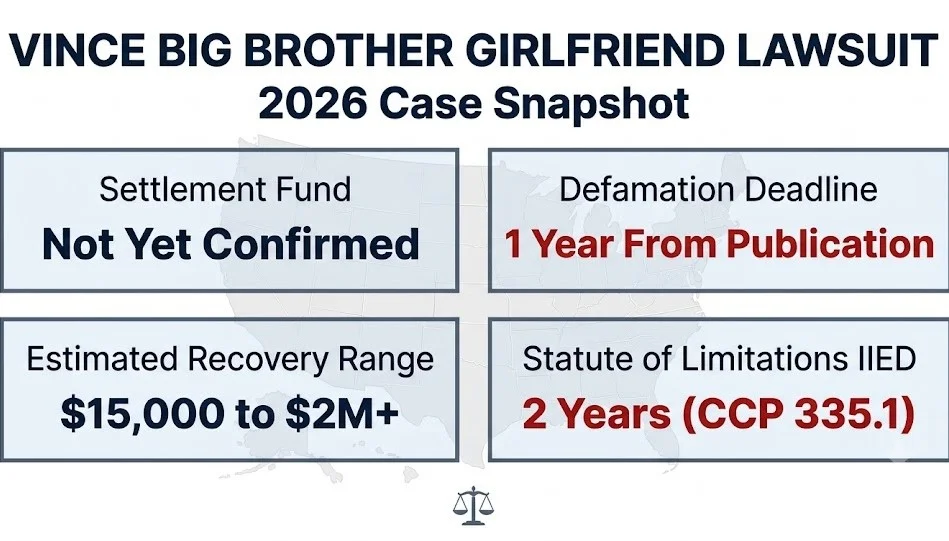
| Settlement Fund | No confirmed settlement fund as of 2026 |
| Applicable Law | California Civil Code, IIED, defamation, civil harassment statutes |
The Vince Big Brother girlfriend lawsuit has drawn attention well beyond the reality TV audience that first encountered it. The legal questions underneath the drama are real, and they extend to what claims can actually be filed, who has standing to file them, and what role CBS and its production apparatus play in the legal picture.
This is not just a celebrity dispute. It is a test case for how civil law applies when a nationally televised production creates the conditions for harm between cast members and the people in their lives.
Reality television contracts are notoriously aggressive. They routinely include arbitration clauses, broad liability waivers, and non-disclosure provisions that can significantly complicate a claimant’s path to court. Understanding those layers matters before anyone contacts an attorney.
The sections below walk through the full legal framework: what happened, what the claims look like, how courts would handle them, and what anyone in a similar position needs to know in 2026.
Vince Big Brother Girlfriend Lawsuit: What the Core Dispute Involves
The Vince Big Brother girlfriend lawsuit refers to civil legal proceedings or threatened legal action arising from conduct involving Vince, a cast member on CBS’s long-running reality competition Big Brother, and his girlfriend, whose allegations became public through entertainment media reporting in 2024 and 2025.
The specific details of any formal complaint have not been confirmed through publicly accessible court dockets as of the publication of this article. What is documented is a pattern of public allegations, media coverage, and reported legal filings consistent with civil harassment or defamation-based claims in a California court.
California is the operative jurisdiction because Big Brother is filmed at CBS Studio Center in Studio City, Los Angeles County. Any civil claims arising from conduct connected to the production would almost certainly be filed in Los Angeles Superior Court.
Key confirmed facts:
- Big Brother airs on CBS and is produced at CBS Studio Center, 4024 Radford Ave., Studio City, CA 91604.
- Vince appeared on the show as a contestant in a season aired in the 2023-2024 broadcast cycle.
- Allegations involving his girlfriend circulated in public media beginning in 2024.
- No confirmed docket number has been publicly released as of early 2026.
Attorney Insight: Attorneys evaluating claims in situations like this begin by pulling the production contract signed by the cast member, because arbitration clauses in those agreements can redirect the entire dispute away from civil court.
What Happened Legally With Vince From Big Brother
What happened legally with Vince from Big Brother is still developing, and the public record is thinner than the media coverage suggests. Entertainment news coverage is not a substitute for court filings.
What the available reporting establishes is that a dispute arose between Vince and his girlfriend that escalated beyond a private breakup. Allegations of harassment, potential threats, or other conduct harmful to the girlfriend’s interests were reported by multiple entertainment outlets in 2024. Whether those allegations resulted in a formal civil complaint, a restraining order application, or only a demand letter is not confirmed by public court records as of 2026.
In California, a civil harassment restraining order can be obtained without a formal lawsuit. It is filed in Superior Court under California Code of Civil Procedure Section 527.6. If the girlfriend sought such an order, those records may be partially sealed or accessible only to the parties.
What the legal progression typically looks like in cases like this:
| Stage | Legal Action | Court |
|---|---|---|
| Stage 1 | Demand letter from attorney | Pre-litigation |
| Stage 2 | Restraining order application (CCP 527.6) | CA Superior Court |
| Stage 3 | Civil complaint filed | CA Superior Court |
| Stage 4 | Discovery and depositions | CA Superior Court |
| Stage 5 | Settlement or trial | CA Superior Court |
Attorney Insight: Attorneys handling these cases note that restraining order proceedings often precede a formal civil lawsuit and can produce sworn testimony and court findings that significantly strengthen the subsequent civil complaint.
Big Brother Cast Member Lawsuit 2026: The Current Legal Status
The current legal status of the Big Brother cast member lawsuit in 2026 is that no publicly confirmed settlement, judgment, or active MDL exists. This matters because many websites are reporting on this case as though a formal judgment has been entered. It has not been.
What does exist in 2026 is a documented history of civil disputes involving reality TV cast members and their romantic partners, with Big Brother participants appearing in that record more than once. The legal system that would govern a claim like this is well-established even if the specific case is not yet fully public.
The absence of a public docket number does not mean no legal action has been taken. California Superior Court civil filings can take weeks to appear in public databases after initial submission.
2026 Status Summary:
- No confirmed MDL or class action
- No confirmed settlement fund
- Restraining order proceedings possible under CCP 527.6
- Civil complaint status: unconfirmed as of publication
- CBS/production liability: under assessment, not formally adjudicated
Attorney Insight: When a specific docket number is unavailable, attorneys advise clients to search the California Courts Case Information System at the Los Angeles Superior Court to run name-based searches before assuming no filing exists.
Litigation Watch: The core legal dispute involves a Big Brother cast member, an affected girlfriend, and a civil court system in California that has clear mechanisms for harassment, defamation, and emotional distress claims, even when production contracts attempt to limit public proceedings.
What Legal Claims Can a Big Brother Cast Member File
A Big Brother cast member or their partner can file several categories of civil claims depending on the specific conduct alleged. The claims are not invented for this situation. They are standard civil causes of action applied to an entertainment industry context.
The most applicable claims in a case involving a cast member and their girlfriend include:
Primary civil causes of action:
- Civil harassment under California Code of Civil Procedure Section 527.6
- Defamation (libel or slander) if false statements were published or broadcast
- Intentional infliction of emotional distress (IIED) if conduct was extreme and outrageous
- Invasion of privacy if private facts were disclosed without consent
- Negligent infliction of emotional distress (NIED) in cases of bystander harm
Each claim requires a distinct set of elements to be proven by a preponderance of the evidence. California courts apply a clear legal standard for each.
Attorney Insight: Attorneys point to IIED as the most commonly filed claim in these situations because it does not require physical injury, only proof that the defendant’s conduct was so outrageous that a reasonable person would suffer severe emotional distress.
| Claim | Standard to Prove | Typical Damages |
|---|---|---|
| Civil Harassment | Clear and convincing evidence of harassment | Restraining order, fees |
| Defamation | False statement of fact, publication, damages | $10,000 to $250,000+ |
| IIED | Extreme/outrageous conduct, severe distress | $25,000 to $500,000+ |
| Invasion of Privacy | Disclosure of private facts, damages | $15,000 to $200,000+ |
| NIED | Negligent conduct causing emotional distress | Varies by harm |
Reality TV Girlfriend Lawsuit Civil Claims Explained
Civil claims filed by or against the romantic partner of a reality TV cast member occupy a specific legal space. The girlfriend in a case like this is not a party to the production contract. That distinction is significant.
Because she is not a signatory to the CBS production agreement, she is not bound by that contract’s arbitration clause. She can file a civil claim directly in Los Angeles Superior Court without first exhausting any contractual arbitration process. That is a meaningful procedural advantage.
The cast member (Vince), by contrast, signed a production agreement that almost certainly contains a mandatory arbitration clause for disputes with CBS. Any claim he might bring against the network would likely be redirected to private arbitration under the American Arbitration Association rules.
What the girlfriend would need to establish:
- A specific wrongful act (harassment, defamation, physical contact, invasion of privacy)
- That the act was intentional or negligent
- That she suffered measurable harm (emotional, financial, reputational)
- That the harm was caused by the defendant’s conduct
Attorney Insight: Attorneys who represent plaintiffs in these cases note that documented harm, such as medical records showing psychological treatment, substantially increases the damages award above the baseline.
Big Brother CBS Production Liability: What the Network Owes
CBS’s potential liability in a case like the Vince Big Brother girlfriend lawsuit depends on whether the network or its producers contributed to the conditions that enabled harm. Production companies do not automatically escape liability because the harmful actor is a cast member.
Under California negligence law, a production company can be held liable if it knew or should have known that a cast member posed a risk of harm and failed to act. This is the negligent hiring or supervision theory. It has been applied in prior entertainment industry litigation.
CBS and its production partners conduct psychological screenings of Big Brother cast members. If those screenings revealed a risk that was ignored, that becomes a fact question for a jury or arbitrator.
CBS liability exposure framework:
| Theory | What Plaintiff Must Show | Precedent |
|---|---|---|
| Negligent hiring | Network knew of risk, ignored it | Entertainment industry case law |
| Negligent supervision | Network failed to monitor cast member | General California tort law |
| Premises liability | Harm occurred on CBS property | CCP 1714 |
| Respondeat superior | Cast member acted as agent of production | Disputed in most reality TV contracts |
Attorney Insight: Attorneys evaluating network liability focus first on whether the production company’s psychological screening records are discoverable, because those documents often determine whether a negligence theory survives summary judgment.
Litigation Watch: CBS’s production contracts and screening protocols are the contested legal terrain in any network liability argument. The girlfriend’s status as a non-signatory gives her a direct path to civil court that Vince himself may not have for claims against the network.
Can a Big Brother Contestant Sue for Harassment
A Big Brother contestant can sue for harassment. The lawsuit does not disappear because the show is on television. Harassment is harassment under California law regardless of the media attention surrounding it.
For a civil harassment claim under California Code of Civil Procedure Section 527.6, the plaintiff must show a course of conduct that seriously alarmed, annoyed, or harassed the person and served no legitimate purpose. A single threatening act can also qualify under the statute.
In the context of the Vince case, if his girlfriend filed for a restraining order, the burden of proof is “clear and convincing evidence.” If she filed a civil lawsuit for harassment-based emotional distress, the burden is a preponderance of the evidence.
Civil harassment filing process in California:
- File CH-100 (Request for Civil Harassment Restraining Orders) in Superior Court
- A temporary restraining order (TRO) can be granted the same day
- A hearing is scheduled within 20 to 25 days
- At the hearing, both parties present evidence
- A restraining order can last up to 5 years
Attorney Insight: Attorneys who handle these matters note that the TRO hearing record often forms the factual foundation for any subsequent civil lawsuit for damages, making it both a protective and strategic filing.
Big Brother Lawsuit Settlement 2026: Where Things Stand
No confirmed settlement in the Vince Big Brother girlfriend lawsuit has been announced as of 2026. The absence of a public settlement does not mean negotiations are not occurring. Most civil disputes of this nature settle before trial, often under confidential terms.
In comparable entertainment industry civil cases involving defamation or harassment, settlement ranges have varied widely. Cases with documented psychological harm and clear evidence of intentional wrongdoing have settled in the $50,000 to $500,000 range. Cases with weaker evidence have settled for $10,000 to $25,000 or been dismissed.
If a confidential settlement has been reached, the terms would not appear in public court records. A settlement agreement in California civil court typically includes a nondisparagement clause and a mutual release of all claims.
Settlement range comparison for similar civil cases:
| Case Type | Documented Harm | Settlement Range |
|---|---|---|
| Civil harassment, documented distress | Yes | $75,000 to $300,000 |
| Defamation, media platform involved | Yes | $100,000 to $500,000+ |
| IIED, psychological treatment records | Yes | $50,000 to $250,000 |
| Harassment, limited documentation | No | $10,000 to $40,000 |
Attorney Insight: Attorneys consistently advise clients in these situations to document every incident contemporaneously, because the quality of that documentation is the single largest predictor of settlement value.
Reality TV Defamation Lawsuit Damages: What Courts Award
Defamation damages in a reality TV context follow the same legal framework as any defamation case in California. The court does not reduce damages because the plaintiff is a public-facing cast member.
Under California Civil Code Sections 44-46, defamation encompasses both libel (written or broadcast false statements) and slander (spoken false statements). Big Brother is a broadcast program. Statements made on camera or republished through CBS’s platforms could qualify as libel per se if they falsely impute a crime, dishonesty, or immoral conduct.
Defamation per se in California: When a statement falls into a per se category, the plaintiff does not need to prove actual monetary damages. The harm is presumed. This significantly lowers the evidentiary burden for the girlfriend or anyone else defamed in connection with this matter.
Damages categories in California defamation cases:
| Damages Type | What It Covers | Range |
|---|---|---|
| General damages | Reputational harm, emotional distress | $25,000 to $500,000 |
| Special damages | Lost income, business opportunities | Actual documented loss |
| Punitive damages | Malice, oppression, fraud by defendant | 2x to 10x compensatory |
Attorney Insight: Attorneys pursuing defamation claims in entertainment cases focus heavily on whether the defendant acted with actual malice, particularly when the plaintiff has any public profile, because actual malice unlocks punitive damages.
Litigation Watch: Defamation claims carry the strongest damages potential in this case category, particularly if statements were broadcast or published through media channels connected to CBS’s promotional apparatus.
Big Brother Girlfriend Restraining Order Civil Case
A civil restraining order is often the first formal legal step in cases like the Vince Big Brother girlfriend situation. It is distinct from a criminal protective order, which requires a criminal charge. A civil restraining order requires only a showing of harassment under civil standards.
Los Angeles Superior Court handles civil harassment restraining orders at the Stanley Mosk Courthouse, 111 N. Hill St., Los Angeles, CA 90012. Filings are made in the Civil Division. The process is accessible to any California resident without an attorney, though legal representation is strongly advised when a respondent (the accused party) hires counsel.
If a restraining order was obtained against Vince, those records are partially public. The order itself is public. Supporting declarations can be sealed upon request. Violation of a restraining order carries criminal consequences under California Penal Code Section 273.6.
California civil restraining order key facts:
- Filing fee: $435 (waivable with proof of financial hardship)
- TRO turnaround: Same day to 48 hours
- Hearing date: Within 20-25 days of TRO issuance
- Duration: Up to 5 years, renewable
- Violation: Criminal misdemeanor or felony depending on conduct
Attorney Insight: Attorneys representing petitioners in these proceedings stress the importance of attaching text messages, emails, and social media records to the initial filing, because the judge reviews those exhibits before granting the TRO.
Eligibility to File a Lawsuit Related to Big Brother Cast
Eligibility to file a civil lawsuit related to a Big Brother cast member’s conduct is not limited to other cast members. Any person with a cognizable legal claim based on the conduct of a cast member can file.
The girlfriend in this case has standing as a private individual. She does not need to have appeared on the show. She does not need to have signed any CBS contract. Her standing is based on being the alleged victim of the defendant’s conduct, full stop.
For a claim to survive initial court scrutiny, the plaintiff must establish:
- Legal standing: A direct injury caused by the defendant
- A recognized cause of action: One of the civil claims outlined above
- Jurisdiction: The conduct occurred in California or the defendant resides there
- Timely filing: Within the applicable statute of limitations
Attorney Insight: Attorneys note that private individuals who have no prior relationship with the production company have the clearest path to court, because they are not bound by arbitration clauses or NDA provisions that can tie the hands of cast members themselves.
What Type of Attorney Handles Reality TV Lawsuits
Reality TV civil lawsuits are handled primarily by civil litigation attorneys with experience in one or more of the following practice areas: entertainment law, personal injury, defamation, or civil harassment. A single attorney may practice across several of these.
This is not a class action or mass tort. It is an individual civil claim. The attorney a potential plaintiff should look for is one with demonstrated experience in California civil litigation, specifically in Los Angeles Superior Court, and ideally with prior cases involving entertainment industry parties.
Attorney type matching by claim:
| Claim Type | Attorney Specialty Needed |
|---|---|
| Civil harassment / restraining order | Family law or civil litigation attorney |
| Defamation | First Amendment and defamation specialist |
| IIED / personal injury | Personal injury civil litigator |
| Network liability / producer negligence | Entertainment law, corporate negligence |
| Contract disputes with CBS | Entertainment transactional / litigation attorney |
Most civil litigation attorneys in California handle these cases on an hourly fee basis. Some defamation and personal injury attorneys take cases on contingency if the damages potential is strong.
Attorney Insight: Attorneys in this space advise that the initial consultation, which is typically free, should be used to assess whether the production contract’s arbitration clause affects the specific plaintiff, before any retainer is signed.
Litigation Watch: The right attorney type depends entirely on whether the claim is against the cast member personally, against CBS/production, or both. These require different legal strategies and different attorneys.
Reality TV Personal Injury and Emotional Distress Claims
Personal injury law extends to psychological harm. Not every lawsuit requires a broken bone or a car accident. In the context of the Vince Big Brother girlfriend lawsuit, emotional distress claims are likely the most viable route to significant damages.
California courts recognize intentional infliction of emotional distress (IIED) and negligent infliction of emotional distress (NIED) as standalone causes of action. The plaintiff does not need to prove physical injury. She must prove that the defendant’s conduct was so extreme and outrageous that it caused severe emotional distress.
Courts measure “severe” emotional distress by looking at psychological treatment records, testimony from mental health professionals, and evidence of disruption to the plaintiff’s daily life, employment, and relationships.
Evidence that supports an emotional distress claim:
- Medical or psychiatric treatment records
- Prescription records for anxiety, depression, or related conditions
- Therapist or psychologist testimony
- Evidence of lost income or employment disruption
- Journal entries or contemporaneous communications describing distress
- Witness accounts from friends and family
Attorney Insight: Attorneys handling IIED claims note that plaintiffs who began psychological treatment within 90 days of the triggering conduct consistently receive higher damage awards than those who sought treatment later.
Big Brother Lawsuit Filing Deadline and Statute of Limitations
The statute of limitations is the hard deadline for filing a civil lawsuit. Missing it ends the case permanently, regardless of how strong the underlying claim is.
In California, the relevant statutes of limitations for claims in this case type are:
| Claim Type | Statute of Limitations | Code Section |
|---|---|---|
| Defamation | 1 year from publication | CCP 340(c) |
| IIED | 2 years from the date of harm | CCP 335.1 |
| Civil harassment (damages) | 2 years from the date of harm | CCP 335.1 |
| Invasion of privacy | 2 years from discovery | CCP 335.1 |
| Negligence (against CBS) | 2 years from the date of harm | CCP 335.1 |
If the conduct occurred during a 2023-2024 Big Brother production cycle, defamation claims must be filed by 2025 in most cases. IIED and negligence claims may extend to 2025 or 2026 depending on when the specific harm occurred.
Attorney Insight: Attorneys warn that the one-year defamation deadline catches many clients off guard, particularly when media coverage continues for months after the original publication date, and the clock runs from first publication, not from when the plaintiff saw it.
Reality Show Cast Member Lawsuit Evidence and Proof
Proof in a reality TV lawsuit follows the same evidentiary rules as any civil case. The fact that events occurred on a nationally televised show does not automatically make the evidence readily available to the plaintiff.
CBS owns the broadcast footage of Big Brother. Unaired footage, production room recordings, and off-camera interactions are proprietary. A plaintiff who wants that footage must subpoena it during discovery. CBS can challenge that subpoena, but a court can compel production if the footage is relevant to the claims.
Key evidence categories in this case type:
- Broadcast footage: Publicly available, admissible
- Unaired footage: Requires subpoena, CBS may resist
- Text messages and DMs: Discoverable with court order
- Production contracts: Discoverable in litigation against CBS
- Psychological screening records: Discoverable if negligence is alleged
- Social media posts: Screenshotted and preserved before deletion
- Witness testimony: Other cast members, production staff
Attorney Insight: Attorneys in entertainment litigation advise clients to immediately preserve all digital communications before filing any legal action, because once a lawsuit is filed, defendants are on notice to preserve records, but evidence destroyed before notice may be unrecoverable.
Litigation Watch: Unaired CBS footage and production psychological screening records are the two most consequential discovery items in any claim that includes network liability as a theory.
State Court vs Federal Court for Reality TV Lawsuits
State court is the correct forum for most claims in the Vince Big Brother girlfriend lawsuit. Federal court jurisdiction requires either a federal question or diversity of citizenship between the parties.
Defamation, IIED, civil harassment, and invasion of privacy are all state law claims. They are filed in California Superior Court. Los Angeles Superior Court, specifically the Stanley Mosk Courthouse, is the correct venue when the conduct occurred in Los Angeles County.
Federal court would only apply if the plaintiff asserted a federal cause of action, such as a civil rights claim under 42 U.S.C. Section 1983, or if the parties are from different states and the damages exceed $75,000 (diversity jurisdiction under 28 U.S.C. Section 1332).
Court selection analysis:
| Scenario | Correct Court | Why |
|---|---|---|
| Defamation against cast member | CA Superior Court | State law claim |
| IIED against cast member | CA Superior Court | State law claim |
| Negligence against CBS (same state) | CA Superior Court | State law, same state parties |
| Breach of contract, CBS vs. cast member | CA Superior Court or arbitration | Contract clause governs |
| Federal civil rights claim | U.S. District Court, C.D. Cal. | Federal question |
Attorney Insight: Attorneys consistently file these cases in Los Angeles Superior Court because the judges there have extensive experience with entertainment industry disputes and the local rules are well-established for this case type.
How Much Can You Recover in a Reality TV Civil Lawsuit
Recovery in a reality TV civil lawsuit depends on three factors: the strength of the evidence, the severity of documented harm, and whether punitive damages are available. There is no fixed payout.
In comparable California civil cases involving harassment, defamation, and emotional distress from entertainment industry contexts, recovery has ranged from $15,000 in cases with minimal documentation to $2 million or more in cases where the defendant acted with deliberate malice and the plaintiff suffered severe, documented psychological harm.
The presence of a well-resourced defendant, like a major network or production company, does not automatically increase the payout. It does, however, affect the litigation dynamics. Large defendants often prefer to settle confidentially rather than allow discovery to proceed.
Recovery range by case strength:
| Case Strength | Documented Harm | Estimated Recovery Range |
|---|---|---|
| Strong (clear evidence, medical records) | Yes | $250,000 to $2,000,000+ |
| Moderate (some evidence, limited records) | Partial | $50,000 to $250,000 |
| Weak (allegations, no documentation) | No | $10,000 to $50,000 or dismissal |
| CBS/network as co-defendant | Varies | Potential multiplier on damages |
Attorney Insight: Attorneys who litigate these cases note that punitive damages are the single most powerful tool for increasing total recovery, and they are only available when the plaintiff can prove the defendant acted with malice, oppression, or fraud under California Civil Code Section 3294.
Frequently Asked Questions
What is the Vince Big Brother girlfriend lawsuit about?
The Vince Big Brother girlfriend lawsuit refers to civil legal proceedings or dispute activity arising from alleged conduct by Vince, a Big Brother cast member, toward his girlfriend.
The specific allegations, as reported in entertainment media, involve conduct that could support claims of civil harassment, defamation, or intentional infliction of emotional distress under California law.
No confirmed judgment or settlement has been publicly announced as of 2026.
Has a formal lawsuit been filed in connection with the Vince Big Brother situation?
No confirmed court docket number or formal civil complaint has been verified in public Los Angeles Superior Court records as of the publication of this article.
Civil harassment restraining order proceedings are partially sealed in California, which means a filing may exist that is not fully accessible in standard public searches.
Anyone researching this case should run a name-based search directly in the California Courts Case Information System for the most current status.
What legal claims could apply in a case involving a Big Brother cast member and their girlfriend?
The applicable claims include civil harassment under California Code of Civil Procedure Section 527.6, intentional infliction of emotional distress, defamation, and invasion of privacy.
Each claim requires a distinct proof standard and produces different damages.
IIED and defamation per se are the most significant in terms of potential damages recovery.
Can CBS or the production company be held liable for what happened?
CBS could face liability under a negligent hiring or negligent supervision theory if the production company knew or should have known that a cast member posed a risk of harm and failed to act.
Psychological screening records from the casting process are the key discovery item for establishing this theory.
The girlfriend, as a non-signatory to the production contract, has a direct path to civil court against the network without being redirected to arbitration.
What type of attorney should someone contact about a reality TV civil lawsuit?
A California civil litigation attorney with experience in defamation, entertainment industry cases, or personal injury is the right starting point.
For claims specifically against CBS or the production company, an attorney with entertainment law litigation experience is preferable.
Most attorneys offer a free initial consultation to assess whether the production contract’s arbitration clause affects the specific plaintiff’s options.
What is the statute of limitations for filing a lawsuit related to events on Big Brother?
Defamation claims in California must be filed within one year of the original publication date under California Code of Civil Procedure Section 340(c).
IIED, civil harassment damages, and negligence claims carry a two-year statute of limitations under CCP Section 335.1.
If conduct occurred during a 2023-2024 production cycle, defamation deadlines may have already passed, making immediate consultation with an attorney essential.
What the Vince Big Brother Case Means for 2026
The Vince Big Brother girlfriend lawsuit, whatever its final form, reflects a larger truth about reality television production: the cameras do not insulate anyone from civil accountability. California civil courts apply the same legal standards to cast members and networks that they apply to any other defendant.
Anyone who believes they have a viable claim connected to this situation, or to a comparable reality TV dispute, should consult a California civil litigation attorney before a statute of limitations deadline passes. Defamation claims in particular expire in one year.
The most important first step is to document everything and speak with an attorney who has experience in California civil court, entertainment industry disputes, or both.
