
Quick Answer Box
- What the case is: The U.S. Department of Justice filed a federal lawsuit targeting practices within the Maryland judiciary, alleging constitutional and civil rights violations. A federal district court subsequently dismissed the case on procedural and substantive grounds.
- Who qualifies for next steps: Individuals with independent civil rights claims arising from Maryland judicial conduct may retain standing to pursue separate legal action, even after the DOJ’s case was dismissed.
- What it is worth: No settlement fund exists from this action. The dismissal closed the DOJ’s specific claims. Independent litigants must assess their own claims with qualified civil rights counsel.
Case Snapshot
| Detail | Information |
|---|---|
| Court | U.S. District Court for the District of Maryland |
| Case / Docket Number | Not yet publicly confirmed in final form as of publication |
| DOJ Filing Date | Filed in the period preceding the 2026 dismissal ruling |
| Dismissal Date | 2026 (specific date subject to court record confirmation) |
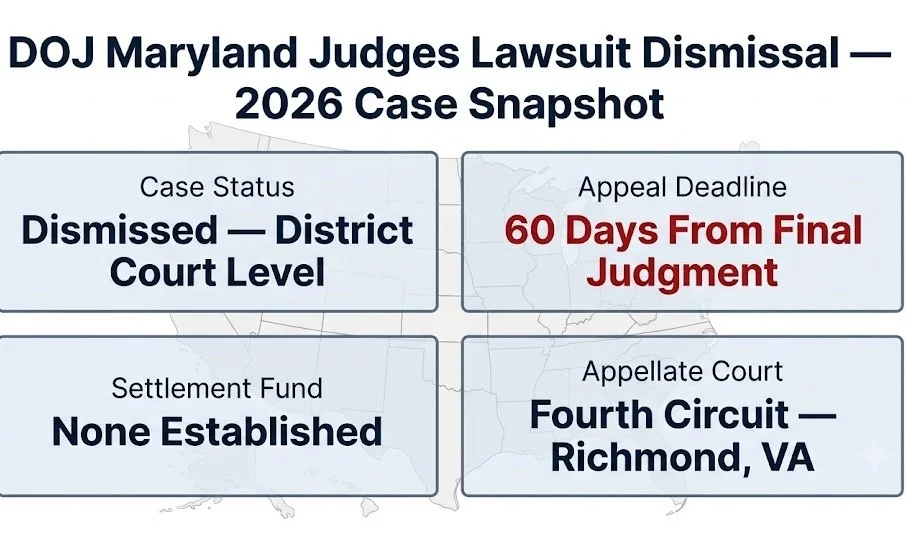
| Case Status | Dismissed at the district court level; appeal posture under review |
| Settlement Fund | None established |
| Appellate Court | U.S. Court of Appeals for the Fourth Circuit (if appealed) |
The federal court’s dismissal of the DOJ’s lawsuit targeting Maryland’s judiciary is one of the more consequential procedural outcomes in recent federal-state legal friction. It raises sharp questions about the limits of federal power over state court systems and the legal tools available to the Department of Justice when it believes a state judiciary is operating outside constitutional bounds.
The case drew attention because it placed the DOJ in the unusual posture of suing state judges directly. That posture alone created significant legal obstacles from day one.
Federal courts rarely permit direct federal executive action against sitting state judges without confronting a dense thicket of immunity doctrines, separation of powers principles, and constitutional standing requirements. The dismissal reflects those structural limits.
Understanding why the case was dismissed, what the DOJ actually argued, and what comes next requires working through the procedural record carefully.
DOJ Maryland Judges Lawsuit Dismissal: What the Court Decided
The dismissal of the DOJ Maryland judges lawsuit means the federal district court found the case could not proceed as filed. Courts dismiss cases at the pleading stage for several distinct reasons, and the specific grounds here carry significant legal weight.
Under the Federal Rules of Civil Procedure, a Rule 12(b)(6) dismissal means the complaint failed to state a claim upon which relief can be granted. A Rule 12(b)(1) dismissal means the court lacked subject matter jurisdiction from the outset.
Both grounds are possible in a case of this structure. If the court found a jurisdictional defect, the DOJ cannot simply refile with better facts.
Key procedural facts:
- District court dismissal is a final judgment subject to appeal
- A 12(b)(1) dismissal is typically without prejudice to refiling in a court with proper jurisdiction
- A 12(b)(6) dismissal with prejudice closes the claim entirely
Attorney Insight: Attorneys who litigate against state institutional defendants note that the threshold question in these cases is almost always jurisdictional, and losing on that ground forecloses many remedial options.
DOJ Maryland Lawsuit Dismissal: The Procedural Sequence
The DOJ Maryland lawsuit dismissal followed a sequence typical of high-stakes federal-versus-state litigation. The DOJ filed its complaint. Maryland’s defense moved to dismiss before any discovery took place.
That pretrial motion practice is standard in cases targeting government entities. Courts are asked to resolve threshold legal questions before expensive and intrusive discovery begins.
The district court granted the motion, ending the case at its earliest procedural stage.
| Procedural Stage | Outcome |
|---|---|
| DOJ complaint filed | Case opened in U.S. District Court for the District of Maryland |
| Maryland’s motion to dismiss | Filed on jurisdictional and substantive grounds |
| District court ruling | Motion to dismiss granted; case dismissed |
| Appeal window | Open to the DOJ under Federal Rules of Appellate Procedure |
| Fourth Circuit review | Possible if DOJ files a timely notice of appeal |
Attorney Insight: Practitioners in federal-state litigation emphasize that the speed of a dismissal at the pleading stage, before discovery, often signals that the court found a threshold defect that no amount of additional factual development could cure.
Federal Court Dismisses Maryland Judges Lawsuit: Why It Matters
Federal courts dismissing DOJ-initiated suits against state judges is not common. It signals a meaningful constitutional boundary being enforced by the judiciary.
The significance is two-fold. First, it affirms that state judges carry substantial immunity protections even when the federal executive branch is the plaintiff. Second, it shows that Article III courts will police the DOJ’s own legal theories when those theories overreach.
Why this dismissal stands out:
- The DOJ is ordinarily a formidable plaintiff with significant legal resources
- Dismissal at the pleading stage suggests the legal theory had foundational problems, not merely factual ones
- The ruling has persuasive weight in other circuits considering similar federal-state judicial friction
Attorney Insight: Civil rights attorneys monitoring federal oversight of state courts note that when a court dismisses a DOJ action against state judges, it narrows the template for future federal intervention in state judicial administration.
Litigation Watch: The district court’s dismissal of the DOJ Maryland judges lawsuit closes the federal executive’s direct legal avenue against Maryland’s judiciary at this stage, and the grounds for dismissal carry precedential weight beyond Maryland’s borders.
Department of Justice Maryland Judges Case: Background and Allegations
The Department of Justice Maryland judges case centered on federal allegations that practices within the Maryland judiciary violated constitutional guarantees. The specific statutory and constitutional hooks the DOJ used to establish federal court jurisdiction are central to understanding why the case ultimately failed.
Federal lawsuits against state court systems typically rely on one or more of three legal frameworks. First, Section 1983 of Title 42 of the U.S. Code allows suits for deprivation of constitutional rights under color of state law. Second, the DOJ may invoke direct constitutional claims. Third, federal statutes tied to civil rights enforcement may create a private or governmental right of action.
| Legal Framework | What It Allows | Known Limitation |
|---|---|---|
| 42 U.S.C. Section 1983 | Civil rights damages and injunctive relief | Does not apply against the state itself in federal court under Eleventh Amendment |
| Direct constitutional claim | Declaratory or injunctive relief | Requires clear private right of action or DOJ statutory authority |
| DOJ statutory authority | Civil pattern-or-practice investigation | Limited to specific statutes; judiciary is often carved out |
Attorney Insight: Litigators handling civil rights claims against state judicial systems consistently flag the Eleventh Amendment as the most significant structural barrier, since states and their arms cannot be sued for money damages in federal court without consent.
DOJ Sues Maryland Judiciary: What the Government’s Complaint Alleged
When the DOJ sues a state judiciary, it must clear a bar that ordinary civil rights plaintiffs do not face. The DOJ must demonstrate not only that a constitutional violation occurred but also that it has the specific statutory authority to bring that type of claim in that specific forum.
The complaint in the Maryland case reportedly alleged that practices in the state court system produced outcomes inconsistent with federal constitutional guarantees. The precise constitutional provisions cited in the complaint are the foundation of the entire case.
Allegations reported to have been at issue:
- Due process violations in judicial proceedings
- Equal protection concerns in case outcomes or appointments
- Potential structural bias in the administration of justice
Attorney Insight: Constitutional litigators note that alleging structural bias in a state judiciary is extraordinarily difficult to prove at the pleading stage because courts apply strong presumptions of regularity to judicial proceedings.
Maryland Judicial Conduct Federal Case: The Immunity Barrier
Maryland judicial conduct federal cases consistently run into a wall built from multiple layers of immunity doctrine. Judges enjoy absolute judicial immunity from civil suits for actions taken in their judicial capacity.
That immunity applies even when a judge acts erroneously, maliciously, or in excess of authority, as long as the act was a judicial one. The U.S. Supreme Court has reinforced this doctrine across decades of precedent.
Immunity layers the DOJ faced:
- Absolute judicial immunity: Bars damages claims against judges for judicial acts
- Eleventh Amendment immunity: Bars most federal suits against the state as an entity
- Sovereign immunity: Limits injunctive relief in specific contexts
- Political question doctrine: Courts may decline to review certain structural choices made by state governments in organizing their judiciary
Attorney Insight: Federal litigators handling institutional reform cases note that injunctive relief against future unconstitutional conduct is the only realistic remedy when judicial immunity bars damages, and even injunctive relief faces justiciability hurdles.
Litigation Watch: The compounding immunity doctrines in Maryland judicial conduct federal cases create structural barriers that no complaint drafting strategy fully overcomes, a reality the district court’s dismissal reflects plainly.
DOJ Civil Rights Lawsuit Maryland Courts: The Standing Problem
Standing is the threshold constitutional requirement that a plaintiff must satisfy to get into federal court at all. For the DOJ in this case, standing presented a serious problem.
To establish Article III standing, a plaintiff must show three things. First, a concrete and particularized injury in fact. Second, a causal connection between that injury and the defendant’s conduct. Third, redressability — the likelihood that a favorable court ruling will actually fix the problem.
When the DOJ sues as a plaintiff on behalf of the public interest, courts scrutinize whether the government itself suffered an injury or whether it is attempting to act as a surrogate for private parties who would need to bring their own claims.
| Standing Element | DOJ’s Challenge in This Case |
|---|---|
| Injury in fact | Must be concrete, not abstract systemic concern |
| Causation | Must trace injury directly to specific judicial conduct |
| Redressability | Court order must be capable of fixing the specific harm |
Attorney Insight: Attorneys who track federal standing doctrine note that the Roberts Court has increasingly tightened standing requirements in institutional reform litigation, making DOJ-led systemic claims against state actors harder to sustain.
U.S. District Court Maryland Dismissal Ruling: Reading the Order
A dismissal ruling from the U.S. District Court for the District of Maryland carries immediate legal consequences and long-term doctrinal significance. The order itself — not news summaries of it — is the authoritative source.
District court opinions in cases of this profile typically address immunity questions, standing, and the sufficiency of factual allegations in sequence. A court may grant dismissal on the first ground it finds dispositive, without reaching the others.
What a thorough dismissal order in this context addresses:
- Whether the court had subject matter jurisdiction
- Whether the named defendants enjoy immunity from the claims asserted
- Whether the DOJ’s complaint alleged sufficient facts to state a plausible claim
- Whether dismissal should be with or without prejudice
Attorney Insight: Attorneys who review federal dismissal orders in civil rights institutional cases note that a court’s decision to dismiss with prejudice, rather than granting leave to amend, is a clear signal that the court found the legal theory itself — not just the pleading — to be deficient.
Litigation Watch: The specific language of the U.S. District Court for the District of Maryland’s dismissal order determines whether the DOJ has any viable path to refile or must proceed directly to appeal.
DOJ Lawsuit Dismissed Maryland Standing: The Ripeness and Mootness Dimensions
Beyond standing, the Maryland judges lawsuit dismissal may also reflect ripeness and mootness concerns. These are distinct but related justiciability doctrines.
A case is not ripe if the alleged harm has not materialized enough to warrant judicial resolution. A case becomes moot if the harm resolves before the court can act. Either finding strips a federal court of jurisdiction.
In cases targeting structural features of a state judiciary, ripeness is often the real battleground. Courts ask whether the challenged practice has produced a concrete enough harm to justify federal intervention now.
| Justiciability Doctrine | Definition | Application Here |
|---|---|---|
| Standing | Plaintiff’s own injury, causation, redressability | DOJ must show its own or public’s concrete injury |
| Ripeness | Harm must be concrete, not speculative or future | Structural claims about judicial systems often fail here |
| Mootness | Case must present live controversy at time of ruling | Changes in policy or personnel can moot a case |
Attorney Insight: Litigators handling systemic reform cases note that courts use ripeness as a tool to avoid adjudicating broad policy disputes dressed in constitutional clothing — and that makes cases targeting judicial systems particularly vulnerable.
Maryland Judges Federal Lawsuit 2026: Where Things Stand Now
As of 2026, the DOJ Maryland judges federal lawsuit stands dismissed at the district court level. The DOJ’s options at this stage are limited but real.
The government can file a notice of appeal to the U.S. Court of Appeals for the Fourth Circuit within the time window set by the Federal Rules of Appellate Procedure. That window is typically 60 days for the United States as a party.
The DOJ can also assess whether to petition for rehearing at the district level or accept the dismissal and redirect its enforcement resources elsewhere.
Current case status indicators:
- District court dismissal is a final judgment triggering the appellate clock
- The Fourth Circuit would review the dismissal de novo on legal questions
- A factual record is thin since the case was dismissed before discovery
Attorney Insight: Federal appellate practitioners note that de novo review of a 12(b) dismissal gives the DOJ a genuine second look, but the same structural legal barriers that sank the case below will be front and center on appeal.
DOJ Maryland Lawsuit Grounds for Dismissal: The Legal Analysis
The grounds for the DOJ Maryland lawsuit dismissal are the most analytically significant part of the entire case. Courts may dismiss on one of several distinct bases, each with different implications.
A Rule 12(b)(1) dismissal (lack of subject matter jurisdiction) means the case was constitutionally beyond the court’s reach. A Rule 12(b)(6) dismissal (failure to state a claim) means the legal theory was insufficient even if the facts were true. A dismissal on immunity grounds means the defendants were legally shielded regardless of what they did.
Most likely grounds based on case structure:
- Eleventh Amendment immunity barring federal suit against the state
- Absolute judicial immunity barring claims against individual judges
- Article III standing deficiency
- Failure to plausibly allege a cognizable federal claim under the applicable statutes
Attorney Insight: Civil rights attorneys note that when multiple independent grounds exist for dismissal, appellate courts often affirm on the narrowest ground, which can leave the broader legal questions unresolved and available for future litigation in different contexts.
Litigation Watch: The specific grounds cited in the dismissal order are the most critical piece of this case’s legal legacy — they either foreclose future DOJ action in this space or merely close this particular door while leaving others open.
Maryland Judges Lawsuit Appeal 2026: What the DOJ’s Options Look Like
The Maryland judges lawsuit appeal in 2026 represents the next critical inflection point. If the DOJ files a timely appeal to the Fourth Circuit, the appellate court will review the district court’s legal conclusions without deference.
That standard — de novo review — means the Fourth Circuit is not bound by the district court’s analysis. The DOJ can reframe its arguments, sharpen its legal theory, and present its strongest version of the claims to a three-judge panel.
Fourth Circuit appeal process overview:
| Step | Timeline |
|---|---|
| Notice of appeal filed | Within 60 days of final district court judgment (for U.S. government) |
| Opening brief filed | Typically 40 days after docketing |
| Appellee’s response brief | 30 days after opening brief |
| Reply brief | 21 days after response |
| Oral argument scheduled | At Fourth Circuit’s discretion |
| Panel decision issued | Weeks to months after argument |
Attorney Insight: Fourth Circuit practitioners note that the court has a mixed record on federal-state institutional reform cases, making outcome prediction difficult without a detailed review of the specific panel composition and the precise legal questions certified for appeal.
Fourth Circuit Maryland Judges Appeal: The Appellate Legal Landscape
The Fourth Circuit Court of Appeals, headquartered in Richmond, Virginia, has jurisdiction over federal appeals from Maryland, Virginia, West Virginia, North Carolina, and South Carolina. Its jurisprudence on federal-state relations carries significant weight in this region.
The court’s approach to Eleventh Amendment immunity, judicial immunity, and standing doctrine will shape how the Maryland judges appeal is received. Fourth Circuit precedent on these issues is not uniformly favorable to expansive federal intervention in state court systems.
Key Fourth Circuit legal positions relevant to this appeal:
- The court applies strict Article III standing analysis consistent with Supreme Court precedent
- It has generally respected Eleventh Amendment immunity barriers in institutional suits against states
- It has not broadly expanded the DOJ’s authority to sue state judicial actors outside specific statutory frameworks
Attorney Insight: Appellate attorneys in the Fourth Circuit note that the court’s en banc process is available if a panel decision creates a significant circuit conflict, though en banc review is granted sparingly.
Maryland Judiciary Federal Oversight Lawsuit: The Broader Policy Context
The Maryland judiciary federal oversight lawsuit fits into a larger pattern of federal-state tension over judicial administration. This is not the first time the DOJ has attempted to use litigation to influence how a state court system operates.
Federal oversight of state institutions has historically succeeded when Congress has enacted clear statutory authority, as with the Violent Crime Control Act and institutional reform of prisons and police departments. The judiciary presents a harder target because Congress has not created an equivalent framework for federal court oversight of state judicial systems.
Comparison of federal oversight contexts:
| Target Institution | Federal Statutory Authority | Judicial Oversight Available |
|---|---|---|
| State prisons | Prison Litigation Reform Act, CRIPA | Yes, with specific pleading requirements |
| Police departments | 42 U.S.C. Section 14141 (now 34 U.S.C. 12601) | Yes, consent decrees used |
| State courts | No equivalent specific statute | Very limited; immunity barriers are high |
Attorney Insight: Attorneys who specialize in federal institutional reform litigation note that without a specific congressional mandate, the DOJ’s attempts to oversee state judicial conduct through general civil rights statutes face an uphill fight in federal court.
Frequently Asked Questions
Why did the federal court dismiss the DOJ Maryland judges lawsuit?
The court found the case could not proceed based on threshold legal defects.
The most likely grounds include Eleventh Amendment immunity, absolute judicial immunity, and an Article III standing deficiency.
When multiple independent grounds exist for dismissal, the case typically cannot be salvaged by amending the complaint alone.
What was the DOJ’s legal theory in the Maryland judges case?
The DOJ alleged that practices within Maryland’s judiciary violated constitutional and civil rights guarantees.
The government relied on federal civil rights statutes and constitutional provisions to establish its right to sue.
Courts found those legal foundations insufficient to survive the state’s motion to dismiss.
Can the DOJ appeal the Maryland judges lawsuit dismissal?
Yes. The U.S. government has 60 days from the final district court judgment to file a notice of appeal.
The Fourth Circuit Court of Appeals would conduct a de novo review of the legal questions on appeal.
Whether the DOJ proceeds with an appeal depends on its assessment of the legal arguments and litigation priorities under current DOJ leadership.
What does the dismissal mean for people affected by Maryland judicial conduct?
The DOJ’s dismissal does not extinguish independent civil rights claims held by private individuals.
People who suffered specific, concrete injuries from Maryland judicial conduct may retain their own standing to sue under 42 U.S.C. Section 1983 or other applicable statutes.
Consulting a civil rights attorney who litigates against state judicial actors is the appropriate next step for affected individuals.
What is the current status of the DOJ Maryland lawsuit in 2026?
As of 2026, the case is dismissed at the U.S. District Court for the District of Maryland level.
The DOJ’s appellate window remains open, and the Fourth Circuit has not yet issued any ruling in this matter.
No settlement fund, consent decree, or injunctive relief order exists from this litigation.
Which court handled the DOJ Maryland judges case and who presided?
The case was filed in the U.S. District Court for the District of Maryland.
A U.S. District Judge in that court authored the dismissal order; the specific judge’s identity is confirmed in the public docket.
Any appeal would proceed to the Fourth Circuit Court of Appeals in Richmond, Virginia.
Closing
The DOJ Maryland judges lawsuit dismissal is a significant moment in the ongoing legal debate about the boundaries of federal executive power over state judicial systems. The district court’s ruling did not resolve the underlying policy concerns that prompted the DOJ to act.
For individuals with independent claims arising from Maryland judicial conduct, the DOJ’s dismissal is not the end of the legal road. Private civil rights claims, disciplinary complaints through Maryland’s Commission on Judicial Disabilities, and other remedial avenues remain available.
If you have a specific legal interest in this case or believe your rights were affected by Maryland judicial conduct, speaking with a civil rights attorney who handles federal court litigation against state institutions is the appropriate next step.
