
Quick Answer
- What this is: The Trump vs. WilmerHale lawsuit is a federal constitutional challenge filed by Wilmer Cutler Pickering Hale and Dorr LLP against a March 2025 executive order signed by President Trump that revoked the firm’s attorneys’ security clearances and directed federal agencies to restrict the firm’s access to government contracts and facilities.
- Who is affected: WilmerHale as an institution, its attorneys holding security clearances, clients requiring cleared counsel for government-related matters, and by legal precedent, any law firm whose representation choices could be targeted by executive action.
- What is at stake: No monetary settlement is sought. The case is a constitutional challenge seeking injunctive relief to void the executive order as an unconstitutional act of First Amendment retaliation, Fifth Amendment due process violation, and an unlawful exercise of executive power over the independent legal profession.
Case Snapshot
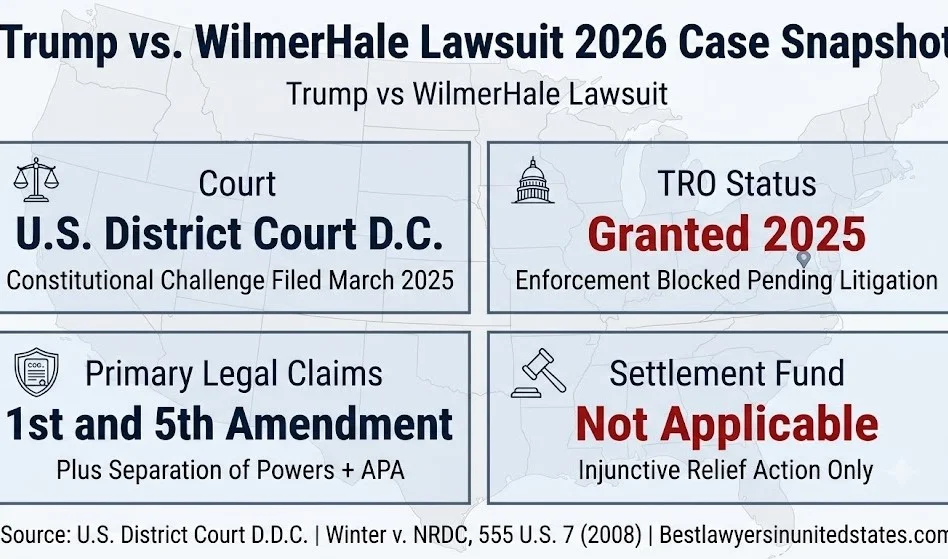
| Detail | Information |
|---|---|
| Case Name | Wilmer Cutler Pickering Hale and Dorr LLP v. Executive Office of the President, et al. |
| Court | U.S. District Court for the District of Columbia |
| Case Number | Confirm current docket number via PACER (D.D.C.) |
| Executive Order Challenged | Trump Executive Order targeting WilmerHale, signed March 2025 |
| Filing Date | March 2025 (confirm exact date via PACER) |
| Presiding Judge | Assigned D.D.C. judge (confirm via PACER docket) |
| TRO Granted | Yes; federal court issued temporary restraining order blocking EO enforcement |
| Primary Legal Claims | First Amendment retaliation; Fifth Amendment due process; separation of powers |
| Current Status | Active litigation; preliminary injunction proceedings ongoing as of 2026 |
| Settlement Fund | Not applicable; injunctive relief action only |
The Trump vs. WilmerHale lawsuit is one of the most constitutionally significant disputes between the executive branch and the private legal profession in modern American legal history. When President Trump signed an executive order in March 2025 targeting Wilmer Cutler Pickering Hale and Dorr LLP, the firm filed an immediate federal lawsuit in the U.S. District Court for the District of Columbia, and a federal judge granted a temporary restraining order blocking enforcement of the order within days.
The case does not involve monetary damages or a settlement fund. It is a direct constitutional confrontation: a law firm asserting that the President of the United States cannot use executive power to punish attorneys for whom they have represented.
WilmerHale is one of the most prominent law firms in Washington, D.C. Its former partners include former FBI Director Robert Mueller. The executive order’s stated rationale cited that connection explicitly.
What makes the 2026 litigation picture compelling is not just the WilmerHale case in isolation. It is part of a broader pattern of executive orders targeting major law firms, producing a set of parallel constitutional challenges that are reshaping the relationship between executive power and attorney independence.
What Is the Trump vs. WilmerHale Lawsuit?
The Trump vs. WilmerHale lawsuit is a federal civil action filed by Wilmer Cutler Pickering Hale and Dorr LLP challenging the constitutionality of a presidential executive order that targeted the firm’s operations, personnel, and government access as an institutional matter. The firm filed the case in the U.S. District Court for the District of Columbia in March 2025.
The complaint names as defendants the Executive Office of the President and the heads of relevant federal agencies directed by the executive order to restrict WilmerHale’s access. The relief sought is a declaratory judgment that the executive order is unconstitutional and a permanent injunction blocking its enforcement.
This is not a standard civil lawsuit between private parties. It is a separation-of-powers dispute in which a private institution is using the federal judiciary to check executive action it alleges exceeds constitutional limits.
Case fundamentals at a glance:
| Element | Detail |
|---|---|
| Plaintiff | Wilmer Cutler Pickering Hale and Dorr LLP |
| Defendants | Executive Office of the President; relevant agency heads |
| Court | U.S. District Court, District of Columbia |
| Relief sought | Declaratory judgment; permanent injunction |
| Legal basis | First Amendment; Fifth Amendment; separation of powers |
| No monetary damages | Injunctive action only |
| TRO status | Granted; enforcement blocked pending litigation |
Attorney Insight: Attorneys handling constitutional challenges to executive action point to the structural significance of TRO issuance. When a federal court grants a TRO against an executive order within days of filing, the judge has made an initial determination that the plaintiff demonstrated a likelihood of success on at least one constitutional claim.
What Did the WilmerHale Trump Executive Order Lawsuit Involve?
The WilmerHale Trump executive order lawsuit involves a direct legal challenge to presidential authority to use executive orders as instruments of retaliation against private law firms based on the clients they represent and the attorneys they employ.
The March 2025 executive order signed by President Trump was the second in a series targeting prominent Washington law firms. The first order targeted Perkins Coie. The WilmerHale order was broader in its stated rationale and more explicit in connecting the firm’s targeting to its institutional association with Robert Mueller’s Special Counsel investigation.
The lawsuit involves three distinct categories of constitutional harm. First, revocation of security clearances held by firm attorneys. Second, restriction of federal government contract access. Third, direction to federal agencies to limit cooperation with the firm and its clients in government-related proceedings.
What the executive order directed against WilmerHale:
- Revocation of security clearances held by WilmerHale attorneys
- Direction to federal agencies to suspend or terminate government contracts with WilmerHale
- Restriction on firm attorney access to federal buildings and classified information
- Direction to agency heads to review and limit interactions with firm clients in agency proceedings
- Reputational and operational harm through the public nature of the order’s stated rationale
Attorney Insight: Attorneys handling First Amendment retaliation cases point to the public rationale stated in an executive order as legally significant. When the government publicly states that it is targeting an entity because of its legal representation choices or institutional associations, that stated rationale becomes direct evidence of the retaliatory purpose required to establish a First Amendment retaliation claim.
What Did Trump’s Executive Order Against WilmerHale Actually Do?
Trump’s executive order against WilmerHale functioned as a directed federal government action targeting a private law firm’s operational capacity across multiple government-facing dimensions simultaneously. The order was signed in March 2025 and directed immediate agency action.
The most operationally severe component was security clearance revocation. Many of WilmerHale’s most senior attorneys hold or held security clearances that are prerequisites for representing clients in national security, defense contracting, and government investigation matters. Revocation stripped those attorneys of the ability to service a significant segment of the firm’s practice without cleared counsel.
The government contracts component created a second category of operational harm. Federal agencies that had active contracts with WilmerHale for legal services were directed to review and potentially terminate those arrangements, creating immediate financial and reputational consequences.
Operational impact of the executive order on WilmerHale:
| Impact Category | Specific Effect | Constitutional Theory Implicated |
|---|---|---|
| Security clearance revocation | Attorneys lost clearance status; client representation affected | Fifth Amendment due process; First Amendment |
| Government contract suspension | Federal agency contracts reviewed and restricted | First Amendment; separation of powers |
| Building and facility access | Restricted access to federal facilities for firm attorneys | Fifth Amendment liberty interest |
| Agency proceeding limitations | Agencies directed to limit cooperation with firm clients | Due process; First Amendment |
| Reputational harm | Public executive order stigmatized firm’s institutional standing | First Amendment; liberty interest |
Attorney Insight: Attorneys handling due process challenges to security clearance revocations point to the Supreme Court’s decision in Department of Navy v. Egan, 484 U.S. 518 (1988), as the traditional starting point, but note that the WilmerHale context differs because the clearance revocations were directed at a firm as retaliation for institutional conduct rather than based on individualized security assessments.
Litigation Watch: The executive order’s simultaneous targeting of security clearances, government contracts, and facility access created three distinct categories of constitutional harm that WilmerHale’s complaint addressed through three separate legal theories, each requiring its own analytical framework at the TRO and preliminary injunction stages.
How Did WilmerHale Sue the Trump Administration?
WilmerHale sued the Trump administration by filing a complaint in the U.S. District Court for the District of Columbia within days of the executive order’s signing in March 2025. The complaint was accompanied by an emergency motion for a temporary restraining order seeking immediate judicial relief before the executive order’s directives could take effect.
The complaint was filed under the Administrative Procedure Act as well as directly under the Constitution. The APA provides a cause of action to challenge final agency action that is arbitrary, capricious, or contrary to constitutional right. The constitutional claims were pleaded independently as direct challenges under the First and Fifth Amendments.
Filing in the D.C. District Court was the legally appropriate venue. The executive order emanated from the White House. The agency defendants are headquartered in Washington. Federal question jurisdiction under 28 U.S.C. Section 1331 established the court’s authority to hear the case.
WilmerHale’s litigation strategy at filing:
- Emergency TRO motion filed simultaneously with the complaint
- APA claim for arbitrary and capricious executive action
- First Amendment retaliation claim (viewpoint discrimination; retaliatory government action)
- Fifth Amendment due process claim (liberty and property interests; no adequate process before clearance revocation)
- Separation of powers claim (executive overreach into judicial branch functions)
- Preliminary injunction motion following TRO to maintain blocking order through litigation
Attorney Insight: Attorneys handling executive branch constitutional challenges point to the simultaneous TRO filing as a standard strategic move when irreparable harm is immediate. Security clearance revocation and government contract suspension are classic irreparable harms because they cannot be adequately remedied by money damages after the fact.
What Are WilmerHale’s First Amendment Claims?
WilmerHale’s First Amendment claims are based on the doctrine of government retaliation against constitutionally protected activity. The firm’s complaint alleges that the executive order was designed to punish WilmerHale for its attorneys’ representation of clients the Trump administration disfavored and for the firm’s institutional association with the Mueller Special Counsel investigation.
The First Amendment protects the right to petition the government, the right to associate for lawful purposes, and by extension through attorney-client relationships, the right to legal representation without government interference. Government action that chills or punishes the exercise of those rights is subject to heightened constitutional scrutiny.
WilmerHale’s First Amendment theory rests on three distinct sub-claims: retaliatory government action against protected association; viewpoint discrimination against the firm based on who it represents; and a chilling effect on the rights of potential future clients to retain counsel.
First Amendment theories in the WilmerHale complaint:
| First Amendment Theory | Legal Basis | How It Applies |
|---|---|---|
| Retaliation for protected activity | Unconstitutional conditions doctrine | EO punishes firm for representation choices |
| Viewpoint discrimination | First Amendment anti-discrimination principle | Government targets firm based on political valence of clients |
| Chilling effect on client rights | Freedom to petition; right to counsel | Clients deterred from retaining firm when government penalizes representation |
| Freedom of association | First Amendment associational rights | Firm attorneys penalized for institutional affiliation with Mueller investigation |
Attorney Insight: Attorneys handling First Amendment retaliation claims in the executive action context point to the Supreme Court’s decision in Garcetti v. Ceballos, 547 U.S. 410 (2006), and its progeny as relevant background, but note that the WilmerHale case involves private parties, not government employees, making the Pickering balancing test inapplicable and the protections stronger.
What Did the Executive Order Do to WilmerHale’s Security Clearances?
The executive order directed the revocation of security clearances held by WilmerHale attorneys, effectively removing those attorneys’ legal authorization to access classified information and to represent clients in matters requiring clearance access.
Security clearances are government-issued credentials that take years and significant resources to obtain. They are held individually by attorneys but are prerequisites for firm-level practice in national security law, defense contracting, intelligence matters, and certain government investigation proceedings. Revocation without individualized adjudication was the specific due process challenge.
WilmerHale’s Fifth Amendment due process challenge focuses on this point. The executive order revoked clearances on an institutional basis, without individual adjudication of each affected attorney’s suitability or any prior notice or opportunity to respond. That wholesale revocation, the complaint argues, violated the procedural protections that attach to constitutionally protected liberty and property interests.
Security clearance revocation: legal analysis:
- Standard clearance adjudication requires individualized review of the specific attorney
- Executive order bypassed individual adjudication and revoked on an institutional basis
- No prior notice or opportunity to respond was provided before revocation
- The revocation was publicly announced, creating stigma cognizable as a liberty interest deprivation
- The Fifth Amendment requires procedural due process before deprivation of a recognized liberty or property interest
Bold callout: Security clearances that take years to obtain and cost tens of thousands of dollars in investigative and firm administrative resources cannot be restored quickly. The irreparable harm from revocation without process is measurable in both attorney career terms and firm operational capacity.
Attorney Insight: Attorneys handling due process challenges to clearance actions point to the “stigma-plus” doctrine as the specific due process theory most applicable here. When the government publicly revokes clearances and stigmatizes the holder in connection with that revocation, it creates a liberty interest deprivation requiring procedural due process.
How Did the Executive Order Affect WilmerHale’s Government Contracts?
The executive order directed federal agencies to review, suspend, and potentially terminate existing government contracts with WilmerHale and to refrain from entering into new contracts with the firm. That direction created immediate and measurable economic harm to the firm’s government-facing practice.
Law firms with significant Washington practices often hold or support government contracts directly, provide legal services to government contractors, and advise clients on regulatory and administrative matters before federal agencies. WilmerHale’s practice includes all of these activities. Restriction of government contract access impairs the firm’s ability to serve existing clients and compete for new government-adjacent work.
The government contracts component also strengthened the irreparable harm showing required for the TRO. Unlike purely prospective harms, the suspension of existing contracts is an immediate, ongoing, and quantifiable injury that cannot be adequately remedied by later monetary recovery.
Government contract impact analysis:
| Contract Category | Impact of Executive Order | Irreparable Harm Factor |
|---|---|---|
| Direct government legal service contracts | Directed to be suspended or terminated | High; immediate revenue and relationship loss |
| Government contractor client representation | Agency cooperation restricted | High; client abandonment risk |
| Regulatory proceeding representations | Agency access limitations imposed | Moderate to high; client matter impairment |
| New contract competition | Firm effectively blacklisted from new awards | Ongoing prospective harm |
Attorney Insight: Attorneys handling challenges to government contractor exclusions point to the Federal Acquisition Regulation’s debarment procedures as the established process for restricting a firm’s government contracting access. Using an executive order to achieve contractor exclusion without following debarment procedures raises a separate APA arbitrary and capricious challenge.
Litigation Watch: The security clearance revocation, First Amendment retaliation theory, and government contract exclusion together form a three-track constitutional challenge that WilmerHale pursued simultaneously in a single filing, each track independently capable of supporting preliminary injunctive relief.
What Constitutional Grounds Do Law Firms Use to Challenge Trump Executive Orders?
Law firms challenging Trump executive orders targeting their operations have used a consistent set of constitutional theories across multiple parallel cases. Those theories are grounded in established Supreme Court doctrine applied to novel executive action.
The primary constitutional grounds are: First Amendment protection against government retaliation for protected legal and political activity; Fifth Amendment due process protection against deprivation of recognized liberty and property interests without adequate process; and separation of powers as a structural constitutional limit on executive authority to interfere with judicial branch functions.
The separation of powers claim has a unique dimension in the law firm context. Courts have an institutional interest in the independence of the attorneys who practice before them. When executive action targets law firms based on their representation choices, it implicates the judiciary’s authority to regulate the legal profession, an authority that Article III reserves to the courts.
Constitutional grounds used in law firm executive order challenges:
| Constitutional Basis | Core Argument | Relevant Precedent |
|---|---|---|
| First Amendment (retaliation) | EO punishes protected representation and association | Unconstitutional conditions doctrine; NAACP v. Button (1963) |
| First Amendment (chilling effect) | EO deters future representation of disfavored clients | Elrod v. Burns (1976); chilling effect doctrine |
| Fifth Amendment (due process) | Clearance revocation and contract exclusion without process | Mathews v. Eldridge (1976); stigma-plus doctrine |
| Separation of powers | Executive encroachment on judicial regulation of the bar | Mistretta v. United States (1989); inherent judicial power |
| APA (arbitrary and capricious) | EO exceeds statutory authority; no rational basis | Motor Vehicle Mfrs. Ass’n v. State Farm (1983) |
Attorney Insight: Attorneys handling separation of powers challenges in this context point to the APA claim as a potentially faster path to relief than the constitutional claims. Courts prefer to resolve cases on statutory grounds before reaching constitutional questions, and an APA ruling that the EO exceeded the President’s statutory authority would provide injunctive relief without requiring the court to decide the broader First Amendment question.
What Was the WilmerHale Temporary Restraining Order?
The WilmerHale temporary restraining order was an emergency judicial order issued by the assigned federal district judge in the U.S. District Court for the District of Columbia blocking enforcement of the executive order against WilmerHale while the constitutional litigation proceeded.
A federal court grants a TRO when the moving party demonstrates: (1) a likelihood of success on the merits; (2) a likelihood of irreparable harm absent the order; (3) that the balance of equities favors the moving party; and (4) that the public interest supports granting the order. This is the four-factor test established in Winter v. Natural Resources Defense Council, 555 U.S. 7 (2008).
The court’s decision to grant the TRO represented a preliminary judicial conclusion that WilmerHale had demonstrated at least a likelihood of success on its constitutional claims. That showing is the most legally significant factor in the TRO analysis.
TRO four-factor analysis applied to WilmerHale:
| Factor | WilmerHale’s Showing | Court’s Assessment |
|---|---|---|
| Likelihood of success on the merits | First Amendment retaliation theory; Fifth Amendment due process | TRO granted; showed sufficient likelihood |
| Irreparable harm | Clearance revocation; contract suspension; attorney career harm | Confirmed as irreparable; money damages insufficient |
| Balance of equities | Firm’s operational harm vs. government’s enforcement interest | Favored WilmerHale |
| Public interest | Independence of legal profession; rule of law | Supports blocking retaliatory executive action |
Attorney Insight: Attorneys handling TRO proceedings in the D.C. District Court point to the irreparable harm factor as typically the most important in executive action challenges. When security clearances are revoked and government contracts suspended, courts in the D.C. Circuit have consistently found that those harms cannot be adequately remediated after the fact.
Which D.C. District Court Is Handling the WilmerHale Lawsuit?
The WilmerHale lawsuit is pending before the U.S. District Court for the District of Columbia, which is the federal trial court with jurisdiction over constitutional challenges to executive branch actions emanating from Washington. The D.C. District Court is the primary venue for challenges to presidential executive orders and administrative agency actions.
The D.C. District Court operates within the jurisdiction of the U.S. Court of Appeals for the District of Columbia Circuit, which is widely regarded as the most influential federal circuit court on administrative law and constitutional questions involving executive power. Decisions from the D.C. Circuit carry substantial weight in shaping the law governing executive-branch constitutional challenges.
The specific judge assigned to the WilmerHale case should be confirmed through the PACER federal court records system, as case assignments occur by random draw among active district judges. The Perkins Coie challenge was assigned to Judge Beryl Howell, who issued strong rulings in that case.
D.C. District Court: key institutional facts:
| Feature | Detail |
|---|---|
| Court name | U.S. District Court for the District of Columbia |
| Appellate jurisdiction | U.S. Court of Appeals for the D.C. Circuit |
| Why this court | All defendants are Washington-based executive branch actors |
| PACER access | Case searchable by party name: “Wilmer Cutler” or “WilmerHale” |
| Relevant parallel case | Perkins Coie v. U.S. Dep’t of Justice (D.D.C.) |
| Judge assignment | Random draw; confirm via PACER |
Attorney Insight: Attorneys practicing in the D.C. District Court on executive power matters point to the D.C. Circuit’s substantial body of precedent on the limits of executive authority as providing WilmerHale with a favorable appellate backdrop should the district court ruling be appealed by either party.
What Did Courts Rule on the WilmerHale Trump Injunction?
Courts ruled in WilmerHale’s favor at the TRO stage, blocking enforcement of the executive order against the firm while the litigation proceeded. That initial judicial determination was significant because it reflected the court’s preliminary assessment that the constitutional challenge had merit sufficient to warrant emergency relief.
The parallel Perkins Coie case provides the most directly relevant judicial precedent. In that case, Judge Beryl Howell of the D.C. District Court issued a preliminary injunction blocking the executive order targeting Perkins Coie, finding on the merits that the order constituted unconstitutional retaliation against the firm for its legal representation activities. That ruling is the most detailed judicial analysis of the First Amendment theory applicable to the WilmerHale case.
Judge Howell’s ruling in the Perkins Coie case found that the government’s action bore “the hallmarks of a retaliatory campaign” against a law firm for its exercise of constitutionally protected conduct. That language and analysis directly inform the WilmerHale litigation.
Court rulings in parallel law firm executive order challenges:
| Firm | Court | Judge | Ruling |
|---|---|---|---|
| Perkins Coie | D.D.C. | Judge Beryl Howell | Preliminary injunction granted; EO blocked as unconstitutional retaliation |
| WilmerHale | D.D.C. | Assigned judge (confirm via PACER) | TRO granted; preliminary injunction proceedings ongoing |
| Covington and Burling | D.D.C. | Assigned judge (confirm via PACER) | Legal challenge filed; status per PACER |
| Paul Weiss | N/A | N/A | Reached agreement with Trump administration; did not litigate |
Attorney Insight: Attorneys handling the WilmerHale litigation point to the Perkins Coie preliminary injunction ruling as the single most important precedent in the D.C. District Court because it provides a detailed, on-the-merits First Amendment analysis by a D.C. District Court judge that WilmerHale can cite directly in its own preliminary injunction briefing.
Litigation Watch: The Perkins Coie preliminary injunction ruling, the WilmerHale TRO grant, and the parallel Covington challenge collectively represent a pattern of federal judicial resistance to the executive order series targeting law firms, a pattern that strengthens WilmerHale’s litigation position as the case progresses toward a merits ruling.
How Does the WilmerHale Case Fit the Broader Trump Law Firm Lawsuits?
The WilmerHale case fits into a pattern of executive orders issued in early 2025 targeting prominent Washington law firms that the Trump administration associated with legal opposition to its first and second-term policy agenda. The WilmerHale order was the second in the series, following the Perkins Coie order.
Each executive order in the series targeted a firm for a stated rationale connected to the firm’s attorneys or the firm’s past representation of clients or causes the administration disfavored. The WilmerHale order cited the firm’s connection to Robert Mueller. The Perkins Coie order cited the firm’s representation of the Democratic National Committee and Hillary Clinton’s 2016 campaign.
The pattern is legally significant because it establishes the retaliatory purpose that is the foundation of the First Amendment claims. When a series of executive orders targets law firms precisely because of their legal representation choices and political associations, that pattern is evidence of the viewpoint-based discrimination that the First Amendment prohibits.
The Trump law firm executive order series:
| Firm Targeted | Order Date | Stated Rationale | Firm Response |
|---|---|---|---|
| Perkins Coie | Early 2025 | DNC representation; Clinton campaign | Sued; preliminary injunction obtained |
| WilmerHale | March 2025 | Mueller investigation connection | Sued; TRO obtained |
| Covington and Burling | 2025 | Biden representation; various clients | Legal challenge filed |
| Paul Weiss | Early 2025 | Mark Pomerantz connection | Reached agreement; withdrew challenge |
| Jenner and Block | 2025 | Robert Mueller partner employment | Legal challenge filed |
Attorney Insight: Attorneys handling pattern-based First Amendment retaliation claims point to the series of executive orders as strengthening each individual firm’s case. Proof of retaliatory intent is easier to establish when the government has publicly stated its reasons across multiple similar actions targeting identifiable groups of political opponents.
What Is the Broader Pattern of Trump Actions Against Law Firms?
The broader pattern of Trump administration actions against law firms in 2025 represents an unprecedented use of executive power to target the legal profession based on firms’ representation choices and attorneys’ prior government service. No prior administration had issued executive orders specifically targeting private law firms in this manner.
The actions created immediate and measurable pressure on the firms’ operational capacity. Several firms that had not yet received executive orders negotiated preemptive agreements with the administration, pledging resources or adjusting representation practices in exchange for assurance that no executive order would be issued targeting them.
That dynamic, firms reaching preemptive agreements to avoid executive orders, itself raises constitutional concerns that legal scholars have characterized as a form of coerced surrender of First Amendment rights. The firms that chose to litigate rather than negotiate, WilmerHale, Perkins Coie, Covington, and Jenner and Block, are the ones whose cases are now producing constitutional law.
Responses to Trump law firm executive orders:
| Response Type | Firms | Outcome |
|---|---|---|
| Filed constitutional challenge | Perkins Coie, WilmerHale, Covington, Jenner and Block | Active litigation; TROs and PI obtained |
| Reached preemptive agreement | Paul Weiss; others reported | Orders withdrawn or not issued |
| Capitulated to EO terms | Not publicly identified | Operational restrictions accepted |
| Ongoing negotiation | Various firms under pressure | Status varies |
Attorney Insight: Attorneys analyzing the law firm executive order pattern as a constitutional matter point to the coercion element in preemptive agreements as legally distinct from voluntary settlements. When a firm agrees to provide pro bono resources or change representation practices to avoid executive retaliation, that agreement may itself be constitutionally voidable as extracted under unconstitutional duress.
What Is the Expected Outcome of the WilmerHale Lawsuit in 2026?
The expected outcome of the WilmerHale lawsuit in 2026 depends on three variables: whether the preliminary injunction is converted from the TRO to a full injunction, what ruling the district court issues on the merits, and whether the case is appealed to the D.C. Circuit.
Based on the Perkins Coie preliminary injunction ruling and the constitutional analysis it contains, WilmerHale’s litigation position on the First Amendment retaliation claim is strong. The D.C. District Court has already demonstrated, in the parallel case, a willingness to issue detailed merits rulings finding that these executive orders violate the First Amendment.
If the district court rules in WilmerHale’s favor on a preliminary or permanent injunction, the government faces a choice: appeal to the D.C. Circuit or seek to negotiate a resolution. The D.C. Circuit’s precedent on First Amendment government retaliation is generally plaintiff-favorable, making the government’s appellate prospects uncertain.
Likely 2026 litigation trajectory:
| Stage | Likely Development |
|---|---|
| Preliminary injunction ruling | Expected; WilmerHale favored based on Perkins Coie precedent |
| District court merits ruling | Full adjudication of constitutional claims; timeline 2026 to 2027 |
| Government appeal to D.C. Circuit | Possible if district court rules against government |
| D.C. Circuit ruling | 12 to 18 months post-district court judgment if appealed |
| Supreme Court review | Possible given national significance; not certain |
| Negotiated resolution | Possible at any stage; depends on administration posture |
Attorney Insight: Attorneys tracking executive power litigation in the D.C. Circuit point to the possibility of an emergency stay application to the Supreme Court as a variable that could accelerate or alter the trajectory of any D.C. Circuit ruling. The Supreme Court’s emergency docket has become an increasingly significant procedural venue in high-profile executive action cases.
Where Does the WilmerHale Trump Lawsuit Stand in 2026?
In 2026, the WilmerHale Trump lawsuit is in active constitutional litigation before the U.S. District Court for the District of Columbia, with the TRO granted and preliminary injunction proceedings ongoing or recently concluded.
The case is part of a larger constitutional moment in which federal courts are adjudicating the outer limits of executive power to target private legal institutions based on their representation activities. The rulings emerging from the D.C. District Court in the law firm executive order cases are generating significant new First Amendment precedent.
For attorneys, law firms, and legal professionals tracking this litigation, the 2026 status requires monitoring three parallel tracks: the WilmerHale case’s own docket, the D.C. Circuit’s handling of any appeals in the parallel Perkins Coie or Covington cases, and the broader executive branch posture toward negotiated resolution versus continued litigation.
2026 status monitoring checklist:
- Monitor WilmerHale case docket on PACER (search “Wilmer Cutler” in D.D.C.)
- Track D.C. Circuit docket for appeals in Perkins Coie and Covington cases
- Follow D.C. District Court preliminary injunction ruling in WilmerHale
- Monitor for any executive branch modification or rescission of the executive order
- Track any legislative response to the executive order series in Congress
- Follow ABA and state bar responses to the law firm executive order pattern
Attorney Insight: Attorneys advising law firms on their exposure to executive order risk point to the WilmerHale and Perkins Coie litigation as establishing, for the first time in modern constitutional law, that law firms have judicially recognized First Amendment rights to represent clients without executive retaliation. That doctrinal development has implications well beyond the current administration’s specific targeting.
Frequently Asked Questions
What did Trump’s executive order against WilmerHale do?
The executive order, signed in March 2025, directed federal agencies to revoke security clearances held by WilmerHale attorneys and to restrict the firm’s access to government contracts and federal facilities.
The order’s stated rationale cited the firm’s institutional connection to former FBI Director Robert Mueller’s Special Counsel investigation.
The order was blocked by a federal court TRO within days of signing.
What constitutional claims did WilmerHale file in its lawsuit?
WilmerHale filed three primary constitutional claims: First Amendment retaliation against protected legal and associational activity, Fifth Amendment due process violations arising from clearance revocation without individual adjudication, and a separation of powers challenge to executive interference with the independent legal profession.
The complaint was filed in the U.S. District Court for the District of Columbia in March 2025.
The firm also pursued an Administrative Procedure Act claim arguing the executive order was arbitrary, capricious, and in excess of statutory authority.
Did a court block the Trump executive order targeting WilmerHale?
Yes, a federal district court granted a temporary restraining order blocking enforcement of the executive order against WilmerHale within days of the complaint’s filing.
That TRO reflected the court’s preliminary determination that WilmerHale demonstrated a likelihood of success on its constitutional claims under the four-factor Winter test.
Preliminary injunction proceedings to extend the block through the full litigation were ongoing in 2026.
How does the WilmerHale case compare to the Perkins Coie lawsuit?
Both cases involve executive orders targeting prominent Washington law firms and constitutional challenges filed in the U.S. District Court for the District of Columbia.
The Perkins Coie case produced a detailed preliminary injunction ruling by Judge Beryl Howell finding the executive order constituted unconstitutional First Amendment retaliation, a ruling that directly informs the WilmerHale litigation.
The WilmerHale order cited different stated rationale but the constitutional theories are substantially parallel.
Did WilmerHale reach a settlement with the Trump administration?
No publicly confirmed settlement has been reported as of this publication.
Unlike Paul Weiss, which reached an agreement with the Trump administration and withdrew its challenge, WilmerHale chose to litigate its constitutional claims.
A negotiated resolution remained possible at any stage of the proceedings, but the firm’s litigation posture in 2026 reflected a commitment to obtaining a judicial ruling on the merits.
What does the Trump vs. WilmerHale lawsuit mean for law firm independence?
The case is producing the first modern constitutional precedent directly recognizing that law firms have First Amendment rights to represent clients without government retaliation based on who those clients are.
If WilmerHale prevails on a permanent injunction, the ruling would establish a judicial check on executive authority to target private law firms through security clearance revocation and contract exclusion.
For the legal profession broadly, the case tests whether the constitutional guarantees of attorney independence and the right to counsel extend to institutional protection from executive retaliatory action.
Closing
The Trump vs. WilmerHale lawsuit is not a political dispute dressed in legal clothing. It is a constitutional case with durable implications for the separation of powers, the independence of the legal profession, and the First Amendment rights of attorneys and their clients.
Federal courts have already demonstrated, in the parallel Perkins Coie case, a willingness to find that executive orders targeting law firms for their representation choices violate the First Amendment. The WilmerHale litigation is building on that foundation.
For attorneys, law firm administrators, and legal professionals tracking executive power, monitoring the WilmerHale docket through PACER and following the D.C. Circuit’s appellate proceedings in the parallel cases are the concrete next steps. For any firm or attorney who believes it faces similar executive retaliation risk, consultation with a constitutional law attorney specializing in First Amendment and administrative law matters is the appropriate professional response.
