
Quick Answer
- What this is: The Ohio Attorney General filed a consumer protection enforcement action against Pawsible Angels, an Ohio-based pet rescue organization, alleging violations of the Ohio Consumer Sales Practices Act through deceptive practices related to animal adoptions, fees, and representations about animal health.
- Who qualifies: Ohio consumers who paid adoption fees, made donations, or entered into transactions with Pawsible Angels and experienced misrepresentations or failed to receive what was promised may be eligible for restitution through the AG action or a private consumer fraud claim.
- What it may be worth: Individual recovery depends on documented losses. Ohio’s Consumer Sales Practices Act allows private plaintiffs to recover actual damages, rescission of contracts, or triple the amount of actual damages, plus attorney fees, in cases of knowing violations.
Case Snapshot
| Detail | Information |
|---|---|
| Case Type | Ohio Attorney General consumer protection enforcement action |
| Defendant | Pawsible Angels (Ohio pet rescue organization) |
| Governing Statute | Ohio Consumer Sales Practices Act, R.C. Chapter 1345 |
| Filing Court | Ohio Common Pleas Court (county to be confirmed via Ohio Courts online system) |
| Case Number | Verify through Ohio Courts online case search |
| Ohio AG Office | Consumer Protection Section, Ohio Attorney General |
| Enforcement Authority | R.C. 1345.07 (AG enforcement); R.C. 1345.09 (private right of action) |
| Current Status | Active enforcement action; resolution terms not publicly finalized as of publication |
| Consumer Restitution | Available as remedy; fund structure pending case resolution |
The Ohio Attorney General’s enforcement action against Pawsible Angels is one of the most visible consumer protection cases involving a pet rescue organization in Ohio’s recent enforcement history. The action targets alleged deceptive practices that affected consumers who paid adoption fees, relied on health representations, or made financial contributions to the organization.
Ohio’s Consumer Sales Practices Act is one of the more plaintiff-favorable consumer protection statutes in the Midwest. It authorizes both AG enforcement and private consumer lawsuits, meaning affected consumers have two independent pathways to seek recovery.
The enforcement action matters in 2026 because the resolution timeline directly affects when and how consumers can access any restitution fund. Consumers who fail to preserve documentation or miss the claims window risk losing their recovery entirely.
Understanding the legal framework behind this action, not just the headline, is what separates a consumer who recovers from one who does not.
What Is the Ohio Attorney General Lawsuit Against Pawsible Angels?
The Ohio Attorney General lawsuit against Pawsible Angels is a civil enforcement action filed under the Ohio Consumer Sales Practices Act (OCSPA), R.C. Chapter 1345. The Ohio AG’s Consumer Protection Section filed the action after investigating consumer complaints alleging that Pawsible Angels engaged in unfair, deceptive, or unconscionable acts in connection with pet adoptions and related transactions.
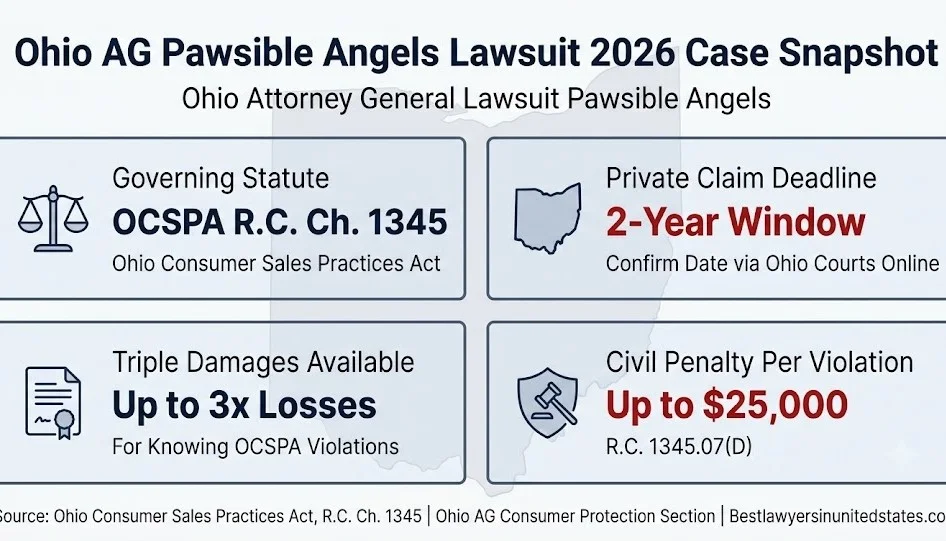
The AG’s office has authority under R.C. 1345.07 to file civil actions in Ohio Common Pleas Court against suppliers who violate the OCSPA. Those actions can result in injunctive relief, civil penalties, and orders for consumer restitution.
Pawsible Angels operated as a pet rescue organization placing animals with Ohio consumers. The complaints leading to the AG action centered on allegations of misrepresentation about animal health, undisclosed conditions, collection of fees without delivering promised services, and related deceptive practices.
Key legal authority in this action:
| Statute | Function |
|---|---|
| R.C. 1345.02 | Prohibits unfair or deceptive acts or practices in consumer transactions |
| R.C. 1345.03 | Prohibits unconscionable acts or practices |
| R.C. 1345.07 | Authorizes AG to seek injunction, civil penalties, and restitution |
| R.C. 1345.09 | Grants private right of action to individual consumers |
Attorney Insight: Attorneys handling these claims point to the AG enforcement action as a significant evidentiary development for private plaintiffs. A filed AG complaint establishes a public record of alleged violations that individual consumers can reference in their own civil claims.
What Is the Pawsible Angels Ohio Lawsuit About?
The Pawsible Angels Ohio lawsuit is about alleged deceptive conduct in consumer transactions involving animal adoptions and related financial exchanges. At its core, the complaint addresses the gap between what Pawsible Angels represented to consumers and what those consumers actually received.
Specifically, the allegations involve misrepresentations about the health and veterinary status of animals placed for adoption, failure to disclose known medical conditions, collection of adoption fees without providing promised services or documentation, and potentially deceptive solicitation of charitable donations.
These are not trivial consumer complaints. Under Ohio law, each individual deceptive act in a consumer transaction constitutes a separate violation. The aggregate of those violations across multiple consumers is what gives the AG action its scope and gives the OCSPA’s civil penalty provisions their teeth.
Categories of alleged deceptive conduct:
- Misrepresentation of animal health status at point of adoption
- Failure to disclose known veterinary conditions prior to transaction
- Collection of adoption fees without delivery of promised documentation or services
- Deceptive representations about organizational practices or animal sourcing
- Potential solicitation of donations without proper charitable registration or disclosure
- Failure to honor stated refund or health guarantee policies
Attorney Insight: Attorneys handling these claims point to the health representation issue as the most legally significant category. Ohio courts have consistently held that misrepresentations about material facts in a consumer transaction, including an animal’s health status, satisfy the deception element under R.C. 1345.02.
What Happened to Pawsible Angels in Ohio?
What happened to Pawsible Angels in Ohio is that consumer complaints accumulated to a threshold that triggered formal investigation by the Ohio Attorney General’s Consumer Protection Section. That investigation produced a civil complaint filed in Ohio Common Pleas Court.
Consumers began filing complaints with the Ohio AG’s office and the Better Business Bureau after experiencing problems following adoptions from Pawsible Angels. Those problems included animals requiring immediate and significant veterinary care for conditions the rescue allegedly knew about or should have known about, and disputes over promised documentation and health certifications that were never provided.
The Ohio AG’s investigation developed from those complaints. Civil investigative demands, a formal tool available to the AG’s office under Ohio law, may have been used to compel production of records before the complaint was filed.
Timeline of events (confirmed details where available):
| Event | Status |
|---|---|
| Consumer complaints filed with Ohio AG | Prior to lawsuit filing |
| Ohio AG Consumer Protection Section investigation | Conducted prior to complaint |
| Formal complaint filed in Ohio Common Pleas Court | Filed; verify exact date via Ohio Courts online |
| Pawsible Angels response to complaint | Pending or filed; check docket |
| Current status | Active proceedings |
| Consumer restitution availability | Pending case resolution |
Attorney Insight: Attorneys handling these claims point to the pattern of consumer complaints as critical pre-litigation evidence. Consumers who filed formal complaints with the Ohio AG’s office before the lawsuit was filed are typically given priority consideration in any subsequent restitution process.
Litigation Watch: The allegations against Pawsible Angels, the statutory framework invoked by the Ohio AG, and the documented pattern of consumer complaints collectively establish the factual and legal foundation for both the enforcement action and any parallel private consumer claims.
What Does the Ohio AG Pawsible Angels Complaint Allege?
The Ohio AG’s Pawsible Angels complaint alleges that the organization engaged in a pattern of deceptive and unconscionable acts that violated the Ohio Consumer Sales Practices Act in transactions with Ohio consumers. The complaint is a formal legal document filed in Ohio Common Pleas Court and is a public record.
The specific allegations, as reflected in press coverage and the AG’s public statements, include material misrepresentations made before or during adoption transactions. Consumers were allegedly told animals were healthy, vaccinated, or cleared by a veterinarian when the actual health status differed materially from those representations.
The unconscionability allegations under R.C. 1345.03 are particularly significant. Ohio courts have recognized that transactions involving misrepresented animal health, where the consumer had no meaningful ability to verify the representations independently, can meet the unconscionability standard.
What the Ohio OCSPA complaint framework requires:
- Identification of Pawsible Angels as a “supplier” under R.C. 1345.01(C)
- Proof that transactions were “consumer transactions” under R.C. 1345.01(A)
- Evidence that specific acts or practices violated R.C. 1345.02 or 1345.03
- Documentation of consumer harm resulting from those violations
- Basis for requested remedies: injunction, civil penalties, restitution
Attorney Insight: Attorneys handling these claims point to the “supplier” classification as foundational. Ohio’s OCSPA applies to suppliers in consumer transactions. If Pawsible Angels is classified as a supplier under the statute, every deceptive act in every adoption transaction is a potential OCSPA violation.
What Consumer Fraud Did Pawsible Angels Allegedly Commit?
The consumer fraud Pawsible Angels allegedly committed falls within the categories of unfair and deceptive acts defined by R.C. 1345.02. That statute prohibits suppliers from committing unfair or deceptive acts in connection with consumer transactions, and it is broadly construed by Ohio courts.
The specific categories of alleged fraud include false statements about animal health prior to adoption, misrepresentation of the organization’s veterinary practices, failure to disclose conditions that materially affected the value of the transaction, and deceptive handling of adoption fees paid by consumers who received less than promised.
Under Ohio law, a representation is deceptive under R.C. 1345.02 if it has the capacity to mislead a reasonable consumer. The consumer does not need to prove the supplier intended to deceive. Capacity to mislead is sufficient.
OCSPA deceptive acts framework applied to Pawsible Angels:
| Alleged Conduct | OCSPA Provision | Legal Standard |
|---|---|---|
| False health representations | R.C. 1345.02(A) | Capacity to mislead a reasonable consumer |
| Failure to disclose known conditions | R.C. 1345.02(B)(1) | Material omission in consumer transaction |
| Misrepresentation of services included | R.C. 1345.02(B)(2) | False statement about nature of transaction |
| Unconscionable pricing or practices | R.C. 1345.03 | Gross disparity; consumer had no meaningful choice |
Attorney Insight: Attorneys handling these claims point to the “capacity to mislead” standard as consumer-favorable. Unlike common law fraud, which requires proof of intent to deceive, the OCSPA’s deception standard is met when a representation could mislead a reasonable person, regardless of the supplier’s subjective intent.
What Is the Ohio Consumer Sales Practices Act and How Does It Apply?
The Ohio Consumer Sales Practices Act (OCSPA) is Ohio’s primary consumer protection statute, codified at R.C. Chapter 1345. It governs consumer transactions between suppliers and consumers and prohibits unfair, deceptive, and unconscionable acts.
The OCSPA applies to Pawsible Angels because pet adoption transactions, and charitable solicitations connected to those transactions, qualify as consumer transactions under R.C. 1345.01. The organization’s conduct in those transactions falls within the scope of practices the statute regulates.
The statute’s enforcement architecture operates on two parallel tracks. The first is AG enforcement under R.C. 1345.07. The second is individual consumer enforcement under R.C. 1345.09, which gives each affected consumer an independent right to sue.
OCSPA remedies available to consumers:
| Remedy | Statutory Basis | Who Can Pursue |
|---|---|---|
| Rescission (undo the transaction) | R.C. 1345.09(A) | Individual consumer |
| Actual damages | R.C. 1345.09(A) | Individual consumer |
| Triple damages (knowing violation) | R.C. 1345.09(B) | Individual consumer (requires knowing violation) |
| Attorney fees | R.C. 1345.09(F) | Individual consumer (prevailing plaintiff) |
| Injunctive relief | R.C. 1345.07 | Ohio AG |
| Civil penalties up to $25,000 per violation | R.C. 1345.07(D) | Ohio AG |
| Consumer restitution | R.C. 1345.07(A) | Ohio AG (fund distributed to consumers) |
Attorney Insight: Attorneys handling these claims point to the triple damages provision as the most powerful tool in the OCSPA’s private remedy arsenal. A consumer who paid a $500 adoption fee and received an animal with undisclosed health conditions may have an individual claim worth $1,500 in damages plus attorney fees.
Litigation Watch: The OCSPA’s dual enforcement structure, AG action plus private consumer claims, means that affected Pawsible Angels consumers have options beyond waiting for the AG to distribute restitution. Individual lawsuits can proceed independently and may produce faster, higher individual recoveries.
Is the Pawsible Angels Ohio Case a Scam Lawsuit?
The Pawsible Angels Ohio case is not a scam lawsuit. It is a legitimate state government enforcement action filed by the Ohio Attorney General’s Consumer Protection Section under a long-established Ohio statute with a strong enforcement history.
The term “scam lawsuit” is sometimes applied by consumer audiences to distinguish fraudulent claims-filing schemes from genuine legal proceedings. This action is the opposite. It is the government acting as a plaintiff on behalf of consumers who allegedly experienced deceptive practices.
What consumers should be alert to is the emergence of fraudulent third-party “claim filing services” that may attempt to charge fees to help consumers submit restitution claims in connection with AG enforcement actions. The official Ohio AG consumer restitution process is free. Any third party charging to file a claim on your behalf in connection with this case is not affiliated with the official proceeding.
Distinguishing the real action from potential fraud:
| Characteristic | Ohio AG Action | Potential Third-Party Scam |
|---|---|---|
| Who filed it | Ohio Attorney General | N/A |
| Cost to affected consumer | Free to participate | Charges fees |
| Official channel | Ohio AG website and court | Unofficial third-party site |
| Restitution distribution | Court-ordered and supervised | No legal authority |
| Documentation required | Through official claims process | May seek unnecessary personal data |
Attorney Insight: Attorneys handling these claims point to the AG enforcement action as the authoritative proceeding. Consumers should obtain information about restitution claims directly from the Ohio Attorney General’s Consumer Protection Section, not from third parties purporting to help.
How Does Ohio Handle Pet Rescue Fraud Enforcement?
Ohio handles pet rescue fraud enforcement through the same OCSPA framework applicable to all consumer transactions, treating pet adoption and rescue operations as suppliers subject to the statute’s prohibitions. Ohio courts have recognized pet adoption transactions as consumer transactions, bringing rescue organizations squarely within the statute’s scope.
The AG’s Consumer Protection Section monitors complaints received through the Ohio AG’s online consumer complaint portal. When complaints against a single supplier reach a threshold indicating a pattern of practice, the section may open a formal investigation, issue civil investigative demands, and ultimately file a civil complaint.
Ohio is not unique in facing the broader problem of fraudulent pet rescue operations. A 2022 Federal Trade Commission report identified deceptive pet sales and rescue operations as a growing consumer fraud category nationally. Ohio’s OCSPA enforcement framework provides one of the more direct remedies available to consumers at the state level.
Ohio’s pet rescue fraud enforcement process:
- Consumer complaints submitted to Ohio AG portal
- Pattern analysis by Consumer Protection Section
- Civil investigative demand issued to organization
- Formal complaint filed in Ohio Common Pleas Court
- Court-ordered remedies including injunction, civil penalties, and restitution
- Restitution fund distributed to qualifying consumers through claims process
Attorney Insight: Attorneys handling these claims point to Ohio’s FTC Act-parallel enforcement standard as significant. Ohio courts regularly apply FTC advisory opinions as guidance in interpreting R.C. 1345.02, meaning federal consumer protection precedent directly informs Ohio OCSPA outcomes.
What Should Pawsible Angels Rescue Customers Know About the AG Action?
Pawsible Angels rescue customers should know that the AG enforcement action creates a formal legal record of alleged misconduct but does not automatically produce payment to individual consumers. Consumers must take affirmative steps to participate in any restitution process.
The Ohio AG’s office will notify known affected consumers if a restitution fund is established. However, consumers who are not in the AG’s database because they never filed a formal complaint may not receive automatic notice. Proactively registering a complaint with the Ohio AG’s Consumer Protection Section is the most important immediate step.
Customers should also be aware that the AG action does not bar a private lawsuit. An individual consumer can simultaneously be a potential restitution claimant in the AG proceeding and a plaintiff in their own OCSPA private action.
What Pawsible Angels customers should do right now:
- File a formal consumer complaint with the Ohio AG’s Consumer Protection Section if not already done
- Preserve all documentation related to the transaction (adoption contract, payment receipts, email correspondence)
- Preserve all veterinary records for the animal adopted, particularly any records showing health conditions not disclosed at adoption
- Document all out-of-pocket costs incurred as a result of undisclosed conditions (veterinary bills, medications)
- Consult a consumer protection attorney about whether a private OCSPA claim is appropriate
- Monitor the Ohio AG’s official communications for restitution claim filing instructions
Attorney Insight: Attorneys handling these claims point to the veterinary record as the single most powerful piece of individual consumer evidence. A veterinary diagnosis of a pre-existing condition made shortly after adoption, particularly when compared against adoption paperwork claiming the animal was healthy, establishes both the misrepresentation and the damages in a single document.
Who Are the Affected Consumers in the Pawsible Angels Ohio Case?
Affected consumers in the Pawsible Angels Ohio case are Ohio residents who entered into consumer transactions with Pawsible Angels, primarily by paying adoption fees, making monetary donations, or entering into foster-to-adopt arrangements that involved financial exchanges.
The consumer class is broader than only adoption fee payers. Ohio courts have recognized that charitable donations made in response to deceptive representations about an organization’s practices can also constitute consumer transactions subject to OCSPA protection in appropriate circumstances.
The scope of affected consumers is determined by the AG’s investigation and any court order defining the eligible class for restitution purposes. Consumers who believe they were affected should not wait for formal notification before documenting and preserving their evidence.
Likely categories of affected consumers:
| Consumer Category | Transaction Type | Potential Claim Basis |
|---|---|---|
| Animal adopters (fee paid) | Adoption transaction | Misrepresentation of health; failure to deliver promised documentation |
| Foster-to-adopt participants | Conditional adoption | Breach of arrangement terms; undisclosed conditions |
| Donors (monetary) | Charitable solicitation | Deceptive representations about organization practices or fund use |
| Multiple-adoption households | Repeat consumer transactions | Pattern of deception; each transaction a separate potential violation |
Attorney Insight: Attorneys handling these claims point to repeat transactions as potentially producing multiple individual OCSPA violations. A consumer who adopted two animals from Pawsible Angels and experienced misrepresentation in each transaction may have two separate OCSPA claims, each carrying its own damages and potential triple damages calculation.
Litigation Watch: The scope of the affected consumer population, the dual enforcement tracks available under the OCSPA, and the documentation requirements for individual claims define the practical landscape for anyone seeking recovery from the Pawsible Angels situation.
Can You Get a Refund from Pawsible Angels in Ohio?
Refund recovery from Pawsible Angels is available through two mechanisms: the AG enforcement restitution process and a private OCSPA lawsuit. Both require documentation of the original transaction and the resulting harm.
Through the AG enforcement process, restitution is ordered by the court and distributed through a claims administrator after the case resolves. The amount each consumer receives depends on their documented losses and the total restitution fund established by court order.
Through a private OCSPA lawsuit, a consumer can seek rescission of the adoption contract plus return of the adoption fee, actual damages including veterinary costs incurred for undisclosed conditions, and if the violation was knowing, triple the amount of actual damages. Attorney fees are recoverable by prevailing plaintiffs.
Refund mechanisms compared:
| Recovery Path | Available Amount | Timeline | Who Pursues It |
|---|---|---|---|
| AG restitution fund | Pro rata share of court-ordered fund | After case resolution | Consumer files claim form |
| Private OCSPA rescission | Return of adoption fee | Private lawsuit timeline | Consumer through attorney |
| Private OCSPA actual damages | Documented out-of-pocket losses | Private lawsuit timeline | Consumer through attorney |
| Private OCSPA triple damages | Up to 3x actual damages (knowing violation) | Private lawsuit timeline | Consumer through attorney |
| Attorney fees | Recoverable by prevailing consumer | End of private litigation | Awarded by court |
Attorney Insight: Attorneys handling these claims point to the choice between the AG restitution path and a private action as a strategic decision that depends on the size of individual losses. Consumers with small documented losses may find the AG restitution process sufficient. Those with significant veterinary costs, multiple transactions, or other substantial losses may benefit more from an individual OCSPA lawsuit.
How Do You File a Complaint Against Pawsible Angels in Ohio?
Filing a complaint against Pawsible Angels with the Ohio Attorney General is the first and most immediately accessible step for affected consumers. The Ohio AG maintains an online consumer complaint portal where any Ohio consumer can file a formal complaint against a supplier.
The complaint should include: the date of the transaction, the amount paid, the specific representations made about the animal’s health or the organization’s practices, documentation of what was promised versus what was delivered, and copies of all receipts, contracts, and veterinary records.
For consumers pursuing a private OCSPA lawsuit, the process is different. A private action is filed in the Ohio Common Pleas Court in the county where the consumer resides or where the transaction occurred. Retaining a consumer protection attorney is the practical starting point for a private action.
Filing a complaint: step-by-step:
- Step 1: Gather all transaction documentation (contract, receipt, adoption paperwork)
- Step 2: Compile veterinary records showing any conditions present at or shortly after adoption
- Step 3: Calculate documented out-of-pocket losses with receipts
- Step 4: File a formal consumer complaint with the Ohio AG Consumer Protection Section through the official Ohio AG portal
- Step 5: Request a case number or confirmation of complaint receipt
- Step 6: Consult a consumer protection attorney about whether a private OCSPA lawsuit is appropriate given your individual loss amount
- Step 7: Monitor the Ohio AG’s official announcements about restitution claim procedures
Attorney Insight: Attorneys handling these claims point to the official complaint filing as protective, not merely procedural. Consumers who have a formal complaint on file with the AG’s office are positioned to be notified of any restitution fund and to participate in its distribution.
Is Restitution Available in the Pawsible Angels Ohio Case?
Restitution is available as a court-ordered remedy in the Pawsible Angels Ohio case under R.C. 1345.07(A), which authorizes the Ohio AG to seek an order requiring a supplier to make restitution to affected consumers. Whether and how much restitution will actually be distributed depends on the case’s resolution.
In Ohio AG enforcement actions that result in a consent judgment or court order, restitution funds are typically administered through a claims process overseen by the AG’s office or a court-appointed administrator. Affected consumers receive notice and are given a window to submit claims with supporting documentation.
The restitution amount available to any individual consumer is generally capped at their documented actual losses. The total fund available for distribution is determined by the court order or consent judgment.
How Ohio AG restitution typically works:
| Stage | What Happens |
|---|---|
| Case resolved by court order or consent judgment | Restitution amount set by court |
| Claims administrator appointed | AG or third-party administrator |
| Consumer notice issued | Known consumers notified by mail or email |
| Claims filing window opens | Consumers submit claims with documentation |
| Claims reviewed and approved | Administrator verifies against case records |
| Payments distributed | Checks or direct payments issued to qualifying consumers |
| Unclaimed funds | May revert to state or be redistributed |
Attorney Insight: Attorneys handling these claims point to the claims documentation requirement as where many consumers underperform. A restitution claim without supporting documentation, such as the adoption contract, payment receipt, and veterinary records, may be reduced or denied even if the consumer legitimately suffered harm.
What Settlement Could Resolve the Pawsible Angels Ohio Lawsuit?
The Pawsible Angels Ohio lawsuit could resolve through a consent judgment, a negotiated settlement agreement, or a court judgment after full litigation. Consent judgments are the most common resolution mechanism in Ohio AG consumer protection enforcement actions.
A consent judgment is a negotiated agreement between the AG’s office and the defendant that is entered as a court order. It typically includes injunctive relief preventing the defendant from continuing the alleged violations, civil penalties, and a restitution fund for affected consumers. The defendant does not necessarily admit liability.
The total monetary value of any resolution depends on the scope of violations proved or stipulated, the number of affected consumers, their aggregate documented losses, and the defendant’s financial capacity to satisfy a restitution order.
Potential consent judgment components:
- Permanent or temporary injunction against continued violations
- Civil penalties (up to $25,000 per violation under R.C. 1345.07(D))
- Restitution fund for affected consumers (amount determined by negotiation or court)
- Compliance monitoring requirements
- Required business practice changes or cessation of operations
- Costs of investigation paid to the AG’s office
Bold callout: Ohio AG consumer protection consent judgments have historically included restitution funds ranging from tens of thousands to several million dollars depending on the scope and number of affected consumers.
Attorney Insight: Attorneys handling these claims point to the civil penalty ceiling of $25,000 per violation as a significant enforcement lever. If the AG documents dozens of individual deceptive transactions, the aggregate civil penalty exposure for Pawsible Angels could create strong incentive to reach an early negotiated resolution.
Where Does the Pawsible Angels Ohio Case Stand in 2024 and 2025?
In 2024 and 2025, the Ohio Attorney General’s action against Pawsible Angels moved through the initial stages of Ohio civil court proceedings. The complaint was filed, the defendant was served, and the parties proceeded through the early phases of litigation or negotiation.
Ohio Common Pleas Court civil cases at this stage typically involve motions practice, early case management conferences, and in enforcement actions, early discussions about consent judgment terms. The Ohio AG’s Consumer Protection Section handles these matters with experienced staff attorneys who manage cases through to final court order.
Consumers during this period should have been actively filing complaints with the AG’s office and preserving documentation. Any consumer who did not file a formal complaint by the time a restitution fund was established may face a higher documentation burden to participate.
2024 and 2025 case status indicators:
| Indicator | Status |
|---|---|
| Complaint filed | Confirmed (date: verify via Ohio Courts online) |
| Defendant served | Standard in Ohio civil proceedings |
| Early case management | Ongoing per Ohio Rules of Civil Procedure |
| Consent judgment discussions | Possible; not publicly confirmed |
| Consumer notification | Dependent on case stage |
| Restitution fund established | Not yet confirmed as of publication |
Attorney Insight: Attorneys handling these claims point to 2024 and 2025 as the window during which consumers should have been building their individual documentation files. Waiting until a restitution fund is announced before gathering records creates unnecessary gaps in a consumer’s claim.
What Is the Status of the Ohio Attorney General Pawsible Angels Case in 2026?
In 2026, the Ohio Attorney General’s case against Pawsible Angels is in active proceedings, with resolution status dependent on how negotiations or litigation have progressed since the complaint was filed. This article reflects the litigation status as known from public records and press coverage through the publication date.
The case status in 2026 is best confirmed through two sources: the Ohio Courts online case search system, where the case can be located by party name, and the Ohio AG Consumer Protection Section’s official updates page, where resolved enforcement actions are publicly reported.
For consumers still holding unpursued claims, the 2026 status is particularly important because both the AG restitution claims window and the OCSPA statute of limitations are time-sensitive.
Ohio OCSPA private action limitations period:
- Standard limitations period: 2 years from the date the consumer knew or should have known of the deceptive act (R.C. 2305.09 as applied to OCSPA claims in Ohio courts)
- Consumers who transacted in 2022 or 2023: Clock may be running toward expiration in 2024 or 2025
- Consumers who transacted in 2024: Private action window likely open through 2026
2026 action checklist for affected consumers:
- Verify case status on Ohio Courts online case search (search Pawsible Angels as party name)
- Check Ohio AG Consumer Protection Section for restitution fund announcements
- Confirm whether a claims filing window is currently open
- Consult a consumer protection attorney about private OCSPA claim viability before any limitations period expires
- File a private action if the limitations period is approaching and the AG restitution process has not yet distributed funds
Attorney Insight: Attorneys handling these claims point to the intersection of the AG restitution timeline and the private action limitations period as the most legally consequential issue for affected consumers in 2026. Waiting indefinitely for the AG process may inadvertently allow the private action window to close.
Frequently Asked Questions
What did Pawsible Angels do that prompted the Ohio AG lawsuit?
The Ohio AG filed its enforcement action after an investigation into consumer complaints alleging deceptive practices by Pawsible Angels in connection with animal adoptions and related transactions.
Specific allegations include misrepresentation of animal health status, failure to disclose known veterinary conditions, and collection of adoption fees without delivering promised services or documentation.
The conduct is alleged to violate the Ohio Consumer Sales Practices Act’s prohibition on unfair and deceptive acts in consumer transactions.
Can Ohio consumers get a refund or restitution from Pawsible Angels?
Yes, two pathways are available for refund or restitution.
The Ohio AG enforcement action may produce a court-ordered restitution fund distributed to qualifying consumers through a formal claims process.
Individual consumers can also pursue private OCSPA lawsuits seeking rescission of the adoption contract, actual damages, and potentially triple damages for knowing violations, plus attorney fees.
What is the Ohio Consumer Sales Practices Act and how does it protect buyers?
The Ohio Consumer Sales Practices Act (R.C. Chapter 1345) is Ohio’s primary consumer protection statute prohibiting unfair, deceptive, and unconscionable acts by suppliers in consumer transactions.
It protects buyers by authorizing both the AG and individual consumers to sue for violations, with individual consumers able to recover actual damages, triple damages for knowing violations, and attorney fees.
Ohio courts broadly construe the OCSPA and apply a “capacity to mislead” standard for deception, which does not require proof of intent to deceive.
Can I sue Pawsible Angels individually under Ohio consumer protection law?
Yes, R.C. 1345.09 gives individual Ohio consumers an independent right to sue under the OCSPA without relying on the AG’s enforcement action.
A successful individual plaintiff can recover actual damages or rescission of the transaction, plus triple damages if the violation was knowing, plus attorney fees.
This private right of action is separate from and does not depend on the outcome of the AG’s case.
How do I document my claim against Pawsible Angels for the AG or a private lawsuit?
Preserve all transaction documents: adoption contracts, fee receipts, email correspondence with Pawsible Angels, and any written representations about the animal’s health.
Collect all veterinary records for the adopted animal, particularly any diagnoses of pre-existing conditions made within weeks or months of adoption.
Document and retain receipts for all out-of-pocket expenses incurred as a direct result of undisclosed conditions, including veterinary bills, medications, and related costs.
What type of attorney handles Ohio consumer fraud cases like Pawsible Angels?
Consumer protection attorneys who specialize in Ohio OCSPA litigation handle these cases.
These attorneys typically operate on contingency or with attorney fees recoverable under R.C. 1345.09(F) if the consumer prevails, meaning upfront cost is often not a barrier to representation.
An initial consultation with an Ohio consumer protection attorney is the appropriate first step for any affected consumer with documented losses above the small claims threshold.
Closing
The Ohio Attorney General’s action against Pawsible Angels is an active enforcement proceeding with real recovery implications for affected consumers. The OCSPA’s dual-track system, AG restitution and private lawsuits, means consumers do not have to wait passively for the government to act.
Documentation is the foundation of any recovery. Every consumer who transacted with Pawsible Angels should be preserving records now, not after a restitution fund is announced.
If your documented losses are significant, a private OCSPA claim may produce faster and higher individual recovery than the AG restitution process. An Ohio consumer protection attorney can assess that question in an initial consultation, often at no charge, before any limitations period forecloses the option.
