
Quick Answer
- What this is: A medical malpractice lawsuit is a civil claim filed when a healthcare provider’s deviation from the accepted standard of care causes measurable patient harm. Approximately 85,000 to 100,000 medical malpractice claims are filed annually in the United States.
- Who qualifies: Patients, or surviving family members in wrongful death cases, who suffered injury directly caused by a physician’s, hospital’s, or other provider’s negligence can pursue a claim if filed within the applicable state statute of limitations.
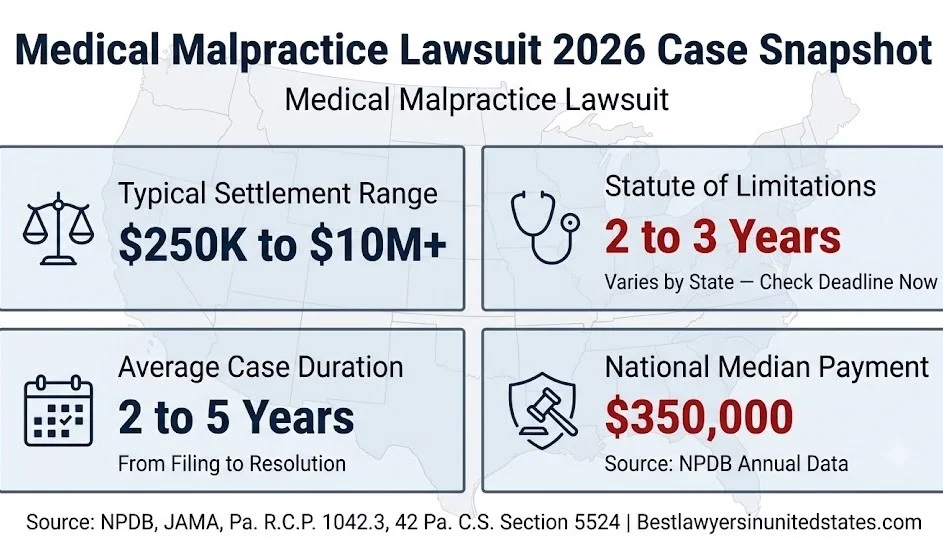
- What it may be worth: Settlements and verdicts range from $250,000 for moderate injury cases to more than $10 million for severe birth injuries, catastrophic surgical errors, or wrongful death, depending on the state, the injury category, and applicable damage caps.
Case Snapshot
| Detail | Information |
|---|---|
| Case Type | Individual civil tort claim (not a class action) |
| Governing Court | State civil court in the jurisdiction where the malpractice occurred |
| Philadelphia Venue | Philadelphia Court of Common Pleas, Major Trial Division / Complex Litigation Center |
| Pennsylvania Pre-Suit Requirement | Certificate of Merit under Pa. R.C.P. 1042.3 (within 60 days of filing) |
| Pennsylvania Statute of Limitations | 2 years from date of discovery, 42 Pa. C.S. Section 5524 |
| Average Case Duration | 2 to 5 years from filing to resolution |
| Typical Settlement Range | $250,000 to $10 million+ depending on injury category |
| Damage Caps | Vary by state; California caps non-economic damages at $350,000 (2026 adjusted); Texas caps at $250,000 per defendant |
| Expert Witness Requirement | Required in virtually all states to establish standard of care |
Medical malpractice lawsuits represent one of the most procedurally demanding categories of civil litigation in the American legal system. The evidentiary threshold is high, the timelines are long, and the procedural requirements vary sharply from state to state.
According to data published by the National Practitioner Data Bank, medical malpractice payments have totaled more than $5 billion annually in recent years, distributed across tens of thousands of resolved claims. Despite that volume, fewer than 2 percent of patients who experience adverse medical events ultimately file a claim.
The gap between harm and litigation is primarily a function of complexity. Malpractice cases require expert testimony, medical record analysis, and a direct causal chain between a provider’s conduct and a patient’s injury.
For anyone evaluating whether to pursue a medical malpractice lawsuit, understanding the full legal picture before the statute of limitations expires is not optional. It is the starting point.
What Is a Medical Malpractice Lawsuit?
A medical malpractice lawsuit is a civil tort action filed against a healthcare provider who deviated from the accepted standard of care and caused quantifiable patient harm as a direct result. The provider can be a physician, surgeon, nurse, hospital, pharmacy, or any licensed healthcare entity.
The legal framework requires proof of four distinct elements. Each must be established, typically through expert testimony, before a court will allow the case to proceed to trial.
The four required elements are: (1) the existence of a professional duty owed to the patient; (2) a breach of that duty through deviation from the accepted standard of care; (3) a direct causal link between the breach and the patient’s injury; and (4) measurable damages resulting from that injury.
The four elements of a medical malpractice claim:
| Element | Legal Meaning | How It Is Proved |
|---|---|---|
| Duty | Provider-patient relationship established | Medical records, billing records, treatment documentation |
| Breach | Deviation from accepted standard of care | Expert witness testimony from same specialty |
| Causation | Breach directly caused the harm | Medical expert, treating physician records |
| Damages | Quantifiable physical, financial, or emotional harm | Medical bills, lost wage records, life care plans |
Attorney Insight: Attorneys handling these claims point to causation as the element most frequently contested by defense experts. Proving that the provider’s breach specifically caused the harm, rather than the underlying medical condition, requires a level of medical and legal analysis that distinguishes winning cases from dismissed ones.
What Qualifies as Medical Malpractice?
Medical malpractice is conduct by a licensed healthcare provider that falls below the standard of care accepted in the medical community for that specialty, under those circumstances, resulting in patient harm. Not every bad medical outcome qualifies.
A poor outcome from a properly performed procedure is not malpractice. The legal question is whether the provider acted as a reasonably competent professional in the same specialty would have acted under the same conditions.
The most frequently litigated categories of qualifying conduct are consistent across jurisdictions and supported by published medical and legal research.
Qualifying categories of medical malpractice:
- Surgical errors: Wrong-site surgery, unintended organ damage, retained surgical instruments, anesthesia errors
- Misdiagnosis or delayed diagnosis: Failure to diagnose cancer, stroke, myocardial infarction, or other time-sensitive conditions
- Medication errors: Incorrect drug, incorrect dosage, failure to check for contraindications or allergies
- Birth injuries: Failure to perform timely C-section, improper use of forceps or vacuum, failure to monitor fetal distress
- Failure to obtain informed consent: Performing a procedure without adequately disclosing risks the patient would have considered material
- Post-operative negligence: Failure to monitor, inadequate discharge instructions, premature discharge leading to complications
What does NOT qualify:
- Adverse outcomes from properly performed procedures with disclosed risks
- Diagnostic disagreements where the chosen approach was within a reasonable range of professional practice
- Patient non-compliance as the primary cause of harm
Attorney Insight: Attorneys handling these claims point to the distinction between a bad outcome and a negligent outcome as the most important initial filter in case evaluation. The standard of care, not the result, is what litigation turns on.
Notable Medical Malpractice Lawsuit Cases
Published verdicts and settlements from publicly reported medical malpractice cases illustrate the range of recovery available across different injury categories and jurisdictions.
In 2023, a Philadelphia jury returned a verdict of $183 million in a birth injury case involving a failure to perform a timely C-section at a major Philadelphia hospital system. That verdict, one of the largest in Pennsylvania history, reflected catastrophic lifetime care costs for a child with cerebral palsy.
According to Jury Verdict Research and CRICO Strategies data, the median malpractice payment nationally falls between $350,000 and $400,000, but cases involving permanent disability, birth injury, or wrongful death regularly exceed $1 million at verdict.
Publicly reported high-value malpractice verdicts and settlements by category:
| Case Category | Reported Range | Notable Jurisdiction |
|---|---|---|
| Birth injury / cerebral palsy | $5M to $200M+ | Pennsylvania, New York, Florida |
| Surgical error (major organ) | $1M to $20M | National |
| Cancer misdiagnosis | $500K to $5M | National |
| Anesthesia error / death | $1M to $10M | National |
| Medication error / death | $500K to $3M | National |
| Failure to diagnose stroke | $500K to $7M | National |
Attorney Insight: Attorneys handling these claims point to publicly reported verdicts as useful benchmarks but caution that state damage caps frequently reduce jury awards post-verdict. A $10 million jury verdict in California may be reduced to the statutory cap on non-economic damages before the judgment is entered.
Litigation Watch: What qualifies as malpractice, how courts categorize the harm, and what verdict data shows about recovery ranges all depend on injury type and state law. Each of those variables must be assessed before any realistic case evaluation can occur.
How Long Does a Medical Malpractice Lawsuit Take?
A medical malpractice lawsuit takes an average of two to five years from the date of filing to final resolution, though cases involving catastrophic injuries or multiple defendants regularly extend beyond five years.
The duration is driven by several mandatory phases that cannot be compressed without court approval. Expert witness identification and deposition alone can consume six to twelve months. Discovery in complex cases involving large hospital systems may take two years before trial is scheduled.
According to data from state court administrative offices and published studies in the Journal of the American Medical Association (JAMA), the median time from claim filing to resolution in resolved malpractice cases is approximately three to four years nationally.
Factors that extend case duration:
- Multiple defendants (hospital, physician, anesthesiologist, nursing staff)
- Catastrophic injury requiring life care planning experts
- Disputes over causation requiring multiple expert depositions
- State court backlogs in high-volume jurisdictions (Philadelphia, New York, Los Angeles)
- Defense tactics including Daubert challenges to plaintiff’s expert witnesses
- Appeals following unfavorable trial rulings
Factors that shorten case duration:
- Clear liability with strong documentary evidence
- Single defendant and single treatment episode
- Early settlement discussions after expert reports are exchanged
- Mediation before trial
Attorney Insight: Attorneys handling these claims point to the pre-suit investigation phase as time not counted in the official litigation clock. Cases that take three years to resolve often took six to twelve months of pre-filing investigation before the complaint was ever filed.
What Is the Medical Malpractice Lawsuit Timeline?
The medical malpractice lawsuit timeline begins before a complaint is ever filed and extends through resolution, which may be settlement, trial verdict, or appeal.
Pre-filing preparation is the first phase. Attorneys obtain and review medical records, consult with medical experts, and assess whether the standard of care was breached. In states with pre-suit notice requirements, that notice must be served before filing.
The post-filing phases follow a structured sequence governed by state rules of civil procedure. Each phase has its own timeline requirements, which vary by jurisdiction.
Detailed medical malpractice lawsuit timeline:
| Phase | Typical Duration | Key Events |
|---|---|---|
| Pre-filing investigation | 3 to 12 months | Medical record review, expert consultation, pre-suit notice (where required) |
| Complaint filing and service | 1 to 3 months | Complaint filed; defendant served; certificate of merit filed (PA: 60 days) |
| Defendant’s response | 30 to 60 days | Answer or motion to dismiss filed |
| Discovery phase | 12 to 24 months | Depositions, interrogatories, expert witness designation |
| Expert witness reports | 6 to 12 months | Standard of care reports; causation and damages experts retained |
| Motions practice | 3 to 6 months | Summary judgment motions; Daubert challenges to experts |
| Trial | 1 to 4 weeks | Jury selection, opening arguments, expert testimony, verdict |
| Post-trial motions / appeals | 6 to 24 months | Motions for new trial; appellate review if verdict is appealed |
Attorney Insight: Attorneys handling these claims point to the discovery phase as the period most likely to produce settlement. Once expert reports are exchanged and each side can assess the strength of the opposing position, the majority of malpractice cases resolve before reaching trial.
What Is the Medical Malpractice Lawsuit Process?
The medical malpractice lawsuit process moves through a defined sequence of stages that begins with the attorney’s initial case assessment and ends with resolution. Each stage serves a specific legal function.
Case intake and investigation is the foundation. The attorney’s first task is obtaining complete medical records from all treating providers. Those records are then reviewed by a consulting medical expert in the same specialty as the defendant provider.
If the expert concludes the standard of care was breached and causation exists, the attorney files the complaint in the appropriate state court. From that point, the procedural requirements of the jurisdiction govern every subsequent step.
The medical malpractice process at a glance:
- Stage 1: Initial client consultation and medical history review
- Stage 2: Medical record collection and physician chart analysis
- Stage 3: Independent expert review of standard of care
- Stage 4: Pre-suit requirements (notice of intent, certificate of merit, medical review panel, depending on state)
- Stage 5: Complaint drafted and filed in state civil court
- Stage 6: Service of process on defendant(s) and their insurance carriers
- Stage 7: Discovery (depositions, requests for production, interrogatories)
- Stage 8: Expert witness designation and report exchange
- Stage 9: Motions practice (summary judgment, Daubert hearings)
- Stage 10: Settlement negotiations or trial
- Stage 11: Verdict, appeal, or settlement agreement and release execution
Attorney Insight: Attorneys handling these claims point to Stage 3, the independent expert review, as the true gatekeeping function of malpractice litigation. Cases that cannot secure a credible expert opinion on breach of the standard of care do not advance past this stage.
Litigation Watch: The timeline, process, and procedural requirements for a medical malpractice lawsuit are not uniform across states. Pennsylvania, California, Texas, and Florida each impose materially different pre-suit hurdles that directly affect when and how a case can be filed.
What Are the Steps in a Medical Malpractice Lawsuit?
The specific steps in a medical malpractice lawsuit follow the same general sequence but include state-specific procedural requirements at the filing stage. Understanding the steps in order prevents the most common cause of case failure: missing a mandatory pre-suit deadline or filing requirement.
Step one is retaining a qualified attorney who specializes in medical malpractice. The attorney then conducts the pre-filing investigation described above.
Step two involves state-mandated pre-suit requirements. These differ significantly across jurisdictions and must be completed before a valid complaint can be filed.
Pre-suit requirements by state:
| State | Pre-Suit Requirement | Deadline |
|---|---|---|
| Pennsylvania | Certificate of Merit (Pa. R.C.P. 1042.3) | Within 60 days of filing complaint |
| Florida | Notice of intent to sue; 90-day pre-suit screening | Before filing complaint |
| Texas | Expert report within 120 days of filing | Post-filing requirement |
| California | No pre-suit notice required (MICRA applies to damages) | N/A |
| New York | Certificate of merit or attorney affirmation | At or before filing |
| Illinois | Affidavit of merit with expert consultation | At filing |
Step three is formal filing and service. The complaint must identify the defendant(s), specify the acts or omissions constituting negligence, allege causation, and state the damages sought.
Attorney Insight: Attorneys handling these claims point to the certificate of merit and expert affidavit requirements as the most common technical failure point. A complaint filed without the required supporting documentation is subject to dismissal with prejudice in many jurisdictions.
How Long Do You Have to File a Medical Malpractice Lawsuit?
You typically have two to three years from the date of injury or discovery to file a medical malpractice lawsuit, but the precise window depends entirely on the state where the malpractice occurred. Filing even one day after the deadline permanently bars the claim.
The discovery rule modifies the limitations period in most states. Under the discovery rule, the clock begins when the patient knew or reasonably should have known about the injury and its potential connection to medical negligence, rather than the date of the procedure.
Tolling provisions exist for specific circumstances. The limitations period is typically tolled for minors until they reach the age of majority, for patients with qualifying mental incapacity, and in some states, for fraudulent concealment of the malpractice.
Statutes of limitations for filing a medical malpractice lawsuit by state:
| State | Standard Limitations Period | Discovery Rule | Minor Tolling |
|---|---|---|---|
| Pennsylvania | 2 years (42 Pa. C.S. 5524) | Yes | Age of majority (18) |
| California | 3 years from injury or 1 year from discovery | Yes | Age of majority |
| New York | 2.5 years from act or omission | Limited | Age of majority |
| Texas | 2 years from occurrence | Limited | Age 12 (then 2 more years) |
| Florida | 2 years from discovery | Yes | Age of majority |
| Illinois | 2 years from discovery; 4-year repose period | Yes | Age of majority |
Attorney Insight: Attorneys handling these claims point to the repose period as a statute of limitations trap. Even where the discovery rule would otherwise extend the filing window, statutes of repose impose an absolute outer deadline, typically four to six years from the act of malpractice, beyond which no claim is permitted regardless of when it was discovered.
What Is the Statute of Limitations for a Medical Malpractice Lawsuit?
The statute of limitations for a medical malpractice lawsuit is the legally mandated deadline by which a plaintiff must file their complaint in court or permanently lose the right to sue. It operates as an absolute bar to relief once expired.
In Pennsylvania, the statute of limitations is two years from the date the patient knew or should have known about the malpractice, governed by 42 Pa. C.S. Section 5524. The Pennsylvania MCARE Act also imposes specific notice and expert requirements that interact with the limitations period.
In California, the limitations period is three years from the injury or one year from discovery, whichever comes first, under the Medical Injury Compensation Reform Act (MICRA). California’s 2022 amendment to MICRA extended the limitations period from one to three years prospectively.
Critical limitations period rules:
- The clock starts on the date of discovery, not necessarily the date of the procedure
- Fraudulent concealment by the provider may toll the period
- Government-employed physicians (VA hospitals, public university hospitals) may trigger shorter notice-of-claim deadlines of 60 to 180 days
- Wrongful death claims have separate limitations periods, typically two years from the date of death
Attorney Insight: Attorneys handling these claims point to claims against government-employed healthcare providers as a separate and faster-moving limitations scenario. A patient treated at a VA facility or public hospital who waits the full state limitations period may have already missed the government tort claims act notice deadline.
Litigation Watch: The statute of limitations is not a procedural technicality. It is the single most common reason valid malpractice claims are never pursued. Any patient who believes they experienced malpractice should consult an attorney immediately, not after waiting to see how their condition develops.
How Do Medical Malpractice Lawsuits Vary by State?
Medical malpractice lawsuits vary significantly by state across three dimensions: the limitations period, the pre-suit procedural requirements, and the caps on recoverable damages. Those three variables together determine the practical value and procedural complexity of any given claim.
States with tort reform legislation impose caps on non-economic damages, which directly limit recovery for pain and suffering, loss of consortium, and emotional distress even when liability is clear and economic damages are substantial.
California’s MICRA cap on non-economic damages was $250,000 from 1975 through 2022. A 2022 amendment raised it to $350,000 for non-death cases and $500,000 for wrongful death cases as of 2026, with annual inflation adjustments through 2033. Texas caps non-economic damages at $250,000 per physician defendant and $250,000 per healthcare institution, for a maximum of $500,000 in a single case.
State-by-state malpractice framework comparison:
| State | Limitations Period | Pre-Suit Requirement | Non-Economic Cap (2026) |
|---|---|---|---|
| Pennsylvania | 2 years | Certificate of Merit (60 days post-filing) | No cap |
| California | 3 years / 1 year from discovery | None | $350,000 (non-death) / $500,000 (death) |
| New York | 2.5 years | Certificate of merit | No cap |
| Texas | 2 years | Expert report (120 days post-filing) | $250,000 per physician; $250,000 per institution |
| Florida | 2 years from discovery | 90-day pre-suit screening | $500,000 (practitioners) / $750,000 (non-practitioners) |
| Illinois | 2 years / 4-year repose | Affidavit of merit at filing | No cap (caps struck down as unconstitutional) |
Attorney Insight: Attorneys handling these claims point to no-cap states like Pennsylvania, New York, and Illinois as significantly more valuable venues for catastrophic injury cases. A case worth $8 million in non-economic damages produces a full recovery in Pennsylvania but is capped at $250,000 in Texas.
What Are Typical Medical Malpractice Lawsuit Settlement Amounts?
Typical medical malpractice lawsuit settlement amounts range from $250,000 to more than $1 million for the majority of resolved claims, with significant variation based on injury severity, the state’s damage cap rules, and the strength of the causation evidence.
According to the National Practitioner Data Bank, the median malpractice payment nationally was approximately $350,000 in the most recently published annual data. That median masks substantial variation at the high end, where catastrophic birth injury and surgical error cases routinely settle in the range of $2 million to $20 million.
Settlements occur at a higher rate than verdicts. Approximately 70 to 80 percent of malpractice cases that proceed past initial filing resolve through settlement before trial. The settlement amount reflects both sides’ assessment of the risk and cost of trial.
Typical settlement ranges by malpractice category:
| Malpractice Category | Typical Settlement Range | Notes |
|---|---|---|
| Misdiagnosis (moderate harm) | $250K to $750K | Delayed diagnosis of cancer, infection |
| Surgical error (non-catastrophic) | $400K to $2M | Retained instruments, nerve damage |
| Anesthesia error | $500K to $3M | Includes awareness, overdose, death |
| Birth injury (cerebral palsy, HIE) | $3M to $20M+ | Life care costs drive value |
| Medication error (death) | $500K to $2M | Depends on decedent’s age and income |
| Failure to diagnose stroke or MI | $500K to $5M | Permanent disability factor |
| Wrongful death (adult breadwinner) | $1M to $10M+ | Lost income projection is key driver |
Attorney Insight: Attorneys handling these claims point to the life care plan as the single document that most directly drives settlement value in catastrophic injury cases. A well-supported life care plan documenting the cost of future medical needs, attendant care, and adaptive equipment often determines whether a case settles for $2 million or $15 million.
How Much Is a Medical Malpractice Lawsuit Worth?
The value of a medical malpractice lawsuit is determined by the total of three damage categories: economic damages, non-economic damages, and in rare cases, punitive damages. The applicable state damage cap then applies as a ceiling on non-economic recovery.
Economic damages are calculated with actuarial precision. They include past and future medical expenses, lost wages, reduced earning capacity, and the cost of long-term care. These damages are not capped in any state.
Non-economic damages, including pain and suffering, loss of enjoyment of life, and emotional distress, are where state caps impose their most significant limitation. In a catastrophic injury case in a no-cap state, non-economic damages can equal or exceed economic damages.
Value calculation framework:
| Damage Category | Calculation Method | Capped? |
|---|---|---|
| Past medical expenses | Actual bills incurred | No |
| Future medical expenses | Life care plan x actuarial life expectancy | No |
| Lost wages (past) | Actual lost income | No |
| Lost earning capacity (future) | Economic expert projection | No |
| Pain and suffering | Jury assessment / multiplier method | Yes (in cap states) |
| Loss of consortium | Jury assessment | Yes (in cap states) |
| Punitive damages | Jury award for egregious conduct | Capped or unavailable in most states |
Bold callout: A catastrophic birth injury case in Pennsylvania, with no cap on non-economic damages, may produce a total verdict of $10 million to $200 million. The same case in Texas is capped at $500,000 in non-economic damages regardless of jury determination.
Attorney Insight: Attorneys handling these claims point to the economic damages component as frequently undervalued by plaintiffs who focus on the pain and suffering element. In catastrophic cases, a properly documented life care plan and economic projection often exceed the non-economic damages in total value.
What Do Medical Malpractice Lawsuit Verdicts Look Like?
Medical malpractice lawsuit verdicts reflect the jury’s findings on liability and damages after trial. They are public records accessible through state court administrative offices and legal research databases.
Verdict outcomes in malpractice cases favor defendants more often than plaintiffs at trial. According to published research from JAMA and CRICO Strategies, defendants win approximately 50 to 60 percent of malpractice cases that proceed to jury verdict. That asymmetry reflects the high evidentiary burden plaintiffs must meet, not the merits of the underlying claims.
Among plaintiff victories, verdict amounts vary enormously. Moderate injury verdicts commonly fall in the $500,000 to $2 million range. Verdicts in catastrophic birth injury cases in states without caps regularly reach $10 million to $200 million, though such verdicts are frequently reduced on post-trial motion or appeal.
Verdict outcome data from published research:
| Outcome | Approximate Frequency |
|---|---|
| Defendant wins at trial | 50% to 60% |
| Plaintiff wins at trial | 40% to 50% |
| Plaintiff verdict reduced by cap post-trial | Common in Texas, California |
| Plaintiff verdict appealed and reduced | Occurs in 15% to 20% of large verdicts |
| Case settles before verdict (out of all filed) | 70% to 80% |
Attorney Insight: Attorneys handling these claims point to the defendant win rate as a reason experienced malpractice attorneys are selective about which cases they take to trial. Cases with clear liability, strong causation, and quantifiable catastrophic harm are far more likely to produce plaintiff verdicts than cases where causation is contested by multiple defense experts.
Litigation Watch: Settlement amounts, verdict data, and damage cap rules collectively reveal why the venue where a malpractice case is filed materially affects its value. A case with the same facts produces a different outcome in Pennsylvania than in Texas, and Philadelphia’s specific court mechanics add another layer of strategic consideration.
How Does a Medical Malpractice Lawsuit Work in Philadelphia?
A medical malpractice lawsuit in Philadelphia is filed in the Philadelphia Court of Common Pleas, Major Trial Division, which handles civil cases above $50,000 in claimed damages. High-value, complex malpractice cases are assigned to the Complex Litigation Center, which operates under distinct case management procedures designed to manage the largest and most technically complex cases in the Pennsylvania court system.
Philadelphia has a historically plaintiff-favorable reputation in malpractice litigation. Several of the largest malpractice verdicts in Pennsylvania history have come out of Philadelphia juries. That reputation influences both the volume of cases filed in Philadelphia and the settlement leverage plaintiffs’ attorneys carry in pre-trial negotiations.
Pennsylvania’s pre-suit requirements apply uniformly to all Philadelphia filings. The Certificate of Merit under Pa. R.C.P. 1042.3 must be filed within 60 days of the complaint. It must be signed by the attorney and confirm that a licensed professional in the appropriate specialty has reviewed the case and determined that the care fell below the standard.
Philadelphia-specific malpractice filing framework:
| Factor | Philadelphia Detail |
|---|---|
| Court | Philadelphia Court of Common Pleas, Major Trial Division |
| Complex cases | Complex Litigation Center (CLC), assigned by court administration |
| Filing venue requirement | Malpractice occurred in Philadelphia County OR defendant resides/practices there |
| Pre-suit requirement | Certificate of Merit, Pa. R.C.P. 1042.3, within 60 days of filing |
| Statute of limitations | 2 years from discovery, 42 Pa. C.S. Section 5524 |
| Damage caps | None in Pennsylvania |
| MCARE Act applicability | Governs expert qualifications, venue, and medical records disclosure |
Pennsylvania MCARE Act highlights relevant to Philadelphia filings:
- Requires defense experts to be in the same specialty as the defendant physician
- Mandates that cases be filed in the county where the cause of action arose or where the defendant has a principal office
- Governs the scope of peer review privilege protecting hospital quality assurance records from discovery
Attorney Insight: Attorneys handling these claims point to Philadelphia’s lack of a damage cap as the central strategic reason why catastrophic injury malpractice cases from across Pennsylvania are sometimes structured to establish venue in Philadelphia. When non-economic damages in a birth injury case can reach eight figures, the absence of a cap is a material case-value variable.
What Type of Attorney Handles a Medical Malpractice Lawsuit?
Medical malpractice lawsuits are handled by plaintiff-side personal injury attorneys who specialize exclusively or primarily in medical negligence litigation. This is a distinct subspecialty, not a case type handled by general personal injury practitioners.
The complexity of malpractice cases requires attorneys who maintain relationships with qualified medical experts across surgical specialties, internal medicine, obstetrics, radiology, and nursing practice. The ability to retain credible, board-certified experts in the defendant’s specific specialty is frequently what determines whether a case can be brought at all.
Most malpractice attorneys operate on a contingency fee basis, typically 33 to 40 percent of the gross recovery. Cases that require significant expert investment before trial may involve higher contingency rates to cover the pre-trial costs, which can reach $50,000 to $250,000 in complex cases.
What to look for in a medical malpractice attorney:
- Exclusive or primary focus on medical negligence litigation
- Verifiable trial experience in the specific court where your case will be filed
- Established relationships with qualified medical experts in the relevant specialty
- Familiarity with the specific pre-suit requirements in your state
- Track record of verdicts and settlements in cases comparable to yours
Attorney fee structures in malpractice cases:
| Fee Model | Typical Range | When Used |
|---|---|---|
| Contingency fee (standard) | 33% to 40% of recovery | Majority of plaintiff malpractice cases |
| Higher contingency (complex) | 40% to 45% | Cases requiring substantial pre-trial expert investment |
| Sliding scale contingency | 25% pre-trial / 33% at trial / 40% on appeal | Some jurisdictions and firms |
| Hourly (rare for plaintiffs) | $300 to $600 per hour | Unusual; primarily defense-side billing model |
Attorney Insight: Attorneys handling these claims point to the front-end expert cost as the primary barrier to case acceptance at most plaintiff firms. A strong liability case with modest damages may not be economically viable for the attorney to take on contingency if the projected recovery does not justify the required expert investment.
Frequently Asked Questions
How long does a medical malpractice lawsuit take to resolve?
A medical malpractice lawsuit takes an average of two to five years from filing to final resolution.
Cases involving multiple defendants, catastrophic injuries, or complex causation disputes regularly extend beyond five years.
Cases that settle before trial typically resolve faster, often within two to three years from filing.
What is the statute of limitations for a medical malpractice lawsuit?
The statute of limitations varies by state and is typically two to three years from the date of injury or discovery.
Pennsylvania imposes a two-year limitations period under 42 Pa. C.S. Section 5524, running from the date the patient knew or should have known about the malpractice.
Claims against government-employed physicians may require a separate notice of claim within 60 to 180 days, which operates independently of the general limitations period.
How much is the average medical malpractice lawsuit worth?
The national median malpractice payment is approximately $350,000, according to National Practitioner Data Bank data.
Cases involving catastrophic birth injuries, wrongful death, or permanent disability regularly produce settlements and verdicts of $2 million to $20 million or more.
State damage caps significantly reduce non-economic damage recovery in Texas, California, and other tort reform states regardless of the jury’s verdict amount.
What qualifies as medical malpractice under the law?
Medical malpractice is any act or omission by a licensed healthcare provider that deviates from the accepted standard of care and directly causes measurable patient harm.
The four required legal elements are duty, breach of the standard of care, causation, and damages, all of which must be established through expert testimony in virtually every jurisdiction.
A poor medical outcome without a breach of the standard of care does not qualify, regardless of how severe the harm.
What is a Certificate of Merit and when is it required?
A Certificate of Merit is a legal document filed by the plaintiff’s attorney confirming that a licensed professional in the relevant specialty has reviewed the case and determined that the care fell below the standard.
In Pennsylvania, it is required under Pa. R.C.P. 1042.3 and must be filed within 60 days of the initial complaint.
Several other states including New York and Illinois have equivalent affidavit-of-merit requirements that must be filed at or shortly after the complaint.
How do I find the right attorney for a medical malpractice lawsuit?
The right attorney for a medical malpractice lawsuit is one who specializes specifically in medical negligence, maintains access to qualified expert witnesses in the relevant specialty, and has documented trial experience in your jurisdiction.
General personal injury attorneys without specific malpractice experience lack the expert networks and procedural knowledge these cases require.
An initial consultation with a malpractice specialist is the first step, and most plaintiff malpractice attorneys offer that consultation at no charge under the contingency fee model.
Closing
Medical malpractice litigation is among the most technically demanding areas of civil law. The procedural requirements, expert testimony obligations, and state-specific rules for filing, damage recovery, and pre-suit notice are not features a patient can manage without qualified legal guidance.
The statute of limitations is real and unforgiving. Every day that passes after the triggering event is a day off the clock.
If you believe a healthcare provider’s conduct caused you or a family member measurable harm, the right move is a consultation with a plaintiff-side medical malpractice attorney in your jurisdiction, not a general practitioner, and not after waiting to see how things develop. These attorneys evaluate cases at no upfront cost and can tell you within an initial consultation whether your situation warrants pursuit.
