
Quick Answer Box
- What the case is: Thousands of passengers have sued Uber Technologies, alleging the company failed to properly screen drivers and allowed serial sexual misconduct to occur across its platform.
- Who qualifies: Passengers who experienced sexual assault, rape, sexual battery, or unwanted sexual contact by an Uber driver, typically while using the app for a ride.
- What it may be worth: Compensation varies by injury category. Estimates for serious assault claims range from $150,000 to over $1 million, depending on severity, documentation, and case-specific facts.
Case Snapshot
| Detail | Information |
|---|---|
| Case Name | In re: Uber Technologies, Inc., Passenger Sexual Assault Litigation |
| Court | U.S. District Court, Northern District of California |
| MDL Number | MDL No. 3084 |
| Presiding Judge | Judge Charles Breyer |
| MDL Consolidation Date | December 2023 |
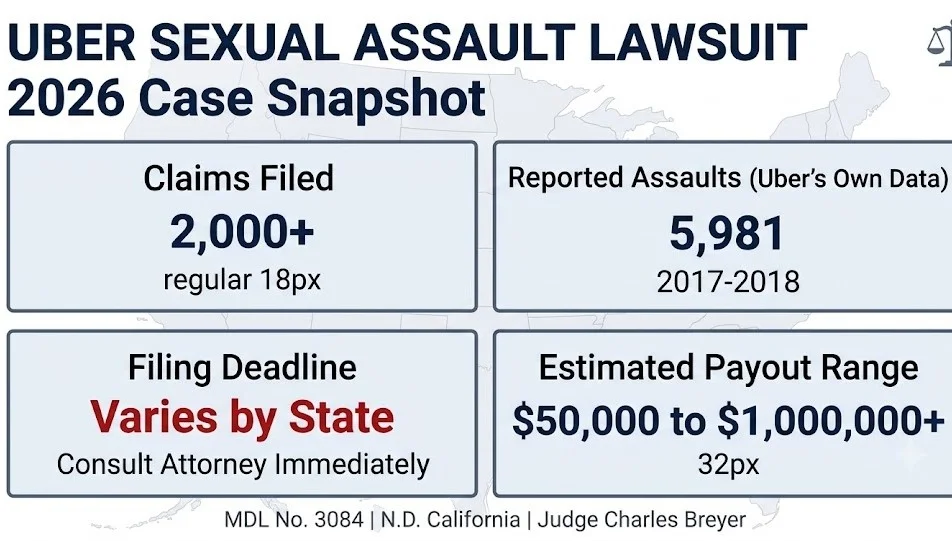
| Estimated Claims Filed | 2,000+ as of early 2026 (actively growing) |
| Settlement Fund | No global settlement announced as of publication |
| Status | Active MDL discovery; bellwether trial preparation ongoing |
| Primary Legal Theory | Negligent hiring, negligent retention, failure to warn |
Uber Technologies faces one of the most significant sexual assault litigations in the history of the rideshare industry. The uber sexual assault lawsuit, consolidated as MDL No. 3084 in the Northern District of California, now encompasses more than 2,000 individual claims from passengers who allege they were sexually assaulted, raped, or otherwise abused by Uber drivers while using the platform.
What sets this litigation apart is scale and documentation. Uber’s own 2019 and 2022 US Safety Reports disclosed thousands of reported sexual assault incidents occurring on its platform. Those disclosures became central evidence in plaintiff filings.
The litigation is not a class action. Each plaintiff’s claim is evaluated individually. That distinction matters when calculating what any one survivor may recover.
Bellwether trials, the test cases courts use to gauge jury responses before broader resolution, have not yet concluded as of early 2026. That means the litigation is at a pivotal procedural stage.
What Is the Uber Sexual Assault Lawsuit?
The Uber sexual assault lawsuit refers to consolidated federal litigation brought by passengers who allege Uber failed to protect them from driver-perpetrated sexual violence. The claims are civil, not criminal. They target Uber as a corporate entity, not individual drivers, through legal theories of negligent hiring, negligent supervision, and negligent retention.
Plaintiffs argue Uber knew, or should have known, that inadequate background checks and insufficient driver monitoring created foreseeable risk to passengers.
Uber’s own published data supported those arguments. The 2019 US Safety Report acknowledged more than 3,000 sexual assault incidents reported on the platform between 2017 and 2018 alone.
Key Allegations in the Litigation:
- Uber failed to conduct adequate criminal background checks before approving drivers
- The company did not remove drivers after assault complaints
- Uber’s background check vendor missed disqualifying criminal records
- Passengers received no warnings about assault risk from known offenders
Attorney Insight: Attorneys handling these claims consistently identify Uber’s own safety reports as the strongest documentary foundation for establishing the company’s prior knowledge of systemic risk.
| Allegation Category | Legal Theory Applied |
|---|---|
| Inadequate background checks | Negligent hiring |
| Failure to remove accused drivers | Negligent retention |
| No passenger warning system | Failure to warn |
| Inadequate complaint investigation | Negligent supervision |
Uber Sexual Assault Lawsuit 2026: Where Things Stand
As of early 2026, the litigation remains in active discovery within MDL No. 3084. No global settlement has been announced. Judge Charles Breyer continues to manage pretrial coordination in the Northern District of California.
The bellwether trial selection process is the most significant procedural development of the past year. Bellwether cases are chosen to reflect the broader plaintiff pool and tested before a jury to signal how similar claims would resolve at trial.
Plaintiff and defense counsel have been exchanging discovery materials, including internal Uber communications, background check records, and driver complaint logs.
2026 Litigation Status Summary:
| Milestone | Status |
|---|---|
| MDL Consolidation | Completed December 2023 |
| Plaintiff Fact Sheets Filed | Ongoing |
| Discovery Exchange | Active as of Q1 2026 |
| Bellwether Case Selection | In process |
| Bellwether Trials | Not yet scheduled for verdict |
| Global Settlement Talks | Not publicly confirmed |
Attorney Insight: Attorneys representing plaintiffs in MDL proceedings note that bellwether verdicts, once returned, typically accelerate global settlement negotiations substantially.
Claimants who have not yet filed should understand that the window to join this litigation is not indefinite. Statutes of limitations are calculated by state, not by the MDL’s internal schedule.
Uber Sexual Assault Lawsuit Settlement: Is There One?
No global settlement in the Uber sexual assault lawsuit has been publicly confirmed as of early 2026. That is the factually accurate answer. What does exist is a litigation trajectory that plaintiff-side attorneys and legal analysts view as settlement-likely before any single bellwether verdict defines jury expectations for all remaining claims.
This pattern mirrors other major mass tort resolutions. In the Roundup glyphosate litigation, Bayer settled the bulk of claims without a final appellate ruling.
Uber and its defense counsel have strong financial incentive to settle before punitive damages arguments reach a jury. Punitive exposure in sexual assault negligence cases can exceed compensatory damages by multiples.
Why Settlement Has Not Yet Been Announced:
- Bellwether trial results typically anchor settlement valuations
- Plaintiff Steering Committee is still compiling full plaintiff fact sheet data
- Discovery disputes have extended the pretrial timeline
- Uber contests the scope of corporate liability at a structural level
Attorney Insight: Attorneys in this MDL note that the absence of a global settlement does not reduce individual claim value. Cases can still resolve through confidential individual agreements.
Possible Settlement Structure (Based on MDL Precedent):
| Tier | Injury Severity | Estimated Range |
|---|---|---|
| Tier 1 | Rape / Penetrative Assault | $400,000 to $1,000,000+ |
| Tier 2 | Attempted Rape / Forcible Contact | $200,000 to $400,000 |
| Tier 3 | Non-penetrative Sexual Battery | $100,000 to $200,000 |
| Tier 4 | Unwanted Sexual Contact / Groping | $50,000 to $150,000 |
These ranges are based on comparable MDL settlement structures, not confirmed Uber-specific figures.
Uber Assault Lawsuit Settlement Amount: What the Numbers Reflect
The ultimate settlement amount in any individual Uber assault lawsuit claim depends on factors courts and mediators weigh across comparable mass tort frameworks. There is no published Uber-specific payout schedule as of early 2026.
What is known: Uber has quietly resolved some individual cases on confidential terms. Those agreements contain non-disclosure provisions that prevent public disclosure of amounts.
Factors That Affect Individual Settlement Value:
- Nature and severity of the assault (penetrative versus non-penetrative)
- Whether the driver had prior complaints on file with Uber
- Medical records documenting physical and psychological injury
- Psychiatric treatment history post-assault
- Whether law enforcement was notified and a police report was filed
- Whether the driver was convicted criminally
Attorney Insight: Attorneys in similar rideshare mass torts emphasize that documented psychiatric treatment, including therapy and PTSD diagnoses, substantially increases claim valuation.
Comparable Rideshare Assault Litigation Settlements:
| Case Reference | Reported Resolution |
|---|---|
| Lyft Sexual Assault MDL (N.D. Cal.) | Individual settlements reported; no global figure disclosed |
| Individual Uber cases pre-MDL | Some resolved in the $500,000 to $2,000,000 range |
| Comparative gig economy assault claims | Varies widely by injury documentation |
Litigation Watch: The absence of a confirmed global Uber settlement fund does not mean individual claims lack value. Prior knowledge evidence, documented assaults, and Uber’s published safety data collectively create a strong liability foundation for plaintiffs at every injury tier.
Uber Assault Lawsuit Payout Per Person: How Much Could You Receive?
Individual payout per person in the Uber assault lawsuit is not fixed and will not be publicly set until either a global settlement framework is announced or bellwether verdicts establish jury award baselines.
What litigators know from analogous mass tort structures is instructive. The more severe and documented the injury, the higher the individual claim value.
Variables That Drive Per-Person Payout Up:
- Penetrative assault with medical documentation
- PTSD diagnosis and ongoing treatment records
- Multiple prior complaints against the same driver on file with Uber
- Video or app data corroborating the assault timeframe
- Lost wages or career disruption documented
Variables That Create Valuation Challenges:
- Delayed reporting of the incident
- No contemporaneous medical or police records
- Driver’s identity not confirmed through app records
Attorney Insight: Attorneys handling claims in MDL No. 3084 consistently advise clients to gather all Uber trip receipts, app notifications, and any communications with Uber’s support team from the incident period, as these records form the evidentiary core of each claim.
The practical floor for serious claims in this litigation type, based on comparable mass tort outcomes, sits well above $100,000. Top-tier claims with strong documentation have resolved individually in the seven-figure range.
Who Qualifies for the Uber Sexual Assault Lawsuit?
Qualifying for the Uber sexual assault lawsuit requires meeting specific factual criteria tied to the nature of the incident and its connection to Uber’s platform. The legal threshold is civil, not criminal.
A successful conviction against the driver is not required to file. What matters is whether the assault occurred during an Uber-facilitated ride and whether Uber’s negligent practices contributed to the risk.
Core Eligibility Criteria:
- The incident involved an Uber driver operating on the platform
- The assault occurred during or immediately adjacent to an Uber trip
- The claimant was a paying passenger or someone using the Uber app at the time
- The incident falls within the applicable state statute of limitations
- The claimant suffered physical, psychological, or both types of documented harm
Incidents Typically Included in the Litigation:
- Rape or attempted rape by an Uber driver
- Sexual battery during a ride
- Unwanted sexual touching or groping
- Sexual coercion or threats during a trip
Incidents That May Require Additional Analysis:
- Assault by a driver who was not actively logged into the app
- Incidents involving Uber Eats delivery personnel (separate legal pathway)
- Third-party assaults in vehicles where an Uber driver was present but not the perpetrator
Attorney Insight: Attorneys note that even passengers who did not immediately report to police can qualify, provided they can establish the ride occurred through app records and the driver’s identity through Uber account data.
Uber Driver Sexual Assault Lawsuit: How Driver-Specific Claims Work
The uber driver sexual assault lawsuit framework targets Uber as a corporate entity for enabling driver access to passengers despite inadequate vetting. The individual driver is often named as a co-defendant, but Uber’s liability stands on its own negligence theories.
Uber has historically argued that its drivers are independent contractors, not employees. That classification, if accepted, would ordinarily limit employer-level liability. Plaintiff attorneys have challenged this argument on multiple grounds.
Why Contractor Classification Does Not Shield Uber Completely:
- Negligent hiring and negligent entrustment claims apply to companies that contract with third parties
- Uber controlled the background check process for all drivers
- Uber set the platform rules governing passenger access
- Uber received and acted on driver complaint data
Driver-Related Evidence That Strengthens Claims:
| Evidence Type | Relevance to Claim |
|---|---|
| Prior complaints against the specific driver | Establishes Uber’s knowledge of risk |
| Criminal record the background check missed | Establishes screening failure |
| Driver’s termination history on the platform | Establishes negligent retention |
| Trip data matching assault timeline | Corroborates presence and access |
Attorney Insight: Attorneys pursuing Uber driver assault claims note that obtaining the driver’s full Uber employment file, including complaint history, through discovery is frequently the most consequential step in building individual case value.
Litigation Watch: Driver-specific negligence theories and corporate negligent hiring claims are distinct legal pathways. Experienced mass tort attorneys pursue both simultaneously, which typically produces stronger outcomes than either path alone.
Uber Sexual Misconduct Lawsuit: Types of Claims Covered
The term “uber sexual misconduct lawsuit” covers a spectrum of conduct beyond forcible rape. The MDL encompasses claims across multiple categories of sexual misconduct, each with its own legal and evidentiary profile.
Understanding the scope matters because some claimants dismiss their own incidents as “not serious enough” to file. Civil law does not require a specific level of severity to establish a viable claim.
Types of Sexual Misconduct Included in Current Litigation:
- Rape (vaginal, oral, or anal penetration by force or without consent)
- Attempted rape
- Forcible sexual battery
- Groping or unwanted touching of genitals, buttocks, or breasts
- Exposure or masturbation in the driver’s presence
- Sexual coercion or solicitation accompanied by threats
- Photographing or recording passengers without consent in a sexual context
Attorney Insight: Attorneys in this litigation consistently advise that unwanted touching claims, while carrying lower estimated valuations than penetrative assault claims, remain legally viable and have produced meaningful individual recoveries in comparable rideshare litigation.
Claim Type vs. Estimated Valuation Range:
| Misconduct Type | Civil Claim Category | Estimated Value Range |
|---|---|---|
| Rape (penetrative) | Sexual battery / negligence | $400,000 to $1,000,000+ |
| Attempted rape | Sexual battery / negligence | $150,000 to $400,000 |
| Groping / unwanted touch | Sexual battery / negligence | $50,000 to $150,000 |
| Exposure / solicitation | Sexual misconduct / IIED | $30,000 to $100,000 |
MDL 3084: The Uber Sexual Assault Federal Case Explained
MDL No. 3084 is the formal federal docket designation for In re: Uber Technologies, Inc., Passenger Sexual Assault Litigation, consolidated in the U.S. District Court for the Northern District of California. Judge Charles Breyer presides.
The Federal Judicial Panel on Multidistrict Litigation transferred cases from federal courts across the country into this single MDL in December 2023. Consolidation allows pretrial discovery to proceed efficiently across thousands of claims without duplicating effort in each case individually.
How MDL 3084 Functions:
- A Plaintiff Steering Committee coordinates strategy across all plaintiff attorneys
- Each plaintiff submits a Plaintiff Fact Sheet with case-specific details
- Discovery is conducted at the MDL level, including depositions of Uber executives
- Bellwether cases are selected to represent the range of claims
Attorney Insight: Attorneys emphasize that joining MDL No. 3084 does not eliminate a claimant’s individual case. Each plaintiff retains their own attorney and their own right to a separate trial if the MDL does not resolve their claim.
MDL 3084 Key Procedural Facts:
| Fact | Detail |
|---|---|
| MDL Number | 3084 |
| Full Case Name | In re: Uber Technologies, Inc., Passenger Sexual Assault Litigation |
| Court | N.D. California |
| Judge | Charles Breyer |
| Transfer Order Date | December 2023 |
| Claims Included | Federal court sexual assault claims against Uber |
How the Uber Sexual Assault MDL Differs from a Class Action
The uber sexual assault MDL is not a class action. That distinction shapes everything about how survivors receive compensation and how attorneys build individual cases.
In a class action, all plaintiffs share one settlement pool and receive proportional payments. In an MDL, each plaintiff’s claim is valued individually based on their own facts, injuries, and documentation.
MDL vs. Class Action: Core Differences
| Feature | MDL | Class Action |
|---|---|---|
| Individual case value | Yes, case by case | No, shared pool |
| Personal attorney | Yes, each plaintiff has their own | One lead counsel for the class |
| Settlement structure | Individual or group tiers | Single fund distributed proportionally |
| Opt-out rights | Retained | Must opt out to pursue individually |
| Payout timing | Varies by individual case | Uniform for all class members |
This matters enormously for sexual assault survivors. A survivor with a documented rape claim supported by medical records and prior driver complaints should not receive the same payout as a claimant with a less severe incident. The MDL structure preserves that distinction.
Attorney Insight: Attorneys representing plaintiffs in MDL No. 3084 note that survivors who retained counsel early tend to have better-organized discovery submissions, which directly correlates with case valuation outcomes.
Litigation Watch: The MDL structure in this litigation actively favors survivors with strong documentation. Claimants who can produce trip records, medical records, and incident reports consistently achieve higher individual resolutions than those with documentation gaps.
How to File an Uber Sexual Assault Lawsuit in 2026
Filing an Uber sexual assault lawsuit in 2026 requires retaining a plaintiff-side personal injury or mass tort attorney who handles rideshare sexual assault cases specifically. Claimants do not file directly into MDL No. 3084 on their own.
The process begins with attorney intake, followed by evidence gathering, then the preparation and submission of a Plaintiff Fact Sheet to the MDL.
Step-by-Step Filing Process:
- Consult a mass tort or personal injury attorney who handles rideshare sexual assault claims
- Gather all available evidence including Uber trip records, medical records, police reports, and communications with Uber’s support team
- Sign a retainer agreement with your chosen attorney
- Attorney files the complaint in federal court, which is then transferred to MDL No. 3084
- Complete and submit the Plaintiff Fact Sheet with case-specific information
- Participate in discovery as directed by your attorney
Attorney Insight: Attorneys note that claimants should preserve all digital evidence immediately, including screenshots of Uber app trip confirmations, driver ratings, and any direct messages sent to Uber after the incident.
Documents to Gather Before Your First Attorney Meeting:
- Uber trip receipt for the incident date
- Medical records from any post-assault examination or treatment
- Police report or incident report number (if filed)
- Photographs of injuries (if documented)
- Any written communications with Uber support
- Therapy or psychiatric treatment records
Uber Assault Claim Filing Deadline: Time Limits That Apply in 2026
The filing deadline for an Uber assault claim is not set by the MDL. It is governed by each state’s statute of limitations for sexual assault civil claims. Missing the deadline ends eligibility permanently.
State-by-state deadlines vary significantly. Several states have enacted adult survivor acts or extended lookback windows in recent years that may still benefit some claimants in 2026.
State Statute of Limitations Overview for Sexual Assault Civil Claims:
| State | Civil SOL for Sexual Assault | Notes |
|---|---|---|
| California | 10 years from act or 3 years from discovery | California Code of Civil Procedure § 340.16 |
| New York | Adult Survivors Act window closed Nov. 2023 | Standard SOL now applies |
| Texas | 5 years from incident | Civil Practice & Remedies Code § 16.0045 |
| Florida | 7 years from incident | Florida Statutes § 95.11 |
| Illinois | 10 years from incident for adults | 735 ILCS 5/13-202.2 |
| Georgia | 2 years (standard personal injury) | May be extended by discovery rule |
Attorney Insight: Attorneys advise that the discovery rule, which starts the statute of limitations clock when a survivor first connects their injury to Uber’s negligence rather than at the date of assault, has successfully extended eligibility for some claimants who did not initially recognize corporate liability.
If you are uncertain whether your claim is time-barred, consult an attorney immediately. The analysis is fact-specific and cannot be resolved without reviewing your state’s current law and the circumstances of your case.
Uber Sexual Assault Statute of Limitations: State-by-State Survival Guide
The uber sexual assault statute of limitations question is the single most time-sensitive issue for potential claimants in 2026. The answer is never universal. It requires a state-specific analysis.
Several developments in the past three years have reopened windows for some survivors. New York’s Adult Survivors Act created a one-year lookback window in 2022 to 2023. That window has closed. However, other states have passed or are considering similar legislation.
States With Recent Legislative Changes Affecting Sexual Assault Civil SOL:
| State | Legislative Change | Current Status (2026) |
|---|---|---|
| New York | Adult Survivors Act (2022 to 2023 lookback) | Window closed November 2023 |
| California | Unlimited SOL for childhood sexual assault; 10 years for adult claims | Active |
| Arizona | Extended adult SOL to 12 years | Active |
| Michigan | Eliminated SOL for sexual assault claims filed after 2018 | Active for eligible claimants |
Litigation Watch: State statutory changes to sexual assault civil deadlines have expanded the eligible claimant pool in MDL No. 3084. Survivors who previously believed they were time-barred should obtain a state-specific legal opinion before assuming they cannot file.
Attorney Insight: Attorneys flag that the discovery rule application in sexual assault cases is fact-intensive. A claimant who suppressed memory of the incident or did not connect the assault to Uber’s specific negligence until years later may have a colorable argument for a later SOL start date.
The Uber Sexual Assault Bellwether Trial: What It Means for All Claims
The uber sexual assault bellwether trial process is the most consequential procedural event on the current MDL 3084 docket. Bellwether trials are test cases selected to reflect the range of claims in the litigation. Their verdicts signal what juries will do with similar facts.
Judge Charles Breyer oversees the bellwether selection and scheduling process. Plaintiff Steering Committee members and Uber’s defense team submit proposed bellwether candidates from their respective pools.
Why Bellwether Trials Matter:
- A high plaintiff verdict signals that Uber faces catastrophic exposure at trial
- A defense verdict or low award gives Uber leverage in global settlement talks
- Both outcomes typically accelerate settlement discussions
- Jury instructions from bellwether trials set evidentiary precedents for later cases
Attorney Insight: Attorneys experienced in mass tort litigation describe bellwether verdicts as the single most reliable predictor of where global settlement valuations will land. A plaintiff-favorable verdict in one case has historically moved settlement offers upward across entire MDL dockets.
Bellwether Trial Status in MDL 3084 (Early 2026):
| Phase | Status |
|---|---|
| Bellwether candidate pool compiled | Yes |
| Trial court scheduling order issued | Pending public confirmation |
| First bellwether trial date | Not yet publicly announced |
| Expected impact on settlement talks | High, upon verdict |
Uber Assault Lawsuit Update 2026: Current Developments
The most significant Uber assault lawsuit update for 2026 is the continued build-out of the MDL discovery record and the acceleration toward bellwether trial scheduling. The litigation has moved past the foundational consolidation phase.
Uber’s defense strategy has centered on two arguments. First, that drivers are independent contractors, insulating the company from respondeat superior liability. Second, that Uber’s safety improvements since the events alleged by plaintiffs demonstrate ongoing good-faith action.
Plaintiff attorneys have countered on both fronts. Courts in other jurisdictions have rejected independent contractor defenses in gig economy negligence cases. Uber’s post-incident safety changes, plaintiff counsel argues, are admissions of prior inadequacy.
Key 2026 Developments at a Glance:
- MDL discovery continues with depositions of Uber safety personnel
- Plaintiff Fact Sheet completion rates have improved significantly since late 2024
- No global settlement announced, but preliminary mediation sessions have been reported in legal filings
- State court cases in California and other jurisdictions continue to proceed in parallel
- International Uber assault litigation in the United Kingdom and Australia is raising parallel questions about Uber’s global safety protocols
Attorney Insight: Attorneys tracking MDL No. 3084 note that parallel state court litigation, particularly in California where Uber is headquartered, creates additional settlement pressure because state court juries are not bound by federal MDL scheduling orders.
What Has Not Changed in 2026:
- Uber has not admitted liability publicly
- No jury verdict in the MDL has been returned
- Claimants must still meet state-specific filing deadlines
The Uber Safety Report Lawsuit Connection: What Internal Data Showed
The uber safety report lawsuit connection is foundational to understanding why this litigation has such strong liability evidence. Uber’s own published reports documented the scale of assault incidents on its platform before most MDL plaintiffs filed their claims.
The 2019 US Safety Report, released voluntarily by Uber, disclosed that 5,981 sexual assaults were reported on the platform from 2017 to 2018. The 2022 report, covering 2019 to 2020, disclosed an additional 3,824 reports of sexual assault across 141 million trips taken annually.
Attorney Insight: Attorneys in this litigation describe Uber’s safety reports as a rare instance of a defendant corporation voluntarily producing the core liability document. The reports establish that Uber had knowledge of the problem at scale.
Uber Safety Report Key Statistics:
| Report Year | Period Covered | Reported Sexual Assaults | Notable Disclosures |
|---|---|---|---|
| 2019 US Safety Report | 2017 to 2018 | 5,981 | Included 464 reports of rape |
| 2022 US Safety Report | 2019 to 2020 | 3,824 | Included 998 reports of rape |
Why These Reports Strengthen Plaintiff Claims:
- They establish Uber had actual knowledge of widespread driver-perpetrated sexual assault
- They document that Uber was aware of specific incident categories and volumes
- They support arguments that Uber’s background check and monitoring systems were inadequate relative to known risk
- They counter Uber’s argument that assault was unforeseeable
Frequently Asked Questions
What is the Uber sexual assault lawsuit about?
The Uber sexual assault lawsuit is federal mass tort litigation in which thousands of passengers allege Uber failed to protect them from driver-perpetrated sexual violence.
Plaintiffs claim Uber’s inadequate driver screening and failure to remove accused drivers created foreseeable harm.
The litigation is consolidated as MDL No. 3084 in the U.S. District Court for the Northern District of California.
How many people have filed an Uber sexual assault lawsuit?
More than 2,000 individual plaintiffs had joined MDL No. 3084 as of early 2026, and the number continues to grow.
Uber’s own 2019 and 2022 US Safety Reports documented nearly 10,000 total reported sexual assault incidents across the two reporting periods.
Legal analysts expect total claim volume to increase as bellwether trial dates are announced and public awareness expands.
What is the MDL 3084 Uber sexual assault case?
MDL No. 3084 is the formal federal docket designation for In re: Uber Technologies, Inc., Passenger Sexual Assault Litigation, presided over by Judge Charles Breyer in the Northern District of California.
It consolidates sexual assault claims from federal courts nationwide into one pretrial proceeding.
MDL consolidation does not eliminate individual claims. Each plaintiff retains their own attorney and their own right to trial.
How much is the Uber sexual assault lawsuit settlement worth per person?
No global settlement fund has been publicly announced as of early 2026. Individual recoveries in this litigation type range from approximately $50,000 for lower-severity unwanted contact claims to over $1,000,000 for documented rape claims with strong evidentiary support.
Valuation depends on injury severity, documentation, the driver’s complaint history, and state law.
Confidential individual settlements have already occurred in cases that were resolved outside the MDL timeline.
Who qualifies to file an Uber sexual assault lawsuit in 2026?
Passengers who experienced sexual assault, sexual battery, rape, or unwanted sexual contact by an Uber driver during or immediately adjacent to an Uber-facilitated trip qualify.
The assault does not need to have resulted in a criminal conviction. Civil claims require a lower standard of proof than criminal charges.
Claimants must also fall within their state’s applicable statute of limitations for sexual assault civil claims.
What is the filing deadline for the Uber sexual assault lawsuit?
There is no single universal filing deadline. Deadlines are governed by each state’s statute of limitations for sexual assault civil claims, which range from two to twelve years from the incident date depending on jurisdiction.
Several states, including California, Michigan, and Arizona, have enacted extended deadlines or eliminated SOLs for adult sexual assault civil claims.
Claimants who are uncertain about their deadline should consult a mass tort attorney immediately, as missing the state deadline eliminates eligibility permanently.
Closing
MDL No. 3084 represents one of the most document-rich mass tort litigations against a consumer platform company in recent memory. Uber’s own safety reports provide a liability foundation that plaintiff attorneys in comparable cases rarely encounter. The litigation will move faster once bellwether trials produce verdicts.
Survivors who experienced assault by an Uber driver should consult an attorney who handles rideshare sexual assault claims specifically. State filing deadlines are the controlling factor for whether a claim can still be filed in 2026. An attorney can assess your state-specific eligibility and the evidentiary strength of your claim during a confidential review.
