
If you’re considering divorce in Georgia, one of your first questions is probably about cost. The answer depends on several factors, but here’s what you need to know upfront: an uncontested divorce in Georgia typically costs between $1,500 and $3,500 with an attorney, while a contested divorce can range from $15,000 to $30,000 or more. DIY divorces can cost as little as $300 to $500 if you qualify.

Quick Cost Overview:
| Divorce Type | Average Total Cost | Timeline |
|---|---|---|
| DIY Uncontested (no children) | $300 – $500 | 31-60 days |
| Uncontested with Attorney | $1,500 – $3,500 | 31-90 days |
| Uncontested with Children | $2,500 – $5,000 | 45-90 days |
| Contested (moderate complexity) | $15,000 – $25,000 | 6-12 months |
| High-Conflict Contested | $30,000 – $50,000+ | 12-24+ months |
| Mediated Divorce | $5,000 – $10,000 | 3-6 months |
The biggest factors affecting your divorce cost in Georgia are whether your divorce is contested or uncontested, whether you have minor children, the complexity of your assets, and how well you and your spouse can communicate.
Divorce Cost Calculator
Get an estimated cost for your divorce based on your specific situation
Your Estimated Divorce Cost
Cost Breakdown
📧 Get a Personalized Consultation
Have questions about your specific situation? Contact our legal experts for guidance tailored to your needs.
Contact Us via EmailUse our free calculator to estimate your specific divorce costs based on your situation. Input your county, whether you have children, asset complexity, and dispute level to get a personalized cost range.
The Average Cost of Divorce in Georgia in 2025
Georgia divorces vary widely in cost depending on your specific circumstances. Understanding these ranges helps you budget appropriately and make informed decisions about your approach.
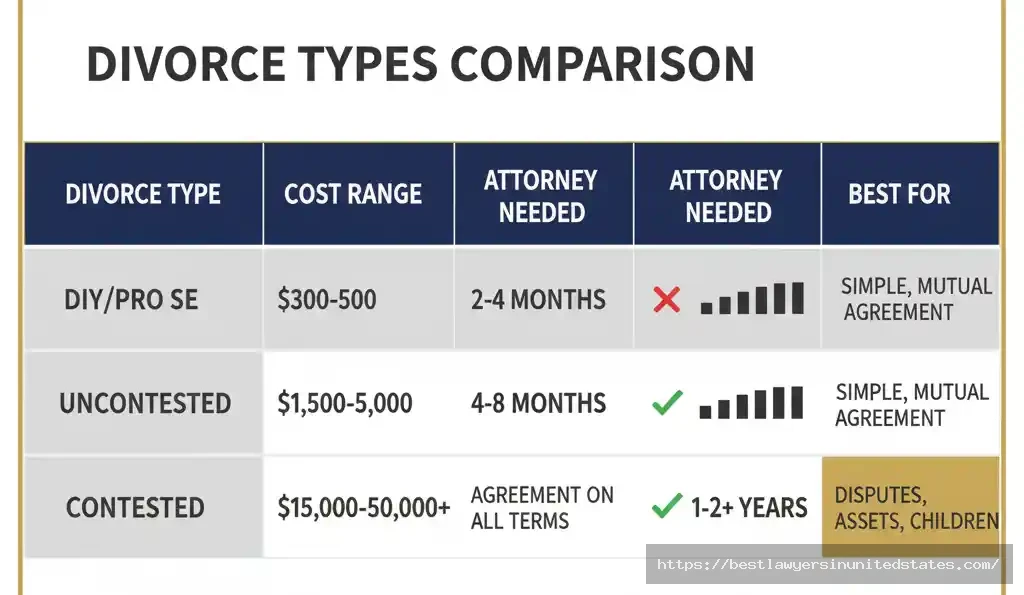
How Much Does an Uncontested Divorce Cost in Georgia?
An uncontested divorce happens when you and your spouse agree on all major issues: property division, debt allocation, child custody (if applicable), child support, and alimony. These divorces move faster and cost significantly less than contested cases.
Uncontested divorce costs in Georgia:
- DIY (self-filed): $300-$500 total
- With attorney assistance: $1,500-$3,000
- With children involved: $2,500-$5,000
The lower end assumes minimal attorney involvement and straightforward circumstances. The higher end typically includes full attorney representation with a parenting plan, child support calculations, and more complex asset division.
Many Georgia family law attorneys offer flat-fee packages for uncontested divorces ranging from $1,500 to $2,500. This covers preparing all documents, filing with the court, and attending the final hearing. Some attorneys charge closer to $3,000-$5,000 if minor children are involved or if you need help negotiating a settlement agreement.
How Much Does a Contested Divorce Cost in Georgia?
Contested divorces occur when spouses disagree on one or more significant issues. These cases require negotiation, discovery, court hearings, and potentially a trial. The costs escalate quickly based on the level of conflict and complexity.
Contested divorce costs in Georgia:
- Low-conflict (1-2 disputed issues): $8,000-$15,000
- Moderate-conflict (multiple disputes): $15,000-$25,000
- High-conflict (custody battle, complex assets): $30,000-$50,000+
Most contested divorces in Georgia fall into the $15,000-$25,000 range. However, high-conflict cases involving custody battles, business valuations, hidden assets, or extensive discovery can easily exceed $50,000 per spouse.
The primary cost driver in contested divorces is attorney time. With hourly rates ranging from $250 to $450 in Georgia (higher in metro Atlanta), legal fees accumulate quickly through depositions, court motions, expert witnesses, and trial preparation.
What Does a DIY Divorce Cost in Georgia?
If you and your spouse have minimal assets, no children, and agree on everything, you might handle your own divorce without an attorney. Georgia courts allow self-representation, though it’s not recommended for complex situations.
DIY divorce costs:
- Filing fee: $200-$400 (varies by county)
- Service of process: $0-$75 (if spouse agrees to waive formal service)
- Online divorce service (optional): $99-$500 for document preparation help
- Total DIY cost: $300-$500
Keep in mind that DIY divorces only work for truly uncontested cases. If you have children, significant assets, retirement accounts, or any disagreements, hiring an attorney is worth the investment to protect your rights and ensure proper documentation.
How Much Does It Cost to File for Divorce in Georgia by County?
Filing fees vary by county in Georgia. Fulton County specifically appears in many searches because it has one of the highest filing fees in the state. Here’s a comprehensive breakdown of divorce filing fees across major Georgia counties.

Fulton County Divorce Filing Fees
Fulton County, which includes much of Atlanta, charges $220 to file a Petition for Divorce without children and $235 with minor children. These are among the highest filing fees in Georgia.
Additional Fulton County costs:
- Service by sheriff: $25-$50
- Service by private process server: $75-$150
- Copy fees: $0.25 per page
- Certified copies: $2.50 per document plus $0.50 per page
Metro Atlanta Counties Divorce Cost Comparison
| County | Filing Fee (No Children) | Filing Fee (With Children) | Service Fee |
|---|---|---|---|
| Fulton | $220 | $235 | $25-$50 |
| Cobb | $218 | $218 | $30-$60 |
| DeKalb | $220 | $235 | $25-$50 |
| Gwinnett | $210 | $225 | $25-$50 |
| Cherokee | $225 | $225 | $25-$45 |
| Forsyth | $215 | $230 | $30-$50 |
| Clayton | $220 | $235 | $25-$50 |
| Henry | $215 | $230 | $25-$50 |
Other Major Georgia Counties Filing Fees
North Georgia:
- Hall County: $210-$225
- Bartow County: $200-$215
- Lumpkin County: $200-$210
Central Georgia:
- Bibb County (Macon): $215-$230
- Houston County (Warner Robins): $210-$225
- Muscogee County (Columbus): $220-$235
South Georgia:
- Chatham County (Savannah): $225-$240
- Glynn County (Brunswick): $215-$230
- Lowndes County (Valdosta): $210-$225
Rural vs. Urban Filing Fee Differences: Rural Georgia counties typically charge $200-$220 for divorce filing fees, while metropolitan counties like Fulton, DeKalb, and Chatham charge $220-$240. The difference isn’t huge, but it’s worth noting if you live near a county line and have filing options.
You must file in the county where either you or your spouse has lived for at least six months before filing. You can verify current filing fees by contacting your county’s Clerk of Superior Court or visiting their website.
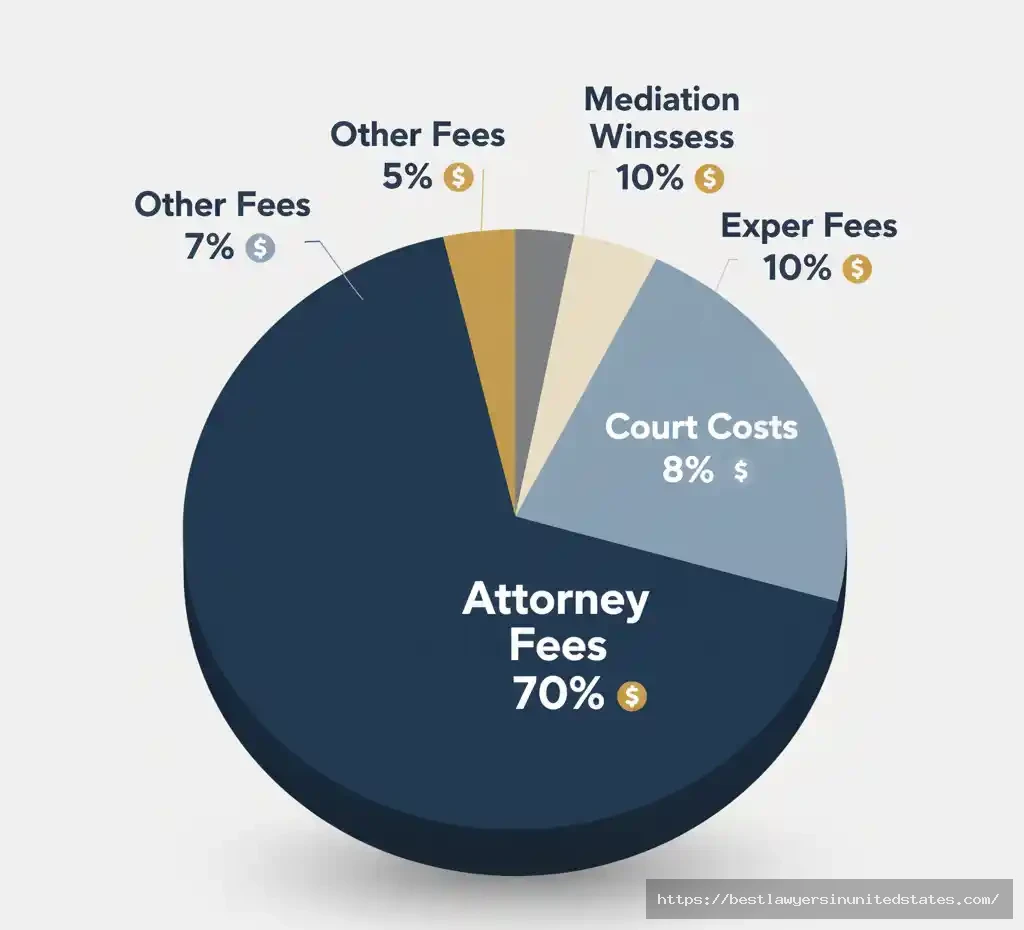
Complete Breakdown of Divorce Costs in Georgia
Understanding where your money goes helps you budget effectively and identify areas where you might reduce costs. Here’s an itemized look at every potential expense in a Georgia divorce.
Court Filing Fees
The Petition for Divorce filing fee is your first expense. As shown in the county table above, this ranges from $200 to $240 across Georgia. This fee is paid to the Clerk of Superior Court when you file your initial divorce petition.
If you need to file additional motions during your divorce (temporary custody, temporary support, contempt, etc.), each motion typically costs $20-$50 to file.
Service of Process Fees
After filing your petition, you must legally notify your spouse. Georgia requires proper service of divorce papers, which costs:
- Sheriff service: $25-$60 depending on county
- Private process server: $75-$150 (faster, more flexible)
- Certified mail: $8-$15 (only if spouse agrees to accept)
- Acknowledgment of Service: $0 (spouse voluntarily signs, no formal service needed)
Most divorcing spouses use sheriff service to save money or have their spouse sign an Acknowledgment of Service to avoid service fees entirely.
Attorney Fees: Retainer, Hourly Rates, and Flat Fees
Attorney fees represent the largest expense in most Georgia divorces. Understanding how attorneys charge helps you budget and negotiate.
Hourly Rate Structures: Most Georgia divorce attorneys bill hourly, with rates varying by experience and location:
- Entry-level attorneys: $200-$275/hour
- Mid-level attorneys (5-10 years): $275-$350/hour
- Senior attorneys: $350-$450/hour
- Metro Atlanta premium: Add $50-$100/hour
Retainer Requirements: Attorneys typically require an upfront retainer deposit:
- Uncontested divorce: $1,500-$2,500
- Contested divorce: $5,000-$10,000
- High-conflict case: $10,000-$25,000
The retainer acts as a deposit against future billable hours. As your attorney works on your case, they deduct their hourly fees from this retainer. If the retainer runs out, you’ll need to replenish it.
Flat Fee Arrangements: Some Georgia attorneys offer flat fees for straightforward uncontested divorces:
- Basic uncontested (no children, simple assets): $1,500-$2,000
- Uncontested with children: $2,500-$3,500
- Uncontested with property division: $2,000-$3,000
Flat fees provide cost certainty and work well for amicable divorces. However, if your case becomes contested, expect to pay additional hourly fees.
What Do Attorney Fees Cover (and Not Cover)?
Typical attorney services include:
- Initial consultation (often free or $100-$200)
- Drafting and filing divorce petition
- Negotiating settlement terms
- Preparing settlement agreement
- Attending court hearings
- Trial representation if needed
- Communication with opposing counsel
- Legal advice throughout the process
Not typically included:
- Court filing fees (you pay separately)
- Service of process fees
- Expert witness fees
- Deposition costs
- Guardian ad Litem fees
- Mediation fees (though some attorneys include one mediation session)
Mediation Costs in Georgia
Mediation helps divorcing couples reach agreements without going to trial. Georgia courts often require mediation before allowing a case to proceed to trial.
Private mediation:
- Cost: $150-$400 per hour
- Typical session: 3-6 hours
- Total cost per session: $450-$2,400
- Split between spouses: $225-$1,200 each
- Complex cases may need 2-3 sessions: $1,500-$5,000 total
Court-ordered mediation:
- Some counties offer reduced-cost mediation programs
- Cost: $100-$200 per hour (subsidized rates)
- Available through court-annexed programs
Mediation costs significantly less than going to trial. A contested divorce that settles in mediation might cost $15,000-$20,000 total, while the same case going to trial could cost $30,000-$50,000+.
Guardian ad Litem Fees and When They’re Required
A Guardian ad Litem (GAL) is an attorney appointed to represent your child’s best interests in contested custody cases. GALs investigate both parents, interview the child, and make custody recommendations to the judge.
GAL costs in Georgia:
- Hourly rate: $200-$350/hour
- Typical total cost: $2,500-$10,000
- High-conflict cases: $10,000-$20,000+
- Split between parents based on income
Judges appoint GALs when:
- Parents have serious custody disputes
- Allegations of abuse or neglect exist
- Child’s welfare is in question
- Parents request GAL appointment
GAL fees can be substantial, but having a neutral professional investigate and recommend custody arrangements often helps resolve high-conflict disputes.
Expert Witness and Appraiser Fees
Complex divorce cases may require expert testimony or professional valuations:
Real estate appraisers:
- Residential property: $400-$600
- Commercial property: $1,000-$5,000+
Business valuation experts:
- Small business: $5,000-$15,000
- Complex business: $15,000-$50,000+
Forensic accountants:
- Hidden asset investigation: $5,000-$20,000
- Tracing marital vs. separate property: $3,000-$10,000
Child custody evaluators (psychological):
- Comprehensive evaluation: $2,000-$5,000
- Expert testimony: $300-$500/hour
Vocational evaluators (for alimony):
- Earning capacity assessment: $1,500-$3,500
You don’t need experts in most divorces, but high-asset or high-conflict cases often require their specialized knowledge.
Parenting Seminar Fees
Many Georgia counties require divorcing parents to attend a parenting education seminar before finalizing their divorce. These programs teach co-parenting strategies and help minimize the impact of divorce on children.
Parenting seminar costs:
- Fee: $30-$50 per parent
- Duration: 4-6 hours (often offered online)
- Required in: Fulton, Cobb, Gwinnett, DeKalb, and many other counties
Check your county’s Superior Court website to find approved parenting education providers and current fees.
Court Reporter and Transcript Fees
If your case requires depositions or a trial transcript, you’ll pay for court reporting services:
Deposition costs:
- Court reporter fee: $300-$600 for 3-4 hours
- Transcript (optional): $3-$7 per page
- Expedited transcript: $5-$10 per page
Trial transcript:
- Original transcript: $3-$6 per page
- Copy: $1-$2 per page
- Average trial: 100-300 pages = $300-$1,800
Many contested divorces require 2-4 depositions, adding $1,200-$2,400 to total costs.
What Factors Impact Divorce Costs in Georgia?
Several key factors determine whether your divorce costs $500 or $50,000. Understanding these helps you anticipate expenses and make strategic decisions.
Contested vs. Uncontested Divorce

This is the single biggest cost factor. Uncontested divorces where both spouses agree on all issues cost a fraction of contested divorces.
Cost impact:
- Uncontested: 10-20 attorney hours = $3,000-$7,000
- Contested: 60-150+ attorney hours = $15,000-$60,000+
Every issue you can resolve through negotiation saves thousands in attorney fees, court costs, and time. Even if you need to compromise more than you’d like, settling is almost always cheaper than fighting in court.
Presence of Minor Children
Divorces involving children cost more because they require additional legal documents and procedures:
Child-related costs:
- Parenting plan preparation: 2-5 attorney hours
- Child support calculations: 1-2 attorney hours
- Mandatory parenting seminar: $30-$50 per parent
- Custody dispute legal fees: $5,000-$25,000+ additional
- Guardian ad Litem (if needed): $2,500-$10,000+
- Custody evaluation (if needed): $2,000-$5,000
Simple uncontested divorces with agreed-upon custody arrangements add about $500-$1,500 to total costs. Contested custody battles can add $10,000-$30,000 or more.
Complexity of Assets and Debts
The more you own together, the more complex (and expensive) your divorce becomes. Simple asset division might add minimal cost, while complex portfolios require extensive work.
Simple assets (adds $500-$1,500 to costs):
- One marital home
- Basic bank accounts
- Standard vehicles
- Minimal debt
Complex assets (adds $5,000-$25,000+ to costs):
- Multiple properties
- Retirement accounts requiring QDRO
- Business ownership
- Stock portfolios or investment accounts
- Inherited property (separate vs. marital determination)
- Significant debt requiring careful allocation
Each retirement account requiring a Qualified Domestic Relations Order (QDRO) adds $500-$1,500 in attorney fees plus $350-$750 for the QDRO preparer.
Attorney Experience and Location
Where you live and whom you hire significantly impacts costs.
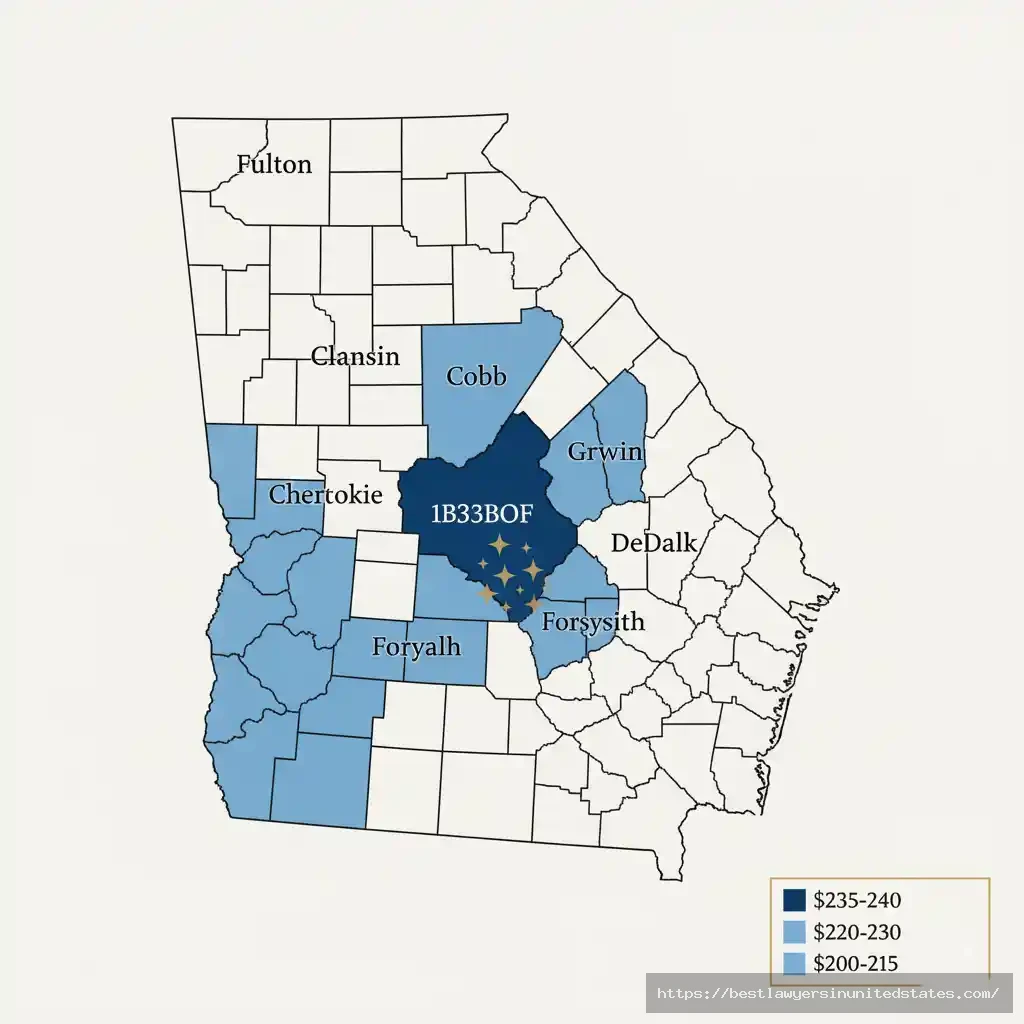
Geographic cost differences in Georgia:
- Metro Atlanta (Fulton, Cobb, DeKalb, Gwinnett): $300-$450/hour
- Mid-size cities (Augusta, Savannah, Macon, Columbus): $250-$350/hour
- Small towns and rural areas: $200-$300/hour
Experienced attorneys cost more but often resolve cases more efficiently. A skilled attorney at $400/hour who settles your case in 30 hours ($12,000) might save you money compared to an inexperienced attorney at $250/hour who takes 60 hours ($15,000) because they’re less effective.
Case Duration and Timeline
Time is money in divorce. The longer your case drags on, the more it costs.
Typical timelines and costs:
- 2-3 months (uncontested): $1,500-$3,500
- 6 months (simple contested): $8,000-$15,000
- 12 months (complex contested): $20,000-$35,000
- 18-24+ months (high-conflict): $35,000-$60,000+
Every additional month in a contested divorce typically adds $1,500-$3,000 in attorney fees. Delays caused by discovery disputes, continuances, and scheduling conflicts accumulate quickly.
Level of Conflict Between Spouses
High-conflict divorces cost exponentially more than amicable ones, even when the issues are similar.
Low-conflict characteristics:
- Both spouses communicate reasonably
- Willingness to compromise
- Focus on practical solutions
- Minimal emotional reactions
- Cost: $5,000-$15,000 for contested issues
High-conflict characteristics:
- Constant disagreements over minor issues
- Refusal to compromise
- Emotionally-driven decisions
- Excessive motions and court hearings
- Using children as leverage
- Cost: $25,000-$60,000+
One highly combative spouse can drive up costs for both parties. Consider whether “winning” a particular issue is worth thousands in additional legal fees.
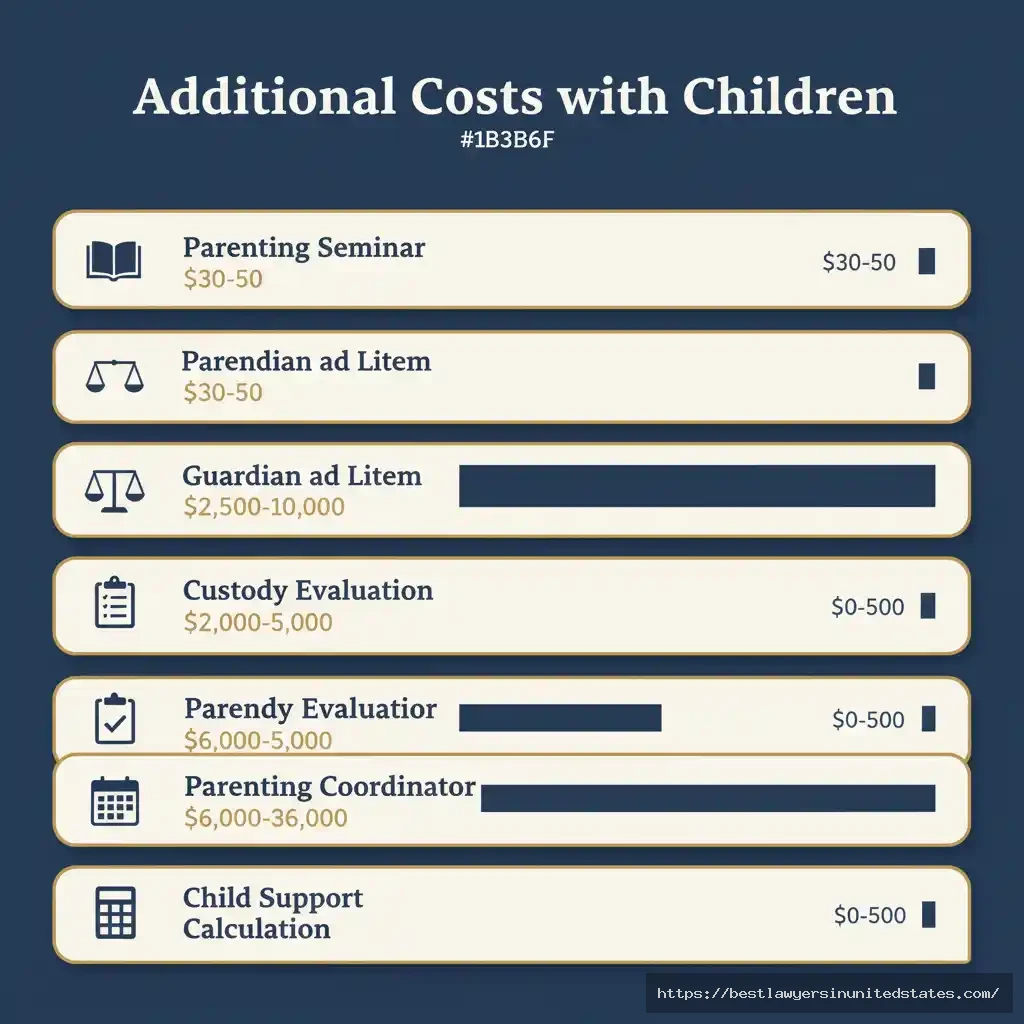
Additional Costs When Children Are Involved
Divorces involving minor children incur specific expenses beyond standard divorce costs. These child-related costs vary based on custody arrangements and the level of agreement between parents.
Mandatory Parenting Education Seminars
Most Georgia counties require divorcing parents to complete an approved parenting education program. These seminars teach effective co-parenting strategies, communication techniques, and how to minimize divorce’s impact on children.
Program details:
- Cost: $30-$50 per parent
- Duration: 4-6 hours
- Format: In-person or online options available
- Timing: Must complete before final divorce hearing
- Required in: Fulton, Cobb, DeKalb, Gwinnett, Cherokee, Forsyth, and most other Georgia counties
You’ll receive a certificate of completion to file with the court. Some counties won’t finalize your divorce without proof of completion.
Guardian ad Litem Fees and When They’re Required
When parents disagree about custody or when concerns about child welfare exist, judges may appoint a Guardian ad Litem to represent the child’s best interests.
What GALs do:
- Interview both parents extensively
- Talk with the child (age-appropriate)
- Visit both homes
- Review school and medical records
- Interview teachers, doctors, and other relevant parties
- Make custody recommendations to the judge
Typical GAL costs:
- Initial retainer: $2,500-$5,000
- Hourly rate: $200-$350
- Simple cases: $2,500-$5,000 total
- Complex cases: $7,500-$15,000+
- High-conflict cases: $15,000-$25,000+
The court typically orders both parents to split GAL fees based on their incomes. If one parent earns 70% of the combined income, they’ll usually pay 70% of GAL fees.
When judges appoint GALs:
- Serious custody disputes
- Allegations of abuse, neglect, or substance abuse
- Mental health concerns
- Parental alienation concerns
- When parents can’t communicate effectively about children
- Complex custody arrangements needed
Child Custody Evaluation Costs
In highly contested custody cases, judges sometimes order comprehensive psychological custody evaluations. These differ from GAL investigations and involve licensed psychologists or custody evaluators.
Evaluation components:
- Psychological testing of both parents
- Psychological testing of children (age-appropriate)
- Home visits to both residences
- Interviews with family members
- Collateral contacts (teachers, therapists, doctors)
- Written report with custody recommendations
Cost breakdown:
- Full custody evaluation: $3,000-$7,000
- Split between parents based on income
- Evaluation takes 4-8 weeks to complete
- Additional cost if evaluator testifies at trial: $300-$500/hour
Custody evaluations are expensive but can be worth the investment in high-conflict cases. They provide judges with professional, objective assessments of parenting capabilities and custody arrangements that serve children’s best interests.
Parenting Coordinator Fees
Some high-conflict divorcing couples need ongoing help implementing their parenting plan. Georgia courts can appoint Parenting Coordinators to help resolve recurring disputes about schedule changes, extracurricular activities, medical decisions, and other parenting issues.
Parenting coordinator services:
- Mediate parenting disputes
- Make decisions about day-to-day parenting issues
- Help implement court orders
- Reduce need for frequent court hearings
Costs:
- Hourly rate: $150-$300/hour
- Monthly retainer: $500-$1,500
- Typically continues for 1-2 years post-divorce
- Total cost: $6,000-$36,000 over the engagement
Parenting coordinators cost money but save even more by preventing constant returns to court.
Real-World Georgia Divorce Cost Examples (2025)
Seeing actual cost breakdowns for different situations helps you estimate your own divorce expenses. These examples reflect typical scenarios based on current Georgia attorney rates and court fees.

Scenario 1: Simple Uncontested Divorce (No Children)
Situation: Sarah and Mike have been married 5 years. They rent an apartment, have no children, own two cars (paid off), and have about $8,000 in savings plus $5,000 in credit card debt. They agree on everything and want to divorce amicably.
Cost breakdown:
- Fulton County filing fee: $220
- Sheriff service fee: $45
- Online divorce document service: $149
- Total cost: $414
Sarah and Mike used an online divorce document preparation service to generate their forms, filed together, and appeared at an uncontested final hearing. Their entire divorce took 38 days from filing to final decree.
Alternative with attorney: If they’d hired an attorney for document preparation and court representation: $1,500-$2,000 flat fee plus $220 filing fee = $1,720-$2,220 total.
Scenario 2: Uncontested Divorce with Children
Situation: Jennifer and David have been married 8 years with two children (ages 4 and 6). They own a home worth $275,000 with a $190,000 mortgage, have $35,000 in retirement accounts, and two financed vehicles. They agree on joint custody (Jennifer is primary physical custodian), child support following state guidelines, and property division. They hired an attorney to ensure everything was done correctly.
Cost breakdown:
- Attorney flat fee: $3,000
- Cobb County filing fee: $218
- Parenting seminar (both parents): $90
- QDRO preparation (retirement accounts): $650
- Total cost: $3,958
Jennifer and David’s divorce took 75 days. Their attorney prepared a detailed parenting plan, calculated child support using Georgia’s guidelines, drafted a comprehensive settlement agreement, and represented them at the final hearing. The flat fee covered all attorney work.
Scenario 3: Contested Property Division (No Children)
Situation: Robert and Amanda have been married 14 years with no children. They own a home worth $425,000 (mortgage $180,000), a rental property worth $220,000 (mortgage $95,000), retirement accounts totaling $285,000, and a small business Robert started during the marriage. They disagree on business valuation and how to divide the rental property.
Cost breakdown:
- Robert’s attorney fees (80 hours at $325/hour): $26,000
- Amanda’s attorney fees (75 hours at $300/hour): $22,500
- Gwinnett County filing fee: $210
- Service of process: $85
- Business valuation expert: $12,000 (split)
- Rental property appraisal: $450 (split)
- Mediation (two 4-hour sessions): $2,800 (split)
- Robert’s total: $33,435
- Amanda’s total: $30,425
Their divorce took 9 months. After two mediation sessions, they reached a settlement avoiding trial. Robert kept the business (valued at $175,000) and the rental property. Amanda received the marital home and 65% of retirement accounts to equalize the division. Both parties spent over $30,000 but saved significant money by settling before trial.
Scenario 4: High-Conflict Custody Battle
Situation: Lisa and James have been married 11 years with three children (ages 9, 7, and 4). James works full-time earning $125,000/year. Lisa works part-time earning $35,000/year. Both want primary physical custody. They own a home worth $380,000 (mortgage $240,000), standard retirement accounts, and two vehicles. The custody dispute is highly contentious with allegations of poor parenting on both sides.
Cost breakdown:
- Lisa’s attorney fees (160 hours at $350/hour): $56,000
- James’s attorney fees (145 hours at $375/hour): $54,375
- DeKalb County filing fee: $235
- Service of process: $75
- Guardian ad Litem: $8,500 (split based on income – James paid $6,375, Lisa paid $2,125)
- Custody evaluation: $5,000 (split same as GAL)
- Parenting seminar (both): $100
- Depositions (3 total): $2,100
- Expert witness testimony (custody evaluator): $1,800
- Trial (2 days): Included in attorney hours above
- Lisa’s total: $62,725
- James’s total: $67,825
Their divorce took 18 months including two months of trial delays. After a two-day trial, the judge awarded joint legal custody with Lisa as primary physical custodian (James has extensive visitation). Both parents spent over $60,000 largely due to the custody battle. If they’d agreed on custody through mediation, costs would likely have been $15,000-$25,000 each.
Scenario 5: Mediated Divorce with Children
Situation: Karen and Tom have been married 12 years with one child (age 8). Karen earns $68,000 as a nurse. Tom earns $95,000 as an engineer. They own a home worth $340,000 (mortgage $195,000), have $180,000 in retirement accounts, and two paid-off vehicles. They disagree on the parenting schedule and alimony but want to avoid court if possible. They committed to divorce mediation with attorney support.
Cost breakdown:
- Karen’s attorney fees (35 hours at $300/hour): $10,500
- Tom’s attorney fees (38 hours at $325/hour): $12,350
- Cherokee County filing fee: $225
- Service by acknowledgment: $0
- Parenting seminar (both): $100
- Private mediation (3 sessions, 12 hours total at $250/hour): $3,000 (split)
- QDRO preparation: $700
- Karen’s total: $12,925
- Tom’s total: $15,425
Their divorce took 5 months. Through three mediation sessions, they agreed on a 60/40 custody split favoring Karen, child support per guidelines, two years of rehabilitative alimony for Karen at $1,200/month, and equal division of retirement accounts. Each spouse’s costs were less than half of what a fully contested case would have cost.
Scenario 6: Free Divorce with Fee Waiver
Situation: Michelle is a single mother of two working part-time earning $18,000/year. Her husband abandoned the family and she hasn’t heard from him in 8 months. She needs a divorce to move forward but has almost no money. She qualifies for a fee waiver and represents herself with help from legal aid.
Cost breakdown:
- Filing fee: $0 (fee waiver granted based on income)
- Service by publication (abandoned spouse): $80
- Legal aid consultation and document review: $0
- Parenting seminar: $35
- Total cost: $115
Michelle’s divorce took 75 days (Georgia requires 30 days waiting period, publication takes additional time). She filed for divorce herself using forms from Georgia Legal Services Program, received a fee waiver by completing an Indigency Affidavit showing she earns less than 125% of federal poverty guidelines, and got free legal advice from Atlanta Legal Aid Society. Publication in the newspaper was her only significant expense because her husband’s whereabouts were unknown.
How to Get a Free Divorce in Georgia (Complete Guide)
Georgia offers several options for low-income individuals who need a divorce but can’t afford attorney fees or court costs. These programs exist to ensure everyone has access to the legal system regardless of financial circumstances.
Income Eligibility Requirements for Fee Waivers
Georgia courts will waive filing fees for individuals who meet specific income requirements. You qualify for a fee waiver if your household income is at or below 125% of the federal poverty guidelines.
2025 Federal Poverty Guidelines (125% threshold):
| Household Size | Annual Income Limit | Monthly Income Limit |
|---|---|---|
| 1 person | $18,375 | $1,531 |
| 2 people | $24,875 | $2,073 |
| 3 people | $31,375 | $2,615 |
| 4 people | $37,875 | $3,156 |
| 5 people | $44,375 | $3,698 |
| 6 people | $50,875 | $4,240 |
| Add per person | +$6,500 | +$542 |
If you receive TANF, SNAP (food stamps), SSI, or other means-tested public benefits, you automatically qualify for a fee waiver in most Georgia counties.
How to Apply for a Fee Waiver: Step-by-Step
Getting a fee waiver in Georgia requires completing specific forms and providing financial documentation. The process is straightforward but requires careful attention to detail.
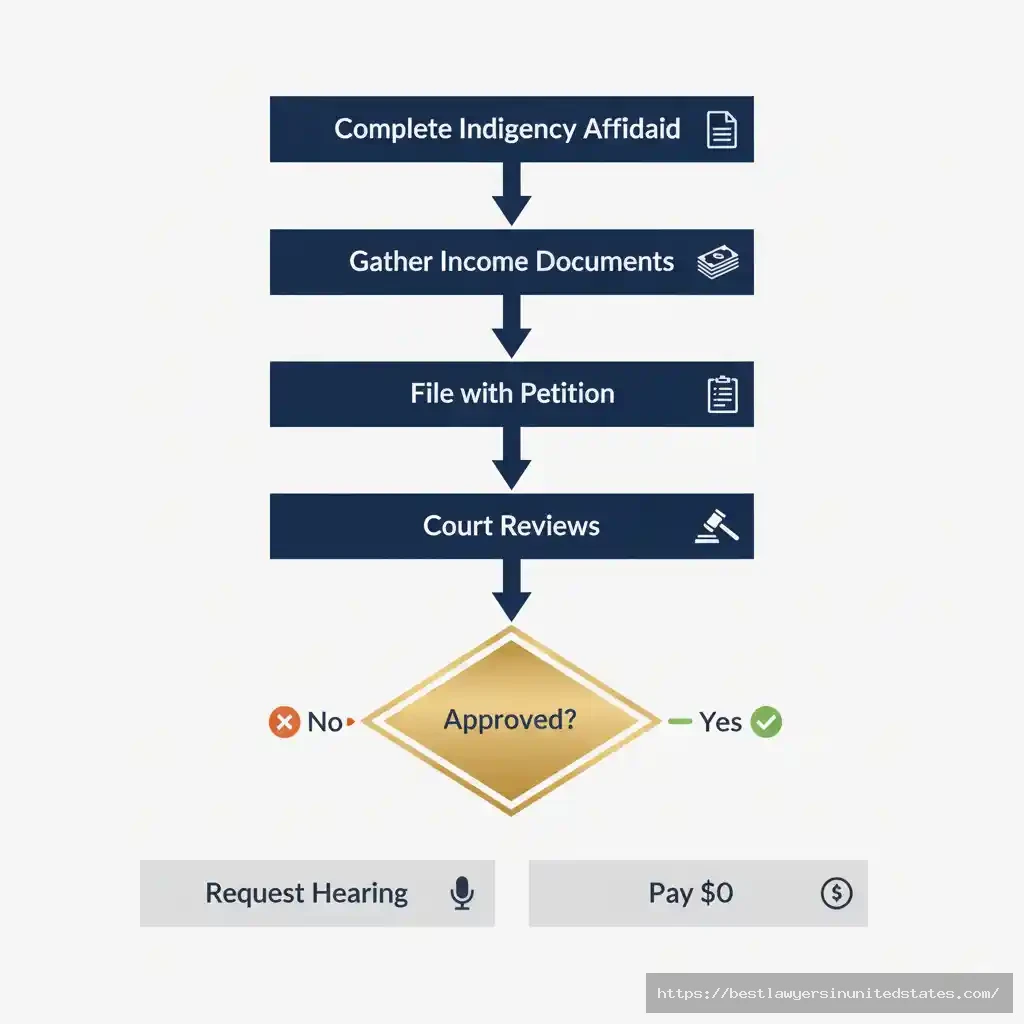
Step 1: Complete the Indigency Affidavit
- Form name: Affidavit of Indigence (Uniform Superior Court Rule 34)
- Available from: County Clerk of Superior Court or online at your county court website
- Information needed: Income, expenses, assets, debts, household size
Step 2: Gather supporting documents
- Last 3 months of pay stubs
- Most recent tax return
- Bank statements
- Proof of government assistance (SNAP/TANF/SSI award letters)
- Bills showing monthly expenses
Step 3: File with divorce petition
- Submit Indigency Affidavit with your Petition for Divorce
- Attach supporting financial documents
- File at Clerk of Superior Court office
- Don’t pay the filing fee until you know if waiver is approved
Step 4: Court review
- Clerk reviews your affidavit and documents
- Most approvals happen same day or within 3-5 business days
- Judge reviews if clerk has questions
- If approved, you pay $0 in filing fees
Step 5: If denied
- You can request a hearing before a judge
- Bring additional documentation
- Explain your financial hardship
- Judge makes final decision
What the fee waiver covers:
- Divorce petition filing fee
- Service by publication (if needed)
- Filing of additional motions
- Certified copies of final decree
What it doesn’t cover:
- Attorney fees (you’ll need legal aid or pro bono help)
- Expert witnesses
- Parenting seminar fees (though some counties offer reduced rates)
Free Legal Aid Resources in Georgia
If you qualify based on income, several organizations provide free legal help for divorces. These programs have limited capacity, so apply as early as possible.

Georgia Legal Services Program (GLSP)
- Serves: All 159 Georgia counties
- Income limit: Generally 125% of federal poverty guidelines
- Services: Legal advice, document preparation, court representation for eligible cases
- Website: glsp.org
- Atlanta office: (404) 206-5175
- Regional offices across Georgia
Atlanta Legal Aid Society
- Serves: Metro Atlanta (Fulton, DeKalb, Cobb, Clayton, Gwinnett, and surrounding counties)
- Income limit: 125% of federal poverty guidelines
- Services: Family law cases including divorce, custody, and domestic violence
- Office: (404) 377-0701
- Walk-in clinic days available
Senior Citizens Law Project
- Serves: Georgians age 60 and older statewide
- Income limit: 150% of federal poverty guidelines
- Services: Family law, elder abuse, housing, healthcare
- Office: (888) 257-9519
Domestic Violence Legal Clinics
- Available through: Multiple organizations across Georgia
- Services: Free legal help for domestic violence victims
- No income requirement for protective orders
- Divorce assistance if domestic violence is involved
Law School Clinics:
Emory University Family Law Clinic
- Location: Atlanta
- Serves: Low-income Fulton and DeKalb County residents
- Services: Supervised law students provide representation
- Contact: (404) 727-6278
University of Georgia School of Law
- Location: Athens
- Services: Family law clinic offers limited representation
- Contact: (706) 542-7541
Georgia State University College of Law
- Location: Atlanta
- Services: Family Violence Clinic assists domestic violence victims
- Contact: (404) 413-9200
Pro Bono Divorce Attorney Programs
Even if you don’t qualify for legal aid, you might find an attorney willing to take your case pro bono (for free) or at significantly reduced rates.
State Bar of Georgia Pro Bono Project
- Connects low-income Georgians with volunteer attorneys
- Call: (404) 527-8700
- Submit application online at gabar.org
Lawyer Referral Service
- State Bar of Georgia program
- Initial 30-minute consultation: $25
- Some attorneys offer reduced fees after consultation
- Call: (404) 521-0777 or (800) 237-2629
Modest Means Program
- For individuals earning 200%-400% of poverty guidelines
- Attorneys charge reduced flat fees or hourly rates
- Typical savings: 30%-50% off standard fees
Local Bar Association Pro Bono Days Many Georgia counties host periodic “pro bono days” where volunteer attorneys provide free consultations and document preparation help. Check with your local county bar association.
DIY Resources and Self-Help Centers
If you don’t qualify for free legal help but can’t afford full attorney representation, Georgia offers self-help resources:
Superior Court Self-Help Centers:
- Located in: Fulton, DeKalb, Cobb, Gwinnett, and other counties
- Services: Forms, instructions, limited assistance from court staff
- Staff cannot give legal advice but can explain procedures
- Free to use
Georgia Court System Forms Library
- Website: georgiacourts.gov
- Free downloadable divorce forms
- Instructions for completing forms
- No legal advice provided
Law libraries:
- Every Georgia county courthouse has a law library
- Free to use during business hours
- Legal research materials available
- Some have pro bono attorneys on-site certain days
Important limitations: Self-help resources work best for truly uncontested divorces. If you have contested issues, property disputes, or custody battles, the cost of making mistakes often exceeds the cost of hiring an attorney.
Is Online Divorce in Georgia Legitimate? What You Need to Know
Many people searching for affordable Georgia divorce options encounter online divorce services. These services typically charge $99-$500 to help prepare divorce documents. But are they legitimate, and when should you use them?
How Online Divorce Services Work
Online divorce services are document preparation companies, not law firms. They don’t provide legal advice or represent you in court. Instead, they help you complete the correct divorce forms based on information you provide.
Typical online divorce process:
- You answer questions online about your marriage, assets, children, and desired outcomes
- The service uses your answers to generate completed Georgia divorce forms
- You receive the completed forms (usually as PDFs)
- You file the forms yourself with your county Superior Court
- You handle all court proceedings yourself
- Some services offer phone support for questions about the forms (not legal advice)
What online divorce services provide:
- Completed, state-specific divorce forms
- Filing instructions
- Information about Georgia divorce procedures
- Form completion accuracy (good services double-check)
What they don’t provide:
- Legal advice about your specific situation
- Negotiation with your spouse
- Court representation
- Advice on what terms you should agree to
- Document filing with the court (you must file yourself)
When Online Divorce Is (and Isn’t) Right for You
Online divorce services work well in very specific situations. Understanding when they’re appropriate prevents costly mistakes.
When online divorce makes sense:
✅ Truly uncontested divorce Both spouses agree on absolutely everything: property division, debt allocation, custody, support, and all other issues.
✅ Simple financial situation
- Limited assets (home, vehicles, bank accounts)
- No businesses, complex investments, or retirement accounts needing QDROs
- Minimal debt
- No hidden assets
✅ No children or agreed custody plan Either no children, or both parents have already agreed on a detailed parenting plan, custody schedule, and child support amount.
✅ Good communication with spouse You can discuss issues reasonably without conflict escalating.
✅ Budget constraints You need to keep costs as low as possible and understand the trade-offs of not having attorney advice.
When to skip online divorce and hire an attorney:
❌ Any contested issues If you and your spouse disagree about anything significant, you need attorney representation. Online services can’t help you negotiate or advocate for your interests.
❌ Minor children with disputed custody Child custody is too important and complex for DIY approaches when parents disagree. Get an attorney.
❌ Complex assets or significant wealth Businesses, retirement accounts, multiple properties, investments, or high incomes require attorney expertise to ensure proper valuation and division.
❌ One spouse is hiding assets If you suspect your spouse isn’t being forthright about finances, you need an attorney who can conduct discovery and investigate.
❌ Domestic violence or abuse Safety concerns require attorney representation. Many legal aid organizations prioritize domestic violence cases.
❌ Significant income disparity Large income differences often involve alimony, which requires legal analysis to ensure fair terms.
❌ Your spouse hired an attorney Never represent yourself against a represented spouse. Hire your own attorney.
What to Look for in an Online Divorce Service
If your situation fits online divorce requirements, choosing a reputable service matters. Not all online divorce companies provide quality service.
Quality indicators:
- ✅ Georgia-specific forms (not generic or multi-state)
- ✅ Recently updated for current law (2024-2025)
- ✅ Money-back guarantee if forms rejected by court
- ✅ Customer reviews from Georgia users
- ✅ Customer support available by phone
- ✅ Clear explanation that they’re not a law firm
- ✅ Privacy policy protecting your information
Red flags to avoid:
- ❌ Promises to represent you in court (they can’t unless they’re attorneys)
- ❌ Legal advice (document preparers can’t give legal advice)
- ❌ “Guaranteed” outcomes or results
- ❌ Pressure to finalize before you’re ready
- ❌ Hidden fees or unclear pricing
- ❌ No refund policy if forms are rejected
- ❌ Out-of-state company using generic forms
Online Divorce Cost vs. Attorney-Assisted Divorce
Cost is often the primary driver for considering online divorce. Here’s how costs compare:
| Service Level | Cost Range | Best For |
|---|---|---|
| Online divorce service | $99-$500 | Truly uncontested, simple assets, no children or agreed custody |
| Limited scope attorney | $750-$1,500 | Document review, advice, no court representation |
| Flat fee uncontested | $1,500-$3,000 | Full attorney representation, simple uncontested case |
| Hourly uncontested | $2,500-$5,000 | More complex uncontested with children/assets |
| Contested divorce | $15,000-$50,000+ | Any disputed issues |
Is saving $1,500-$2,500 worth the risk?
That’s the key question. If your situation is genuinely simple and uncontested, online divorce can save significant money. But if you make mistakes with property division, custody arrangements, or other terms, fixing those mistakes later costs far more than hiring an attorney upfront.
Middle-ground option: Some Georgia attorneys offer “limited scope representation” where they review your online divorce documents and provide advice without full representation. This typically costs $500-$1,000 and provides peace of mind that your documents are correct.
For more information on the overall costs of hiring a divorce lawyer, see our comprehensive guide on divorce lawyer costs.
Attorney Fees: What to Expect in Georgia
Understanding how divorce attorneys structure their fees helps you budget appropriately and avoid surprises. Georgia divorce attorneys typically use one of three fee structures: hourly billing, flat fees, or retainer agreements.
Hourly Rate vs. Flat Fee Arrangements
Hourly billing is the most common structure for contested divorces. You pay your attorney for every hour (or fraction of an hour) they work on your case.
Georgia hourly rates:
- New attorneys (0-3 years): $200-$275/hour
- Mid-level attorneys (4-10 years): $275-$350/hour
- Experienced attorneys (10+ years): $350-$450/hour
- Top-tier attorneys (20+ years, high-profile): $450-$600+/hour
What counts as billable time:
- Phone calls (including with you)
- Emails and correspondence
- Document drafting
- Legal research
- Court appearances
- Depositions and hearings
- Case strategy and planning
- Opposing counsel communications
- Travel time (usually at reduced rate)
Most Georgia attorneys bill in 6-minute increments (0.1 hour). A 10-minute phone call becomes 0.2 hours. A quick email might be 0.1 hours.
Flat fee arrangements work well for uncontested divorces where the scope is predictable. The attorney quotes a single price covering all work from start to finish.
Typical flat fees:
- Basic uncontested (no children, simple assets): $1,500-$2,000
- Uncontested with children: $2,500-$3,500
- Uncontested with property division: $2,000-$3,000
- Uncontested with everything: $3,000-$4,500
What flat fees typically include:
- Initial consultation
- Document preparation
- Filing petition with court
- Service coordination
- Settlement agreement drafting
- One or two court appearances
- Email and phone communication
What flat fees don’t include:
- Court filing fees
- Service of process fees
- Changes to the agreement
- Contested issues that arise
- Additional court hearings beyond what’s standard
Hybrid approaches sometimes combine elements of both. For example, an attorney might charge a flat fee for an uncontested divorce with the understanding that if issues become contested, they’ll switch to hourly billing.
Typical Retainer Amounts in Georgia
Most Georgia divorce attorneys require an upfront retainer deposit before beginning work on your case. The retainer acts as a deposit that the attorney draws against as they bill hourly.
How retainers work:
- You pay retainer deposit (e.g., $5,000)
- Attorney works on your case and tracks billable hours
- Attorney sends monthly billing statements showing hours worked and costs
- Fees are deducted from your retainer balance
- When retainer runs low, attorney requests a replenishment
- At case end, any unused retainer is refunded
Typical retainer amounts in Georgia:
| Case Type | Initial Retainer | Total Expected Cost |
|---|---|---|
| Simple uncontested | $1,500-$2,500 | Often covers entire case |
| Complex uncontested | $3,000-$5,000 | Usually covers case or requires small top-up |
| Simple contested | $5,000-$7,500 | May need 1-2 replenishments |
| Complex contested | $10,000-$15,000 | Typically needs 2-4 replenishments |
| High-conflict custody | $15,000-$25,000 | Often needs 3-6+ replenishments |
The retainer doesn’t represent your total cost – it’s just the starting deposit. Contested cases almost always require retainer replenishments as the case progresses.
Retainer agreements should specify:
- Hourly rate
- What services are covered
- Billing increments (e.g., 0.1 hour/6 minutes)
- When billing statements are sent
- When replenishments are required
- Refund policy for unused retainer
- Costs not covered by retainer
What Attorney Fees Cover (and Don’t Cover)
Understanding what your attorney fees include prevents confusion about additional costs.
Attorney fees typically cover:
- ✅ All legal work on your case
- ✅ Document preparation and review
- ✅ Court appearances and representation
- ✅ Communication with opposing counsel
- ✅ Negotiation and settlement efforts
- ✅ Legal advice and strategy
- ✅ Phone calls, emails, and meetings with you
- ✅ Case management and file maintenance
Costs not included in attorney fees:
- ❌ Court filing fees ($200-$240 in Georgia)
- ❌ Service of process ($25-$150)
- ❌ Mediation fees (if mediator is not your attorney)
- ❌ Expert witness fees
- ❌ Guardian ad Litem fees
- ❌ Court reporter and transcript costs
- ❌ Appraiser fees
- ❌ Parenting seminar fees
- ❌ QDRO preparation (sometimes separate)
- ❌ Copying and postage (some attorneys absorb, others charge)
Always ask your attorney upfront what’s included in their fees and what you’ll pay separately. Get the fee agreement in writing before signing.
How to Reduce Your Divorce Costs in Georgia
Even if you can’t avoid divorce, you can control costs through strategic decisions and smart preparation. These tactics work whether your divorce is contested or uncontested.
Consider an Uncontested Divorce
The single most effective cost-saving strategy is reaching agreement with your spouse on all issues. Every issue you resolve through negotiation saves thousands in attorney fees.
Cost comparison:
- Uncontested: $1,500-$5,000 total
- Contested: $15,000-$50,000+ per spouse
Even if you must compromise more than you’d prefer, settling usually saves money. Calculate whether fighting over a particular issue is worth the legal fees it will generate.
How to move toward uncontested:
- Start with issues where you agree
- Use mediation to resolve disagreements
- Focus on practical solutions rather than “winning”
- Consider what matters most and compromise on lesser issues
- Remember children benefit from parents who can cooperate
If you and your spouse can agree, you’ll save potentially tens of thousands of dollars.
Use Mediation Instead of Litigation
Mediation costs a fraction of trial costs and often helps settle cases that seem hopelessly deadlocked.
Cost comparison:
- One mediation session: $600-$1,500 (split between spouses)
- Going to trial: Adds $10,000-$25,000+ per spouse in attorney fees
Most contested Georgia divorces settle after mediation. Even if mediation doesn’t resolve everything, settling some issues reduces overall costs.
Mediation tips for cost control:
- Prepare thoroughly before mediation
- Have realistic settlement goals
- Listen to the mediator’s suggestions
- Focus on interests, not positions
- Consider long-term implications, not just immediate desires
Stay Organized and Prepared
Disorganization wastes attorney time (your money). Being prepared and organized significantly reduces billable hours.
Organization strategies:
Financial documentation:
- Create spreadsheets listing all assets and debts
- Gather tax returns, pay stubs, bank statements
- Organize retirement account statements
- Collect vehicle titles and home deeds
- Track monthly household expenses
- Document your spouse’s income and assets
Time-saving practices:
- Respond promptly to attorney requests
- Provide organized documents (labeled, dated)
- Prepare written summaries instead of long explanations
- Keep chronologies of important events
- Save emails and texts in organized folders
Meeting efficiency:
- Prepare questions in advance
- Stick to relevant facts
- Avoid emotional tangents
- Take notes during meetings
- Follow up in writing after important discussions
Every hour you save your attorney through good preparation is $250-$450 saved.
Communicate Efficiently With Your Attorney
How you communicate with your attorney significantly impacts costs. Efficient communication saves money while ensuring you get necessary advice.
Expensive communication habits:
- Long, rambling phone calls
- Frequent calls about minor issues
- Emotional venting sessions
- Repeating information already provided
- Calling without thinking through your questions
Cost-effective communication:
- Batch questions: Save non-urgent questions and ask several at once rather than making multiple calls
- Email when possible: Email often costs less than phone calls and provides written records
- Be concise: Get to the point quickly with relevant facts
- Separate legal from emotional: Vent to friends and therapists, discuss legal strategy with attorneys
- Prepare before calling: Write down questions beforehand to stay focused
Example cost difference:
- Five 15-minute phone calls about minor issues: $325
- One 30-minute call covering all five topics: $165
- Savings: $160
Multiply that across months of divorce proceedings and efficient communication saves thousands.
Handle Simple Tasks Yourself
You don’t need an attorney for everything. Handling administrative tasks yourself reduces billable hours.
Tasks you can do yourself:
- Gathering financial documents
- Making copies
- Organizing files
- Scheduling routine court dates (once attorney advises)
- Filling out standard forms (with attorney review)
- Delivering documents to opposing counsel
- Scheduling the parenting seminar
Tasks requiring attorney expertise:
- Legal strategy decisions
- Document drafting (petitions, motions, settlement agreements)
- Negotiations with opposing counsel
- Court hearings and trial
- Legal advice about your rights and options
Ask your attorney which tasks you can handle to save money.
Choose the Right Attorney for Your Case
Attorney selection significantly impacts costs. The right attorney for your situation saves money through efficiency and appropriate expertise.
Matching attorney to case:
For simple uncontested divorces:
- Newer attorney or paralegal-heavy firm
- Flat-fee arrangements
- Less expensive hourly rate acceptable
- Typical cost: $1,500-$3,000
For moderate complexity contested:
- Mid-level experienced attorney
- Someone who negotiates well
- Reasonable hourly rate
- Typical cost: $10,000-$20,000
For high-conflict or complex assets:
- Highly experienced family law specialist
- Proven trial skills
- Deep knowledge of complex financial issues
- Higher hourly rate justified by better outcomes
- Typical cost: $25,000-$50,000+
Red flags that drive up costs:
- Attorney who is overly aggressive (escalates conflict unnecessarily)
- Poor time management (meetings run long, misses deadlines)
- Inexperienced attorney learning on your dime
- Attorney who doesn’t return calls promptly (causes duplicated efforts)
- Lack of organized systems (spends time finding information)
Green flags for cost efficiency:
- Skilled negotiator (settles cases rather than fighting)
- Organized and responsive
- Appropriate experience level for your case
- Transparent about costs and provides regular billing
- Uses paralegals for routine tasks (lower billing rate)
For more guidance on selecting a family law attorney, visit our family and divorce lawyers directory.
What If You Can’t Afford Divorce Attorney Fees?
Many people need divorce but lack the financial resources to hire an attorney at standard rates. Georgia offers several options for making divorce more affordable.
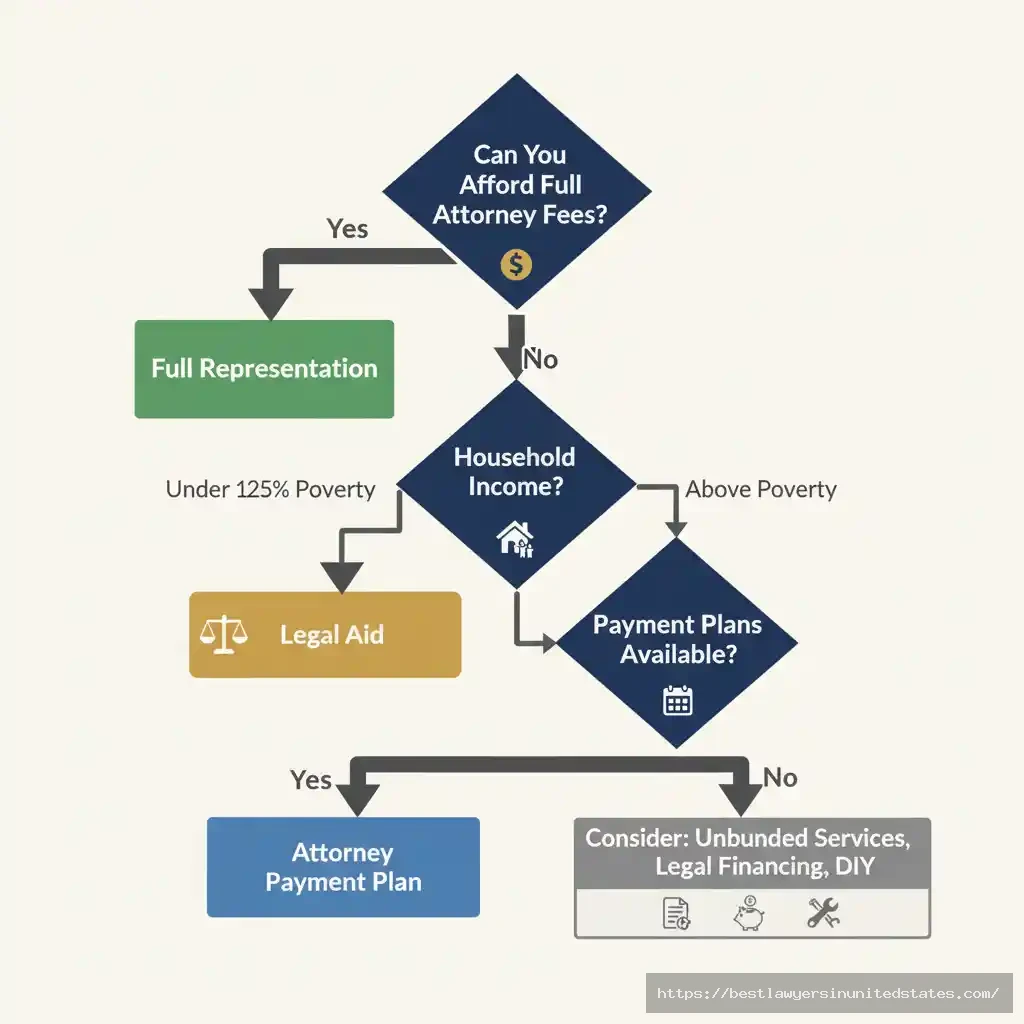
Attorney Payment Plan Options
Most Georgia divorce attorneys understand that divorce creates financial strain. Many offer flexible payment arrangements to make representation accessible.
Common payment plan structures:
Retainer with monthly payments:
- Pay initial retainer: $2,000-$5,000
- Make monthly payments: $250-$500/month
- Attorney continues work as you pay
- Works for: Moderate-income clients with regular employment
Reduced retainer with fee agreement:
- Lower initial retainer: $1,000-$2,500
- Sign agreement for payment schedule
- Payments continue during case
- Works for: Clients who can’t afford full retainer upfront
Flat fee installments:
- Flat fee broken into payments
- Example: $3,000 flat fee paid as $1,000 down + $500/month for 4 months
- Works for: Uncontested divorces with predictable costs
Post-settlement payment:
- Attorney works on contingency basis
- Fees paid from property settlement or other proceeds
- Not common in Georgia family law but some attorneys offer
- Works for: Cases where you’ll receive significant assets in divorce
How to negotiate payment plans:
- Be honest about your financial situation
- Provide proof of income and expenses
- Propose realistic payment amounts you can sustain
- Offer security if possible (property lien, promissory note)
- Get payment agreement in writing
- Keep payments current (missed payments may result in attorney withdrawal)
Not all attorneys offer payment plans, but many do. Ask during initial consultations.
Legal Financing and Loan Options
If you can’t afford attorney fees or payment plans, specialized legal financing companies provide loans for divorce costs. These work like personal loans but are designed specifically for legal fees.
Legal financing companies:
- Loan amounts: $2,500-$50,000
- Interest rates: 8%-36% depending on credit
- Repayment terms: 12-60 months
- Approval: Based on credit score and income
- Funds: Paid directly to you or your attorney
Pros of legal financing:
- Access representation you couldn’t otherwise afford
- Competitive rates compared to credit cards
- No collateral required
- Get divorce finalized rather than delaying
Cons of legal financing:
- Interest costs increase total expense
- Monthly payments continue after divorce
- May have origination fees
- Approval not guaranteed if poor credit
Using Credit Cards or Personal Loans
Some people pay divorce costs using credit cards or personal loans. This carries risks but may be necessary in certain situations.
Credit card considerations:
Pros:
- Immediate access to funds
- Rewards points on some cards
- 0% APR promotional periods available
- No approval process if you already have the card
Cons:
- High interest rates (18%-29% typical)
- Can quickly accumulate unmanageable debt
- Damages credit utilization ratio
- May not have sufficient credit limit
Personal loan considerations:
Pros:
- Lower interest than credit cards (7%-25% typical)
- Fixed monthly payments
- No collateral required (unsecured loans)
- Predictable repayment timeline
Cons:
- Interest increases total cost
- Requires good credit for best rates
- Origination fees (1%-8% of loan amount)
- Adds debt burden post-divorce
Best practices if using debt to finance divorce:
- Borrow only what you absolutely need
- Shop for lowest interest rates
- Consider 0% balance transfer credit cards
- Have repayment plan in place
- Try to pay off before divorce finalizes
Negotiating Fees With Your Attorney
Many attorneys will work with clients on fees, especially if you’re honest about your financial constraints and demonstrate commitment to the case.
Negotiation strategies:
Ask about:
- Payment plans with reduced or no interest
- Unbundled services (limited scope representation)
- Paralegal handling of routine tasks (lower hourly rate)
- Flat fee options instead of hourly
- Reduced hourly rate in exchange for prompt payment
Demonstrate reliability:
- Make initial payment on time
- Follow through on commitments
- Stay organized to reduce wasted time
- Communicate efficiently
- Show ability to make monthly payments
What to offer:
- Professional services in trade (if attorney needs your services)
- Security interest in property you’ll receive
- Lump sum payment after settlement
- Referrals to other clients
What won’t work:
- Asking for free representation (unless through legal aid)
- Expecting attorney to wait indefinitely for payment
- Being unreliable with agreed payments
- Using financial constraints as negotiating leverage
Most attorneys want to help and will work within reason if you’re upfront and reliable.
How Divorce Timeline Affects Total Costs
Time is money in divorce cases. The longer your case takes, the more you’ll pay in attorney fees and costs. Understanding what drives timeline helps you control costs.
Cost Accumulation by Month
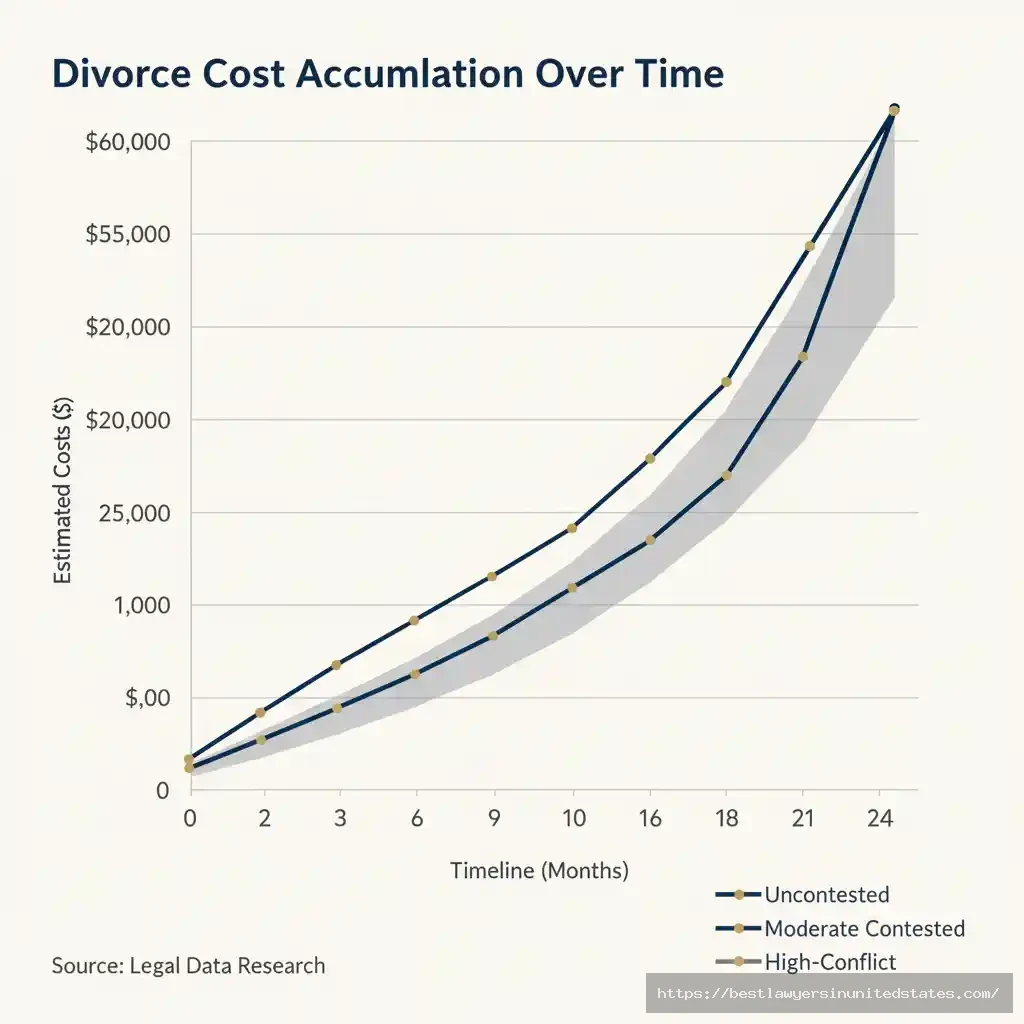
Contested divorces bill attorney time monthly, with costs accumulating steadily. Here’s how a moderately contested divorce at $300/hour might break down:
Month 1-2 (Case filing and initial actions):
- Attorney hours: 8-12 hours
- Tasks: Initial consultation, document preparation, filing, temporary orders motion
- Cost: $2,400-$3,600
Month 3-4 (Discovery and information gathering):
- Attorney hours: 12-18 hours
- Tasks: Discovery requests, document review, financial analysis, negotiation attempts
- Cost: $3,600-$5,400
Month 5-6 (Depositions and expert involvement):
- Attorney hours: 15-25 hours
- Tasks: Deposition preparation and attendance, expert consultations, continued negotiation
- Additional costs: Depositions ($600-$1,200), experts ($2,000-$5,000)
- Cost: $7,100-$12,900
Month 7-9 (Pre-trial motions and settlement efforts):
- Attorney hours: 18-30 hours
- Tasks: Motion hearings, intensive settlement negotiations, mediation, trial preparation
- Additional costs: Mediation ($1,500-$3,000)
- Cost: $6,900-$12,000
Month 10-12 (Trial or final settlement):
- Attorney hours: 25-40 hours
- Tasks: Trial preparation, trial (2-3 days), post-trial motions, final decree preparation
- Additional costs: Court reporter ($800-$1,500), expert testimony ($1,500-$3,000)
- Cost: $9,800-$16,500
Total 12-month case:
- Attorney fees: $29,800-$50,400
- Additional costs: $5,000-$12,000
- Grand total: $34,800-$62,400
These numbers show why settling early saves money. If this same couple settled in Month 4, they’d each save $25,000-$45,000.
What Causes Divorces to Take Longer (and Cost More)
Several factors extend divorce timelines and increase costs. Recognizing these helps you avoid unnecessary delays.
High-conflict dynamics: When spouses fight over every issue, cases drag on indefinitely. Each disagreement requires attorney time for motions, hearings, and arguments.
Cost impact: High-conflict cases take 2-3x longer than cooperative cases. An 8-month cooperative divorce becomes 18-24 months when high-conflict.
Discovery disputes: If one spouse hides assets or refuses to provide financial information, the other must file discovery motions and potentially depositions to obtain needed information.
Cost impact: Discovery fights add $3,000-$10,000 in attorney fees per side, plus 2-4 months to timeline.
Court scheduling delays: Georgia courts have limited hearing dates available. In busy counties like Fulton or Gwinnett, getting a trial date might take 8-12 months from when you request it.
Cost impact: Each 3-month court delay typically adds $3,000-$5,000 in attorney fees as the case remains active.
Continuances (postponements): When attorneys or parties request postponements, cases stall and costs continue accumulating.
Cost impact: Each continuance adds 1-3 months and $1,500-$3,000 in additional fees.
Complex financial issues: Cases involving business valuations, tracing separate property, or analyzing complex investments take longer to prepare.
Cost impact: Complex financial cases take 6-12 months longer than simple cases, adding $10,000-$25,000 in fees.
Custody evaluations or GAL investigations: Comprehensive custody investigations by GALs or evaluators take 2-4 months to complete, during which the case remains pending.
Cost impact: Custody investigations add 3-6 months to timeline plus $5,000-$15,000 in fees.
Timeline Strategies to Control Costs
You can influence how long your divorce takes through strategic decisions and proactive behavior.
Respond promptly to discovery: When your spouse’s attorney requests financial documents or information, provide complete responses quickly. Delays lead to court motions and additional attorney time.
Savings: 1-2 months timeline, $2,000-$4,000 in fees
Prioritize settlement discussions: Actively engage in settlement negotiations rather than waiting for court-ordered mediation. Early settlement saves months of litigation.
Savings: 3-6 months timeline, $8,000-$20,000 in fees
Be flexible with court scheduling: When scheduling hearings, give your attorney several date options. Difficult-to-schedule clients extend cases unnecessarily.
Savings: 2-4 weeks per hearing scheduled
Limit unnecessary motions: Every court motion costs $1,000-$3,000 in attorney time. Only file motions for truly necessary issues, not to “send messages” to your spouse.
Savings: $3,000-$10,000 in unnecessary motion costs
Make decisions efficiently: When your attorney needs decisions from you, respond within 24-48 hours. Delayed decisions stall cases.
Savings: Maintains momentum, prevents accumulating delays
Use temporary agreements: Rather than fighting over temporary custody or support, agree to temporary arrangements while negotiating permanent terms. This keeps focus on final settlement.
Savings: 1-3 months, $3,000-$8,000
Consider mediation early: Don’t wait for court-ordered mediation. Schedule voluntary mediation as soon as significant issues are identified.
Savings: 2-6 months, $5,000-$15,000
For additional information on divorce costs across different states, you may find our guides helpful: divorce cost in California, divorce cost in Texas, divorce cost in Florida, and divorce cost in New York.
Contested vs. Uncontested: Cost Comparison
The fundamental distinction between contested and uncontested divorces drives more cost variation than any other factor. Understanding the differences helps you make informed decisions about your approach.
| Factor | Uncontested Divorce | Contested Divorce |
|---|---|---|
| Definition | Both spouses agree on all issues | Spouses disagree on one or more major issues |
| Timeline | 31-90 days | 6-24+ months |
| Attorney Fees | $1,500-$5,000 | $15,000-$50,000+ per spouse |
| Court Hearings | 1-2 (usually just final hearing) | 4-10+ hearings |
| Discovery | Minimal or none | Extensive (interrogatories, depositions, subpoenas) |
| Mediation | Usually unnecessary | Often required, sometimes multiple sessions |
| Expert Witnesses | Rarely needed | Often needed ($5,000-$20,000+) |
| Court Filings | Basic petition and agreement | Multiple motions throughout case |
| Emotional Toll | Lower stress | High stress and conflict |
| Control | Spouses control outcomes | Judge decides contested issues |
| Privacy | Mostly private | Public court proceedings |
| Modification Risk | Lower (agreed terms) | Higher (imposed terms may be unrealistic) |
Financial impact example:
Couple A (Uncontested):
- Married 8 years, one child, home, standard retirement accounts
- Agreed on custody, child support, and property division before filing
- Used flat-fee attorney at $2,800
- Total time: 62 days from filing to final decree
- Total cost per spouse: $2,800 + $235 filing fee = $3,035
Couple B (Contested):
- Same assets and circumstances as Couple A
- Disagreed on custody schedule and home equity division
- Required 4 court hearings, one mediation session, GAL investigation
- 14-month process
- Total cost per spouse: $31,500
Same circumstances, different approach, $28,500 difference in cost per spouse ($57,000 total difference).
Do You Need a Lawyer for Your Georgia Divorce?
Whether you need an attorney depends on your specific circumstances. In some situations, representing yourself is reasonable. In others, it’s a costly mistake.

When You Should Hire an Attorney
Absolutely hire an attorney if:
Your spouse hired an attorney: Never represent yourself against a represented spouse. You’re at a massive disadvantage. Hire your own attorney immediately.
You have minor children and custody disputes: Child custody is too important to risk mistakes. The long-term implications of custody arrangements require professional legal guidance.
Significant assets or complex property: If you own a business, have substantial retirement accounts, own multiple properties, or have complex investments, attorney expertise ensures proper valuation and division.
Domestic violence or abuse: Safety concerns require attorney representation. Many legal aid organizations prioritize domestic violence cases.
Your spouse is hiding assets: If you suspect your spouse isn’t disclosing all assets, an attorney can conduct discovery to uncover hidden property or income.
Alimony is disputed: Alimony calculations involve complex legal factors. Get attorney advice to ensure fair outcomes.
You don’t understand legal procedures: If you feel overwhelmed by the legal process, an attorney guides you through each step and handles technical requirements.
Significant income disparity: When one spouse earns substantially more, proper legal representation ensures fair support and property division.
Mental health concerns: If either spouse has mental health issues affecting parenting or decision-making, attorney guidance is essential.
Your spouse is being unreasonable: If your spouse won’t negotiate in good faith, you need an attorney to advocate for your interests.
When DIY Divorce Might Be Appropriate
Consider representing yourself only if ALL these factors are true:
✅ Both spouses agree on everything: Complete agreement on property division, debt allocation, custody, child support, and all other issues.
✅ Simple financial situation: Minimal assets, no retirement accounts needing QDROs, straightforward property ownership.
✅ No minor children OR complete custody agreement: Either no children, or detailed written agreement on parenting time, decision-making, and support.
✅ Short marriage (under 5 years): Less likelihood of complex alimony or significant asset accumulation issues.
✅ Both spouses can communicate reasonably: Ability to discuss issues calmly and reach practical compromises.
✅ No domestic violence or power imbalances: Both spouses feel safe and able to advocate for themselves.
✅ You understand basic legal concepts: Comfortable reading and completing forms, following procedures, appearing in court.
✅ Budget is extremely tight: Attorney fees would create genuine financial hardship (though legal aid might be available).
Hybrid option – Limited Scope Representation: If you want to save money but need some attorney guidance, consider “unbundled” or “limited scope” representation:
- Attorney reviews documents you prepared: $500-$1,000
- Attorney advises on specific issues: $500-$1,500
- Attorney handles court appearance only: $750-$2,000
- Attorney drafts settlement agreement only: $750-$1,500
This provides professional guidance at lower cost than full representation.
Planning for Post-Divorce Financial Life
Divorce costs don’t end when the judge signs your final decree. Post-divorce financial adjustments significantly impact your long-term financial health.
Budget Adjustments After Divorce
Your financial life changes dramatically after divorce. Single-household budgets require careful planning.
Income changes:
- Loss of spouse’s income contribution
- Possible alimony received or paid
- Child support received or paid
- Tax filing status change (single or head of household)
- Loss of spouse’s benefits (health insurance, etc.)
Expense changes:
- Housing costs (mortgage or rent)
- Utilities split from shared to individual
- Health insurance (often more expensive)
- Child care costs (if you now have primary custody)
- Transportation (two households, two cars)
- Legal fees continuing (if modifications needed)
Creating a realistic post-divorce budget:
- Calculate new income:
- Your salary/wages
- Child support received
- Alimony received
- Other income sources
- Less: Child support paid
- Less: Alimony paid
- List all expenses:
- Housing (mortgage/rent, insurance, taxes)
- Utilities
- Food and groceries
- Transportation
- Health insurance and medical
- Child-related costs
- Debt payments
- Retirement savings
- Emergency fund contributions
- Identify gaps and solutions:
- Income insufficient? Consider additional work, roommate, or downsizing
- Expenses too high? Look for reduction opportunities
- Child support inadequate? May need modification
- Alimony ending? Plan for transition
Many divorcing individuals underestimate post-divorce costs and overestimate their ability to maintain pre-divorce lifestyles. Realistic budgeting prevents post-divorce financial crisis.
Updating Estate Planning Documents
Divorce requires immediate updates to estate planning documents. Failure to update these can have disastrous consequences.
Critical updates needed:
Wills:
- Remove ex-spouse as beneficiary
- Name new executor (if spouse was named)
- Update guardianship provisions for minor children
- Revise property distribution plans
Powers of Attorney:
- Revoke any financial power of attorney naming your ex-spouse
- Create new power of attorney naming trusted person
Healthcare Directives:
- Remove ex-spouse as healthcare decision-maker
- Name new healthcare proxy
- Update living will provisions
Beneficiary Designations (NOT in wills):
- Life insurance policies
- Retirement accounts (401(k), IRA, etc.)
- Bank accounts with “payable on death” designations
- Investment accounts
Trusts:
- Revise trust terms if ex-spouse was beneficiary or trustee
- Update successor trustee designations
- Modify distribution provisions
Georgia law revokes gifts to ex-spouses in wills automatically upon divorce, but you should update your will anyway to avoid confusion. Beneficiary designations on life insurance and retirement accounts are NOT automatically revoked and must be changed manually.
Timing: Update these immediately after divorce finalizes. Don’t wait. The cost of updating estate documents ($500-$1,500) is trivial compared to the cost of not updating them.
Tax Implications of Divorce
Divorce creates significant tax consequences that affect your finances for years to come.
Filing status changes:
- You can’t file “married filing jointly” after divorce finalizes
- Options: Single or Head of Household (if you have qualifying children)
- Head of Household provides better tax rates than Single
- Year of divorce: Status determined by December 31st of that year
Dependency exemptions:
- Generally, custodial parent claims children as dependents
- Parents can agree to alternate years
- Non-custodial parent needs signed Form 8332 to claim exemptions
Child support:
- Not taxable to recipient
- Not tax-deductible to payer
- This has been true for all divorces since 2019
Alimony:
- For divorces finalized after December 31, 2018: alimony is NOT taxable to recipient and NOT deductible by payer
- For divorces before 2019: Old rules apply (recipient pays taxes, payer deducts)
Property division:
- Generally not taxable when transferred between spouses as part of divorce
- Exception: Tax-deferred retirement accounts need proper QDRO to avoid taxes and penalties
- Home sale exclusion: Each spouse can exclude $250,000 of gain if they owned and lived in home 2 of previous 5 years
Retirement account division:
- QDROs allow penalty-free transfers
- Without QDRO: 10% early withdrawal penalty plus taxes apply
- Cost of QDRO ($500-$1,500) is worth avoiding these penalties
Tax filing for divorce year: If your divorce finalizes in 2025:
- January-December 31, 2025: File married filing jointly or married filing separately
- January 1, 2026 onward: File single or head of household
Consider consulting a tax professional or financial advisor during divorce to understand your specific tax situation.
Frequently Asked Questions About Georgia Divorce Costs
Do you need a lawyer for an uncontested divorce in Georgia?
No, Georgia law doesn’t require attorneys for uncontested divorces. If you and your spouse agree on all issues, have no children or agree on custody arrangements, and have simple assets, you can file for divorce yourself using forms available from the Georgia court system. However, most people benefit from at least consulting with an attorney to ensure their agreement is fair and legally sound. A flat-fee attorney for an uncontested divorce typically costs $1,500-$3,000, which provides peace of mind that everything is handled correctly.
How long do uncontested divorces take in Georgia?
Uncontested divorces in Georgia take a minimum of 31 days. Georgia law requires a 31-day waiting period between filing and finalizing a divorce when no minor children are involved. For divorces involving children, most counties require parents to complete a parenting education seminar before the final hearing, which typically extends the process to 60-90 days. The fastest possible timeline is filing on day 1, both spouses being served immediately or waiving service, and having a final hearing scheduled on day 32 or later.
How much does it cost to file for divorce in Fulton County?
Filing for divorce in Fulton County costs $220 for cases without minor children and $235 for cases with children. Additional costs include service of process (sheriff service costs $25-$50, private process servers cost $75-$150) and potential copying fees ($0.25 per page). These are just the court filing fees and don’t include attorney fees if you hire a lawyer. Total DIY divorce costs in Fulton County range from $300-$500 if you and your spouse agree on everything.
Can I get a divorce without going to court in Georgia?
No, all Georgia divorces require at least one court appearance for the final hearing. Even completely uncontested divorces require you (and sometimes both spouses) to appear before a judge to finalize the divorce. The judge asks questions to ensure you meet Georgia’s residency requirements, understand the agreement, and entered into it voluntarily. However, most uncontested divorces involve only this single brief hearing lasting 10-20 minutes. Contested divorces require multiple court appearances including hearings on temporary orders, motions, and potentially a multi-day trial.
What’s the cheapest way to get a divorce in Georgia?
The cheapest Georgia divorce costs $300-$500 total and requires: (1) you and your spouse agreeing on all issues, (2) no minor children or complete agreement on custody, (3) simple assets and debts, (4) completing your own paperwork using online forms or document services, and (5) attending the final hearing without an attorney. Even cheaper (sometimes free) options exist if you qualify for a fee waiver based on income below 125% of federal poverty guidelines. Georgia Legal Services Program provides free legal help to eligible low-income individuals.
Who pays for the divorce costs in Georgia?
Generally, each spouse pays their own attorney fees in Georgia divorces. However, Georgia law allows judges to order one spouse to pay the other spouse’s attorney fees if there’s a significant income disparity and one spouse lacks the financial ability to pay. This typically happens when one spouse is the primary earner and the other has limited income or assets. Filing fees and other court costs are usually split equally unless the court orders otherwise. In high-conflict cases where one spouse behaves unreasonably, judges sometimes order that spouse to pay additional costs.
How much does a contested divorce cost in Georgia?
Contested divorces in Georgia typically cost $15,000-$50,000 or more per spouse, depending on complexity and conflict level. Simple contested cases with one or two disputed issues might cost $8,000-$15,000 each. Moderate-complexity contested divorces with several disputed issues average $15,000-$25,000 per spouse. High-conflict divorces involving custody battles, business valuations, or significant assets often exceed $30,000-$50,000 per spouse. These costs include attorney fees (the largest expense), court filing fees, mediation, potentially Guardian ad Litem fees, expert witnesses, and depositions.
Can I get a fee waiver if I can’t afford filing fees?
Yes, Georgia courts waive filing fees for individuals whose household income is at or below 125% of federal poverty guidelines. For 2025, this means annual household income below $18,375 for one person, $24,875 for two people, $31,375 for three people, or $37,875 for four people. To request a fee waiver, complete an Affidavit of Indigence (available from the Clerk of Superior Court) and provide supporting documentation like pay stubs, tax returns, and proof of government benefits. If approved, the court waives your filing fee and potentially other court costs. If you receive SNAP, TANF, or SSI benefits, you typically qualify automatically.
Is Georgia divorce online legitimate?
Yes, online divorce document preparation services are legitimate for truly uncontested Georgia divorces. These services (costing $99-$500) help you complete Georgia-specific divorce forms based on information you provide. However, they only work if you and your spouse agree on everything and have a simple situation with no contested issues. Online services are document preparers, not law firms, so they can’t give legal advice, negotiate with your spouse, or represent you in court. They’re legitimate for simple uncontested cases but inappropriate for contested divorces, cases with children (unless custody is fully agreed), or complex assets.
How much does mediation cost in Georgia divorce cases?
Private mediation in Georgia costs $150-$400 per hour, with typical sessions lasting 3-6 hours. Total cost per mediation session ranges from $450-$2,400, usually split equally between spouses ($225-$1,200 each). Complex cases often require 2-3 mediation sessions totaling $1,500-$5,000. Some Georgia counties offer court-annexed mediation programs at reduced rates of $100-$200 per hour. Despite the cost, mediation almost always saves money compared to going to trial. A case that settles in mediation might cost $15,000-$20,000 total, while the same case going to trial could cost $30,000-$60,000+.
What factors make Georgia divorces more expensive?
The most significant cost factors are: (1) contested vs. uncontested (contested costs 5-10x more), (2) presence of minor children with custody disputes (adds $10,000-$30,000), (3) complex assets like businesses or multiple properties (adds $5,000-$25,000), (4) high conflict between spouses (doubles or triples costs), (5) attorney experience and location (metro Atlanta costs more than rural areas), (6) case duration (every month adds $1,500-$3,000), and (7) need for experts like business valuators, custody evaluators, or forensic accountants ($5,000-$20,000+). Agreeing on issues, communicating reasonably, and settling early are the most effective cost control strategies.
How much do divorce lawyers cost in Georgia?
Georgia divorce lawyer hourly rates range from $200-$450 per hour depending on experience and location. Entry-level attorneys charge $200-$275/hour, mid-level attorneys charge $275-$350/hour, and experienced attorneys charge $350-$450/hour. Metro Atlanta attorneys typically charge $50-$100/hour more than rural Georgia attorneys. Many attorneys offer flat fees for uncontested divorces ranging from $1,500-$3,500. For contested cases, attorneys require retainers of $5,000-$25,000 upfront, which they bill against as they work on your case. Total costs depend on case complexity and duration.
How long does a Georgia divorce take?
Uncontested divorces take 31-90 days from filing to final decree. Georgia requires a minimum 31-day waiting period for divorces without children (46 days in some counties). With children, most cases take 60-90 days to allow time for parenting seminars. Contested divorces take 6-24+ months depending on complexity and court scheduling. Simple contested cases might resolve in 6-9 months. Complex contested divorces often take 12-18 months. High-conflict custody battles can extend beyond 24 months. Court backlogs, continuances, and discovery disputes significantly affect timeline.
What’s the difference between contested and uncontested divorce costs?
Uncontested divorces cost $1,500-$5,000 total per spouse including attorney fees, while contested divorces cost $15,000-$50,000+ per spouse. The difference comes from attorney time required: uncontested cases need 10-20 attorney hours, while contested cases require 60-150+ hours. Contested divorces also involve additional expenses like depositions ($600-$1,200), mediation (required in most contested cases, $1,500-$5,000), potentially Guardian ad Litem fees ($2,500-$10,000), expert witnesses ($5,000-$20,000), and multiple court hearings. Every issue you can settle through agreement saves thousands in attorney fees and costs.
Can I get legal aid for my Georgia divorce?
Yes, if your household income is at or below 125% of federal poverty guidelines, you may qualify for free legal aid from organizations like Georgia Legal Services Program or Atlanta Legal Aid Society. These organizations provide free legal advice, document preparation, and sometimes court representation for eligible individuals. Income limits for 2025 are approximately $18,375 for one person, $24,875 for two people, or $31,375 for three people. Priority goes to cases involving domestic violence, children, or urgent situations. Apply early as these programs have limited capacity. For domestic violence cases, income requirements may be waived.
Do I have to pay my spouse’s attorney fees in Georgia?
Not usually. Generally, each spouse pays their own attorney fees in Georgia divorces. However, judges can order one spouse to pay the other’s fees if there’s significant income disparity and one spouse can’t afford representation. This typically occurs when one spouse is the primary earner and the other has limited income or assets. Courts also consider whether one spouse behaved unreasonably and unnecessarily increased costs. If ordered to pay your spouse’s fees, this is in addition to your own attorney fees, making it very expensive. Good faith negotiation and reasonable behavior help avoid these orders.
How much does it cost to get divorced if both parties agree?
If both parties agree on all issues, Georgia divorce costs range from $300-$500 for complete DIY divorce (using online document services plus court filing fees) to $1,500-$3,500 with attorney representation. The cost depends on whether you have children (adds $500-$1,500 due to parenting plan and child support), complexity of assets (retirement accounts needing QDROs add $500-$1,500), and whether you hire an attorney. Most people with agreed divorces choose flat-fee attorney representation at $2,000-$3,000 to ensure everything is done correctly.
What happens if I can’t afford a divorce lawyer in Georgia?
You have several options: (1) apply for free legal aid through Georgia Legal Services Program or Atlanta Legal Aid Society if you meet income requirements, (2) look for pro bono representation through State Bar of Georgia’s Pro Bono Project, (3) seek reduced-fee representation through the Modest Means Program (for those earning 200%-400% of poverty guidelines), (4) ask attorneys about payment plans or reduced retainers, (5) consider legal financing companies that provide loans for attorney fees, (6) use unbundled “limited scope” representation where an attorney handles only specific parts of your case, or (7) represent yourself with help from court self-help centers. Never let cost prevent you from getting a divorce you need.
Are there hidden costs in Georgia divorces?
Yes, several costs catch people by surprise. Beyond attorney fees and filing costs, expect: parenting seminar fees ($30-$50 per parent), service of process ($25-$150), mediation if required ($1,500-$5,000 split), Guardian ad Litem fees if custody is disputed ($2,500-$10,000+ split based on income), expert witness fees if needed ($5,000-$20,000+), QDRO preparation for retirement accounts ($500-$1,500 per account), deposition costs if your case requires them ($600-$1,200 per deposition), court reporter transcripts ($3-$7 per page), and potential post-judgment modification costs if circumstances change after divorce. Always ask your attorney for a complete cost estimate including potential additional expenses.
How much does a Guardian ad Litem cost in Georgia divorces?
Guardian ad Litem (GAL) fees in Georgia typically range from $2,500-$10,000 for straightforward cases and $10,000-$25,000+ for complex or high-conflict custody disputes. GALs bill hourly at $200-$350 per hour depending on experience and location. Courts generally order both parents to split GAL fees based on their respective incomes. If one parent earns 70% of combined income, they pay 70% of GAL fees. GALs are appointed when parents have serious custody disputes, allegations of abuse or neglect, or can’t communicate effectively about children. While expensive, GALs often help resolve difficult custody cases by providing objective recommendations to judges.
Next Steps: Getting Started With Your Georgia Divorce
Understanding divorce costs helps you prepare financially and make informed decisions. Whether your divorce will cost $500 or $50,000 depends largely on the choices you and your spouse make.
Key takeaways:
- Uncontested divorces cost $1,500-$5,000 with attorney help
- Contested divorces cost $15,000-$50,000+ per spouse
- County filing fees in Georgia range from $200-$240
- Fee waivers available for those earning under 125% of poverty guidelines
- Every issue you settle saves thousands in legal fees
- Children involved adds $500-$30,000 depending on whether custody is disputed
- Mediation costs less than trial in every case
- Legal aid and payment plans available for those who qualify
Recommended next steps:
- Assess your situation honestly: Is your divorce likely to be uncontested or contested? This single factor determines 80% of your costs.
- Gather financial documentation: Start collecting tax returns, pay stubs, bank statements, retirement account statements, mortgage documents, and other financial records.
- Consult with attorneys: Most Georgia divorce attorneys offer free initial consultations. Meet with 2-3 to understand your options and get cost estimates.
- Explore all options: Consider mediation, collaborative divorce, or unbundled representation if full representation isn’t affordable.
- Check eligibility for assistance: If income-qualified, contact Georgia Legal Services Program or Atlanta Legal Aid Society before hiring a private attorney.
- Create a divorce budget: Use the cost information in this guide to estimate your expenses and identify how you’ll pay for them.
- Talk with your spouse: If communication is possible, discuss approaching the divorce cooperatively to minimize costs.
Remember that divorce is an investment in your future. While costs can be significant, the goal is ending an unsuccessful marriage and moving forward. Making informed, strategic decisions about your divorce approach ensures you protect your interests without unnecessarily draining your finances.
For more divorce resources, explore our comprehensive guides on general divorce costs, use our divorce cost calculator, or browse our family lawyer directory to find qualified attorneys in your area.
