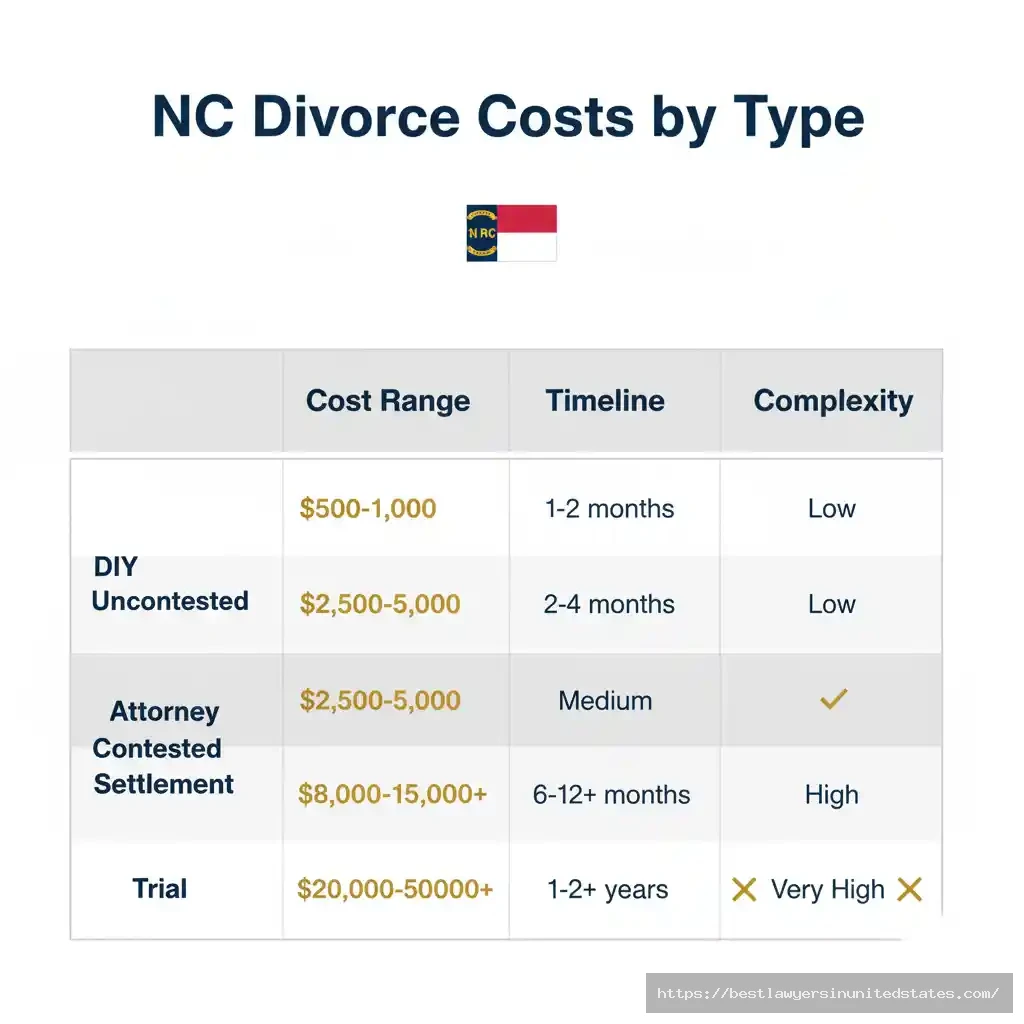
A divorce in North Carolina typically costs between $1,500 and $20,000+. Uncontested divorces where both parties agree average $1,500-$5,000, while contested divorces range from $8,000-$15,000. If your case goes to trial, expect costs to exceed $20,000-$50,000 or more.
The biggest cost factors? Whether you hire an attorney, how much you and your spouse disagree, and North Carolina’s mandatory 1-year separation requirement—which can add thousands in living expenses before you even file.
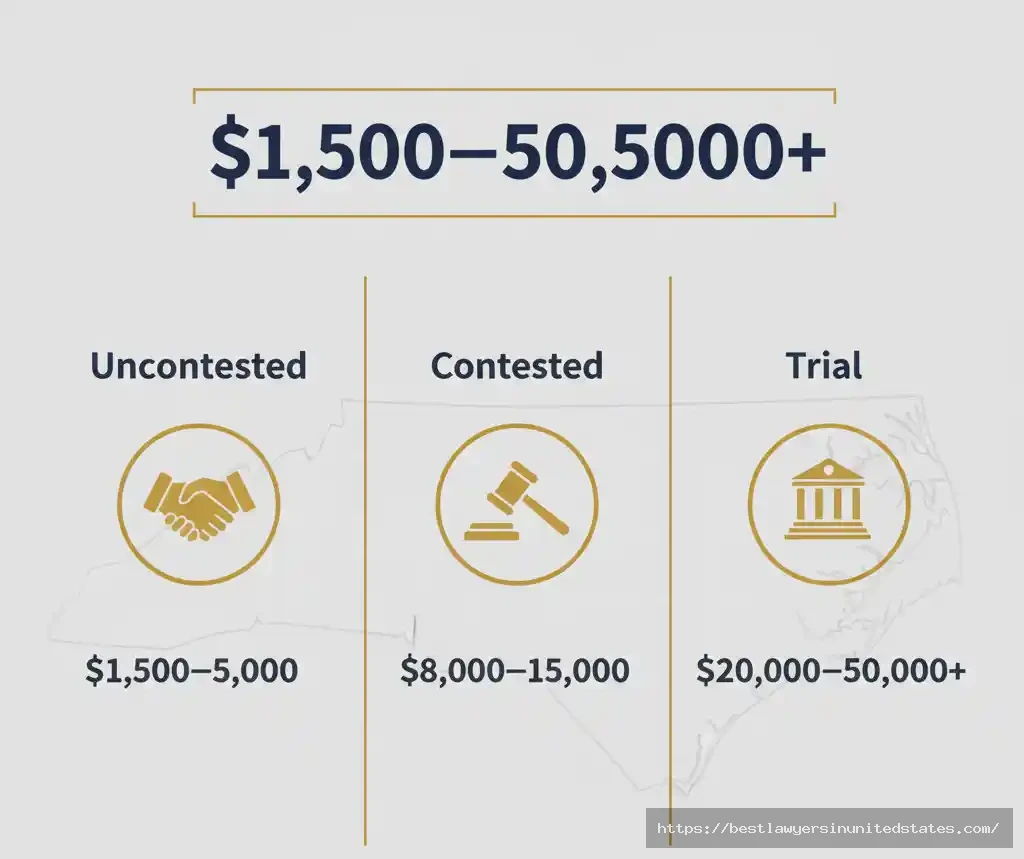
This guide breaks down every cost you’ll face, reveals hidden expenses most people miss, and shows you exactly when DIY divorce makes sense versus when you need a lawyer.
Divorce Cost Calculator
Get an estimated cost for your divorce based on your specific situation
Your Estimated Divorce Cost
Cost Breakdown
📧 Get a Personalized Consultation
Have questions about your specific situation? Contact our legal experts for guidance tailored to your needs.
Contact Us via EmailUse our free calculator to estimate your specific divorce costs based on your situation.
How Much Does a Divorce Actually Cost in North Carolina?
Here’s what you need to know upfront about NC divorce costs:
Average Cost by Divorce Type:
| Divorce Type | Typical Cost Range | What’s Included |
|---|---|---|
| Uncontested DIY | $300-$1,000 | Filing fees, forms, service costs (no attorney) |
| Uncontested with Attorney | $1,500-$5,000 | Attorney fees, court costs, document prep |
| Contested (Settlement) | $8,000-$15,000 | Attorney fees, mediation, negotiations |
| Contested (Trial) | $15,000-$50,000+ | Full representation, trial prep, expert witnesses |
The total you’ll pay depends on five main factors:
- Whether it’s contested or uncontested (biggest variable)
- Attorney involvement (hourly rates vs. flat fees)
- Property and asset complexity (simple vs. multiple assets)
- Child custody disputes (agreement vs. court battle)
- Duration and cooperation level (quick settlement vs. lengthy fight)
Let’s break down each cost component.
What Are the Basic Court Filing Fees in North Carolina?
North Carolina charges $225 to file for divorce. This filing fee is paid when you submit your Complaint for Absolute Divorce to the Clerk of Superior Court in your county.
Additional Filing Costs:
| Fee Type | Cost | When You Pay It |
|---|---|---|
| Divorce filing fee | $225 | When submitting complaint |
| Service of process | $75-$125 | Serving papers to spouse |
| Certified divorce decree copies | $5-$20 each | After divorce is final |
| Name change (if requested) | Included | No additional fee if done with divorce |
Can’t afford the filing fee? North Carolina allows fee waivers for those who qualify as indigent. We’ll cover the exact process later in this guide.
How Much Do Divorce Lawyers Cost in North Carolina?
Attorney fees are the biggest variable in your total divorce cost. Here’s what to expect.
Hourly Rates for NC Divorce Attorneys
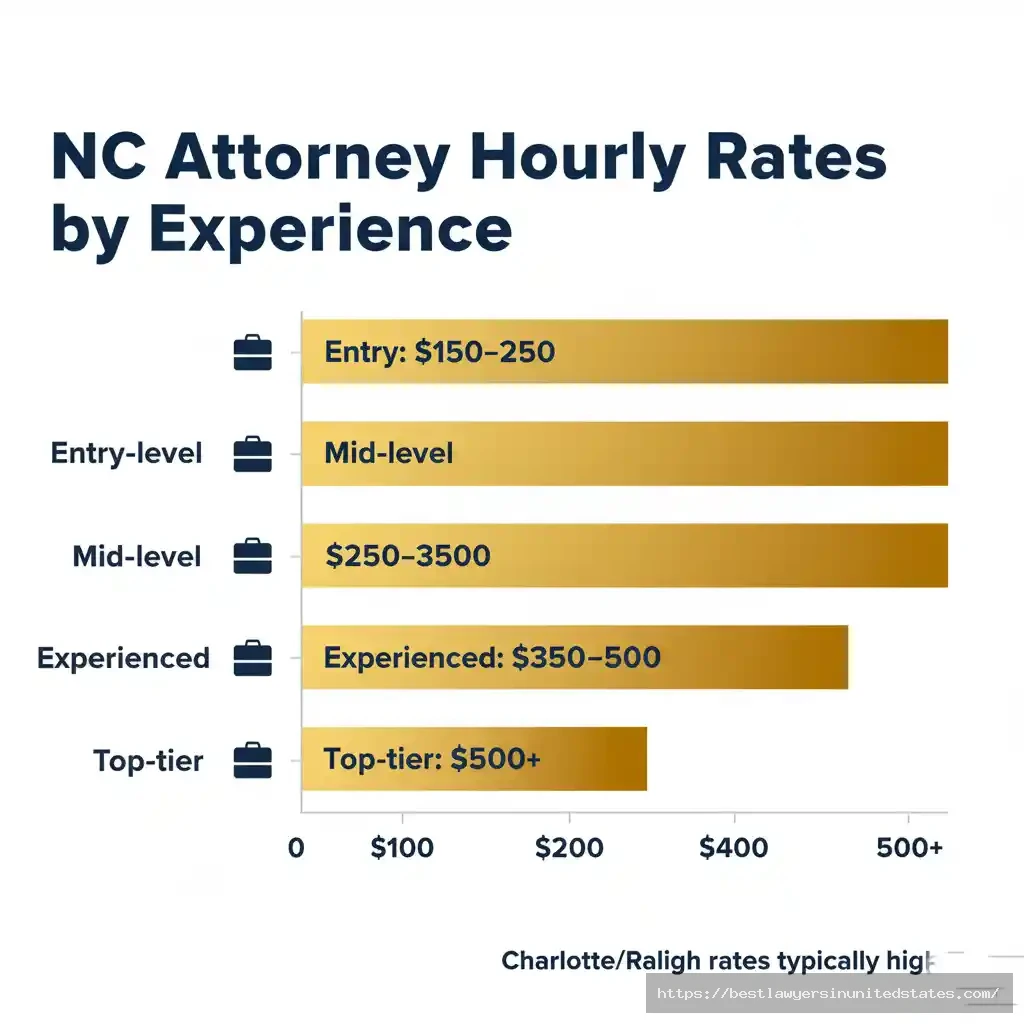
Most North Carolina family law attorneys charge by the hour:
| Attorney Experience Level | Hourly Rate Range | Typical For |
|---|---|---|
| Entry-level attorney | $150-$250/hour | Simple uncontested cases |
| Mid-level attorney | $250-$350/hour | Standard divorces with some complexity |
| Experienced family law specialist | $350-$500/hour | Contested cases, high assets, custody battles |
| Top-tier/Big city attorneys | $500+/hour | Complex estates, business ownership, trials |
Charlotte, Raleigh, and Durham attorneys typically charge on the higher end. Smaller cities like Greensboro, Wilmington, and Asheville fall in the middle range.
Flat Fee Arrangements for Uncontested Divorces
Many attorneys offer flat fees for simple uncontested divorces:
- Flat fee range: $1,500-$3,500
- What’s included: Document preparation, filing, basic court appearance
- What’s NOT included: Issues that arise if spouse contests, child custody disputes, property division negotiations
Retainer Fees: What You Pay Upfront
For contested divorces, attorneys require a retainer—money paid upfront that they draw from as they work:
- Typical retainer: $2,500-$10,000
- How it works: Attorney bills against the retainer; you replenish it as funds deplete
- Unused funds: Returned to you after case concludes
Example: Your attorney requires a $5,000 retainer at $300/hour. After 16 hours of work ($4,800), you’ll need to add more funds to continue representation.
The Hidden Costs of Divorce Most People Don’t Expect
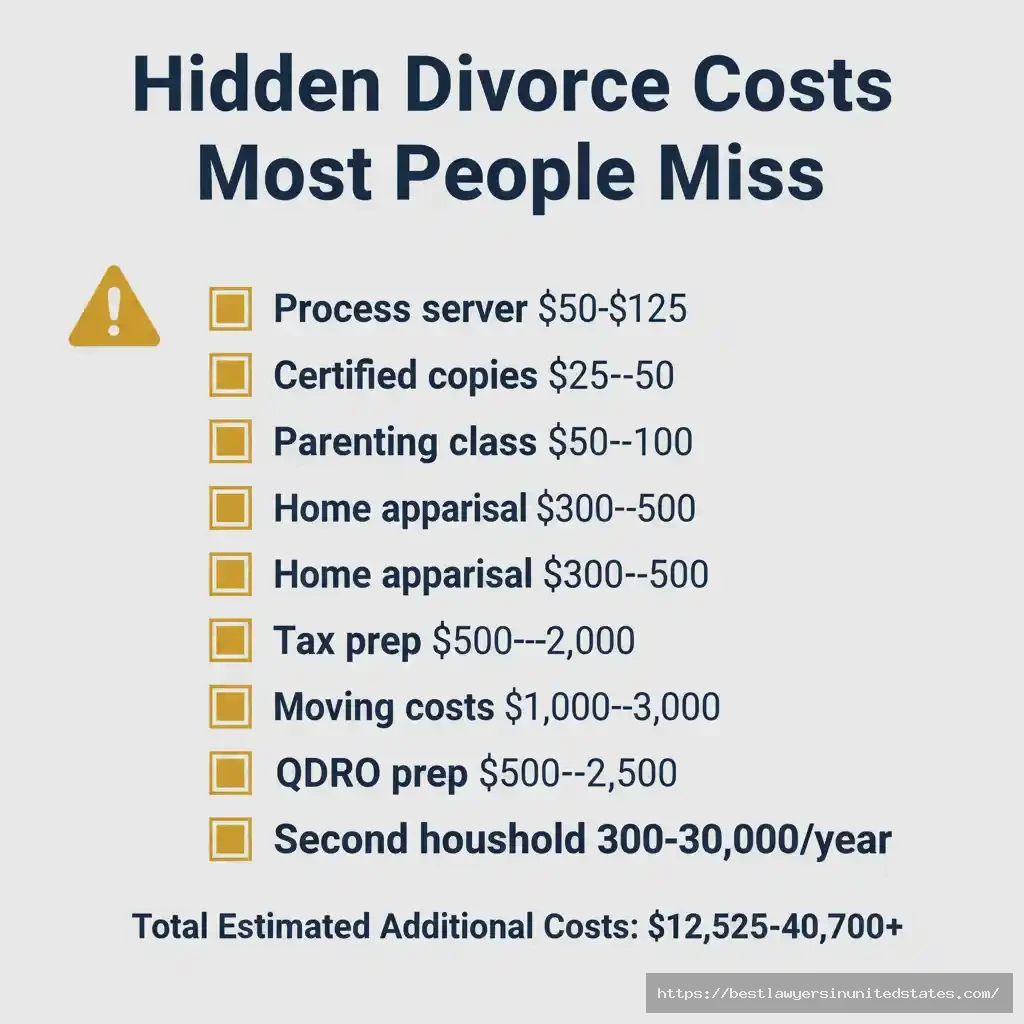
Beyond attorney fees and filing costs, these expenses catch people off guard:
15 Unexpected Divorce Expenses
| Hidden Cost | Typical Amount | Why You Need It |
|---|---|---|
| Process server fees | $50-$125 per attempt | Legally serving papers to spouse |
| Certified copies of decree | $5-$20 each (need 3-5) | Banks, employers, government agencies |
| Parenting class | $50-$100 | Required in NC if you have minor children |
| Credit reports | $10-$40 | Identifying debts for division |
| Home appraisal | $300-$500 | Determining property value |
| Business valuation | $2,000-$10,000+ | If spouse owns a business |
| Tax prep for divorce year | $500-$2,000 | Complex filing status changes |
| Moving costs | $1,000-$3,000 | Relocating to separate residence |
| Name change documents | $200-$300 | Driver’s license, passport, SS card updates |
| Estate planning updates | $1,000-$3,000 | New will, POA, beneficiary changes |
| QDRO preparation | $500-$2,500 | Dividing retirement accounts |
| Mortgage refinancing | $2,000-$5,000 | Removing ex-spouse from home loan |
| Storage unit rental | $100-$200/month | Temporarily storing belongings |
| Therapy/counseling | $100-$200/session | Emotional support during process |
| Second household costs | Varies significantly | The biggest hidden expense (see next section) |
The real kicker? Most people focus on legal fees but forget they’ll be maintaining two households, potentially for over a year because of North Carolina’s separation requirement.
How Does North Carolina’s 1-Year Separation Rule Affect Divorce Costs?
Here’s what makes North Carolina divorces expensive compared to other states: you must live separately for one full year before filing for absolute divorce.
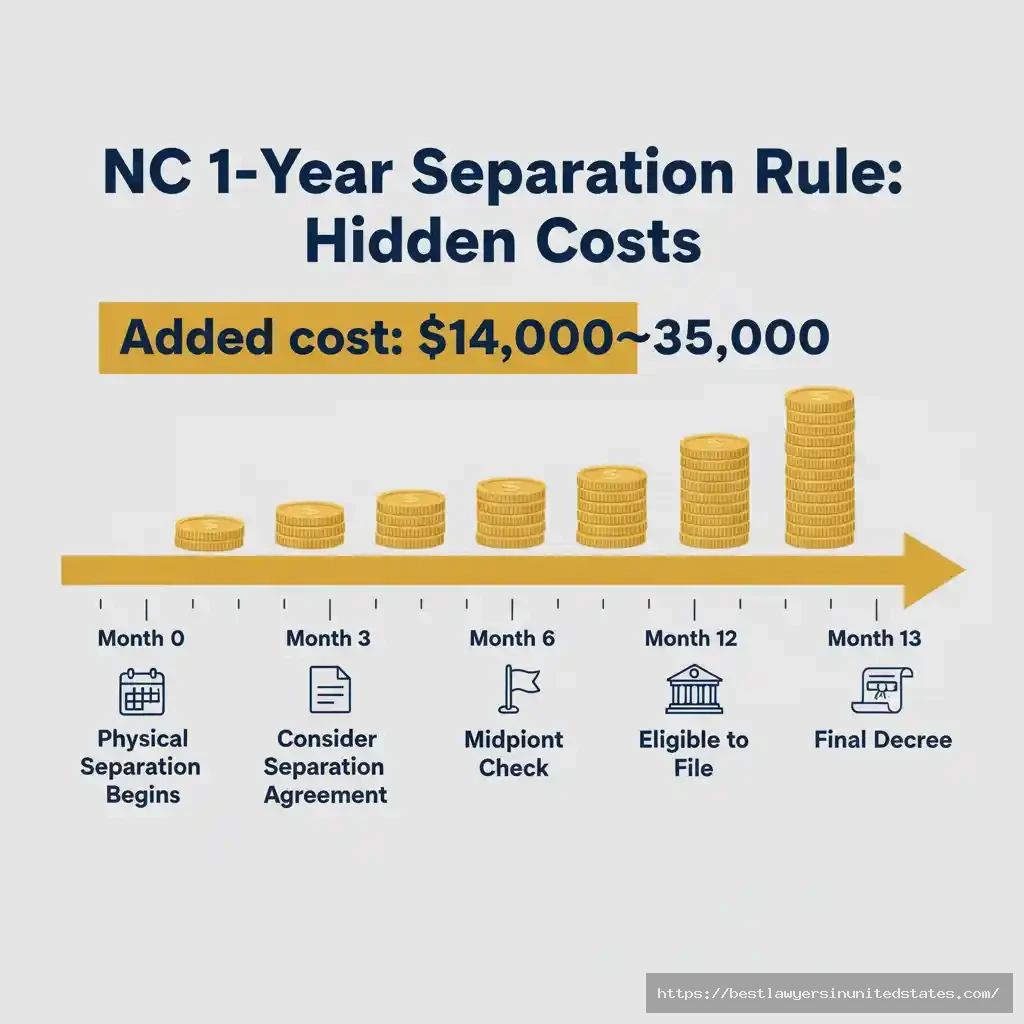
The True Cost of NC’s Mandatory Separation
This isn’t just an inconvenience—it’s a major financial burden:
Additional separation costs over 12 months:
- Second rent/mortgage: $800-$2,000/month = $9,600-$24,000/year
- Duplicate utilities: $150-$300/month = $1,800-$3,600/year
- Additional food/household costs: $200-$400/month = $2,400-$4,800/year
- Separation agreement (recommended): $500-$2,500 one-time
Total extra cost just from waiting: $14,300-$34,900 before you even file for divorce.
Compare this to states with no separation requirement—couples there can file immediately and finalize in 2-4 months. North Carolina’s process takes minimum 13 months from separation to final divorce decree.
Can You Avoid the 1-Year Wait?
Short answer: No, not for absolute divorce.
However, you have options:
1. Divorce from Bed and Board (Limited Divorce)
This is an immediate legal separation available without waiting:
- Filing cost: Same $225 fee
- What it does: Legal separation while remaining married
- What it doesn’t do: Doesn’t end the marriage; you’re still legally married
- Who needs it: Those seeking immediate court orders for spousal support, child custody, or property division
- Attorney costs: $2,000-$8,000+ depending on disputes
2. Living “Separate and Apart” Under the Same Roof
North Carolina law technically allows this, but:
- You must prove complete separation (separate bedrooms, no shared meals, no sexual relations)
- Courts scrutinize this heavily
- Much harder to prove than actual physical separation
- Not recommended unless physical separation is impossible
Bottom line: Budget for 12+ months of separation costs. This is North Carolina’s reality.
For cost comparison, see how divorce costs vary by state in our national guide.
What Factors Affect Your Total North Carolina Divorce Cost?
Let’s break down what makes some divorces cost $1,500 and others $50,000+.
Contested vs. Uncontested Divorce
This is the single biggest cost factor.
Uncontested divorce means:
- Both parties agree on everything (property, debts, custody, support)
- Minimal attorney involvement needed
- Often handled with flat fee or brief hourly work
- Cost: $1,500-$5,000 with attorney, $300-$1,000 DIY
Contested divorce means:
- Disagreements on major issues
- Requires negotiations, possibly mediation
- May need discovery (document requests, depositions)
- Could go to trial
- Cost: $8,000-$50,000+ depending on complexity
What turns uncontested into contested:
- One spouse refuses to cooperate
- Can’t agree on property division
- Child custody disputes
- Alimony disagreements
- Hidden assets suspected
Property and Asset Division Complexity
North Carolina uses “equitable distribution”—fair, but not necessarily equal division.
Simple property division (lower cost):
- Minimal assets (one car each, rental apartment, little savings)
- Clear separation of property
- Both parties agree on split
- Added cost: $1,000-$3,000 in attorney time
Complex property division (higher cost):
- Multiple properties or real estate
- Business ownership (requires valuation)
- Retirement accounts (needs QDRO)
- Investment portfolios
- Valuable collections (art, vehicles, antiques)
- Suspected hidden assets (requires forensic accounting)
- Added cost: $5,000-$25,000+ in attorney fees and expert costs
Is North Carolina a 50/50 divorce state? No. Unlike community property states, NC courts divide marital property “equitably” based on factors like:
- Each spouse’s income and debts
- Duration of marriage
- Contributions to marital property
- Custodial parent needs
- Tax consequences
This means the split might be 60/40, 70/30, or any ratio the court deems fair.
Child Custody and Support Disputes
If you have children and disagree on custody, costs escalate quickly.
Agreed custody arrangement (lower cost):
- Parents create parenting plan together
- Submit to court for approval
- May use mediator to facilitate ($500-$1,500)
- Added cost: $1,000-$3,000
Custody battle (much higher cost):
- Court-ordered mediation required in NC (before trial)
- Multiple court hearings
- Guardian ad litem may be appointed ($2,000-$5,000+)
- Psychological evaluations if requested ($2,000-$5,000 each)
- Expert witness testimony
- Added cost: $10,000-$30,000+
Child support itself is calculated using NC guidelines based on income, so it’s more straightforward. The disputes arise when:
- Income is unclear (self-employed, cash income)
- Extraordinary expenses are involved (special needs child)
- One parent tries to hide income
Alimony/Spousal Support Negotiations
Alimony isn’t automatic in North Carolina. The court considers:
- Financial need of dependent spouse
- Ability of other spouse to pay
- Duration of marriage
- Standard of living during marriage
- Marital misconduct
If you can agree on alimony terms: Minimal added cost If you litigate alimony: Add $3,000-$10,000+ in attorney fees
Attorney Experience and Location
Geography matters:
| NC Region | Average Hourly Rates | Cost of Living Impact |
|---|---|---|
| Charlotte | $300-$500/hour | Highest rates in state |
| Raleigh-Durham | $275-$450/hour | Major metro pricing |
| Greensboro/Winston-Salem | $225-$375/hour | Mid-range |
| Wilmington/Asheville | $225-$350/hour | Mid-range |
| Rural counties | $150-$275/hour | Most affordable |
Experience level:
- New attorney (0-5 years): Lower rates, less efficient
- Mid-level (5-15 years): Balance of cost and experience
- Senior/specialist (15+ years): Highest rates, most efficient
Money-saving tip: A more expensive attorney who resolves issues in 20 hours may cost less total than a cheaper attorney who takes 50 hours.
Should You DIY Your North Carolina Divorce?
The answer depends entirely on your situation. Here’s an honest assessment:
When DIY Divorce Makes Sense (and Saves $4,000-$15,000)
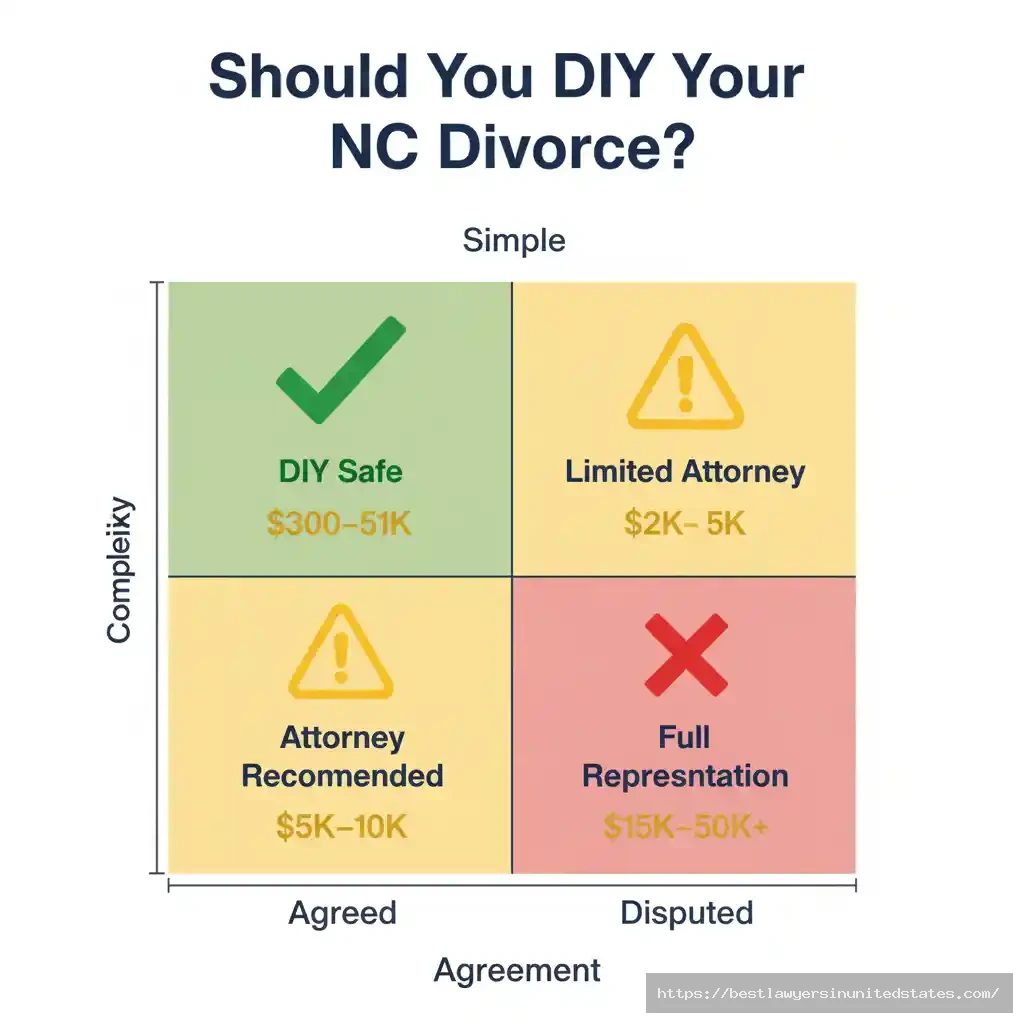
Safe for DIY if ALL these apply:
✅ Both parties agree 100% on all terms ✅ No minor children OR complete agreement on custody/support ✅ Minimal assets (no real estate, retirement accounts, businesses) ✅ Married less than 5 years ✅ No spousal support/alimony requested ✅ Both parties can communicate civilly ✅ No domestic violence or abuse ✅ Neither party has concerns about hidden assets
Your DIY cost: $300-$1,000
- $225 filing fee
- $75-$125 service of process
- $150-$500 online divorce service (optional but helpful)
Potential savings: $4,000-$15,000+ in attorney fees
When You NEED an Attorney (Risk Assessment)
| Your Situation | Risk Level | Recommended Action | Estimated Cost |
|---|---|---|---|
| No kids, no property, married <2 years, both agree | LOW | DIY or online service | $300-$1,000 |
| No kids, one shared home, married 5+ years, mostly agree | MODERATE | Limited scope attorney | $2,000-$5,000 |
| Kids involved with custody disagreement | HIGH | Full representation | $8,000-$20,000+ |
| Business ownership or high assets | VERY HIGH | Experienced attorney | $15,000-$50,000+ |
| Spouse hiding assets or being deceptive | VERY HIGH | Attorney with forensic accountant | $20,000-$60,000+ |
| Domestic violence concerns | CRITICAL | Full representation immediately | Cost is secondary to safety |
Red flags that mean you need an attorney:
- Your spouse already hired one
- Spouse is pressuring you to sign documents quickly
- You don’t understand the paperwork
- Power imbalance (one spouse controlled finances)
- Your spouse owns a business
- Substantial retirement accounts to divide
- Concerns about being treated unfairly
Remember: A $3,000 attorney might save you $50,000 in incorrectly divided assets. Sometimes DIY is the most expensive option.
Online Divorce Services for North Carolina
If you qualify for uncontested DIY, online services can help:
Popular NC-approved services:
- Cost: $150-$500
- What they provide: Completed NC divorce forms, filing instructions, document preparation
- What they don’t provide: Legal advice, representation, help if spouse contests
These work best when:
- You’ve already agreed on everything
- You need help with paperwork but not legal strategy
- You want guidance on the process
- Both parties are cooperative
How to Get a Free Divorce in North Carolina
If you can’t afford divorce costs, you have options. Here’s exactly how to access free or low-cost legal help.
Qualifying for Indigent Divorce (Fee Waiver)
North Carolina courts waive the $225 filing fee if you qualify as indigent.
Income thresholds (2025 Federal Poverty Guidelines):
| Household Size | Annual Income Limit | Monthly Income Limit |
|---|---|---|
| 1 person | $15,060 | $1,255 |
| 2 people | $20,440 | $1,703 |
| 3 people | $25,820 | $2,152 |
| 4 people | $31,200 | $2,600 |
Add $5,380/year for each additional person.
You also qualify if you receive:
- SSI (Supplemental Security Income)
- Food stamps (SNAP)
- Medicaid
- TANF (Temporary Assistance for Needy Families)
- Work First
Step-by-Step: Filing for Fee Waiver
1. Complete Form AOC-G-103
- “Petition to Proceed as an Indigent”
- Available free at any NC courthouse or online at nccourts.gov
2. Gather required documentation:
- Last 3 months of pay stubs (if employed)
- Previous year’s tax return
- Proof of public assistance (if applicable)
- Bank statements showing current balance
- List of monthly expenses and debts
3. File the petition with your divorce complaint
- Submit both at the same time
- Clerk reviews your financial information
- Decision usually within 1-3 business days
4. If approved:
- Filing fee is waived ($225 saved)
- May also waive service costs (save another $75-$125)
- Proceed with divorce process at no court cost
If denied: You can appeal or pay the filing fee in installments (ask the Clerk’s office).
Free Legal Aid Resources in North Carolina
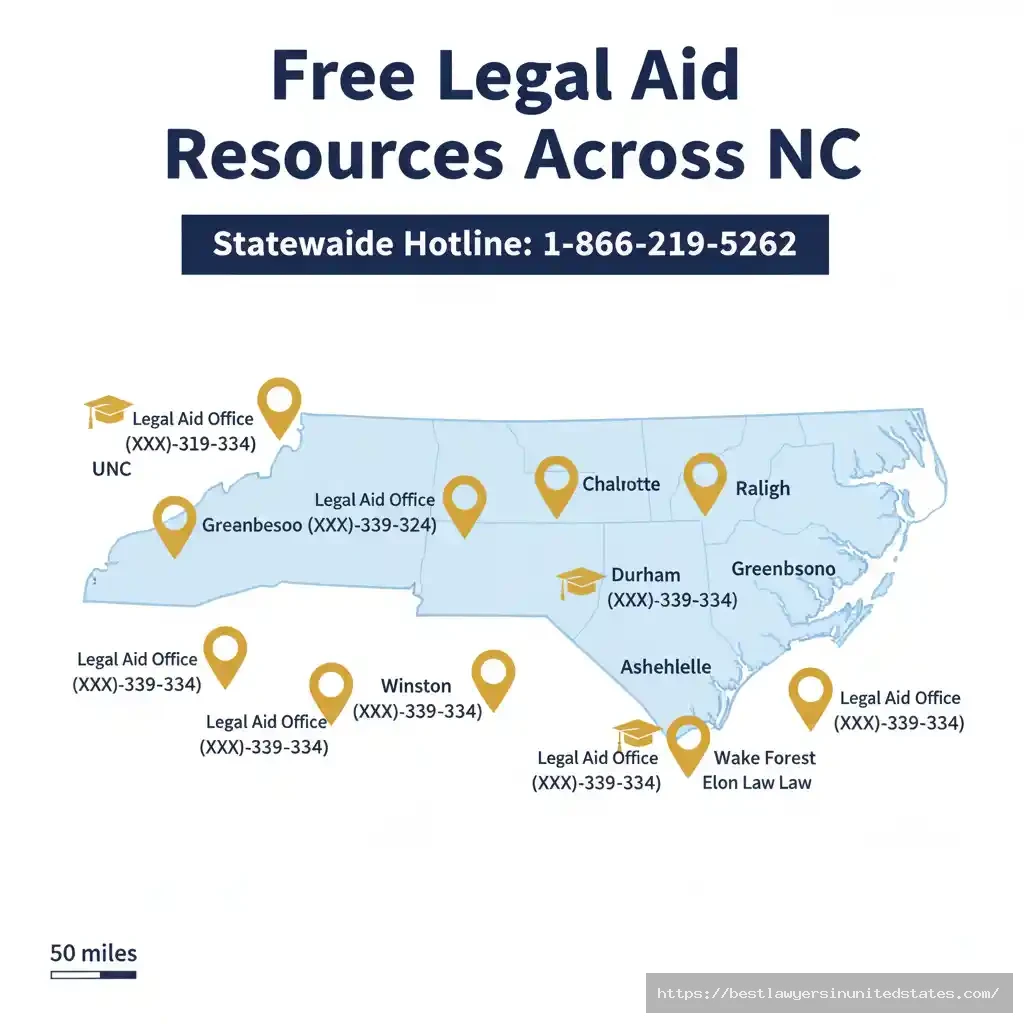
Legal Aid of North Carolina provides free legal help to low-income residents:
Eligibility:
- Income below 200% of federal poverty level (roughly $30,000-$40,000/year depending on household size)
- Priority given to cases involving domestic violence, children, or elderly
How to apply:
- Call statewide intake: 1-866-219-5262
- Apply online at legalaidnc.org
- Explain your situation in detail
- Wait for case review (2-4 weeks typically)
What Legal Aid covers:
- Uncontested and simple contested divorces
- Domestic violence protective orders
- Child custody and support
- Property division in qualifying cases
Regional offices: Legal Aid has offices in Charlotte, Raleigh, Greensboro, Asheville, Wilmington, and 15+ other NC cities.
North Carolina Law School Clinics
Five NC law schools offer free family law clinics:
1. Campbell University School of Law (Raleigh)
- Family Law Clinic
- Phone: (919) 865-4604
2. Duke University School of Law (Durham)
- Community Enterprise Clinic (handles some family law)
- Phone: (919) 613-7096
3. North Carolina Central University School of Law (Durham)
- Family Law Clinic
- Phone: (919) 530-5077
4. University of North Carolina School of Law (Chapel Hill)
- Family Law Clinic
- Phone: (919) 843-9044
5. Wake Forest University School of Law (Winston-Salem)
- Domestic Violence Advocacy Clinic
- Phone: (336) 758-5836
How clinics work:
- Law students supervised by licensed attorneys
- Free or very low cost ($0-$100 typically)
- Limited to qualifying low-income clients
- Call early—waitlists are common
- Academic calendar affects availability (not available during summer break)
Pro Bono Resources by County
North Carolina Bar Association Pro Bono Program:
- Connects qualifying individuals with volunteer attorneys
- Website: ncbar.org
- Each county has different resources
Contact your county’s legal aid:
- Wake County: (919) 856-2564
- Mecklenburg County (Charlotte): (704) 376-1600
- Durham County: (919) 688-6396
- Guilford County (Greensboro): (336) 272-0148
- Forsyth County (Winston-Salem): (336) 725-9166
Domestic violence survivors: Immediate free legal help available through:
- North Carolina Coalition Against Domestic Violence: 1-888-232-9124
- National Domestic Violence Hotline: 1-800-799-7233
Looking for more information on affordable legal help? Check our guide on family lawyer costs nationwide.
How Do Divorce Lawyers Structure Payment Plans?
Most divorce attorneys offer flexible payment options because they understand divorce is financially stressful.
Do Divorce Lawyers Offer Payment Plans?
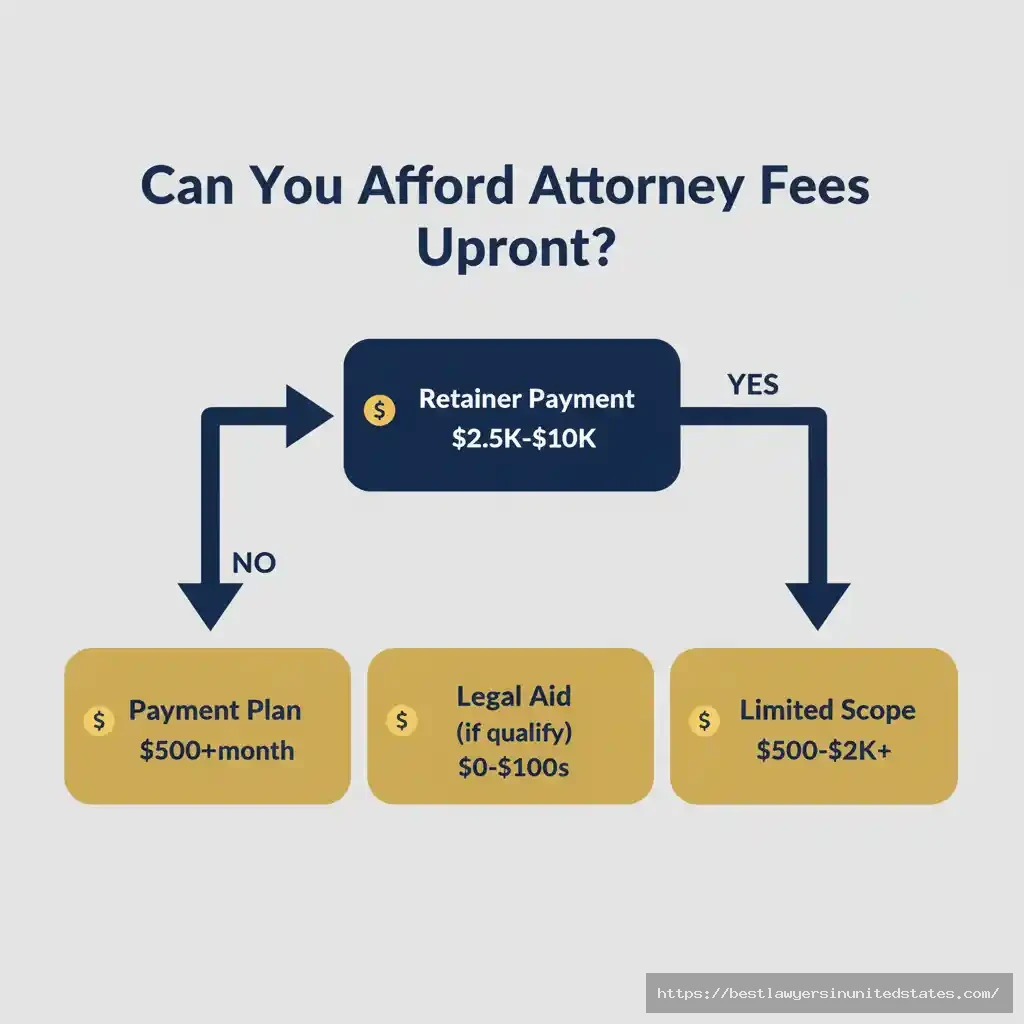
Yes, many NC family law attorneys offer payment arrangements:
Common payment structures:
- Retainer with monthly replenishment
- Pay initial retainer ($2,500-$5,000)
- Add funds monthly as retainer depletes
- Most flexible option
- Installment plans for flat fees
- Agree to $3,500 flat fee for uncontested divorce
- Pay $500 down, then $500/month for 6 months
- Attorney typically won’t file until fully paid
- Credit card payments
- Many attorneys accept credit cards
- Allows you to use 0% intro APR cards to spread costs
- You pay interest to credit card company, not attorney
- Contingency arrangements (rare in divorce)
- Attorney takes percentage of settlement
- Almost never available for divorce (illegal in most states)
- May apply to related matters like property claims
Questions to ask attorneys about payment:
- “Do you offer payment plans?”
- “What’s the minimum retainer required?”
- “Can I replenish the retainer in installments?”
- “Do you accept credit cards?”
- “What happens if I can’t make a payment?”
Be upfront about finances. Attorneys appreciate honesty and may work with you if they know your situation upfront.
Using Credit Cards or Personal Loans
Pros of financing divorce:
- Spreads cost over months/years
- Allows you to hire better attorney now
- Avoids depleting savings immediately
- Can use 0% APR offers strategically
Cons:
- Interest charges increase total cost
- Adds debt burden during already stressful time
- May hurt credit score if you miss payments
Smarter financing options:
- 0% APR credit card offers (12-18 months typical)
- Personal loan from credit union (lower rates than credit cards)
- Borrow from family (document as loan for tax purposes)
Avoid:
- Payday loans (predatory interest rates)
- Title loans on your car
- Borrowing from retirement accounts (see next section)
Borrowing from Retirement Accounts (Pros/Cons)
IRS allows penalty-free withdrawals from retirement accounts for certain expenses, but divorce isn’t one of them.
If you withdraw from 401(k) or IRA before age 59½:
- ❌ Pay 10% early withdrawal penalty
- ❌ Pay income tax on the full amount
- ❌ Permanently reduce retirement savings
Example: Withdraw $10,000 to pay attorney
- Lose $1,000 to penalty (10%)
- Lose $2,200 to taxes (22% bracket)
- Actually receive: $6,800
- You need to withdraw $14,700 to net $10,000
Better alternatives:
- 401(k) loan (if your plan allows)
- Borrow up to $50,000 or 50% of vested balance
- No taxes or penalties if you repay on schedule
- Interest goes back to your own account
- Risk: If you leave job, entire balance due immediately
- Roth IRA contributions (not earnings)
- Can withdraw original contributions anytime tax/penalty free
- Must track contribution amounts
- Doesn’t affect earnings portion
Bottom line: Retirement withdrawal should be last resort. Explore all other options first.
10 Cost-Saving Strategies for Your North Carolina Divorce
Want to reduce your divorce costs? These strategies actually work:
1. Get organized before meeting your attorney
How it saves money: Attorneys charge $200-$500/hour. Don’t waste time having them organize documents you could compile yourself.
Do this:
- List all assets (bank accounts, retirement, property, vehicles)
- List all debts (mortgages, cards, loans)
- Gather 3 years of tax returns
- Collect pay stubs and bank statements
- Document major purchases during marriage
- Create proposed parenting schedule (if kids)
Time saved: 3-5 billable hours ($600-$2,500)
2. Communicate efficiently with your attorney
How it saves money: Every email, call, and text gets billed.
Do this:
- Batch questions in one email vs. multiple
- Ask if quick questions can be answered by paralegal (lower rate)
- Prepare written list before phone calls
- Don’t use attorney as therapist
- Avoid after-hours emergency calls unless truly urgent
Money saved: $1,000-$3,000 over case duration
3. Reach agreements outside attorney involvement
How it saves money: Every item attorneys must negotiate costs money.
Do this:
- Try to agree on small items (who keeps dishes, furniture splits)
- Use mediation before litigation
- Compromise on minor issues
- Save attorney time for genuinely disputed matters
Money saved: $2,000-$8,000
4. Consider mediation instead of litigation
Mediation costs: $150-$300/hour split between both parties ($75-$150 each) Attorney litigation costs: $300-$500/hour each party ($600-$1,000 combined per hour)
Benefits:
- Faster resolution
- Less adversarial
- Both parties have control
- Can reach creative solutions courts can’t order
When mediation works:
- Both parties willing to compromise
- Communication is possible
- Power imbalance isn’t severe
- No domestic violence
Average savings: $5,000-$15,000 per party
5. Respond promptly to discovery requests
How it saves money: Delays mean more attorney time, possible court sanctions, extensions that drag out case.
Do this:
- Meet all deadlines
- Gather requested documents immediately
- Don’t make attorney chase you for information
- Answer interrogatories thoroughly first time
Money saved: $1,500-$5,000
6. Keep emotions in check
The most expensive divorces are driven by anger, not issues.
Emotional battles cost money through:
- Unnecessary motions and hearings
- Refusing reasonable settlements
- Fighting over items of minimal value
- Retaliatory legal actions
- Using attorney to send messages to spouse
Reality check: That $500 piece of furniture you’re fighting over? You just spent $2,000 in attorney time arguing about it.
Money saved: Potentially $10,000-$30,000+
7. Choose “limited scope representation”
Also called “unbundled services”—attorney helps with specific parts while you handle others.
Examples:
- Attorney reviews separation agreement you drafted ($500-$1,000)
- Attorney handles court appearance only ($1,500-$2,500)
- Attorney files paperwork while you do negotiations ($1,000-$2,000)
Vs. full representation: $5,000-$15,000+
Money saved: $3,000-$10,000
8. Don’t weaponize the children
Custody battles are the most expensive part of divorce.
If you genuinely cooperate on custody:
- No custody evaluation needed (save $4,000-$10,000)
- No guardian ad litem (save $2,000-$5,000)
- No expert witnesses (save $3,000-$8,000)
- Fewer hearings (save $5,000-$15,000)
Put kids first, save $15,000-$38,000.
9. Understand what’s actually worth fighting for
Not everything is worth the legal cost to pursue.
Financial analysis before fighting:
- Item’s value: $1,000
- Attorney time to fight: 5 hours × $300 = $1,500
- Result: Spent $1,500 to get $1,000 = $500 net loss
Pick your battles. Some things cost more to fight for than they’re worth.
10. File during the separation year, not after
Many people wait the full year, then call an attorney to start.
Smarter approach:
- Consult attorney within 1-2 months of separation
- Draft separation agreement early
- Have paperwork ready to file on day 366
- Finalize divorce quickly once eligible
Why this saves money:
- Prevents disputes from festering
- Protects assets during separation
- Provides clarity on financial obligations
- Gets you to final divorce faster
Time and money saved: Potentially 6+ months of limbo and $2,000-$5,000 in preventable disputes
Looking for more ways to reduce costs? Our divorce cost calculator helps you plan your budget.
What Does a Trial Cost in a North Carolina Divorce?
Hope you never need this section, but here’s what trial costs look like:
When Does a Divorce Go to Trial?
Only 5-10% of divorces actually go to trial. Most settle before reaching this stage.
Your divorce goes to trial when:
- You can’t reach agreement after months of negotiation
- Mediation fails
- Major disputes remain (custody, high-value assets, alimony)
- One party refuses to cooperate
- Judge must make final decisions
Trial is the most expensive divorce option—and the least predictable.
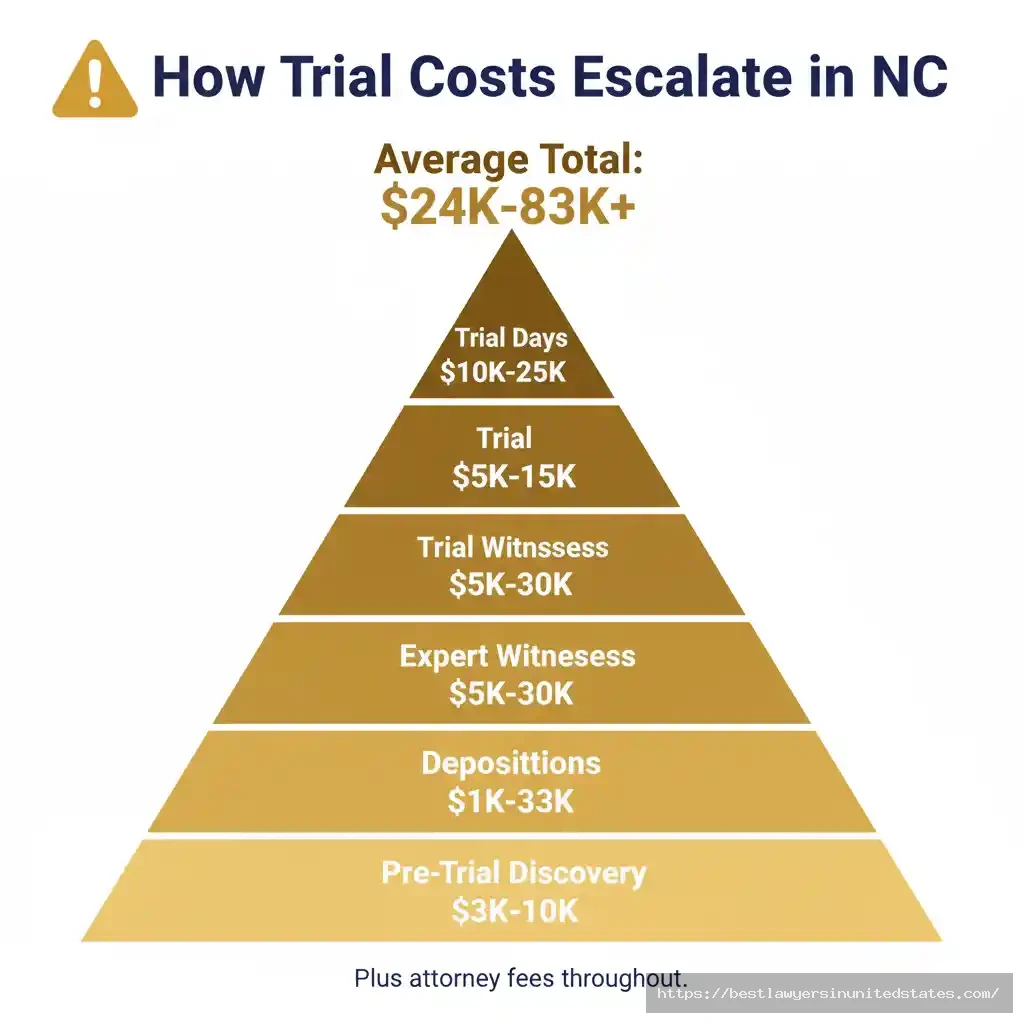
Trial Preparation Expenses
Before you even reach the courtroom:
| Pre-Trial Cost | Amount | What It Covers |
|---|---|---|
| Discovery process | $3,000-$10,000 | Document production, interrogatories, requests for admission |
| Depositions | $500-$1,000 each | Court reporter, attorney prep time, video recording |
| Expert witness preparation | $2,000-$5,000 per expert | Research, report writing, pre-trial meetings |
| Trial preparation | $5,000-$15,000 | Strategy sessions, witness prep, exhibit creation, motions |
Total pre-trial costs: $10,000-$31,000+
Expert Witness Fees in NC Divorces
Common expert witnesses and their costs:
Custody evaluator / Psychologist
- Purpose: Assess parenting fitness, child’s best interest
- Cost: $3,000-$7,000 for evaluation
- Testimony: $300-$500/hour
Real estate appraiser
- Purpose: Value marital home or properties
- Cost: $300-$500 for appraisal
- Testimony: $200-$400/hour
Business valuator
- Purpose: Determine business worth for division
- Cost: $5,000-$25,000+ for valuation
- Testimony: $400-$800/hour
Forensic accountant
- Purpose: Find hidden assets, trace funds, analyze complex finances
- Cost: $5,000-$20,000+ for investigation
- Testimony: $400-$600/hour
Vocational expert
- Purpose: Assess earning capacity for alimony decisions
- Cost: $2,000-$5,000 for evaluation
- Testimony: $300-$500/hour
Medical experts (if disability/earning capacity disputed)
- Cost: $5,000-$15,000+
Trial Day Attorney Fees
Most divorce trials last 1-5 days in NC.
Attorney trial costs:
- Per day rate: $2,500-$5,000 per day
- Preparation time: Additional 20-40 hours ($6,000-$20,000)
- Post-trial work: Proposed orders, appeals research ($2,000-$5,000)
Example 3-day trial cost breakdown:
- Trial days: 3 × $3,500 = $10,500
- Prep time: 30 hours × $350 = $10,500
- Post-trial: $3,000
- Total: $24,000 just for trial phase
Add pre-trial costs: $10,000-$31,000 Add expert witnesses: $5,000-$30,000 Total trial cost: $39,000-$85,000+
And here’s the kicker: You might lose. The judge’s decision may be worse than the settlement offer you rejected.
Bottom line: Settlement almost always costs less than trial—often by $30,000-$60,000.
How Much Does Divorce Cost in North Carolina vs. Neighboring States?
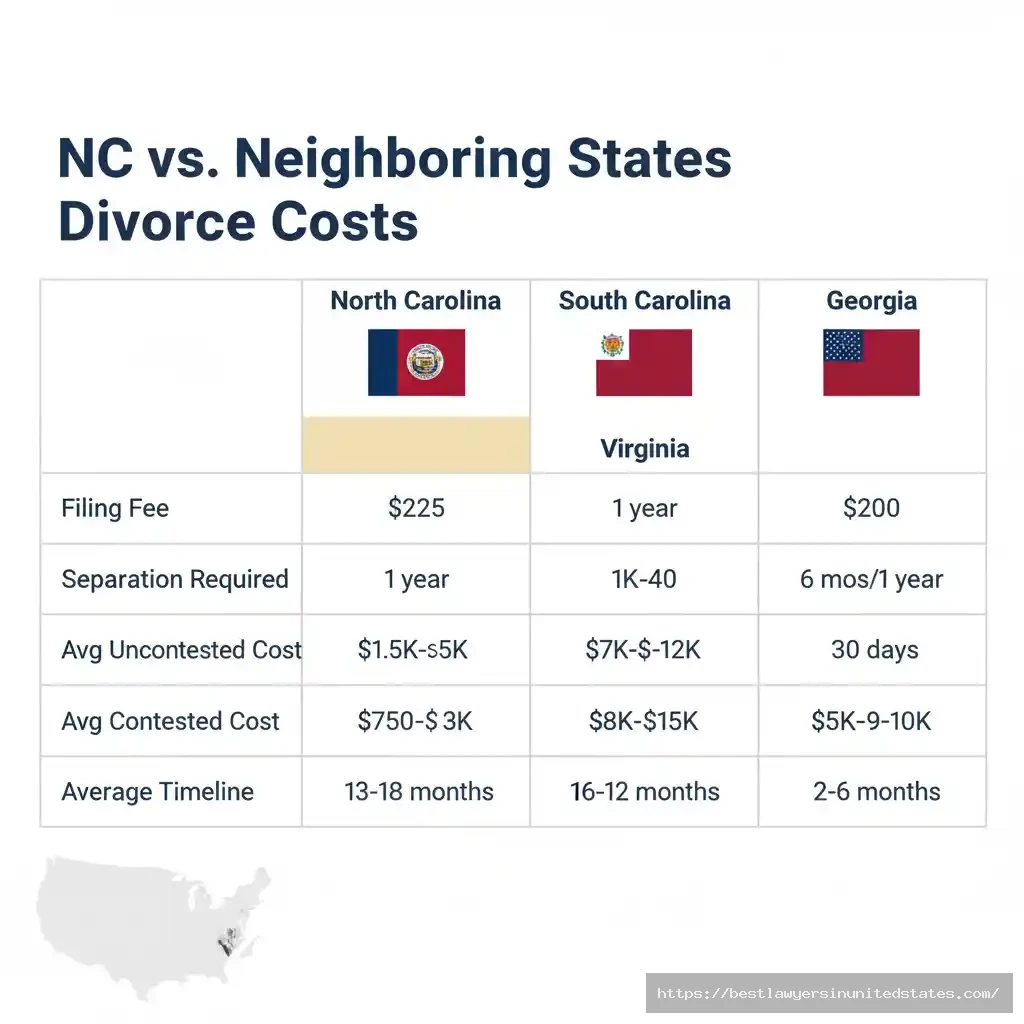
Curious how NC compares? Here’s the reality:
NC vs. South Carolina Divorce Costs
| Cost Factor | North Carolina | South Carolina |
|---|---|---|
| Filing fee | $225 | $150 |
| Separation requirement | 1 year | 1 year (or 3 months if no kids and both agree) |
| Average uncontested | $1,500-$5,000 | $1,200-$4,000 |
| Average contested | $8,000-$15,000 | $7,000-$14,000 |
| Attorney hourly rates | $200-$500 | $175-$450 |
| Property division | Equitable distribution | Equitable distribution |
Verdict: South Carolina is slightly cheaper overall. Lower filing fee, sometimes shorter separation period.
For detailed South Carolina costs, check out how much divorce costs in South Carolina (Note: We’ll be adding SC-specific content soon).
NC vs. Virginia Divorce Costs
| Cost Factor | North Carolina | Virginia |
|---|---|---|
| Filing fee | $225 | $86-$100 |
| Separation requirement | 1 year | 6 months (if no kids and separation agreement) OR 1 year |
| Average uncontested | $1,500-$5,000 | $1,200-$4,500 |
| Attorney hourly rates | $200-$500 | $250-$600 (higher in Northern VA) |
Verdict: Virginia offers faster divorce (6 months possible) and lower filing fee, but Northern Virginia attorney rates rival DC pricing.
NC vs. Georgia Divorce Costs
| Cost Factor | North Carolina | Georgia |
|---|---|---|
| Filing fee | $225 | $200-$400 (varies by county) |
| Separation requirement | 1 year | None (can file immediately) |
| Average uncontested | $1,500-$5,000 | $1,500-$5,000 |
| Attorney hourly rates | $200-$500 | $200-$500 |
Verdict: Georgia’s biggest advantage is NO separation requirement—you can file and finalize in 31-60 days.
Compare costs across all states in our comprehensive divorce cost guide.
What About Tennessee and Other Border States?
Tennessee:
- No separation requirement for irreconcilable differences
- Filing fees: $200-$400
- Faster process than NC
The pattern: North Carolina’s 1-year separation makes it slower and often more expensive than neighboring states.
Can you file in another state to save money?
No, not unless you meet their residency requirements:
- Most states require 6-12 months residency before filing
- At least one spouse must be NC resident for 6 months to file here
- You can’t “divorce shop” across state lines
Exception: Military members may have options under the Servicemembers Civil Relief Act. See our military divorce lawyer guide for details.
Frequently Asked Questions About North Carolina Divorce Costs
What is the cheapest way to get divorced in North Carolina?
The cheapest divorce costs $225-$1,000 total through:
- Filing for fee waiver if you qualify as indigent (saves $225)
- DIY divorce with both parties agreeing on everything
- Using free online forms from NC courts website
- Serving papers yourself or via sheriff (avoid private process server)
- Not hiring an attorney
This only works for simple uncontested divorces with no children, minimal assets, and complete cooperation.
How much does a divorce cost if both parties agree in North Carolina?
When both parties agree on all terms, expect:
- DIY cost: $300-$1,000 (filing fee, service costs, forms)
- With attorney: $1,500-$5,000 (flat fee or limited hourly work)
Even with agreement, hiring an attorney for document review ($500-$1,000) is smart to ensure you’re not overlooking anything important like retirement account division or tax implications.
Why do you have to wait a year to get divorced in NC?
North Carolina requires one year of separation before filing for absolute divorce under NC General Statutes § 50-6. The law’s intent is to:
- Allow time for possible reconciliation
- Ensure the decision is final
- Give parties time to resolve related matters (property, custody)
Cost impact: This year of mandatory separation means maintaining two households for 12 months, adding $10,000-$30,000+ to your total divorce expenses before legal costs even begin.
What is a wife entitled to in a divorce in North Carolina?
North Carolina uses “equitable distribution,” not automatic 50/50 splits. A wife (or any spouse) may receive:
Property division:
- Fair share of marital property (acquired during marriage)
- Courts consider: income, debts, contributions, custody, future needs
- Separate property (owned before marriage, inherited) stays separate
Spousal support/alimony:
- Not automatic—must show financial need and spouse’s ability to pay
- Factors: earning capacity, duration of marriage, standard of living, marital misconduct
- Can be temporary or long-term
Child support:
- Based on NC child support guidelines
- Calculated using both parents’ incomes
- Custodial parent typically receives support
NC is NOT a 50/50 state. Division is equitable (fair), not equal (50/50).
Is North Carolina a 50/50 divorce state?
No. North Carolina uses equitable distribution, meaning property is divided fairly but not necessarily equally. Courts may award 60/40, 70/30, or any split deemed fair based on:
- Each spouse’s income and earning potential
- Duration of the marriage
- Age and health of each spouse
- Contributions to marital property (including homemaking)
- Debts and liabilities
- Tax consequences
- Custodial parent’s housing needs
Unlike community property states (California, Texas, Arizona), NC doesn’t automatically split everything 50/50.
Can you get a divorce in NC without going to court?
For most divorces, yes—you never physically go to court. Here’s how:
Uncontested divorce process:
- File Complaint for Absolute Divorce with court
- Serve papers to spouse
- Spouse doesn’t contest (doesn’t file answer)
- Wait 30 days
- Submit final paperwork to judge
- Judge signs divorce decree without hearing
You appear in court only if:
- Contested issues require hearing
- Judge requests your presence (rare in simple cases)
- Trial is necessary
- You need emergency orders
Total time in court for uncontested: Zero hours.
What happens if you can’t afford a divorce lawyer in North Carolina?
You have several options:
1. Legal Aid of North Carolina
- Free legal help for qualifying low-income residents
- Call 1-866-219-5262 or visit legalaidnc.org
2. Law school clinics
- Free or low-cost help from supervised law students
- Available at Campbell, Duke, NCCU, UNC, and Wake Forest law schools
3. Pro bono attorney programs
- NC Bar Association connects qualifying clients with volunteer lawyers
- Contact your county bar association
4. Fee waiver (indigent divorce)
- File form AOC-G-103 to waive $225 court filing fee
- Qualify based on income or public assistance receipt
5. Limited scope representation
- Hire attorney for specific tasks only (document review, court appearance)
- Costs $500-$2,000 vs. $5,000-$15,000 for full representation
6. Payment plans
- Many attorneys offer monthly payment arrangements
- Be upfront about financial situation when consulting
Who pays for the divorce in North Carolina?
Generally: Each party pays their own attorney fees and costs.
Exceptions where court orders one spouse to pay the other’s fees:
- Significant income disparity
- One spouse can’t afford attorney
- Other spouse has ability to pay
- Marital misconduct
- Spouse’s bad behavior caused divorce
- Court may order guilty party to pay innocent party’s fees
- Unreasonable litigation tactics
- One party dragging out case unnecessarily
- Frivolous motions or refusal to cooperate
Attorney fees as alimony: Courts can award attorney fees as part of spousal support in appropriate cases.
Filing fees: The person who files for divorce pays the $225 filing fee initially, but this can be reimbursed as part of final settlement.
How long does a divorce take in NC and how does time affect cost?
Minimum timeline: 13 months
- 12 months mandatory separation
- 1+ month from filing to finalization
Typical uncontested divorce: 13-15 months total
- 12 months separation
- 1-3 months processing after filing
Contested divorce: 18-36+ months
- 12 months separation
- 6-24+ months for negotiations, discovery, hearings, trial
How time affects cost:
- Longer case = more attorney hours = higher cost
- Each additional month of attorney involvement: $500-$2,000+
- Discovery, depositions, and multiple hearings add $5,000-$15,000+
- Trial preparation adds months and $10,000-$30,000+
Fastest path: Both parties agree on everything before separation year ends, file immediately after 12 months, finalize in 30-60 days.
What is the 10-10-10 rule for divorce?
The “10/10 rule” refers to military retirement division, not NC-specific divorce law. Under federal law:
- Service member must have 10 years of marriage
- That overlaps with 10 years of military service
- Then the former spouse can receive retirement payments directly from DFAS (Defense Finance and Accounting Service)
If under 10/10: Retirement division still happens, but paid through service member, not directly from military.
This matters in NC divorces involving military members. For more details, see our military divorce guide.
Who loses more financially in a divorce?
Research shows women typically lose more financially post-divorce:
- Women’s household income drops 41% on average after divorce
- Men’s household income drops 23% on average
- Impact greater for women who took career breaks for childcare
- Single mothers face greater financial challenges
However, in individual cases it varies based on:
- Who was primary earner
- Asset division specifics
- Alimony and child support awards
- Property settlement terms
- Post-divorce earning potential
In NC specifically: Equitable distribution aims for fairness, considering each party’s financial situation, but doesn’t guarantee equal financial outcomes.
Can my spouse stop me from getting a divorce in North Carolina?
No. North Carolina is a “no-fault” divorce state—you don’t need your spouse’s permission or cooperation to divorce.
What your spouse CAN’T do:
- Prevent you from filing
- Block the divorce from happening
- Force you to stay married
What your spouse CAN do:
- Contest terms (property, custody, support)
- Make the process longer and more expensive
- Refuse to sign papers (doesn’t stop divorce, just delays it)
- File counter-claims
If spouse refuses to participate:
- Serve them properly with papers
- They have 30 days to respond
- If they don’t respond = default judgment
- You get divorce on your terms (within legal limits)
Domestic violence concerns? Courts can issue protective orders and expedite proceedings. Contact Legal Aid immediately.
How does child custody affect divorce costs in North Carolina?
Child custody is the single biggest cost driver in contested divorces:
Agreed custody (lower cost):
- Create parenting plan together
- File with court
- Minimal attorney involvement
- Added cost: $500-$2,000
Disputed custody (high cost):
- Court-ordered mediation required: $500-$1,500
- Guardian ad litem for children: $2,000-$5,000+
- Psychological evaluations: $2,000-$5,000 per person
- Home studies: $1,500-$3,000
- Expert witnesses: $3,000-$10,000
- Multiple hearings: $5,000-$15,000
- Trial: $15,000-$40,000
- Total added cost: $10,000-$60,000+
Money-saving reality: Every hour you spend fighting over custody costs $600-$1,000 (both attorneys billing). If you genuinely cooperate on custody, you can save $15,000-$40,000.
Do I need a separation agreement in North Carolina?
Legally required? No.
Strongly recommended? Yes, especially if you have:
- Shared property or debts
- Children
- Spousal support considerations
- Business interests
What separation agreements cover:
- Property division
- Debt allocation
- Child custody and visitation
- Child support amounts
- Spousal support/alimony
- Health insurance
- Tax filing status
Cost: $500-$2,500 depending on complexity
Benefits:
- Prevents disputes during separation year
- Provides financial clarity
- Becomes binding contract
- Can be incorporated into final divorce decree
- Protects both parties legally
DIY separation agreements: Available online but risky. $500-$1,000 for attorney review is smart investment.
What assets cannot be touched in divorce in North Carolina?
Separate property stays separate:
- Property owned before marriage
- House purchased before wedding
- Savings account from before marriage
- Vehicle titled only in your name pre-marriage
- Inherited property (even during marriage)
- Money inherited from parents
- Property gifted specifically to you
- Trust fund designated for you alone
- Gifts to one spouse (from third party)
- Wedding gift to you specifically
- Gift from parents to you alone
- Personal injury settlements (for your injuries)
- Award for your pain and suffering
- Compensation for your disability
IMPORTANT EXCEPTIONS that convert separate to marital:
- Commingling (mixing separate funds with joint accounts)
- Using marital funds to improve separate property
- Adding spouse’s name to separate property title
- Not keeping clear documentation of separate status
Example: You owned home before marriage ($100,000 value). During marriage, you used joint money to renovate ($50,000). Now worth $200,000. Your spouse may have claim to the $50,000 increase in value.
Best protection: Keep separate property completely separate—don’t mix finances, don’t add spouse to title, maintain clear records.
Next Steps: Planning Your North Carolina Divorce Budget
You now know what divorce really costs in North Carolina. Here’s how to move forward:
Create Your Divorce Budget
Fixed costs you’ll definitely pay:
- Filing fee: $225 (or $0 if fee waiver approved)
- Service of process: $75-$125
- Certified copies: $25-$50
Variable costs based on your situation:
- Attorney fees: $0-$50,000+ (biggest variable)
- Separation costs: $10,000-$30,000+ (12 months of expenses)
- Mediation: $500-$3,000
- Expert witnesses (if needed): $2,000-$20,000+
Your total range:
- Simple uncontested: $300-$5,000
- Contested with settlement: $8,000-$20,000
- Trial: $20,000-$70,000+
Use our calculator to estimate your specific costs: Divorce Cost Calculator
Questions to Ask Divorce Attorneys in Consultations
Most NC divorce attorneys offer free 30-minute consultations. Ask these questions:
About costs:
- “What’s your hourly rate?”
- “What retainer do you require?”
- “What’s your estimate for my total cost based on similar cases?”
- “Do you offer payment plans?”
- “What’s included vs. extra costs?”
- “Will I work with you or a junior attorney?”
About your case:
- “Do you recommend I hire you, or can I do this myself?”
- “What’s the likely outcome for [custody/property/alimony]?”
- “What’s the best strategy for my situation?”
- “How long will this take?”
- “What mistakes do people make in cases like mine?”
About their practice:
- “How many divorce cases have you handled?”
- “What percentage go to trial vs. settle?”
- “How do you communicate with clients?”
- “Who handles my calls when you’re unavailable?”
Free consultation checklist: Bring your separation date, list of assets/debts, and specific questions about your situation.
North Carolina Divorce Resources and Forms
Official NC court resources:
- NC Judicial Branch: nccourts.gov
- Free divorce forms: nccourts.gov/forms
- Filing instructions: nccourts.gov/help-topics/family
Legal aid:
- Legal Aid of North Carolina: legalaidnc.org | 1-866-219-5262
- NC Bar Association: ncbar.org
County-specific clerk offices:
- Wake County (Raleigh): (919) 792-4200
- Mecklenburg County (Charlotte): (704) 686-0900
- Guilford County (Greensboro): (336) 641-3355
- Durham County: (919) 808-3010
- Forsyth County (Winston-Salem): (336) 761-2365
Domestic violence resources:
- NC Coalition Against Domestic Violence: 1-888-232-9124
- National DV Hotline: 1-800-799-7233
Related guides on our site:
- Understanding divorce lawyer costs nationwide
- Prenuptial agreement attorney guide
- Annulment as alternative to divorce
- Domestic partnership vs. marriage
Conclusion: What You Need to Remember About NC Divorce Costs
The bottom line on North Carolina divorce costs:
✅ Expect $1,500-$20,000+ depending on complexity ✅ Uncontested = $1,500-$5,000 | Contested = $8,000-$50,000+ ✅ NC’s 1-year separation adds $10,000-$30,000 in living expenses ✅ Attorney fees are the biggest variable cost ✅ Free options exist for qualifying low-income residents ✅ DIY works only for simple, fully agreed cases ✅ Trial should be absolute last resort (cost: $20,000-$70,000+)
Your divorce cost depends on one fundamental question: Can you and your spouse cooperate?
If yes → Uncontested divorce, minimal attorney involvement, $1,500-$5,000 total. If no → Contested divorce, full representation needed, $8,000-$50,000+.
The smartest financial move? Invest $300-$500 in an initial consultation with an experienced NC family law attorney. They’ll give you honest assessment of whether you need full representation or can handle portions yourself.
Remember: A $3,000 attorney might save you $50,000 in incorrectly divided assets or unfavorable terms. Sometimes the attorney fee is the best money you’ll spend.
Ready to take the next step? Browse our directory of North Carolina family law attorneys to find qualified help in your area.
Questions about divorce costs in other states? Check our guides:
- California divorce costs
- Texas divorce costs
- Florida divorce costs
- New York divorce costs
- Compare all 50 states