Quick Answer: Prostitution—defined as vaginal intercourse with an unspecified person for compensation—is illegal in Japan under the 1956 Prostitution Prevention Law. However, the law contains no penalties for the act itself, only for those who facilitate or profit from it. This narrow legal definition has created a massive loophole allowing non-penetrative sexual services to thrive legally across the country.
Japan’s approach to sex work confuses many travelers and legal researchers. The country technically bans prostitution but operates one of the world’s largest adult entertainment industries, earning an estimated $24 billion annually. Understanding this contradiction requires looking at the exact wording of Japanese law and how businesses have legally sidestepped it for decades.
Understanding Japan’s Prostitution Prevention Law
The Prostitution Prevention Law (売春防止法, Baishun bōshi hō), Law No. 118, passed on May 24, 1956, and came into full effect on April 1, 1958. The law aimed to end the post-war prostitution boom that flourished during the American occupation.
What the 1956 Law Actually Prohibits
Article 2 defines prostitution as “having sexual intercourse with a non-specified person(s) in exchange for compensation or the promise of such.” Article 3 states “No person may either do prostitution or become the customer of it,” but critically, no judicial penalty is defined for this act.
The law only penalizes:
- Soliciting customers in public (Article 5)
- Operating brothels (Article 11)
- Procuring or coercing people into prostitution (Articles 7-8)
- Profiting from another person’s prostitution (Article 12)
What this means in practice: If you pay someone for vaginal intercourse, you’re technically breaking the law—but you won’t be arrested or fined. Japanese police focus enforcement on businesses and third parties, not customers or individual sex workers.
Why “Legal Brothels” Don’t Technically Exist
Japan has no legal framework for licensed brothels like Nevada’s regulated establishments. The law eliminated the historical “red line” (akasen) system where prostitution occurred in designated zones. Any venue explicitly offering paid vaginal intercourse operates illegally, even if police rarely raid these establishments.
That said, thousands of venues across Japan offer sexual services by exploiting the law’s specific language.
The Legal Loophole: Non-Penetrative Services
The definition of prostitution is strictly limited to sexual intercourse with an ‘unspecified person,’ and does not criminalize numerous other acts performed by sex workers in exchange for compensation, such as oral sex, anal sex, mammary intercourse, and other non-coital sex acts.
This precise wording has spawned an entire industry of “fuzoku” (風俗) establishments—literally “customs” or “public morals”—offering every imaginable sexual service except vaginal penetration. These businesses are regulated under the 1948 Businesses Affecting Public Morals Regulation Law, which treats them as entertainment venues requiring licensing.
Legal vs. Illegal Services in Japan: Complete Breakdown
The Japanese sex industry has developed highly specific service categories, each with different legal standing. Understanding these distinctions matters for anyone researching the topic—whether for academic, legal, or travel purposes.
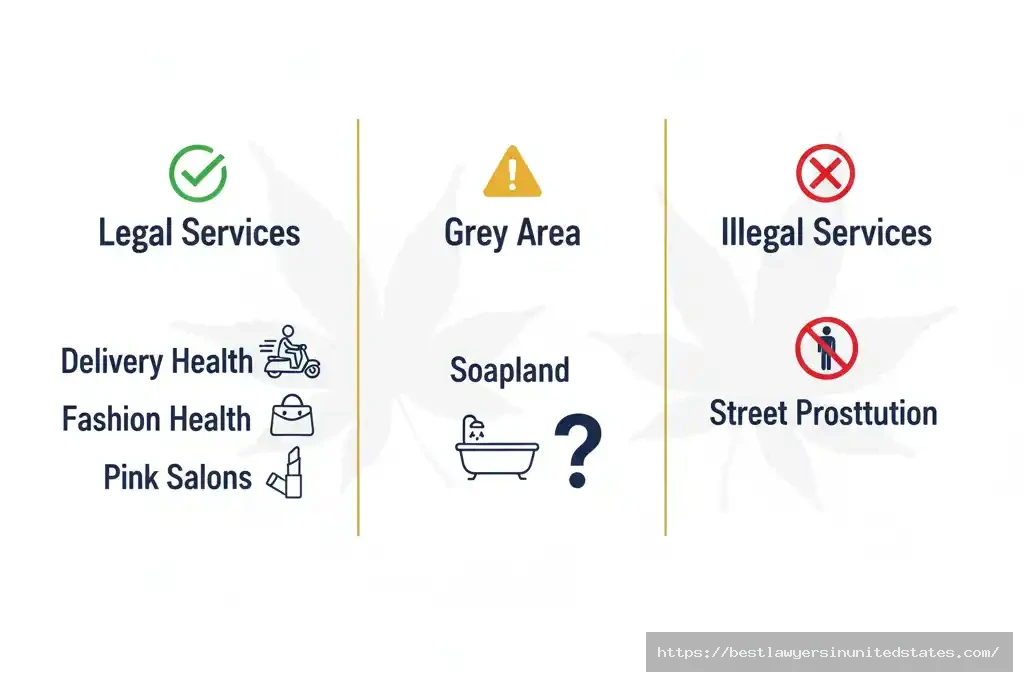
Fully Legal Services
These establishments operate within Japanese law by avoiding vaginal intercourse:
Delivery Health (Deriheru – デリヘル)
Escort-style services where workers come to your hotel or home. Services may include oral sex, hand jobs, and massage. Intercourse remains off-limits. These businesses advertise openly in major cities and require no special permits beyond standard entertainment licensing.
Fashion Health Clubs
Physical locations where customers receive sexual massage, oral services, and other non-penetrative acts. Workers typically wear themed costumes. Prices range from ¥15,000-30,000 ($100-200) for 60-90 minute sessions.
Pink Salons (Pinku Saron – ピンクサロン)
Oral-only establishments often disguised as regular bars or cafes. Customers sit at the bar while workers provide oral stimulation under counters or in semi-private booths. These venues cluster in entertainment districts like Kabukicho.
Image Clubs (Imekura – イメクラ)
Brothels themed around popular sexual fantasies such as offices, doctor’s offices, classrooms, or train carriages, where sex workers wear exaggerated costumes and activities are usually limited to oral sex. Some simulate scenarios like groping on trains—activities that would be criminal in real settings but are legal as consensual roleplay.
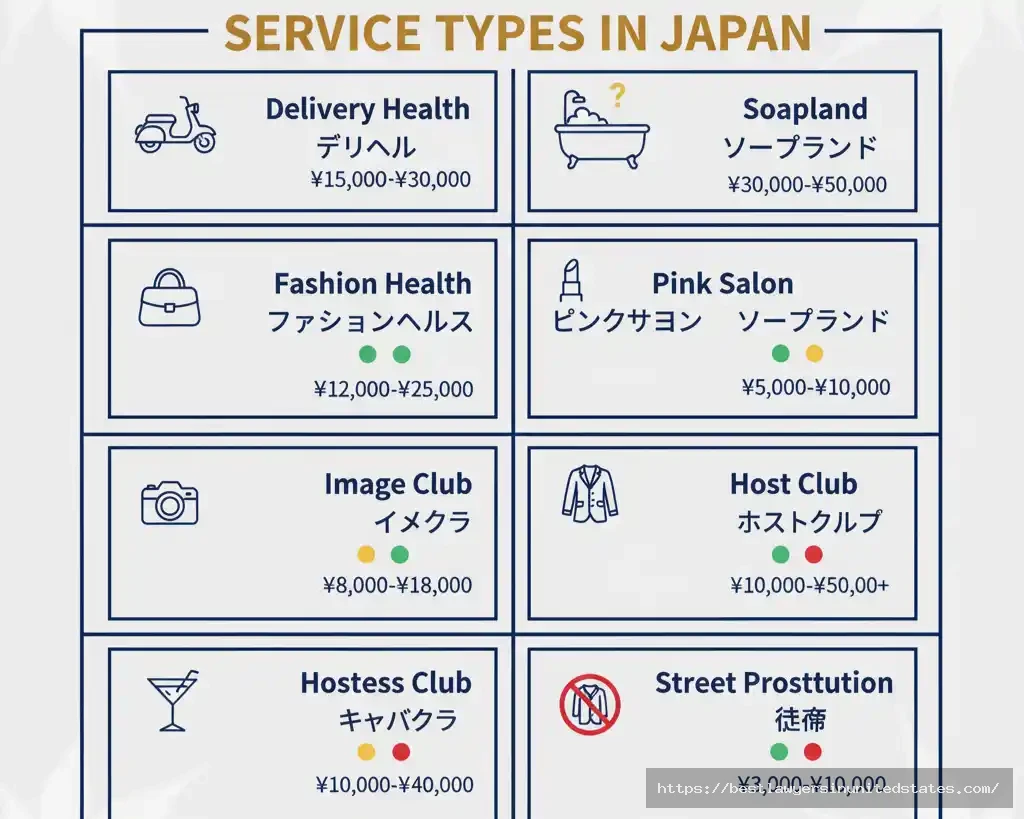
Hostess Clubs & Host Clubs
Entertainment venues where attractive staff pour drinks, engage in flirtatious conversation, and provide companionship. Sexual services are not part of the official business model, though private arrangements sometimes occur outside the club. The companionship itself is legal; any sexual activity would need to avoid vaginal intercourse to remain within the law.
Happening Bars
Swinger-style venues where couples or singles meet for consensual group activities. No money exchanges hands for sex specifically, making these venues legal as long as entry fees cover only facility access.
Grey Area Services
Soaplands: Why They Operate Despite the Law
Soaplands represent the most legally ambiguous category. These bathhouse-style establishments offer full-service experiences including sexual intercourse, yet they’ve operated openly for decades in designated areas of major cities.
Soaplands exploit a loophole wherein compensated sexual intercourse may be conducted between “specified” (acquainted) persons. Customers pay an entry fee to “use the bathing facilities” and a separate fee for massage. While the massage takes place, the masseuse and customer become “acquainted,” resulting in any paid sexual services following this as not being viewed as prostitution as defined by the law.
This legal fiction dates to the 1960s. Courts have occasionally prosecuted soaplands for violating the Anti-Prostitution Law, but enforcement remains sporadic. Most soaplands operate with tacit police acceptance in recognized districts like Yoshiwara (Tokyo) and Tobita Shinchi (Osaka).
Legal status: De facto tolerated but de jure illegal. Police prioritize trafficking and organized crime enforcement over consensual adult transactions in established venues.
Explicitly Illegal Services
Street Prostitution
Soliciting by streetwalkers is illegal under Article 5, and police regularly arrest sex workers engaging in this activity, particularly foreign nationals who may face deportation.
Private Arrangements for Intercourse
Any private arrangement for vaginal intercourse in exchange for money falls under the prostitution law. While not directly punishable, individuals involved risk extortion, scams, or becoming entangled in police investigations targeting facilitators.
| Service Type | Legal Status | Typical Cost | What’s Offered |
|---|---|---|---|
| Delivery Health | ✅ Legal | ¥20,000-40,000 | Oral, manual, massage (no intercourse) |
| Fashion Health | ✅ Legal | ¥15,000-30,000 | Oral, manual, massage |
| Pink Salons | ✅ Legal | ¥5,000-15,000 | Oral services only |
| Image Clubs | ✅ Legal | ¥15,000-35,000 | Roleplay, oral, manual |
| Hostess/Host Clubs | ✅ Legal | ¥10,000-50,000+ | Conversation, drinks, flirting (no sex) |
| Soaplands | ⚠️ Grey Area | ¥30,000-80,000 | Bath, massage, full service (intercourse) |
| Street Solicitation | ❌ Illegal | Varies | Any services (high risk) |
| Private Prostitution | ❌ Illegal | Varies | Intercourse (legally prohibited) |
Japan vs. U.S.: How Prostitution Laws Differ
For American readers, Japan’s system looks nothing like U.S. prostitution law. Understanding these differences matters for legal professionals, researchers, and travelers.
How Japan Compares to Other Legal Jurisdictions
While Japan operates through legal loopholes, countries like the Netherlands take a completely different approach. Amsterdam’s regulated red-light district system offers a stark contrast to Japan’s grey-area fuzoku industry, with mandatory health checks, taxation, and union representation for sex workers.
Nevada’s Legal Brothels vs. Japan’s Loopholes
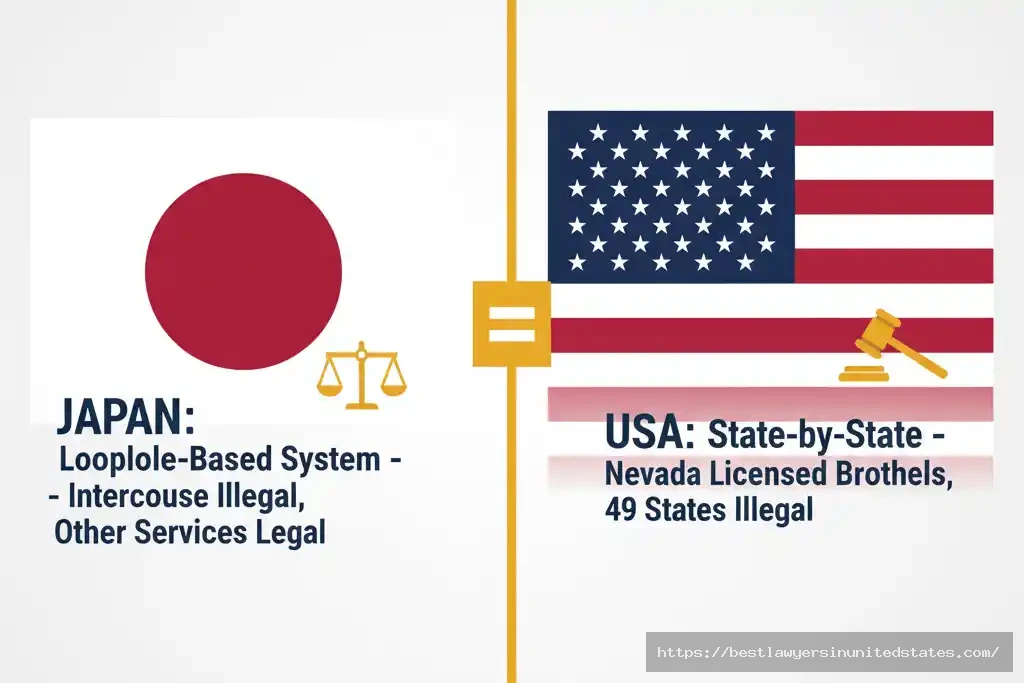
United States: Prostitution is illegal in 49 states. Nevada permits licensed brothels in counties with populations under 700,000, where workers undergo mandatory health screenings, pay taxes, and operate under strict regulations. Customers can legally pay for any consensual sexual service including intercourse at these licensed venues.
Japan: No legal framework exists for licensed prostitution. Instead, the law’s narrow definition of illegal conduct (vaginal intercourse only) has spawned an unregulated industry of “technically legal” alternatives. Workers face no mandatory health screenings, no labor protections, and no legal recourse if exploited—because the services officially don’t include prostitution.
The key difference: Nevada regulates and permits; Japan prohibits but doesn’t enforce against specific loopholes.
Can Americans Face Legal Issues at Home?
The PROTECT Act of 2003 strengthened U.S. ability to prosecute child sex tourism, carrying penalties up to 30 years in prison for engaging in any sexual conduct with minors abroad. Since passage, U.S. authorities have arrested over 8,000 Americans for child sex tourism and exploitation.
Critical distinction: The PROTECT Act applies only to sexual conduct with persons under 18 years of age. It is a federal crime for U.S. citizens to travel abroad and engage in any illicit sexual conduct with a minor, regardless of local age of consent laws.
For adult services in Japan: No U.S. law prohibits American citizens from participating in legal adult sexual services abroad. However, Americans should understand their home state’s laws, as some states like California impose strict penalties for domestic prostitution offenses. If you visit a delivery health service or pink salon in Japan—establishments operating within Japanese law with workers over 18—you face zero U.S. legal consequences upon return.
However: Even if commercial sex work is legal in some countries, sex trafficking, sex with a minor, and child pornography are ALWAYS criminal activities according to U.S. laws. Someone who engages in these activities in a foreign country can be prosecuted under that country’s law while abroad and under U.S. law after returning to the United States.
Americans should also know that arrests abroad for any reason can trigger visa denials, security clearance issues, and appear in background checks—even if the conduct was legal in the foreign country.
Red Light Districts and Foreigner Access
Japan’s major cities have well-established entertainment districts where fuzoku establishments cluster. These areas operate openly, though many venues explicitly prohibit foreign customers.
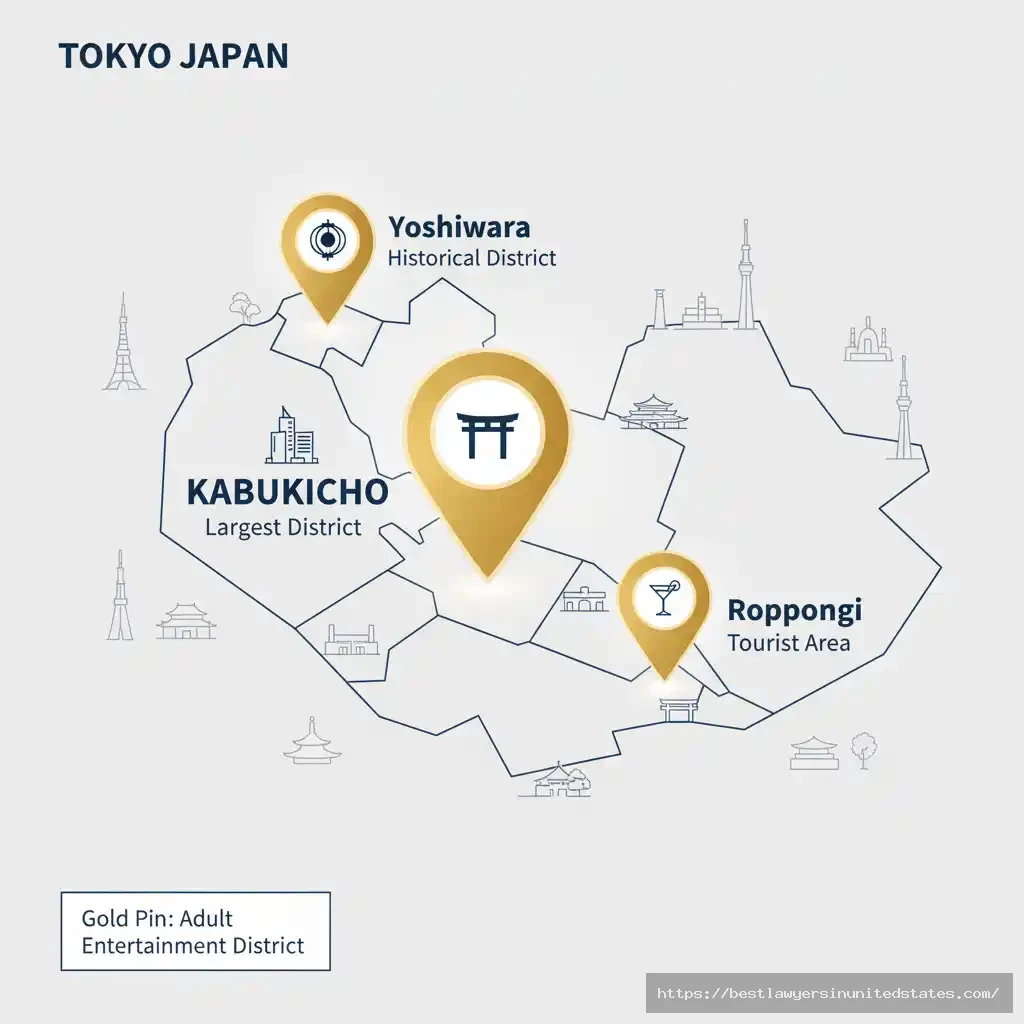
Yoshiwara (Tokyo)
Tokyo’s most famous historical red-light district, located in Taito Ward. From the 15th century, Chinese, Koreans, and other East Asian visitors frequented brothels in Japan, and Yoshiwara served as Tokyo’s licensed pleasure quarter during the Edo period (1603-1868). Today it houses hundreds of soaplands on neon-lit streets. Most establishments display “Japanese only” (日本人のみ) signs at entrances.
Kabukicho (Shinjuku)
Tokyo’s largest entertainment district, featuring hostess clubs, host clubs, love hotels, and various fuzoku establishments across multiple blocks near Shinjuku Station. While more foreigner-friendly than Yoshiwara, many premium venues still maintain Japanese-only policies. Street touts aggressively solicit customers, often leading tourists to overpriced or scam operations.
Tobita Shinchi (Osaka)
Osaka’s traditional pleasure quarter, where workers sit in storefronts behind glass windows. This district maintains older customs where customers can see workers before selecting. Foreign tourists rarely gain entry due to strict Japanese-only policies and the need for Japanese language skills to negotiate.
Why Many Venues Ban Foreigners
The “no foreigners” policy (外国人お断り, gaikokujin okotowari) reflects several business concerns:
- Language barriers complicate service explanation and consent protocols
- Cultural misunderstandings about service boundaries and etiquette
- Legal risks if foreign customers report establishments to embassies or police
- Immigration concerns that foreign patrons may be law enforcement investigators
- Organized crime connections – some establishments have yakuza ties and avoid attention from international authorities
These policies are not illegal discrimination under Japanese law, as businesses can refuse service for operational reasons. Attempting to circumvent these restrictions by using Japanese intermediaries or fake IDs creates additional legal and personal safety risks.
Legal Risks for Tourists and Expats
Foreign visitors should understand that while many services are legal, significant risks still exist—particularly for non-Japanese speakers navigating an industry built on discretion and informal rules.
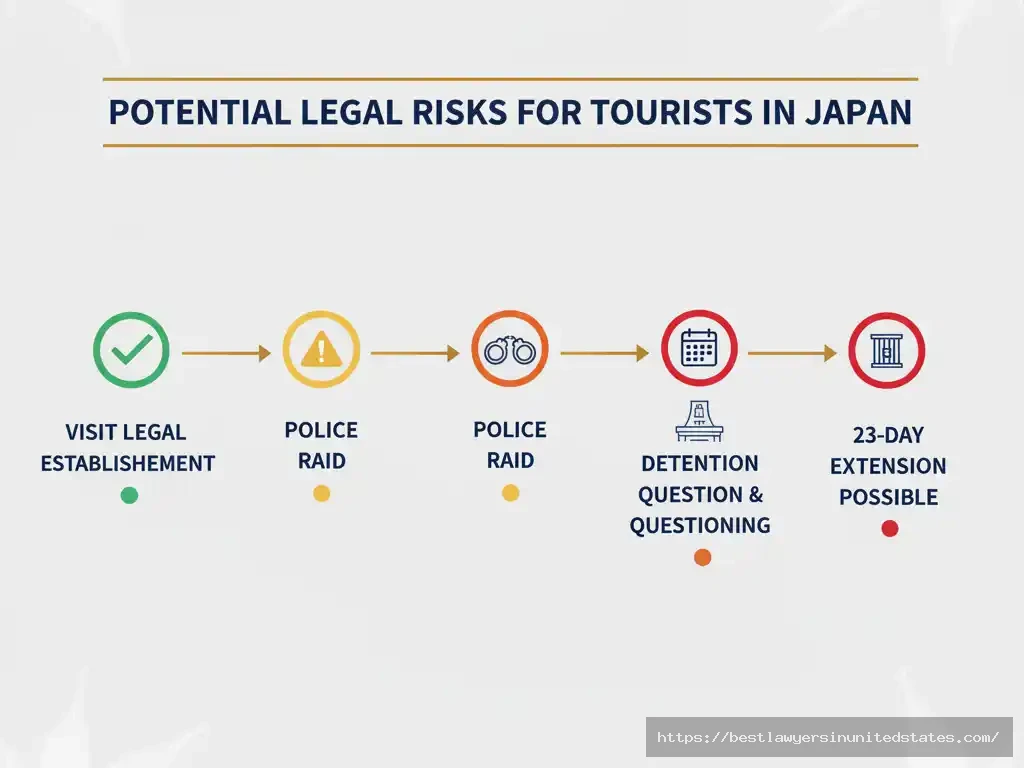
Arrest and Detention: What to Expect
Women in prostitution detained during police raids and arrested migrant workers are sometimes fined or deported without being screened for trafficking indicators. Foreign customers caught in raids on illegal venues face different treatment:
If police raid a legal establishment (delivery health, pink salon): You’ll likely be questioned briefly and released. Police verify you’re not involved in trafficking or other serious crimes. Your passport information gets recorded.
If police raid an illegal venue (soapland offering intercourse, street prostitution): Expect hours of detention for questioning. Japan’s legal system allows detention up to 23 days without formal charges. While customers rarely face prosecution, police can hold you during investigations of the business operators.
Japan has no equivalent to U.S. Miranda rights. Police can question you extensively without a lawyer present. Confessions carry enormous weight in Japanese courts—often more than physical evidence.
Police Raids and Enforcement Reality
Japanese police focus enforcement resources on:
- Human trafficking operations
- Venues employing foreign workers illegally
- Establishments with organized crime connections
- Businesses operating without proper licenses
- Venues where minors are present
Routine raids on established fuzoku venues remain rare unless complaints trigger investigations. Police generally tolerate adult entertainment in recognized districts as long as businesses maintain low profiles and avoid public nuisances.
While customers are rarely charged, you could be detained, questioned, or added to a watchlist. Immigration records noting your presence at a raided venue could complicate future visa applications to Japan or countries sharing immigration databases.
Immigration Consequences
For tourists: Being questioned by police in connection with illegal sexual services rarely results in deportation unless you’ve violated visa terms (working illegally) or committed serious crimes. However, overstaying your visa while involved in the sex industry triggers automatic deportation.
For residents: Resident visa holders face heightened scrutiny. Involvement in illegal activities—even without criminal conviction—can result in visa non-renewal or deportation during renewal processes. Japanese immigration authorities have broad discretion to determine whether a foreign resident maintains “good conduct.”
For all foreign nationals: Sex workers, particularly migrant workers, face regular arrests and deportation as law enforcement focuses on foreign nationals in the Japanese sex industry. This enforcement disparity means foreign customers at illegal venues risk guilt by association during immigration investigations.
What to Do If You’re Detained in Japan
Americans arrested or detained in Japan face a criminal justice system dramatically different from U.S. procedures. Knowing your rights and resources can mean the difference between quick release and prolonged detention.
Contact the U.S. Embassy Immediately
Under the Vienna Convention on Consular Relations, you have the right to contact your embassy within a reasonable time after arrest. Japanese police must inform you of this right.
U.S. Embassy Tokyo: +81-3-3224-5000 (24-hour emergency line)
U.S. Consulate Osaka: +81-6-6315-5900
Embassy services include:
- Providing lists of English-speaking attorneys
- Contacting family members in the U.S.
- Monitoring your detention conditions
- Ensuring fair treatment under Japanese law
- Explaining the Japanese legal process
What embassies cannot do: Pay legal fees, post bail, provide legal advice, or intervene in the Japanese legal process beyond ensuring fair treatment.
Japan’s Criminal Justice System Basics
Japan maintains a 99% conviction rate in criminal cases—one of the highest globally. Understanding how different countries approach prostitution laws helps contextualize Japan’s unique system.This statistic reflects the system’s structure rather than aggressive prosecution:
Detention periods: Police can hold suspects for up to 72 hours without charges. Prosecutors can request two 10-day detention extensions, totaling 23 days of pre-charge detention. During this period, authorities pressure suspects to confess.
Bail system: Bail exists but remains rare in Japan compared to the U.S. Courts often deny bail for foreign nationals considered flight risks. If granted, bail amounts can reach millions of yen.
Right to counsel: You have the right to an attorney, but unlike the U.S., police can restrict attorney access during questioning “if it would hinder the investigation.” Japan has no public defender system for most criminal cases.
Questioning procedures: Japanese law allows marathon questioning sessions without lawyers present. Police can question you for 8-12 hours daily during detention. Refusing to cooperate can extend your detention, as courts view non-cooperation as evidence of guilt.
Finding English-Speaking Legal Help
Most Japanese attorneys don’t speak English fluently. The U.S. Embassy maintains current lists of English-speaking criminal defense attorneys in major cities:
Tokyo Bar Association: Lawyer Referral Service at +81-3-3581-2205
Osaka Bar Association: +81-6-6364-1248
Expect legal fees of ¥300,000-500,000 ($2,000-3,500) just for initial consultations and detention hearings. Full criminal defense for serious charges can cost ¥2-5 million ($13,000-35,000).
Travel insurance: Most travel insurance policies exclude coverage for criminal defense or bail. Check your policy before traveling. Specialized legal insurance for expats working in Japan may cover criminal defense costs.
Are There Legal Sex Services for Women in Japan?
Western media rarely discusses female sex tourism in Japan, but the country hosts a substantial host club industry catering to female customers. Understanding this sector reveals gender asymmetries in both law enforcement and cultural attitudes.
Host Clubs and Their Legal Status
Host clubs (ホストクラブ, hosuto kurabu) are entertainment venues where attractive young men serve female customers drinks, engage in flirtatious conversation, and compete for “number one host” rankings based on customer spending. Famous host club districts include Kabukicho in Tokyo and Umeda in Osaka.
Legal framework: Host clubs operate under the same entertainment business licenses as hostess clubs. They’re fully legal because the core service is conversation and companionship—not sexual services. Hosts pour champagne, light cigarettes, play drinking games, and make customers feel special through attention and flattery.
Sexual services: Some hosts arrange private meetings outside the club where sexual activity may occur, but this happens independently of the club business. Customers pay hosts directly rather than the establishment. Whether money exchanges hands for these private encounters makes them legally indistinguishable from private prostitution arrangements—technically illegal but rarely prosecuted.
Pricing: Entry to host clubs typically costs ¥3,000-5,000, plus mandatory drink orders. Champagne bottles range from ¥30,000 to ¥500,000+ ($200-3,500+). Customers competing to sponsor their favorite hosts can spend millions of yen monthly.
Gender Asymmetry in Japan’s Sex Industry
Japan’s sex industry demonstrates stark gender disparities:
For male customers: Thousands of easily accessible, openly advertised fuzoku establishments offering every imaginable sexual service short of vaginal intercourse. Many operate in legal grey areas with minimal police interference.
For female customers: Host clubs provide social intimacy and ego gratification but rarely offer explicit sexual services as part of the business model. Private arrangements outside clubs mirror illegal prostitution dynamics but face virtually zero enforcement.
Why the asymmetry? Cultural factors explain much of this difference. Japanese society historically viewed male sexual satisfaction as a necessity for social stability—the “necessary outlet” justification that influenced the 1956 law’s enforcement gaps. Female sexual desire received less policy consideration, creating a market gap that host clubs partially fill through emotional rather than physical intimacy.
Male sex workers serving female clients: This market segment exists but remains small and underground compared to the massive fuzoku industry. Delivery health services employing male workers operate primarily in LGBTQ+ districts, not in mainstream entertainment zones.
Scams, Safety, and Health Risks
The Japanese sex industry’s legal ambiguity creates opportunities for exploitation, particularly targeting foreign customers unfamiliar with local customs and unable to communicate effectively in Japanese.
Common Scams Targeting Foreigners
Drink scams in Kabukicho and Roppongi: Touts on the street offer “free entry” to bars where attractive women immediately approach. After a few drinks, the bill arrives showing ¥50,000-200,000 ($350-1,400) in charges. Security staff block exits until you pay. Some establishments accept credit cards, others force ATM withdrawals.
Bait-and-switch services: Some illegal establishments set traps by agreeing to intercourse, then threatening to expose customers unless they pay significantly more money. This extortion scheme targets tourists who can’t report the crime without admitting participation in illegal prostitution.
Fake police scams: Criminals posing as police approach customers leaving establishments, claiming to investigate illegal activities. They demand “fines” or confiscate money/documents, then disappear. Real Japanese police wear uniforms and never collect on-the-spot fines.
Overcharging after services: Legitimate establishments provide clear pricing upfront. Scam operations quote low entry fees but add massive “service charges,” “tip requirements,” or “premium time” fees afterward. Without Japanese language skills, customers struggle to dispute charges.
STI Risks and Health Precautions
Illegal spots may skip STI checks or use trafficked workers. Legal places often have better hygiene and transparency.
Japan has universal healthcare, but sex workers—particularly those in illegal sectors—face barriers accessing regular STI screening. No legal requirement mandates health checks for fuzoku workers, unlike Nevada’s licensed brothels.
STI rates in Japan: Japan reports relatively low HIV/AIDS rates (0.01% of population) compared to many developed nations. However, other STIs including gonorrhea, chlamydia, and syphilis have increased among young adults over the past decade. Drug-resistant strains of gonorrhea have emerged in Asia-Pacific regions.
Protection: Condom use varies by establishment type. Delivery health and pink salons typically require condoms for any insertive sexual acts. Some soaplands offer “no condom” services at premium prices—dramatically increasing STI transmission risks.
Testing after travel: If you become ill after travel, see a healthcare provider immediately and tell them about your recent travel and sexual activities. When you return from your trip, make an appointment with a healthcare provider to get a medical checkup including STI testing, including an HIV test.
Extortion Schemes
Yakuza (organized crime) connections persist in some segments of Japan’s sex industry, particularly soaplands and street-level operations. While most establishments operate independently, some maintain ties to organized crime for “security” and dispute resolution.
Hidden cameras: Some illegal venues install hidden cameras to record customers in compromising situations, then demand payment for deletion. Japan has strict privacy laws, but pursuing legal remedies requires admitting you were at the establishment.
Threats of immigration reporting: Scammers threaten to report foreign customers to immigration authorities for illegal activity unless they pay additional money. This tactic particularly targets visa holders (students, workers) who fear visa cancellation.
“Emergency” fees: Workers suddenly claim “managers” are en route to punish them for unsatisfactory service unless customers pay significantly more. These manufactured crises pressure quick payment decisions.
Protection strategies:
- Only use establishments with clear, written pricing
- Avoid street touts and “too good to be true” offers
- Never hand over your passport or wallet
- Immediately leave situations that feel threatening
- Have emergency contacts programmed in your phone
Cultural Context: Geisha, Prostitution, and Misconceptions
Western media frequently conflates geisha with prostitutes, creating persistent misconceptions about both traditions. Understanding these distinctions matters for anyone studying Japanese culture or law.
Why Geisha Are Not Prostitutes
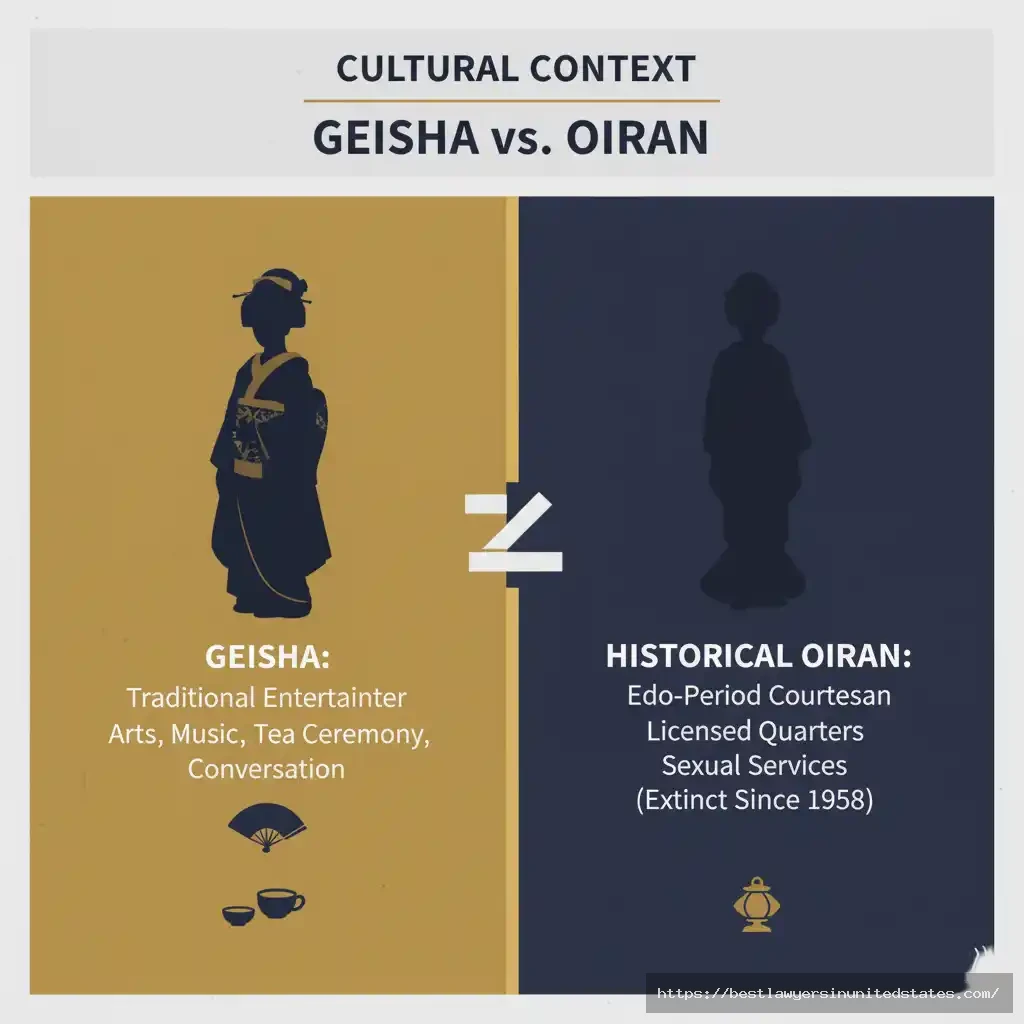
Geisha (芸者, “arts person”) are traditional Japanese entertainers skilled in classical music, dance, conversation, and tea ceremony. Training begins in teenage years and takes years to master. Modern geisha work at ochaya (teahouses) in historic districts like Kyoto’s Gion.
Historical context: During the Edo period (1603-1868), courtesans called oiran provided sexual services in licensed quarters like Yoshiwara. Geisha emerged as a distinct profession offering artistic entertainment without sexual services. By law, geisha and courtesans occupied separate social and legal categories.
Modern reality: The Diet undoubtedly knew when passing the 1956 law that it had to place subtle limitations. Male Diet members who owned and frequented geisha houses were probably well-aware that Japanese men needed some form of sexual freedom. The geisha would act as a substitute, providing escape for Japanese men without instilling the same hostility from other countries because of her history and tradition.
Today’s geisha entertain at private parties, perform at public events, and preserve traditional arts. Sexual services are not part of their profession. Mistaking geisha for prostitutes is considered deeply offensive in Japan.
People Also Ask confusion: The frequent question “What do Japanese geisha girls do?” reflects Western misconceptions popularized by novels like Memoirs of a Geisha. That fictionalized account portrayed sexual relationships between geisha and patrons that don’t represent the profession accurately.
Historical Context: Edo-Era Pleasure Quarters
Japan has a history of supervised prostitution dating back to the Kamakura period (1185-1333). In 1618, during the Edo period, yūkaku areas were set up and prostitution regulated. The Tokugawa shogunate confined prostitution to licensed quarters, creating elaborate social hierarchies among sex workers.
Yoshiwara, established in 1617, exemplified this system. High-ranking courtesans (oiran) received education in arts and literature, similar to geisha. Lower-ranking workers served in less prestigious establishments. This regulated system continued until 1958 when the Prostitution Prevention Law fully took effect.
Cultural legacy: Modern Japan’s tolerance for fuzoku districts partially stems from this historical acceptance of regulated pleasure quarters. The concept that sexual services should be confined to specific areas while remaining officially illegal creates the contradictory legal framework we see today.
Modern Policy Alternatives to Japan’s Approach
Other developed nations have experimented with different frameworks. Canada adopted the Nordic model in 2014, criminalizing the purchase of sexual services while decriminalizing sellers—a policy designed to reduce demand while protecting sex workers from prosecution.
Frequently Asked Questions
Is it illegal to visit a pink salon in Japan?
No. Pink salons are legal establishments because they offer only oral sex, not vaginal intercourse. Japanese law specifically prohibits paid vaginal intercourse but doesn’t criminalize other sexual services.
Can I be arrested for using a delivery health service?
Technically no, as these services are legal. However, if the worker offers intercourse for extra money and you accept, you’re participating in illegal prostitution. While rarely prosecuted, you could be detained during police investigations.
What happens if I’m caught in a soapland during a police raid?
You’ll be questioned about your activities, possibly for several hours. Customers are rarely charged, but you could be detained, questioned, or added to a watchlist. Your passport information will be recorded. Immigration authorities might learn of your presence there.
Is paying for sex with a streetwalker illegal?
Yes. Street prostitution is explicitly illegal in Japan. Both the sex worker (for soliciting) and potentially you (for engaging in prostitution) could face legal consequences. These encounters carry high risks of robbery, extortion, and police involvement.
Are foreigners allowed in all these establishments?
No. Many venues maintain strict “Japanese only” policies due to language barriers, cultural concerns, and desire to avoid international legal complications. Some establishments in tourist areas accept foreign customers, but expect significantly higher prices and potential communication issues.
Can I privately pay someone for sex if we agree in advance?
This arrangement still violates Japanese prostitution law. Private arrangements for intercourse are considered prostitution under Japanese law, and while not directly punishable, individuals involved risk extortion or becoming entangled in police investigations.
What if a service provider offers intercourse for extra money?
Decline politely to avoid possible extortion or involvement in illegal activity. This is often part of a scam to trap customers into compromising positions.
Are these laws the same all over Japan?
The Prostitution Prevention Law is national legislation applying everywhere in Japan. However, enforcement varies significantly by prefecture and city. Red-light districts in major cities receive more lenient enforcement than small towns. Local ordinances may add additional restrictions.
Is oral sex legal in all establishments?
Yes, if it’s within a registered and compliant business not offering intercourse, oral sex is legal. The law’s definition of prostitution includes only vaginal intercourse, making all other sexual acts technically legal when provided in licensed entertainment venues.
What should I do if I feel unsafe during a session?
Leave calmly. If threatened, call 110 (police emergency) or your embassy. Never escalate the situation yourself. Walk to a public area immediately. Don’t attempt to negotiate or argue with threatening individuals.
Can U.S. citizens face legal consequences at home for using these services in Japan?
No, as long as all parties are adults (18+). The PROTECT Act allows prosecution of U.S. citizens for sexual conduct with minors abroad, but it does not criminalize adult sexual activity in foreign countries, even if illegal locally. That said, if you’re arrested abroad for any reason, certain states may consider this during professional licensing reviews or background checks.
For example, Florida law enforcement takes international arrests seriously during concealed carry permit applications and professional licensing.
Do soaplands really get away with offering illegal services?
Yes, through a legal fiction where customers become “acquainted” with workers during the bath and massage, making subsequent sexual activity technically between “specified persons” rather than commercial prostitution. Courts have occasionally prosecuted soaplands, but enforcement remains inconsistent.
What are the differences between hostess clubs and fuzoku establishments?
Hostess clubs offer conversation, drinks, and flirtatious attention without sexual services—entirely legal social entertainment. Fuzoku establishments provide various sexual services short of intercourse. The two industries operate under different licensing categories, though some establishments blur these lines.
How can I tell if an establishment is legitimate?
Legitimate fuzoku businesses: (1) display clear pricing before services, (2) operate from fixed locations with proper signage, (3) never approach you on the street, (4) provide detailed service explanations upfront, and (5) never pressure you for additional payments mid-service.
What legal protections exist for sex workers in Japan?
Very few. Because the law treats most fuzoku work as entertainment rather than employment, workers lack standard labor protections. No legal requirement exists for health screenings, minimum wages, or workplace safety standards in the sex industry. Workers cannot easily report exploitation without risking their own legal exposure.
Conclusion: The Legal Reality vs. Social Tolerance
Japan’s prostitution laws create one of the world’s most legally complex sex industries. The 1956 Prostitution Prevention Law technically bans paid intercourse but defines illegal conduct so narrowly that a massive industry operates in technical compliance with the law.
This system reflects uniquely Japanese approaches to regulating vice—acknowledging certain behaviors will occur regardless of legal prohibitions, then creating frameworks allowing them to continue while maintaining official disapproval. The gap between written law and enforcement practice defines how prostitution functions in modern Japan.
For travelers: Legal grey areas create real risks despite widespread tolerance. Cultural barriers, language challenges, and scam operations make navigating this industry dangerous without local knowledge. The fact that something operates openly doesn’t guarantee it’s legal or safe.
For legal professionals: Japan’s system offers a case study in how narrow statutory definitions create industries exploiting loopholes. The absence of penalties for acts defined as illegal (Article 3) combined with enforcement focused solely on facilitators demonstrates how legal systems can prohibit conduct while tolerating its practice.
For researchers: The fuzoku industry reveals broader insights into Japanese approaches to sexuality, gender, policy enforcement, and cultural tradition. Understanding why this system persists—and how it reflects both modern and historical Japanese values—requires examining factors beyond simple legal text.
The prostitution question in Japan has no simple answer. Yes and no simultaneously capture the legal reality better than either alone.