
Quick Answer: Selling sex is legal in Canada, but buying it isn’t. This unusual approach has been in place since 2014 under Bill C-36 (Protection of Communities and Exploited Persons Act). Canada follows the “Nordic model” — sex workers can sell their services legally, but clients who purchase face criminal charges.
What’s Legal vs. Illegal: At a Glance
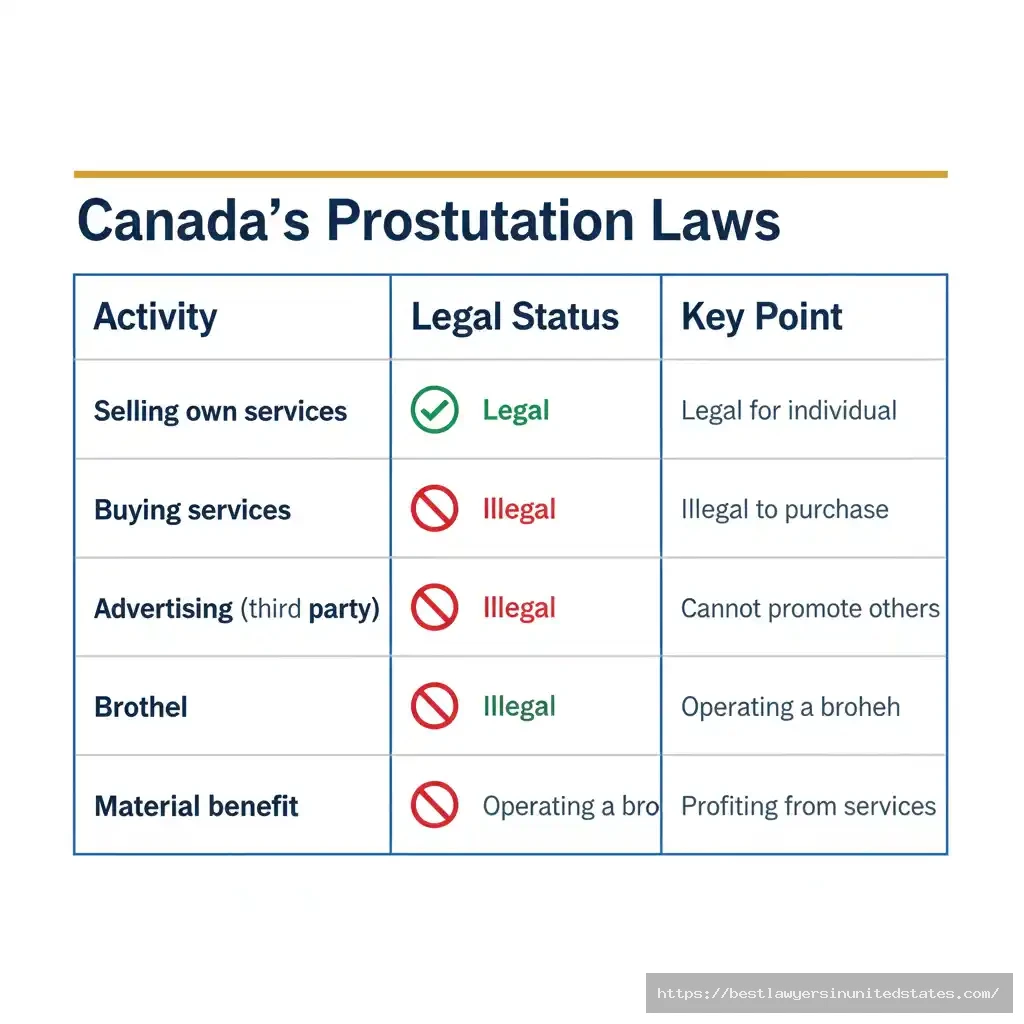
| Activity | Legal Status | Key Point |
|---|---|---|
| Selling your own sexual services | ✅ Legal | Sex workers cannot be charged |
| Buying sexual services | ❌ Illegal | Clients face up to 5 years in prison |
| Advertising sexual services | ❌ Illegal | Applies to third parties and platforms |
| Operating a brothel/bawdy house | ❌ Illegal | Cannot work from shared locations |
| Taking money from someone’s sex work | ❌ Illegal | Pimping and profiting are criminal offenses |
The law creates a paradox: you can legally sell something that others cannot legally buy.
For a global overview, see our explainer on is prostitution legal worldwide.
Understanding Bill C-36: The Game Changer
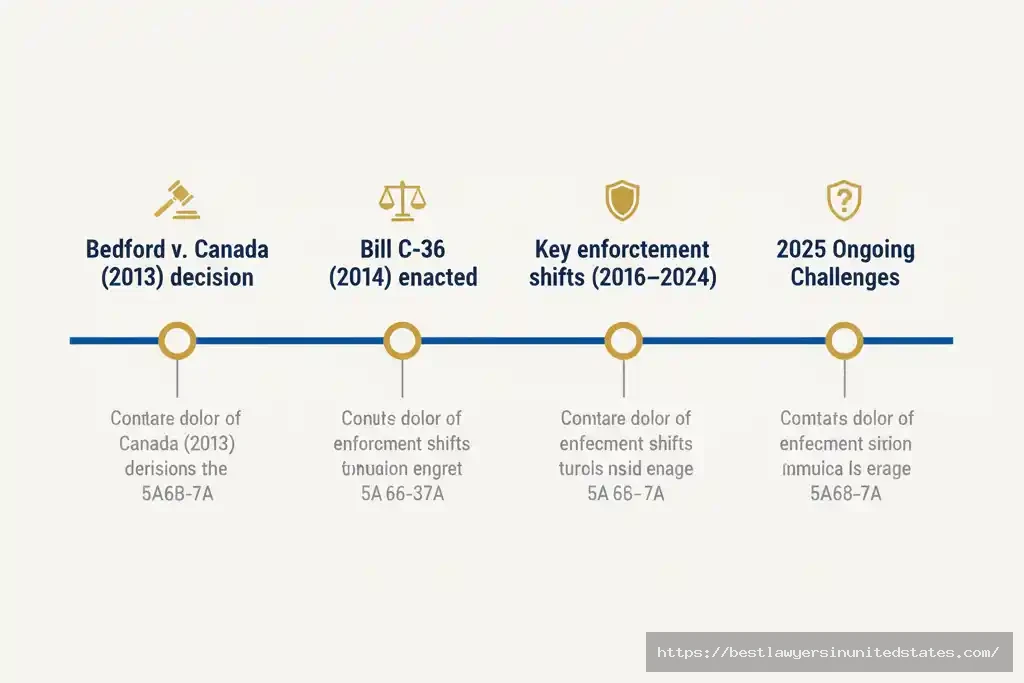
Bill C-36 completely rewrote Canada’s prostitution laws after the Supreme Court struck down the old system in Bedford v. Canada (2013).
What Changed in 2014?
Before 2014:
- Prostitution itself was legal
- Communicating in public was illegal
- Operating brothels was illegal
- Living off proceeds was illegal
After 2014:
- Focus shifted to buyers, not sellers
- Five new criminal offenses created
- Sex workers protected from most charges
- Nordic model officially adopted
Why Canada Adopted the Nordic Model
The government borrowed this approach from Sweden, which pioneered it in 1999. The philosophy treats sex workers as victims or vulnerable persons rather than criminals.
The government’s stated goals:
- Reduce demand for purchased sex
- Protect sex workers from exploitation
- Discourage human trafficking
- Shift criminal liability to buyers
What critics say: The law still pushes sex work underground and makes workers less safe because they can’t screen clients openly or work together for security.
The 5 Criminal Offenses Under Current Law
1. Purchasing Sexual Services (Section 286.1)
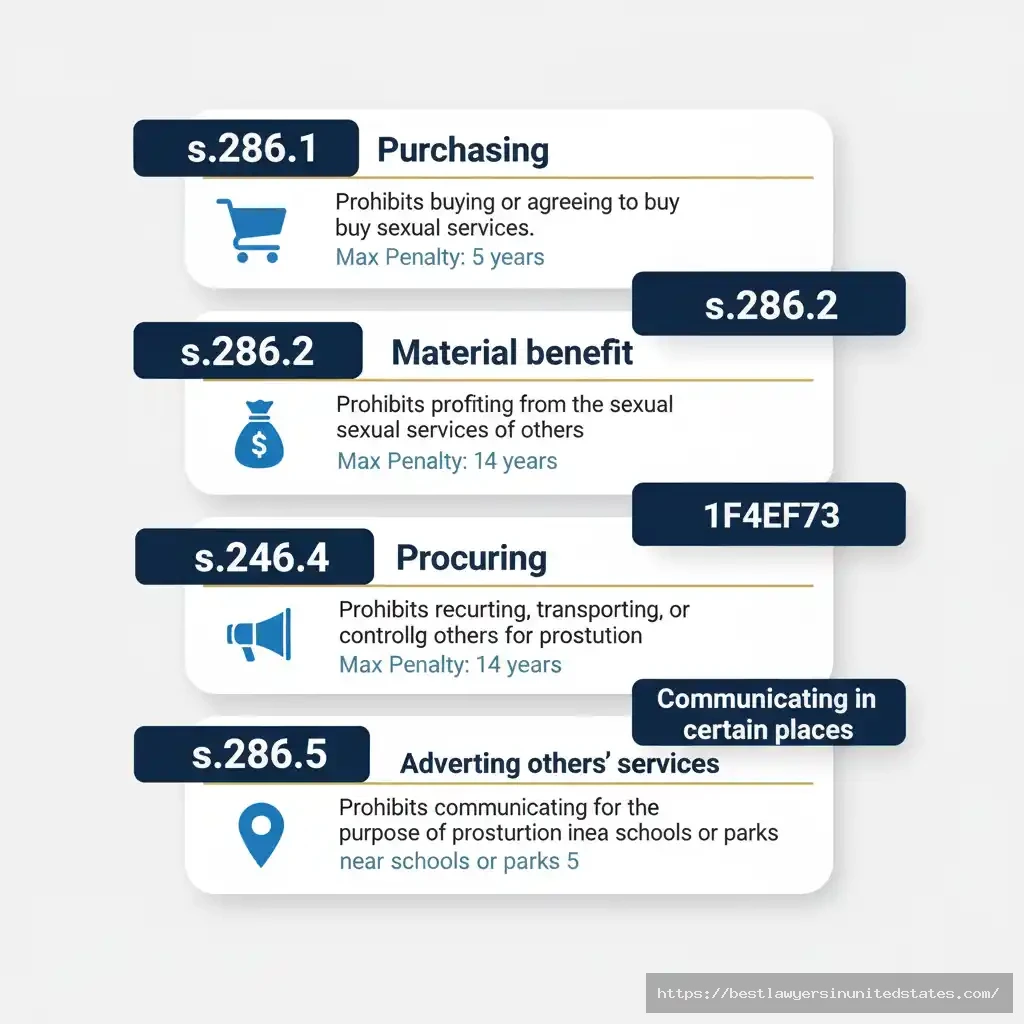
Anyone who pays or offers to pay for sexual services faces criminal charges. This is the most commonly enforced provision.
Maximum penalties:
- First offense: Up to 5 years in prison
- Summary conviction: Up to 18 months and/or fines
What counts as “purchasing”:
- Direct payment for sex acts
- Offering gifts, money, or services in exchange
- Attempting to purchase (even if no transaction happens)
Real-world enforcement: Most first-time offenders are offered diversion programs (“john schools”) instead of criminal records. Toronto and Vancouver police run regular sting operations targeting buyers.
2. Receiving Material Benefit (Section 286.2)
This targets anyone who receives money or benefits from someone else’s prostitution. Primarily aimed at pimps, but the law’s language is intentionally broad.
Examples that could lead to charges:
- Taking a cut of earnings
- Charging inflated rent to sex workers
- Managing bookings for a fee
- Providing “protection” services
Important legal exceptions:
The law recognizes that sex workers need access to regular services. You won’t be charged if you’re:
- A lawyer, accountant, or security provider offering legitimate services
- A roommate sharing normal living expenses
- A family member receiving support (unless it’s exploitative)
- Providing goods/services at market rates
These exceptions prevent the law from criminalizing everyday business relationships.
3. Procuring (Section 286.3)
This offense targets anyone who causes, assists, or encourages someone to provide sexual services through control, deception, or coercion.
This includes:
- Recruiting people into sex work
- Exercising control over someone’s activities
- Using threats, intimidation, or deception
- Hiding or harboring someone for prostitution
Maximum penalty: Up to 14 years in prison (one of the harshest penalties under Bill C-36)
Important distinction: Helping someone with logistics isn’t automatically procuring. A friend helping with safety arrangements won’t face charges. Someone coercing, manipulating, or controlling will.
4. Advertising Sexual Services (Section 286.4)
Anyone who advertises the sexual services of another person commits a criminal offense. This provision dramatically changed online classified advertising in Canada.
What’s affected:
- Escort websites
- Adult classified sections
- Social media promotional posts
- Print advertisements in adult publications
What’s NOT affected: Sex workers can advertise their own services. The law only targets third parties who profit from hosting or placing ads.
Notable impact: Several Canadian classified websites shut down their adult services sections after Bill C-36 passed. Others moved servers outside Canada or implemented strict verification systems to avoid liability.
5. Communicating in Certain Places (Section 286.5)
Sex workers can be charged for communicating to sell services in specific locations:
- Near schools, playgrounds, or daycares
- In areas where children could reasonably be present
The rationale: Protecting children from exposure to the sex trade.
Enforcement reality: This sees less enforcement than buyer-focused provisions but gives police discretion in residential neighborhoods and school zones.
How Laws Vary Across Canada
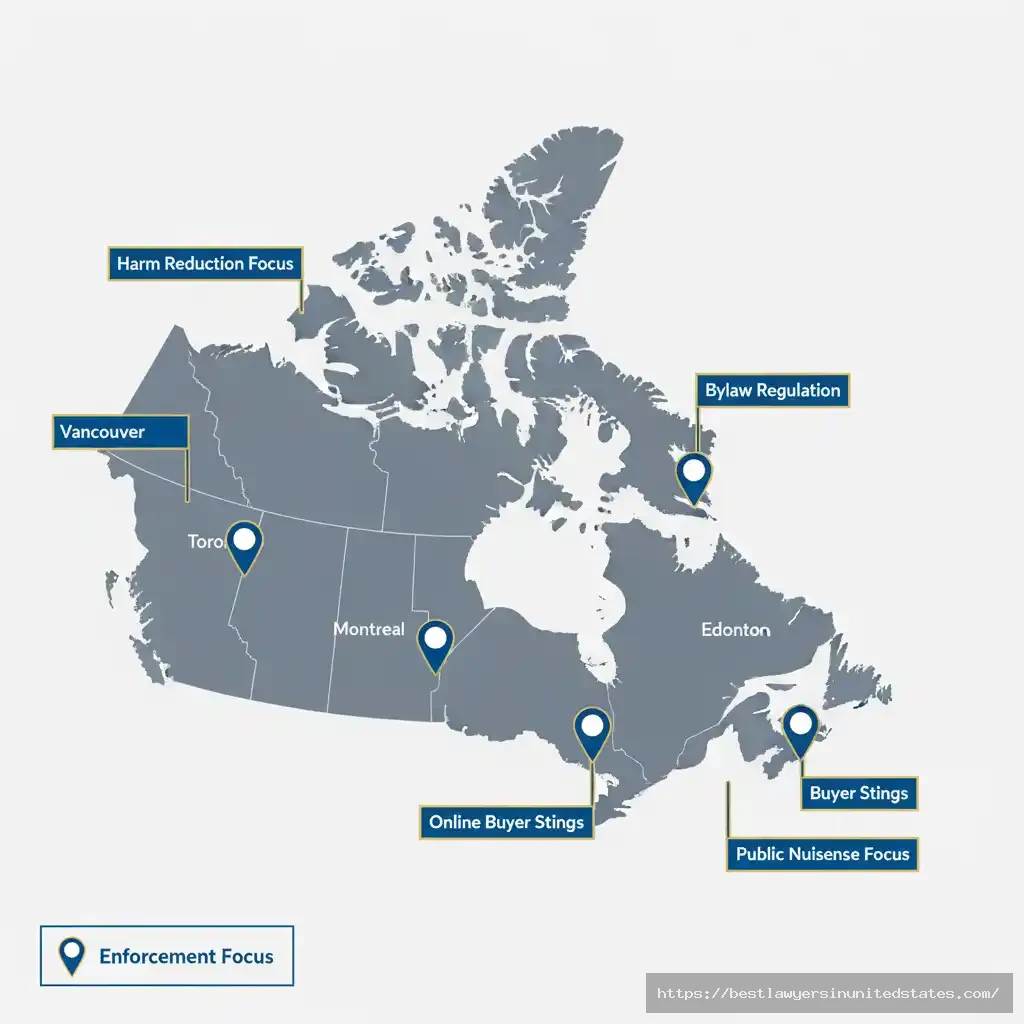
Federal Law Applies Everywhere
Bill C-36 is federal legislation. The five criminal offenses apply uniformly from coast to coast. No province can override these laws.
Provinces and Cities Add Their Own Rules
While criminal law is federal, provinces and municipalities regulate related activities through licensing, zoning, and public safety bylaws.
Ontario (Toronto, Ottawa, London)
Toronto’s approach:
Toronto has additional bylaws targeting street prostitution and regulating adult businesses:
- Safe Streets Act: Prohibits aggressive solicitation
- Body rub parlor licensing: Strict regulations and inspections
- Zoning restrictions: Adult entertainment businesses have location limits
Toronto Police run “Operation Northern Spotlight” annually, coordinating with agencies across North America to target trafficking.
What this means for residents: Street-level sex work is heavily policed in downtown areas. Body rub parlors operate under intense scrutiny with regular inspections.
Quebec (Montreal, Quebec City)
Montreal’s approach:
Montreal takes a somewhat more tolerant enforcement approach:
- Fewer aggressive street-level operations
- Greater focus on trafficking than consensual adult sex work
- Body rub parlors operate more openly
Important note: Federal law still applies. Buyers face charges regardless of local enforcement priorities.
Language considerations: Legal materials and police interactions occur in French in Quebec. Understanding your rights requires French-language resources or translation.
British Columbia (Vancouver, Victoria)
Vancouver’s situation:
Vancouver has historically had more visible street-level sex work, particularly in the Downtown Eastside.
Current enforcement strategy:
- Harm reduction focus
- Police prioritize trafficking and exploitation
- Municipal bylaws regulate massage parlors strictly
Advocacy influence: BC has strong sex worker advocacy organizations like Pivot Legal Society, which successfully challenge enforcement practices and push for decriminalization.
Alberta (Calgary, Edmonton)
Aggressive enforcement approach:
Both cities employ proactive tactics:
- Regular undercover buyer stings
- “John-shaming” (publishing names of charged individuals)
- Strict licensing for massage and body rub parlors
- Community awareness campaigns
Edmonton Police specifics: They distinguish clearly between consensual sex work and trafficking in public communications, running education programs about exploitation indicators.
For contrast, learn how prostitution is legal in Nevada (in certain counties) and why the framework differs from Canada’s buyer-focused model.
Related Activities: What’s Actually Legal?
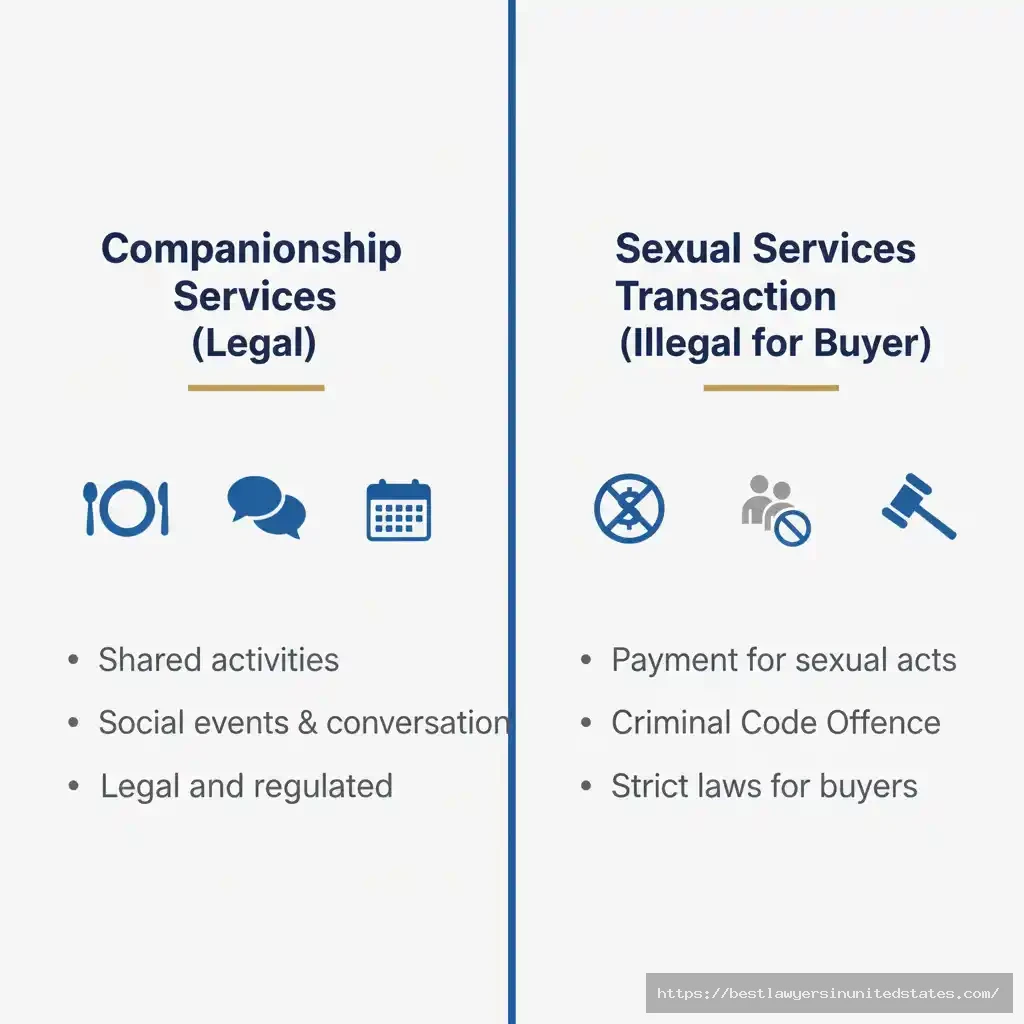
Are Escort Services Legal in Canada?
The nuanced answer: Companionship services are legal. Sexual services arrangements are not (for the buyer).
Legal escort services can provide:
✅ Companionship for events
✅ Dinner dates and social outings
✅ Conversation and company
✅ Platonic accompaniment
What they cannot legally do:
❌ Advertise sexual services explicitly
❌ Arrange sexual transactions
❌ Take commissions on sexual services
The gray area in practice:
Most escort advertising uses coded language. “Companionship” and “entertainment” are legal advertising terms. Explicit sexual service descriptions violate Section 286.4.
Escort services operate openly in major Canadian cities. Police typically focus enforcement on trafficking and exploitation rather than consensual adult arrangements.
In the U.S., prostitution laws in California criminalize both buying and selling, highlighting a different policy choice than Canada’s demand-focused model.
Are Massage Parlors Legal in Canada?
It depends on what services they offer.
| Type | Legal Status | Requirements |
|---|---|---|
| Licensed therapeutic massage | ✅ Completely legal | Therapist must be licensed by provincial college |
| Body rub parlors (non-sexual) | ✅ Legal with license | Municipal business license and inspections required |
| “Happy ending” massage | ❌ Illegal | Violates purchasing sexual services law |
| Unlicensed sexual services | ❌ Illegal | Multiple violations (advertising, material benefit) |
What “happy ending” means legally:
If a massage includes sexual services for additional payment, the client commits the offense of purchasing sexual services. The establishment could face charges for material benefit and advertising.
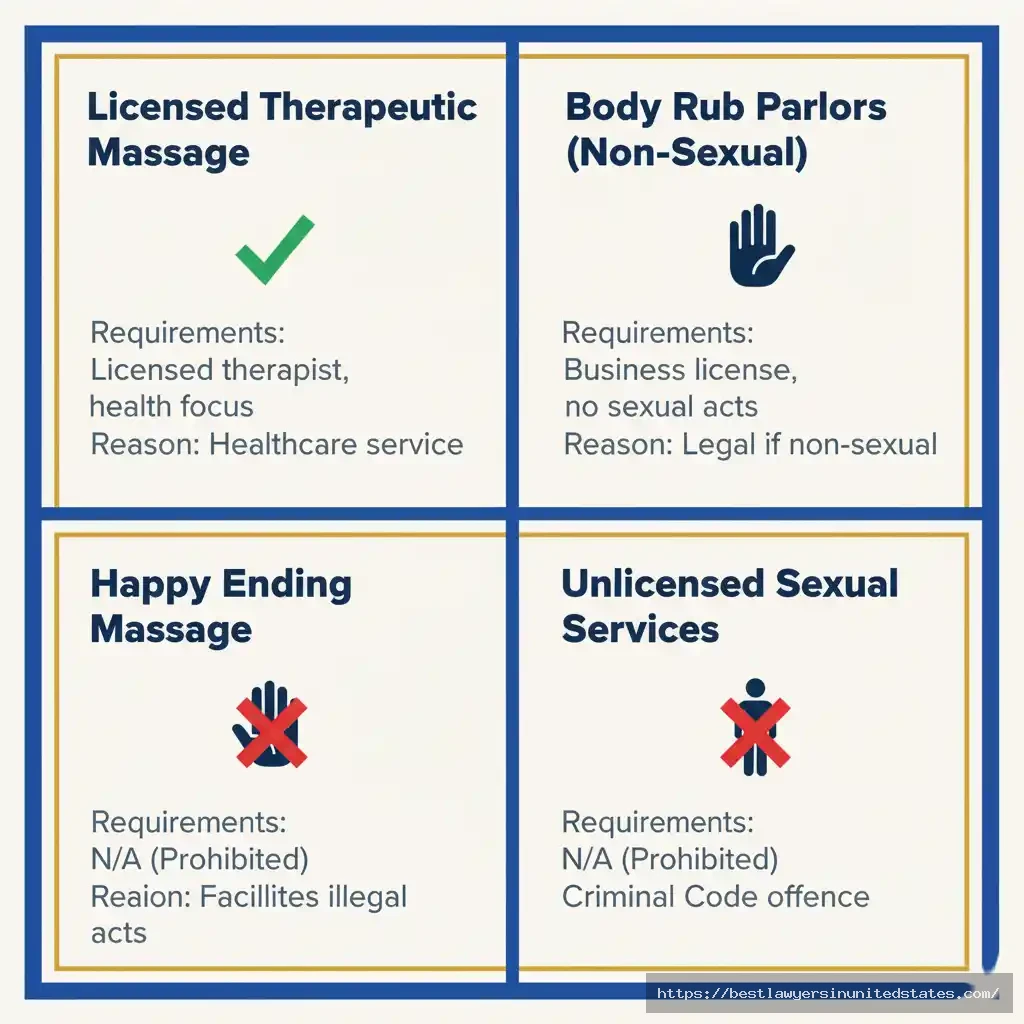
How municipalities regulate:
Cities require body rub parlor licenses with conditions:
- Background checks for operators
- Regular inspections
- Age verification for workers
- Location restrictions (distance from schools, churches)
- Posted licensing and rates
Is Stripping Legal in Canada?
Yes, strip clubs and exotic dancing are completely legal in Canada, regulated as adult entertainment venues.
What’s allowed:
✅ Strip clubs and exotic dance venues
✅ Lap dances and private dances
✅ Topless and nude dancing (in licensed venues)
✅ Champagne rooms (for dancing only)
What’s NOT allowed:
❌ Sexual services for payment
❌ Direct genital contact
❌ Prostitution occurring on premises
Regulation structure:
- Provincial: Liquor licensing authorities regulate alcohol service
- Municipal: Business licenses and zoning laws apply
- Federal: Criminal Code applies to any sexual services
Lap dance legality: Physical contact during lap dances is legal as long as it doesn’t constitute sexual services. Touching breasts or buttocks during a dance is legal entertainment. Sexual acts for payment are not.
Are Cam Girls and OnlyFans Legal in Canada?
Yes, online adult content creation is completely legal in Canada.
Legal activities:
✅ Creating adult content for platforms (OnlyFans, Fansly, etc.)
✅ Live cam performances
✅ Selling photos and videos
✅ Receiving tips and subscriptions
✅ Direct messaging with fans
Why it’s different from prostitution:
- No physical contact or in-person services
- Content creation falls under freedom of expression
- Platform transactions are digital services, not sexual services
Tax considerations:
Content creators must report income to the Canada Revenue Agency (CRA). This is self-employment income subject to income tax. Many creators incorporate or use business structures to optimize taxes.
Platform responsibility: International platforms like OnlyFans aren’t subject to Bill C-36’s advertising provisions since they host content creators advertising their own services, not third-party sexual services.
Is Being a Sugar Baby Illegal in Canada?
The legal status depends entirely on the arrangement.
Gray area explained:
The law doesn’t specifically address “sugar dating” or “sugar baby” relationships. Whether it’s legal depends on whether it constitutes prostitution.
Potentially legal arrangements:
- Dating relationships with financial support
- Mentorship with gifts or allowance
- Companionship-focused relationships with generosity
Potentially illegal arrangements:
- Explicit exchange: money for specific sexual acts
- Arrangement where sexual services are the primary expectation
- Transactional sex-for-payment agreements
The critical distinction:
If the relationship looks like prostitution (payment specifically for sexual services), it falls under Bill C-36. The buyer would face criminal charges.
If it’s a genuine relationship where one person provides financial support, it’s not prostitution — even if sex is part of the relationship.
Practical reality: Enforcement is rare unless the arrangement clearly resembles traditional prostitution transactions.
Real-World Enforcement: What Actually Happens
Operation Northern Spotlight
This is Canada’s largest coordinated anti-trafficking operation, occurring annually across multiple provinces.
2024 Operation Results (most recent complete data):
- 270+ arrests across Canada
- 89 individuals identified as potentially trafficked
- 34 children recovered
- Hundreds of police agencies participated
Focus areas:
- Hotels and motels
- Online advertisements
- Truck stops and highways
- Known trafficking routes
Important distinction: The operation targets human trafficking and exploitation, not consensual adult sex work. However, many sex workers report increased police scrutiny during these operations.
“John Schools” and Diversion Programs
Many Canadian cities offer diversion programs for first-time offenders charged with purchasing sexual services.
How john schools work:
- Eligibility: First-time offenders with no violence history
- Fee: Usually $500-$1,000 to attend
- Duration: One-day program (typically 6-8 hours)
- Content: Education about exploitation, health risks, legal consequences
- Outcome: Charges withdrawn upon completion
Cities offering programs:
- Toronto (John School Diversion Program)
- Calgary (Prostitution Offender Program)
- Edmonton (PEACE Program)
- Vancouver (various diversion options)
Pros and cons:
Benefits: Avoids criminal record, educational opportunity, community impact
Criticism: Some argue it treats all sex work as exploitation and doesn’t distinguish between consensual transactions and trafficking.
“John-Shaming” Tactics
Some police services publish the names and photos of individuals charged with purchasing sexual services.
Cities using this approach:
- Calgary Police Service (regular public releases)
- Edmonton Police Service (media releases)
- York Regional Police (online postings)
Legal considerations:
Publishing names is legal because charges are public record. However, this occurs before conviction, raising “innocent until proven guilty” concerns.
Effectiveness debate:
Proponents argue: Public shame deters potential buyers and raises community awareness.
Critics argue: It damages reputations before conviction and may push activity further underground rather than stopping it.
Your Legal Rights: What You Should Know
If You’re a Sex Worker
Your protected rights:
✅ You cannot be charged for selling your own sexual services
✅ You can advertise your own services online
✅ You can hire security, accountants, and lawyers
✅ You can report violence without fear of automatic arrest
✅ You have Charter rights protecting you from discrimination
What you cannot do without risk:
❌ Work from a shared location (brothel laws)
❌ Communicate near schools or where children are present
❌ Have others advertise for you
❌ Have a manager or agent take cuts of earnings
If police approach you:
You have the right to:
- Remain silent (except providing identification)
- Ask if you’re being detained or free to leave
- Contact a lawyer before answering questions
- Refuse consent to searches (they need a warrant)
Reporting violence:
You can report assault, robbery, or other crimes without automatic charges. However, be aware that police may investigate your activities as part of a broader investigation. Consider contacting a sex worker advocacy organization before making a police report.
If You’re Charged with Purchasing Services

Immediate steps:
- Do not make statements to police beyond identifying yourself
- Contact a criminal defense lawyer immediately
- Do not discuss the case on social media or with others
- Keep all documentation related to the charge
What to expect:
- First court appearance within weeks of charge
- Opportunity for diversion program if eligible
- If proceeding to trial: disclosure, pre-trial motions, trial date
- Potential outcomes: diversion, guilty plea, trial
Potential penalties if convicted:
- Summary conviction: Up to 18 months jail and/or fines
- Indictable offense: Up to 5 years in prison
- Criminal record: Yes, unless charges are withdrawn or absolute discharge granted
Defense considerations:
Common defenses include:
- Entrapment (police went beyond proper investigative techniques)
- Mistaken belief (you didn’t know sexual services were offered)
- Charter violations (illegal search or detention)
If You’re Charged with Material Benefit or Procuring
These are more serious charges with harsher penalties.
Maximum sentences:
- Material benefit: Up to 10 years
- Procuring: Up to 14 years
You need a lawyer immediately if charged with either. These charges often involve:
- Extensive police investigations
- Surveillance evidence
- Witness testimony
- Financial records analysis
Do not:
- Speak to police without a lawyer
- Contact potential witnesses
- Destroy any evidence
- Discuss the case online
2025 Legal Developments and Current Challenges
Ongoing Constitutional Challenges
Several groups continue to challenge Bill C-36’s constitutionality.
Current legal challenges argue:
- The law still endangers sex workers despite claims it protects them
- Provisions violate Charter rights to security and liberty
- Evidence shows the law pushes sex work underground
- Workers cannot screen clients safely due to advertising restrictions
Key case to watch:
R v. Anwar (Ontario Court of Justice) is examining whether purchasing provisions violate Charter rights. The decision could impact how the law applies nationally.
Calls for Decriminalization
New Zealand model:
Many advocates point to New Zealand’s 2003 Prostitution Reform Act, which fully decriminalized sex work. Studies suggest this approach improved:
- Worker safety and health outcomes
- Ability to report violence
- Access to legal protections
- Workplace standards
Amnesty International position:
In 2016, Amnesty International called for full decriminalization of consensual sex work, distinguishing it from trafficking and exploitation.
Canadian advocacy groups:
Organizations like the Canadian Alliance for Sex Work Law Reform push for:
- Full repeal of Bill C-36
- Decriminalization following New Zealand’s model
- Separation of consensual sex work from trafficking laws
- Enhanced resources for those wanting to exit sex work
Municipal Responses and Variations
Vancouver’s approach:
Vancouver has implemented harm reduction strategies:
- Police don’t prioritize consensual adult sex work enforcement
- Resources directed toward trafficking and exploitation
- Collaboration with sex worker advocacy groups
Toronto’s crackdowns:
Toronto periodically intensifies enforcement:
- Regular raids on body rub parlors
- Increased street-level operations
- “Community safety” focus in residential areas
Montreal’s tolerance:
Montreal maintains relatively low enforcement of consensual adult sex work while focusing resources on trafficking and organized crime.
Common Myths About Prostitution in Canada
Myth #1: “All prostitution is illegal in Canada”
The truth: Selling sexual services is legal. Only purchasing and certain surrounding activities are criminal offenses.
This confusion stems from the Nordic model’s unusual structure. Sex workers themselves aren’t criminals, but their clients are.
Myth #2: “Escort services are completely legal”
The truth: Companionship services are legal. Sexual services are not (for the buyer).
The distinction matters in advertising and actual services provided. Escort agencies walk a legal tightrope, advertising companionship while many clients seek more.
Myth #3: “You can’t be arrested for selling sex”
The truth: While selling your own services is legal, you CAN be charged for:
- Communicating near schools
- Working from a shared location (brothel)
- Having someone else advertise for you
The law protects sellers in theory but creates practical legal risks.
Myth #4: “Red light districts exist in Canada”
The truth: Canada has no official red light districts where prostitution is legally permitted in specific zones. Despite popular belief, prostitution in Las Vegas is illegal; brothels operate only outside Clark County.
Some areas have higher concentrations of street-level sex work, but it remains subject to the same federal laws. There are no Amsterdam-style legal zones.
Myth #5: “Sex workers pay no taxes”
The truth: Sex workers are required to report income to the CRA and pay taxes just like any self-employed person.
Income from sexual services is taxable self-employment income. Workers can deduct legitimate business expenses (advertising, safety equipment, workspace costs) like other self-employed Canadians.
Frequently Asked Questions
Is prostitution legal in Canada right now?
Selling sexual services is legal, but buying them is illegal. This has been the law since Bill C-36 passed in December 2014. Canada follows the Nordic model, which criminalizes demand rather than supply.
Can you go to jail for hiring a prostitute in Canada?
Yes. Purchasing sexual services carries a maximum penalty of 5 years in prison for an indictable offense. First-time offenders typically receive lighter sentences or diversion programs, but jail time is possible, especially for repeat offenders.
Penalties vary by jurisdiction; for example, prostitution laws in Florida impose enhanced penalties in designated zones and for repeat offenders.
Are escort agencies legal in Canada?
Escort agencies offering companionship services are legal. However, they cannot advertise sexual services or arrange sexual transactions. Agencies that facilitate prostitution violate Bill C-36’s advertising and material benefit provisions.
Is OnlyFans legal in Canada?
Yes, creating adult content on OnlyFans and similar platforms is completely legal in Canada. These are digital content services with no physical contact, so they don’t fall under prostitution laws. Creators must report income to the CRA for tax purposes.
Can sex workers work together for safety?
This is legally complicated. Two sex workers cannot legally work from the same location, as this could constitute operating a common bawdy house. However, they can share safety information, screen clients separately, and have security personnel present.
What happens if you’re caught buying sex in Canada?
You’ll be charged under Section 286.1 (purchasing sexual services). Police will:
- Arrest and fingerprint you
- Set a court date
- Possibly offer diversion (john school) if it’s your first offense
- If convicted, you’ll have a criminal record
Do massage parlors in Canada offer sexual services?
Licensed therapeutic massage therapists offer legal, non-sexual services. Some unlicensed establishments advertise as “body rub” parlors and may offer sexual services illegally. Receiving sexual services at any location violates federal law for the purchaser.
Is street prostitution legal in Canada?
Selling sexual services on the street is legal under federal law, but communicating for that purpose near schools or where children are present is illegal. Many cities have municipal bylaws that restrict street solicitation in other ways (loitering, public nuisance laws).
Can you advertise sexual services in Canada?
You can advertise your own sexual services. Third parties (websites, publications, agents) cannot advertise someone else’s sexual services without violating Section 286.4. This is why many Canadian classified sites removed adult services sections.
What’s the difference between prostitution and escort services?
Legally, escort services provide companionship, conversation, and social interaction. Prostitution involves sexual services for payment. In practice, the line blurs, but the legal distinction matters. Escort agencies must avoid explicitly advertising sexual services.
Are sugar baby arrangements illegal in Canada?
It depends on the nature of the arrangement. If it’s essentially payment for sexual services, it falls under prostitution law (illegal for the buyer). If it’s a genuine relationship with financial support, it’s not prostitution. The distinction is fact-specific.
Can police charge you for texting about sexual services?
Yes, communication about purchasing sexual services (even via text, email, or online messages) can form the basis for charges. Many undercover sting operations involve text or online communication before any in-person meeting.
Is prostitution decriminalized in any Canadian province?
No. Bill C-36 is federal law applying across all provinces and territories. No province can decriminalize prostitution on its own. Only Parliament can change federal criminal law.
What is Operation Northern Spotlight?
It’s an annual coordinated law enforcement operation across Canada targeting human trafficking and exploitation in the sex trade. Hundreds of police agencies participate, resulting in arrests and identification of trafficking victims. It occurs each January.
Do sex workers have to pay taxes in Canada?
Yes. Income from sexual services is taxable self-employment income. Sex workers must file tax returns and report earnings to the Canada Revenue Agency. They can deduct legitimate business expenses like any self-employed person.
Resources and Support
Legal Aid and Support
For sex workers:
- Pivot Legal Society (BC): 604-255-9700
- Maggie’s Toronto Sex Workers Action Project: 416-964-0150
- Stella Montreal: 514-285-8889
- Legal Aid Ontario: 1-800-668-8258
Crisis and Safety Resources
National Human Trafficking Hotline: 1-833-900-1010
Canada Crisis Hotline: 1-833-456-4566
Assaulted Women’s Helpline: 1-866-863-0511
Advocacy Organizations
- Canadian Alliance for Sex Work Law Reform
- Sex Workers United Against Violence
- Butterfly Asian and Migrant Sex Workers Support Network
Finding a Criminal Defense Lawyer
If you’re charged with a prostitution-related offense:
- Law Society Referral Services: Each province has a law society offering lawyer referral
- Legal Aid: May provide free representation if you qualify financially
- Criminal Lawyers Association: Can provide specialist referrals
Final Thoughts
Canada’s prostitution laws remain controversial eight years after Bill C-36’s passage. The Nordic model aims to reduce demand and protect sex workers, but critics argue it simply pushes the industry underground while maintaining legal risks for workers.
Understanding these laws matters whether you’re a sex worker navigating legal rights, someone considering purchasing services, or simply a Canadian wanting to understand current legislation. The legal landscape is complex, enforcement varies by region, and ongoing constitutional challenges may reshape the law in coming years.
The key takeaway: Selling sex is legal in Canada, but almost everything surrounding it isn’t. This paradox creates practical and safety challenges that continue to fuel debate about whether the law achieves its stated goals.
If you’re facing charges or need legal advice about specific situations, consult a criminal defense lawyer in your province. Laws may change, and individual circumstances require professional legal guidance.
Stay informed. Know your rights. Understand the law. Researching abroad? Compare Canada’s approach with prostitution laws in Colombia, where regulation and enforcement follow a different framework.
Related Articles:
Is Prostitution Legal in Japan? A Legal Analysis (2025)
Is Prostitution Legal in Amsterdam? Complete 2025 Legal Guide
Is Prostitution Legal in New York 2025? Complete Guide to NYC Laws & Penalties
Is Prostitution Legal in Mexico? Complete 2025 Guide to Sex Work Laws by State
Is Prostitution Legal in Europe? 2025 Complete Guide
