
Quick Answer: No, prostitution is illegal throughout California under Penal Code Section 647(b). Both selling and buying sexual services remain criminal offenses as of 2025, though recent legislative changes have reduced penalties and expanded protections for sex workers who report crimes.
California maintains some of the strictest anti-prostitution laws in the United States, with no counties exempted like in neighboring Nevada. Whether you’re in Los Angeles, San Francisco, or any other California city, engaging in or soliciting prostitution can result in criminal charges, fines, and a permanent record.
However, significant legal reforms between 2020-2024 have transformed how these laws are enforced, particularly regarding condom possession, loitering arrests, and immunity protections for those reporting other crimes.
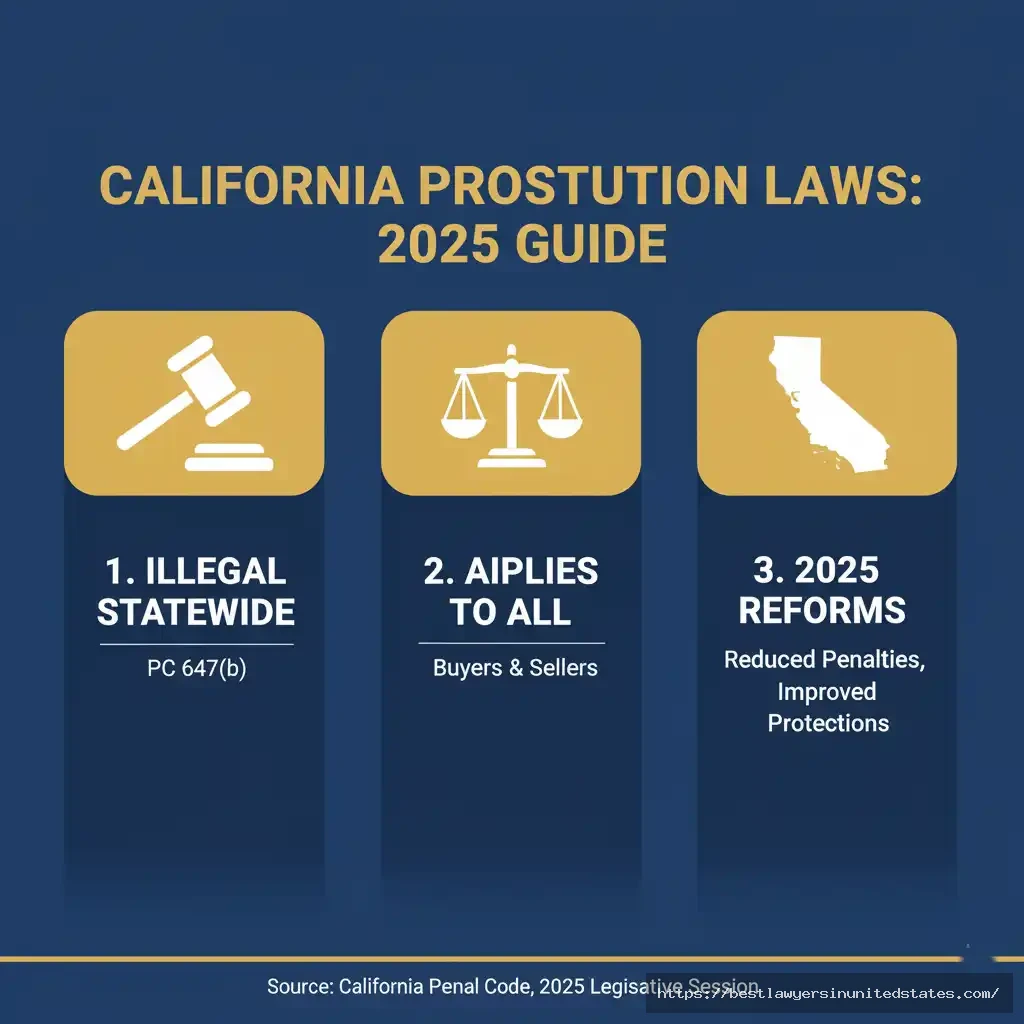
Understanding California Penal Code 647(b)
California Penal Code Section 647(b) defines prostitution as “engaging in sexual conduct for money or other consideration.” This statute criminalizes three distinct actions:
What’s Actually Illegal:
- Agreeing to exchange money (or anything of value) for sexual acts
- Soliciting someone else to engage in prostitution
- Actually engaging in the sexual act after an agreement
The law applies equally to sex workers and clients, though enforcement patterns have historically differed significantly between buyers and sellers.
What Prosecutors Must Prove
To secure a prostitution conviction under PC 647(b), the District Attorney must establish beyond reasonable doubt that you:
- Agreed to engage in sexual conduct with another person
- Did so in exchange for money or other compensation
- Performed an overt act in furtherance of that agreement (such as withdrawing money, driving to a location, or discussing specifics)
Importantly, the sexual act doesn’t need to actually occur. Simply agreeing to the exchange and taking any preparatory step can constitute a crime under California law.
Penalties for Prostitution in California (2025)
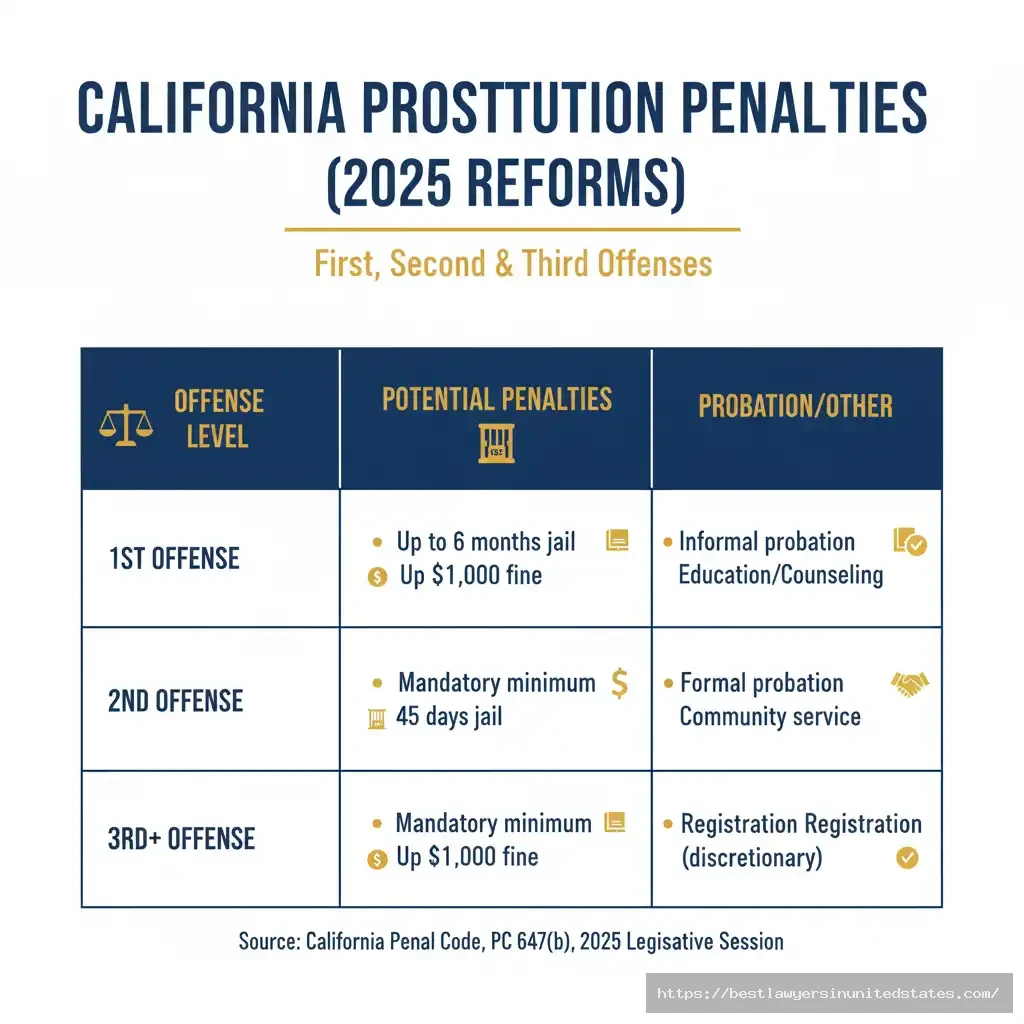
Prostitution charges carry different consequences depending on whether it’s your first offense or you have prior convictions.
First Offense Penalties
| Consequence | Details |
|---|---|
| Classification | Misdemeanor |
| Jail Time | Up to 6 months in county jail |
| Fine | Minimum $400 (can reach $1,000+) |
| Probation | Summary (informal) probation possible |
| Diversion Programs | Eligible for education programs in many counties |
| Criminal Record | Conviction appears on background checks |
Most first-time offenders in California avoid jail time, particularly if they complete a diversion program like John School. However, prosecutors in conservative counties may pursue harsher sentences.
Repeat Offense Penalties
Second and subsequent prostitution convictions trigger mandatory minimum penalties:
| Offense | Minimum Jail Time | Typical Fine |
|---|---|---|
| Second conviction | 45 days mandatory | $1,000+ |
| Third+ conviction | 90 days mandatory | $1,000+ |
| HIV-positive (knowing) | Felony possible | Up to $10,000 |
Additional Consequences Beyond Criminal Penalties
A prostitution conviction creates collateral damage that extends far beyond fines and jail timeFor individuals seeking civil representation, our network of Personal Injury Lawyers offers support for related cases:
Professional Impact: Licensed professionals (nurses, teachers, therapists, real estate agents) face disciplinary action from state licensing boards. Many employers conduct background checks that reveal misdemeanor convictions.
Immigration Consequences: Non-citizens face potential deportation or inadmissibility, as prostitution is considered a crime involving moral turpitude under federal immigration law.
Housing Barriers: Landlords frequently deny rental applications from individuals with criminal records, even for misdemeanor offenses.
Child Custody Issues: Family courts may consider prostitution convictions when determining custody arrangements, particularly if combined with substance abuse or other factors.
Major Legal Changes in California (2020-2025)
California has enacted three landmark bills that fundamentally altered prostitution law enforcement while maintaining the underlying criminalization.
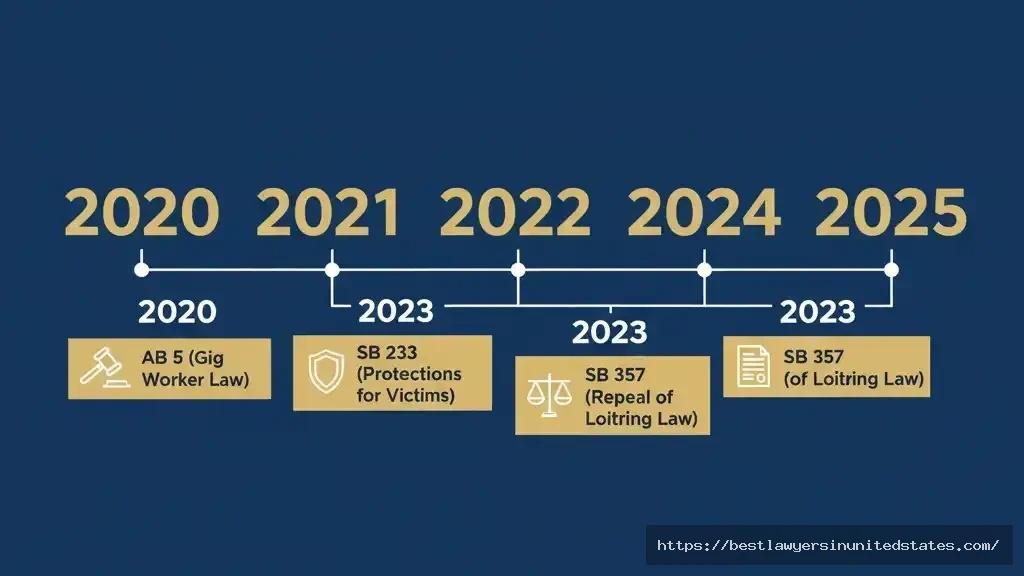
Senate Bill 233 (Effective January 2023)
SB 233 addressed two critical issues that disproportionately impacted sex workers.
Condoms Can No Longer Be Used as Evidence
Before 2023, California police routinely seized condoms as evidence of intent to engage in prostitution. This practice discouraged sex workers from carrying protection, increasing HIV and STI transmission rates.
Now, prosecutors cannot introduce condom possession as evidence in prostitution-related cases. You can legally carry any number of condoms without fear of this being used against you in court.
Immunity When Reporting Serious Crimes
SB 233 grants immunity from prostitution charges when you report violent crimes, including:
- Sexual assault or rape
- Human trafficking
- Kidnapping or false imprisonment
- Assault with a deadly weapon
- Robbery or extortion
This immunity applies even if you were engaged in prostitution at the time of the crime. You cannot be arrested or prosecuted for prostitution when coming forward as a witness or victim of these serious offenses.
Real-World Impact: A sex worker who witnesses a violent assault can now contact police without risking arrest for their own prostitution activity. This protection extends to crimes that occurred days or even weeks earlier, as long as you report within a reasonable timeframe.
Senate Bill 357 (Effective January 2023)
SB 357 repealed California’s “loitering with intent to engage in prostitution” law, which police had used for decades to arrest individuals—particularly transgender women and people of color—based solely on their appearance or location.
What Changed:
Before SB 357, police could arrest someone for simply standing in an area known for prostitution while wearing “suggestive” clothing or speaking to potential clients. Officers relied on subjective factors like:
- Clothing style or amount of makeup
- Repeatedly talking to drivers or pedestrians
- Being in a “high prostitution area”
- Carrying condoms
The law was widely criticized for enabling discriminatory enforcement based on how someone looked rather than any criminal act.
Current Law: Police now need evidence of an actual agreement to exchange sex for money. They cannot arrest you simply for your location, appearance, or talking to strangers in public spaces.
Assembly Bill 5 (Effective January 2020)
AB 5 reclassified many adult entertainers from independent contractors to employees, impacting exotic dancers and strippers at California clubs.
Under the “ABC test,” workers are presumed to be employees unless the hiring entity proves:
- The worker is free from company control
- The work performed is outside the usual course of the hiring entity’s business
- The worker is customarily engaged in an independently established trade
Most California strip clubs now classify dancers as employees rather than independent contractors, entitling them to minimum wage, workers’ compensation, unemployment benefits, and other labor protections.
How California Prosecutes Buyers vs. Sellers
Despite laws that theoretically apply equally, California’s criminal justice system has historically treated buyers and sellers very differently.
Traditional Enforcement Patterns
Sex Workers (Sellers):
- Face more frequent arrests, particularly for street prostitution
- Often charged with additional offenses (loitering, trespassing, drug possession)
- Less likely to afford private attorneys
- Higher rates of incarceration
- Disproportionately women, transgender individuals, and people of color
Clients (Buyers):
- Less frequent arrests, typically through targeted “john stings”
- More likely to be offered diversion programs
- Better legal representation
- Focus on education rather than punishment
- Often first-time offenders with no criminal history
The Shift Toward Demand-Side Enforcement
Several California District Attorneys have announced policies prioritizing buyer prosecution over seller arrests, following the “Nordic Model” used in Sweden and other countries.
Recent Policy Shifts:
Los Angeles County DA George Gascón has deprioritized prostitution cases involving consenting adults, focusing resources instead on human trafficking and exploitation. San Francisco DA Brooke Jenkins similarly emphasizes trafficking cases over street prostitution.
However, these policies vary dramatically by county. Conservative jurisdictions like Orange County, Riverside, and San Bernardino continue aggressive enforcement against both buyers and sellers.
John School Diversion Programs
First-time buyers in many California counties can avoid conviction by completing “John School”—an eight-hour education program covering:
- The link between prostitution and human trafficking
- Health risks and STI transmission
- Impact on communities and families
- Legal consequences of repeat offenses
Upon successful completion and payment of program fees ($500-$1,000), charges are typically dismissed. This option is almost universally available to buyers but rarely offered to sex workers.
City-by-City Enforcement Reality in California
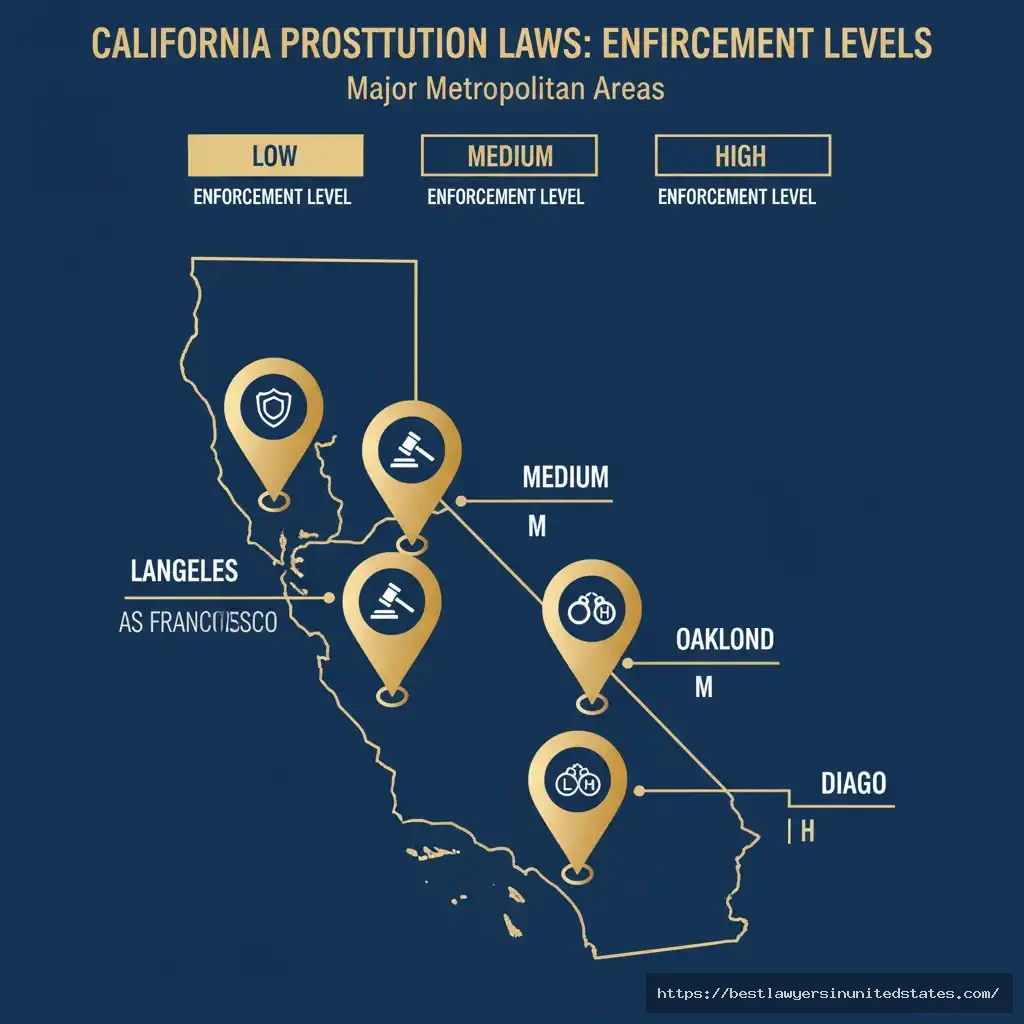
Prostitution laws are enforced with wildly different priorities across California’s major cities, despite the statewide prohibition.
Los Angeles
High-Activity Areas:
- Figueroa Street corridor (South LA)
- Sunset Boulevard (Hollywood)
- Sepulveda Boulevard (San Fernando Valley)
Enforcement Approach: LAPD conducts periodic “sweeps” in high-visibility areas, particularly following community complaints. However, DA George Gascón’s 2020 policy directive reduced prostitution prosecutions by over 60%, with resources redirected to human trafficking investigations.
Street prostitution arrests have declined significantly since 2020, though undercover operations targeting indoor prostitution (escort services, massage parlors) continue.
San Francisco
High-Activity Areas:
- Tenderloin District
- Capp Street (Mission District)
- Parts of the Bayview neighborhood
Enforcement Approach: SFPD maintains the lowest prostitution arrest rate among major California cities. The city’s progressive political culture and harm-reduction philosophy emphasize connecting sex workers with social services rather than incarceration.
San Francisco offers robust support services, including St. James Infirmary (a health clinic specifically for sex workers) and legal aid through organizations like the Sex Workers Outreach Project.
San Diego
High-Activity Areas:
- El Cajon Boulevard
- National City
- Parts of downtown near the Gaslamp Quarter
Enforcement Approach: San Diego Police Department runs regular undercover operations targeting both street prostitution and online escort services. The city maintains one of California’s most active vice units, with a more conservative enforcement philosophy than LA or San Francisco.
Tourist areas receive heightened attention, particularly during major events like Comic-Con when law enforcement visibility increases.
Oakland
High-Activity Areas:
- International Boulevard (formerly East 14th Street)
- Parts of West Oakland
Enforcement Approach: Oakland PD has deprioritized prostitution enforcement due to limited resources and competing public safety priorities. The city experiences higher rates of violent crime, drawing police focus away from vice operations.
Community-led initiatives aim to address root causes (poverty, addiction, lack of housing) rather than relying solely on criminal enforcement.
Smaller Cities: Stockton, Vallejo, Pomona, Lancaster
These mid-sized cities typically mirror county-level enforcement philosophies. Conservative counties (like Lancaster in LA County’s northern region) maintain more aggressive enforcement, while progressive areas focus resources elsewhere.
Key Pattern: Prostitution enforcement intensity inversely correlates with city size and progressive political leanings. Smaller, conservative cities often conduct more frequent arrests relative to population than San Francisco or Los Angeles.
The Figueroa Street Phenomenon: Why This LA Street Dominates Searches
Figueroa Street in South Los Angeles appears in thousands of online searches about California prostitution laws. This 30-mile corridor—particularly the section between downtown LA and Inglewood—has been associated with street prostitution for over 40 years.

Historical Context
During the 1980s and 1990s, economic disinvestment, gang activity, and the crack cocaine epidemic created conditions where street prostitution became highly visible along Figueroa. The area’s proximity to major freeways made it easily accessible to clients driving from across Southern California.
Despite decades of law enforcement operations, community improvement efforts, and gentrification in some areas, Figueroa Street remains one of the most recognizable locations for street prostitution in the United States.
Current Enforcement (2025)
LAPD’s Southwest Division regularly conducts operations along the Figueroa corridor, though arrest frequency has declined significantly since 2020. The department now emphasizes:
- Connecting sex workers with social services
- Targeting pimps and traffickers rather than workers
- Responding to specific community complaints
- Addressing related crimes (drug dealing, theft)
Community organizations like the Coalition to Abolish Slavery and Trafficking (CAST) work directly on Figueroa, providing outreach, healthcare, housing assistance, and exit services to those seeking to leave sex work.
Why It Appears in So Many Searches
Figueroa Street has become shorthand in online discussions about California prostitution, similar to how the Bunny Ranch represents Nevada’s legal brothel industry. News coverage, documentaries, and social media discussions frequently reference the area, driving search interest from:
- People curious about visible street prostitution
- Researchers studying urban sex work
- Visitors to Los Angeles encountering street solicitation
- Individuals seeking to engage with sex workers
The street’s notoriety perpetuates itself—each news article or viral video generates more searches, which prompts more content creation, continuing the cycle.
Escort Services vs. Prostitution: Understanding the Legal Line
California law draws a critical distinction between legal escort services and illegal prostitution, though the line often blurs in practice.
What Makes Escort Services Legal
Legitimate escort services in California operate under the premise that clients pay for time and companionship only, not sexual acts. Legal escort activities include:
- Accompanying clients to dinners, parties, or events
- Providing conversation and social company
- Traveling with clients as a companion
- Attending public functions together
The exchange of money must be explicitly for non-sexual companionship. Many California cities require escort services to obtain business licenses, and escorts may need to register with local law enforcement.
When Escort Services Become Prostitution
The arrangement becomes illegal the moment there’s an agreement—explicit or implied—to exchange money for sexual services. This can occur when:
- An escort agrees to sexual acts for additional payment
- Advertisements use coded language suggesting sexual services
- Clients and escorts negotiate sex acts during the booking
- Money changes hands with the understanding that sex will occur
Law Enforcement’s Approach: Police departments run undercover operations targeting escort services believed to be fronts for prostitution. Officers pose as clients, booking appointments and attempting to elicit offers of sexual services in exchange for money.
The critical moment in these stings comes when the officer asks about specific sexual acts and the escort quotes a price or agrees to the exchange. This constitutes the agreement element required under PC 647(b).
Why Aren’t Escort Websites Prosecuted?
Websites advertising escort services operate in a legal gray area, carefully avoiding explicit references to sexual services. Platforms like:
- Use disclaimer language: “Escorts provide time and companionship only”
- Prohibit discussion of sexual services in messages
- Operate as advertising platforms, not service providers
- Claim protection under Section 230 of the Communications Decency Act
Federal law generally shields websites from liability for third-party content, making direct prosecution of the platforms difficult. Law enforcement instead targets individual escorts and agencies using the sites.
Why Is Pornography Legal But Prostitution Isn’t?
This question appears frequently in California prostitution discussions, as the state hosts the majority of America’s adult film industry while criminalizing similar conduct outside the context of filmed entertainment.
The Legal Distinction
California courts have held that pornography is protected speech under the First Amendment, while prostitution is not. The key differences:
Pornography Production:
- Filmed for commercial distribution, not private consumption
- Involves professional actors performing for an audience
- Subject to health regulations (STI testing, documentation)
- Protected as artistic expression and free speech
- Regulated by California’s Division of Occupational Safety and Health
Prostitution:
- Private exchange between individuals
- Money compensates the individual participant, not for creating content
- No broader expressive or artistic purpose
- Considered conduct rather than speech
- No constitutional protection
The First Amendment Shield
In People v. Freeman (1988), the California Supreme Court ruled that paying performers for sexual conduct during adult film production does not constitute prostitution under PC 647(b). The court reasoned that hiring actors to appear in expressive content—even sexually explicit content—falls within First Amendment protections.
This ruling applies only when:
- The primary purpose is creating content for distribution
- Performers are hired as actors in a production
- The resulting material has at least minimal expressive content
- Proper documentation and health protocols are followed
Why Critics Call This Hypocritical
Opponents of prostitution criminalization argue the distinction is arbitrary and illogical. In both scenarios:
- Consenting adults engage in sexual activity
- Money is exchanged for sexual conduct
- The acts themselves are identical
The only difference is whether a camera is present and whether the content will be distributed commercially. Critics contend this reveals that California’s real concern is about who profits rather than protecting public health or morality. If facing charges, consult an experienced Criminal Defense Lawyer for guidance.
What Reddit Gets Right (and Wrong) About California Prostitution Laws
Reddit communities like r/legaladvice, r/AskLosAngeles, and r/California frequently discuss prostitution laws, with users sharing experiences and legal interpretations. Some information is accurate; much is misleading.
What Reddit Gets Right
“You can carry condoms legally now” ✓ Correct. SB 233 prevents condom possession from being used as evidence in prostitution cases. Users accurately note that this 2023 change protects sex workers who prioritize safe sex.
“SB 357 stopped arbitrary loitering arrests” ✓ Correct. Reddit discussions properly identify that police can no longer arrest someone simply for standing in a known prostitution area or talking to strangers.
“Enforcement varies dramatically by city” ✓ Correct. Users correctly observe that San Francisco and LA have deprioritized prostitution arrests compared to conservative counties.
“It’s still illegal everywhere in California” ✓ Correct. Despite rumors about San Francisco “legalizing prostitution,” no California city has decriminalized it. State law supersedes local preferences.
What Reddit Gets Wrong
“Escort services are fully legal if you don’t discuss sex” ✗ Misleading. While escort services can be legal, the arrangement becomes illegal the moment there’s an implicit understanding that sex will occur. Simply avoiding explicit discussion doesn’t create legal immunity if other evidence suggests an agreement.
“Police don’t really enforce prostitution laws anymore” ✗ Partially Wrong. While some jurisdictions have reduced enforcement, many California cities continue regular operations. This varies by county and police department priorities.
“You can’t be arrested for prostitution if you report a crime” ✗ Incomplete. SB 233 grants immunity only for specific serious crimes (sexual assault, trafficking, kidnapping, robbery, assault with deadly weapons). It doesn’t cover reporting minor offenses or engaging in prostitution unrelated to reporting.
“First offense is just a fine, no jail time” ✗ Oversimplified. While many first-time offenders avoid jail, prosecutors can pursue up to six months incarceration. Outcomes depend heavily on the county, judge, and specific circumstances.
“Nevada prostitution laws apply near the California-Nevada border” ✗ Completely Wrong. Nevada’s legal brothel system applies only within Nevada. California law governs the moment you cross into California, regardless of proximity to the state line.
California vs. Nevada: Why Neighboring States Have Opposite Laws
California and Nevada share an 800-mile border, yet maintain radically different prostitution policies. Understanding why requires examining each state’s legal philosophy, political culture, and economic interests.
The Nevada Model
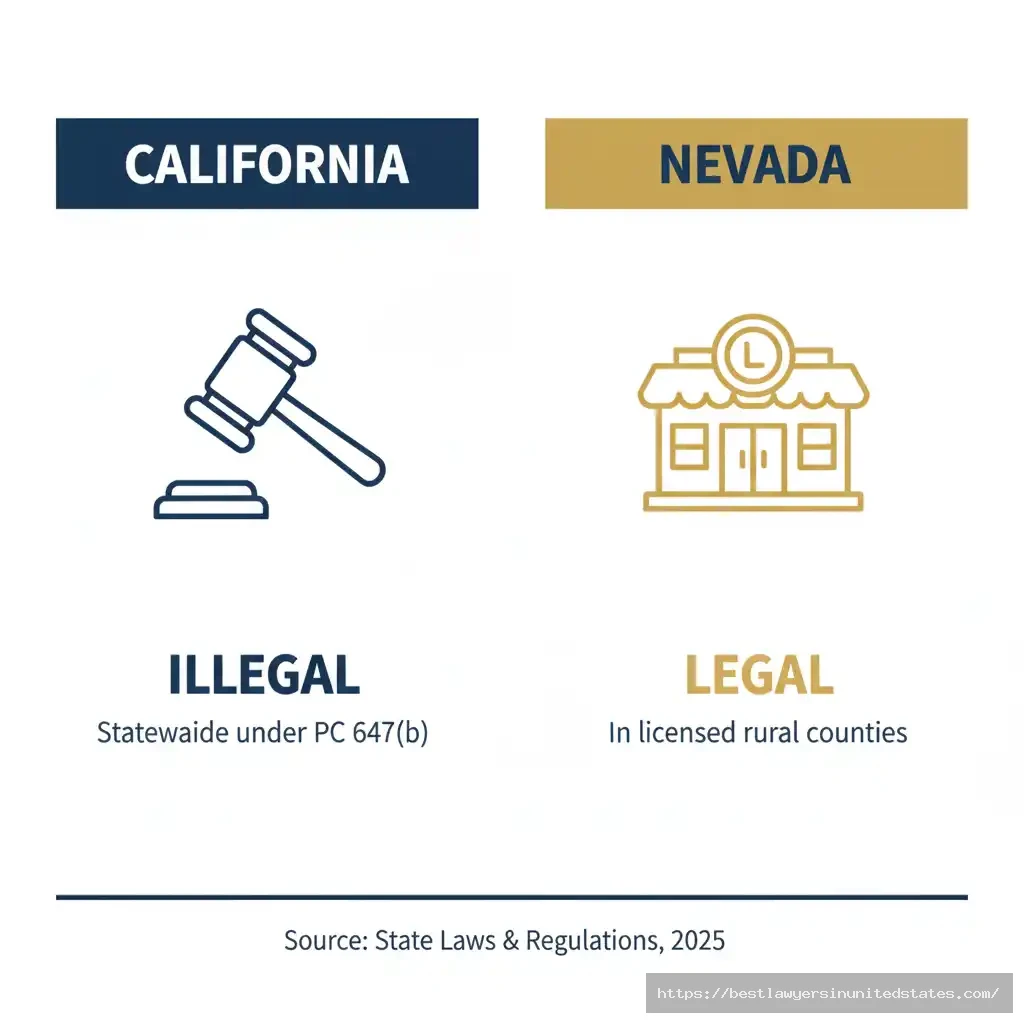
Nevada permits licensed brothels in counties with populations under 700,000, effectively legalizing prostitution in rural areas while keeping it illegal in Las Vegas and Reno. This hybrid approach reflects Nevada’s libertarian leanings and gambling-driven economy.
Licensed brothels in Nevada must:
- Register with county governments
- Conduct weekly STI testing on all workers
- Prohibit workers from living on-premises
- Pay business licensing fees and taxes
- Maintain specific health and safety standards
For a detailed analysis of Nevada’s legal brothel system, see our comprehensive guide: Is Prostitution Legal in Nevada?
California’s Prohibitionist Approach
California maintains total criminalization based on:
Moral Arguments: Historical influence of conservative religious groups and “progressive” reformers who viewed prostitution as exploitation requiring criminal sanctions.
Public Health Concerns: Officials cite HIV/STI transmission, though sex worker advocates argue criminalization worsens health outcomes by driving the industry underground.
Human Trafficking Fears: Law enforcement contends that legalizing prostitution increases sex trafficking, though research on this claim remains disputed.
Political Consensus: Both conservative Republicans (moral objections) and progressive Democrats (exploitation concerns) oppose legalization, creating rare bipartisan agreement.
Why the Difference Matters
For Tourists: Visitors to California—particularly those from Nevada or countries with decriminalized sex work—must understand that California’s laws apply the instant they cross the state border. The proximity of legal Nevada brothels doesn’t create any California exception.
Many people searching for California prostitution laws have previously researched Nevada’s system. Compare specific Nevada county regulations | Is Prostitution Legal in Las Vegas Nevada for more on city-specific rules
Will California Legalize Prostitution? Legislative Trends to Watch
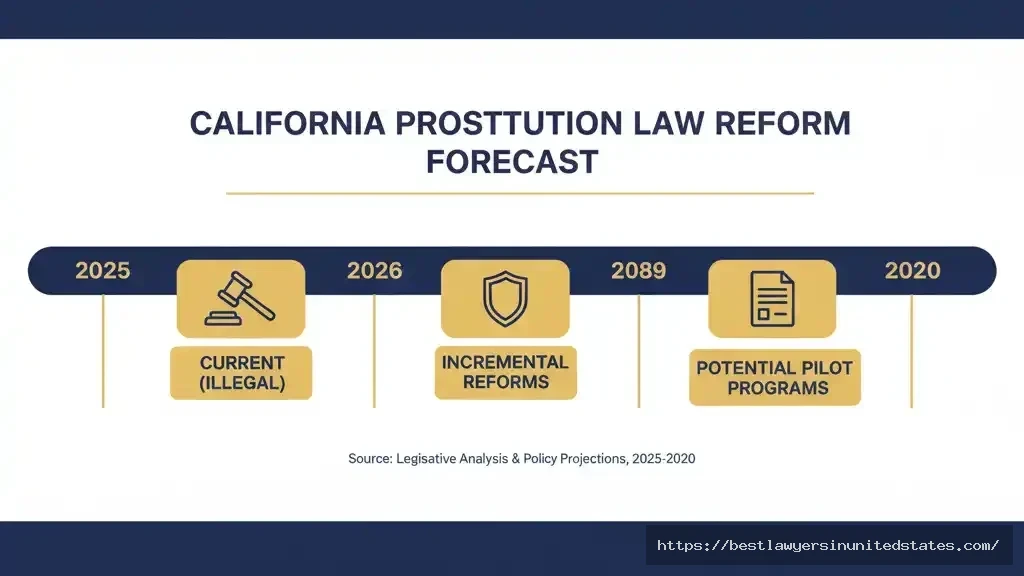
Despite recent reforms that reduce penalties and expand protections, full legalization or decriminalization of prostitution appears politically unlikely in California through at least 2026-2027.
Current Legislative Landscape
Decriminalization Bills Failed (2019-2022): Multiple attempts to introduce decriminalization legislation died in committee without receiving full Assembly or Senate votes. Even in California’s Democratic supermajority legislature, prostitution decriminalization faces significant opposition.
Partial Reforms Succeeded: The success of SB 233, SB 357, and AB 5 demonstrates legislative willingness to reduce harms associated with criminalization without fully legalizing sex work. This incremental approach currently commands broader political support than complete decriminalization.
Political Obstacles to Legalization
Law Enforcement Opposition: Police unions and district attorneys’ associations consistently oppose legalization, arguing it would increase trafficking and complicate prosecution of exploitation cases.
Anti-Trafficking Advocacy Groups: Organizations focused on combating sex trafficking—both conservative and progressive—contend that legalization would worsen trafficking by increasing demand for commercial sex.
Divided Progressive Coalition: While some progressives support decriminalization as a harm reduction measure, others view sex work as inherently exploitative under patriarchy. This split prevents unified advocacy.
Public Opinion: California polls show roughly 50-55% of residents oppose full legalization, though support has grown among younger demographics.
Models Under Consideration
If California eventually moves toward legalization, likely models include:
Full Decriminalization (New Zealand Model): Remove all criminal penalties for buying and selling sex between consenting adults, while maintaining laws against trafficking, pimping, and exploitation of minors.
Legalization with Licensing (Nevada Model): Permit prostitution only in licensed establishments subject to health testing, zoning restrictions, and tax collection.
Nordic Model (Partial Criminalization): Decriminalize selling sex but maintain criminal penalties for buying. Several California counties have informally moved toward this approach.
Municipal Experimentation: Allowing cities like San Francisco to establish pilot decriminalization programs while keeping statewide prohibition in place.
Timeline Projection
2025-2026: Expect continued incremental reforms (expanding immunity provisions, additional expungement options) rather than wholesale legalization.
2027-2030: Growing public support among Gen Z and Millennials, combined with evidence from international decriminalization models, may create momentum for pilot programs in progressive cities.
Post-2030: If other states successfully decriminalize and demonstrate reduced trafficking and improved health outcomes, California could follow. However, this remains speculative.
Visiting California? What Out-of-State Visitors Should Know
Tourists and temporary visitors face the same legal consequences as California residents, though several factors create confusion about how laws apply.
Common Misconceptions
“I’m from Nevada where it’s legal” Your home state’s laws provide no protection. California law applies to all conduct within California’s borders, regardless of where you reside or what’s legal elsewhere.
“Las Vegas is so close, surely LA has similar rules” Las Vegas prostitution is actually illegal—Nevada’s legal brothels operate only in rural counties. But even if you’re thinking of those legal brothels, California’s entirely separate legal system begins at the state line.
“Hotels won’t report escort services” While many hotels don’t actively monitor guests, they will cooperate with law enforcement investigations. Some hotels in high-tourism areas have security protocols specifically targeting potential prostitution activity.
Practical Advice for Visitors
Escort Service Advertisements: Seeing escort service ads in California doesn’t mean prostitution is legal. These services claim to provide only legal companionship, but arranging sexual services remains illegal regardless of how the initial contact was made.
High-Visibility Tourist Areas: Police departments in tourist zones (Gaslamp Quarter in San Diego, Hollywood, Fisherman’s Wharf in San Francisco) conduct regular undercover operations. High-profile arrests of tourists occasionally make local news.
Legal Consequences Follow You Home: A California prostitution conviction appears on national criminal databases, potentially affecting employment, professional licenses, and security clearances in your home state.
Out-of-State Attorneys: If arrested, you’ll need a California-licensed attorney or a local attorney who can appear in California courts. Your home state lawyer cannot represent you in California proceedings.
If You’re Arrested as a Tourist
- Do Not Make Statements: Politely decline to answer questions without an attorney present.
- Contact the Consulate: If you’re an international visitor, request consular notification.
- Arrange Local Representation: Contact the California State Bar’s referral service or the local Public Defender’s office.
- Understand Court Dates: You may need to return to California for court appearances, or your attorney may be able to appear on your behalf for minor charges.
- Consider Diversion Options: First-time offenders often qualify for programs that can result in dismissal, but you must usually complete requirements in California.
Common Legal Defenses Against Prostitution Charges
If charged with prostitution in California, several defense strategies may apply depending on your specific circumstances.
Entrapment
California law prohibits law enforcement from inducing someone to commit a crime they weren’t predisposed to commit. Entrapment occurs when:
- Police pressure or coerce you into agreeing to prostitution
- Officers make repeated requests after initial refusals
- Police offer unusually high payment or other inducements
What Isn’t Entrapment: Simply providing an opportunity to commit a crime doesn’t constitute entrapment. If an undercover officer poses as a client and you agree to sexual services for money, that’s not entrapment—you demonstrated predisposition to commit the offense.
Insufficient Evidence
Prosecutors must prove every element beyond a reasonable doubt. Your attorney may argue:
- No clear agreement was reached
- The conversation remained ambiguous
- Money wasn’t explicitly for sexual services
- No overt act occurred in furtherance of the agreement
Text messages, recorded conversations, and witness testimony become critical evidence. If prosecution evidence is weak or contradictory, charges may be reduced or dismissed.
Mistaken Identity
In cases involving online communications or confusion about who engaged in the alleged conduct, mistaken identity can be a viable defense:
- Someone else used your phone or computer
- You weren’t present at the alleged location
- Witness descriptions don’t match your appearance
- Surveillance footage shows you elsewhere
No Agreement to Exchange Sex for Money
Some conversations are genuinely ambiguous. Your defense attorney may demonstrate:
- You were offering legitimate escort services (companionship only)
- The client misunderstood the nature of services offered
- Discussion of money wasn’t connected to sexual acts
- Any sexual conduct would have been separate from the financial arrangement
Police Misconduct
If officers violated your constitutional rights or engaged in misconduct, evidence may be suppressed:
- Illegal search or seizure of your property
- Coerced confessions without Miranda warnings
- Destruction or fabrication of evidence
- Discriminatory targeting based on race, gender, or appearance
How to Clear a Prostitution Conviction From Your Record
California provides several mechanisms for clearing prostitution convictions, particularly following the passage of SB 357.
Automatic Relief for SB 357 Violations
If you were convicted of loitering with intent to engage in prostitution under the old law (repealed by SB 357), you may be eligible for:
Automatic Dismissal and Sealing:
- Current sentences automatically terminated
- Convictions dismissed and sealed from public records
- No petition required if still serving sentence
- Effective immediately upon SB 357’s passage
Petition for Old Convictions: If you completed your sentence before SB 357 passed, you must petition the court to:
- Vacate the conviction
- Dismiss the case
- Seal your records
Most counties process these petitions routinely with minimal court appearance requirements.
Expungement Under Penal Code 1203.4
For prostitution convictions under PC 647(b), California’s standard expungement process applies:
Eligibility Requirements:
- Completed probation (or obtained early termination)
- Paid all fines and restitution
- Not currently charged with, on probation for, or serving a sentence for any other offense
- Did not serve time in state prison for this offense
Effect of Expungement:
- Conviction is dismissed and set aside
- You can legally state you haven’t been convicted (in most contexts)
- Record still visible to law enforcement and some licensing boards
- Does not restore gun rights or eliminate sex offender registration
Immigration Considerations
Prostitution convictions can devastate non-citizens facing:
- Deportation proceedings
- Inadmissibility determinations
- Green card denials
- Citizenship application rejections
Critical Steps:
- Consult an Immigration Attorney: Before accepting any plea deal or diversion program, understand immigration consequences.
- Seek Alternative Resolutions: Some plea bargains avoid categorical immigration bars.
- Vacate Convictions if Possible: Under Penal Code 1473.7, you may vacate convictions obtained without proper immigration advisements.
Sex Worker Rights and Protections in California (2025)
Despite continued criminalization, California law now provides specific protections for sex workers, particularly when they report other crimes or seek to exit the industry.
Immunity When Reporting Crimes (SB 233)
If you witness or experience certain serious crimes, you cannot be arrested or prosecuted for prostitution when coming forward:
Protected Crimes:
- Sexual assault, rape, or sexual battery
- Human trafficking or forced labor
- Kidnapping or false imprisonment
- Robbery, burglary, or extortion
- Assault with a deadly weapon
- Murder or attempted murder
How Immunity Works:
- Contact law enforcement to report the crime
- Inform them you’re invoking immunity under SB 233
- Provide information about the crime you’re reporting
- You may bring an attorney or support person with you
- Police cannot arrest you for prostitution-related offenses connected to your presence at the scene
Important Limitations:
- Immunity doesn’t extend to crimes you personally committed beyond prostitution
- You must be reporting the crime in good faith
- Immunity doesn’t apply to unrelated prostitution activity
- You may still face prosecution for trafficking or exploiting others
Employment Protections Under AB 5
Exotic dancers, strippers, and other adult entertainers reclassified as employees under AB 5 gain:
Labor Rights:
- Minimum wage protection ($16/hour as of 2024)
- Overtime pay for hours exceeding 8 per day or 40 per week
- Workers’ compensation for on-the-job injuries
- Unemployment benefits if terminated
- Meal and rest break requirements
- Protection against workplace discrimination and harassment
Practical Changes: Many California strip clubs initially resisted AB 5, preferring the independent contractor model. However, enforcement actions by the California Labor Commissioner have pushed most clubs toward compliance.
Access to Support Services
California funds various organizations providing services to sex workers:
St. James Infirmary (San Francisco): Free, confidential healthcare specifically for sex workers, including STI testing, general medical care, and mental health services. No judgment, no reporting to authorities.
Coalition to Abolish Slavery & Trafficking (CAST): Comprehensive services for trafficking victims and those seeking to exit sex work, including housing, legal aid, job training, and trauma counseling.
SWOP-USA Chapters: Advocacy, peer support, legal referrals, and know-your-rights training for current and former sex workers across California.
Frequently Asked Questions
Is prostitution legal anywhere in California?
No. Prostitution is illegal in all California cities and counties. Unlike Nevada, which allows licensed brothels in certain counties, California has no exemptions anywhere in the state.
What is the punishment for prostitution in California?
First offense: Up to 6 months in county jail and minimum $400 fine (typically $1,000+). Most first-time offenders avoid jail through diversion programs. Second offense: 45 days mandatory jail. Third offense: 90 days mandatory jail.
Can I be arrested for carrying condoms in California?
No. Since January 2023, condoms cannot be used as evidence in prostitution cases under SB 233. You can legally carry any number of condoms without this being used against you.
Are escort services legal in California?
Escort services offering companionship only are legal. However, the arrangement becomes illegal if there’s an agreement to exchange money for sexual services. Police conduct undercover operations targeting escort services suspected of providing prostitution.
Why is pornography legal but prostitution isn’t?
Courts have ruled that adult film production is protected speech under the First Amendment, while prostitution is not. The key difference is that pornography creates content for distribution as artistic expression, while prostitution involves private sexual conduct for direct compensation.
Can police arrest me just for being on Figueroa Street?
No. SB 357 repealed loitering laws that allowed arrests based solely on location and appearance. Police now need evidence of an actual agreement to exchange sex for money before making an arrest.
Will California legalize prostitution soon?
Unlikely in the near term. While California has enacted reforms reducing penalties and expanding protections (SB 233, SB 357), full legalization faces opposition from law enforcement, anti-trafficking groups, and divided political coalitions. Incremental reforms are more politically viable than complete decriminalization through at least 2026-2027.
If I’m arrested for prostitution, will I go to jail?
Not necessarily. First-time offenders often qualify for diversion programs like John School, which can result in case dismissal. Outcomes depend heavily on the county, specific circumstances, and whether you have prior convictions.
Can I get my prostitution conviction removed from my record?
Yes, through two main pathways: (1) If convicted under the old loitering law, you’re eligible for automatic relief under SB 357. Petition the court to vacate and seal the conviction. (2) For PC 647(b) prostitution convictions, you can pursue expungement under Penal Code 1203.4 after completing probation and paying all fines. Expungement dismisses the conviction, though it remains visible to law enforcement and some licensing boards.
Do prostitution laws apply the same to buyers and sellers?
Legally yes, but enforcement differs significantly. Historically, sex workers faced more frequent arrests and harsher treatment, while buyers were offered diversion programs more readily. Recent policy shifts in progressive counties (LA, San Francisco) now emphasize demand-side enforcement, targeting buyers more aggressively while connecting sellers with services rather than prosecution.
What happens if I report a crime while engaged in prostitution?
SB 233 grants immunity from prostitution charges when you report serious crimes including sexual assault, human trafficking, kidnapping, robbery, or assault with a deadly weapon. You cannot be arrested for prostitution when coming forward as a witness or victim of these specific offenses, even if you were engaged in sex work at the time.
Can I be deported for a prostitution conviction?
Possibly. Prostitution is considered a crime involving moral turpitude under federal immigration law, which can trigger deportation proceedings, inadmissibility determinations, or citizenship application denials for non-citizens. If you’re not a U.S. citizen, consult an immigration attorney before accepting any plea deal or diversion program.
Is it legal to advertise escort services in California?
Advertising escort services for companionship is legal, but advertisements cannot explicitly offer sexual services. Most escort advertising platforms use disclaimer language stating services are for time and companionship only. However, if the arrangement actually involves exchanging money for sex, both the escort and client can face prostitution charges regardless of how the advertisement was worded.
What should I do if police want to question me about prostitution?
Politely exercise your Fifth Amendment right to remain silent. Say: “I’m invoking my right to remain silent and would like to speak with an attorney.” Do not attempt to explain your way out of the situation, as anything you say can be used against you. Contact a criminal defense attorney immediately.
How do police catch people for prostitution in California?
Common enforcement tactics include: (1) Undercover officers posing as clients online or on the street, (2) Undercover officers posing as sex workers to catch buyers, (3) Monitoring escort service websites and arranging appointments, (4) Surveilling known prostitution areas, (5) Responding to complaints from hotels, neighbors, or community members. Officers typically need evidence of an explicit agreement and an overt act in furtherance before making arrests.
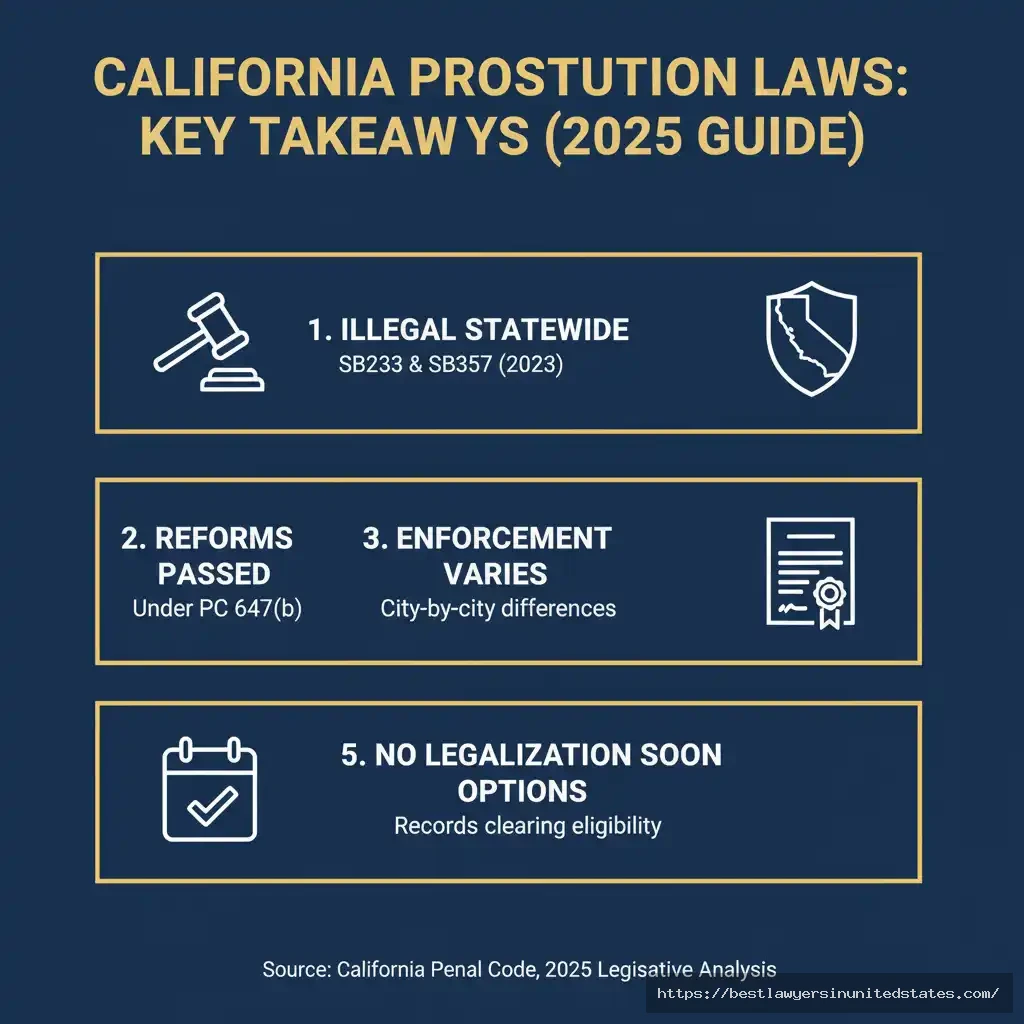
Key Takeaways: California Prostitution Laws in 2025
| Aspect | Current Status |
|---|---|
| Legal Status | Illegal statewide under PC 647(b) |
| First Offense Penalty | Up to 6 months jail + $400-$1,000 fine |
| Condoms as Evidence | Prohibited since SB 233 (2023) |
| Loitering Arrests | Eliminated by SB 357 (2023) |
| Immunity for Reporting Crimes | Yes, for serious crimes (SB 233) |
| Buyer vs. Seller Enforcement | Shifting toward demand-side focus in progressive counties |
| Record Expungement | Available through PC 1203.4 process |
| City Variations | LA/SF deprioritize; conservative counties maintain aggressive enforcement |
| Legalization Timeline | Unlikely before 2027-2030 |
Conclusion: Navigating California’s Complex Legal Landscape
Prostitution remains firmly illegal throughout California in 2025, with both buyers and sellers facing criminal penalties under Penal Code 647(b). However, the legal landscape has transformed significantly since 2020 through legislative reforms that:
- Prohibit using condoms as evidence (SB 233)
- Eliminate discriminatory loitering arrests (SB 357)
- Grant immunity when reporting serious crimes (SB 233)
- Reclassify adult entertainers as employees with labor protections (AB 5)
These changes reflect California’s attempt to reduce harms associated with criminalization while maintaining the underlying prohibition. Enforcement varies dramatically by jurisdiction—San Francisco and Los Angeles have largely deprioritized prostitution cases involving consenting adults, while conservative counties continue aggressive prosecution of both buyers and sellers.
The distinction between legal escort services (companionship only) and illegal prostitution (sexual services for money) creates a gray area where misunderstandings or misrepresentations can lead to criminal charges. Visitors from states or countries with different laws must understand that California’s prohibition applies the moment they cross the state border, regardless of what’s legal elsewhere.
Looking forward, full legalization or decriminalization appears politically unlikely through at least 2026-2027, though continued incremental reforms expanding protections and reducing penalties remain possible.The state’s approach contrasts sharply with neighboring Nevada’s licensed brothel system and reflects California’s unique political dynamics. For a state-by-state comparison, explore Is Prostitution Legal in the US.
If you’re facing prostitution charges in California, consult a White Collar Criminal Defense Lawyer immediately. First-time offenders often qualify for diversion programs that can result in dismissal.
For related information on prostitution laws in other states, see our comprehensive guides:
- Is Prostitution Legal in Nevada? Complete Guide – Detailed analysis of Nevada’s legal brothel counties
- Is Prostitution Legal in Las Vegas? – Why Las Vegas specifically prohibits what’s legal elsewhere in Nevada
- Is Prostitution Legal in the US? State-by-State Guide – Complete overview of prostitution laws across all 50 states
Disclaimer: This article provides legal information for educational purposes and does not constitute legal advice. Prostitution laws and enforcement practices change frequently. For advice regarding your specific situation, consult a California-licensed criminal defense attorney.
Related Articles:
Is Prostitution Legal in Japan? A Legal Analysis (2025)
Is Prostitution Legal in Amsterdam? Complete 2025 Legal Guide
Is Prostitution Legal in New York 2025? Complete Guide to NYC Laws & Penalties
Is Prostitution Legal in Mexico? Complete 2025 Guide to Sex Work Laws by State
Is Prostitution Legal in Europe? 2025 Complete Guide
Is Prostitution Legal in Canada? 2025 Laws Explained
Is Prostitution Legal in Florida? [2025 Complete Legal Guide]
Is Prostitution Legal in Colombia? [2025 Legal Guide]
