
Quick Answer
No, prostitution is illegal in Las Vegas and throughout Clark County, Nevada. While Nevada is the only U.S. state that permits regulated prostitution in licensed brothels, this does not apply to Las Vegas, Reno, or any county with a population exceeding 700,000 residents. The closest legal brothels operate approximately 60 miles west of Las Vegas in Pahrump, located in Nye County.

The Short Answer: Prostitution Laws in Las Vegas vs. Nevada
The confusion surrounding prostitution’s legal status in Nevada stems from the state’s unique county-by-county approach. Nevada state law gives individual counties the option to license and regulate brothels, but this authorization comes with significant restrictions.
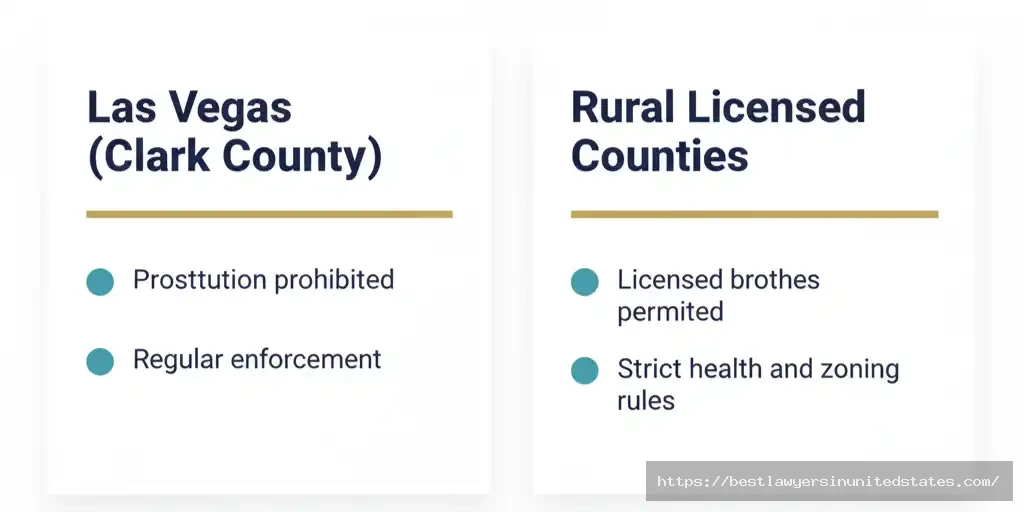
Clark County, which encompasses Las Vegas, the Las Vegas Strip, Henderson, and surrounding areas, explicitly prohibits all forms of prostitution. This ban has been in effect since the county’s early development and remains strictly enforced today. The Las Vegas Metropolitan Police Department conducts regular undercover operations targeting both prostitutes and those who solicit their services.
Meanwhile, several rural Nevada counties with smaller populations have chosen to license brothels under strict health and safety regulations. These legal establishments operate in designated areas, far from major population centers and tourist districts.
Why Is Prostitution Legal in Nevada But Illegal in Las Vegas?
Historical Context: Tourism, Image, and Local Control
The answer lies in Nevada’s legislative history and the unique economic concerns of its major cities. In 1971, the Nevada Legislature passed NRS 244.345, which fundamentally changed how prostitution could be regulated statewide.
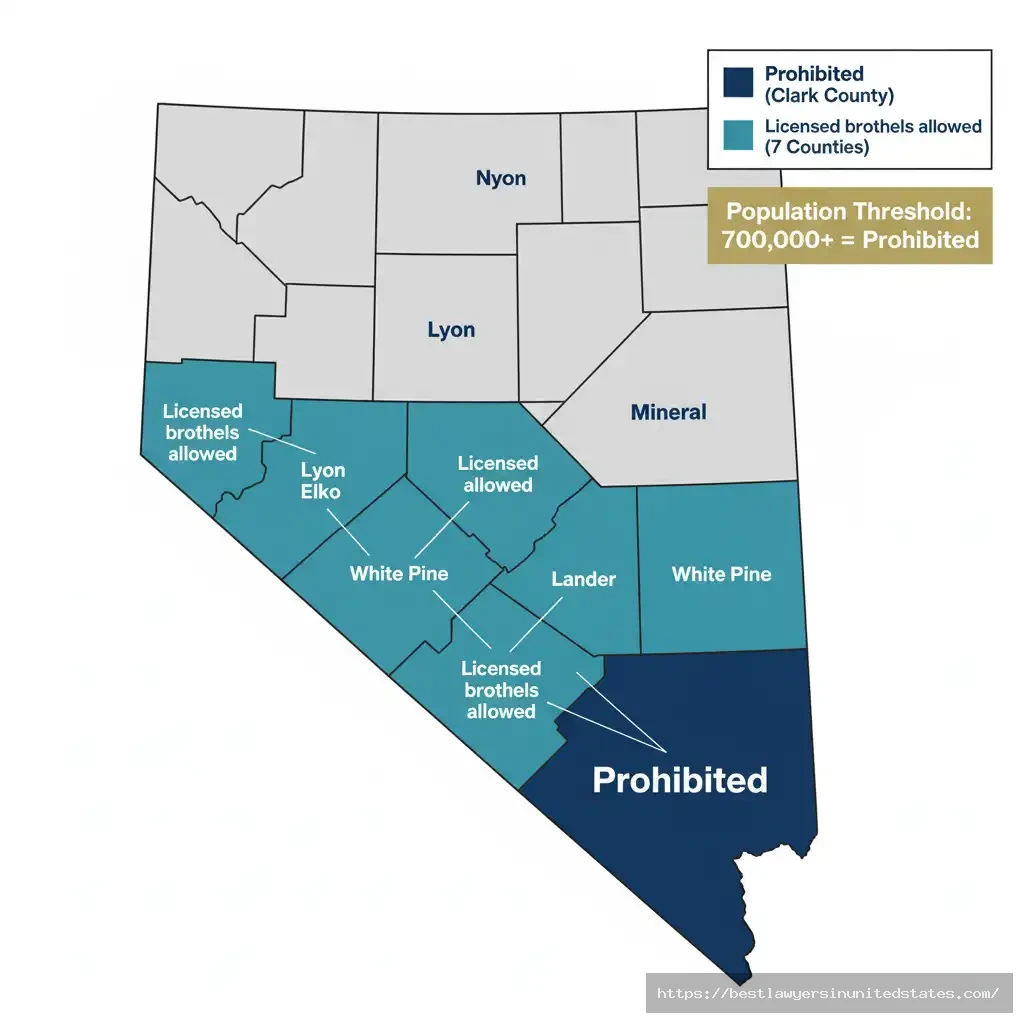
Rather than creating a blanket state policy, lawmakers granted county governments the authority to decide whether to permit licensed brothels within their jurisdictions. However, the statute included a critical population threshold: counties with 700,000 or more residents were automatically prohibited from allowing prostitution.
At the time, only Clark County (home to Las Vegas) and Washoe County (home to Reno) met this population requirement. The legislature’s intent was clear—Nevada’s major tourist destinations and population centers would not permit legal prostitution, preserving these cities’ broader appeal and mainstream tourism image.
Las Vegas had additional motivations for maintaining its prohibition. During the 1960s and 1970s, the city worked aggressively to shed its reputation for organized crime and to position itself as a family-friendly entertainment destination. Allowing open prostitution would have undermined these rebranding efforts and potentially deterred convention business, corporate events, and family tourism—all critical revenue streams for the local economy.
The religious and political climate also played a role. Nevada’s Mormon population, particularly influential in local politics during this period, strongly opposed legalizing prostitution in populated areas. Combined with business interests seeking to legitimize Las Vegas as a mainstream destination, this created a powerful coalition supporting the prohibition.
How Nevada’s County-by-County Law Works (NRS 244.345)
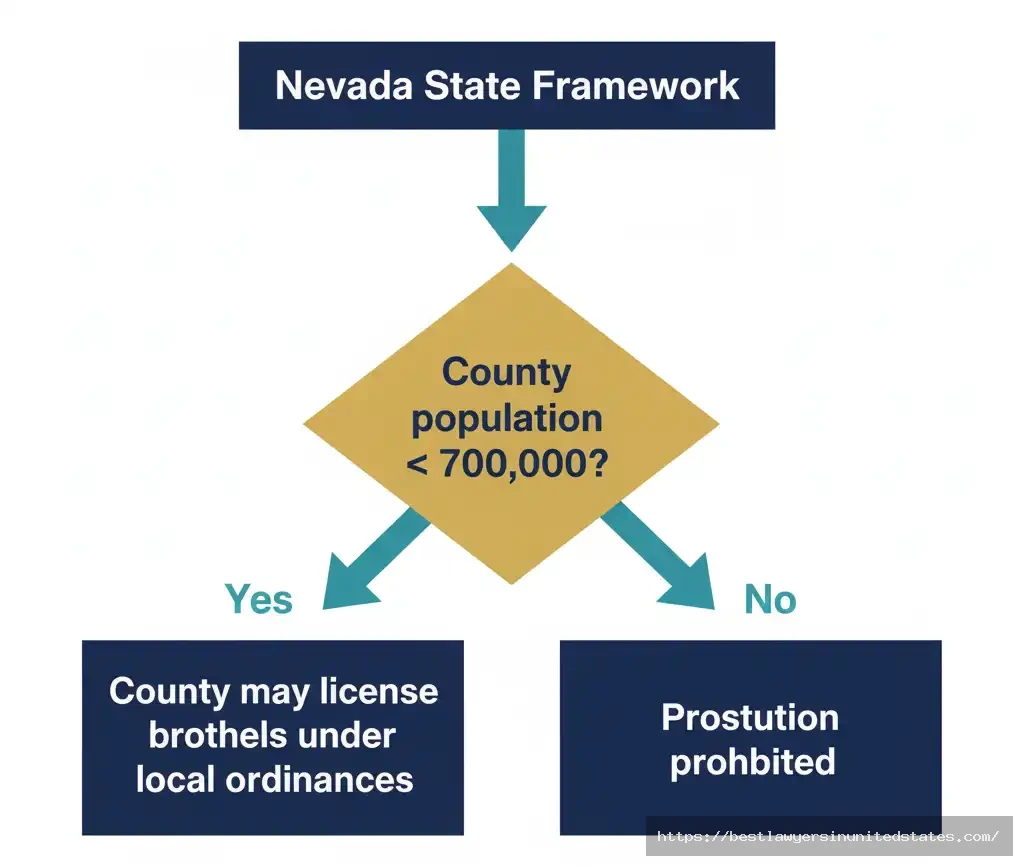
NRS 244.345 establishes the framework that allows some Nevada counties to license brothels while prohibiting others from doing so. The statute’s key provisions include:
Counties with populations below 700,000 may choose to permit and regulate brothels through local ordinances. County commissioners have the authority to establish licensing requirements, set operational standards, designate permissible locations, and create health and safety regulations.
Counties exceeding the 700,000 population threshold are explicitly prohibited from licensing brothels, regardless of local preferences or economic considerations.
Even in counties where brothels are theoretically permitted, they cannot operate within 400 yards of a school or place of worship, within the boundaries of incorporated cities, or in areas where local ordinances specifically prohibit them.
This structure means that while Nevada is known for legal prostitution, the practice is only permitted in small, rural areas far from the state’s major population centers and tourist attractions.
Where Is Prostitution Legal in Nevada?
Counties That Allow Licensed Brothels
Currently, seven of Nevada’s seventeen counties permit licensed brothels to operate within unincorporated areas:
Nye County – Home to several active brothels, including facilities near Pahrump and Crystal. This is the closest legal option to Las Vegas, approximately 60 miles west.
Lyon County – Houses multiple brothels near Mound House, including historically significant establishments. Recent years have seen local debates about continuing to allow these operations.
Storey County – Known for the Mustang Ranch and other brothels near Virginia City, operating under strict county oversight.
Elko County – Permits several brothels in the Elko and Wells areas, serving the region’s mining and ranching communities.
Lander County – Allows limited brothel operations in Battle Mountain under county licensing.
White Pine County – Maintains brothel operations in the Ely area with restrictive local regulations.
Mineral County – Permits a small number of licensed establishments in Mina.
Each county imposes its own licensing requirements, operational standards, health testing protocols, and zoning restrictions. Brothels must obtain county licenses, submit to regular health inspections, ensure all workers undergo weekly STD testing, maintain detailed records, and operate only in designated locations away from schools and churches.
Counties Where Prostitution Is Illegal
The remaining ten Nevada counties prohibit all forms of prostitution:
| County | Major Cities | Population Status |
|---|---|---|
| Clark County | Las Vegas, Henderson, North Las Vegas | Over 700,000 (prohibited by state law) |
| Washoe County | Reno, Sparks | Over 700,000 (prohibited by state law) |
| Carson City | Carson City | Independent city; local prohibition |
| Churchill County | Fallon | County choice to prohibit |
| Douglas County | Minden, Gardnerville | County choice to prohibit |
| Esmeralda County | Goldfield | County choice to prohibit |
| Eureka County | Eureka | County choice to prohibit |
| Humboldt County | Winnemucca | County choice to prohibit |
| Lincoln County | Caliente, Panaca | County choice to prohibit |
| Pershing County | Lovelock | County choice to prohibit |
How Far Is the Closest Legal Brothel from Las Vegas?

Legal Brothels in Pahrump (Nye County)
Pahrump, located in Nye County, hosts the nearest legal brothels to Las Vegas. The town sits approximately 60 miles west of the Las Vegas Strip, accessible via Nevada State Route 160.
Two licensed brothels currently operate in the Pahrump area:
Sheri’s Ranch – A full-service legal brothel offering various accommodation options and pricing tiers. The facility operates under Nye County licensing and maintains strict health protocols.
Chicken Ranch – Another established legal brothel in the Pahrump vicinity, known for its adherence to county regulations and health standards.
Driving Distance and Directions
From the Las Vegas Strip to Pahrump, the drive typically takes 60 to 75 minutes depending on traffic conditions. Travelers take I-15 South to Blue Diamond Road (State Route 160 West), which leads directly to Pahrump.
The route passes through the Spring Mountains and offers scenic desert views, though it includes winding mountain roads that require careful driving, particularly at night.
Other Legal Brothel Locations in Nevada
Beyond Pahrump, several other Nevada locations host legal brothels, though they require significantly longer travel from Las Vegas:
Lyon County (Mound House) – Approximately 430 miles north via U.S. 95, a 6-7 hour drive from Las Vegas. This area near Carson City houses multiple established brothels.
Storey County (near Virginia City) – Roughly 450 miles north, accessible via U.S. 95 and State Route 341. The historic Mustang Ranch operates in this jurisdiction.
Elko County (Elko) – About 290 miles northeast via I-15 and I-80, requiring approximately 4.5 hours of driving. Several brothels serve the region’s mining communities.
White Pine County (Ely) – Approximately 250 miles north via U.S. 93, a 4-hour journey through remote desert terrain.
For anyone specifically traveling to Nevada to visit a legal brothel, Pahrump represents the most practical option due to its proximity to Las Vegas and available services.
What Are the Penalties for Prostitution in Las Vegas?
First Offense Penalties
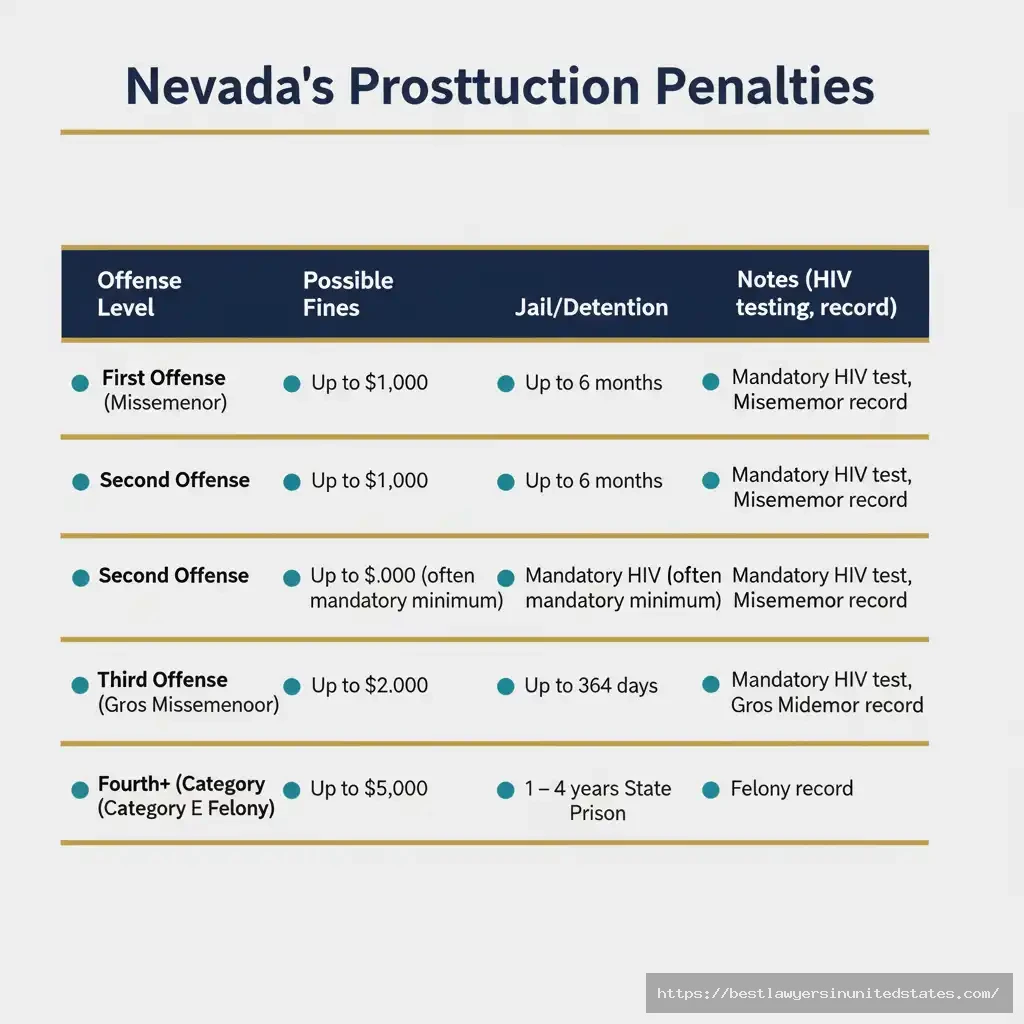
In Las Vegas and throughout Clark County, engaging in prostitution or soliciting a prostitute constitutes a misdemeanor offense under NRS 201.354. For a first-time offense, the penalties include:
A fine of up to $1,000, though judges typically impose lower amounts for first offenders without aggravating circumstances.
Up to six months in the Clark County Detention Center, though jail time is less common for first offenses when the defendant has no prior criminal history.
Mandatory HIV testing at the defendant’s expense, regardless of the circumstances of the arrest.
Potential community service hours as determined by the sentencing judge.
A permanent criminal record that will appear on background checks unless later sealed through legal proceedings.
Many first-time offenders, particularly tourists or Nevada residents with no criminal history, can negotiate plea agreements that result in reduced charges or alternative sentencing arrangements. However, this typically requires representation by a criminal defense attorney familiar with Las Vegas prostitution cases.
Repeat Offender Consequences
Nevada law treats subsequent prostitution convictions more seriously, with escalating penalties:
Second Offense – A fine of up to $1,000 and mandatory minimum 10 days in jail. Judges have limited discretion to reduce jail time for second convictions.
Third Offense – Classified as a gross misdemeanor rather than a simple misdemeanor, carrying up to $2,000 in fines and up to one year in jail. Most judges impose significant jail time for third convictions.
Fourth and Subsequent Offenses – May be charged as a Category E felony if the defendant has three or more prior prostitution convictions. Felony prostitution charges carry 1 to 4 years in Nevada State Prison and fines up to $5,000.
Repeat offenders also face additional consequences including mandatory STD education programs, longer probation periods, more extensive community service requirements, and increased difficulty negotiating favorable plea agreements.
Additional Consequences (Background Checks, HIV Testing)
Beyond immediate criminal penalties, a prostitution conviction creates lasting problems:
Employment Consequences – Most employers conduct background checks that will reveal prostitution convictions. This can disqualify applicants from positions requiring state licensing (healthcare, education, childcare), government employment, jobs involving security clearances, and many corporate positions.
Professional Licensing Issues – State licensing boards for attorneys, doctors, nurses, teachers, real estate agents, and other professions may deny or revoke licenses based on prostitution convictions.
Immigration Consequences – For non-U.S. citizens, a prostitution conviction can trigger deportation proceedings, denial of visa applications, denial of citizenship applications, and permanent inadmissibility to the United States.
Housing Difficulties – Many landlords and property management companies reject rental applicants with criminal records, including prostitution convictions.
HIV Testing Requirements – Nevada law mandates HIV testing for anyone convicted of prostitution. If the test returns positive, the defendant faces additional criminal charges under NRS 201.358 if they subsequently engage in prostitution.
The permanent nature of these consequences makes it critical for anyone arrested on prostitution charges to consult with a criminal defense attorney immediately, rather than simply pleading guilty and paying a fine.
What Happens If You’re Arrested for Prostitution in Vegas?
The Arrest Process
Prostitution arrests in Las Vegas typically occur through three mechanisms: street-level enforcement, online sting operations, and hotel-based undercover operations.
During street-level enforcement, plainclothes officers pose as potential clients in areas known for prostitution activity, such as certain stretches of Las Vegas Boulevard away from the main Strip, downtown Las Vegas streets, and specific casino parking lots. When a suspect offers sexual services in exchange for money, officers make the arrest immediately.
Online sting operations target individuals who advertise escort services on websites and apps. Officers respond to advertisements, arrange meetings, and make arrests when the suspect indicates willingness to exchange sex for money.
Hotel-based operations involve undercover officers posing as guests and responding to solicitations from individuals working in or around casino properties.
Once arrested, the suspect is transported to the Clark County Detention Center for booking, which includes fingerprinting, photographing, and recording of personal information. Most prostitution defendants are released on their own recognizance or on relatively low bail, typically appearing in court within 48 to 72 hours.
How Police Conduct Undercover Stings

The Las Vegas Metropolitan Police Department’s Vice Section conducts regular undercover prostitution enforcement operations. Understanding their tactics helps explain why certain legal defenses may apply in specific cases.
In typical sting operations, plainclothes officers establish contact with suspected prostitutes either on the street, through online advertisements, or in response to solicitations in casino areas. The officer engages in conversation designed to elicit clear statements indicating the suspect’s willingness to exchange sexual acts for money.
Nevada law requires that the suspect make an overt act in furtherance of prostitution—merely discussing the possibility is insufficient for arrest. Officers must obtain explicit agreement on specific sexual acts and specific payment amounts before making an arrest. This requirement protects individuals from arrest based solely on suggestive conversation.
During online stings, officers create fake advertisements or respond to existing ads, then arrange meetings at specific locations. They record phone conversations and text messages as evidence. When the suspect arrives and confirms the arrangement, officers make the arrest.
These operations have specific legal constraints. Officers cannot initiate the offer of prostitution—the suspect must be the one to propose the illegal transaction. Officers cannot use threats, harassment, or other coercive tactics to pressure someone into agreeing to prostitution. And officers must provide opportunities for the suspect to withdraw or decline before arrest.
Your Legal Rights
Anyone arrested on prostitution charges retains constitutional protections that apply throughout the criminal process.
You have the right to remain silent. Do not discuss the circumstances of your arrest with police, jail staff, or other inmates. Any statements you make can be used as evidence against you. Politely decline to answer questions beyond providing basic identification information, and request to speak with an attorney.
You have the right to an attorney. If you cannot afford private counsel, the Clark County Public Defender’s Office will represent you. However, private criminal defense attorneys often achieve better outcomes in prostitution cases due to their experience negotiating with prosecutors and their ability to dedicate more time to individual cases.
You have the right to challenge the evidence against you. Your attorney can file motions to suppress evidence obtained through illegal searches, challenge the prosecution’s witnesses, and contest any violations of proper arrest procedures.
You should not plead guilty at your first court appearance. Many defendants, particularly first-time offenders, feel embarrassed and want to resolve the matter quickly. However, pleading guilty without consulting an attorney often results in harsher penalties and eliminates opportunities to get charges dismissed or reduced.
Legal Defenses for Prostitution Charges in Nevada
Entrapment by Law Enforcement
Entrapment occurs when law enforcement officers induce someone to commit a crime they were not otherwise predisposed to commit. This defense applies when police tactics go beyond providing an opportunity to break the law and instead actively encourage or coerce illegal behavior.
In prostitution cases, entrapment might involve an undercover officer who repeatedly pressures someone to agree to prostitution after initial refusals, offers unusually high payment amounts specifically to overcome reluctance, uses emotional manipulation or sob stories to elicit sympathy, or threatens negative consequences if the person doesn’t agree.
However, entrapment does not apply when officers simply provide an opportunity for someone already engaged in prostitution to commit the offense, offer standard payment amounts without unusual inducements, or engage in typical negotiation processes.
Nevada courts apply a subjective test for entrapment, focusing on whether the defendant was predisposed to commit the crime. If evidence shows the defendant regularly engaged in prostitution or quickly agreed to the transaction without unusual persuasion, entrapment defenses typically fail.
Lack of Intent
Prostitution charges require proof that the defendant intended to exchange sexual acts for money or other compensation. Without this specific intent, no crime occurred.
This defense applies in situations where conversation was merely suggestive or flirtatious without explicit offers, discussion involved legal escort services with no mention of sexual acts, the defendant agreed to social companionship but explicitly refused sexual services, or misunderstandings occurred due to language barriers or unclear communication.
For example, Nevada law permits escort services that provide legal companionship without sexual activity. If an undercover officer assumes sexual services are included but the defendant never explicitly offered them, lack of intent provides a valid defense.
Text messages, recorded conversations, and witness testimony become critical evidence in these cases. Defense attorneys carefully review all communications to identify ambiguities or alternative interpretations that negate criminal intent.
Illegal Search and Seizure
The Fourth Amendment protects against unreasonable searches and seizures. If police obtained evidence through unconstitutional means, that evidence cannot be used in court.
In prostitution cases, illegal search issues often arise when officers search a defendant’s phone without a warrant or proper consent, enter hotel rooms or residences without legal authority, conduct vehicle searches without probable cause or consent, or detain individuals without reasonable suspicion.
If your attorney successfully argues that police conducted an illegal search, the court will suppress any evidence obtained through that search. In many cases, suppression of key evidence results in dismissal of charges because prosecutors lack sufficient proof to proceed.
Getting Charges Dismissed or Reduced
Even when defenses don’t result in complete acquittal, experienced criminal defense attorneys often negotiate favorable outcomes:
Charge Reduction – Prosecutors may agree to reduce prostitution charges to lesser offenses such as disorderly conduct, loitering, or breach of peace. These charges carry reduced penalties and less severe long-term consequences.
Deferred Adjudication – First-time offenders may qualify for programs that postpone formal conviction. Successful completion results in charge dismissal, leaving no criminal record.
Pretrial Diversion – Some defendants can avoid conviction by completing counseling programs, community service, or educational requirements.
Plea Bargains – Negotiated agreements might involve pleading guilty to reduced charges in exchange for minimal fines and no jail time.
The availability of these options depends on the defendant’s criminal history, the specific circumstances of the arrest, the strength of the prosecution’s evidence, and the skill of defense counsel in negotiations.
Are Escorts Legal in Las Vegas? (And Other Gray Area Questions)
Escort Services vs. Prostitution: Where’s the Line?
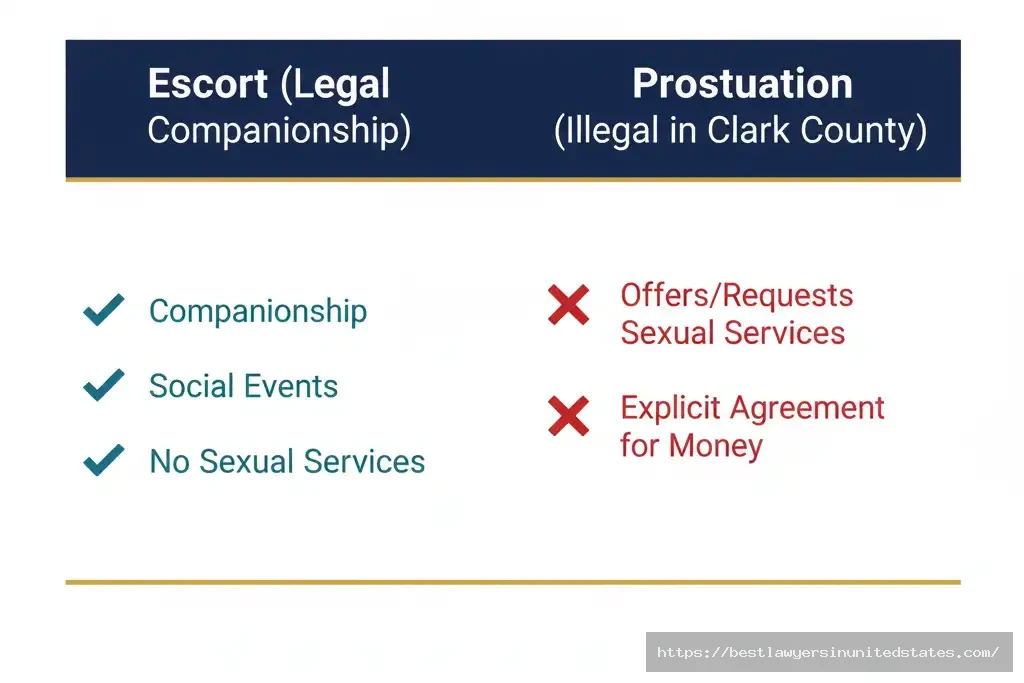
Nevada law distinguishes between legal escort services and illegal prostitution based on what services the arrangement involves. This distinction creates confusion because the line can appear blurry in practice.
Escort services legally operate in Las Vegas when they provide companionship without sexual activity. Legal escort services may include accompanying clients to dinners, shows, or social events, providing conversation and social companionship, attending parties or business functions as a date, and spending time with clients in social settings.
The arrangement becomes illegal prostitution when sexual services are offered, requested, or expected as part of the transaction. The law doesn’t require that sexual activity actually occur—merely agreeing to exchange sex for money constitutes illegal solicitation.
Many escort advertisements carefully use language suggesting only legal companionship services while implying that other arrangements might be negotiated privately. However, if actual negotiations involve explicit offers of sexual services for money, both parties face prostitution charges regardless of how the advertisement was worded.
Las Vegas Metropolitan Police regularly conduct sting operations targeting escort services that cross into prostitution. Officers pose as clients responding to advertisements, then make arrests when escorts explicitly offer sexual services.
Anyone using escort services in Las Vegas should understand that if sexual activity is offered, requested, or discussed as part of the arrangement, they risk criminal prosecution. The legal distinction depends entirely on what services are actually agreed upon, not how the service is advertised or marketed.
Are “Happy Ending” Massages Legal?
No, massages that include sexual stimulation or release are illegal in Las Vegas and throughout Nevada, even though regulated prostitution is legal in some parts of the state.
Nevada law requires massage therapists to be licensed through county health departments and state boards. Licensed massage therapy encompasses only legitimate therapeutic massage techniques. Any massage that includes sexual contact or sexual release violates both massage therapy licensing laws and prostitution statutes.
Law enforcement treats “happy ending” massage parlors as prostitution operations. These establishments face criminal charges including prostitution, pandering, keeping a house of prostitution, and licensing violations.
Customers who request or receive sexual services during massages face the same prostitution charges as if they had hired a street prostitute. The fact that the encounter occurred in a business setting offering legitimate massage services provides no legal protection.
Some massage establishments in Las Vegas operate legally while others serve as fronts for prostitution. Indicators that an establishment may be operating illegally include advertisements emphasizing attractive masseuses rather than therapeutic techniques, pricing significantly above or below market rates for legitimate massage, requests for cash-only payment, and locations in areas not typically associated with wellness services.
If you seek legitimate massage therapy in Las Vegas, choose licensed establishments with proper business credentials, therapists with documented certifications, published price lists for standard massage services, and professional business practices.
Are Lap Dances Legal in Las Vegas?
Yes, lap dances are legal in Las Vegas strip clubs when they comply with local regulations governing adult entertainment venues.
Nevada law and Clark County ordinances permit nude and topical dancing in licensed adult entertainment establishments. These venues operate under strict regulations regarding physical contact, but legal lap dances can include significant contact between dancers and patrons within defined limits.
Legal lap dances typically involve dancers performing in close proximity to seated patrons, physical contact that doesn’t involve genital touching, clothed or topless performances depending on the club’s license, and transactions that involve payment for dancing performance only, not sexual services.
The transaction becomes illegal when dancers offer or patrons request sexual services beyond dancing, genital contact or sexual acts occur, payment is negotiated for services beyond dancing, or arrangements are made for prostitution to occur off-premises.
Strip clubs in Las Vegas work to maintain clear boundaries between legal adult entertainment and illegal prostitution. Most legitimate establishments have strict policies prohibiting prostitution and will eject patrons or terminate dancers who violate these policies.
However, law enforcement does conduct undercover operations in some strip clubs, particularly those suspected of permitting prostitution on premises. Both dancers and patrons can face charges if arrangements for prostitution are made, even if sexual activity is planned to occur elsewhere.
Common Las Vegas Prostitution Scams and Safety Warnings
Street Solicitation Scams
Street-level prostitution in Las Vegas frequently involves scams targeting tourists unfamiliar with the area and local crime patterns.
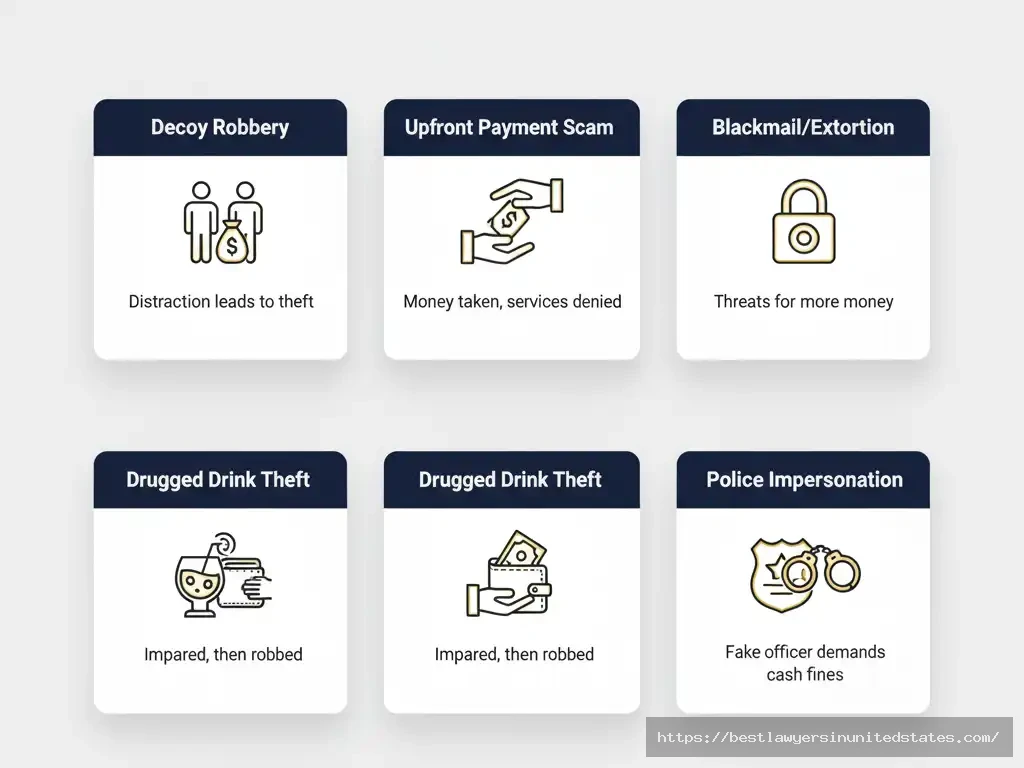
The Decoy Scam – A prostitute solicits a customer, agrees to services, and directs the customer to a specific location. When the customer arrives, accomplices rob them, sometimes violently. The prostitute was never intending to provide services—the entire encounter was designed to identify robbery targets.
The Upfront Payment Scam – The prostitute demands payment before providing services, then disappears immediately after receiving money. Many tourists don’t report these incidents because they’re embarrassed about attempting to hire a prostitute illegally.
The Blackmail Scam – After engaging with a customer, the prostitute or an accomplice threatens to report the customer to police or contact their family unless additional payment is made. Some variations involve recording compromising video or taking photos of the customer.
The Drug Robbery – The prostitute offers drugged drinks to customers, waits for them to become incapacitated, then steals wallets, phones, jewelry, and other valuables. Victims often wake up hours later with no memory of what occurred.
The Police Impersonation Scam – After a customer agrees to prostitution, someone posing as a police officer appears and demands payment to avoid arrest. These fake officers sometimes have realistic badges and identification.
To avoid these scams, never engage with street prostitutes in Las Vegas, keep valuables secured and out of sight, avoid isolated areas late at night, travel in groups when possible, and don’t accept drinks from strangers or new acquaintances.
Fake Escort Services
Online escort advertisements create additional scam opportunities targeting those seeking companionship services.
The Advance Fee Scam – The “escort” demands payment via wire transfer, gift cards, or cryptocurrency before meeting, claiming it’s a deposit or verification fee. Once payment is sent, the escort disappears and stops responding to messages.
The Bait-and-Switch Scam – The person who arrives looks nothing like the photos in the advertisement. Some victims feel pressured to proceed anyway or fear confrontation. Others are told they must pay a cancellation fee.
The Verification Scam – The supposed escort requests personal information including copies of driver’s licenses, credit card numbers, or social security numbers for “verification purposes.” This information is then used for identity theft.
The Outcall Robbery – When escorts arrive at hotel rooms or residences, accomplices follow and commit robbery once inside. Some variations involve the escort distracting the victim while accomplices enter.
Protect yourself by never sending money before meeting someone in person, never providing sensitive personal information to verify identity, meeting only in public places or well-established business locations, and being aware that both hiring prostitutes and being scammed by them involves illegal activity police won’t help resolve.
What Is the “$20 Trick” in Vegas Hotels?
The “$20 trick” is not prostitution and involves a completely different practice in Las Vegas hotels.
This technique involves hotel guests discreetly offering $20 to $40 to front desk clerks during check-in while asking about available room upgrades. Some clerks respond by providing complimentary upgrades to better rooms or higher floors when available inventory exists.
The practice operates in a gray area—hotels officially discourage it, but many clerks accept tips and provide upgrades as a customer service gesture. No sexual services are involved, and the practice doesn’t violate prostitution laws.
However, the “$20 trick” is often confused with prostitution by tourists unfamiliar with the practice. This confusion sometimes leads visitors to misunderstand other transactions or to inappropriately offer money in situations where it could be misinterpreted as solicitation for sexual services.
To successfully use the “$20 trick” for hotel upgrades, place a folded $20 bill between your ID and credit card when checking in, politely ask if any complimentary upgrades are available, and accept whatever response the clerk provides without pressure or further negotiation.
This is entirely separate from prostitution and involves tipping for customer service, similar to tipping valets, cocktail servers, or other hospitality workers.
How to Legally Visit a Brothel in Nevada
What to Expect at a Legal Brothel
Legal brothels in Nevada operate as licensed businesses under county regulation, creating an experience significantly different from illegal prostitution.
Upon arrival, visitors enter a reception area where they meet a manager or host who explains the brothel’s policies and procedures. Visitors then meet available workers in a lineup or social setting, allowing them to choose someone to spend time with.
After making a selection, the visitor and worker discuss services and negotiate pricing privately. Legal brothels require workers to clearly explain all prices before any services begin, preventing misunderstandings or surprise charges.
All services occur in private rooms on the brothel premises. Workers cannot leave with clients or provide services off-property. This requirement ensures safety and maintains regulatory compliance.
Before any sexual activity, workers must confirm the client doesn’t have visible signs of sexually transmitted diseases. Nevada law requires this examination. Workers then ensure condoms are used for all sexual contact, as mandated by state health regulations.
After services conclude, payment is processed through the brothel, which maintains all financial records as required by county licensing authorities.
The experience emphasizes safety, consent, and professionalism. Workers have the right to refuse any services they’re uncomfortable providing and can end sessions at any time. Clients who behave disrespectfully or violate rules will be asked to leave and may be banned from returning.
Pricing and Payment
Legal brothel pricing varies significantly based on services requested, time spent, the specific brothel, and individual worker rates.
Base rates typically start around $200 for basic services lasting 30 to 45 minutes, while more extensive services or longer sessions can range from $500 to several thousand dollars. Some brothels offer package deals for extended stays or multiple sessions.
Unlike illegal prostitution where prices are often negotiated on the street, legal brothels encourage open negotiation between clients and workers. Workers set their own rates within the brothel’s general pricing structure.
Payment is always processed through the brothel rather than paid directly to workers. Most establishments accept cash, credit cards, and debit cards, though some clients prefer cash for privacy reasons.
Tipping is customary and appreciated but not mandatory. Tips are separate from negotiated prices and given directly to workers.
Visitors should budget significantly more than minimum prices, as most clients choose services above the basic offerings. Being clear about budget limits during negotiation helps avoid awkwardness or disappointment.
Health and Safety Regulations
Nevada’s legal brothels operate under some of the nation’s strictest sex work health regulations.
Mandatory STD Testing – All brothel workers must undergo weekly testing for HIV, syphilis, gonorrhea, and chlamydia. Monthly blood tests screen for additional conditions. Workers cannot provide services without current negative test results.
Condom Requirements – Nevada law mandates condom use for all sexual contact in legal brothels. Workers who violate this requirement face termination and potential criminal charges. Clients who refuse condoms will be denied service.
Health Examinations – Before any sexual activity, workers conduct visual examinations of clients to check for obvious signs of sexually transmitted infections. Clients with visible symptoms will be refused service and encouraged to seek medical treatment.
Facility Inspections – County health departments regularly inspect brothels to ensure compliance with sanitation standards, proper condom availability, accurate testing records, and appropriate facility maintenance.
Worker Rights – Nevada law protects brothel workers’ right to refuse any client or service. Workers cannot be punished or terminated for refusing services they’re uncomfortable providing.
These regulations make legal Nevada brothels among the safest commercial sex environments in the world from a public health perspective. The requirement for weekly testing and mandatory condom use significantly reduces STD transmission compared to illegal prostitution.
Notable Legal Brothels (Sheri’s Ranch, Chicken Ranch, etc.)
Sheri’s Ranch (Pahrump, Nye County) – One of Nevada’s most well-known legal brothels, Sheri’s Ranch markets itself as an upscale destination with resort-like amenities. The facility includes a pool, bar, and various entertainment options. Sheri’s Ranch maintains an active online presence and accepts reservations in advance.
Chicken Ranch (Pahrump, Nye County) – Another established Pahrump brothel, the Chicken Ranch has operated for decades under Nye County licensing. The establishment emphasizes discretion and professionalism.
Mustang Ranch (Storey County) – Perhaps Nevada’s most famous brothel, the Mustang Ranch has a long history and has been featured in numerous documentaries and media coverage. Located near Reno, it remains one of the state’s busiest legal establishments.
Moonlite Bunny Ranch (Lyon County) – Made famous by HBO’s reality series “Cathouse,” the Bunny Ranch is one of Nevada’s most recognized brothels. The establishment markets itself as an upscale experience with a wide selection of workers.
Love Ranch (Crystal, Nye County) – A smaller establishment that gained notoriety in 2015 when former NBA player Lamar Odom was found unconscious on the premises. The brothel continues to operate under strict county oversight.
All legal brothels maintain websites with information about their locations, services, and policies. Many accept inquiries and reservations through phone or email. First-time visitors often appreciate contacting establishments in advance to ask questions and understand what to expect.
2025 Update: Recent Legal Changes and Enforcement Trends
As of November 2025, several developments have shaped Nevada’s prostitution landscape:
Lyon County Brothel Debates – Lyon County residents have continued discussing whether to ban legal brothels entirely. While brothels remain legal as of this writing, the county has faced pressure from new residents and technology industry workers moving to the area who prefer to eliminate the adult businesses. Several ballot initiatives to ban brothels have been proposed, though none have yet succeeded.
COVID-19 Lasting Impacts – The pandemic forced Nevada brothels to close temporarily in 2020 and 2021. When they reopened, many implemented enhanced health protocols that remain in place. These include more frequent health testing, improved ventilation systems, and additional sanitation requirements. Some smaller brothels never reopened, reducing the total number of operating establishments statewide.
Technology and Enforcement – Las Vegas Metropolitan Police have increased online prostitution enforcement, using sophisticated techniques to identify advertisements that violate Nevada law. Officers now monitor websites, social media, and apps more extensively than in previous years, leading to more arrests of both prostitutes and clients.
Sex Trafficking Awareness – Law enforcement has improved training to distinguish between voluntary prostitution and sex trafficking. While prostitution arrests continue, police now screen arrestees more carefully for signs of coercion or exploitation. Genuine trafficking victims are increasingly directed to social services rather than prosecuted.
Zoning Changes – Some rural counties have tightened zoning restrictions on brothel locations, making it more difficult to open new establishments or relocate existing ones.
Decriminalization Discussions – While no significant legislation has emerged, some Nevada policymakers and advocacy groups have discussed potential decriminalization of prostitution in more areas. These conversations remain in early stages, with no concrete proposals under serious consideration as of late 2025.
Strip Safety Initiatives – The Las Vegas Strip has seen increased security presence aimed at reducing street-level prostitution solicitation. Private security guards working for casino properties coordinate with police to move prostitutes away from tourist areas more aggressively than in past years.
None of these changes have fundamentally altered Nevada’s prostitution legal framework—Las Vegas and Clark County remain areas where all prostitution is illegal, while select rural counties continue to permit licensed brothels.
Frequently Asked Questions (FAQs)
Are there undercover prostitutes working with police in Vegas?
No, prostitutes do not work as undercover officers in sting operations. However, Las Vegas Metropolitan Police do use undercover officers who pose as potential clients to arrest prostitutes, and use undercover officers who pose as prostitutes to arrest clients seeking to hire them. These operations occur regularly on streets known for prostitution activity and through online platforms where escort services advertise.
Will a prostitution charge show on a background check?
Yes, prostitution convictions appear on criminal background checks. This includes employment background checks, rental application screenings, professional licensing reviews, and immigration proceedings. The conviction remains visible unless legally sealed through court proceedings. Nevada permits record sealing for some offenses after waiting periods, but this requires filing formal petitions and meeting specific eligibility requirements.
Is prostitution legal on the Las Vegas Strip?
No, prostitution is completely illegal on the Las Vegas Strip and throughout Clark County. The Strip is part of the unincorporated Paradise area, which falls under Clark County jurisdiction. All forms of prostitution are prohibited, and the area sees regular enforcement through undercover operations and street-level patrols.
What about prostitution in hotel rooms?
Prostitution in hotel rooms is illegal throughout Las Vegas and Clark County, just as it is everywhere else in the jurisdiction. The fact that the activity occurs in a private hotel room provides no legal protection. Undercover police operations frequently target hotel-based prostitution, with officers posing as guests and making arrests when services are offered.
How much do legal brothels cost in Nevada?
Prices at legal Nevada brothels vary widely based on services, duration, and individual workers’ rates. Basic services typically start around $200 for shorter sessions, with more extensive experiences ranging from $500 to $2,000 or more. Premium services, overnight stays, or arrangements with particular workers can cost several thousand dollars. Prices are negotiable between clients and workers, and establishments process all payments through official business channels.
Is male prostitution treated differently?
No, Nevada law applies equally to prostitution regardless of gender. Male prostitutes face the same charges and penalties as female prostitutes, and clients hiring male prostitutes face identical solicitation charges. Undercover operations target both male and female prostitution, though female prostitution receives more enforcement attention due to higher prevalence.
Can prostitution charges be expunged?
Nevada uses the term “sealing” rather than “expungement,” but the effect is similar—sealed records are hidden from most background checks. First-time prostitution misdemeanors can be sealed two years after case closure. Repeat offenses require longer waiting periods. Sealing requires filing a petition with the court, obtaining a court order, and notifying relevant agencies. The process typically benefits from legal representation to ensure proper completion.
What’s the difference between prostitution and solicitation?
Prostitution refers to offering or agreeing to engage in sexual conduct for money. Solicitation refers to offering money or other compensation to another person for sexual conduct. Both are crimes in Las Vegas. The prostitute commits prostitution; the client commits solicitation. Both face the same penalties under Nevada law.
Can I be arrested just for talking to someone?
No, mere conversation is insufficient for prostitution charges. Nevada requires an “overt act” in furtherance of prostitution—clear agreement on specific sexual acts for specific payment. Ambiguous conversation, flirting, or suggestive remarks without explicit offers don’t constitute criminal activity. However, once explicit terms are discussed and agreed upon, arrest becomes lawful even if no money changes hands and no sexual activity occurs.
Do legal brothels require identification or registration?
Legal Nevada brothels typically require clients to be at least 18 years old and may ask for identification to verify age. However, they don’t require formal registration or documentation beyond age verification. Visits are private, and brothels don’t share client information with third parties except when legally required. Most establishments prioritize discretion and client privacy.
What happens if I’m visiting Las Vegas and get arrested for prostitution?
Out-of-state visitors arrested for prostitution in Las Vegas face the same legal process as Nevada residents. You’ll be booked at Clark County Detention Center, appear in court within 72 hours, and must either post bail or remain in custody until your case resolves. If you live far from Las Vegas, judges may allow you to leave Nevada pending trial with requirements to return for court appearances. Missing court dates results in bench warrants and additional charges. Hiring a local attorney becomes especially important for out-of-state defendants who cannot easily appear in person.
Is it illegal to drive to legal brothels in Nevada?
No, traveling to legal brothels in counties where they’re permitted is completely legal. Driving from Las Vegas to Pahrump or other areas with licensed brothels involves no criminal activity. However, transporting someone else for purposes of prostitution can constitute pandering under Nevada law, so you should not bring another person to engage in prostitution or accept payment for providing transportation to brothels.
Can I use escort services in my hotel room if no sex is involved?
Yes, hiring escorts for legal companionship services without sexual activity is permitted in Las Vegas. However, you must ensure that no discussion of sexual services occurs and that all parties understand only legal companionship is being arranged. If sexual services are offered, discussed, or agreed upon, both parties face prostitution charges regardless of whether sexual activity actually occurs.
What should I do immediately after being arrested for prostitution?
First, exercise your right to remain silent—do not discuss your case with police, jail staff, or other inmates. Second, contact a criminal defense attorney as soon as possible, either through private counsel or the public defender’s office. Third, do not plead guilty at your first court appearance without consulting an attorney. Fourth, gather any evidence that might support your defense, including text messages, emails, or witness information. Fifth, comply with all bail conditions and court appearance requirements to avoid additional charges.
Are massage parlors in Las Vegas legal?
Legitimate massage therapy businesses are legal in Las Vegas when properly licensed. However, massage parlors that provide sexual services operate illegally and face criminal prosecution. Licensed massage therapists must meet state and county requirements, and their services are limited to therapeutic massage techniques. If a massage establishment offers or provides sexual services, both the business and clients face prostitution-related charges.
If You’re Facing Prostitution Charges: Legal Resources
Being arrested for prostitution in Las Vegas creates serious consequences that extend beyond immediate criminal penalties. A conviction can impact employment opportunities, professional licensing, immigration status, housing applications, and personal relationships for years.
If you’ve been charged with prostitution or solicitation in Las Vegas, taking immediate action significantly improves your chances of a favorable outcome.
Consult with a Criminal Defense Attorney Immediately – Don’t wait until your court date to seek legal advice. Many defense attorneys offer free initial consultations where they can evaluate your case, explain your options, and discuss potential defenses. Early legal involvement often leads to better outcomes because attorneys can intervene before you make statements or decisions that harm your case.
Consider Private Counsel vs. Public Defenders – While public defenders are skilled attorneys, they handle heavy caseloads that limit the time they can dedicate to individual cases. Private criminal defense attorneys focusing on prostitution cases often achieve better results through more thorough investigation, more aggressive negotiation with prosecutors, and more personalized attention to your specific circumstances.
Understand Your Defense Options – Experienced attorneys can identify defenses you might not recognize, including entrapment by overzealous law enforcement, lack of intent due to misunderstandings or ambiguous communication, illegal search and seizure violations, insufficient evidence of overt acts, and procedural errors by police or prosecutors.
Explore Charge Reduction Possibilities – Even when complete dismissal isn’t possible, skilled attorneys frequently negotiate charge reductions to lesser offenses like disorderly conduct that carry minimal penalties and fewer long-term consequences.
Consider Record Sealing – If you’re convicted or accept a plea agreement, discuss record sealing options with your attorney. Understanding when you’ll be eligible to seal your record and planning for that process helps minimize long-term damage to your employment and personal life.
Address Immigration Concerns Promptly – Non-U.S. citizens must inform their attorney immediately about their immigration status. Prostitution convictions can trigger deportation, denial of visa renewals, and permanent inadmissibility to the United States. Attorneys experienced in both criminal defense and immigration law can often structure plea agreements that minimize immigration consequences.
Don’t Ignore the Charges – Some defendants, particularly tourists or business travelers, consider simply leaving Nevada and not returning for court. This approach results in bench warrants, additional charges for failure to appear, and potential extradition. Nevada shares arrest warrant information nationally, meaning you can be arrested in other states and returned to Nevada to face charges.
Protect Your Privacy – Prostitution arrests can damage reputations and relationships. While court records are generally public, experienced attorneys understand how to protect your privacy to the greatest extent possible under Nevada law. Discuss confidentiality concerns with your lawyer early in the process.
The stigma surrounding prostitution charges causes many people to feel too embarrassed to mount a proper defense. This is a mistake. Criminal defense attorneys handle these cases routinely, approach them professionally, and understand that charges don’t reflect your character or values. Their job is to protect your legal rights and minimize the impact on your life.
Las Vegas sees thousands of prostitution-related arrests annually. Many defendants successfully resolve their cases with minimal consequences through proper legal representation. Don’t let embarrassment or fear prevent you from protecting your rights and your future.
Final Thoughts
Nevada’s prostitution laws reflect a unique compromise between allowing regulated adult businesses in rural areas while maintaining strict prohibitions in major population centers like Las Vegas. This creates confusion for visitors who assume Nevada’s reputation for legal prostitution applies everywhere in the state.
The key facts to remember: prostitution is completely illegal throughout Las Vegas, Clark County, Reno, and Washoe County. Legal brothels operate only in certain rural counties, with the closest options approximately 60 miles from Las Vegas in Pahrump. Penalties for illegal prostitution in Las Vegas include criminal charges, fines, potential jail time, and permanent records affecting employment and other life opportunities.
Understanding these laws helps visitors avoid criminal charges and tourists make informed decisions about legal adult entertainment options in Nevada. If you’re interested in legal commercial sexual services, visiting licensed brothels in counties where they operate lawfully represents the only legal option. If you’re facing charges for prostitution-related offenses, consulting with an experienced criminal defense attorney immediately provides the best opportunity for protecting your rights and minimizing consequences.
Whether you’re seeking information about Nevada’s unique legal framework, considering visiting legal establishments, or dealing with criminal charges, understanding the clear distinctions between legal and illegal activity helps you navigate Nevada law and make informed decisions.
