
Quick Answer
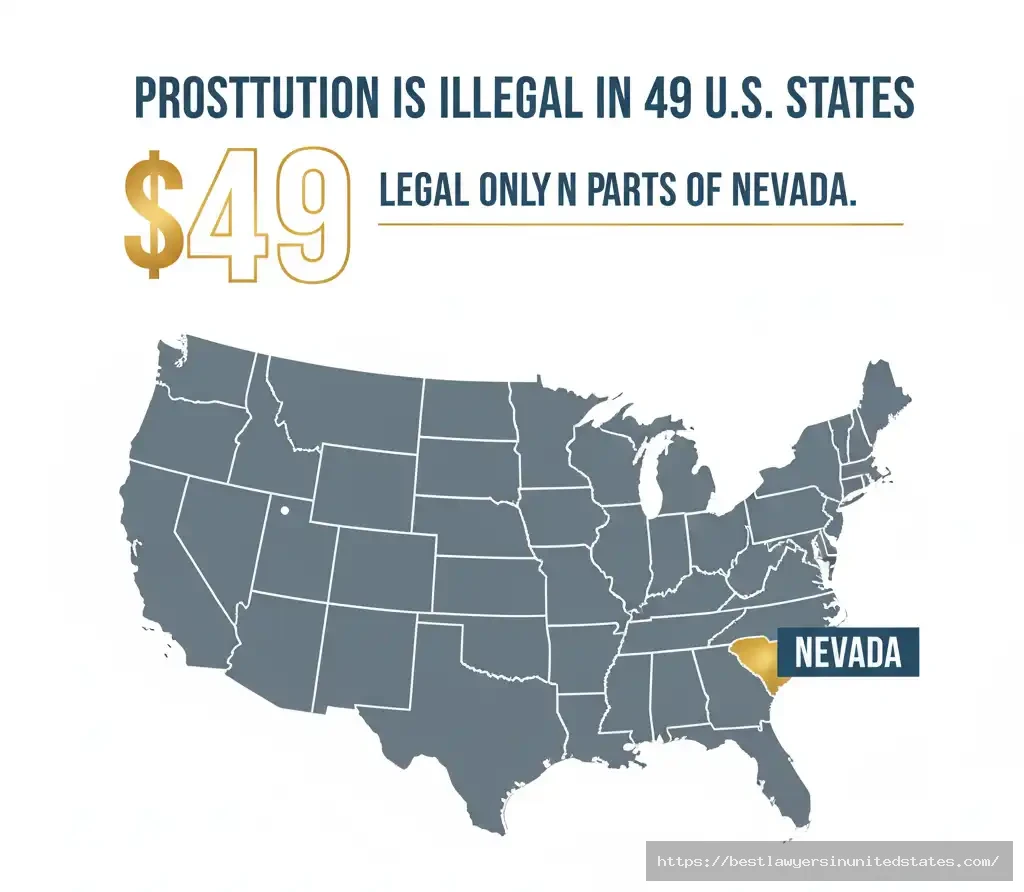
Prostitution is illegal in 49 US states. Nevada is the only state where prostitution is legal, and even there, it’s restricted to licensed brothels in certain counties. Las Vegas and Reno prohibit prostitution despite being in Nevada. Every other state criminalizes the exchange of sexual acts for money or anything of value, with penalties ranging from misdemeanors to felonies depending on circumstances. Also Read: Is Prostitution Legal in Las Vegas, Nevada?
Prostitution remains one of the most heavily criminalized activities in American law. While enforcement has declined dramatically in many major cities over the past decade, the legal framework remains largely unchanged. Understanding these laws matters whether you’re facing charges, researching policy, or simply curious about how the American legal system handles sex work.
The short answer is straightforward: Nevada stands alone. But the longer answer reveals a complex patchwork of state laws, evolving enforcement practices, and ongoing debates about decriminalization that shape how prostitution laws actually function in 2025.
Is Prostitution Illegal Under Federal Law?
Federal law doesn’t make simple prostitution a crime. The US Constitution reserves general criminal law enforcement to states, and Congress has respected that boundary. You won’t find a federal statute that says “prostitution is illegal.”

What federal law does criminalize is prostitution-adjacent activity that crosses state lines or involves federal interests:
- The Mann Act makes it a federal crime to transport someone across state lines for prostitution or “immoral purposes” (up to 10 years in federal prison)
- Sex trafficking laws target anyone who uses force, fraud, or coercion to cause commercial sex acts (10-15 year mandatory minimums)
- Child exploitation statutes criminalize causing anyone under 18 to engage in commercial sex
- Military law prohibits service members from patronizing prostitutes under the Uniform Code of Military Justice
The federal focus has shifted almost entirely to trafficking and exploitation cases. FBI and federal prosecutors dedicate resources to international trafficking rings and organized criminal enterprises. Local prostitution between consenting adults rarely triggers federal interest.
Where Is Prostitution Legal in the United States?
Nevada is the only state where prostitution is legal, but significant restrictions apply. Only 10 of Nevada’s 17 counties permit licensed brothels, and state law prohibits prostitution in counties with populations over 700,000—which excludes Clark County (Las Vegas) and Washoe County (Reno).
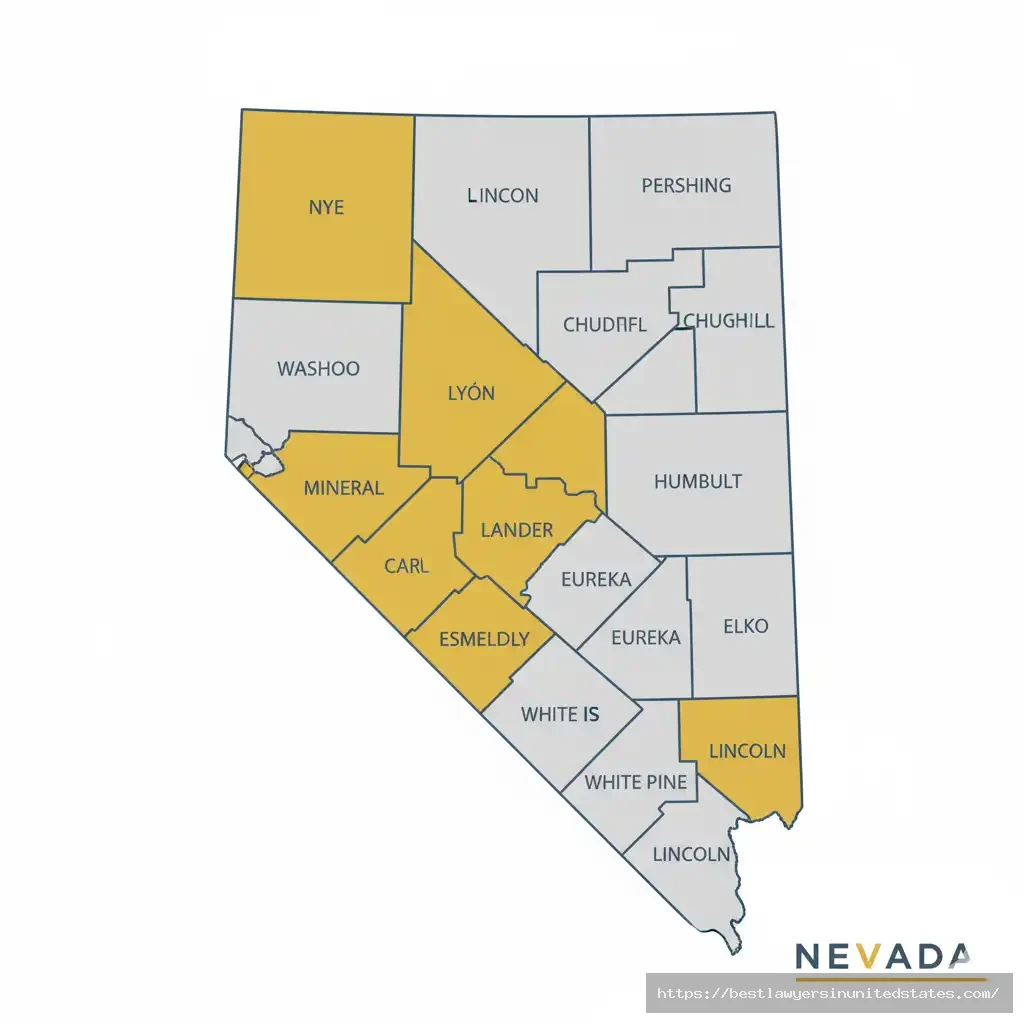
Currently, about 20 licensed brothels operate in Nevada. They must follow strict regulations including mandatory STI testing, condom requirements, and county licensing. Street prostitution remains illegal statewide, even in counties that permit brothels.
States where prostitution is completely illegal:
All 49 other states criminalize prostitution in all forms. This includes California, New York, Texas, Florida, Illinois, and every other state and territory. Some jurisdictions have reduced enforcement or changed priorities, but the laws remain on the books.
The concept of “legal prostitution” confuses many people when they hear about escort services or massage parlors operating openly. These businesses claim to sell companionship, massage, or entertainment—not explicitly sexual services. While prosecutors often view them as prostitution fronts, proving the exchange of money for sex requires evidence of the specific agreement.
What’s Actually Illegal? Understanding Sex Work Laws
State penal codes don’t just criminalize the transaction. They target everyone involved in the commercial sex economy through multiple statute violations:
Selling Sex (Prostitution)
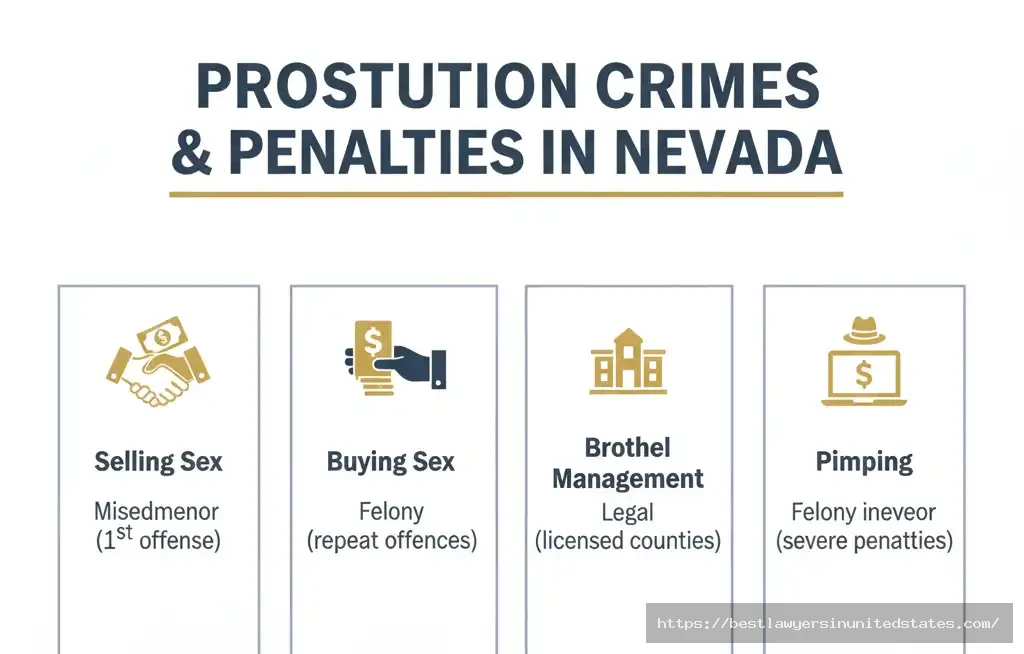
Offering or agreeing to engage in sexual conduct for a fee. This is the traditional prostitution charge against sex workers themselves. Most states classify first offenses as misdemeanors, though repeat offenses often escalate to felonies.
Buying Sex (Solicitation/Patronizing)
Offering to pay or agreeing to pay for sexual services. Buyers face criminal charges identical or similar to sellers in most jurisdictions. Some states use “patronizing a prostitute” language while others charge buyers with solicitation.
Promoting Prostitution (Pimping/Pandering)
Receiving money from or managing someone engaged in prostitution. This covers traditional pimps but also anyone who profits from another person’s prostitution. Penalties are substantially higher—usually felonies even for first offenses.
Maintaining a Place for Prostitution
Owning, managing, or leasing property knowing it’s used for prostitution. Landlords, hotel managers, and brothel operators face these charges. Commercial property owners can lose their buildings through civil forfeiture.
Compelling Prostitution
Using force, fraud, or coercion to cause someone to engage in prostitution. This overlaps with trafficking laws and carries the most severe penalties—often 10-20 year prison sentences.
Advertising Sexual Services
Many states now criminalize advertising or promoting prostitution online. These laws emerged after Backpage.com facilitated sex work advertising. Posting ads offering sexual services can result in criminal charges even without completing any transaction.
State-by-State Legal Status: Prostitution Laws Across America
| State | Legal Status | Charge Type | Penalties (First Offense) | Enforcement Level |
|---|---|---|---|---|
| Nevada | Legal (licensed brothels only, 10 counties) | N/A where legal | Illegal outside licensed brothels | Moderate |
| California | Illegal | Misdemeanor | Up to 6 months jail, $1,000 fine | Low in major cities |
| New York | Illegal | Misdemeanor (Class B) | Up to 3 months jail, $500 fine | Very low in NYC |
| Texas | Illegal | Class B Misdemeanor | Up to 180 days jail, $2,000 fine | Moderate to high |
| Florida | Illegal | Second Degree Misdemeanor | Up to 60 days jail, $500 fine | High |
| Illinois | Illegal | Class A Misdemeanor | Up to 1 year jail, $2,500 fine | Low in Chicago |
| Pennsylvania | Illegal | Third Degree Misdemeanor | Up to 1 year jail, $2,500 fine | Moderate |
| Arizona | Illegal | Class 1 Misdemeanor | Up to 6 months jail, $2,500 fine | High |
| Georgia | Illegal | Misdemeanor | Up to 1 year jail, $1,000 fine | Moderate |
| Washington | Illegal | Misdemeanor | Up to 90 days jail, $1,000 fine | Low in Seattle |
Penalties by Role in Commercial Sex
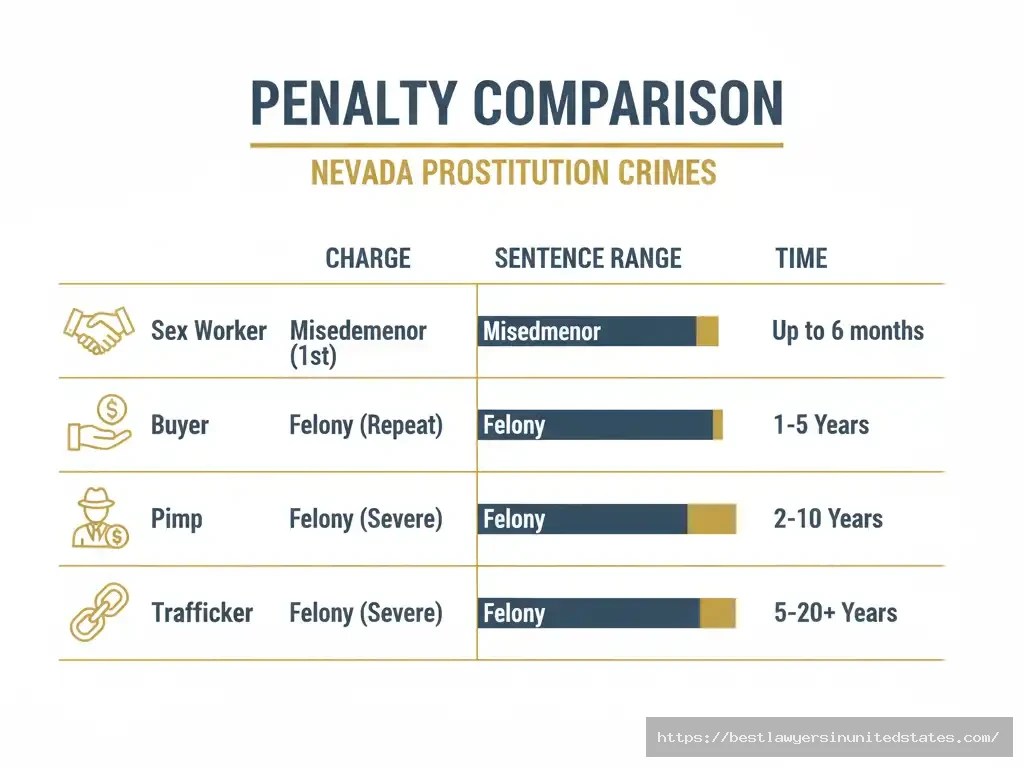
| Role | Typical Charge | First Offense | Repeat Offenses | Additional Consequences |
|---|---|---|---|---|
| Selling sex | Prostitution | Misdemeanor, fine/probation | Escalates to felony (3rd-4th offense) | Possible sex offender registration in some states |
| Buying sex | Solicitation/Patronizing | Misdemeanor, fine/diversion | Same as seller, or harsher in “demand reduction” states | “John school” programs, public disclosure |
| Promoting/Pimping | Promoting prostitution | Felony (2-5 years typical) | Enhanced felony (5-20 years) | Asset forfeiture, RICO charges possible |
| Running brothel | Maintaining premises | Felony (1-10 years) | Enhanced penalties | Property forfeiture, business license revocation |
| Using force/coercion | Compelling prostitution/Trafficking | Felony (10-25 years) | Life imprisonment possible | Sex offender registration mandatory, federal charges likely |
Why Is Prostitution Illegal But Pornography Isn’t?
This question confuses many people. Both involve payment for sexual acts, yet one lands you in jail while the other operates as a multi-billion dollar legal industry.
The legal distinction comes down to a 1981 California case that has been followed nationwide. Courts ruled that pornography receives First Amendment protection as a form of expression. Performers aren’t paid for having sex—they’re paid to create expressive content that others will watch.
Prostitution lacks this expressive element. The customer directly participates in the sexual act. There’s no creative work being produced for public consumption. Courts view this as pure commercial transaction of sexual services, which states have historically regulated as conduct rather than speech.
Key legal differences:
- Pornography: Payment for creating recorded sexual content (protected speech)
- Prostitution: Payment for participating in private sexual acts (regulatable conduct)
- Escort services: Payment for companionship/time (legal unless sex is explicitly agreed upon)
The distinction gets murky in practice. Someone filming a sexual encounter and claiming “we’re making pornography” doesn’t automatically make it legal. Legitimate adult film production involves business licenses, permits, documented performer consent, STI testing protocols, and compliance with 2257 record-keeping regulations.
Criminal Charges and Penalties: What Happens If You’re Arrested?
Penalties vary dramatically by state, role, and circumstances. Understanding the potential consequences helps evaluate your situation if you’re facing charges.
Misdemeanor Prostitution Charges (Most Common)
First-time sellers and buyers typically face misdemeanor charges carrying:
- Jail time: Usually 0-6 months (often suspended for probation)
- Fines: $500-$2,500 range
- Probation: 1-2 years with conditions
- Diversion programs: “John schools” or counseling programs
- Community service: 20-100 hours typical
Many jurisdictions offer diversion programs where completing education and counseling results in dismissed charges. Prosecutors increasingly view first-time offenders, particularly buyers, as candidates for alternatives to prosecution.
Enhanced Penalties
Penalties increase substantially for:
- Prior convictions: Third or fourth offense often becomes a felony
- Public places: Soliciting near schools, churches, or residential areas
- Minors involved: Any involvement with persons under 18 triggers felony charges
- HIV positive status: Some states enhance charges if the defendant has HIV
- Vehicle use: California and other states can impound vehicles used in solicitation
Felony Prostitution Charges
Promoting prostitution, pimping, pandering, and compelling prostitution are felonies in every state. Sentences typically range from 2-20 years depending on:
- Number of persons involved
- Whether minors were involved (mandatory enhancements)
- Use of force or coercion
- Prior criminal history
- Aggravating factors like gang involvement
Sex Offender Registration
Most states do NOT require sex offender registration for simple prostitution or solicitation. However, registration may be required for:
- Compelling or trafficking charges (always required)
- Prostitution involving minors (always required)
- Repeat offenses in some jurisdictions
- Soliciting in areas frequented by minors
Registration requirements vary by state but typically last 10 years to life and require annual in-person verification, address restrictions, and public disclosure.
Enforcement Trends: Are People Actually Getting Arrested?
The gap between law on the books and law in practice has never been wider. While prostitution remains illegal nearly everywhere, enforcement has collapsed in many major cities.
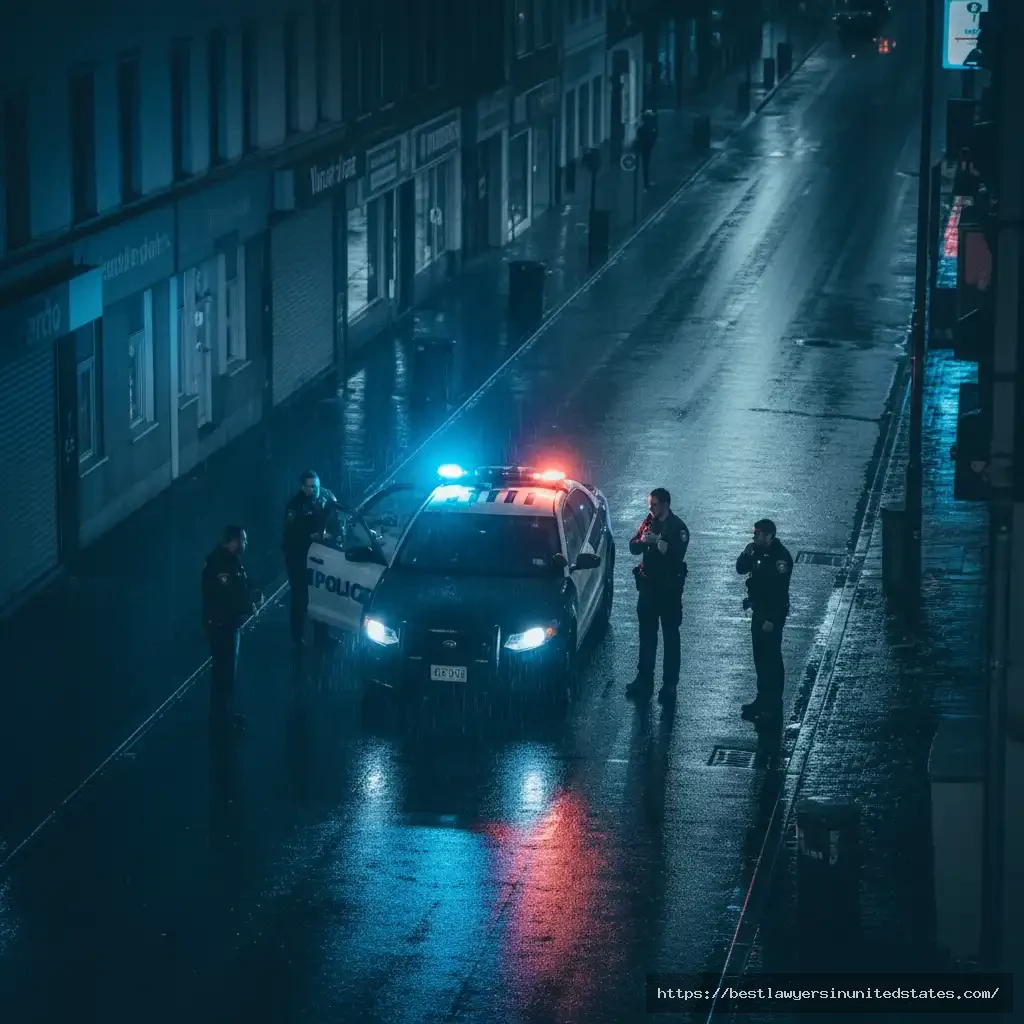
Arrest data shows dramatic declines:
- New York City: Prostitution arrests dropped from over 10,000 annually in the 1990s to approximately 100 in 2024
- Manhattan DA: Announced in 2021 they would no longer prosecute prostitution cases
- Philadelphia DA: Stopped prosecuting sex workers in 2018
- Baltimore: Ceased prosecuting prostitution in 2020
- Los Angeles: Prostitution arrests down 80% since 2015
Progressive prosecutors elected on criminal justice reform platforms have deprioritized prostitution enforcement. They view prostitution as a low-level offense that disproportionately affects vulnerable populations and diverts resources from violent crime.
Current Enforcement Priorities
Law enforcement focus has shifted to:
- Human trafficking investigations: Multi-agency task forces target traffickers rather than sex workers
- Online prostitution networks: FBI operations targeting large-scale commercial sex websites
- Demand reduction: Some jurisdictions focus exclusively on arresting buyers (“johns”) while diverting sellers to services
- Organized crime connections: Prostitution linked to drugs, weapons, or gang activity receives heightened attention
Undercover Sting Operations
Police still conduct undercover operations, particularly in:
- Suburban and rural areas with more traditional law enforcement approaches
- Jurisdictions responding to community complaints
- Areas with visible street prostitution
- Online platforms advertising sexual services
Common sting tactics include:
- Vice officers posing as sex workers online or on streets
- Officers posing as customers to arrest sex workers
- Monitoring escort ad websites and arranging meetings
- Surveillance of suspected brothels or massage parlors
Most stings require the suspect to explicitly agree to exchange money for specific sexual acts. Saying “yes” to a date or companionship isn’t enough—prosecutors need evidence of the sexual transaction agreement.
Sex Trafficking vs. Prostitution: Critical Legal Distinction
Conflating prostitution with sex trafficking creates massive confusion. These are separate crimes with different elements, victims, and penalties.
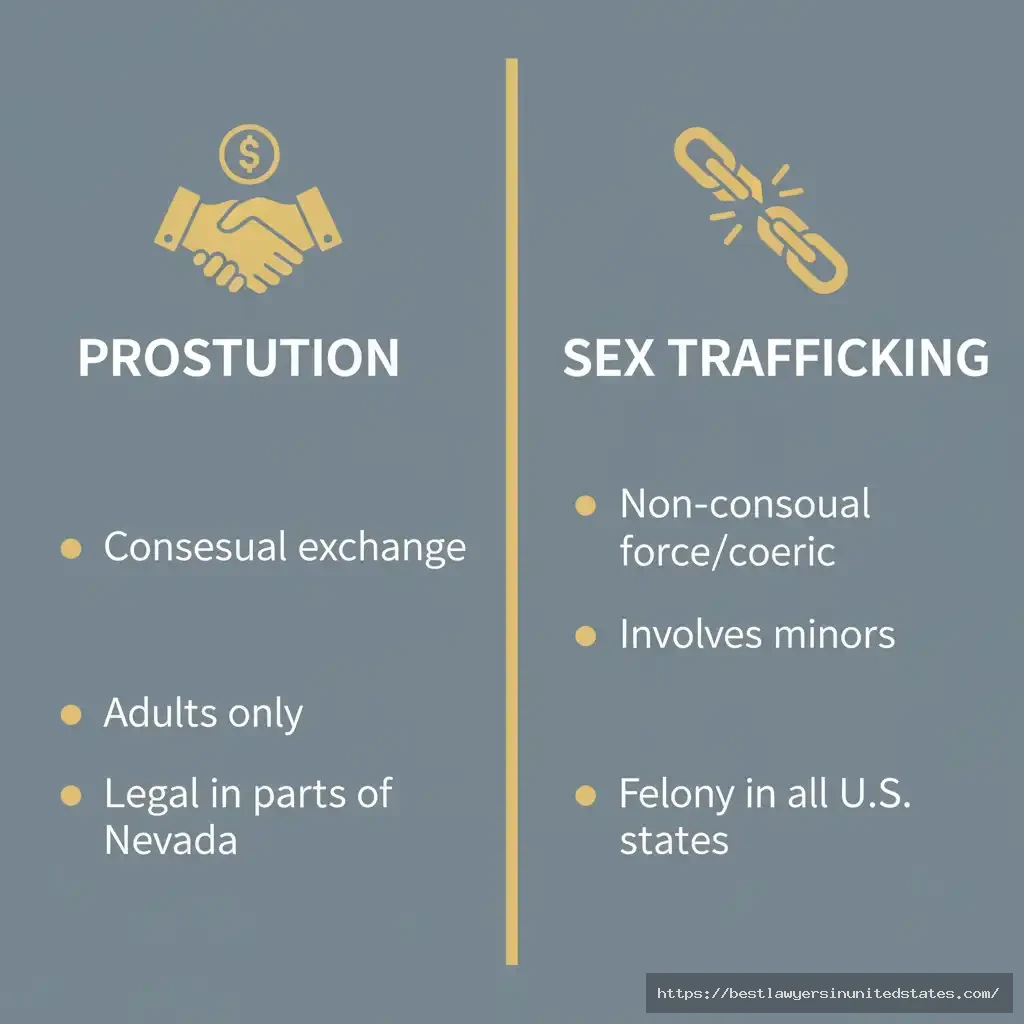
Prostitution
- Voluntary exchange of sexual services for money between adults
- All parties consent without force, fraud, or coercion
- Charged as misdemeanor (typically) for first offenses
- Both buyer and seller face similar charges
- Increasingly viewed as a policy issue rather than serious crime
Sex Trafficking
- Involves force, fraud, coercion, or anyone under 18
- Victims are controlled through violence, threats, manipulation, or debt bondage
- Always a felony with severe mandatory sentences
- Traffickers face decades in prison; victims eligible for services and protection
- Treated as serious violent crime by all jurisdictions
Federal trafficking definition requires:
- Commercial sex act induced by force, fraud, or coercion, OR
- Commercial sex act involving anyone under 18 (no force required)
The distinction matters enormously. Calling all prostitution “sex trafficking” stigmatizes consensual adult sex workers and can actually harm trafficking victims by making it harder to identify them. Law enforcement trained to recognize trafficking distinguishes between:
- Force: Physical violence, confinement, assault
- Fraud: False promises about job type, debt manipulation, fake documents
- Coercion: Threats of harm, deportation threats, psychological control, using addiction
Many prostitution arrests reveal trafficking situations upon investigation. Someone initially arrested for prostitution may actually be a trafficking victim entitled to immunity and services. Defense attorneys must explore this possibility when representing prostitution defendants.
Decriminalization Efforts and Legal Reform Movements
Legal reform movements have gained momentum over the past decade, though actual law changes remain limited. Understanding the different approaches helps navigate this evolving landscape.
Decriminalization vs. Legalization
These terms mean different things:
Decriminalization: Removing criminal penalties while not creating a legal regulated market. No arrests for buying or selling sex between adults. This is what advocacy groups primarily support.
Legalization: Creating a legal, regulated framework like Nevada’s system or European models. Licensing, health requirements, zoning restrictions, and government oversight.
Nordic Model (Partial Decriminalization): Decriminalizing sellers while maintaining criminal penalties for buyers. Aimed at reducing demand while protecting sex workers.
Recent Legislative Activity (2018-2025)
| Year | State/Jurisdiction | Action | Status |
|---|---|---|---|
| 2021 | New York | Decriminalization bill introduced | Died in committee |
| 2020 | Washington DC | Decriminalization measure passed council | Blocked by Congress |
| 2019 | Maine | Decriminalization bill | Failed |
| 2021-2024 | New York | Prostitution Diversion Court established | Operating |
| 2023 | Vermont | Decriminalization study commission | Ongoing |
| 2024 | Massachusetts | Decriminalization bill introduced | Pending |
No state has successfully decriminalized prostitution through legislation since Nevada’s system was grandfathered in. Congressional oversight of DC has blocked reform there. State legislatures remain hesitant despite advocacy pressure.
Why Reform Hasn’t Passed
Opposition comes from multiple directions:
- Law enforcement unions argue decriminalization enables trafficking
- Religious and conservative groups oppose on moral grounds
- Some feminist organizations view all prostitution as inherently exploitative
- Trafficking survivors have mixed views; some support decriminalization, others oppose
- Political calculation makes legislators wary of “soft on prostitution” attacks
Supporters include civil liberties groups, sex worker advocacy organizations, some trafficking experts, progressive prosecutors, and public health organizations. They argue criminalization:
- Drives sex work underground, making it less safe
- Prevents sex workers from reporting violence or seeking help
- Wastes law enforcement resources on consensual activity
- Disproportionately impacts marginalized communities
- Creates barriers to exiting sex work through criminal records
What Happens If You’re Arrested for Prostitution?
The arrest and court process follows predictable patterns. Understanding what to expect helps you navigate the situation more effectively.
The Arrest Process
Most prostitution arrests happen in two scenarios:
Sting Operations: Undercover officers arrange meetings through online ads or street encounters. Once you explicitly agree to exchange money for specific sexual acts, officers move in for arrest. They typically wait until money changes hands or you arrive at the designated location.
Vice Raids: Police obtain warrants to raid suspected brothels, massage parlors, or escort operations. Everyone present may be arrested, then prosecutors sort out charges based on individual roles.
Upon arrest, police will:
- Read Miranda rights (if they plan to question you)
- Search your person and immediate area
- Confiscate phones, money, and evidence
- Transport you to jail for booking
- Document the arrest with photos and fingerprints
Critical: Remain silent. Do not discuss the situation with officers, cellmates, or anyone except your attorney. Nothing you say will help—it can only be used against you.
Booking and Release
First-time misdemeanor prostitution arrests typically result in:
- Booking process (2-8 hours)
- Release on own recognizance or small bail ($500-$2,500)
- Court date scheduled within 2-6 weeks
- Return of personal property (except evidence)
Some jurisdictions hold defendants overnight for arraignment the next morning. Others release immediately with a citation to appear.
Court Process
Your case will proceed roughly as follows:
Arraignment (First Appearance): You’ll be formally charged, advised of rights, and asked to enter a plea. Plead not guilty and request a court-appointed attorney if you can’t afford one. The judge sets bail conditions if you weren’t already released.
Pre-Trial Period: Your attorney will receive discovery (police reports, evidence, witness statements) and negotiate with prosecutors. This is when most cases resolve through plea bargains or dismissals. Diversion programs are typically offered at this stage.
Diversion Programs: Many jurisdictions offer education programs (“john schools”) or counseling in exchange for dismissed charges. Completing the program successfully results in no conviction. Programs typically cost $500-$1,500, take one or two days, and focus on legal consequences, health risks, and human trafficking awareness.
Trial: Very few prostitution cases go to trial. If yours does, prosecutors must prove beyond reasonable doubt that you agreed to exchange money for sexual acts. Defense attorneys challenge the evidence, officer credibility, and whether entrapment occurred.
Sentencing: For convictions, first-time offenders usually receive probation, fines, and community service. Jail time is uncommon unless aggravating factors exist or you have prior convictions.
Affirmative Defenses
Several legal defenses may apply:
- Entrapment: Police induced you to commit a crime you weren’t predisposed to commit (rarely succeeds)
- Lack of agreement: No explicit discussion of sex for money occurred
- Trafficking victim: You were coerced or forced into prostitution
- Mistake of fact: You believed you were meeting for legal escort services
- Constitutional violations: Illegal search, Miranda violations, lack of probable cause
Long-Term Consequences
Beyond immediate penalties, prostitution convictions create collateral consequences:
- Employment: Background checks reveal convictions; some professional licenses prohibit holders with prostitution convictions
- Immigration: Non-citizens risk deportation; prostitution is a deportable offense
- Housing: Some landlords deny applications based on criminal records
- Reputation: Public arrest records appear in online searches
- Child custody: May be used against you in custody disputes
Expungement may be available after completing sentence and waiting period (typically 3-7 years). This seals the conviction from most public searches but doesn’t erase it for law enforcement purposes.
Why You Need an Attorney

Even for misdemeanor charges, hire a criminal defense attorney experienced with prostitution cases. They can:
- Negotiate diversion programs or dismissals
- Challenge weak evidence or illegal police conduct
- Protect you from saying things that worsen your case
- Navigate trafficking victim defenses if applicable
- Minimize long-term consequences through plea negotiations
- Pursue expungement after case resolution
If you’re facing prostitution charges, contact our criminal defense team for a confidential consultation. We’ve successfully defended hundreds of clients against prostitution and solicitation charges.
Key Takeaways
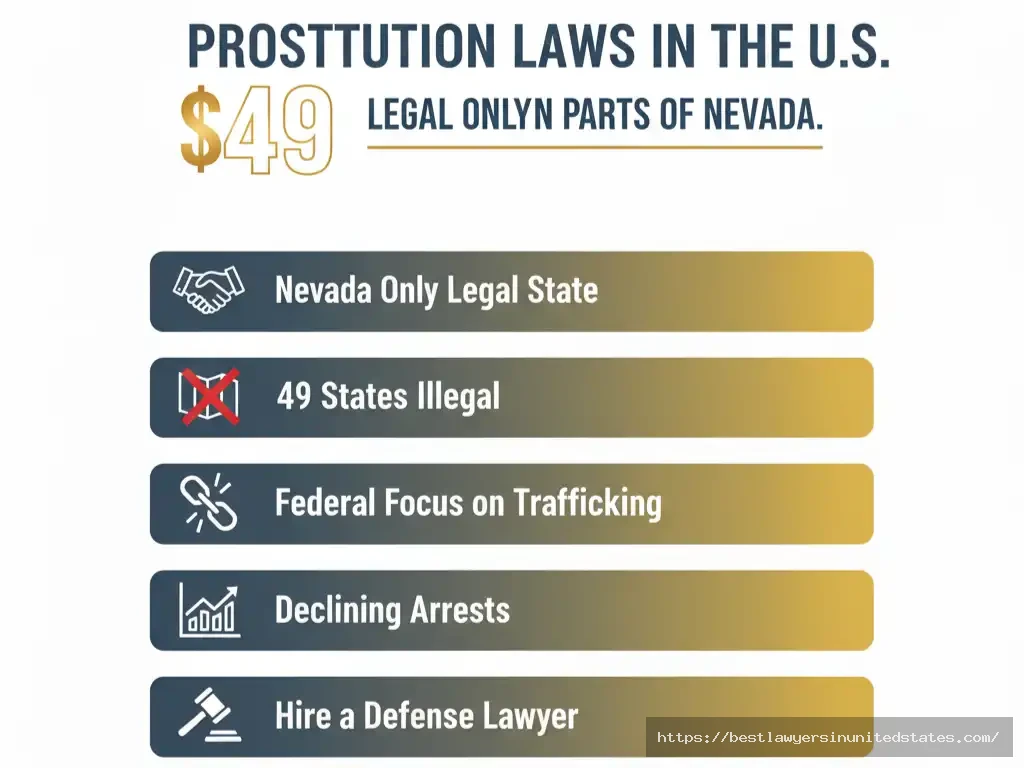
Understanding prostitution laws requires looking beyond simple “legal or illegal” answers:
- Nevada is the only state with legal prostitution, limited to licensed brothels in 10 counties (excluding Las Vegas and Reno)
- All other states criminalize selling sex, buying sex, promoting prostitution, and related activities
- Federal law doesn’t prohibit prostitution directly but criminalizes interstate transportation, trafficking, and child exploitation
- Enforcement has declined dramatically in major cities, though laws remain unchanged
- First-time offenders usually face misdemeanor charges with diversion programs available
- Promoting or compelling prostitution carries felony charges with prison sentences
- Sex trafficking is legally distinct from prostitution—trafficking requires force, fraud, coercion, or involves minors
- Decriminalization efforts have gained momentum but haven’t succeeded in changing state laws
- Pornography is legal because courts treat it as protected expression, unlike the conduct-based transaction of prostitution
- If arrested, remain silent and immediately contact a criminal defense attorney
The legal landscape continues evolving as progressive prosecutors deprioritize enforcement and advocates push for decriminalization. However, prostitution remains a crime in 49 states, and arrests still occur regularly in many jurisdictions. Anyone involved in commercial sex work or facing related charges needs to understand both the formal law and the practical enforcement reality in their specific location.
Frequently Asked Questions About Prostitution Laws
In what states is prostitution legal?
Nevada is the only state where prostitution is legal, and only in licensed brothels in 10 of its 17 counties. State law prohibits prostitution in counties with populations exceeding 700,000, which excludes Las Vegas and Reno. All other states—including California, New York, Texas, Florida, and the remaining 45 states—criminalize prostitution entirely.
Why do prostitutes go to jail?
Prostitutes go to jail because state laws criminalize offering or agreeing to exchange sexual services for money or anything of value. First-time offenders typically face misdemeanor charges with fines and probation rather than actual jail time. However, repeat offenses escalate to felonies in most states, and using public places or involving other aggravating factors increases penalties substantially.
What is the US punishment for prostitution?
First-time prostitution charges typically result in misdemeanor penalties of $500-$2,500 fines, up to 6 months jail (usually suspended), probation, and community service. Many jurisdictions offer diversion programs where education classes lead to dismissed charges. Repeat offenses escalate to felonies with 1-5 years prison time. Promoting or compelling prostitution carries felony charges with 2-20 year sentences.
Where is prostitution most legal?
Nevada has the most permissive prostitution laws in the US, allowing licensed brothels in rural counties. Internationally, prostitution is fully legal and regulated in New Zealand, Netherlands, Germany, Austria, Switzerland, Greece, and parts of Australia. Several other countries have decriminalized prostitution or adopted the Nordic model that criminalizes buyers but not sellers.
Why is porn legal but not prostitution?
Pornography is legal because courts ruled it receives First Amendment protection as expressive content created for public consumption. Performers are paid to create recorded sexual material, not for participating in private sexual acts. Prostitution lacks this expressive element—customers directly participate in private sexual conduct. Courts treat this as regulatable commercial activity rather than protected speech.
What is the number one state for prostitution?
Nevada is the only state with legal prostitution, making it number one by that measure. For illegal prostitution activity, law enforcement data and arrest statistics historically showed the highest concentrations in New York, California, Texas, Florida, and Nevada (outside legal brothel areas). However, enforcement data is unreliable for measuring actual prostitution prevalence since most activity goes undetected.
Can you go to jail for hiring an escort?
Yes, if the escort service involves paying for sexual acts rather than just companionship. Simply hiring an escort for a date or event is legal. However, if you agree to pay for sexual services, that constitutes solicitation or patronizing a prostitute—a criminal offense in 49 states. Police sting operations frequently target escort service customers, and convictions carry the same penalties as other prostitution charges.
What is solicitation of prostitution?
Solicitation is offering, agreeing to, or requesting engagement in prostitution. Both buyers (“soliciting a prostitute”) and sellers (“soliciting customers”) can be charged with solicitation. The crime is complete when the agreement is made—no sexual act needs to occur. Most states classify solicitation as a misdemeanor for first offenses, with penalties of fines, probation, and possible jail time.
Do prostitution charges require sex offender registration?
Most states do not require sex offender registration for simple prostitution or solicitation charges. However, registration is mandatory for compelling prostitution, trafficking, or prostitution involving minors. Some states require registration for repeat prostitution offenses or solicitation in areas frequented by children. Registration requirements vary significantly by state, so consult local laws or a criminal defense attorney.
What happens if you’re caught with a prostitute?
If police catch you with a prostitute, you’ll typically be arrested and charged with solicitation or patronizing a prostitute. Police will confiscate evidence (phones, money), book you, and release you on bail or your own recognizance. First-time offenders usually receive misdemeanor charges with diversion programs available. Penalties include fines, probation, community service, and mandatory education classes rather than jail time for most first offenses.
Related Articles:
Is Prostitution Legal in Japan? A Legal Analysis (2025)
Is Prostitution Legal in Amsterdam? Complete 2025 Legal Guide
Is Prostitution Legal in New York 2025? Complete Guide to NYC Laws & Penalties
Is Prostitution Legal in Mexico? Complete 2025 Guide to Sex Work Laws by State
Is Prostitution Legal in Europe? 2025 Complete Guide
Is Prostitution Legal in Canada? 2025 Laws Explained
Is Prostitution Legal in Florida? [2025 Complete Legal Guide]
Is Prostitution Legal in Colombia? [2025 Legal Guide]
Is Prostitution Legal in California? [2025 Complete Guide]
Is Prostitution Legal in Nevada? [2025 Complete Guide]
Is Prostitution Legal in Las Vegas, Nevada?
